Predictable Strategy in Spray and Wait using
PRoPHET Routing Protocol
Yaxita Patel1, Trupesh Patel2
ME Research Scholar, Department of Computer Engineering, SOCET, GTU, Gujarat, India1
Assistant Professor, Department of Computer Engineering, SOCET, GTU, Gujarat, India2
ABSTRACT: Routing in Delay Tolerant Networks is considered as one of the most attracting research areas. Out of many approaches to introduce protocols used in DTN, few aimed to improve existing protocols. There are chances of a new algorithm based on the predictability concept since it introduces better resources management in terms of bandwidth, messages delivery compared to other routing algorithms for DTN, to prove it by large-scale simulations, the effectiveness of specific algorithm in terms of eventually delivered messages, failed transmissions, dropped messages between nodes, buffer time and hop count enhancement. Our new approach, improvement of the PRoPHET routing protocol is based on the belief that every node is DTN are constantly and inconsistently moving towards or away from each other. Possibilities of destination node are closer to old source than the one message is been transmitted to, not necessarily but the old source may be closer to the node which is next to destination node, which was initially predicted as be not close to the destination node.
KEYWORDS: Delay tolerant networks; epidemic; spray and wait; probabilistic routing protocol; prophet routing protocol.
I. INTRODUCTION
The Internet [1] has been a remarkable success in terms of interconnecting communication devices throughout the world by using communication protocols. There are thousands number of networks compose the Internet which uses the routing protocols and guarantees the reliability for transferring messages using various devices. Wired and the other is wireless are two types of link connectivity.
Delay Tolerant Network is designed to provide communication in the most unstable and stressed environment where the network would be subjective to visit and durable distances and high bit error rates that could severely degrade the normal communications[2]. It is the improvement of Mobile Ad-Hoc Network (MANET). It is sparse and intermittent connected network where reliable communication end to end connectivity is not available for message transmission.A network designed to operate effectively over extreme distances such as those encountered in space communication or an interplanetary scale.The examples [3] of DTN are Military Ad-Hoc Networks, Sensor/Actuator networks, Terrestrial wireless networks, Exotic Media Networks
Fig 1 Store and forward approach in DTN mechanism[5]
DTN architecture introduced new layer named ‘Bundle layer’, is below of Application layer and above of the Transport layer. Other layers of DTN architecture are the Physical layer, Link layer, Network layer, and Transport layer which all are common protocols for all nodes. The bundle protocol [6] supports an end to end retransmission. A node stores the message until another node receives the message.
When the number of copies for each message increases, the message delivery ratio increases and decreases the delay of transmission. It results in large communication overhead. There are several factors of routing protocols have been proposed to intrinsic characteristics of DTN.
In this paper, we propose predictability concept based on spray and wait using Prophet routing protocol. The proposed method predicts the next node using prophet routing protocol. Through the new approach, it increases message delivery and decreases overhead ratio when increasing no of hosts.
II. RELATED WORK
Routing protocols in DTN are classified based on selecting and searching paths from source to destination in the network. They can be classified in flooding-based routing protocol and forwarding based routing protocol. In flooding strategy [7], it creates a large number of copies and sends to the other nodes in the network. The nodes store the message in the buffer until it reaches its destination node. No need to require any knowledge about the network. In forwarding strategy, to find out the best path from source to destination, there has to be required to knowledge about the network. No replication of messages in the network.
Epidemic routing protocol
Epidemic routing [8] is flooding based forwarding in nature, where node receives the messages. It makes copies of the message and sends it to the other nodes in the network. Each message which is stored in the buffer has its own unique identifier called summary vector. When nodes communicate each other in the network, they exchange and compare their summary vector and send the messages which they don’t have. The protocol finds ideal path to reach the destination. The wastage of resources like buffer and bandwidth are the disadvantages of this protocol.
Spray and Wait routing protocol
There are two types of spray and wait protocol, Source spray and wait and Binary spray and wait. In Source Spray and wait routing protocol comprises of two phases, spray phase and wait phase. In spray phase, Source [8] node creates L no of copies and sends it to the relay nodes. If the message is not reached to its destination, all L nodes go to the wait phase. Where the nodes are waiting for the message delivery.
In Binary spray and wait protocol, source node creates L copies when it encounters to the other node, it forwards L/2 no of copies to the node and keeps the remaining copies. The process continue till the each node have only one copy remaining, then node switches to the wait phase until the message is reached to its destination.
PROPHET routing protocol
1. Direct Contact[10]
( , ) = ( , ) + (1− ( , ) ) ×
( , ), the predictability of node b stored in the node a.
[0,1], the scaling factor is increases after first encounter.
2. Transitivity[11]
( , ) = ( , ) + (1− ( , ) ) × ( , ) × ( , ) ×
β ϵ ]0,1[ is a constant that controls the transitivity on the delivery predictability.
3. Aging[1]
( , ) = ( , ) × ⱪ
∈ ] , 1[ , the aging constant and k is the number of time units that has elapsed since the last time metric was aged.
III. PROPOSED PREDICTABILITY BASED SPRAY AND WAIT PROTOCOL USING PROPHET
ROUTING PROTOCOL
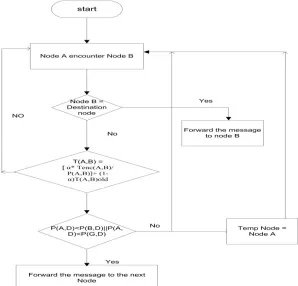
Our new approach improvement of the PRoPHET routing protocol is based on the belief that every node is DTN are constantly and inconsistently moving towards or away from each other. Direct Contact between source and destination nodes after each transmission is possible. There are possibilities of destination node be closer to old source than the one message is been transmitted to. Taking into consideration these possibilities, not necessarily but the old source may be closer to the node which is next to destination node, which was initially predicted as be not close to the destination node. So message delivery can be made faster if the old source is allowed to check prediction again and send the copy once to new node which may be closer to the destination. The flow diagram of the proposed method is described in fig 2.
Proposed algorithm
1. Initialize PRoPHET Router and settings 2. Initialize predictability HASH
3. Get prediction for current host using following: P(a,b) = P(a,b)_old + (1 - P(a,b)_old) * P_INIT
4. Store current host in new DTNHost parameter as oldHost 5. Update delivery prediction for newHost
6. Move to next host P(a,b) 7. Get prediction for old host
8. Update delivery prediction for oldHost 9. Update prediction delivery table 10. Send messages to all hosts via newHost 11. Send messages to all hosts via oldHost 12. Update prediction table
13. If newHost is the destinationHost 14. Go to step 16
15. Else go to step 3 16. End
IV. PERFORMANCE EVALUATION
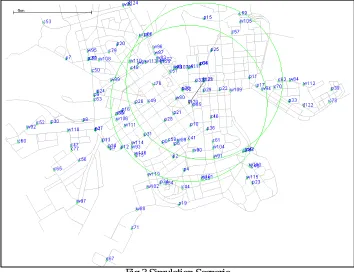
The ONE(Opportunistic Network Environment) simulator and the other supporting language is JAVA. It [9] was developed by Helsinki University and provides a map of the Helsinki area. This city covers an area of 4500 m x 3400 m, and there are 156 mobilenodes, which move along the city roads or tramways, including pedestrians, cars, and trams. The screenshot of ONE simulator is represented below in fig 3.
Simulation Results
1. Delivery Probability: With the increase in a number of hosts in the network, for different buffer sizes, the delivery probability is marginally improved as indicated below. This can lead to more messages delivered successfully if the scenario is simulated for more time. This delivery ratio described in fig 4.
Fig 4 Delivery Ratio
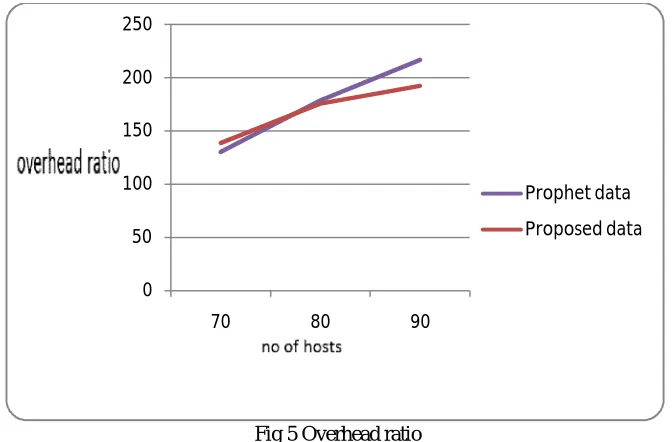
2. Overhead ratio: Interestingly, for 5MB buffer size, the overhead ratio is significantly increased till 80 hosts, but proposed readings show marginal improvement over 90 hosts. For 10 & 15 MB buffer size, the overhead ratio is higher around 70 hosts, decreasing for 80 and 90 hosts. This is a significant improvement for proposed results. Here described overhead ratio in fig 5 is for 5MB.
Fig 5 Overhead ratio
0 0.1 0.2 0.3 0.4 0.5
60 70 80
Prophet data
Proposed data
no of hosts delivery
Prob
0 50 100 150 200 250
70 80 90
Prophet data
V. CONCLUSION AND FUTURE WORK
In this paper, we focused on the improvement of the prophet routing protocol through a new approach to implementing the predictability improved factor. We were interested in the amount of finally delivered messages to the destination, the amount of delivery probability, overhead ratio, and latency. Compared to the classic prophet algorithm and to the spray and wait routing protocol, our approach has proved a clear improvement of the predictability concept. Through the new approach, more messages can arrive at the destination with less aborted transmissions. Moreover, messages have an opportunity to get more probability of getting delivered thus leading to more energy efficiency.
Future work will focus on assessing the impact of improvement in overhead ratio. It will also focus on introducing the priority concept in message delivery between the nodes.
REFERENCES
[1] Ahmed El Ouadrhiri, ImaneRahmouni, Mohamed El Kamiliand Ismail Berrada “Controlling Messages for Probabilistic Routing Protocols in Delay-Tolerant Networks”
[2]Vangie Beal “DTN-Disruption Tolerant Network”, http://www.webopedia.com/TERM/D/Disruption_Tolerant_Networking.html
[3] kevin fall “Delay-Tolerant Networking: Architecture and Applications” Stanford networking seminar,2003
[4] R. S. Mangrulkar ,Dr. Mohammad Atique “Routing Protocol for Delay Tolerant Network: A Survey and Comparison” IEEE pp.210-215, 2010 [5] Forrest Warthman, “Delay- and Disruption-Tolerant Networks (DTNs)” IPNSIG 2012
[6] Wei Sun, Congmin Liu, Dan Wang, “On Delay-Tolerant Networking and Its Application” ICCSIT Vol. 51pp.238-244©2012
[7] Jianshen, SangmanMoh, Ilyong Chung “Routing Protocols for Delay Tolerant Networks: A comparative survey” ITC-CSCC pp.1577-1580, 2008 [8] AnjulaMehto, Meenuchawla “Comparing Delay Tolerant Network Routing Protocols for Optimizing L-copies in Spray and Wait Routing for Minimum Delay” CAC2S pp.239-244,2013
[9] Eung-Hyup Kim, Jae-Choong Nam, Jae-In Choi, You-Ze Cho “Probability-based Spray and Wait Protocol in Delay Tolerant Networks” IEEE ICOIN pp.412-416, 2014
[10] Ho-Jong Lee, Jae-Choong Nam, Won-KyeongSeo, You-Ze Cho, Soong-Hee Lee “Enhanced PRoPHET Routing Protocol that Considers Contact Duration in DTNs” IEEE pp.523-524, 2015
![Fig 1 Store and forward approach in DTN mechanism[5]](https://thumb-us.123doks.com/thumbv2/123dok_us/1444335.1176957/2.595.124.481.168.325/fig-store-and-forward-approach-dtn-mechanism.webp)