ar^i=jla^ifqv=qljldo^mevW=qeb=fj^db=^k^ivpfp= ======QOR=
gìêå~ä=qÉâåçäçÖá, 54 (Sains & Kej.) Keluaran Khas, Jan. 2011: 425–442 © Universiti Teknologi Malaysia
e^oat^ob=absbilmjbkq=lc=bib`qof`^i=`^m^`fq^k`b= qljldo^mev=clo=fj^dfkd=^=jfuqrob==
lc=t^qbo=^ka=lfi=
=
bijv=gle^k^NG
I=c^wiri=o^ej^k=jlea=vrkrpI=orw^fof=
^_ari=o^efjP
=C=`e^k=hlh=pblkdQ
=
^Äëíê~ÅíK= This paper proposes the process of investigating the changes of capacitance value due to the changes of permittivity distribution of a different dielectric materials such as water and oil in a conveying pipeline using twelve externally Electrical Capacitance Tomography (ECT) sensor. Electrical capacitance tomography system is a system which can be used for imaging industrial multi-component processes involving non-conducting fluids in pipeline. Therefore, in this research, a 12 electrodes electrical capacitance tomography system is developed. This system can provide more data for processing to obtain more precise images of the pipeline. In order to reduce the noise in the system, on-plate signal conditioning board is applied in this research to eliminate certain noise source from the analogue transmission line. Then, various of ac capacitance measuring circuits has been developed in terms of performance and sensitivity to achieve low noise level, wide dynamic range and high immunity stray capacitance to suits the appropriate design for system development. The signal produced by the detection circuit is digitized by using multiplexing circuit, ADC circuit and buffering so that the transferring data is suitable for pc interface. A graphic user interface (GUI) is developed with visible controls and indicators to provide users with organized interactive panels.
hÉóïçêÇëW= Capacitance tomography, 12 electrodes, on-plate signal conditioning board
=
^Äëíê~âK Kertas kerja ini membentangkan kajian perubahan nilai kapasitan terhadap
pengukuran perbezaan bahan dielektrik seperti minyak dan air di dalam saliran paip menggunakan 12 pengesan elektrod di atas permukaan paip. Sistem Kapasitan Elektrik Tomografi (ECT) berupaya memaparkan pembentukan imej di dalam industri proses campuran-komponen yang melibatkan cecair bukan pengalir di dalam paip. Oleh yang demikian, menerusi kajian ini, 12 elektrod kapasitan elektrik tomografi dibangunkan. Sistem ini membolehkan banyak data diperolehi bagi pembentukan imej yang lebih jelas di dalam aliran paip. Untuk mengurangkan hingar di dalam sistem ini, litar perapi telah di bina di atas plat pengesan di atas satu plat yang sama bagi menghilangkan sebahagian hingar yang datang dari talian penghantaran
1
Faculty of Electrical and Electronic Engineering, Universiti Tun Hussein Onn Malaysia, 86400 Parit Raja, Batu Pahat, Johor
2
Japan Malaysia Technical Institute (JMTI), Pulau Pinang
3
Department of Control and Instrumentation, Faculty of Electrical Engineering,
Universiti Teknologi Malaysia, 81310 UTM Johor Bahru, Johor Darul Ta’azim, Malaysia
4
Evolusi Sdn. Bhd.
QOS bijvI=c^wiri=o^ej^kI=orw^fof=C=`e^k=hlh=pblkd=
isyarat analog. Setelah itu pelbagai litar pengukur kapasitan telah dibina dari segi prestasi dan kepekaannya bagi memperolehi aras hingar yang rendah, kadar dinamik yang luas dan imun kepada kebocoran kapasitan bagi memenuhi reka bentuk yang sempurna untuk sistem yang dibina. Isyarat yang terhasil dari litar pengesan di tukar dalam bentuk digital menerusi litar multiplex, penukar analog kepada digital dan penampan maka dengan itu data yang dihantar bersesuaian dengan pengantaramukaan computer. Pengantaramukaan pengguna grafik (GUI) dibina dengan pengawal dan penunjuk yang lebih jelas member kemudahan kepada pengguna berinteraksi dengan panel kawalan.
h~í~=âìåÅáW= Kapasitan tomografi; 12 elektrod; plat pengesan; perapi atas satu plat
= =
NKM= fkqolar`qflk= =
The word ØíçãçÖê~éÜó∞ is derived from the Greek words Øíçãçë∞ meaning ‘to slice’ and ‘Öê~éÜ∞=meaning ‘image’. The Oxford English Dictionary defines tomography as ‘radiography’ in which an image of a predetermined plane of the body or other object is obtained by rotating the detector and the source of radiation in such a way that points outside the plane produces blurred image.
Abel, a Norwegian physicist, for an object with axis-symmetrical geometry, first published the concept of tomography as early as 1826. In 1917, an Austrian mathematician, Radon, extended Abel’s ideas for objects with arbitrary shapes. Godfrey Hounsfield and Allen Cormack were jointly awarded the Nobel Prize in 1979 for the pioneering work on x-ray tomography [1].
Tomographic technology involves the acquisition of measurement signals from sensors located on the periphery of an object, such as vessel or pipeline [1]. This gives information on the nature and distribution of components within the sensing area. Most of the tomographic techniques are concerned with abstracting information to form a cross sectional images. This can be done by placing sets of array sensors (mainly electrodes) around the pipes to be imaged. The sensing field interrogates a projection of a suitable radiation across the materials of interests, which is assumed to be a circular cross section [2].
Various techniques of systems tomography are being investigated by scientists and engineers around the globe for example electrical impedance tomography (EIT), electrical capacitance tomography (ECT), electrical resistance tomography (ERT), ultrasonic tomography and optical sensors tomography.
OKM= b`q=pvpqbj=abpfdk=
ar^i=jla^ifqv=qljldo^mevW=qeb=fj^db=^k^ivpfp= ======QOT=
is not enough to provide sufficient data for an accurate imaging. Therefore, in this research, a 12 electrodes electrical capacitance tomography system is developed. This system can provide more data for processing to obtain more precise images of the pipeline. However, the number of electrodes in an ECT system is inverse proportional to the size of the electrodes. Decrement of electrodes’ size will lower the sensitivity of the sensor towards the materials being investigated, and therefore lessen the Signal to Noise Ratio (SNR) of the system. In order to reduce the noise in the system, on-plate signal conditioning board is applied in this research to eliminate certain noise source from the analogue transmission line.
Twelve electrodes ECT sensor was constructed, as this number will produce better and adequate data for image reconstruction. These electrodes were connected directly to capacitance detection circuit through PCB sockets. The measured data are connected to the computer using DAQ card for image reconstruction. The sensor is comprised of an array of 12 electrodes mound around the periphery of the pipe or the vessel to be imaged. The measuring unit conditions the signal captured by the sensors and transmits the signals to the control computer. The control computer processes the acquired information and constructs permittivity distribution images corresponding to the cross-section viewed by the sensor. The control computer employs the Linear Back Projection algorithm (LBP) for generating permittivity images. The images are displayed on a 1024 square pixel grid using a suitable graduated color scale indicate the variation of permittivity. The imaged are analyzed to compute the parameters related to the process such as, spatial distribution, flow rate, and volume ratio of the materials inside the pipes [1].
The ECT system shown in Figure 1 shows the block diagram of the ECT system used to acquire permittivity distribution images of contents of the pipe during a process.
cáÖìêÉ=N Block diagram of electrical capacitance tomography system (ECT)
The system consists of the following:
QOU bijvI=c^wiri=o^ej^kI=orw^fof=C=`e^k=hlh=pblkd=
• Capacitance measuring unit to acquire and process the signals obtained from the capacitance sensor.
• Data acquisition system (DAS) is to acquire and digitize the analog signal to digital signal to control computer.
• Control computer to reconstruct and display the permittivity distribution of image using the obtained measurement data, and to monitor as well as to control the process taking place inside the pipe.
PKM= pbkplo=abpfdk= =
The design of ECT sensors is closely linked to the capabilities of the capacitance measuring unit to be used with the sensor. An ideal capacitance measuring system will have very low noise level, a wide dynamic measurement range and high immunity stray capacitance to earth and be able to carry measurement at high speed [4]. Sensors used for ECT systems are designed according to the cross-section of the vessel to be imaged and position of the electrodes. The electrodes can be mounted from the outside or the inside of the vessel of interest. The selection of placing the electrodes depends on the material used to manufacture the pipe. If the pipe is made of conducting material, internal electrodes are used. If the pipe is made from insulating material, external electrodes are used.
ar^i=jla^ifqv=qljldo^mevW=qeb=fj^db=^k^ivpfp= ======QOV=
measurement circuitry will saturate or overload once the highest capacitance measurement threshold is exceeded [5].
Sensors with external electrodes are non-intrusive, and easy to design. These sensors are not subjected to high temperature, high pressure and turbulences of the materials inside the pipe. Therefore, the sensors will not interfering, and get contaminated by the process itself. However, external sensors can exhibit considerable non-linearity in their response to dielectric materials introduced inside the sensor. This effect is caused by the presence of the sensor wall, which introduces an additional series coupling capacitance into the measurement of the inter-electrode capacitance [2].
The selection of the number of electrodes around the circumference of the sensor is a tradeoff between axial and radial resolution, sensitivity and image capture rate [2]. ECT systems can be used with sensors having 6, 8, 12 and 16 electrodes [6]. The measurement sensitivity depends on the surface area of the sensor electrodes as the electrodes normally occupy most of the circumference. If the number of electrodes is increased, the radial resolution will be improved, while a reduction in length of electrodes will give better axial resolution [7][4]. In this research, 12 electrodes had been fabricated onto the pipeline. The arrangement of 12 electrode ECT system is illustrated in Figure 2. Aluminum is used as the electrodes’ material. Despite the fact that this material is a highly conductive material (3.82 x 10⁷ Sm-1), the cost of this material is low and it is easy to be fabricated. The placement of electrodes on the outer surface is done carefully to ensure that the electric field produce during the excitation is equally distributed among the detecting electrodes. Due to this, the circle (cross-section) of the pipeline is divided equally into twelve sectors, which each sector is 30o
. The total width for one section is only 26.179mm. The width of each electrode is 18mm, which is around 360°. The spacing between electrodes and the radial screen is around 2mm, and left only around 4.75mm as the axial guard width, the overall view is illustrated in Figure 3. The total electrode length should normally be at least equal to the diameter of the vessel to be imaged. A larger value for electrode length will further increase the sensitivity of the sensor. The external pipeline’s diameter is 100.0mm. Taking into consideration of the parameter, the length of the electrode is 200.0mm which is double of the acrylic pipe’s diameter.
QKM= b`q=pbkplo=`fo`rfq=
QPM bijvI=c^wiri=o^ej^kI=orw^fof=C=`e^k=hlh=pblkd=
[8][7]. An essential requirement of the imaging system is that for each capacitance measurement, the measurement sensitivity should be focused into a narrow area between the two-selected electrodes.
cáÖìêÉ=O Electrical capacitance tomography sensor
cáÖìêÉ=P= ECT sensor geometry diagram
Sensing electrode
Acrylic pipe Outer screen
ar^i=jla^ifqv=qljldo^mevW=qeb=fj^db=^k^ivpfp= ======QPN=
The charge/discharge capacitance measuring circuit suffers charge injection problem due a lot of CMOS switches used to control charge/ discharge operation and to select excitation and detection electrodes. Typical charge and discharge capacitance measuring circuit is shown in Figure 4. Due to this problem, AC based detecting circuit was selected as the measurement circuit [9][8]. A typical AC based capacitance measuring circuit is shown in Figure 4, where `ñ=is the unknown inter-electrode capacitance, sá is the sine-wave excitation voltage, sç is the front-end output voltage, `Ñ and oÑ are the feedback capacitance and resistance for the
op-amp, respectively , and `ëN=and `ëO=are stray capacitance. =
=
=
cáÖìêÉ=Q Charge/discharge capacitance measuring circuit
= =
QPO bijvI=c^wiri=o^ej^kI=orw^fof=C=`e^k=hlh=pblkd=
In general, each electrode can be used for either excitation or detection. For this purpose, the electrode selections are selected through CMOS switches. This because CMOS switches have a high switching speeds, low oçå (turn on internal resistance) and minimum leakage error. The derived transfer function of the amplifier is;
(1)
= =
= =
=
cáÖìêÉ=R AC-based capacitance measuring circuit
= =
The selection of different values of `Ñ=and oÑ=can affect the output voltage. At the initial stage, the feedback capacitance and resistance were chosen so that capacitive feedback predominated, i.e., NLω`Ñ=…=oÑK In this case, equation 1 becomes
(2)
=
The main characteristic of this design is that the circuit’s sensitivity is independent of the excitation frequency, and is set by the excitation voltage and the feedback capacitance only.
On the other hand, the feedback capacitance and resistance values can be selected so that resistive feedback predominates, i.e., oÑ « 1/ω`ÑK=In this case, equation 1 will reduce to
(3)
Cs1 Cs2
Cx
Rf
Cf
Vi
ar^i=jla^ifqv=qljldo^mevW=qeb=fj^db=^k^ivpfp= ======QPP=
Were the –j indicates the output voltage is 1800
phase shifted with respect of the excitation signal.
The system applied with sá== 3.53 Vrms, Ñ = 500 kHz, `Ñ = 22 pF and oÑ = 200 kΩ, equation (3) has been satisfied as general equation throughout this project. In practical method, a few fem to hundred Farad of standing capacitance measured producing few hundreds mili-volt AC output only. This is not sufficient for next operation use. Therefore, a few stages of amplifier circuits have been applied to enable the voltage range fall in 0 to 10 volts.
In this analysis, an ideal op-amp, zero stray capacitance and zero CMOS on resistance are assumed. In practice, the op-amp would not be ideal as its open-loop gain decreases as the frequency of operation increases. The non-ideal characteristic would affect the performance of the op-amp circuit.
= =
QKN= ^`=íç=a`=`çåîÉêíÉê=`áêÅìáí= =
Even though the response of AC based detecting circuit meets and proven to be proportional to the standing capacitance measured through ECT electrode system, but with AC signal output is unsuitable for further manipulation use. The AC signal produces unstable signal compared to DC signal. To allow the signal directly interfacing with DAS card system for sending the data to the computer, AC to DC converter or absolute value circuit is needed. The circuit provides better response of the detected output, yet the excellent method is to apply demodulator in the capacitance measuring circuit. However due to restriction of demodulator circuit complexity and higher cost needed, the AC to DC converter circuit is considered sufficient.
Basically, the AC to DC converter circuit adapted is easily made absolute value circuit. Generally, the absolute value circuit provides positive values regardless of its input. The absolute value circuit is shown in Figure 6. Despite its simplicity, the outputs are considered fast among the available circuit. The other choice available is the ready-made RMS to DC converter chip. Unfortunately, these circuits can be applied on low frequency, low duty-cycle pulse trains only which unsuitable to be implemented with 500kHz input signal frequency [9] [8].
QPQ bijvI=c^wiri=o^ej^kI=orw^fof=C=`e^k=hlh=pblkd=
of the Op-Amp. That is, the voltage at the junction of R5 and D2 in the same magnitude (but opposite polarity) as the input voltage
= =
= =
=
cáÖìêÉ=S AC to DC converter or absolute value circuit
= =
When a negative input voltage is injected to the dual half-wave rectifier circuit, the output of the operational amplifier goes to positive direction. This forward-biases D1 thus completes the feedback loop through R11. Diode D2 is reverse-biased. In the case of the basic dual half-wave rectifier circuits, the voltage at the junction of R3 and D2 is equal in magnitude (but opposite in polarity) to the input voltage. However, in the case of the circuit in Figure 7, the voltage decrease because of the resistance effect of the current flowing through R4, R6 and R10.
The outputs from the dual half-wave rectifier circuit are applied to the inputs of a differential amplifier circuit. Since the two half-wave signals are initially 180º out of phase and amplifier inverts only one of them, it can conclude that the two signals appear at the output have same polarity. In other words, both polarities of input signal produce the same polarity of output signals.
All resistor values are the same in the absolute value circuit, the calculations for design is rather simple. The actual built circuit shown in Figure 7. Slew rate and small signal bandwidth are investigated as the basis for operational amplifier selection. The required unity gain frequency for the operational amplifier can be computed with the equation as follow,
= ⎥ ⎦ ⎤ ⎢ ⎣ ⎡ + + = = 1 10 6 10 R R R BW BWxA
funitygain gain (4)
ar^i=jla^ifqv=qljldo^mevW=qeb=fj^db=^k^ivpfp= ======QPR=
kHz k
k k
kHz 1 750
56 56
56
500 =
⎥⎦ ⎤ ⎢⎣
⎡ +
Ω + Ω
Ω
= (5)
From equation (5) the bandwidth of TLE2072CD which is 10 MHz, is more sufficient than the required bandwidth. The required slew rate for the measurement can be calculated as follows:
=
max
out
fV
slewrate=π (6)= =
s V
kHz µ
π.500 .10 =15.71
= (7)= =
=
= =
=
cáÖìêÉ= T Implemented absolute value and inverting amplifier circuit for the capacitance measurement system
= =
QKO= `çåíêçä=råáí=`áêÅìáí= =
In general, the development of the ECT system, control unit circuit consists of a PIC 16F84A microcontrollers with function of selecting each electrode to be used for either excitation or detection electrode at any one time. For this purpose, the excitation and detection modes being selected using the CMOS switches. This type of switches is being chosen because it features high switching speeds, low oçå= and keeping leakage errors at minimum.
QPS bijvI=c^wiri=o^ej^kI=orw^fof=C=`e^k=hlh=pblkd=
circuit which consists of electrode selection unit , measuring and converter circuit. In general, only two switches per electrode are required as shown in Figure 8. The switch S1 ON to select it as excitation electrode while S2 OFF at the interval. In the other hand, switch S2 ON to make it as detecting electrode and S1 OFF for the time being.
= =
=
cáÖìêÉ=U Four switch arrangement of excitation and detection mode
=
QKP= bñÅáí~íáçå=~åÇ=aÉíÉÅíáçå=pÉäÉÅíáçå= =
In practice the 4 CMOS switches arrangement is required as shown in Figure 8. In general, only one electrode is excited at any point in time and the remaining electrodes functions as detectors. In the excitation mode, switches S1 and S3 are ON. In the detection mode, switches S2 and S4 are ON instead. Switch S2 ON to drive the coupling capacitance of switch S4 to earth and therefore eliminates its effect on the inter-electrode capacitance measurement. Considerably, this arrangement reduces the effect of the coupling capacitance of the CMOS switches. =
=
QKQ= jáÅêçÅçåíêçääÉê=`çåíêçä=råáí= =
ar^i=jla^ifqv=qljldo^mevW=qeb=fj^db=^k^ivpfp= ======QPT=
others as detectors. The capacitances between the electrode pairs 1-2, 1-3 ,1-4 to 1-12 are measured simultaneously. After measuring all the possible pairs of capacitances, electrode 2 is made as source electrode and the process measurement is repeated till electrodes 12 has made as excitation electrode. Measurements taken at sequentially excitation electrodes e1 to e12 is consdered as 1 frame. In this protocol, 144 capacitance measurement are obtained in 1 frame, however there some measurements are overlapping. Only 66 individual msurement are necessary for image reconstruction.
Idealy, the voltage measured for E3 as source and E1 as detecting electrode (electrode 3-1) should be the same as reverse arrangement (electrode 1-10) . However, due to the slight different during electrode fabrication and tolerance of the circuit parameter, the output are different at these pairs.
The control unit consists of PIC16F84A microcontroller and CMOS switches. The ADG201A chip CMOS switch comprises of four independent switches to be used as four switch arrangement in the excitation and detection mode of each mesurement channel. Therefore, parallel measurement required a ADG201A chip for each measurement channel. The ADG201A switches operates at HIGH (ON) when the input signal is logic ‘0’, while LOW (OFF) when the control logic is at ‘1’. The control signal and the CMOS switches conditions is shown in Table 1.
=
q~ÄäÉ=N Electrode selection signal of excitation and detection mode
pí~íÉ=N pí~íÉ=O
Input
terminal
Logic
input
Switch
condition
Electrode
status
Logic
input
Switch
condition
Electrode
status
IN1 0 HIGH Source 1 LOW Detection
IN2 1 LOW - 0 HIGH -
IN3 1 LOW - 0 HIGH Detection
IN4 0 HIGH Source 1 LOW -
= =
QPU bijvI=c^wiri=o^ej^kI=orw^fof=C=`e^k=hlh=pblkd=
which corresponds to every 2 ms after the each electrode selected to be the detecting electrode. The sampling occur during the positive edge to ensure the signal captured at the steady state.
= =
cáÖìêÉ=V Controller circuit with PIC16F84A
The required electrode selection signals are generated by PIC16F84A microcontrollers at terminal RA0 to RA3. The microcontroller generates 4-bit binary number which equivalent to the measurement channels. The generated signal is then feed to 4-to-16 decoder to produce logic ‘0’ signal which activates the required measurement channel. A total of 12 burst signal are generated to complete a frame of data. The trigger signal will inform DAQ card of 1 scan cycle completed after receiving the 12th
burst signals . This is illustrated in Figure 10. The positive edge of trigger signal will inform the DAQ card that 1 scan frame completed which corrresponds of every electrode has been selected as source electrode.
QKR= a~í~=^Åèìáëáíáçå=`~êÇ=Ea^nF= =
ar^i=jla^ifqv=qljldo^mevW=qeb=fj^db=^k^ivpfp= ======QPV=
multi channel measurement mode is set to RSE, the maximum sampling of 200 kS/s (1 sample for every 5.0 µs) will be divided by the number of channels used.
The overall data acquisition time for one image, of 66 inter electrode capacitances is 920ms (from the measurement starting to the end of analog-to digital conversion) provides data capture rate of 10 frames/s. Thus, the maximum sampling is estimated 6.6 kS/s per channel, which is sufficient for the data acquisition card.
=
1 2 E 1
E2 E3 E4 E5 E6 E7 E8 E9 E1 0 E1 1 E 1 2
1 2 3 4 5 6 7 8 9 1 0 1 1 Trigg er
B urst
1 fram e = 40 0m s A cq ui red
d ata
= =
=
cáÖìêÉ=NM Trigger and burst signals to interface with the DAQ card
= QKS= e~êÇï~êÉ=^ëëÉãÄäó=
=
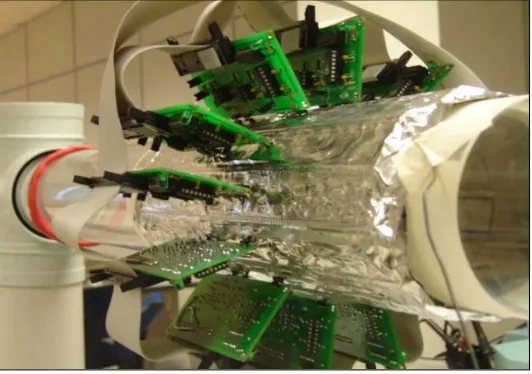
Finally, all the fabricated hardware components have been assembled to form the complete ECT system. The actual system is shown in Figure 11.
QQM bijvI=c^wiri=o^ej^kI=orw^fof=C=`e^k=hlh=pblkd=
= =
cáÖìêÉ=NN Complete ECT sensor
= =
RKM= obpriqp=^ka=afp`rppflkp= =
The main objective of tomography is to provide cross-sectional images inside pipe investigated. The sample of image reconstructed is shown in Figure 12 through Figure 13
= = = = = =
cáÖìêÉ=NO Reconstruction image of 60% water (a) Actual 2D image (b) 2D LBP image
ar^i=jla^ifqv=qljldo^mevW=qeb=fj^db=^k^ivpfp= ======QQN=
= = = = =
cáÖìêÉ=NP Reconstruction image of 80% water (a) Actual 2D image (b) 2D LBP image
=
RKM= `lk`irpflk=
A hardware system and software programming to provide cross sectional image of the ECT system have been developed. The system can be used to investigate mixture of water and oil particularly in horizontal-stratified distribution. The results obtained as shown in figure 12 and 13 showing the flow regime of the experimental column are quite promising.
obcbobk`bp=
[1] Prof. L. R. Subramaniam and Sharath Subash Donthi. 2004. `~é~Åáí~åÅÉ=_~ëÉÇ=qçãçÖê~éÜó=Ñçê= fåÇìëíêá~ä=^ééäáÅ~íáçåëK=M.Tech Credit Seminar Report. Electronic System Group, EE Dept.IIT, Bombay.
[2] Williams R. A and M. S Beck. 1995. Process Tomography= ¥=Principles,=Techniques and ApplicationK United Kingdom: Butterworth Heinemann Ltd.
[3] York, T.A., Phua, T.N., Reichelt, L., Pawlowski, A., Kneer, R. 2006. A Miniature Electrical Capacitance Tomography. jÉ~ëìêÉãÉåí=pÅáÉåÅÉ=~åÇ=qÉÅÜåçäçÖó. 17: 2119–2129.
[4] Process Tomography Limited. 2001. båÖáåÉÉêáåÖ=aÉëáÖå=oìäÉë=Ñçê=b`q=pÉåëçêë fëëìÉ=Q. United Kingdom , PTL App.Note AN3.
[5] Malcolm Byars. 2001. Developments in Electrical Capacitance Tomography. PTL Application Notes.
[6] Qussai Marashdeh, Warsito Warsito, Liang-Shih Fan, and Fernando L. Teixeira. 2007. A Multimodal Tomography System Based on ECT Sensors. fbbb=pÉåëçêë=gçìêå~ä. 7(3): 426-433. [7] S. M Huang, C. G.Xie, R. Thorn, D. Snowden, M. S Beck. 1992. Design of Sensor Electronics for
Electrical Capacitance Tomography. IEE Proceedings-G. Vol.139, No.1, February. 83-88/
QQO bijvI=c^wiri=o^ej^kI=orw^fof=C=`e^k=hlh=pblkd=
[8] H. Hannel, W. Q Yang and T. A York. 1995. An AC-based Capacitance Measuring Circuit for Tomography Systems and its Silicon Chip Design. IEE Colloquium: Advances in Sensors. 7 Disember. London.
[9] Tan Ching Tat. 2003. t~íÉêLláä= cäçï= fã~ÖáåÖ= çÑ= bäÉÅíêáÅ~ä= `~é~Åáí~åÅÉ=qçãçÖê~éÜó= póëíÉãK Tesis Sarjana Muda, Universiti Teknologi Malaysia.