Deterministic and Probabilistic Effects of External Event in Safety Assessment
Takaaki KONNO
Secretariat of Nuclear Safety Commission
ABSTRACT
Safety assurance implicitly assumes a certain risk. The risk results from the cumulative contribution of many kinds
of events. The safety design of nuclear facilities is expected to minimize the overall risk considering the deterministic and
probabilistic effects from internal and/or external events. Conventional safety assessment for external events is based on
a conditional risk insight, considering the severe hazard that will cause large deterministic effects on safety systems.
When low probability effects are considered, the safety margins calculated by the conventional assessment are not clear,
and it is not certain that the risks remain acceptably low. Assessment considering low probability effects should be
performed for external events in order to strengthen the reliability of the risk constraint. These aspects of low probability
effects in nuclear facilities are not yet fully integrated in a total risk management for external events. A rational safety
design for external events is therefore required to comply with the risk constraint based on the probabilistic safety
assessment. The cumulative probabilistic hazard is needed to evaluate the risk constraint and the risk significant effect of
the hazardous events. A de-aggregation of the cumulative probabilistic hazard is necessary to develop design basis events
that are risk dominant events for use in a deterministic safety design. The determination of design basis events based on
the de-aggregation from the cumulative probabilistic hazard must not compromise the risk constraint. Aspects of the
deterministic and probabilistic effects of external events are categorized by the indexes of damage rate and the
probability of failure, respectively. This paper discusses a new methodology for enhancing the reliability of safety
assurance by safety and risk assessments that comply with damage rate and probability of failure.
INTRODUCTION
Nuclear facilities install multiple safety systems in order to assure the defense-in-depth safety for unexpected
failure occurrences during internal and/or external events. Internal events are potential hazards inherently in the safety
systems. Examples are: malfunctions, mishandlings, errors in maintenance activities, aging, and other situations that are
inevitable in a large complex facility. External events are natural events such as earthquakes, floods, landslides, or
man-made external events such as aircraft crashes, explosions, etc. The effects of these events results from interaction
between the characteristics of affecting events and responding facilities. The effects should be clarified in order to ensure
the safety for such events. Effects of the internal and/or external events can be graded from the low safety significance to
the high safety significance depend on severity. Conventional safety designs to evaluate the capacity of the safety
installations to overcome the effects of such events are based on the deterministic design basis events. However, the
predicted intensity of the safety significance events is uncertain because of the spatial and temporal variability of future
events. The performance capacity of safety installations also has uncertainty influenced by the variability both of the
events can only be predicted probabilistically assuming past events experiences and present knowledge. The
characteristics of future events will depend on the many uncertain factors when the prediction is conducted based on past
experience. In order to clarify effects of future events, uncertainties for both the future event characteristics and the safety
performance capacity should be considered. To perform this rational safety design, the defense-in-depth should be
established in accordance with the characteristics of external future events. The actual safety margin is generally
uncertain because of the influence of environmental conditions in the construction, operation, and maintenance. The
logical safety of defense-in-depth must explicitly consider such uncertainty factors.
For the internal events, safety is established based on the experiences of the past events for the safety systems,
accumulated during nearly 40 years operations. The efficiency of defense-in-depth has been demonstrated for the internal
events by maintained safety at occurrences of incidents or accidents in operation. Defense-in-depth safety is not yet
established for the external events. There are few experiences of external events on the defense-in-depth safety systems in
nuclear facilities. Past external events experiences like earthquake events show us that the aspect of the events were
varied diversely and also the effect were varied diversely even in the non-nuclear/conventional facilities which do not
have complex safety systems of defense-in-depth. It is therefore deduced that defense-in-depth safety systems of nuclear
facilities will response more diversely to external events than the response to internal events because of the extensive
nature of effects by external events. The extensive nature of effects from external events can negate the efficiency of the
diversity and redundancy of the safety systems that are useful for internal events. Conventional deterministic safety
design for external events is therefore criticized when uncertainty is considered. The safety accountability considering the
uncertainty should be enhanced to comply with such criticism. A safety design methodology that is compatible with both
the deterministic effects and the probabilistic effects of the safety significance events could be enhance the safety
accountability. Effects of safety significance events could be categorized in the deterministic domain or the probabilistic
domain considering the damage rate and the failure probability of events for the safety assurance. The methodology of
safety assurance by defense-in-depth based on the safety and risk assessments is important for external events. The
logical safety of defense-in-depth for external events that assures risk insignificance is established by performing both
deterministic and probabilistic safety design and risk assessments. For the seismic events, a methodology of
risk-informed design basis earthquake ground motion was proposed (Konno, 2003) [1], and a methodology of seismic
safety design and risk assessment was proposed (Konno, 2005) [2]. The categorization of the effects of external events
into the deterministic and/or probabilistic is helpful to understand the importance of the safety design and risk
assessment.
EFFECTS OF EXTERNAL EVENTS
In the safety assessment of the nuclear facilities, initial internal design events are selected deterministically based
on effects causing incidents or accidents to confirm the safety performance. In the external event, the effects have to be
analyzed based on the structural interaction between the affecting external events and responding facilities. The
characteristics of both of the external events and the facilities will depend on the many uncertainty factors when
assessment is conducted for future occurrences. Effects are mainly dominated by the relationship between the intensity of
external events and the performance capacity of safety installations. As the intensity of external events becomes larger
or accidents.
What is the point of categorizing the effect of external events to deterministic or probabilistic effects? Past external
events are examples of the deterministic effects regardless the severity because of the effects appeared were actual results
with a conditional effect in each probability of occurrence in the relationship of events and facilities. That is, a
deterministic effect is a conditional effect. But the characteristics of future events will vary depending on the many
uncertainty factors in the prediction.
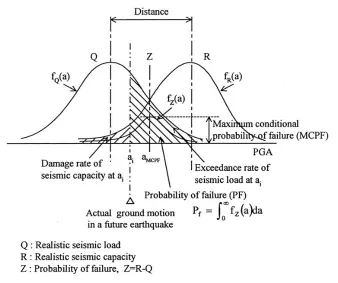
Figure 1 Relationship of seismic event and seismic capacity
Figure 1 shows the probability distribution functions of an affecting seismic event and the capacity of a responding
facility, representing the variability depending on the many factors of uncertainty. The relationship is a common feature
in the natural events. Both the intensity of an affecting event and the performance capacity of a responding facility are
generally represented by lognormal probability density functions. The occurrence probability of incidents or accidents
therefore can be derived regardless the magnitudes of the intensity of external events or the capacity of the facilities. In
the estimation of the effects derived by the relationships, the values of median and standard deviation of the events and
facilities respectively are important metrics. The influence rate of the events can be evaluated by controlling the distance
of each median value as related with the standard deviation between the affecting events and responding facilities.
Considering the variability, two types of effects can be derived from such relationships of events and facilities. The one is
a conditional failure probability that is derived as a probable actual case in the occurrence variability and the other one is
integration of the conditional failure probability. Looking from positive side, the conditional failure probability can be
seen as a damage rate. The occurrence of the damage influences directly the safety performance. How safety performance
is degraded depends on the damage rate. The acceptable damage rate will be defined by confirming the safety
performance can be maintained with the damage rate. If the safety performance is sufficient to maintain safety with the
damage rate then the damage rate is acceptable. The safety performance is required to maintain safety for the maximum
damage rate in the conditional failure probability. The maximum damage rate is the deterministic effect in the
relationships of events and facilities and is the most safety-significant parameter for the safety design.
Looking from the negative side, the failure probability shows the necessary probability of failure to maintain safety
even though the maximum damage rate is acceptable. This means that safety assured by the safety performance still
needs to confirm risk insignificance for the design events. The probability of failure derived as the sum of the conditional
failure probability is the probabilistic effect in the relationships of events and facilities to be used for the risk assessment.
The categorization of external event effects is that the deterministic effect is the positive side of effect such as the
damage rate as the safety significant condition to be used for the safety assessment while the probabilistic effect is the
negative side of the effect such that the probability of failure is the risk significant condition to be used for the risk
assessment.
SAFETY AND RISK ASSESSMENTS
It is important to recognize the difference between safety and risk assessments. There is no absolute safety, but the
probability of success or failure defines rational safety assurance. Both the estimated capacity and the predicted intensity
could vary in the future in accordance with the probability of occurrences, respectively. Consider that variability in the
capacity of safety installations can not always cover the intensity of safety obstructions. There is a probability of failures
even if a rational safety level is designed.
In order to estimate the insignificance of such probability cases, the risk evaluation methodology was developed.
Risk is represented quantitatively by multiplying the event occurrence frequency, safety failure probability and the
consequence of the outcome. When a hazardous event would be induced an incident/accident the safety functions of the
facilities responds in order to ease the progress of going through the success path for plant safety conditions. These routes
are confirmed by the event trees and fault trees composed using the safety installations. Safety for such events is
maintained when the progress of the incident/accident is controlled through a success path with the necessary safety
performance. If the progress of the incident/accident goes to the failure path, then safety is not maintained. Whether the
progress of the incident/accident come to success or failure to maintain safety is estimated in the basis of probability and
depends on the relationship of the safety capacity and event intensity. Nuclear facilities are designed such that
incidents/accidents go through the positive safety path with high confidence, but not with a zero probability of failure. As
the event occurrence frequency become high the probability of failure also increases even if the failure probability by the
individual event is low.
Therefore it is important to perform not only safety assessment but also risk assessment in order to have not undue
risk from nuclear facilities to the public. The relationship between safety and the risk can be seen. The safety assessment
confirms safety performance for the most safety significant event based on the maximum damage rates. The most safety
and the capacity of safety installations. The risk assessment intends to confirm the risk insignificance as evaluated by the
cumulative failure probability distribution functions based on the occurrence frequency of all events and the
consequences. Safety is assured for the each safety significant event to confirm safety performance. Risk is evaluated
based on the failure probabilities accumulating with every event occurrence frequencies. The safety level for the each
event can not control the risk level because of the risk is provided by the effects of cumulative events.
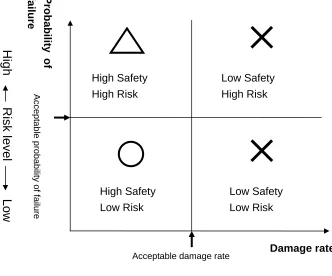
The combination of safety and risk levels should be the high safety level and low risk level but it is possible to
appear any types such as, both of the safety and risk levels are high, the safety level is high and risk level is low, the
safety level is low and risk level is high, and both of the safety and risk levels are low. When the safety level is very high
it might be acceptable the risk level is high. While even the risk level is very low it might be not acceptable if the safety
level is low. Acceptable safety level will be decided by the combination with the risk level as shown in the Figure 2.
Figure 2 Relationship of safety and risk levels
ational safety design is therefore not enough without formal risk assessment. The safety performance analysis is
also i
e logical safety of defense-in-depth should be established in the R
mportant in the safety design. Safety performance should be confirmed during the damage rate derived by the most
safety significant event, while risk assessment should be performed with the cumulative failure probability derived from
the contribution of every event occurrence frequencies.
To assure the practical safety for external events, th
High Safety level Low
✕
Acceptable damage rate
Acce
pt
abl
e probabilit
y of failure
H
ig
h
R
is
k
le
v
e
l L
safety
safety and risk assessments is important for establishment of
defen
NCLUSION
The safety assurance of nuclear facilities in Japan currently endorses deterministic the safety design. Safety
conf
ISCLAIMER
xpressed in this paper are those of author and should not be construed to reflect the official Japanese design considering the uncertainty of the future external events. The practical safety is generally influenced by the
interaction among the variable conditions of construction, operations, and environments. The logical safety of
defense-in-depth is needs to also consider such uncertainty factors. There are few experiences of external events on the
defense-in-depth safety systems for nuclear facilities. The experiences of past external events like earthquake events
shows the aspect of the events varied diversely and the effect appearances varied diversely even in the non-nuclear
conventional facilities without complex safety systems of defense-in-depth. It is deduced that defense-in-depth safety
systems of nuclear facilities will respond with more complexity in the external events than the response in the internal
events because of the more extensive effects in external events. The common cause of failures in external events can
reduce or eliminate the efficiency of safety systems.
The methodology of safety assurance by both
se-in-depth safety for external events. The risk is calculated by the contribution of all kinds of affecting events but
the technology and knowledge has not matured yet to estimate the risk of every kind of event on the basis of total risk
management. The risk estimated by all events such as earthquakes, floods, etc., will be used as the risk constraint in risk
management.
C
irmed by such safety design is based on the conditional success probability of maintaining safety conditions.
However, the safety based on this conditional success probability can not prove risk insignificance because of the
quantity of the failure probability is derived by the total of every event’s contributions even though each event only
contributes a low probability of failure. The probability of failure is not zero even though the probability of success to
safety is very high. The risk based on the failure probability therefore must be constrained by the insignificance level in
order to enhance the reliability of the safety assurance. Effects of external events can be categorized to the
positive/deterministic effect and the negative/probabilistic effect. The conditional success probability stands on the
positive side and can be represented by the damage rate that is used to confirm the safety performance. The failure
probability stands on the negative side to assess the risk significance. The failure probability is derived from the total
contributions of many events even though each event has only a low probability of failure. The defense-in-depth safety
logic for nuclear facilities should consider both of the positive and negative effects of external events. The safety
significant conditions can be determined deterministically but the significance of failure conditions can not determine
deterministically. The maximum damage rate derived from the safety significant conditions should be confirmed to be
acceptable by the safety performance analysis with the damage rate. The failure probability derived from the all events
should confirm the risk insignificance. Performing both the safety assessment for the deterministic effects and the risk
assessments for the probabilistic effects are important aspects to enhance the safety assurance reliability and to more
precisely comply with the inherent success and failure probabilities in the affecting external events and responding
facilities.
D
REFERENCES
3) “A Developing Risk-informed Design Basis Earthquake Ground Motion Methodology “ SMiRT-17,
IC SAFETY DESIGN AND RISK ASSESSMENT “ SMiRT-18, Beijing, China 1. Konno, T., (200
Plague, Czech Republic