Jurnal Teknologi, 49(F) Dis. 2008: 297–310 © Universiti Teknologi Malaysia
COMPUTATIONAL FLUID DYNAMICS ANALYSIS OF AN INJECTION MIXER FOR CNG ENGINES SIMULATION
RAHMAT MOHSIN1*, ZULKEFLI YAACOB2 & YVONNE CHANG3
Abstract. The poor mixing in gaseous injection mixers is one of the culprits for unsatisfactory engine performance and lethal exhaust emissions. Thus, effect of injection frequency on the mixing in Throttle Body Injection Mixer (TBIM) for a CNG motorcycle was studied in this work through Computational Fluid Dynamics (CFD) simulation. Injection frequencies of 1, 2, 4, 5 and 7 injections per engine cycle had been investigated using the RNG κ−ε turbulent model. CFD results revealed a significant effect of various injection frequencies on the hydrodynamics of air and fuel in TBIM. It was found that the injection frequency of 4 injections per engine cycle was the most optimum one throughout the case studies.
Keywords: Injection frequency; throttle body injection mixer (TBIM); emision; engine performance; computational fluid dynamics (CFD)
Abstrak. Pencampuran lemah di dalam pencampur suntikan gas merupakan salah satu penyebab utama terhadap prestasi enjin yang tidak memuaskan dan menghasilkan emisi ekzos yang amat merbahaya. Oleh itu, kesan terhadap frekuensi suntikan di dalam sistem pendikit badan pencampur (TBIM) bagi sebuah motorsikal CNG telah dikaji menggunakan simulasi Dinamik Bendalir Berkomputer (CFD). Frekuensi suntikan 1, 2, 4, 5 dan 7 bagi setiap kitaran enjin telah dikaji menggunakan model turbulen RNG κ−ε. Keputusan CFD yang diperolehi menunjukkan kesan ketara bagi beberapa frekuensi suntikan ke atas hidrodinamika udara dan bahan api di dalam TBIM. Kajian yang dijalankan juga mendapati frekuensi 4 suntikan bagi setiap kitaran enjin adalah merupakan suntikan optimum bagi semua kes kajian yang telah dijalankan.
Kata kunci: Frekuensi suntikan; pendikit badan pencampur (TBIM); emisi; prestasi enjin; dinamik bendalir berkomputer (CFD).
1.0 INTRODUCTION
One of the problems of gaseous mixers is the ability to prepare a homogeneous mixing of air and fuel at a specific air-fuel ratio prior to entering the engine. This issue, if not being taking care of, may result in high BSFC and high exhaust emissions. Hence, investigation was conducted to enhance the mixing in Throttle Body Injection
1&2Department of Gas Engineering, Faculty of Chemical and Natural Resources Engineering, Universiti
Teknologi Malaysia, 81310 UTM Skudai, Johor Bahru, Malaysia
3 Department of Chemical Engineering, Universiti Teknologi PETRONAS Bandar Seri Iskandar,
31750 Tronoh, Perak, Malaysia
Mixer (TBIM), which is the new generation of mixer for a CNG motorcycle, through CFD simulation. The purpose of this study is to prepare a homogeneous mixing of air and fuel at a specific air-fuel ratio before entering the engine.
Recent research that has integrated CFD simulation into the design of IC engines include the optimisation of air-fuel mixing in a direct injection spark ignition (DISI) engine [1], measurement of in-cylinder mixing rate [2], simulation of the interaction of intake flow and flow spray in a DISI engine [3], simulation and control of CNG engines [4], optimisation of air-fuel mixing homogeneity and performance improvements of a stratified-charge direct injection combustion system [5] and so forth. In this research, CFD simulation was conducted to determine and optimise the injection frequency in TBIM for the best air-fuel mixing prior to entering the engine.
As yet, the research works available in improving the mixing quality of injection-type mixers include the study of geometry design, injection to crossflow velocity ratio, crossflow swirl strength, injection timing, wall-impinging injection with a bump placed in the injection impingement region, injection position and injection inclination angles [6]. Study on the effect of various injection frequencies on mixing is still rarely seen. Hence, to ensure the simulation condition was compatible with the actual engine operating condition, experimental work was conducted at the outset of the research to obtain the engine suction pressure in the intake manifold for each case study. The data was then verified thoroughly through previous work before applying it in the CFD simulation [6]. The same research methodology had been carried out to investigate the effect of various injection inclination angles on the mixing in TBIM and its results were found to be consistent with previous work [6].
Concern over the consistency of CFD simulation results with the corresponding theoretical and experimental findings has been an issue since the last few years. Nevertheless, the performance of CFD simulation has shown a dramatic improvement after consecutive refinements over the years. Ref [3] claimed that CFD simulation was an equal partner with pure theory and pure experiment in the analysis and solution of fluid dynamic problems. Other researches such as [1], [5] and [7] have also proven the validity of the results obtained through CFD simulation. In addition, CFD simulation of the single-phase mixing problems has been well-established [3]. Thus, the results obtained in this simulation work can be utilised with a very high level of confidence.
2.0 METHODOLOGY
2.1 Computational Fluid Dynamics Simulation of Throttle Body Injection Mixer
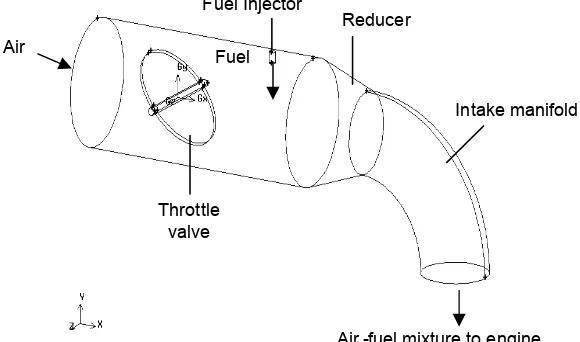
manipulated by the opening of throttle valve whereas the amount of fuel required is controlled by the fuel injector. The air and fuel are mixed in TBIM before entering the engine. In this work, the fuel was injected at various injection frequencies, i.e. 1, 2, 4, 5 and 7 injections per engine cycle to study its effect on the mixing in TBIM. CFD simulation of TBIM commenced with model meshing, followed by the optimisation of grids and selection of turbulent model before starting the computation.
2.1.1 Model Meshing
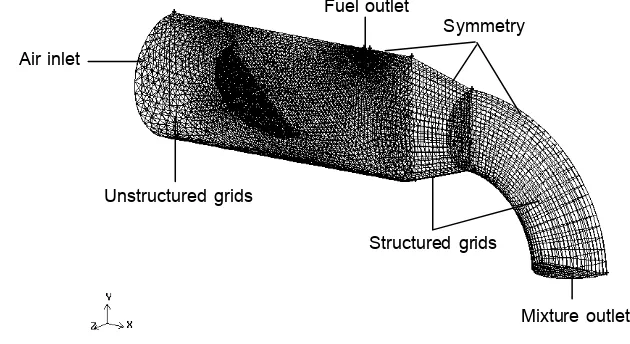
Owing to the symmetrical attribute of TBIM and consideration of computational expense, only a symmetrical portion of TBIM was modelled (Figure 2). By doing so, the simulation would yield an output for the whole of TBIM at 10% of the computational time.
There are two types of grids to choose from for model meshing, i.e. structured and unstructured grids. The first one is composed of hexahedral elements while the latter one consists of tetrahedral elements. A general rule of thumb is to apply the structured grids on simple geometries and the unstructured grids on complex geometries. For a complex geometry such as the main body of TBIM, which consists of a throttle valve and an injector, the unstructured grids were applied (Figure 2). On the other hand, the structured grids were chosen for simple geometries like the intake manifold (an arched cylinder) and the reducer (a pinnacle-less cone) that connects the main body of TBIM with the intake manifold (Figure 2).
A general guideline of model meshing is to always mesh the more critical domains (i.e. high velocity, high pressure or pressure drop flow fields) in advance of the less
Figure 1 Outline of TBIM structure
Throttle valve
Fuel Injector
Reducer
Air Fuel
critical ones. For TBIM, the more critical domains include the regions around the openings of throttle valve and the injector (Figure 2). The fineness of grid applied increases with the criticalness of a domain. After TBIM was appropriately meshed, the boundary conditions of TBIM were identified for the air inlet, fuel outlet, mixture outlet and the symmetry plane (Figure 2). Boundary conditions of ‘pressure inlet’ and ‘mass flow inlet’ were selected for the air inlet and fuel outlet, whereas the mixture outlet and the symmetry plane were given the boundary condition of ‘wall’. These choices of boundary condition were depending on the available data and also the data required from the simulation.
2.1.2 Optimisation of Grid
After model meshing, the grids on TBIM were optimised. This step is essential as it helps to minimise the numerical errors in computation during the simulation work. The intention of this optimisation process is to determine an acceptable grid size that is able to reach a balance between the amount of computing time and the accuracy in the solution of flow variables.
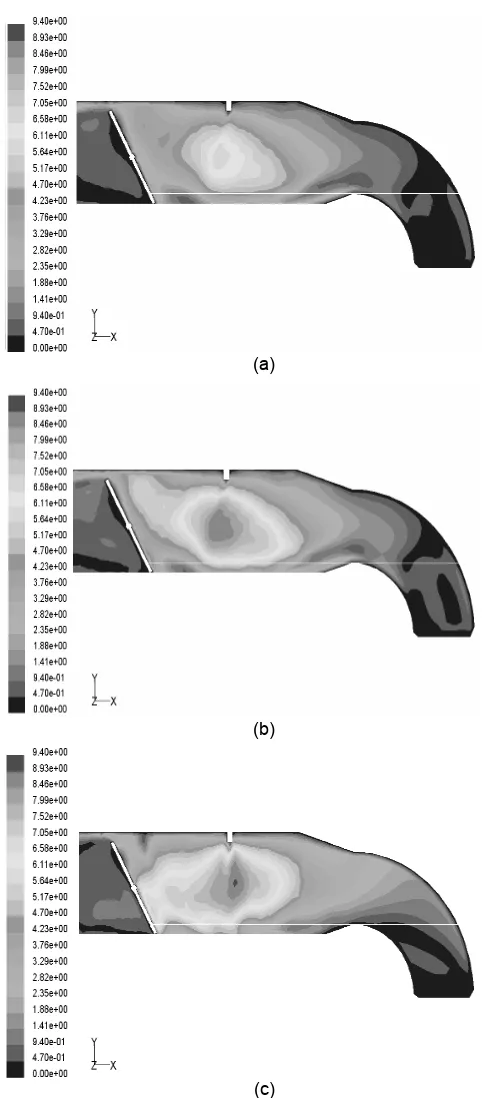
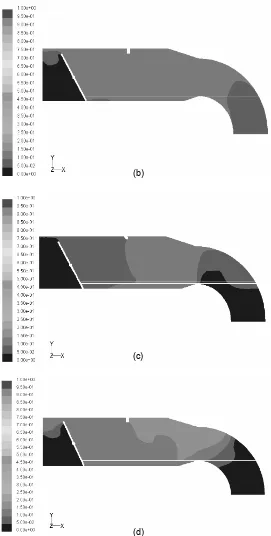
Figure 3 exhibits the velocity contours captured at the axisymmetric plane of TBIM which utilise three different total numbers of grid cells, i.e. 20149, 41263 and 61840 cells. It is obvious that the velocity contours of 20149 grid cells are different from those of 41263 and 61840 grid cells. The latter two are, however, in a good agreement with each other. In consideration of the less computing time involved, TBIM with a total number of 41263 grid cells was selected over the one with 61840 grid cells.
Figure 2 Computational mesh system and boundary conditions of TBIM for CFD simulation
Air inlet
Mixture outlet Fuel outlet
Symmetry
Figure 3 Velocity contours of TBIM with a total number of (a) 20149, (b) 41263 and (c) 61840 grid cells
(a)
(b)
2.1.3 Determination of Turbulent Model
Among all the turbulent models, the κ−ε model was selected in this work because it is the most widely used and validated one in terms of consistency and reliability [8 – 9]. There are three types of κ−ε model, namely the Standard κ−ε model, Renormalization Group (RNG) κ−ε model and Realizable κ−ε model. The major differences between these models are the methods in calculating the turbulent viscosity, turbulent Prandtl numbers and the generation and destruction terms in the
ε equation.
The Standard κ−ε model is the most extensively used and validated turbulent model among all the κ−ε models. It has achieved notable successes in calculating a wide variety of thin shear layer flows. Nevertheless, it is reported not to perform well in some important cases like flows with large extra strains (e.g. curved boundary layers, swirling flows) and rotating flows [9]. The RNG κ−ε model, on the other hand, is similar in form to the Standard κ−ε model, except for some added refinements to improve the accuracy for rapidly strained flows. As for the Realizable κ−ε model, initial studies have shown that it is the best κ−ε model in solving fluid dynamic problems. However, the Realizable κ−ε model has yet to prove in exactly which instances it consistently outperforms the RNG κ−ε model. According to [10] and [1], the RNG κ−ε model showed a better agreement with experiments than the other κ−ε models, particularly in predicting the gaseous penetration of both free and confined injection. It is more responsive to rapid strain and streamlines curvature relative to the other two κ−ε models. In addition, it takes into account the effect of swirl on turbulence, thus enhancing the accuracy for swirling flows. Therefore, for a rapidly strained gaseous flow with a confined injection in TBIM, the RNG κ−ε model was preferred. The transport equations of RNG κ−ε used in this work are as follows:
( )
(
i)
k eff k b m ki j j
k
k ku G G Y S
t ρ x ρ x α µ x ρε
∂ + ∂ = ∂ ∂ + + − − +
∂ ∂ ∂ ∂ (1)
( )
(
i)
eff(
k b)
e ei j j
u C G G G C R S
t x x ε x ε k ε ε k
ε ε ε ρε ρε α µ ρ ∂ + ∂ = ∂ ∂ + + − − + ∂ ∂ ∂ ∂ 2
1 3 2
(2)
where ρ is the fluid density, κ is the kinetic energy, ε is the dissipation rate, u is the mean velocity, µeff is the effective viscosity, αk is the inverse effective Prandlt number for the k term, αε is the inverse effective Prandlt number for the ε term,
Gk is the generation of turbulent kinetic energy due to mean velocity gradients, Gb
of the fluctuating dilation in compressible turbulence to the overall dissipation rate,
Sk and Sε are the user defined source terms for k and ε, respectively. Rε is an additional term in the RNG κ−ε model which is modelled by:
(
)
C R k η η µ ε ρη ε ε βη − = ⋅ + 03 2 2
3
1
1 (3)
where η= Sk/ε, η0 = 4.38 and β = 0.012 [8]. By substituting (3) into (2), the (2) can be rewritten as:
( )
(
)
(
)
21 3 2
* k
i e e k b e
i j j
u C G G G C
t x x x k
ε
ε ε ε ε
ρε ρε α µ ρ
∂ + ∂ = ∂ ∂ + + −
∂ ∂ ∂ ∂ (4)
where the constants C1e = 1.42 and C2e= 1.68 [8].
3.0 AIR FUEL MIXING AND HOMOGENEITY
In this work, air and fuel were delivered into TBIM at stoichiometric air-fuel ratio,
i.e. 17.3:1. Nevertheless, the air-fuel ratio of the mixing before entering the engine could be differed from this value owing to poor mixing. A good mixing would give a stoichiometric mass fraction of methane (Mch4.s) locally throughout the mixing region. The Mch4.s was calculated as follows:
Mch4.s = 1/18.3 = 0.0546 (5)
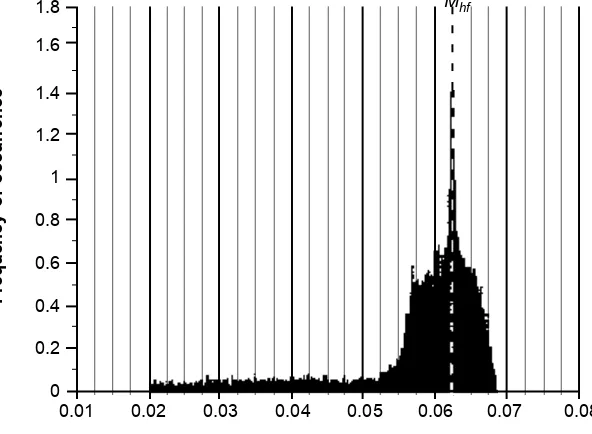
In order to determine the quality of mixing in TBIM, the mass fraction of methane (Mch4) throughout the axial length of TBIM was investigated using the histogram as shown in Figure 4. During the investigation, Mch4 with the highest frequency (Mhf) was retrieved from each histogram. The closer the Mhf to the Mch4.s, the better the mixing quality obtained and vice versa.
In addition, the quality of mixing was also investigated through the mixing homogeneity (Hm) in TBIM. The Hm was defined as the ability of air and fuel to mix with a uniform Mch4 in TBIM. To justify the Hm more effectively, the quality of Hm
(a)
Mhf
Mch4 throughout the axial length of TBIM
0.01 0.02 0.03 0.04 0.05 0.06 0.07 0.08
Figure 4 Histogram of Mch4 used to determine Mhf 1.8
1.6
1.4
1.2
1
0.8
0.6
0.4
0.2
0
Figure 5 Standardization of quality of Hm with (a) Grade A, (b) Grade B, (c) Grade C and (d) Grade D
4.0 RESULTS AND DISCUSSION
4.1 Effect of Injection Frequencies on Mhf
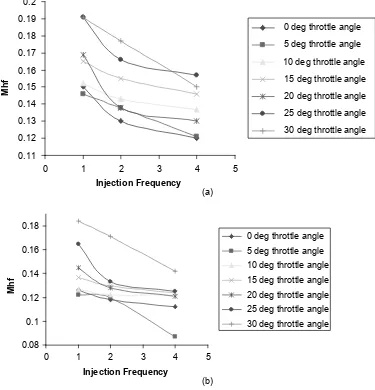
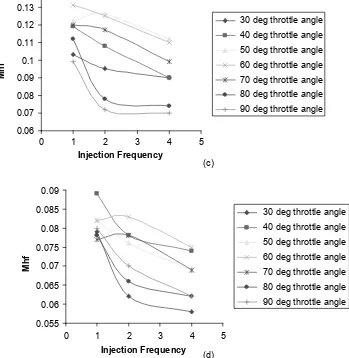
Figure 6 shows the effect of various injection frequencies on Mhf throughout the case studies at different engine speeds and throttle openings. The injection frequencies studied were 1 (1if), 2 (2if) and 4 (4if) injections per engine cycle. On the whole, the Mhf at 4if showed the lowest value compared to the other two smaller injection frequencies. The lower the Mhf, the closer it was to the Mch4.s, and thus the better the mixing quality. Hence, injection frequency at 4if exhibited the best mixing quality in TBIM.
The effect of injection frequency on the mixing in TBIM was strongly related to the sustainability of injection momentum and mixing energy. By applying more
0.11 0.12 0.13 0.14 0.15 0.16 0.17 0.18 0.19 0.2
0 1 2 3 4 5
Injection Frequency
Mhf
0 deg throttle angle
5 deg throttle angle
10 deg throttle angle
15 deg throttle angle
20 deg throttle angle
25 deg throttle angle
30 deg throttle angle
(a)
0.08 0.1 0.12 0.14 0.16 0.18
0 1 2 3 4 5
Injection Frequency
Mhf
0 deg throttle angle 5 deg throttle angle 10 deg throttle angle 15 deg throttle angle 20 deg throttle angle 25 deg throttle angle 30 deg throttle angle
Figure 6 Mhfvs injection frequency at (a) 1680 rpm, (b) 2160 rpm, (c) 4500 rpm and (d) 7200 rpm 0.06 0.07 0.08 0.09 0.1 0.11 0.12 0.13
0 1 2 3 4 5
Injection Frequency
Mh
f
30 deg throttle angle 40 deg throttle angle 50 deg throttle angle 60 deg throttle angle 70 deg throttle angle 80 deg throttle angle 90 deg throttle angle
(c) 0.055 0.06 0.065 0.07 0.075 0.08 0.085 0.09
0 1 2 3 4 5
Injection Frequency
Mhf
30 deg throttle angle 40 deg throttle angle 50 deg throttle angle 60 deg throttle angle 70 deg throttle angle 80 deg throttle angle 90 deg throttle angle
(d)
than one injection per engine cycle in the TBIM, a much greater turbulent intensity could be achieved as the injection took place intermittently [11]. Hence, the sustainability of injection momentum and mixing energy were increased. In this way, the mixture was able to mix thoroughly owing to the adequate mixing energy provided periodically. As a result, the Mhf decreased with increasing injection frequencies.
4.2 Effect of Injection Frequencies on Hm
in Table 1. This might due to inadequate distribution of mixing energy which was governed by other parameters such as the injection position, injection inclination angle [12] as well as crossflow of air into TBIM [13 – 14].
4.3 Optimisation of Injection Frequency
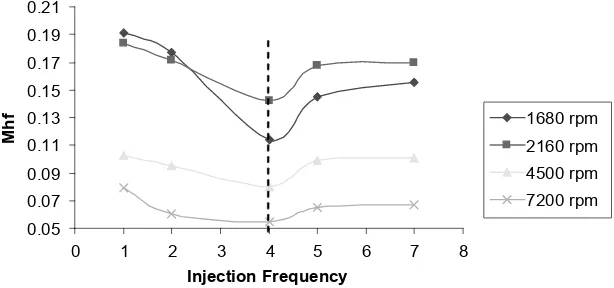
To obtain the optimum injection frequency for the best mixing quality, further investigation was conducted for 5if (5-injection/engine cycle) and 7if (7-injection/ engine cycle) on selected case studies. As shown in Figure 7, the Mhfat 4if generally showed the lowest value which was closest to Mch4.s relative to the other injection frequencies studied. Thus, 4if gave the best mixing at Mch4.s. For the Hm, on the other hand, it was evident that the Hm obtained at 1if and 4if were comparatively better than those obtained at 2if (Table 1). The former ones had 9 and 8 case studies for Grade A while the latter one had only 4 case studies, as shown in Table 1. Determination of the best Hm obtained between 1if and 4if was rather difficult as they showed nearly the same number of case studies for Grade A. Nonetheless, an obvious variation of the number of case studies obtained for Grade B and Grade C could be seen. Since 4if produced a larger number of case studies for Grade B and a fewer for Grade C, it was claimed to be a better injection frequency for Hm than 1if. Therefore, it could be concluded that the optimum injection frequency of TBIM for the best Hm with Mch4 closed to Mch4.s was 4if.
Table 1 Number of case studies obtained for each grade of Hm
Injection frequency Grades of Hm
A B C
1if 9 12 7
2if 4 17 7
4if 8 19 1
Figure 7 Mhf vs injection frequency at 30 degree throttle opening for different engine speeds 0.05
0.07 0.09 0.11 0.13 0.15 0.17 0.19 0.21
0 1 2 3 4 5 6 7 8
Injection Frequency
Mhf
5.0 CONCLUSION
The effect of various injection frequencies on the mixing quality of TBIM in terms of
Mhf and Hm had been studied in this research. A good mixing was that with Mhf
closed to Mch4.s and the best Hm at the same time, which was shown by a single contour of Mch4 throughout the mixing region during CFD simulation. Although the
Hm was not improved remarkably, the Mhf was, however, enhanced dramatically with a varying injection frequency. The optimum injection frequency for both Mhf
and Hm throughout the case studies was found to be at 4if. Future studies on the effect of other parameters such as injection position, injection inclination angle as well as crossflow of air into TBIM should be conducted to further enhance the air-fuel mixing prior to entering the engine.
ACKNOWLEGEMENT
We wish to record our sincere gratitude to Universiti Teknologi Malaysia (UTM) and Universiti Teknologi PETRONAS (UTP). Apart from financial support, they made available to us research facilities and resources which were integral to this work. In addition, unstinting technical assistance from Mr. Martin Philip King Ik Piau, Mr Yeap Beng Hi, Mr. Chin Vee Dee, En. Rosdi Baharim, En. Mohd Redhuan Ramli and En. Faizal Ali Othman is greatly acknowledged.
REFERENCES
[1] Papageorgakis, G. and D. N. Assanis. 1998. Optimizing Gaseous Fuel-Air Mixing in Direct Injection Engines Using an RNG Based κ-ε Model. SAE Technical Paper Series. SAE 980135.
[2] Lacher, S. J., L. Fan, B. Backer, J. K. Martin, R. Reitz, J. Yang and R. Anderson. 1999. In-Cylinder Mixing Rate Measurements and CFD Analyses. SAE Technical Paper Series. SAE 1999-01-1110.
[3] Anderson, R., J. Yi, Z. Han, J. Yang, N. Trigui and R. Boussarsar. 2000. Modeling of the Interaction of Intake Flow and Fuel Spray in DISI Engines. SAE Technical Paper Series. SAE 2000-01-0656.
[4] Dyntar, D., C. Onder and L. Guzzella. 2002. Modeling and Control of CNG Engines. SAE Technical Paper Series. SAE 2002-01-1295.
[5] Yi, J., Z. Han and N. Trigui. 2002. Fuel-Air Mixing Homogeneity and Performance Improvements of a Stratified-Charge DISI Combustion System. SAE Technical Paper Series. SAE 2002-01-2656.
[6] Chang, S. H. Effect of Injection Characteristics on Throttle Body Injection Mixer for Compressed Natural Gas Motorcycle. Universiti Teknologi Malaysia. Malaysia: M. Eng. Thesis.
[7] Yi, J., Z. Han, J. Yang, R. Anderson, N. Trigui and R. Boussarsar. 2000. Modeling of the Interaction of Intake Flow and Fuel Spray in DISI Engines. SAE Technical Paper Series. SAE 2000-01-0656.
[8] Fluent Inc. 2001. Fluent 6 User’s Guide. India: Fluent Documentation Software.
[9] Versteeg, H. K. and W. Malalasekera. 1999. An Introduction to Computational Fluid Dynamics – The Finite Volume Method. England: Longman Group Ltd.
[10] Han, Z. and R. D. Reitz. 1995. Turbulence Modeling of Internal Combustion Engines Using RNG κ-ε Models. Comb. Sci. & Tech. Vol. (106): 267-295.
[11] Christian, F. 1996. Experimental Study of Mixing Performances Using Steady and Unsteady Jets. In: Cheremisinoff, N. P. ed. Mixed-Flow Hydrodynamics – Advances in Engineering Fluid Mechanics Series. Texas: Gulf Publishing Company. 359-381.
[13] Busnaina, A. A. 1985. Transient Predictions of Lateral Jet Injection into Typical Isothermal Combustor Flowfields. AIAA 23rd Aerospace Sciences Meeting. January 14-17. Nevada: American Institute of Aeronautics and Astronautics, 1-9.