University of Windsor University of Windsor
Scholarship at UWindsor
Scholarship at UWindsor
Electronic Theses and Dissertations Theses, Dissertations, and Major Papers
8-27-1964
An evaluation of the Semantic Differential Technique as a tool for
An evaluation of the Semantic Differential Technique as a tool for
the discrimination and prediction of Extraversion-Introversion.
the discrimination and prediction of Extraversion-Introversion.
Nikolaus Tines University of Windsor
Follow this and additional works at: https://scholar.uwindsor.ca/etd
Recommended Citation Recommended Citation
Tines, Nikolaus, "An evaluation of the Semantic Differential Technique as a tool for the discrimination and prediction of Extraversion-Introversion." (1964). Electronic Theses and Dissertations. 6320.
https://scholar.uwindsor.ca/etd/6320
AH EVALUATION OF THE SEMANTIC DIFFERENTIAL TECHNIQUE AS A TOOL FOR THE DISCRIMINATION AND PREDICTION
OF EXTRAVERSION-INTROVERSION
A Thesis
Submitted to fibs Faculty of Offa1*11#*** studies through the Department of Psychology in P artial Fulfillm ent
of the Requirements fo r the Degree of
Master o f A rts at Assumption University of Windsor
fey
NIKOLAUS TINES, B .A . Assumption University of Windsor, 1969
UMI Number: EC52499
INFORMATION TO USERS
The quality of this reproduction is dependent upon the quality of the copy
submitted. Broken or indistinct print, colored or poor quality illustrations and
photographs, print bleed-through, substandard margins, and improper
alignment can adversely affect reproduction.
In the unlikely event that the author did not send a complete manuscript
and there are missing pages, these will be noted. Also, if unauthorized
copyright material had to be removed, a note will indicate the deletion.
®
UMI
UMI Microform EC52499
Copyright 2008 by ProQuest LLC.
All rights reserved. This microform edition is protected against
unauthorized copying under Title 17, United States Code.
ProQuest LLC
789 E. Eisenhower Parkway PO Box 1346
Approved by:
ABSTRACT
The personality traits of Extraversion and Introversion, because of
th e ir outstanding and pervasive nature, have received a great deal of attention
by research psychologists. Many investigators were concerned with the
measurement of these tra its . If M e of th eir results however, proved adequate
from flie points of view of either validity or relia b ility .
As a possible solution to this problem, an approach to the measure*
ment of these traits through the use of the Semantic D ifferential technique is
suggested in this investigation. The Semantic D ifferential has high reliab ility
and seems to have face validity for Urn measurement of Extraversion-Intr o-
versicn. Thy hypothesis put forth in this investigation is that a satisfactory
concurrent (statistical) validity can be obtained for the Semantic D ifferential
as a technique for measuring these tra its .
To test this hypothesized validity, toe Semantic D ifferential scores
of a group of 43 subjects were analyzed for their capability to discriminate
between subjects classified as being either extroverted or introverted m toe
basis of toe recognizable presence of either tra it in a set of drawings com
pleted by them and rated according to lUdsch's form al c rite ria of style.
The correlation between Extraversion-Introversion scores predicted
on the basis of Semantic D ifferential intensity scores and actual Extraversion-
Introversion scores received by the subjects on the basis of projective c rite ria
was found to be significant beyond the .01 level. The coeMcient of multiple
determination, i.e . toe variance among actual Extraverslon-lntroversion
scores explained fey the Semantic D ifferential, was found to fe® .25.
It was concluded, therefore, that the Semantic D ifferential oewld
effectively discriminate between and predict Ejdraveroieo-lntrw ersion.
PREFACE
Th© author ytBhflw to exp roes hi* gprstfffttl. upp^frtli ttffii to B r, V J .
r i i« m > # »fi f a * ■ ! m iwb n Ai fm A i't n i l A S * A M m i i m J kmu i m A r t f t i i * a * an Mi n t W i A i a M i k M A A t a m A wmM&W WB0p| CuIn&OvlOtt till cl WVBNyf W&S MwEI wPHENB©
guidance he toed la Its execution. B# is »hu> t© Brothoic Roser PhiU©.
F .S .C. , »ad D r. B.A* Belling for their efforts la eorreoting the manuscript
TABLE OF CONTENTS
AT*&T*P Af**!*
AJCS0 A *WM# A •, », #, ^ •, », *, «,
PREFACE ,
LIST OF TABLES ,
Chapter
f nrmnTTnNr
A JJFt A AAVAliJwW.Jn Alwwf », % «{ •, *. •,
a THE PROBLEMS OF MEASUREMENT ,
The Paper and Pencil Test Approach
Critique: The Problems of Validity and R eliability The Projective Approach
Critique: The Problems of Validity and R eliability The Semantic D ifferential Approach
The Applicability of the Semantic Differential Approach
M METHODOLOGY AND PROCEDURE
W PRESENTATION AND ANALYSIS OF RESULTS ,
Discussion of Results
Y SUMMARY AND CONCLUSIONS .
APPENDIX A * Project!v® Data . , ” ,
APPENDIX B - Semantic D ifferential Data ,
REFERENCES ...
VITA A U C T O R IS ...
LIST OF TABLES
Table 1
2
3
4
3
6
7
8
9
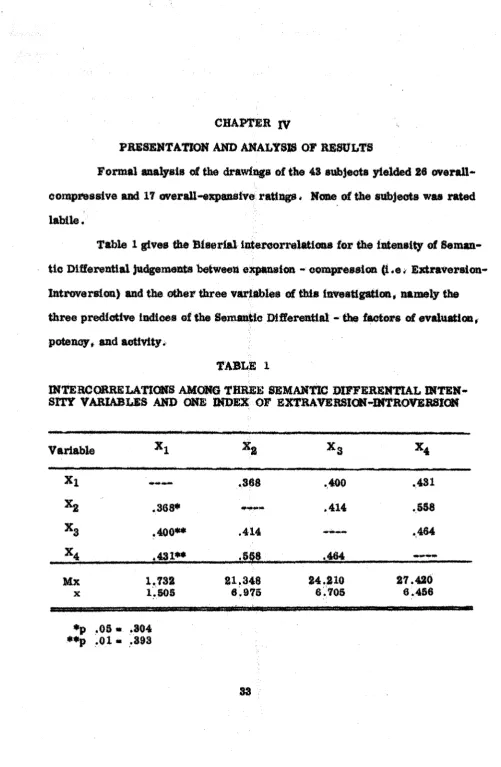
Fag® Intercorrelations Among Three Semantic D ifferential
Intensity Variables and One Index of
Extraversion-Introversion 23
Intercorreiations Among Three Semantic D ifferential Direction Variables and One Index of
Extraversion-39
Regression Coefficients of the Multiple Regression of Extraversion-Introversion on Semantic D ifferential
Intensity Scales 36
A Comparison of Actual Ratings and Predicted Ratings
of Extraversicra-Introversion ( I - I ) 37
Expansion-Compression Ratings of Four Judges for 43
Subjects on the Basis of Projective C rite ria (Appendix A) 43
Ten Semantic D ifferential Scales for the Measurement
of Extraversion-Introversion (Appendix B) 48
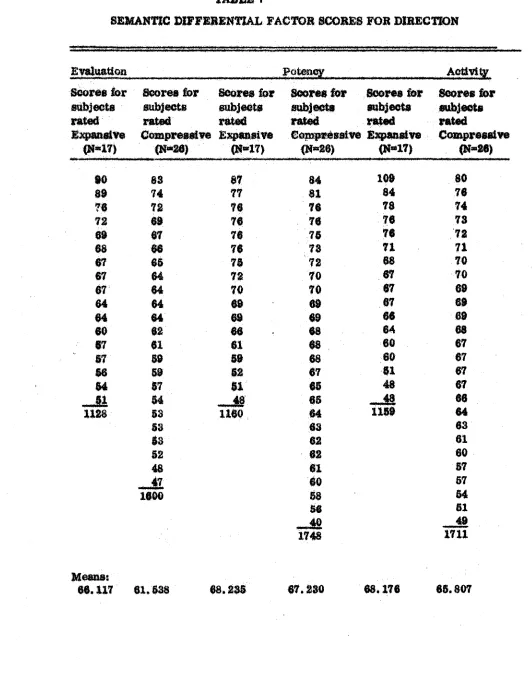
Semantic D ifferential Factor Scores for Direction
(Appendix B) 49
Semantic D ifferential Factor Scores for Intensify
(Appendix B) 50
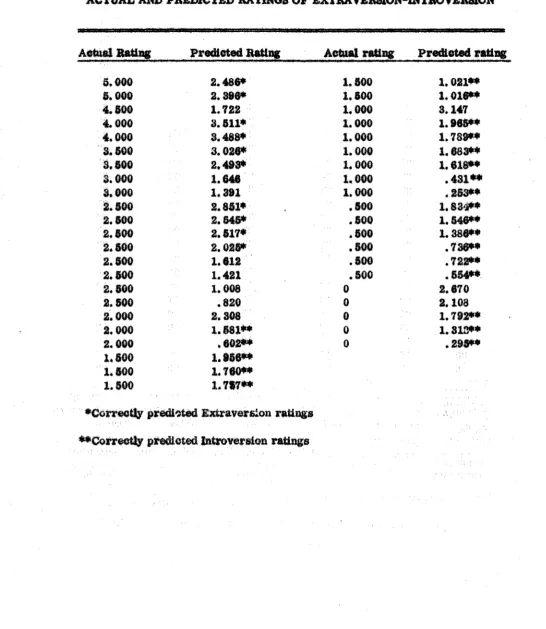
Actual and Predicted Ratings of Extraversion-Introversion 51
(Appendix B)
CHAPTER I
INTRODUCTION
It may be observed that in social situations the behavior of some
people appears psychologically uninhibited, that of others restricted. Some
individuals from earliest childhood seem to be characteristically inhibited.
By the tim e adolescence is passed these behavior patterns frequently seem to
be set to such a degree that a fa ir prediction maybe made concerning a per
son’s mode of reaction to other people in social situations.
This phenomenon has been, and s till Is , given considerable attention
by psychologists in general, and personality theorists and social psycholo
gists in particular. Some have assumed that it is or becomes a basic, i .e .
general mid persistent, mode of individual behavior in , and adjustment to , a
variety of social environments. Different names*, the most fam iliar perhaps
being Jung's (1923) terms Extraversion-Ihtroversion, have been used to des
cribe these modes of reaction. These habitual modes of behavior were thus
conceptualized as personality tra its .
Extraversion, according to t e g (1923), is characteristic of indivi
duals whose behavior is directed toward, or dependent on, the external world.
The extrovert is characteristically active and contented when surrounded by
people; carried to the neurotic extreme his behavior appears as an irrational
* & a comprehensive review of the early theoretical and experimental work done in this area, Guilford (1934) presents an outline of the various term s and definitions most frequently employed to describe Extraversion-Ihtroversion, each depending largely on the theoretical bias of its particular author.
2
flight from himself into society, where his feelings are acted out. Jung called
hysteria the extrovert's neurosis.
Introversion on the other hand is characteristic of the individual who
is normally contemplative, who enjoys solitude, whose behavior is dependent
on, or directed toward, him self, i.e . his inner daviionmexii. In its extrem e,
Introversion represents a flight firom externa! life into the individual's own
inner w orld, where his fantasies tend to become more meaningful to him than
objective re a lity . Jung saw psychasthenia as the introvert's neurosis, and
scMzephrenia as his psychosis.
Jung did not suggest, however, that a ll individuals be dlohotomously
classified as extroverts or introverts, since everyone has both tendencies to
some degree, though one generally predominates. In other words it is assumed
to be a bi-polar dimension of personality.
Allport (1032) speaks of 'expansion* and 'reclusion* as being the easiest
of expressive traits to identify:
Our firs t meeting with a person gives the clue, and subse quent experience m erely confirms our judgements. A person who is expansive projects him self into bis social relationships; he talks freely, expresses Ms opinion frequently, and leaves little doubt as to his views on any subject. The reclusive person finds little to say; he relates Ms opinion briefly or not s ta ll. He is reticent.
Since these traits are by definition overt in expression, it is not surprising that several studies show them to be the most reliably sated of a ll the common traits of personality. A garru lous person is almost always garrulous, a 'human clam* is under almost any circumstances hard to pry open. (A iiport, 1939).
A llport's description of observed behavior tendencies clearly deals
with the same bi-polar dimension previously defined by Jung as Extraversion-
Introversion. The names are modified, the concepts however are basically
congruent.
outstanding nature of these personality tra its , as evidenced by human behavior
in general, aroused widespread interest hi their investigation. Many of these
investigations were concerned with the development of a technique for the
measurement of this bi-polar dimension and its specific intensities within the
individual, m well as its relationship to other personality tra its . These early
attempts, however, proved unsuceessM, largely because they were unable
adequately to isolate and conceptualise E xtraverslon-Introverslon as an inde
pendent personality dimension.
More recently a renewed attempt at measurement and integration of
these traits within the framework of personality structure was made by
Eysenck (1947). ta a review of factorial studies involving these tra its , he
reports that in the main these early studies agree in finding:
a bi-polar factor variously called ’surgency-desurgency* (C atteil 19*6) . , , 'aggressive-inhibitive' (M ae , or whatever term s seem appropriate . , . (and) . , . these factors closely agree with one another, as w ell as cur own
aeurotie Introversion) factor. l@4?# p.ffl)
Ey@0iiok him self distiinituish©3 tki*0© pervasive £tnd rslfitivdlv }n
sions in the personality domain, namely Extraversion-Introversion, Neuroticism ,
and Psychottcism. He places these traits into (he context of a theoretical per*
sonality theory g , as yet, disputed validity. Further, although he assumes
Extraversion-Introversion, as measured by him , to be completely independent
of other tra its , there is contradictory experimental evidence for this assump
tion.
The problem of effective measurement of Extraversicai-Introversion
rem ains, therefore, unresolved. One of two alternative conclusions could be
drawn from these previous failures to isolate these lim its as independent per
(i) Extroversion and Introversion are not basic, Independent person
ality tra its j ©r
(ii) f ie approaches ©I previous investigators to the measurement ©I
E xtraversion-lhtroversion were inadequate tr&m the points of view of either
validity or relia b ility .
In this investigation ft is assumed that it is the second alternative
which is correct. Paper and pencil measures of these tra its , though quite re li
able, are not based upon an adequate concept of Extraversion-Introversion, and
do not differentiate Extroversion-Iatroversion as independent personality traits
and, therefore, lack validity for th eir measurement. Projective techniques on
the other hand, though seemingly appropriate, lave been shown to lack reliab i
lity and are , therefore, equally inadequate for effective measurement of
Ext raverston-Introversioa. C learly, an effective approach to the measurement
of these traits requires that both c rite ria of validity and relia b ility be m et.
As a possible solution to this problem, an approach to the measure
ment of these traits through the use of the Semantic D ifferential technique is
suggested in this investigation, f he Semantic D ifferential technique is a combi
nation of controlled association and sealing procedures. The subject is provided:
with a concept to be differentiated and a set of bi-polar adjectival scales against which to do it, his only task being to indicate for each item (pairing of a concept with a scale) the direction of his association and its intensity on a seven-point scale. (Osgood, Suoi, & Tannenbaum, ig f?, p .20)
The Semantic D ifferential has high reliab ility and seems to have face validity
fo r the measurement of Extraversion-Introversioa.
The hypothesis put forth in this investigation is that a satisfactory con
current (statistical) validity (Cronbach, 1960) can be obtained fo r the Semantic
D ifferential as a technique for measurement of these traits . To test this hypo
analysed for their capability to discriminate between subjects classified as
being either extraverted ©r introverted on the basis ©I the recognizable
presence ©t either tra it in a set ©f drawings completed by them and rated accord
ing to Eikisch’s (1945) form al c rite ria of style.
The purpose of this study then is to investigate the validity of the
Semantic D ifferential technique as the tool for measuring Extraversion-
C B A F n i s
THE PROBLEM OF MEASUREMENT
The Paper and Pencil Test Approach
(1 ) E arlv Developments. For a number of years after lung's formula
tion of Extraversion-Introversion these concepts enjoyed much popularity among
psychologists of that period. Th eir popularity In him brought about a flood of
research concerned with their isolation, measurement, and especially th eir re
lationship to other personality variables, (A llport* 19305 A llport & Vernon 1933;
B erareuter, 1933 (a) & (b); Conklin 1923, 1927; Downoy, 1924; Freyd, 1924;
G utttofd, 1934; Guthrie, 1127; Hehtoreder, 1926, 1927? L a ird , 1923? Lembke,
1930; e ta l.).
The m ajority of these early studies were concerned with the relation-
shio between Extraversion-toiroveraion and other nersonalltv variables such as
intelligence (Freyd, 19241* ®ex (Heidforedar, 1923? L aird , 1925), and particu
la rly neurotlolsm (Berareuter, 1933; Conklin, 1927; Moore, 193#, T h eir
results, however, often directly conflict with each other.
Laird (1925), for example, reports such a greater tendency toward
Introversion to women fbffp to men told he finds It necessary to assign different
percentile scores to the two sexes.
Heidbreder (1927), m the other hand, found no differences between men
and women to respect to Extraversion-Introversion tendencies. She also cites
endhe* study on the same problem conducted to the University to Mtoue*tos
Laird (1925) in Ms inventory and the same type of subject (college students) and
with only m inor differences in their respective proceedings. The results of
IM s study also indicated sex differences to he ng|Ugible in determining an indi
vidual's position on an Extravergion-lntroversian scale.
Investigations into die relationship between Extraversion-Introversion
and neuroticism produced sim ilarly conflicting re m its . Moore and Steel (1934),
and Bem reuter (193% have found such high correlations between Introversion
and neuroticism that Berareuter (1933% concludes the two are not distinct con
cepts, but are "names given to a flngle tra it whose real nature has bean ob
scured by Inadequacies of the tests by which they have been estim ated.n(p.402)
Conklin (192%, however, attributes this confusion to the fact that most
of these early investigators failed clearly to conceptualise the differential
nature of Extraversion-Introversion as basic personality traits on the one hand,
and their abnormal manifestations in neuroticism, on the other. Their scales,
therefore, more often than not were designed to measure the abnormal manifes
tations of these tra its .
C ollier and Emek (1957) agree with Conklin and point out that this con
siderable confusion as to the definition of the traits stems horn the fact fbBt the
various authors of these definitions retained the term s E xtraversion-M rover-
sion, while ignoring the main lines of fang's arguments in favor erf their own
theoretical preferences.
The most frequent variety of definition is based on Freud's (1920) adop
tion of the term Introversion, according to which it is one of the invariable and
indispensable considerations in every case of psycho-neurosis - a substitution
fo r actual objects of phantasies of these objects, (1929). According to C ollier
meaning and la as©." (1888, p. 1041)
Sim ilar contradictions are evident in the results of other early studies
correlating these tra its with various personality variables. A comprehensive
review of such studies Is presented by Guilford (1934).
The general confusion in the early development of this area prompted
Guthrie (1927, p .83) to conclude that "in most of the accounts of introversion
and extraversion, evidence of the existence of these types or of the measure
ment of their degrees is conspicuously absent." This seems almost an echo of
the Allports* (1921, p. 38) pessimistic sentiments concerning the measurement
of these traits expressed some years before, when they had to admikthai,
"owing to its (this trait*®) importance many tests we re sought by us mid many
possible correlations scrutinized, but with little resu lt."
A fter this burst of investigations concerning these tra its , and the dis
couraging and often conflicting results reported by them, the concepts of E xtra*
version-Introversioa lost their popularity and little work was done in this area
fo r some tim e.
( ii) Later Developments. A recent development in the investigation of
Extraversion-Introversion is the Maudsley Personality Inventory (M P I). This
is a questionnaire developed by Eysenck (1919) for the measurement of E xtra-
version-Introversioa m l neuroticism . On this questionnaire Eysenck’s subjects
showed no significant correlation between Extraversion and neuroticism and he
concludes therefore that these tra its , as measured by the Maudsley Personality
Inventory, are independent unrelated.
Commenting favorably on Eysenck’s data and the conclusions drawn
from that study, Jensen (1958, p .322) suggests that any slight correlation that
may be found between Extraversion-Introversion and neuroticism could be ex
and extraverted item s." However, he is forced to admit that some of these
‘slight correlations’ between Extraversion-Introversion and neuroticism are
not altogether s© slight according to the data presented by him . As a m atter of
fact, these traits are correlated at the .OS level of significance for 200 normal
adult males, and at fii© .01 level of significance for 145 university students of
both sexes, and at the same level for another group of 86 nursing and mixed
university students.
Such correlations are hardly in accord with Eysenck’s conclusions.
Jensen cannot explain this conflict, yet he concludes teat, although Eysenck’s
theory may have deficiencies and his questionnaire may need improvements,
even in its present form , “the Maudsley Personality Inventory . , . can be
recommended for research purposes as being perhaps the best questionnaire
measure of introversion-oxtraversioa and neuroticism available at the present
tim e. ’ (1058, p.324)
Other investigators have found it difficult to accept such conclusions in
the face of tee conflicting results reported on the questionnaire. Bronm ft,
Hayes, W elch, and Koltuv(1960) recently found Extraversion and neuroticism,
as measured by the Maudsley personality Inventory, to be negatively corre
lated. They ccnolude therefore teat, contrary to Eysenck’s theory and Jensen's
interpretation of Eysenck's data, there is a negative relationship between Extro
version and neuroticism as measured by teat questionnaire.
Cervin (1860) in Ms comparison of tee results obtained from a battery
of scales, - Including his Emotional Besponsiveness and Bigldity scales (1957),
the Taylor Manifest Anxiety scale, and tee Maudsley Personality Inventory
(MP1) Extraversion and Neuroticism scales (Eysenck, 1969) - also found a signi
ficant negative relationsMp between Extraversion and neuroticism as measured
1 0
Further, Eysenck (1955) hypothesized that Taylor’s Manifest Anxiety*
scale should show a strong positive correlation with the M PI Neuroticism scale
and
a sm aller negative correlationwith the
Extraversion scale. This hypothesis is supported fcy Bendig’s (1957) study, In which he found correlation co
efficients, significant at the .01 level, between the three scales in the direction
hypothesised. Sim ilar findings were
also
reported by Jensen (1958). However,the
correlation obtained by Cervin(1960) from several sizable samples, suggestthat the Taylor Anxiety scale ratings are
negatively
correlated with both M PIscales,
Cervin
(i960)te th e r found that his
Emotional Responsiveness scaledisplayed a significant positive
correlation with
theMPI
Neuroticism scale anda significant negative correlation
with
theMPI
Extraversion scale. A sim ilarbut less significant relationship
was indicated between Ms
Rigidityscale
and theMPI scales. Nevertheless, he considers these
correlations between the E xtra-version-fiitroversion scores
and the other personality measures
used to be’relatively
1sm all,Since, moreover, the
reliab ility of theMPI
Extraversionscale is good, he feels
the use ofthe Extraversion
scale for prediction of behavior
in experimental
situations to be warranted.However,
he also found thatthere
are three
subdimensions of Extraversion-Introversion — quickness ofreaction,
level of activity, and degree ofself
control ««* which are purer dimensions than Extraversion-Introversion, as measured by the M P I, and have more
predictive power,
Jensen (1058) also reports correlation coefficients for the M PI scales
w ith related measures, inducing O attell’s Contact Personality Factor scale
(1954), the M innesotaTSEraM roversion-Extraversion scales (gvaaa>
c., &
1 1
S o cia b ility scales <1956). These measures are reported to correlate with
th eir respective M PI scales as expected by Jensen, except lo r Heron's Neuro
ticism scale, which shows a significant negative correlation with the M PI
Extraversion soak.
Thus, Eysenck's theory and questionnaire have brought about renewed
interest in these personality dimensions, th eir conceptual crystallization mid
measurement, mid th eir relationship to other variables. Nevertheless, it seems
that some of the oonftision observed by Conklin (1923) in this area earlie r s till
persists, especially in the relationship between present Extraversion-Introver-
sion measures and neuroticism. This confusion can be interpreted as stem
ming either from the fact that Extraversion and Introversion may not be basic,
independent personality traits; o r, more plausibly, from the fact that the
approaches of previous investigators to the measurement of these traits were
inadequate from the points of view of reliab ility and validity and consequently
were unable adequately to Isolate Extraversion-Introversion from related tra its .
Conklin (1923) concluded the second alternative to be true for the early studies
reviewed. From the above discussion it appears that this conclusion also applies
to the later developments cited.
Critique: The Problems of V alidity and R eliability
(i) E arly Developments. In his review of early tests purporting to
measure Extraversion-Introversion, Guilford notes their ’’wide divergencies in
reliab ilities and validities” . (1 9 3 4 , p .3 3 7 ). Sim ilarly Guthrie, speaking o f
Laird's questionnaire, credits it with 'substantial relia b ility ' but has to conclude
that the fact "that it is a test for introversion, however, is a pure assumption".
(1927, p .84).
1 2
of early Extraversion-Introversion questionnaires generally, for attempts at
th eir validation consisted largely of arriving at correlation coefficients with
other questionnaires of equally dubious validity purporting to measure the same
tra its . The validity coefficients obtained in this manner w ere, furtherm ore,
consistently low. According to Guilford (1934), validity coefficients for Laird's
questionnaire, for example, are .42 when compared with the Heidbreder
questionnaire; .27 and .23 when compared with Conklin's (1927) test; and .40 to
. 53 when compared with self-estim ates. The Heidbredor questionnaire in turn
is reported (Freyd, 1924) to correlate .37 with self-associate ratings and .39
with Conklin's test.
Bernreuter's test (1933b) was so constructed as to give scores, when
weighted differently, upon four different personality tra its , of which E xtraver-
sion-Introversion is one. V alidity coefficients of .92 and .99 are reported for
this test; however, Extraversion-Introversion scores and scores for 'neurotic
tendency', as measured by the same test, usually co rrelate.94. This fact, as
mentioned e a rlie r, led Berareuter to conclude the two variables to be identical
for his test.
According to G uilford, this ’’unsatisfactory state of the attempts at
measurement in the field of Extraversion-Introversion" is partly the result of
the "almost universal suspicion (in this early stage) that the introvert is inclined
to maladjustment, if not to more serious instability." (1934, p .343). He states
that consequently Berareuter and others engaged in the construction of question
naires of Extraversioa-Infcroversion and ’neurotic tendency', found it difficult to
keep the two from correlating significantly with one another. Guilford reports
that this also applies to Laird's and Beidbreder's questionnaires, which were
12
neurotic tendency (Guilford, 193$,
Eysenck also has presented a review of such early investigations of
Jung's hypothesis through the use of Extraversion-Introversion and neuroticism
questionnaires (1953). And he also points out that neither the various E xtraver-
sion-Introversion nor neuroticism questionnaires correlated closely with each
other; to the contrary, Extraversion-Introversion questionnaires correlated with
neuroticism questionnaires almost a§ highly as individual questionnaires of
either category with each other (1939).
(ii) Later Developments. Recently, the APA Committee on Test Stand
ards, In its 'Technical Recommendations fo r Psychological Tests and Diagnostic
Techniques? (Tolor, 196$, distinguished four types of validity: predictive, con
current, content, and construct validity.
Predictive validity denotes correlation between the test and subsequent
criterion measures,as the correlation of vocational interest or aptitude tests
with later success would denote.
Concurrent validity denotes correlation between the test and concurrent
external c rite ria , such as psychiatric diagnosis, for example.
Content validity is claimed if the test items can fee shown to fee an ade
quate sample of the universe under investigation.
In construct validation the meaning assigned to test scores is substan
tiated fey demonstrating that the scores are consistent with deductions from the
theory from wMch the meaning Is derived. This validation process is much the
same as that involving &© validation of the theory its e lf.
13
the score on the block test may predict something he cares about).
Content validity is studied when the tester is concerned with the type of behavior involved in the test performance. Indeed, if the test is a work sample, the behavior represented in the test may be an end in its e lf.
Construct validity is ordinarily studied when the tester has no definite criterion measure of the quality with which he is con cerned, and must use indirect measures. Here the tra it or quality underlying the test Is of central importance, rather than
either the test behavior or the scores on the criterion (APA, 1954 , p. 14).
Construct validity then is used for teste intended to measure a construct
arising from some theory; the validation consists of evidence that the scores
vary from person to person o r occasion to occasion as the theory would im ply.
It is such construct validity which Eysenck <1039) claims for his
questionnaire. F o r, although Eysenck assumes Extraversion-Introversion and
neuroticism to be completely independent, an integral contention of, or con
struct arising from , Ms underlying personality theory <1047, 1953) is that hys
terics and psychopaths are extraverted and neurotic, while dysthymlos,
(Eysenck's overall-term for reactive-depressives, obsessive-compulsives,
and those suffering from neurotic amdety states) are introverted mid neurotic,
Construct validation of tee M M scales, therefore, requires that dysthymics
should have high scores on Introversion and neuroticism, while hysterics and
psychopaths should have high scores on Extraversion and neuroticism .
Jensen (195% and Hildebrand (195% tend to concur with Eysenck's
claim of construct validity for his questionnaire. Hildebrand found teat in his
study '’hysterics and psychopaths are clustered at tee exfravexi end of tee dis
tribution, with the mixed neurotics occupying a central p o s itio n (195%
However, ilg a l, Star, and Franks, (1053% in their investigation of tee
validity of the Extraversion and Neuroticism scales of the M PI found that hys
terics and psychopath®, considered as one nosological group, are not signifi
14
tend to have a lower mean Extraversion score than the normal group. Conse
quently, they conclude:
that either hysterics and dysthymics cannot be used in the described manner (i.e . in the context of Eysenck’s personality theory construct}, or the Extraversion-Introversion and
Neuroticism scales do not measure Introversion-Extraversion
and Neuroticism , or that both statements are tru e. (Sigal, et a l. 1958a, p. 148).
Eysenck (1988, p .281) counters that really ’’th eir findings agree with
prediction but fa il to do so significantly." He suggests that their sample (of 52
subjects) was ’’not sufficient to bring out the significance of their findings." He
further points out that additional studies with bigger samples showed statistic
a lly significant differences between the groupsinth© expected direction.
In a rejoinder Sigal, S tar, and Franks (1958b, p .381) claim that
Eysenck "committed errors of logic and arrived at incorrect conclusions".
’I’ poi nt out that their:
results suggest that the us© of these groups would lim it the range to the introverted side of the Extraversion-Introversion continuum, that it would provide no information about the validity of tests or theories in tee extraverted end of the continuum, and that teste constructed using hysterics and dysthymics as criterion groups might produce markedly skewed distributions when used in the normal population. These groups, used as a pair are, therefore, inadequate as criterion groups in tee measure of Extraversion- Introversion, if the Extraversion scale is a valid measure of Extraversion-Introversion. (p .381).
They reaffirm their original conclusion, namely,
either hysterics and dysthymics cannot be used as criterion groups in the measure of Extraversion-Jntroversion, or the Extraversion- Introversion and Neuroticism scales do not measure Extraversion- Intr a v e r sio n and N e u r o tic ism , o r that both sta tem en ts are t r u e. (p .382).
Thus it seems that not a ll the confusion observed e a rlie r la this area
has been resolved. Whether or not Eysenck's questionnaire w ill eventually be
accepted as a valid measure of Extraversion-Introversion w ill depend largely
15
theoretical construct.
Many paper and pencil tests are reported to have high re lia b ility , and
consequently they also are assumed to have a high potential validity (Cronbaoh,
19501 for the measurement of Extraversion-Introversion. To translate this high
potential validity into actual validity for the measurement of these traits would
require item selection sufficiently pure to isolate them from related tra its .
Such pure item selection in turn would require a clear conceptualization of the
nature of these traits (Conklin, 192^. As seen from the discussion above,
these requirements have, as yet, not been met by the paper and pencil tests
reviewed; consequently approaches using these tests for the measurement of
E xtraversion-Introversion have proved to be inadequate.
The Projective Approach
Measurement of lxtraver@ ion-£atroverslon has also been approached
from the more unstructured point of view of projective techniques, which are
finding wide and increasing use in present-day studies of personality. These
techniques are potentially the moat penetrating diagnostic instruments available
fo r personality and psychotherapeutic research.
Cm category of projective techniques, dealing with the analysis of
the ’artistic* productions of the subject, appears particularly suitable for inves
tigations concerned with overt expressive traits of the type under consideration
in this study.
Free drawings, for example, reveal a great deal about the person who
has drawn them. 8© much so, that recently several such drawing analysis
techniques have developed into diagnostic clinical instruments. Their interest
has been focussed largely upon the content - the object or lite ra ry ideas - of
It lias been found, however, that drawings also lend themselves to
analysis of their form quality, that is , how It was drawn rather than what was
drawn. The expressive movements employed in drawing leave te ll-ta le clues
which enable the investigator to te ll, for instance, whether the artist worked
tensely and rig id ly, or freely and uninhibitedly. It is possible, then, to trace
a correlation of the emotional attitude of the subject with his form production
and And an approach to personality through form al c rite ria of style. (Waehner,
1942). Such formal analysis should lend its e lf particularly w ell to the investi
gation and measurement of Extraversion-Introversion, since, as stated e a rlie r,
these traits manifest themselves overtly in the style, or form , of die subject’s
expression.
Hot surprisingly, therefore, it is found that one widely used set of c ri
te ria for assessing the form quality of spontaneous drawings, that of Paula
Elkisch (1945), defines Extraversion-Introversion, or rather expansitm-compres-
sion as she calls them, ms one of four basic c rite ria for the analysis of the form
quality of drawings.
llk is c h ’s c riteria were formulated after a 3tudy of a group of problem
children’s drawings they center about the concepts of ’adjustment*
'maladjustm ent'. As pointed out e a rlie r (C ollier & Im ch , 1938), identification
of Introversion with neurotic tendency, and Extroversion, per contra, with nor-
m ality i^i uc^t ita lino ts^iili ,1 un^^' st oi^i^^fnjil , for according to dung (1923),
”It is a mistake to believe that introversion is more or less the same as neurosis.
As concepts the two have not the slightest connection with one another.” There
fo re, in applying Elkisch’s technique to this study, car© was exercised not to
adopt the concept of adjustment into a situation where it is not applicable; only
17
On page 13 of her monograph, Elkisch (1945) defines this criterion
of expansion-coxnpression, or Sxtraversion-Introversion as it w ill be called
fo r the sake of consistency throughout the discussion, as follows:
Expansion is expressed; a) Through a widening of the space at the drawer*s disposal by presenting only part of the object - this might also be abstraction- which has to bo completed by imagina tion; ^ through the creation of a spacious background which may bo presented on a sheet of paper of any size; o) through the crea tion of an experience of space by means of rhythm and integration. For example, a w ell formed representation of an explosion
the space by ’bursting it* . Such an expression conveys a controlled aggressiveness, W HIM and forceful activity.
Expansion stimulates the imagination dynamically . It con veys an atmosphere of freedom, courage, adventure, and may be a symptom of vitality and healthily developed extroversion.
Expansion stands tor a direction toward the surrounding world; for a ootential abilitv of maid no- contact.
Thus expansion is that quality in a drawing which implies that the
drawer has expressed him self freely and unlnhibitedly, with imagination and a
sense of proper relationship between the objects drawn and the background. Or
b rie fly , an expansive drawing is one that shows imagination and is made with
f ' '
fre e , bold lines ami good use of the drawing space available.
Compression is based on a meticulous, fearful concept of space, ejpressed either in the spatial appearance of the object its e lf, or the space at the drawer's disposal. Compression conveys a feeling of discomfort, of being shut in , of pressure and
eompul-if connected with other tra its , be a symptom of a neurotically developed introversion, even of a eompilsion-neurosis. Compression stands for isolation. (p. 15)
Compression, then, is a quality in a drawing trhich indicates that the
subject has been unable or unwilling to express him self freely. More specific
a lly , com p ress!css is Indicated by fla t geom etries r e p re se n ta tio n s and by a lack
of any effort to portray life and w illfu l activity. Some other signs of compression
are tim id, faint lines; rig id , minute pictures, or conventional and abstract
pictures. Another common sign of compression is poor proportion - the picture
18
indicative of compression.
These definitions by Elkisch clearly deal with the same expressive
tra its previously defined by Jung as Extraversion-Introversion. However,
they do not cover the fe ll extension or bi-polar range given them by Jung, since
expansion as defined by Elkisch seems to fa ll somewhere between the polar ex
trem e of Jungian Extraversion and m id-polar ambiversion. Although extreme
polarity represents an abnormal manifestation of these tra its , even in Jungian
term s, it must be accounted for in order to achieve an adequate conceptualiza
tion of their entire bi-polar dimension.
Elkisoh's description of the style manifestations of these expressive traits in term s of control, going from severe overcontrol in polar compression
to healthily balanced control in normal expansion, w ill therefore have to be
extended to cover lack of control over expression in polar expansion, the style
manifestation of which might be called la b ility .
L ab ility, then, is simply that quality in a drawing which implies that
the drawer was unable to exercise control over, and impose organization upon,
his production within the drawing space at Ms disposal.
Other investigations into the products of 'artistic* expression largely
support Elkisoh's definitions of the overt manifestations of these behavior traits
in the productions of her subjects. In their surveys of artistic behavior in the
abnormal, Anastas! and Foley (1940, 1941) mention many of the characteristics
of 'maladjusted subjects' drawings wMch would come under the heading of com
pression according to the Elkisch system. To mention only a few:
PEster found 'sm all, feint line* drawings among fearfel neurotics as
well as chronic schizophrenics and the final stages of catatonia. (1941, p . 193).
19
drawings by schizophrenics were their stiffness and lack of expressiveness."
(1941, p. 196).
One of Traube's conclusions after the study of children's drawings was
that "extrem ely small drawings were often associated with feelings of inferior
ity ." (1941, p . 218).
These instances may serve to show that there is other evidence sup
porting the placing of small drawings, for example, under the heading of com
pression.
Other aspects of Elkisoh's definitions of these tra its , or rather the
overt manifestations of these tra its , are sim ilarly supported by independent
research and are brought a it particularly clearly by Traube's (1941) further
conclusion that geometric, and especially fla t, representations of objects,
absence of living beings in a picture, and lack of any effort to portray movement
suggest mental retardation. Lembke (1930) reported sim ilar findings in his
study of drawings of bold and tim id children.
We see then that projective measurement of Extraversion-Introversion,
and of other expressive tra its , is entirely possible. Elkisch claims to have iso
lated these traits by projective c rite ria and, hence, they appear to be independent.
The problem concerning the measurement of Extraversion-Introversion, as
brought out in the above discussion, consists of finding an adequate, i.e . valid and
reliable, approach for the isolation and measurement of these tra its .
Critique: The Problem of Validity and R eliability
As stated e a rlie r, projective measurement is potentially the most
direct and penetrating of personality measurement techniques. Nevertheless,
however direct and penetrating in its measurement, it is s till essentially sub
20
clinical judgement as to the rating to be assigned the subject on the particular
task in question.
However, aside from its validity, the usefulness of a measurement
technique, projective or ether, is determined by the answers to two basic
questions:
a) How stable is a given subject's (Extraversion-Intr ©version) score
from one experimental session to another ?
b) How reliable is this measurement from one experimenter to
another?
The answer to the firs t question is a vital one to an understanding of
what this measure means in terms of the subject's general personality constel
lation.
A. study of expansion - compression ratings of subjects who have par
ticipated in more than one experimental session shows that subjects do change
in their degree of expansion-compression (I.e . Extraversion-totroversion).
Frequently, a subject is compressive on his firs t drawing or two; however, as
he warms up to the situation and becomes adjusted to his task, he frequently
begins to expand. (Humphrey, 1946).
In answer to the second question, it seems obvious that there are
subjective elements involved in these judgements and that therefore some degree
of variability from experimenter to experimenter is to be expected. Humphrey
and Stuart (1946), both clinically experienced, made their judgements inde
pendently and found that they correlated .67 and .77 (for 32 and 63 cases re
spectively) . Although explaining only 40-50 percent of experimental variance,
this would show a relatively good degree of agreement for m aterial of this
21
one had any clinical experience, and found that his judgements alone showed a
significantly high correlation with hers for practical purposes.
A number of other studies have also shown clinical judgement to be
highly variable from clinician to clinician, to their study of interjudge agree
ment among 60 clinical psychologists, Runt, Arnoff, and Cotton (1954), for
example, found a range from .02 to .03 on a fa irly w ell difined task with d early
stated c rite ria . Furtherm ore, when extreme groups with respect to clinical
sophistication have been compared, the results have net uniform ly favored the
most highly trained. (Arnoff, 1954).
Understandably then, there is a reluctance among clinicians to accept
other clinicians* judgements. And there is , of course, an even greater reluc
tance among individuals from outside the field to do so. Consequently, if suoh
clinical insight of the experimenter is a prerequisite for the use of Elkisoh’s
rating technique, then its application would be lim ited even in the clinical set
tin g. However, the cmeepte; of E^raversion-totroversion are of a far more
general nature and should find useful application in a wider context, in a broader
field of investigation.
The problem, therefore, is how to make such projective m aterial ob
jectively shareable without losing its most useful aspects, which lie in the direct
ness of its measure. This problem of successfully translating projective mate
ria l and individual clinical insights into objectively shareable form is m e of the
most formidable challenges - according to Rapaport (1942) the sine qua non - of
diagnostic testing and clinical psychology today.
C learly, objectitieatim here necessitates the use of instruments and
techniques of investigation which prevent the experimenter from entering the ex
22
obtained from the subject, while preserving the direct, projective nature of the
technique.
Conclusion. If one accepts the claims of Elkisch, that the traits
Extraversion and Introversion have been isolated, then, one may assume that
'they are independent. ' The inability of paper »«d pencil tests to measure these
tra its effectively must be ascribed to certain inadequacies in these approaches,
rather than to a lack of independence on the part of these traits themselves.
To be adequate an approach must be bote valid and reliab le. Indeed, Cronbaeh (1960, p. 132) considers these two c rite ria to be closely related* He
asserts that f,th# correlation between tee test and an ivd»|M»»danit criterion cit11
never be higher than the square root of the correlation between two forms of the
te st." (I9 6 0 , p. 132). According to Cronbach's rationale then the maximum
possible validity of any measure is tee square root of its re lia b ility .
W ith their relatively high re lia b ilitie s , paper and pencil tests would
have a correspondingly high potential validity. However, in order to realize
this potential and to translate it Into actual validity, relatively pure item selec
tion is required.A ecording to Conldin (1923) such pare item selection was not
achieved by early investigators, because they failed adequately to conceptualize
Extraversion-tetroversion as independent tra its . Consequently, the actual v a li
dity achieved for their tests is generally low.
The actual validity of Eysenck's recent M PI Extraversion-totroversion
scale has not been clearly established as yet, sines he formulated it in the fram e
work of a theoretical construct which at present is its e lf lacking adequate valida
tio n. The actual validity of the M PI Extraversion-Introversion scale w ill conse
quently be a function of the validity Of the underlying theoretical construct.
23
fo r the measurement of Extraversion-Introversion, approaches to these traits
through the use of these tests hare so far proved inadequate. Projective c rite
r ia , on the other hand, have been shown to lack adequate re lia b ility , especially
when employed by investigators lacking in clinical experience (Humphrey, 1946).
Consequently the actual validity of projective techniques for the measurement
of these traits is impaired and often inadequate.
It «an be concluded thaw that neither paper end pencil tests nor pro
jective c rite ria provide a measurement of Extraversion-Introversion that is
sufficiently adequate from the points of view of both relia b ility and validity.
The Semantic D ifferential Approach
As we have seen, neither the objectively quantified, indirect approach,
nor the more direct but subjective approach of projective techniques provide for
measurement of Extraversion-Introversion that is both sufficiently valid and re
liable . The form er approach is reliab le, yet of questionable actual validity,
while the la tte r Is apparently valid ta t lacks re lia b ility . And, of course, accord
ing to Cronbach, low reliab ility also indicates a correspondingly low actual
valid ity.
What seems needed, then, is a measurement that provides a synthesis
of objectively quantified scale reliab ility with the validity inherent in the measure
ment of these expressive traits through projective techniques. The method of
the Semantic D ifferential seems to provide such a synthesis.
According to Osgood (1937) this method is:
24
Further, the Semantic D ifferential is not a ‘test1 with a definite set
of item sa a n d a s p e c ific s c o r e , but rather!
it is a very general way of getting a certain type of inform ation, a highly generalizabl© technique of measurement, which must be adapted to the requirement of each research problem to which it is applied. (1957, p. 120)
There are no standard concepts and no standard scales, but rather the
choice of either depends on the particular requirements of each individual ex
perimental situation. Its general form , however, ean be described as follows:
(stimulus - concept)
polar adjective Y : : : : : : polar adjective X
* * * > * *
7 6 5 4 3 2 1
X and Y represent the polar directions open to the subject's choice,
while the seven point space dividing them yields an indication of the subject's in
tensity of association between the stimulus - concept and the polar direction
chosen. Thus, the direction taken from the m id-polar origin (i.e . 4) depends on
the alternative polar adjective selected and can be thought of as the quality of
association.
The distance checked from the m id-polar origin, or the extremeness
of the scale position checked toward the polar extrem e, is the intensity of the
association. The seven degrees of intensity are defined fo r the subject as:
(1) extremely X (7) extremely Y
(2) quite X (6) quite Y
m slightly X (5) slightly Y
(4) neither X nor Y * or equally X and Y
According to Osgood et a l. (1957), these scale distance definitions of
slightly, quite, and extremely can bo taken to yield nearly perfectly equal in
25
position lo r either direction. To support this contention of equal-intervals lo r
the scale positions of the Semantic D ifferential they site a study by Normah
C liff at Princeton which found the same adverbial quantifiers to yield almost per
fectly equal increasing degrees of intensity. In this investigation it w ill be
assumed, therefore* that the intervals between the Semantic D ifferential scale
positions are equal.
The Applicability of the iem antic D ifferential
Although a general technique, the Semantic D ifferential was originally
designed to tap variations in representational mediation processes in the context
of Osgood’s theory of as a moifHa^rw process. Much
of the research Involving the Semantic D ifferential to date has centered around
the meaning of certain concepts, or has dealt with comparisons of the connota-
tive meanings at various concepts. 21 has also been applied in this manner to
the evaluation of the connotative meaning of various projective m aterial?, notably
the cards of the Rorschach (Rabin, 1959; Sines, 1960), the TAT (Osgood et a l.
1957) * and the Bender Gestalt (fo lo r, I960).
Indeed, Osgood (1957) considers the Semantic D ifferential to be a
technique applicable to at least the quantification of projective and introspective
data, if not their objectification. He argues that it should be possible to index a
subject’s reactions by having him make judgements against the differential
scales. (p .237), He goes on to point out that;
aspects id the ««*»»»$.*» measurement operation other thaw the meanings of concepts per m may be relevant to personality variables , . . and even the way the subject checks the scales (e .g . the dispersion of Ms check marks toward the extremes) may relate to a tra it like ’constriction’ . (p .219)
Marked differences between individuals in their personal checking
26
Stagner (166?) as early as 1646 and Osgood cites various studies attempting to
relate these differential styles to intellectual, situational, emotional, and
tabsjf variables.
Be concludes that there have mot been "as yet tested any specific hy
potheses relating scale-checking styles to personality variables," (1367, p.227),
except perhaps one fragmentary investigation carried out at the University of
Nebraska, fa that study ’constriction* as judged by peers was correlated with
the dispersion of judgements over the semantic scales, and it was found that
subjects judged more constricted tended to avoid the polar extremes, ’compres
sing* their judgements toward m id-polar neutrality, (p.227)
The above study, though fragmentary, seems to have dealt essentially
with the same tra it described as Introversion by dung (1326) , reclusion by
A llport (1939), and compression by Elkisch (1946) in the context of our foregoing
discussion of Extraversion-Introversion.
Apparently, the Semantic D ifferential has face validity as a technique
fo r the investigation of Extraverslon-Introversion. As such it should have defi
nite advantages over earlie r discussed techniques in that it seems to meet both
essential c rite ria , reliab ility and directness of measure, established in our dis
cussion above for effective measurement of these tra its .
F irs t, it is objective, quantified, and reliab le. It eliminates the idio
syncrasies of tiie investigator or clinician, Ms personality, biases, intuitive
judgement. Indeed, with this method "two investigators given the same collection
of check-marks and following the rules must end up with toe same meanings of
concepts and patterns of conceptual structures," (1967, p . 125). Osgood also
provides test-retest correlation data of 40 item s, selected at random from 1000
27
yielding a reliab ility coefficient of .83 (1087, p . 127).
Second, it seems to lend its e lf to a rather direct, nearly projective
type of measurement, for it can be reasoned that if the stimulus situation to
which the subject is required to respond is relatively ambiguous, it w ill enable
the subject optimally to reveal his individuality of functioning, his private idio
syncratic meanings, attitudes, and organization in a fashion basically alike to
free projection and yet adapted to , and measuring, a specially preselected set
of personality dimensions in an objective, quantified maimer.
This study attempts to bring about such concurrent validation of the
Semantic D ifferential as a measure of the expressive tra its of
CHAPTER I I I
METHODOLOGY AND PROCEDURE
Hypotheses. 1. The Semantic D ifferential technique can he used to
discrim inate effectively between extraverted and introverted subjects and to
predict these traits tor the subjects tested from their scores obtained on the
Semantic D ifferential.
2 . Further, it is expected that it w ill he the intensity
scores of the Semantic D ifferential, rather than its direction scores, that w ill
serve as the basis for discrimination between Extraversion and introversion.
Subjects. The subjects for this study were 44 undergraduate univer
sity students, 20 males and 24 females, attending Assumption University of
Windsor and ranging la age from 18 to 81 years, the average being 19 years
old.
A ll were volunteers and unaware of the theoretical considerations
underlying this investigation. For the sake of convenience in presenting the
m aterial, they were divided into three groups, two consisting of 14 subjects
each and one of 18 subjects, but the experimental procedure was the same for
each group. Each group was assigned to a different experimental session.
One compressive subject’s Semantic Differential judgements were un
bearable and her record had to be discarded.
M aterials, Tea Semantic D ifferential scales of bi-polar adjectives
( Appendix, Table 6) were selected from a lis t of such scales factor analysed by
Osgood at a l. (AS&7, ch. 2 ), In his factor analysis of these scale®, Osgood
found three general and pervasive factors to dominate semantic space, namely:
29
evaluation, (measured by scales such as good-bad), potency (measured by scales
such as strong-weak), and activity (measured by scales such as last-slo w ). The
significance of these factors lies in th eir relationship to semantic space as pro*
ceived by Osgood - an area not of direct concern to this investigation - rather
than in their relationship to the expressive traits under investigation here.
These considerations could therefore have been disregarded.
However , for the sake of continuity between Osgood's Semantic D iffer
ential technique and the adoption of the technique for this investigation, it was
considered better to retain as much of the original technique as was compatible
with the nature of this investigation. There are several reasons for th is, the
most important perhaps being the preservation of tost standards, such as re lia
b ility , established for the original. Another reason, of course, is the possibi
lity of a more elective statistical analysis as a result of the factor analysis
data provided by Osgood for the scales. A third reason is toe greater compara
b ility of results from this investigation with results from other investigations
employing the Semantic D ifferential.
The ten scales used to this study were therefore selected on the strength
of their face-validity for the measurement of Extraversion-Introversion, as well
as their factorial loading in toe factors of evaluation, potency, and activity.
The firs t tores Semantic D ifferential scales show a high loading in the evalua
tion factor, the second three to the potency factor, and toe third three In toe
activity factor. In addition, one aggressiveness scale was included for its appa
rent relevance to the dimension of Extraversion-Introversion and fo r its corre
lation with the activity factor. The positive poles (e .g . good, strong, fast, etc.)
of all ten scales were arranged on toe le ft, toe negative poles (e .g . bad, weak,