Efficient Algorithms for Mining Top-K High
Utility Itemsets
Sajitha V, Shyni
P.G Scholar, Dept. of Computer Science and Engineering, Cochin College of Engineering, Kerala, India
Assistant Professor, Dept. of Computer Science and Engineering, Cochin College of Engineering, Kerala, India
ABSTRACT: High utility itemsets mining is an emerging topic in data mining. Here refers discovering all itemsets
having a utility meeting a user specified minimum utility threshold. According to users it is a difficult to set min_util. If min_util is set too low, too many HUIs will be generated, it may cause the mining process very inefficient. If min_util is set too high, may be there is no HUIs. Here the above issues are addressed by proposing a new method for mining top-k high utility itemset. Here k is mentioned as the number of HUIs to be mined. Two algorithms named TKU (mining Top-K utility itemsets) and TKO(mining Top-K Utility itemsets) are proposed for mining. These algorithms mine the itemsets without setting min_util threshold.
KEYWORDS: High utility itemset, frequent itemset mining, top-k pattern mining.
I. INTRODUCTION
Data mining (occasionally called knowledge discovery) is the process of analyzing data from different angles and summarizing it into useful data. Data mining is a tool for analyzing data. It allows users to analyze data from different levels or angles, arrange it, and the relationships among the data are found. Data mining is the process of finding patterns among sufficient of fields in large relational databases.
.
Several studies have been done to HUI mining [1,2,4,7], it is very difficult for users to choose a minimum utility threshold. According to the value of threshold, the output size can be very small or very large. The choice of the threshold greatly influence the performance of the algorithms. If the threshold is too low, too many HUIs will be generated and it is very difficult for the users to understand the results. A large number of HUIs also causes the mining algorithms to become inefficient. If the algorithms generate more HUIs , It uses more resources also. If the threshold is set too high, no HUI will be generated. To find value for the min_util threshold, users need to try different values by guessing and re-executing the algorithms. This process is very time consuming.
To limit the output size and to control the itemsets with the highest utilities without setting the thresholds, a better solution is to change the task of mining HUIs as mining top-k high utility itemsets. Here the users specify k. Here k is the number of desired itemsets, instead of specifying the minimum utility threshold. Setting k is more easier than setting the threshold because k is the number of itemsets that the users want to find whereas selecting the threshold depends on database characteristics, which are unknown to users.
generated. In phase II
,
top-k HUIs are identified from the set of PKHUIS generated in phase I. The next algorithm is TKO, it uses a list-based structure named utility-list to store the utility information of itemsets in the database. It uses vertical data representation techniques to find top-k HUIs in one phase.II.RELATED WORK
1. High Utility Itemset Mining
High Utility Itemset Mining is a popular concept and many algorithms have been proposed for HUI mining such as two-phase[13], IHUP[2], IIDS[15], UP-Growth[12], and HUI-Miner[14]. These algorithms can be generally classified in two types: Two-phase and one-phase algorithms. The characteristics of two-phase algorithm is that it consist of two phases. In the first phase, they create a set of candidates that are potential high utility itemsets. In the second phase, they calculate the precise utility of each candidate found in the first phase to identify high utility itemsets. Two-phase, IHUP, IIDS, and UP-Growth are two-phase based algorithms.
2. Top-k Pattern Mining
Many studies have been proposed to mine diverse kinds of top-k patterns, such as top-k frequent itemsets[3,15], top-k frequent closed itemsets[3], top-k association rules[6], top-k sequential rules[5]. The choice of data structures and look for strategy affect the effectiveness of a top-k mining algorithm in terms of both memory and execution time.
Apriori is a famous algorithm used in data mining The Apriori algorithm is based on the concept that if a subset H appears N times, any other subset H’ that contains H will appear N times or less. So, if H doesn’t pass the minimum support threshold, neither does H’. There is no need to calculate H’, it is discarded apriori. Now here going to show an example of this algorithm. Let’s suppose here a client john with transactions [ [pen, pencil, book], [pen, book, bag], [pen, bag], [pen, pencil, book] ], and a minimum support threshold m of 50 percentage (2 transactions). First step: Count the singletons apply threshold The singletons for john are: pen: 4, pencil: 2, book: 3, bag: 2 All of the single items appear L or more times, so none of them are discarded. Second step: Generate pairs, count them and apply threshold. The pairs created were: pen, pencil, pen, book, pen, bag, pencil, book, pencil, bag, book, bag. Now we proceed to count them and applying the threshold. pen, pencil: 2 pen, book: 3 pen, bag: 2 pencil, book: 2 pencil, bag: 0 book, bag: 1 pencil, bag and book, bag have not passed the threshold, so they are discarded and any other subcombination both of them can generate.
UP-Tree structure.: UP-Tree structure is described in [15]. Each node N of a UP-Tree has five entries: N.name is the item name of N; N.count is the support count of N; N.nu is the node utility of N; N.parent indicates the parent node of N; N.hlink is a node link which may point to a node having the same item name as N.name. The Header table is a structure employed to facilitate the traversal of the UP-Tree. A header table entry contains an item name, an estimated utility value, and a link. The link points to the first node in the UP-Tree having the same item name as the entry. The nodes whose item names are the same can be traversed efficiently by following the links in header table and the node links in the UP-Tree.
Construction of UP-Tree: A UP-Tree can be constructed by scanning the original database twice. In the first scan, the transaction utility of each transaction and TWU of the each item are completed. Subsequently, items are inserted into the header table in descending order of their TW use. During the second database scan, transactions are reorganized and then inserted into the UP-Tree. Initially, the tree is created with a Root. When a transaction is retrieved, items in the transaction are sorted in descending order of TWU. A transaction after the above reorganization is called reorganized transaction and its transaction utility is called reorganized transaction utility. After inserting all the reorganized transactions, the construction of the UP-Tree is completed
Generating PKHUIs from the UP-Tree : The TKU algorithm uses an internal variable named border minimum utility threshold, which is initially set to 0 and raised dynamically after a sufficient number of itemsets with higher utilities has been captured during the generation of PKHUIs. TKU applies the UP-Growth search procedure to generate PKHUIs.
Example 1 Consider that k = 4 and abs_min_util = 0. Let P be the set of all 1-itemsets {{A}:20, {D}:20, {B}:16,
{E}:15, {C}:13, G:7, F:5} in D, where the number beside each item-set is its absolute utility. By Lemma 1, {C}, {G}, {F} are un-promising to be the top-4 HUIs. Therefore abs_min_util can be raised to the 4-th highest utility value in P (i.e., 15) and no top-k HUIs will be missed.
Identifying top-k HUIs from PKHUIs: After identifying PKHUIs, TKU calculates the utility of PKHUIs by scanning the original database once, to identify the top-k HUIs.
2.
The TKO Algorithm.It can find top-k HUIs in only one phase. It uses the basic search procedure of HUI-miner and its utility-list[14] structure. Whenever an itemset is generated by TKO, utility of the generated itemset is calculated by its utility-list without scanning the original database.
Construction of Utility-list structure: Utility list is described in [10] ,in the case of TKO algorithms, each item related with a utility-list. The utility-list of items are generally called initial utility lists. These are constructed by scanning the database twice. In the first scan, the TWU and utility values of items are calculated. During the second scan, items in each transaction are sorted in order TWU values and the utility list of each item is constructed.
VII.SIMULATIONRESULTS
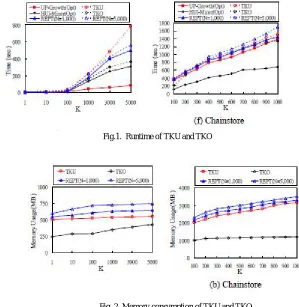
Fig.( 1) and Fig. (2) respectively show the runtime of algorithms and memory usage of the algorithms on Retail and Chainstore. TKO generally uses less memory than TKU , this is because TKU is a two-phase algorithm. When they could not effectively raise the minimum utility thresholds, they may consider too many candidates and local UP-Trees during the mining process, which causes the algorithm to consume much more memory than TKO. Here compares with another algorithm REPT also. The memory consumption of REPT(N=5,000) is higher than that of TKU. This is be-cause REPT maintains not only a global UP-Tree in mem-ory but also a RSD matrix. When there are many promising items and N is set too large for REPT, the RSD matrix could be very large and make REPT uses more memory.
Fig.1. Runtime of TKU and TKO
Fig. 2. Memory consumption of TKU and TKO
REFERENCES
1 R. Aggrawal, " Efficient Algorithms for Mining Association Rules", ‖ in Proc. of Int'l Conf. on Very Large Data Bases, pp. 487-499, 1995. 2 C. Ahmed, S. Tanbeer, B. Jeong , "Efficient Tree Structures for High-utility Pattern Mining in Databases", ‖ IEEE Transactions on Knowledge
and Data Engineering , pp. 1708-1721, 2009.
3 K. Chuang, J. Huang and M. Chan, "Mining Top-K Frequent Patterns primarily in the Presence of the Memory Constraint", ‖ The Journal, Vol. 17, pp. 1321-1344, 2009.
4 R. Chan, Q. Yang and Y. Shan, "Mining High-utility Itemsets", ‖ in Proc. of IEEE Int'l Conf. on Data Mining, pp. 19-26, 2003.
5 P. Fournier-Viger, V. S Tseng, "Mining Top-K Sequential Rules", ‖ in Proc. of Int’l Conf. on Advanced Data Mining and Applications, pp. 180-194, 2011.
6 P. Fournier-Viger, C. Wu, V. S. Tsenge, "Mining Top-K Association Rules", ‖ in Proc. of Int’l Conf. on Canadian conference on Advances in Artificial Intelligence, pp. 61–73, 2013.
7 P. Fournier-Viger, C. Wu, V. S. Tseng, "Novel Concise Representations of High Utility Itemsets Using Generator Patterns", Int’l. Conf. on Advanced Data Mining and Applications and Lecture Notes in Computer Science, Vol. 8933, pp. 30-43, 2014.
8 J. Han, J. Pei and Y. Yin, "Mining Frequent Patterns without Candidate Genera-tion", ‖ in Proc. of ACM SIGMOD Int'l Conf. on Management of Data, pp. 1-12, 2000.
9 J. Han, J. Wang, Y. Lu and P. Tzvetkov," Mining Top-K Frequent Closed Patterns without Minimum Support", ‖ in Proc. of IEEE Int'l Conf. on Data Mining, pp. 211-218, 2002.
10 S. Krishnamoorthy, "Pruning Strategies for Mining High Utility Itemsets", ‖ Expert Systems with Applications, Vol. 42(5), pp. 2371-2381, 2015.
11 C. Lin, T. Hong, G. Lan, J. Wong and W. Lin, "Efficient Updating of Discovered High-utility Itemsets for Transaction Deletion in Dynamic Databases", ‖ Advanced Engineering Informatics, Vol. 29(1), pp. 16-27, 2015.
12 G. Lan, T. Hong, V. S. Tseng and S. Wang, "Applying the Maximum Utility Meassure in High Utility Sequential Pattern Mining", ‖ Expert Systems with Applications, Vol. 41(11), pp. 5071-5081, 2014.
13 Y. Liu, W. Liao, and A. Choudhary, "A Fast High Utility Itemsets Mining Algorithm", ‖ in Proc. of the Utility-Based Data Mining Workshop, pp. 90-99, 2005.
14 M. Liu and J. Qu, "Mining High Utility Itemsets without Candidate Generation", ‖ in Proc. of ACM Int'l Conf. on Information and Knowledge Management, pp. 55-64, 2012.
15 J. Liu, K. Wang and B. Fung, "Direct Discovery of High Utility Itemsets without Candidate Generation", ‖ in Proc. of IEEE Int'l Conf. on Data Mining, pp. 984-989 , 2012.
BIOGRAPHY
Sajitha Vis a P.G Scholar, Dept. of Computer Science and Engineering, Cochin College of Engineering, Kerala, India