CONSUMER BEHAVIOR ON ENERGY EFFICIENT COOLING DEVICES – A CASE STUDY
FARZANEH MOAYEDI
A project report submitted in partial fulfilment of the requirements for the award of the degree of Master of Science (Construction Management)
Faculty of Civil Engineering Universiti Teknologi Malaysia
ACKNOWLEDGEMENT
This acknowledgement is dedicated to the following wonderful individuals who gave me invaluable assistance, guidance and contributions for the completion of this dissertation directly and indirectly.
Overall, the project was the direct result of learning from many of my lecturers. As life was a process of continuous learning and I was blesses with many good and dedicated lecturers whom nurtured the learning culture in my life. I would like to acknowledge a few of the non-academic and academic lecturers who have assisted me wherever I met the obstacles and difficulties in my educational life.
I extend my heartfelt gratitude appreciation to my supervisor, Dr. Khairulzan Yahya who has exhibited tremendous support, encouragement, inspiration, tolerance and guidance, that all in, has tremendously helped me to keep my vision and mission alive, and to pursue the completion of my Masters degree.
The dedication of this dissertation with all my love goes to all my friends and family members for their constant love, care, assurances, psychological and emotional support, patience and understanding.
Last but not least, I would like to thank the management team and residents of Sri Samudera Condominium for being supportive and participative in the survey.
ABSTRACT
ABSTRAK
TABLE OF CONTENT
CHAPTER TITLE PAGES
ACKNOWLEDGEMENT iv
ABSTRACT v
ABSTRAK vi
TABLE OF CONTENT vii
LIST OF TABLES xii
LIST OF FIGURES xiv
LIST OF APPENDICES xvi
1 INTRODUCTION 1
1.1 Background of the Study 1
1.2 Problem Statement 3
1.2.1 Current Environmental Issues 3
1.2.2 Greenhouse Gasses Emissions in Malaysia 4 1.2.3 Buildings and Environmental Impact 4
1.3 Aims & Objectives of Study 5
1.4 Scope of Study 6
1.5 Brief Project Methodology 6
1.6 Report Outline 9
2 LITERATURE REVIEW 10
2.2 Construction Industry and Sustainability: The Malaysian
Perspective 13
2.3 Carbon emission: Worldwide perspective 17
2.4 CO2 emissions by sector 18
2.5 Renewable Energy 22
2.5.1 Energy Efficiency Potential in Buildings 23 2.5.2 The Environment and the Energy Saving Resources 25
2.5.3 Power Companies of Malaysia 26
2.6 Green Building 26
2.6.1 Reducing Environmental Impact 27
2.6.2 Goals and Motives of Green Building 27 2.6.2.1 Building and Structure Design Efficiency 28 2.6.2.2 Indoor Environmental Quality (IEQ)
Enhancement 28
2.6.2.3 Indoor Air Quality 29
2.6.2.4 Thermal Quality 29
2.6.2.5 Lighting Quality 29
2.6.2.6 Operations and Maintenance Optimization 30
2.7 Energy Efficiency (EE) 30
2.7.1 Introduction 30
2.7.2 Benefits of EE 31
2.7.2.1 Lowers energy bills, greater customer control, and greater customer satisfaction 31 2.7.2.2 Achieving fast and significant energy savings 32 2.7.2.3 Delivers Environmental Benefits 32
2.7.3 Delivering EE to Consumer 32
2.7.4 Market Stages for EE 34
2.7.5.1 Customer Profile 36
2.7.5.2 Consumers’ Interest 36
2.7.5.3 Spending Behavior 37
2.7.5.4 Demographic 37
2.7.5.5 Housing Characteristic 37
2.7.5.6 Size and Age 38
2.7.5.7 Building Envelope 38
2.7.5.8 Cooling Practices 38
2.8 Consumer Behavior 39
2.8.1 Household Energy Preservation Behaviors 40
2.8.1.1 Efficiency Behaviors 40
2.8.1.2 Curtailment Behaviors 41
2.8.2 The Green Consumer and the Energy Saving
Behavior 42
3 METHODOLOGY 44
3.1 Introduction 44
3.2 Study Location 46
3.3 Research Design 47
3.4 Survey 47
3.5 Data Collection Strategy 48
3.5.1 Quantitative & Qualitative Methods 50
3.5.2 Questionnaire Survey 50
3.5.3 Structure 50
3.5.4 Rating Scale 51
3.5.5 Pilot test 51
3.5.6 Sampling 51
3.6 Analysis Techniques 52
3.6.2 Cross Tabulation 52
3.6.3 Average Index Analysis 53
3.6.4 Spearman’s Correlation Analysis 53
3.7 Semi-structured Interviews 54
3.8 Research Hypotheses 54
4 ANALYSIS AND RESULT 57
4.1 Residents Demographic 57
4.2 The Features and Characteristics of ACs Installed in the
Units of Sri Samudera Condominium 60
4.3 The Residents’ Behavior of AC Usage 64
4.4 The Residents’ Desire Level of Thermal Comfort and
Preferred Cooling Devices 71
4.5 The Residents Willingness and Affordability to Invest in an
Energy Efficient Cooling Device 74
4.6 The Correlations of Variables 74
4.7 Sample Case 80
4.7.1 Comparison between Conventional AC and Energy
Efficient (EE) AC 80
4.7.2 Comparison of energy usage and emission between conventional AC and Sustainable AC 81 4.7.3 Cash Flow for Energy Consumption of Conventional
ACs & EE ACs 83
4.8 Summary 85
5 CONCLUSION AND RECOMMENDATIONS 86
5.1 Introduction 86
5.2 Section A: Evaluation on the Aim and Objectives of the
Study 86
5.2.1 Aim and Findings 86
5.3 Limitation of Studies 89 5.3.1 Respondents Standings (Selective Perception) 89 5.3.2 The Difference between Respondents’ Intention and
Action 90
5.4 Section B: Recommendations 90
5.4.1 Recommendations to the Marketers and Industry 90
5.4.1.1 Marketers 91
5.4.1.2 Government 91
5.4.2 Recommendations for Future Academic Research 92 5.4.2.1 Conduct the survey at a broader range and area of
coverage. 92
5.4.2.2 Research on energy efficient AC should be carried out at a broader perspective. 93 5.4.2.3 Research to be conducted from the perspective of
partnership between the marketers and government or non-profit organisation 93
5.5 Conclusion 93
REFERENCES 95
LIST OF TABLES
TABLE NO. TITLE PAGE
2.1 Criteria of GBI 15
2.2 Market Stages for EE (Adopted from Energy Efficient:
Principles and Practices, 2009) 34
3.1 An example of a five-point Likert Scale used in the study 51
3.2 The Average Index Assessment Scale 53
4.1 Period of Time (Days) The House is Left Unoccupied
Annually 60
4.2 The number of air-conditioning (AC) equipment owned by the
respondents 61
4.3 The brands of AC used by the residents in Sri Samudera
Condominium 62
4.4 The quantity of Inverter Based AC and Non-inverter Based AC 63 4.5 The duration of AC being switch on during sunny days 65
4.6 The variation of AC usage during rainy day 68
4.7 The change of behaviour on AC usage through the course of
time 68
4.8 The regularity of residents using AC at present, comparing to the previous years (for residents who change their attitude of ac
usage) 69
4.9 The Cooling Devices/ Systems preferred by the residents 73
4.10 Pearson’s Correlation Coefficient 75
4.12 Correlation Between the Usage of AC in Relation to the Floor
Level 76
4.13 Correlation Between the Usage of AC in Relation to the Amount Willing to be Spend on New Energy Efficient (EE)
Cooling Device 77
4.14 Correlation Between Household Income in Relation to the Amount Willing to be Spend on New Energy Efficient (EE)
Cooling Device 78
4.15 Correlation Between Ownership of the House in Relation to the Amount Willing to be Spend on New Energy Efficient (EE)
Cooling Device 79
4.16 Cash flow of Energy Consumption of Conventional AC and
LIST OF FIGURES
FIGURE NO. TITLE PAGE
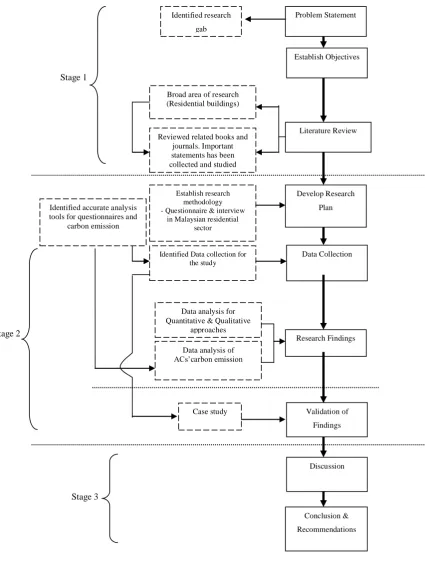
1.1 Flow chart of research Methodology 8
2.1 The Effect of GHGs on Earth 11
2.2 CO2 emission of the world 12
2.3 The main element of Green PASS assessment 16
2.4 Contribution of CO2 among countries 18
2.5 World CO2 emissions by sector in 2010 19
2.6 CO2 emissions from electricity and heat generation* in 2009
and 2010 20
3.1 Case study location (Sri Samudera Condominium) 46
4.1 Residents’ monthly income 57
4.2 The number of residents in the households 59
4.3 The brands of AC used by the residents in Sri Samudera
Condominium 62
4.4 Fracture of AC Unit by Horsepower 63
4.5 The duration of AC being switch on during sunny days in
Living Room 66
4.6 The duration of AC being switch on during sunny days in
Bedroom 1 66
4.7 The duration of AC being switch on during sunny days in
Bedroom 2 67
4.8 The duration of AC being switch on during sunny days in
4.9 The reason(s) respondents use AC less often comparing the
present and the past 69
4.10 The reason(s) respondents use AC more often comparing the
present and the past 70
4.11 ACs’ contribution towards monthly electricity bills 70 4.12 The Cooling Devices/ Systems preferred by the residents 72 4.13 The amount willing to be spent on energy efficient cooling
device by the respondents who are the owners 74 4.14 Summary of Comparison between Conventional and
Sustainable ACs 82
4.15 Cash flow of Energy Consumption of Conventional AC and
Energy Efficient (EE) Cooling Device 84
LIST OF APPENDICES
APPENDIX TITLE PAGE
A Questionnaire Survey Form 105
B C
Calculation of The Energy usage & CO2 Emission Types of Apartments
CHAPTER 1
1 INTRODUCTION
1.1 Background of the Study
As in other industrialized and developing countries around the globe, energy use in residential buildings in Malaysia accounts for significant proportions of total energy-consumption (Wood, Newborough, 2003; Banfi et al. 2006).
According to Environmental Statistics 2010 for Malaysia, the total population for Malaysia is about 27 million by the year 2010. Population is growing at the rate of about 2% annually (Department of statistic and economic planning unit). Obviously, the demand for energy will also be increasing by means of time. Energy is, indeed, needed in almost all aspect of daily life (e.g. agricultural, drinking water, lighting health care, telecommunication, and industrial activities) (Sopian et al. 2005).
According to Banfi et al. 2006, the main elements of identifying the overall energy efficiency of a building are the features of heat insulation of the building envelope and the type of air ventilation systems used.
Wood & Newborough (2003) suggested that to enhance indoor air circulation and quality in order to achieve desire level of thermal comfort, far reaching research and development have to be carried out and proper solutions have to be implemented, for instance, the invention or combination of new technologies, discover of alternative energy source and more importantly, the consumer behaviour and energy efficiency awareness attitude, which is the main topic to be discussed in this paper.
According to Heberlein (1972), environmental attitudes had changed from an economic to a moral orientation in the industrialized societies. The importance of this observation cannot be overrated, although it is usually neglected by economists and political scientists and more importantly by most politicians (Thøgersen 1999). In fact, it is now incontrovertibly that any proportional response to today’s environmental challenges will require profound changes to the way that most people in developed countries choose to live. This will impose widespread and yet far-reaching changes in individual behaviour, fundamental changes in business practice, and the implementation of ambitious new policies and regulations to drive these changes by government (Rowlands et al., 2003; Menges et al., 2004; Thøgersen & Crompton, 2009; Eves & Kippes, 2010). Furthermore, some property developers and marketers have already played their reles in encouraging changes in human behaviour and cultural practices to opt for greener building.
consequences are affecting their daily life negatively. In developed countries such as The United States and United Kingdom, various surveys have been carried out by researchers, e.g. Mintel survey, Green Market Alert and others and results have shown an increasing environmental consciousness has extending to great depth effecting consumer behaviour, which eventually expand the green product market remarkably (Prothero, 1990; Lawrence, 1993).
Bodo B. Schlegelmilch et al. (1996) suggested that one of the ways for property developers and marketers to target and then, position themselves into the arising green market is to segment the market based on the levels of pro-environmental purchase behaviour and then target the “greener” consumer segments. Thus, this paper aims to find out the public awareness of energy usage by looking at the significance of consumer socio-demographic profile and behavioural indicators in segmenting environmental conscious consumers.
1.2 Problem Statement
1.2.1 Current Environmental Issues
1.2.2 Greenhouse Gasses Emissions in Malaysia
Currently, Malaysia still largely depending on the electricity generated from non-renewable source such as coal, petroleum and natural gas (also known as fossil fuels). Carbon footprint becomes a widely used term and concept in the public debate on responsibility and abatement action against the threat of global climate change (Nation Master Statistic 2010). It has had a tremendous increase in public appearance over the last few months and previous years and is now a buzzword widely used across the media, the government and in the business world. Malaysia is ranked 30th in the world for countries that have largest amount of carbon emission. In addition, 24% from the total carbon dioxide comes from the construction industry in the country (Nation Statistics, 2010). In addition, Buildings are responsible for more than one third of total energy use and associated greenhouse gas emissions in society, both in developed and developing countries.
1.2.3 Buildings and Environmental Impact
energy-conscious consumer behaviour are very important and have to be carried out to determine the marketability of green products or green energies.
1.3 Aims & Objectives of Study
As a rule of thumb, those who are able to identify potential consumers of green products and green energy promptly and precisely will be successful in positioning and targeting themselves in this green market and gaining a profitable share from the market. Therefore, the paper aims to understand the level of environmentally conscious consumer behaviour and to profile consumers on the basis of their acceptance and willingness to pay for energy efficient cooling device in relation to the type of air ventilation system that preferred and affordable to the dweller and lastly to propose marketing strategy for energy efficient cooling devices and green electricity market.
The objectives of this study are:
i. To understand the current consumer behaviour towards energy consumption in the selected condominium in Johor Bahru;
ii. To examine the willingness of the residents to switch conventional AC to lower energy consumption cooling device.
iii. To quantify and calculate the carbon emission from the residential cooling devices to measure their environmental impacts.
1.4 Scope of Study
By referring to Wood, Newborough (2003), there are basically three general routes to reduce rates of energy-consumption and carbon emissions in the residential sector as shown below:
i. New housing project should be sustainable by adopting efficient house construction and design which is low energy consumption to minimise cooling loads;
ii. Research and development of low energy consumption electrical appliances; and
iii. Encourage and promote “Environmentally Conscious Consumer Behaviour”.
However, the scope of research in this paper is only focusing on reviewing the second and third statement suggested by Wood, Newborough (2003). In particular, the study will examine the type of cooling system used and preferred by the residents and their behaviour towards environmentally friendly products. Emphasis is given to determine the level of environmentally conscious behaviour and their willingness to go for green products.
The population of respondents is only restricted to the residents in selected Condominiums at Johor Bahru in peninsular Malaysia.
1.5 Brief Project Methodology
sources of information and the ways to collecting and obtaining the data have to be identified. The research methodology of this study can be divided into three stages namely literature review, primary data collection and discussion & recommendation.
Figure 1.1: Flow chart of research Methodology Stage 1 Stage 2 Stage 3 Problem Statement Establish Objectives Literature Review Develop Research Plan Data Collection Research Findings Validation of Findings Identified research gab
Broad area of research (Residential buildings)
Reviewed related books and journals. Important statements has been collected and studied
Establish research methodology - Questionnaire & interview
in Malaysian residential sector
Identified Data collection for the study Identified accurate analysis
tools for questionnaires and carbon emission
Data analysis for Quantitative & Qualitative
approaches
Data analysis of ACs’carbon emission
Case study
Discussion
1.6 Report Outline
This study is divided into 6 chapters. The first chapter would be the introductory chapter of the report which begins with the introduction of the research background, statements of problem, aims, research objectives, scope of research and brief methodology.
Followed by Chapter 2, literature review, this chapter aims to study the findings of previous researches. This chapter will be discussing the consumer behaviour towards energy efficiency electrical appliances, market segmentation, Government’s policy towards green energy and energy efficiency, Types of energy source used in Malaysia and etc.
Chapter three discusses the methodology used throughout the study together with the structure and description of the questionnaire survey. The questionnaire will aim to collect information on the respondents’ attitude and awareness towards energy efficiency electrical appliances, air conditioning systems in particular.
The fourth chapter elaborates on the data collected by survey questionnaires. The fifth chapter evaluates the result of the information collected. SPSS software will be used to determine the reliability of the data gathered.
REFERENCES
Arminda Do Paço, Lília Varejão (2010). Energy Saving and the Contribution of Green Marketing to Behavioural Change
Assael Henry (1987). Consumer Behaviour: Motivation Research (Marketing) Published by Kent Pub. Co. (Boston, Mass.) 3rd Edition
Banerjee, S., Gulas, C. and Iyer, E. (1995). Shades of Green: A Multidimensional Analysis of Environmental Advertising. Journal of Advertising, Vol. 24, Nº2,
1995, Pp. 21-31.
Batley, Colbourne D, Fleming Pd, Urwin P. (2001). Citizen versus Consumer: Challenges in the UK Green Power Market.
Becker, L. J., Seligman, C., Fazio, R. H., & Darley, J. M. (1981). Relating Attitudes to Residential Energy Use. Environment and Behavior
Berkhout, P. H. G., Muskens, J. C., & Velthuijsen, J. W. (2000). Defining the Rebound Effect. Energy Policy, 28(6/7), 425–432.
Black. J. S., Stern. P. C. & Elworth. J. T. (1985). Personal and Contextual Influences on Household Energy Adaptations. Journal of Applied Psychology,
70(1). 3-21.
Bmu. (2008a). Entwicklung Der Erneuerbaren Energien in Deutschland Im Jahre 2007.
Bmu. (2008b). Erfahrungsbericht 2007.
Http://www.Bmu.De/Files/Pdfs/Allgemein/Application/Pdf/Erfahrungsbericht_E eg_2007.Pdf [8 December 2008].
Bodo B. Schlegelmilch et al. (1996). The Link between Green Purchasing Decisions
and Measures of Environmental Consciousness. European Journal of
Marketing,Vol. 30 No. 5, 1996, pp. 35-55.
Booi-Chen Tan, Teck-Chai Lau (2009). Examining Sustainable Consumption Patterns of Young Consumers: Is there a Cause for Concern?
Buchanan, A. H., & Honey, B. G., “Energy and carbon dioxide implications of building construction,” Energy and Buildings, vol. 20, pp. 205-217, 1994.
Charter, M., Peattie, K., Ottman, J. and Polonsky, M. (2002) Marketing and Sustainability, Centre for Business Relationships, Accountability, Sustainability
and Society (Brass) in association with the Centre for Sustainable Design
Chris Eves, Stephan Kippes (2010), Public Awareness of “Green” and “Energy Efficient” Residential Property
Christ S, Bothe D. (2007). Bestimmung Der Zahlungsbereitschaft Für Erneuerbare
Energien Mit Hilfe Der Kontingenten Bewertungsmethode.
Http://Www.Ewi.Uni-Koeln.De/Fi Leadmin/User/Wps/Ewiwp0701.Pdf [8 December 2008].
CIDB (2013, April, 1). CIDB Introduces Green PASS [Online]. Available: http://1bina.my/blog/2012/08/01/cidb-introduces-green-pass
Cleveland. M., Kalamas. M. And Laroche. M., Shades Of Green: Linking Environment Locus of Control and Pro-Environment Behaviours. Journal of
Consumer Marketing, Vol. 24. N° 4. 2005. Pp. 198-212.
Coddington, W. (1993), Environmental Marketing: Positive Strategies for Reaching The Green Consumer.
Convention on Climate Change,” Kuala Lumpur: Ministry of Science, Technology and the Environment, 2007.
D. Chandranayagam. (2010, Feb. 25). Malaysia’s Green Building Index for Tropical Structures [Online]. Available: http://www.csrdigest.com/2010/02/malaysias green-building-index-for-tropical structures/
D’souza, C., Taghian, M., (2005). Green Advertising Effects on Attitude and Choice of Advertising Themes, Asia Pacific Journal of Marketing and Logistics, Vol. 17,
Nº 3.
Dam, Y. And Apeldoorn, P., (1996). Sustainable Marketing, Journal of Macromarketing, Vol. 16, Nº 2, 1996, Pp. 45-56.
Dembkowski, Hanmer-Lloyd (1994). The Environmental Attitude-System Model: A Framework to Guide the Understanding of Environmentally Conscious
Diller H. (2008). Preispolitik (4th Edn). Kohlhammer: Stuttgart.
Ding. “Developing a multicriteria approach for the measurement of sustainable performance,” Building Research &Information, vol. 33(1), pp. 3-16, 2005. Edward Vine (2007). Breaking Down The Silos: The Integration of Energy
Efficiency, Renewable energy, Demand Response and Climate Change. Springer
Link, Energy Efficiency. Vol.
EIB, 2008. Energy Information Bureau (EIB) Malaysia. Online Accessed: http://www.eib.ptm.org.my
Ellerman, D.A., F.J. Convery, C. de Perthuis, E. Alberola, R. Baron, B.K. Buchner, A. Delbosc, C. Hight, F. Matthes and J. Keppler (2010), Pricing Carbon, The European Emissions Trading Scheme, Cambridge University Press, Cambridge.
Emory, C. W. & Cooper, D. R. (1991) Business Research Methods, (4th ed.). Homewood: Irwin.
Energy Commission (Suruhanjaya Tenaga) (2010). Energy Efficiency Programs in Malaysia.
Environmental Statistics for Malaysia(2010) (Data From World Bank, Http://Go.Worldbank.Org/Mdxnk51hb0)
F. Shafii & M.Z. Othman (1999). Sustainable Building in the Malaysian Context. International Conference on Sustainable Building Asia- SB07 Seoul, Korea.
Farhar Bc. (1999). Willingness to Pay for Electricity from Renewable Resources: A Review of Utility Market Research, Nrel/Tp.550.26148. National Renewable
Energy Laboratory: Golden, Co.
Fazio, R. H. (1998). Handbook of Motivation and Cognition: Foundations of Social Behaviour Sorrentino, Richard M.; Higgins, E. Tory. New York: Guilford
Press. 204 – 243
Ferguson Eg. (1999). Renewable Resources and Conservation: What Consumers Want. Bonneville Power Administration: Portland, Or.
Fong,W.K., Matsumoto, H., Lun, Y.F. and Kimura, R. 2007a. System Dynamic Model for the Prediction of Urban Energy Consumption Trends. Proceeding I of the 6th International Conference on Indoor Air Quality, Ventilation & Energy
Conservation in Buildings (IAQVEC 2007), 28-31 October 2007, Sendai, Sendai,
Fransson and Garling (1999) Environmental Concern: Conceptual Definitions, Measurement Methods, and Research Findings. Journal of Environmental
Psychology, Volume 19, Number 4, December 1999 , Pp. 369-382(14) Publisher: Academic Press
G. Wood, M. Newborough. “Dynamic energy-consumption indicators for domestic appliances: environment, behaviour and design”. Journal of Energy and Building, Vol. 35, pp. 821-841, 2003.
Gardner and Stern, (2002). Environmental Problems and Human Behaviour (2nd Ed.). Boston, Ma: Pearson Custom Publishing.
Gärling T., Eek D., Loukopoulos P., Fujii S., Johansson-Stenman O., Kitamura R., Pendyala R. & Vilhelmson B. (2002). A Conceptual Analysis of The Impact of Travel Demand Management on Private Car Use. Transport Policy 9(1): 59-70.
Gatersleben, B., & Vlek, Ch. (1998). Household Consumption, Quality-Oflife and Environmental Impacts: A Psychological Perspective and Empirical Study.
Geller, E. S. (1981). Evaluating Energy Conservation Programs: Is Verbal Report Enough? Journal of Consumer Research, 8, 331–335.
Granzin Kl, Olsen Je. (1991). Characterizing Participants in Activities Protecting The Environment: A Focus on Donating, Recycling, and Conservation
Behaviours. Journal of Public Policy and Marketing 10(2): 1–27.
Greenbuildingindex. GBI. (2009). The GBI Assessment Process [Online]. Available: http://www.greenbuildingindex.org/how-GBI-works.html.
H. Van, "Minerals and Metals: Cement," Dept. Geology., US Government., Washington, D.C, 1999, vol. 1, pp. 16.1-16.13.
Hammond, G. P., Jones C. I. “Inventory of Carbon and Energy,” University of Bath, 2008.
Heberlein (1972). Land Ethic or Golden Rule: Comment on “Land Ethic Realized” Journal of Social Issues Volume 33, Issue 3.
Herrmann A, Huber F, Sivakumar K, Wricke M. (2004). An Empirical Analysis of the Determinants of Price Tolerance. Psychology and Marketing 21: 533–551.
Horská Elena (2010). The Role of In-Store Communication in the Process of
Learning, Memory And Consumer Perception
Http://www.Bmu.De/Erneuerbare_Energien/Downloads/Doc/39830.Php [8 December 2008].
IEA (2012), Energy Technology Perspectives 2012 (ETP 2012), OECD/IEA, Paris. IEA (2012), World Energy Outlook 2012 (WEO 2012), OECD/IEA, Paris.
IGES. 2004. Urban Energy Use and Greenhouse Gas Emission in Asian Mega Cities: Policies for a Sustainable Future. Kanagawa: Institute of Global
Environmental Strategies.
Innovest Strategic Value Advisors [Innovest] (2002). Energy Management & Investor Returns: The Real Estate Sector.
IPCC (2007), Revised 1996 IPCC Guidelines for National Greenhouse Gas Inventories (1996 IPCC Guidelines), IPCC, Bracknell, UK.
IPCC, “Climate Change: The Physical Science Basis, Geneva: Intergovernmental Panel on Climate Change,” 2007.
IPCC. 2001. Climate Change 2001: The Scientific Basis. Geneva: Intergovernmental Panel on Climate Change.
IPCC. 2005. IPCC Special Report on Carbon Dioxide Capture and Storage Climate Change 2007. Geneva:Working Group III of the Intergovernmental Panel on Climate Change.
IPCC. 2007. Climate Change 2007: The Physical Science Basis. Geneva: Intergovernmental Panel on Climate Change.
J. F. Hair, R. P. Bush and D. J. Ortinau, Marketing research : Within a Changing Information Environment, 2nd Edition, Boston London: McGraw- Hill/Irwin, 2003
J. W. Creswell and V. L. Plano Clark, Designing and Conducting Mixed Bergs, "The Effect of Healthy Workplaces on the Well-being and Productivity of
Office Workers," symposium paper, plants-in-buildings.com, Netherlands, pp. 1-12. 2009
John Thøgersen & Tom Crompton (2009). Simple and Painless? The Limitations of Spillover in Environmental Campaigning
John Thøgersen (1999). Spillover Processes in the Development of A Sustainable Consumption Pattern. Journal of Economic Psychology, 20, 53-81.
John Thøgersen (1999). The Ethical Consumer: Moral Norms and Packaging Choice. Journal of Consumer Policy, 22, 439-460.
K. Sopian, M.Y.Othman, B. Yatim, and W.R.W. Daud (2005). Future Directions in Malaysian Environment Friendly Renewable Energy Technologies Research and
Development.
Kilbourne We, Beckmann Sc, Thelen E. (2002). The Role of the Dominant Social Paradigm in Environmental Attitudes: A Multinational Examination. Journal of
Business Research 55: 193–204.
Kilbourne, W., Mcdonagh, P. And Prothero, A., (1997). Sustainable Consumption and The Quality Of Life: A Macromarketing Challenge to the Dominant Social
Paradigm, Journal of Macromarketing, Vol.17, 1997, Pp. 4-15.
Kinnear. T. And Taylor. J. (1973). The Effects of Ecological Concern on Brand Perceptions. Journal of Marketing Research. Vol. 10. Pp. 191-197.
Kotler, P. And Keller, K. (2008). Marketing management, 13th Ed., Prentice Hall. Kuckartz U, Rheingans-Heintze A. (2006). Trends Im Umweltbewusstsein.
Kushler, M., Ph.D., York, D., Ph.D., and Witte, P., M.A. (2005). Examining the Potential for Energy Efficiency to Help Address the Natural Gas Crisis in the
Midwest. Washington, Dc: American Council for an Energy-Efficient Economy
[Aceee].
L. Braganca, R. Mateus, and H. Koukkari, "Building Sustainability Assessment," Journal Sustainability, vol. 2, pp. 2011-2023, 2010.
L. S. Yin, “GBI Forum & GBI [MS1525]” Seminar, 2009. [Online]. Available: http://pamsabah.com/archives/3177.
Laroche M, Bergeron J, Barbaro-Forleo G. (2001). Targeting Consumers who are Willing to Pay More for Environmentally Friendly Products. Journal of Consumer Marketing.
Lawrence, J. (1993). Green Product Sprouting Again: More Focused Efforts Avoid Controversy.
International Conf. on Environmental Research and Technology, Penang,
Malaysia, 2008, pp. 313-317.
Malaysia., 2007. Malaysian Budget 2008. Ministry of Finance, Malaysia. http://www.treasury.gov.my
Mari Martiskainen (2007). Affecting Consumer Behaviour On Energy Demand Memo On The Renewable Energy And Climate Change Package 23 January 2008 Menges R, Schröder C, Traub S. (2004). Erhebung Von Zahlungsbereitschaften Für
Ökostrom. Marketing Zfp 26
Mintu-Wimsatt, A. And Lozada, H., (1996) Sustainable Development and International Business: A Holistic Perspective. New York: The Haworth Press.
Murphy Pe, Kangun N, Locander Wb. (1978). Environmentally Concerned Consumers: Racial Variations. Journal of Marketing 42: 61–66.
My H. Bui (2005). Environmental Marketing: A Model Of Consumer Behaviour. Nadel, S., Shipley, A., and Elliott, R.N. (2004). The Technical, Economic and
Achievable Potential for Energy Efficiency in the U.S.—A Meta-Analysis Of
Recent Studies. Washington, Dc: American Council for an Energy-Efficient
Economy [Aceee].
National Action Plan For Energy Efficiency, 2006
Nation Master Statistic, “Co2 Emission by Country,” October 19, 2012. from Nation Master: http:/www.nationmaster.com
Ninth Malaysia Plan. 2006. Ninth Malaysia Plan 2006-2010. Published By The Economic Planning Unit,
Paco. A., Raposo, M. And Filho. W. (2009). Identifying the Green Consumer: A Segmentation Study. Journal Of Targeting, Measurement & Analysis For Marketing. Vol.17, N° 1. 2009. Pp. 17-26.
Paolo Bertoldi, Rita Werle, (2009). Energy Efficiency in Domestic Appliances and Lighting.
Patermann, C. “The fifth EU framework programme and its consequences for the construction industry,” Building Research & Information, vol. 27(6), pp. 412-418, 1999.
Pickett, G., Kangun, N. And Grove, S. (1995) An Examination of the Conservative Consumer: Implications for Public Formation Policy in Promoting
Conservation Behaviour.
Polonsky, M. And Mintu-Wimsatt, A. (1995). Environmental Marketing: Strategies, Practice, Theory and Research, New York: The Haworth Press, 1995.
Prime Minister's Department, Putrajaya, Malaysia. http://www.epu.jpm.my
Prothero, A. (1990). Green Consumerism and the Societal Marketing Concept: Marketing Strategies for the 1990s, Journal of Marketing Management, Vol. 6
No. 2, Pp. 87-103.
Pushkar, S., Becker, R., & Katz, A. (2005). A Methodology for Design of Environmentally Optimal Buildings by Variable Grouping. Building and
Environment, 40. Doi:10.1016/J.Buildenv.
Roe B, Teisl Mf, Levy A, Russell M. (2001). US Consumers’ Willingness to Pay for Green Electricity. Energy Policy 29: 917–925.
Roskos-Ewoldsen, D. R., & Fazio, R. H. (1992). On the Orienting Value of Attitudes: Attitude Accessibility as a Determinant of an Object's Attraction of
Visual Attention. Journal of Personality and Social Psychology, 63, 198-211.
Rowlands Ih, Parker P, Scott D. (2000). Ready to Go Green? The Prospects for Premium-Priced Green Electricity in Waterloo Region, Ontario. Environments
28(3): 97–119.
Rowlands Ih, Parker P, Scott D. (2002). Consumer Perceptions of ‘Green Power. Journal of Consumer Marketing
Rowlands Ih, Parker P, Scott D. 2003. Consumers and Green Electricity: Profiling Potential Purchasers. Business Strategy and the Environment 12.
Sabarinah, S.H., Ahmad. Thermal Comfort and Building Performance of Naturally Ventilated Apartment Building in the Kelang valley: A Simulation Study. Proceedings of the Energy in buildings (sustainable symbiosis) Seminar, 2006, pp. 115-132.
See Kok Fong, Nik Hashim Mustapha, Kee Diang Sin (2005). Efficiency Change In Malaysian Electricity Generation Industry
Schmitt, N. W. & Klimoski, R. J. (1991). Research methods in human resources management, Ohio: South-Western Publishing.
Shen, L. Y., Wu, Y. Z., Chan, E. H. W., & Hao, J. L. “Application of system dynamics for assessment of sustainable performance of construction projects,” Journal of Zhejiang University SCIENCE, vol. 6A(4), pp. 339-349, 2005
Sheth, J. and Parvatiyar, A. (1995). Ecological Imperatives and the Role of Marketing. New York: The Haworth Press.
Siero, F. W., Bakker, A. B., Dekker, G. B., & Van Den Burg, M. T. C. (1996). Changing Organizational Energy Consumption Behaviour through Comparative
Feedback. Journal of Environmental Psychology, 16, 235–246.
Silvia Banfi A, Mehdi Farsi A, Massimo Filippini A,B, Martin Jakob (2006). Willingness to Pay For Energy-Saving Measures in Residential Buildings.
Published By Elsevier B.V.
Simmons Market Research Bureau. (1991). Study of Media and Markets. Syndicated Division Of Simmons: New York.
Staats, H. J., Wit, A. P., & Midden, C. Y. H. (1996). Communicating the Greenhouse Effect to the Public: Evaluation of a Mass Media Campaign from a
Social Dilemma Perspective. Journal of Environmental Management, 45, 189– 203.
Stern Pc, Dietz T, Guagnano Ga. (1995). The New Ecological Paradigm in Social-Psychological Context. Environment and Behaviour 27(6): 723-743.
Stern, P. C, T. Dietz. V. W. Ruttan, R. H. Socolow and J. L. Sweeney (Eds.). (1997a). Environmentally Significant Consumption: Research Directions. Washington, D.C: National Academy Press.
Straughan Rd, Roberts Ja. (1999). Environmental Segmentation Alternatives: a Look at Green Consumer Behaviour in the New Millennium. Journal of Consumer
Marketing 16(6): 558–575.
TCPA, “Town and Country Planning Association Building sustainability: How to plan and construct new housing for 21st century,” TCPA, London, UK. 2003. The Centre for Design at RMIT, (2004). ‘Environmentally Conscious Home Buyers’
Who Are They And What Do They Want?
Torsten J. Gerpott, Ilaha Mahmudova, (2010). Determinants of Green Electricity Adoption among Residential Customers in Germany.
U.S. Environmental Protection agency (USEPA), 2010. Climate Change. Available at: http://www.epa.gov/climatechange/index.html.
Ugwu, Haupt, T. C. “Key performance indicators and assessment methods for infrastructure sustainability in South African construction industry perspective, “Building and Environment, vol. 42(2), pp. 665-680, 2007.
United Nations, “Malaysia Initial National Communication: United Nations Framework
United Nations, “United Nations Division for Sustainable Development,” Retrieved 7 October, 2011, from Sustainable Development Issues:
Van Houwelingen, J. H., & Van Raaij, F. W. (1989). The Effect of Goalsetting and Daily Electronic Feedback on In-Home Energy Use. Journal of Consumer
Research, 16, 98–105.
Wayne D. Hoyer, Deborah J. Macinnis, (2006). Consumer Behaviour. WBDG Sustainable Committee (2009).
Wokje Abrahamse, Linda Steg, Charles Vlek, Talib Rothengatter, (2005). A Review of Intervention Studies Aimed at Household Energy Conservation Elsevier Ltd.
Journal Of Environmental Psychology 25.
World Bank (2012), State and Trends of the Carbon Market 2012, World Bank, Washington.
World Commission on Environment and Development, “What is sustainable development?,” Brundtland Report, pp. 43, 1987. [Online]. Available:
http://www.3mfuture.com/sustainability/definition_sustainable_development.ht m
Y. Sanchez, "Strategic & Standardization CMGT-564 : U.S. Green Building & Standards 189" Catholic University of America, Washington, DC, Aug. 2008, pp. 6.
Yam-Tang. E. And Chan. R. (1998). Purchasing Behaviours and Perceptions of Environmentally Harmful Products. Marketing Intelligence and Planning. Vol. 16. N° 6. 1998, Pp. 356-362.
Yan H., Shen Q., Fan L C.H., Wang Y., Zhang L. “Green Gas Emission in Building Constrction: A case study of one Peking in Hong Kong” Building and Environment, vol. 45, pp. 1-7, 2010.