EVALUATION OF BOND STRENGTH BETWEEN HOT MIX ASPHALT AND STONE MASTIC ASPHALT SURFACING LAYERS
VRIDA INGRID VELIAN
A project report submitted in partial fulfillment of the requirement for the award of the degree of
Master of Engineering (Civil-Highway and Transportation)
Faculty of Civil Engineering Universiti Teknologi Malaysia
iii
iv
ACKNOWLEDGEMENT
Firstly, I would like to praise the almighty God for giving me the strength and energy to complete this report.
At the same time, I would like to express my sincere appreciation to my supervisor, Dr Haryati Yaacob for the patience, encouragement, advices and guidance to me. I would also like to thanks to all my friends for their support and help.
v
ABSTRACT
vi
ABSTRAK
vii
TABLE OF CONTENT
CHAPTER TITLE PAGE
DECLARATION ii
DEDICATION iii
ACKNOWLEDGEMENTS iv
ABSTRACT v
ABSTRAK vi
TABLE OF CONTENTS vii
LIST OF TABLES x
LIST OF FIGURES xiv
CHAPTER 1 INTRODUCTION 1.1 Introduction 1 1.2 Problem Statement 2 1.3 Objective 3 1.4 Scope of Study 3
1.5 Significance of the Study 4
CHAPTER 2 LITERATURE REVIEW
2.1 Introduction 5
viii
2.3 Factor Affecting the Interface Shear Strength of 7
Pavement Layers 2.3.1 Tack Coat Types 7
2.3.2 Tack Coat Application Rate 10
2.3.3 Surface Condition 11
2.3.4 Curing Time of Asphalt Emulsion 13
2.3.5 Thickness of Layers 15
2.3.6 Pavement Types 15
2.3.7 Temperature 16
2.4 Technology, Workmanship and Construction 18
Quality 2.5 Types of Tack Coat Failure 20
2.5.1 Inadequate Bond Strength 21
2.5.2 Delamination Failure 22
2.5.3 Slippage Failure 22
2.6 Shearing Testing Devices 23
2.6.1 Direct Shear Test Devices 24
2.6.1.1 Leutner Device 24
2.6.1.2 NCAT Device 25
2.6.1.3 LCB Device 25
2.6.2 Simple Shear Test Devices 26
2.6.2.1 ASTRA Device 27
2.6.2.2 Shear Box Device 27
2.6.2.3 Superpave Shear Test Device 28
2.7 Stone Mastic Asphalt 29
2.8 SMA Composition 31
CHAPTER 3 METHODOLOGY 3.1 Introduction 32
3.2 Operational Framework 33
ix
3.3.1 Aggregate 34
3.3.2 Aggregate Gradation 34
3.3.3 Tack Coat 37
3.3.4 Bitumen 37
3.4 Mixture Design 38
3.5 Sample Preparation 38
3.5.1 Preparation of Binder Course 39
3.5.2 Application of Tack Coat 40
3.5.3 Preparation of Wearing Course 42
3.5.4 Compact Specimen 42
3.5.5 Condition Specimen 44
3.6 Shear Test 45
CHAPTER 4 RESULTS AND DISCUSSIONS 4.1 Introduction 48
4.2 Result and Analysis 49
4.2.1 Interface Shear Strength Results 49
4.2.2 Influence of Tack Coat Types and Wearing 51
Course on Interface Shear Strength for Different Application Rate 4.2.3 Influence of Tack Coat Types and 53
Application Rate on Interface Shear Strength for Different Application Rate CHAPTER 5 CONCLUSIONS & RECOMMENDATIONS 5.1 Introduction 56
5.2 Conclusions 57
x
xi
LIST OF TABLES
TABLE NO TITLE PAGE
3.1
3.2 3.3
Amount of aggregate needed for SMA at respective thickness
Gradation limit for AC 28 Gradation limit for SMA 14
34
35 36
3.4 Tack coat types and application rates 37
3.5 3.6 3.7
Designed OBC for SMA
Marshall results and specification of SMA Test factorial design
3.8 38 39 3.8 Number of compaction blows on the effect of thickness
and degree of compaction for SMA
43
4.1 4.2 4.3
Interface shear strength of SMA 14 for RS-1K Interface shear strength of SMA 14 for RS-2K Interface shear strength of SMA 14 for RS-2KL
xiv
LIST OF FIGURES
FIGURE NO TITLE PAGE
1.1
2.1
2.2
Slippage failure due to poor bonding between HMA layers
Possible modes of pavement interface failure during service life
Emulsified Asphalt
3
6
8
2.3 Power Broom 13
2.4 Wirtgen milling machine 13
2.5 2.6
Combination of different mix types
Illustration of asphalt molecules t lower and higher temperature
16 17
2.7 Application of tack coat using asphalt distributor truck performing
19
2.8 Application of tack coat using hand wand sprayer 19
2.9 Excessive tack coat application 20
2.10 Non-uniform tack coat application 21
2.11 Delamination failure 22
xiv
2.13 Leutner Shear Strength Test 24
2.14 2.15 2.16 2.17 2.18 2.19 2.20 2.21 3.1 3.2 3.3 3.4 3.5 3.6
Schematic of the NCAT shear testing device Illustration of LCB Shear Test
Ancona Shear Testing Research and Analysis Illustration of shear box device
Shear box inside SST sample
Comparison between SMA and conventional HMA SMA aggregates skeleton
Major components of SMA mixture
Flow chart of laboratory process and analysis Gradation limit for AC 28
Gradation limit for SMA 14
Binder course layer and left for cooling process at room temperature
Tack coat application Curing process 25 26 27 28 29 30 30 31 33 35 36 40 40 40 3.7 Wearing course layer was prepared and ready for 42
Compaction
3.8 Relationship of compaction blow and density for 43 SMA 14 specimen of different thickness
3.9 Marshall Hammer Compactor 44
3.10 Completed specimen and ready to be tested 44 3.11 Typical specimen interface response under the 46
influence of shear load
3.12 Shear box 47
3.13 Installing a ring to accommodate the double 47 layered specimen
3.13 Sample condition after testing process 48
4.1 Mean interface shear strength against application 52 rate for three different thickness for RS-1K
4.2 Mean interface shear strength against application 52 rate for three different thickness for RS-2K
xv
4.4 Mean interface shear strength against application rate 54 for three different thickness for RS-1K
4.5 Mean interface shear strength against application rate 55 for three different thickness for RS-2K
CHAPTER 1
INTRODUCTION
1.1 Introduction
Asphalt pavement plays an important role in order to ensure that the pavement distribute the traffic loadings to the base course. Asphalt pavement consists of several layers and it is depends greatly on the mechanical properties of each layers as well as the bonding between the pavement interlayers to perform better during its service life.
Besides that, pavement surface course consists of wearing course and binder course, which is the crucial part during construction to provide good bonding between the pavement layers in order to maintain the structural integrity of pavement. Therefore, the most important variable which influences the bond between the pavement layers is a tack coat.
2
Asphalt emulsion is the most common used of tack coat followed by the paving grade and cutback asphalt. However, the use of cutback asphalt as tack coat has significantly decline due to the environmental concern related to the volatile components. Thus, asphalt emulsion is the most favored use as tack coat due to the simplicity of being capable to be applied at lower temperature and relatively pollution free.
1.2 Problem Statement
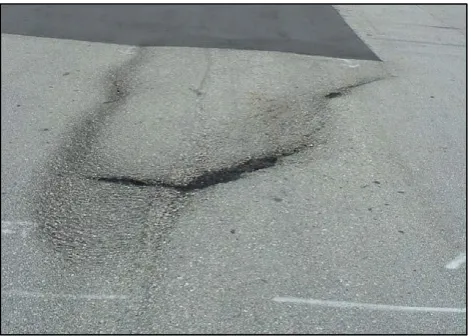
The influence of surface characteristics on the bonding properties at the interlayer is important to understand better how multilayered pavements behave under traffic conditions. Nowadays, problem related to the pavement surface due to the poor bonding no longer new issues. Poor bonding between asphalt layers cause many distresses, and the most typical problem is the slippage failure. This failure usually occurs when there are exists insufficient bond between the interfaces of the two layers in contact as shown on Figure 1.1. Normally, slippage cracking occurs at location where there is a sharp curves and busy junction where the vehicle accelerates and decelerates continuously. However, this problem was also results from where vehicle is likely to exert high horizontal force.
3
Figure 1.1: Slippage failure due to poor bonding between HMA layers (West et al, 2005)
1.3 Objective of the Study
The specific objective of this research was to evaluate the influence of tack coat types, application rates, and layer thickness on the interface bond strength between hot mix asphalt and stone mastic asphalt.
1.4 Scope of Study
4
each test. Direct shear test was conducted at shearing rate 1 mm/min and shearing platens 5 mm gap.
1.5 Significance of the Study
REFERENCES
Abraham B, Louay, N.M, Elseifi M.A, Buttton, J. and Patel N. (2010). “Effects of Temperature on Interface Shear Strength of Emulsified Tack Coats and Its Relationship to Rheological Properties.” Journal of Transportation Research board No. 2180, pp 102-109.
Ahmad b Ramly. (2002). “Prinsip Dan Praktis Pengurusan Penyenggaraan Bangunan.” Kuala Lumpur: Pustaka Ilmi, Percetakan Putrajaya Sdn. Bhd. (in Malay Language)
ASTM D8-02 (2004). “Standard Terminology Relating to Materials for Roads and Pavements, Annual Book of ASTM Standard”, Vol. 04.03.
Bernd Schneider. Stone Mastic Asphalt. Regional Export Manager, Road Construction Division, J.Rettenmaier & Sohne, Germany.
Buchanan, M.S., & Woods. M.E. (2004). Field Tack Coat Evaluator (ATACKerTM).
Chaignon, F. and J.C. Roffe. (2001). “Characterization Tests on Bond Coats: Worldwide Study, Impact, Tests, Recommendations.” Canadian Technical Asphalt Association, Canada
Construction of Hot Mix Asphalt Pavements. Manual Series No. 22 (MS-22), Second Edition, The Asphalt Institute, Lexington, KY.
Cross, S.A. and Shrestha, P.P., (2005), “Guidelines for Using Prime and Tack Coats.” Federal Highway Administration Report, FHWA-CFL/TD-05-002.
Chang, F.L., H. Yaacob, M.R. Hainin, and Putra R. (2013). “Curing Time of Malaysian Asphalt Emulsified Tack Coat.” Unpublished raw data.
Chen J.S, and Huang, C.C. (2010). “Effect of Surface Characteristic on Bonding Properties of Bituminous Tack Coat.” Journal of the Transportation Research Board No. 2180, pp 142-149.
Hachiya, Y. and Sato, K. (1997). “Effect of Tack Coat in Bonding Characteristic at Interface between Asphalt Concrete Layers.” Proceeding of 8th
International Conference on Asphalt Pavements, Vol. I, pp 349-362.
H. Yaacob, M.R. Hainin, A. Safuan and Fung-Lung Chang. (2013). Construction of hot mix asphalt surfacing layers: Information for the Malaysian Asphalt Industry towards Better Bonding. Manuscript submitted for publication.
H. Yaacob, M.R.Hainin and Fung-Lung Chang. (2013). Single face compaction on
laboratory marshall specimen towards satisfactory degree of compaction and thickness. Manuscript submitted for publication
“Hot-Mix Asphalt Paving Handbook,” (2000) AC 150/5370-14A, USACE.
60
JKR. (2008). Section 4: Flexible Pavement Standard Specification for Road Works: Jabatan Kerja Raya.
Lavin, Patrick G. (2003). “Asphalt Pavements”. Spon Press, New York, NY.
Liu Si Hong. (2009).“Application of in situ direct shear device to shear strength measurement of rockfill materials.” Water Science and Engineering, 2(3): 48-57
Louay N.M, Elseifi M.A, Bae A. and Patel N, (2012), “Optimization of Tack Coat for HMA Placement”, Transportation Research Board.
Low, S. P. (1993). The rationalization of quality in the construction industry: Some empirical findings. Construction Management and Economics, 11(4): p. 247-259
Miro, R.R., Perez-Jimenez., Martinez A. (2003). “Assessing heat-adhesive emulsions for tack coats” 6th
RILEM Symposium PTEBM’03, Zurich, pp 550-556.
Mohammad, L.N., Raqib, M.A., and Huang, B. (2002). “Influence of Asphalt Tack Materials on Interface Shear Strength.” Transportation Research Record: Journal of the Transportation Research Record, No1789, pp 56-65.
Mohammad, L.N., Wu Zhong, Raqib M.A. (2005). “Investigation of the Behaviour of Asphalt Tack Interface Layer”. Louisiana Transportation Research Center, L.A.
OHIO. (2001). “Proper tack coat application,” Technical Bulletin by Flexible Pavements of OHIO.
61
Partl M.N., Canestrari F., FerrottI G., and Santagata E. (2005). “Advanced Testing and Characterization Interlayer Shear Resistance”. Journal of the
Transportation Research Board No.1929, pp 69-78.
Partl, M. N., & Raab, C. (1999). Shear adhesion between top layers of fresh asphalt pavements in Switzerland Paper presented at the 7th Conference on Asphalt Pavements for Southern Africa.
Patel, N. 2010. Factors affecting the interface shear strength of pavement layers. Master’s Thesis in Civil & Environmental Engineering, Louisiana State University.
Raab, C. and Partl,M. (2004). “Interlayer Shear Performance: Experience with Different Pavement Structure.” 3rd
Eurasphalt & Eurobitumen Congress, Vienna.
Raab Christiane. (2010).“Development of a Framework for Standardisation of Interlayer Bond of Asphalt Pavements.” Department of Civil and Environmental Engineering, Carleton University.
Roberts F.L, Kandhal P.S, and Brown E.R, (1996), “Hot Mix Asphalt Materials, Mixture Design and Construction”, NAPA Research and Education Foundation, Maryland
Sanders, P.J.,Brown, S.F., Thom N.H. (1999). “Reinforced Asphalt for Crack and Rut Control.” 7th
Conference on Asphalt Pavements for Southern Africa, pp 847-855.
Sangiorgi C.,Collop, A.C., and Thon, N.H. (2002). “Laboratory Assessment of Bond Condition using the Leutner Shear Test.” Proceeding of 3rd International Conference on Bituminous Mixtures and Pavement, pp 315-324, Greece.
62
Satterfield, Z. 2005. Quality Control in Construction Projects. Tech Brief, National Environmental Services Center.
Sholar, G. A., Page, G. C., Musselman, J. A., Upshaw, P. B., & Moseley, H. L. (2003). “Preliminary Investigation of a Test Method to Evaluate Bond Strength of Bituminous Tack Coats”. Journal of the Association of Asphalt Paving Technologists, 73, 23-52.
Sholar, G., Page, G., Musselman, J., Upshaw, P., and Moseley H. (2004). “Preliminary investigation of a test method to evaluate bond strength of bituminous tack coats.” Electron. Journal of the Association of Asphalt Paving Technologists, 73, 771-801.
Stephen R. Thomas, Richard L. Tucker, William R. Kelly.1998. Critical communications variables, Journal of Construction Engineering and Management. 124(1): p. 58-66.
Sutradhar Bidyut Bikash (2012). “Evaluation of Bond between Bituminous Pavement Layers.” Department of Civil Engineering, Rourkela.
Tashman Laith, Nam Kitae, and Papagiannakis Tom. (2006). “Evaluation of the Influence of Tack Coat Construction Factors on the Bond Strength between Pavement Layers.” Washington State Department of Transportation.
Tashman, L., Nam, K., Papagiannakis, T., Willoughby, K., Pierce, L., & Baker, T. (2008). “Evaluation of Construction Practices That Influence the Bond Strength at the Interface between Pavement Layers”. Journal of Performance of Constructed Facilities, 22(3), 154-161
Unified Facilities Guide Specification (UFGS). (2008). “Unified Facilities Guide Specifications”. U.S. Army Corps on Engineering.
63
Uzan, J., Livneh, M., Eshed, Y. (1978). “Investigation of Adhesion Properties between Asphaltic Concrete Layers.” Journal of the Association of Asphalt Paving Techinologists, Vol. 47, pp 495-521.