ISSN(Online): 2320-9801
ISSN (Print): 2320-9798
International Journal of Innovative Research in Computer
and Communication Engineering
(An ISO 3297: 2007 Certified Organization) Vol. 4, Issue 11, November 2016
Examine Effective Bug Triage with Software
Data Reduction Techniques
Jam Jam Satyanarayana
M.Tech, Dept. of Computer Science and System Engineering with a Specialization in Bioinformatics, Andhra University(Autonomous), Visakhapatnam, Andhra Pradesh, India
ABSTRACT:In this paper, we deal with the software bugs where large software company spent lot many of their cost
in the same. The step of fixing the bug is called as bug triage where we correctly assign a developer to a new bug. Here, we address the problem of data reduction for bug triage. The problem of data reduction deal with how to reduce the scale and improve the quality. Hence, we combine instance selection with feature selection both simultaneously to reduce bug dimension and word dimension. We also extract the historical bug data set and predictive model to build new data set. This work provides leveraging techniques on data processing for high quality bug data in the software development.
KEYWORDS-bug triage, bug repositories, bug data reduction, feature selection, instanceselection
I. INTRODUCTION
In current world, software companies maintains a large-scale databases for storing the output of the software project, e.g., source code, bugs, emails, and specifications. Conventional software analysis is not fully suitable for the large-scale and complex data in bug repositories. Hence, Data mining has a promising means to handle bugs. Mining repositories can uncover interesting information in software repositories and solve the real world software problems. A bug repository has a collection of bug repots that plays an important role in managing bugs. Software bugs are always happening and clearing bugs is costly in software development. Huge software projects maintain bug repositories to collect the information and to help developers to handle the bugs. A bug repository maintains a bug report, which records the description the bug and the updates about the status of bug that has to be fixed. A bug repository contains several types of bugs such as fault prediction, bug localization, and reopened bug analysis.
II. LITERATURE SURVEY
Literature survey is the most important step in software development process. Before developing the tool it is necessary to determine the time factor, economy and company strength. Once these things are satisfied, then next steps are to determine which operating system and language can be used for developing the tool. Once the programmers start building the tool the programmers need lot of external support. This support can be obtained from senior programmers, from book or from websites. Before building the system the above consideration are taken into account for developing the proposed system.
III. METHODS AND MATERIAL
A. EXISTING WORK
ISSN(Online): 2320-9801
ISSN (Print): 2320-9798
International Journal of Innovative Research in Computer
and Communication Engineering
(An ISO 3297: 2007 Certified Organization) Vol. 4, Issue 11, November 2016
further techniques e.g., a tossing graph approach and a collaborative filtering approach. However, the techniques of automatic bug triage are blocked in bug repositories which are low in quality. As data are a kind of simple text data, the well-processed bug data has to be generated to facilitate the application.
B. PROPOSED SCHEME
In proposed system, the problem of data reduction for bug triage is addressed, i.e., how the bug data is reduced to bring down the labor cost of developers and the quality is improved to facilitate the process of bug triage. Data is reduced by removing bug reports and words, which are redundant or non-informative. Bug triage aims to build an efficient set of bug data .In our work, the bug dimension and the word dimension are reduced simultaneously by combining the techniques instance selection and feature selection. Thus the reduced bug data has lesser number of
bug reports and lesser number of words than the original bug data. Although data is reduced it provides similar information as it is in the original bug data. The results of four instance selection algorithms and four feature selection algorithms are examined to avoid the bias of a single algorithm .when an instance selection algorithm and a feature selection algorithm is given, the order of applying these two algorithms may affect the results of bug triage.
In the proposed paper, predictive model is used to determine the order of applying instance selection and feature selection. From the experiments conducted over bug repots, it is identified that applying instance selection technique to the data set can reduce relevant subset of bug reports but the accuracy of bug triage may be decreased; applying the feature selection technique can reduce subset of relevant words in the bug data and the accuracy can be increased. Hence it is found that combining both these techniques can increase the accuracy, as well as reduce bug reports and words.
Contributions of this paper are as follows:
a) To simultaneously reduce the scales of the bug dimension and the word dimension b) To improve the accuracy of bug triage.
c) Combination approach is proposed to address the problem of data reduction. That is application of instance selection and feature selection in bug repositories.
d) A binary classifier is built to predict the order of applying instance selection and feature selection.
ISSN(Online): 2320-9801
ISSN (Print): 2320-9798
International Journal of Innovative Research in Computer
and Communication Engineering
(An ISO 3297: 2007 Certified Organization) Vol. 4, Issue 11, November 2016
C. BACKGROUND AND MOTIVATION BUG TRIAGE
A bug tiage is a formal process where each bug is priotitized based on its severity, frequency, risk and etc. The bugs are sorted based on the priority. Bugs with high priority will be fixed first. Low priority bugs will be fixed later. To achieve better balance working, important bugs are prioritized first. Three ways of differentiating bugs:
a) bug which is fixed.
b) bug which is fixed later and c) bug which is not fixed.
A bug triage meeting for developers is held regularly for discussing about project life cycle. The Quality Assurance lead calls these meetings. The number of occurrences of meeting will vary from project to project, based on current status of project.
Motivation
Real-world data consists of noisy and redundant data which leads to increase in the cost factors of data processing. In the bug repository, all the bug reports are filled by developers in normal language. The bugs which are low in quality are collected in the bug repositories with the growth in scale. Such data which are inefficient may worsen the accuracy of fixing bugs.
ISSN(Online): 2320-9801
ISSN (Print): 2320-9798
International Journal of Innovative Research in Computer
and Communication Engineering
(An ISO 3297: 2007 Certified Organization) Vol. 4, Issue 11, November 2016
IV. RESULT AND DISCUSSION
A. EXPERIMENTAL WORK Data preparation
Data preparation means manipulating data into a form suitable for further analysis. Data preparation is the process of collecting, cleaning, and consolidating data. It is a process of pre-processing data.
Here, we present the data preparation for applying the bug data reduction. Bug triage predicts developers to fix bugs. The unfixed bugs are assigned to a developer to fix it. In bug repositories, some registered developers may have fixed very less number of bugs. Such in active developers who fixed less than 10 bugs are removed. Applying Instance Selection and Feature Selection.
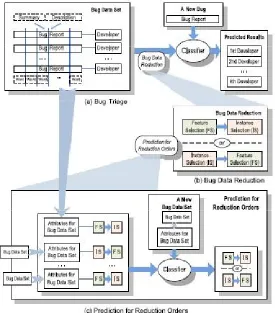
In our work, we combine instance selection and feature selection to perform data reduction with more accuracy. The original data set is replaced with the reduced data set for bug triage. Instance selection and feature selection are widely used techniques in data processing. Instance selection is to obtain a subset of relevant instances (i.e., bug reports in bug data) while feature selection is to obtain a subset of relevant features (i.e., words in bug data). Instance selection technique reduces the number of instances by removing noisy and redundant instances. An instance selection algorithm can provide a reduced data set by removing relevant instances. Feature selection is a pre-processing technique for reducing relevant features for big scale data sets. When an instance selection algorithm IS and a feature selection algorithm FS is given, the order of applying has to be predicted. We use FS->IS to denote the bug data reduction, which first applies FS and then IS, and in IS->FS first applies IS and then FS.
B. BENEFITS OF DATA REDUCTION Reducing the Data Scale
Bug dimension: Bug triage is to assign developers for bug fixing. Developers can examine history of fixed bugs to find a solution to the current bug report. If the bug is already fixed then it can be replaced. The labor cost of developers can be saved by fixing bugs from history using instance selection, instead fixing in their own manually. The reduced data set can be handled more easily by automatic techniques (e.g., bug triage approaches) than the original data set.
Improving the Accuracy
Bug dimension: Instance selection can remove uninformative bug reports, while the accuracy may be decreased by removing bug reports. Word dimension: feature selection removes uninformative words, but the accuracy of bug triage is improved. This can recover the accuracy loss by instance selection.
V. CONCLUSION
ISSN(Online): 2320-9801
ISSN (Print): 2320-9798
International Journal of Innovative Research in Computer
and Communication Engineering
(An ISO 3297: 2007 Certified Organization) Vol. 4, Issue 11, November 2016
the correct project to the correct developer .The developer fixes less than 10 bugs will be removed by the Quality analyst (QA) during the bug triage process meet.
A SurveON
TABLE I. COMPARISON OF VARIOUS BUG TRIAGING TECHNIQUES
S. Title Year Techniques used Pros Cons Analysis
N. for Bug Triage
1 Automatic bug 2004 Naïve Bayes The bug can be The two problems with In order to improve the triage using text Classifier automatically assign to the this approach is approach for handling bug
categorization potential developer for sometime the developer triage is that on
evaluating all the bug report who fix the bug is not should involve the project’s carefully which saves the one to whom it was developer too.
resources used in bug triage officially assigned, We should add on factors that or bug assigning task. second the algorithmwould even deal with
does not proved to be as unlabeled document in corpus.
efficient as it was
thought to be.
2 Who should fixed 2006 SVM, Naïve Bayes A. It has provided help The processes only In order to analyzed that the
bug Classifier triager to assigning bugs work on Eclipse, improvement of the bug
more efficient. Firefox, and gcc; it does assignment process and it is B. If company has little not work on other found that gcc project is far knowledge then new triager projects. worse than eclipse and firefox
can work on it. projects.
3 Modeling Bug 2007 Bugzilla A. It is provide to reducing This process only work The reporter should be
Report Quality overall software on two projects i.e., provided with
maintenance cost. Mozilla and Firefox. Complete guidelines on
B. Usage of this what all information,
model leads to attachment they should
better Precision and recall provide along with the
result. bug report.
4 Information 2010 Card sorting In this paper, interaction The drawback is that, It is analyzed that, it show the Needs in Bug technique between developer and user the result is only information status of bug Reports: are necessary for fixing the applicable for eclipse report that means if any
Improving bug in time. and Mozilla and might information is
Cooperation not be other projects. missing to filled by user then it
Between will show a “pending status”
Developers and and will keep on notifying the
Users reporter about it.
5 Towards Training 2011 feature selection Reduce the large scale of The disadvantage is that We analyzed that, to reduce Set Reduction for algorithm Χ 2 -test training set and decreases the combination istraining set by using Bug Triage (CHI), instance the noisy and redundant data limited for eachcombination of instance selection in bug triage. algorithms selection and feature selection
algorithm, Iterative algorithm.
Case Filter (ICF)
6 Efficient Bug 2013 Naïve Bayes Automatic assign bug to the Cost increases due to It predicts an experienced Triaging Using Classifier, five potential developer. the overloaded workdeveloper to fix a new reported
Text Mining selection methods distribution using Naïve bug and redistribute the load of
areLOR,X2, Bayes algorithm. overloaded developer. And
TFRF, MI, DFS also analysed x2 selection
mehod is more effective than other for bug assignment.
7 An Approach to 2014 N-gram Features, The technique has provided This technique isWe
analyzed Detecting Cluster Chrinkage to improve the Detecting applicable for onlyhere,improvement of Duplicate Bug Technique Duplicate Bug performance. AgroUML, Apache and classification power for
Reports using N- SVN and might notduplication detection by
ISSN(Online): 2320-9801
ISSN (Print): 2320-9798
International Journal of Innovative Research in Computer
and Communication Engineering
(An ISO 3297: 2007 Certified Organization) Vol. 4, Issue 11, November 2016
and Cluster and Firefox problem occurs due to N-gram
Chrinkage Features is reduced by the
Technique Cluster Chrinkage
8 Bug Triaging: 2015 Domain Mapping Rather than using historical The drawback is onlyIt is analyzed that, To Profile Oriented Matrix (DMM) bug report it uses domain chroming bug repository recommend the most suitable
Developer mapping matrix for expertise is used. developer list for new bug
Recommendation profile of developer reports.
maintenance.
REFERENCES
J. Anvik, L. Hiew, and G. C. Murphy, “Who should fix this bug?” in Proc. 28th Int. Conf. Softw. Eng., May 2006, pp. 361–370.
2. S. Artzi, A. Kie _ zun, J. Dolby, F. Tip, D. Dig, A. Paradkar, and M. D. Ernst, “Finding bugs in web applications using dynamic test generation and explicit-state model checking,” IEEE Softw., vol. 36, no. 4, pp. 474–494, Jul./Aug. 2010.
3. J. Anvik and G. C. Murphy, “Reducing the effort of bug report triage: Recommenders for development-oriented decisions,” ACM Trans. Soft. Eng. Methodol., vol. 20, no. 3, article 10, Aug. 2011.
4. C. C. Aggarwal and P. Zhao, “Towards graphical models for text processing,” Knowl. Inform. Syst., vol. 36, no. 1, pp. 1–21, 2013. 5. Bugzilla, (2014). [Online]. Avaialble: http://bugzilla.org/
6. K. Balog, L. Azzopardi, and M. de Rijke, “Formal models for expert finding in enterprise corpora,” in Proc. 29th Annu. Int. ACM SIGIR Conf. Res. Develop. Inform. Retrieval, Aug. 2006, pp. 43–50.
7. P. S. Bishnu and V. Bhattacherjee, “Software fault prediction using quad tree-based k-means clustering algorithm,” IEEE Trans. Knowl. Data Eng., vol. 24, no. 6, pp. 1146–1150, Jun. 2012.
8. H. Brighton and C. Mellish, “Advances in instance selection for instance-based learning algorithms,” Data Mining Knowl. Discovery, vol. 6, no. 2, pp. 153–172, Apr. 2002.
9. S. Breu, R. Premraj, J. Sillito, and T. Zimmermann, “Information needs in bug reports: Improving cooperation between developers and users,” in Proc. ACM Conf. Comput. Supported Cooperative Work, Feb. 2010, pp. 301–310.
10. V. Bolon-Canedo, N. S anchez-Marono, and A. Alonso-Betanzos, “A review of feature selection methods on synthetic data,” Knowl. Inform. Syst., vol. 34, no. 3, pp. 483–519, 2013.