University of Windsor University of Windsor
Scholarship at UWindsor
Scholarship at UWindsor
Electronic Theses and Dissertations Theses, Dissertations, and Major Papers
2016
Linear-Phase FIR Digital Filter Design with Reduced Hardware
Linear-Phase FIR Digital Filter Design with Reduced Hardware
Complexity using Extremal Optimization
Complexity using Extremal Optimization
Manpreet Singh Malhi University of Windsor
Follow this and additional works at: https://scholar.uwindsor.ca/etd
Recommended Citation Recommended Citation
Malhi, Manpreet Singh, "Linear-Phase FIR Digital Filter Design with Reduced Hardware Complexity using Extremal Optimization" (2016). Electronic Theses and Dissertations. 5746.
https://scholar.uwindsor.ca/etd/5746
This online database contains the full-text of PhD dissertations and Masters’ theses of University of Windsor students from 1954 forward. These documents are made available for personal study and research purposes only, in accordance with the Canadian Copyright Act and the Creative Commons license—CC BY-NC-ND (Attribution, Non-Commercial, No Derivative Works). Under this license, works must always be attributed to the copyright holder (original author), cannot be used for any commercial purposes, and may not be altered. Any other use would require the permission of the copyright holder. Students may inquire about withdrawing their dissertation and/or thesis from this database. For additional inquiries, please contact the repository administrator via email
Linear-Phase FIR Digital Filter Design with Reduced Hardware
Complexity using Extremal Optimization
By
Manpreet Singh Malhi
A Thesis
Submitted to the Faculty of Graduate Studies
through the Department of Electrical and Computer Engineering in Partial Fulfillment of the Requirements for
the Degree of Master of Applied Science at the University of Windsor
Windsor, Ontario, Canada
2016
Linear-Phase FIR Digital Filter Design with Reduced Hardware
Complexity using Extremal Optimization
by
Manpreet Singh Malhi
APPROVED BY:
______________________________________________ Dr. Guoqing Zhang
Department of Mechanical, Automotive & Materials Engineering
______________________________________________ Dr. Huapeng Wu
Department of Electrical and Computer Engineering
______________________________________________ Dr. Hon Keung Kwan, Advisor
Department of Electrical and Computer Engineering
iii
DECLARATION OF ORIGINALITY
I hereby certify that I am the sole author of this thesis and that no part of this thesis
has been published or submitted for publication.
I certify that, to the best of my knowledge, my thesis does not infringe upon anyone’s
copyright nor violate any proprietary rights and that any ideas, techniques,
quotations, or any other material from the work of other people included in my
thesis, published or otherwise, are fully acknowledged in accordance with the
standard referencing practices. Furthermore, to the extent that I have included
copyrighted material that surpasses the bounds of fair dealing within the meaning of
the Canada Copyright Act, I certify that I have obtained a written permission from
the copyright owner(s) to include such material(s) in my thesis and have included
copies of such copyright clearances to my appendix.
I declare that this is a true copy of my thesis, including any final revisions, as
approved by my thesis committee and the Graduate Studies office, and that this
thesis has not been submitted for a higher degree to any other University or
iv
ABSTRACT
Extremal Optimization is a recent method for solving hard optimization problems.
It has been successfully applied on many optimization problems. Extremal
optimization does not share the disadvantage of most of the other evolutionary
algorithms, which is the tendency to converge into local minima. Design of finite
word length FIR filters using deterministic techniques can guarantee optimality at
the expense of exponential increase in computational complexity. Alternatively,
Evolutionary Algorithms are capable of converging very fast to a minimum, but
have higher chances of failure if the ratio of feasible solutions is very less in the
search space. In this thesis, a set of feasible solutions are determined by linear
programming. In the second step, Extremal Optimization is used to further refine
these results. This strategy helps by reducing the search space for the EO algorithm
v
Dedicated to my mother, who supported me both financially and morally and to
vi
ACKNOWLEDGEMENTS
I would like to thank Prof. H. K. Kwan for introducing me the subject of digital filter
design using extremal optimization and his guidance and support throughout the
research. I would also like to thank Dr. H. Wu and Dr. G. Zhang for their valuable
feedback and suggestions. And also, Kunwar Rehan for the valuable discussions
vii
TABLE OF CONTENTS
DECLARATION OF ORIGINALITY ... iii
ABSTRACT ... iv
ACKNOWLEDGEMENTS ... vi
LIST OF TABLES ... x
LIST OF FIGURES ... xi
LIST OF ABBREVIATIONS/SYMBOLS ... xiv
Chapter 1 Introduction ... 1
1.1 Types of filters ... 1
1.1.1 Based on the frequency response ... 1
1.1.2 Based on the impulse response ... 3
1.2 FIR filters ... 3
1.2.1 Linear Phase Filters ... 4
1.3 Design of FIR filters ... 7
1.3.1 Equi-ripple design of linear phase FIR filters ... 8
1.3.2 Effect of finite precision ... 10
1.4 Quantization of coefficients ... 11
1.4.1 Signed magnitude representation ... 11
1.4.2 One’s compliment representation ... 11
1.4.3 Two’s compliment representation ... 12
1.4.4 Signed digit format ... 12
1.4.5 Canonical signed digit representation ... 12
1.4.6 Non-uniform quantization ... 12
viii
1.5 Normalized Peak Ripple Magnitude (NPRM) ... 14
1.6 Reduced hardware complexity designs ... 16
1.6.1 Using CSD coding of the coefficients ... 16
1.6.2 Reduced adder graph designs ... 17
1.7 Motivation ... 17
1.8 Thesis organization ... 17
1.9 Main contributions ... 18
Chapter 2 Review of Literature ... 19
2.1 Filter design algorithms ... 20
2.1.1 Deterministic algorithms ... 20
2.1.2 Heuristic algorithms ... 23
2.2 MCM algorithms ... 24
2.2.1 MCM algorithm of A. Yurdakul and G. Dündar [2] ... 24
2.2.2 RAG-n algorithm ... 25
2.3 Speeding up the linear program ... 27
2.4 Reducing the search space... 28
Chapter 3 Extremal Optimization ... 30
3.1 Bak-Sneppen Model ... 31
3.2 Extremal Optimization ... 31
3.3 Generalized EO ... 32
3.4 Population based EO ... 33
Chapter 4 Proposed Method... 35
4.1 Finding the filter order and word-length ... 41
4.2 Fixing some coefficients to zero ... 43
ix
4.4 Selecting the search neighborhood ... 47
4.5 Tree search algorithm to fix the coefficients ... 48
4.6 Speeding-up the frequency response calculations ... 51
Chapter 5 Results ... 53
5.1 Convergence analysis ... 53
5.2 Design examples ... 59
5.2.1 Example 1: Design of filter A... 60
5.2.2 Example 2: Design of filter S2 ... 64
5.2.3 Example 3: Design of filter B ... 67
5.2.4 Example 4: Design of filter C ... 69
5.2.5 Example 5: Design of filter Y1... 72
5.2.6 Example 6: Design of filter G1... 75
5.2.7 Example 7: Band-pass filter ... 77
5.2.8 Example 8: Band-stop filter ... 79
5.3 Summary of the results ... 81
5.4 Run-time of the algorithm ... 83
Chapter 6 Conclusion ... 85
REFERENCES ... 86
x
LIST OF TABLES
Table 1.1. Symmetric filters... 5
Table 5.1. Specifications of the benchmark filters ... 59
Table 5.2. Specifications of the Band pass and Band stop filters ... 60
Table 5.3. Filter A coefficients, basis set and its adder synthesis ... 63
Table 5.4. Filter S2 coefficients, basis set and its adder synthesis ... 65
Table 5.5. Filter B coefficients, basis set and its adder synthesis ... 67
Table 5.6. Filter C coefficients, basis set and its adder synthesis ... 70
Table 5.7. Filter Y1 coefficients, basis set and its adder synthesis ... 72
Table 5.8. Filter G1 coefficients, basis set and its adder synthesis ... 75
Table 5.9. Band pass filter coefficients, basis set and its adder synthesis ... 77
Table 5.10. Band stop filter coefficients, basis set and its adder synthesis ... 79
Table 5.11. Comparison of the results with other methods ... 82
Table 5.12. Results of Band-pass and Band-stop filters ... 83
xi
LIST OF FIGURES
Fig. 1.1. Types of filters based on the frequency response ... 2
Fig. 1.2. FIR filter in direct form ... 3
Fig. 1.3. FIR filter in transposed direct form ... 4
Fig. 1.4. Type I FIR filter coefficients ... 6
Fig. 1.5. Phase response of a linear phase filter ... 7
Fig. 1.6. Filter specifications... 8
Fig. 1.7. Comparison between finite and infinite precision FIR filter responses ... 10
Fig. 1.8. Possible values in a non-uniform quantization scheme ... 13
Fig. 1.9. Frequency response with scaling of the coefficients ... 14
Fig. 1.10. Linear phase type I FIR filter with reduced number of multipliers ... 16
Fig. 2.1. Constant multiplication realization using the algorithm... 25
Fig. 2.2. The adder tree for the above example ... 25
Fig. 4.1. Variation of cost function with iterations ... 37
Fig. 4.2. Flowchart of the algorithm ... 38
Fig. 4.3. Extremal optimization algorithm ... 40
Fig. 4.4. Estimating filter order and word-length ... 42
Fig. 4.5. Flowchart of the algorithm for fixing the zero coefficients... 44
Fig. 4.6. Flowchart of the algorithm for partitioning the gain ... 46
xii
Fig. 5.1. Convergence at 𝜏 = 1.0 ... 53
Fig. 5.2. Convergence at 𝜏 = 1.8 ... 54
Fig. 5.3. Convergence at 𝜏 = 2.4 ... 54
Fig. 5.4. Convergence at 𝜏 = 3.0 ... 55
Fig. 5.5. Variation of mean value of objective with 𝜏 ... 56
Fig. 5.6. The variance of the final objective with 𝜏. ... 57
Fig. 5.7. Variance (dots) and mean value (stars, shifted vertically) ... 57
Fig. 5.8. Expected number of iterations at different 𝜏. ... 58
Fig. 5.9. Variation of error of the filter quantized at different gains ... 61
Fig. 5.10. Variation of number of multiplier block adders at different gains ... 62
Fig. 5.11. Magnitude response of filter A ... 63
Fig. 5.12 Passband of the magnitude response of filter A ... 64
Fig. 5.13. Magnitude response of filter S2... 66
Fig. 5.14. Passband of the magnitude response of filter S2 ... 66
Fig. 5.15. Magnitude response of filter B ... 68
Fig. 5.16. Passband of the magnitude response of filter B ... 68
Fig. 5.17. Magnitude response of filter C ... 71
Fig. 5.18. Passband of the magnitude response of filter C ... 71
Fig. 5.19. Hardware implementation of filter Y1 ... 73
xiii
Fig. 5.21. Passband of the magnitude response of filter Y1 ... 74
Fig. 5.22. Magnitude response of filter G1 ... 76
Fig. 5.23. Passband of the magnitude response of filter G1 ... 76
Fig. 5.24. Magnitude response of Bandpass filter ... 78
Fig. 5.25. Passband of the magnitude response of Bandpass filter ... 78
Fig. 5.26. Magnitude response of Band stop filter ... 80
xiv
LIST OF ABBREVIATIONS/SYMBOLS
ACO b CSA CSD DFT 𝐷(𝜔) 𝛿 𝛿𝑝 𝛿𝑠 EO EWL 𝐸(𝜔) FIR g GA ℎ𝑘 𝐻(𝜔) IIR LP MAG MCM MILP MSB N NP NPRM Obj Pmax Pmin
Ant Colony Optimization
Passband gain
Carry Save Adders
Canonical Signed Digit
Discrete Fourier Transform
Desired frequency response
Passband ripple
Specified passband ripple
Specified stopband ripple
Extremal Optimization
Effective Word-length
Weighted error function
Finite Impulse Response
Passband gain
Genetic Algorithm
kth filter coefficient
Frequency response of the filter
Infinite Impulse Response
Linear Program
Minimized Adder Graph
Multiple Constant Multiplication
Mixed Integer Linear Programming
Most Significant Bit
Filter length
Non-deterministic Polynomial Time
Normalized Peak Ripple Magnitude
Objective function value
Maximum absolute value of frequency response in passband
xv PSO
RAG-n
RCA
SA
Smax
SPOT (SPT)
𝑊(𝜔)
𝜔
𝜔𝑝
𝜔𝑠
Particle Swarm Optimization
n-Dimensional Reduced Adder Graph
Ripple Carry Adders
Simulated Annealing
Maximum absolute value of frequency response in stopband
Sum of Power of Two
Weighting function
Normalized frequency
Passband cut-off frequency
1
Chapter 1
Introduction
An analog filter in electronics is used to remove or attenuate certain frequencies from the
input signal and allow others to pass. Digital filters have similar purpose, but they work on
digital signals. A digital filter works by doing mathematical operations on the input signal
and its delayed versions.
The use of digital filters is widespread nowadays due to number of advantages over analog
filters, some of which are shown below:
1. Digital filters can be used to achieve frequency responses which are impossible or
difficult to achieve using analog filters. For example, it is extremely difficult to
construct linear phase analog filters.
2. Digital filters are extremely stable due to their inherent mathematical construction. The
frequency response does not change with time. On the other hand, due to the finite
tolerances involved in the manufacture of electronic components the frequency
response of similar analog filters are never exactly same. Also, the values of capacitors,
resistors, etc. used in the analog filters may change with ageing, resulting in the change
in filter characteristics.
3. Analog filters usually take lots of space for their construction compared to digital
filters.
4. The characteristics of the digital filters can be easily changed by reprogramming, while
an analog filter might need a complete redesign of the circuit.
1.1
Types of filters
1.1.1 Based on the frequency response
Based on the frequency response, the filters can be categorized in the following 4 common
2
Fig. 1.1. Types of filters based on the frequency response
These are described below:
1. Low pass filter: The low pass filter allows low frequencies to pass while removing the
high frequencies.
2. High pass filter: The high pass filter allows high frequencies to pass while removing
the low frequencies.
3. Band pass filter: The band pass filter allows only a certain band of frequencies to pass.
4. Band stop filter: The band stop filter allows all frequencies to pass except a band
which it removes.
In addition to these basic types, there are other types such as notch filters, comb filters, etc.
The slant part of the frequency response of the filters is called the transition region, in
which the frequency response transitions from the pass band to stop band or vice versa. A
3 1.1.2 Based on the impulse response
Based on the impulse response, there are 2 categories of digital filters, namely, finite
impulse response (FIR) and infinite impulse response (IIR) filters. As the names suggest,
when an impulse input is given to the FIR filter, the output decays to 0 in a finite amount
of time. On the other hand the output takes infinite amount of time to decay to 0 in the case
of an IIR filter. This is due to the recursive nature of an IIR filter, where the output is fed
back to the filter, resulting in an output even when the input has been stopped.
1.2
FIR filters
Fig. 1.2 shows the direct implementation of an FIR filter. 𝑇 is delay and ℎ0, ℎ1… ℎ𝑁−1 are
filter coefficients. 𝑥[𝑘], 𝑥[𝑘 − 1], … 𝑥[𝑘 − 𝑁 + 1] are the input and the delayed versions
of the input. 𝑦[𝑘] is the output of the filter. It can be noted from the figure that there is no
feedback from the output of the filter.
T
T
+
. . .
x[k]
y[k]
T
X[k-1] X[k-2] X[k-N+1]
h
0h
1h
2h
N-1+
+
+
Fig. 1.2. FIR filter in direct form
The output of the filter can be written in the following equation form:
𝑦[𝑘] = ℎ0𝑥[𝑘] + ℎ1𝑥[𝑘 − 1] + ⋯ + ℎ𝑛−1𝑥[𝑘 − 𝑁 + 1] 1.1
4 𝐻(𝑧) = ∑ ℎ𝑛𝑧−𝑛
𝑁−1
𝑛=0
1.2
The frequency response of the filter can be found by substituting 𝑧 with 𝑒𝑗𝜔𝑇 as shown
below, where 𝜔 is the frequency of the input signal.
𝐻(𝑒𝑗𝜔𝑇 ) = ∑ ℎ
𝑛𝑒−𝑗𝜔𝑛𝑇 𝑁−1
𝑛=0
= ∑ ℎ𝑛cos (𝜔𝑛𝑇)
𝑁−1
𝑛=0
− 𝑗 ∑ ℎ𝑛sin (𝜔𝑛𝑇)
𝑁−1
𝑛=0
1.3
Generally, in practical implementations, the direct transposed form is used for the FIR
filter. This has the advantage, as it does not require the extra shift register for the input.
+
. . .
x[k]
y[k]
h
0h
1h
2h
N-1+
T
+
T
+
T
Multiplier block
Fig. 1.3. FIR filter in transposed direct form
1.2.1 Linear Phase Filters
The equations 1.1-1.3 represent general FIR filters with arbitrary magnitude and phase
response. It can be shown that it is possible to construct FIR filters with linear phase
response. This is possible when the filter coefficients have an even or odd symmetry.
Depending on the order of the filter and the symmetry of the filter coefficients, the linear
5
Order Symmetry 𝐻(𝜔)at 𝜔 = 0 𝐻(𝜔) at 𝜔 = 𝜋/𝑇
Type I even even any any
Type II odd even any 0
Type III even odd 0 0
Type IV odd odd 0 any
Table 1.1. Symmetric filters
If ℎ0, ℎ1… ℎ𝑁−1 are the filter coefficients, where 𝑁 is the length of the filter, then the
following relations hold for the coefficients of the different types of filters.
Type I: ℎ𝑘 = ℎ𝑁−𝑘+1, 𝑁 is odd
Type II: ℎ𝑘 = ℎ𝑁−𝑘+1, 𝑁 is even
Type III: ℎ𝑘 = −ℎ𝑁−𝑘+1, 𝑁 is even
Type IV: ℎ𝑘 = −ℎ𝑁−𝑘+1, 𝑁 is odd
1.4
The amplitude responses of the four types of the filters can be expressed in the following
equations:
Type I:
𝐻(𝜔) = ℎ(𝑀) + 2 ∑ ℎ𝑛cos ((𝑀 − 𝑛)𝜔) 𝑀−1
𝑛=0
1.5
Type II:
𝐻(𝜔) = 2 ∑ ℎ𝑛cos ((𝑀 − 𝑛)𝜔)
𝑁/2−1
𝑛=0
1.6
6 𝐻(𝜔) = 2 ∑ ℎ𝑛sin ((𝑀 − 𝑛)𝜔)
𝑀−1
𝑛=0
1.7
Type IV:
𝐻(𝜔) = 2 ∑ ℎ𝑛cos ((𝑀 − 𝑛)𝜔)
𝑁/2−1
𝑛=0
1.8
Where, 𝑀 = (𝑁 − 1)/2
It can be seen that Type I can be used to construct both low and high pass filters, Type II
can be used to construct only low pass filters, Type IV can be used to construct only high
pass filters and Type III can be used to construct only band pass filters. Due to this, Type
I filters are most common.
In the following figure, coefficient values of a Type I linear phase filter are shown:
7
The coefficients are symmetric around the central coefficient, as can be seen in the above
figure.
The phase response of a linear phase filter is shown in the following figure:
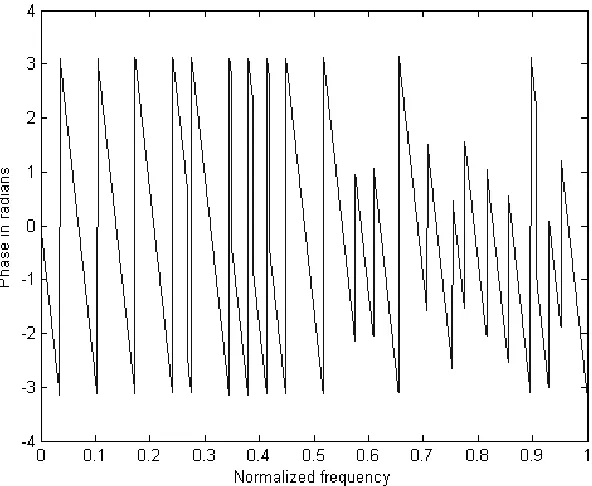
Fig. 1.5. Phase response of a linear phase filter
We can see that the phase response of the filter varies linearly. The discontinuities are due
to two reasons:
1. 2𝜋 + 𝜃 = 𝜃, resulting in the phase being confined from−𝜋 to 𝜋.
2. The sign reversal of the frequency response.
1.3
Design of FIR filters
FIR filters can be designed using various methods. The most common of these methods
8
1. Equi-ripple (minimax) design in which the maximum frequency response error from
the specified frequency response is minimized. Parks-McClellan method can be used
to design FIR filters based on minimax criterion.
2. Least mean square design, in which the mean square error is minimized from the
desired frequency response.
3. Window-based methods based on inverse DFT.
Here, we will focus on the minimax design of FIR filters, as this is the criterion on which
the work in this thesis is based.
1.3.1 Equi-ripple design of linear phase FIR filters
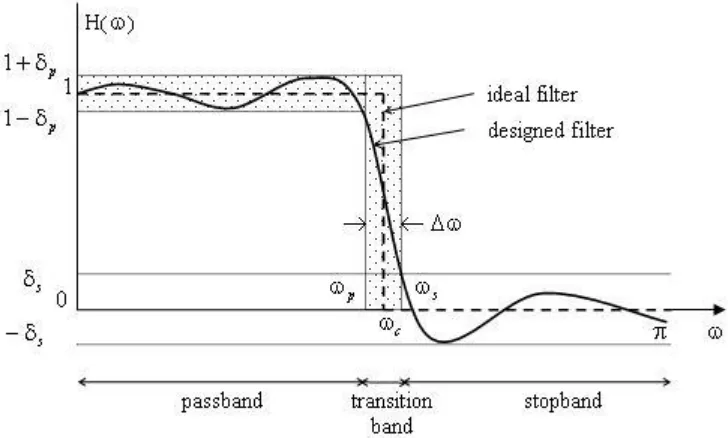
The specifications of the filter are given, before it is designed. Fig. 1.6 shows the
specifications of a low-pass filter, which is to be designed based on equi-ripple method.
Fig. 1.6. Filter specifications
The broken plot represents the desired filter response, which corresponds to an ideal
low-pass filter, with cut-off frequency 𝜔𝑐. The response is exactly 1 in the passband and drops
to 0 in the stopband sharply. In practical filters of finite length, the frequency response
deviates from the ideal response as shown in the solid curve in the figure. Therefore, the
9
The interval 0-𝜔𝑝 is the pass-band and 𝜔𝑐-1 is the stop-band of the filter. For the designed
filter, in the pass-band, the response can vary from 1-𝛿𝑝 to 1+𝛿𝑝 and in the stopband from
-𝛿𝑠 to 𝛿𝑠. In the transition region, which is from 𝜔𝑝 to 𝜔𝑠 the response can take any value.
𝛿𝑝 is called the pass-band ripple and 𝛿𝑠 the stop-band ripple. The tighter the filter
specifications are, the higher the filter length, 𝑁 is required to design the filter.
The above design problem can be formulated as a linear program shown in the following
equations:
Minimize 𝛿
Such that: 1 − 𝛿 ≤ 𝐻(𝜔) ≤ 1 + 𝛿, for 𝜔 ∈ [0, 𝜔𝑝]
−(𝛿𝑠𝛿)/𝛿𝑝 ≤ 𝐻(𝜔) ≤ (𝛿𝑠𝛿)/𝛿𝑝, for 𝜔 ∈ [ 𝜔𝑠, 1]
1.9
Where, 𝐻(𝜔) is the frequency response of the filter and is given by
𝐻(𝜔) = ∑ ℎ(𝑛)Trig(𝜔, 𝑛)
⌊𝑁−12 ⌋
𝑛=0
1.10
Where N is the filter length and Trig is a trigonometric function depending on the type of
the filter and whether the filter length is odd or even (See equations 1.5-1.8).
Solving the linear program (LP), we can find the values ofthe filter coefficients ℎ(𝑛) and
the ripple 𝛿.
The filter can be instead designed using Parks-McClellan method which is very efficient.
This is an iterative algorithm, reducing the maximum error in each iteration. The MATLAB
function firpm is based on the Parks-McClellan method and can be used to design
linear-phase FIR filters with a given length and specified pass and stop bands. The syntax of the
10 b = firpm(n,f,a,w)
where, n is the filter order, which is one less than the filter length,
f and a define the pass and stop bands. For example, f = [0 0.3 0.5 1], and a = [1 1 0 0]
represents a low pass filter with pass band from 0 to 0.3𝜋 and stop band from 0.5𝜋 to 𝜋.
w is the weight vector of length equal to the number of bands. Each value in the vector
represents the weight assigned to the corresponding band of the filter.
1.3.2 Effect of finite precision
In practice due to the finite length of registers in processors, a filter with continuous filter
coefficients is not possible to implement. The coefficients must be represented by numbers
of finite word-length. This affects the frequency response of the filter negatively.
Fig. 1.7. Comparison between finite and infinite precision FIR filter responses
In Fig. 1.7 the blue solid plot represents the response of an optimal un-quantized filter
11
constant. After the filter coefficients are quantized to an effective word-length (EWL) of
10 bits excluding the sign bit, the frequency response is again plotted and is shown in green,
dashed graph. It is seen that even with 10 bits EWL, there is a significant distortion in the
frequency response of the filter, which is clearly noticeable in the stop band of the response.
In addition, the equi-ripple character of the response is lost.
1.4 Quantization of coefficients
The continuous filter coefficients can be quantized using either uniform quantization or
non-uniform quantization. The uniform quantization can be achieved by the following
number representations:
1.4.1 Signed magnitude representation
In this representation the magnitude of the number is represented by the bits excluding the
MSB and the sign of the number is represented by the MSB.
For example: (0101)2 = +510 and (1010)2 = -210
The number 0 has 2 possible representations in this system, which are (0000)2 and (1000)2.
1.4.2 One’s compliment representation
In this representation the negative of a number is equal to bitwise OR of the number.
For example: (0110111)2 = +5510 and (1001000)2 = -5510
In order to add two one’s compliment numbers, it is necessary to add the end-around carry
to the result to obtain the correct answer. For example:
(1110001)2 + (0010000)2 = (1 0000001)2
To obtain the correct answer the carry bit is added to the remaining number, which gives
12 1.4.3 Two’s compliment representation
To avoid the task of adding the carry bit after the addition of two one’s compliment numbers, in the two’s compliment representation the negative of a number is formed by
taking bit-wise not of the number and then adding 1 to the result.
For example: -5510 is represented by (1001000)2 + (1)2 = (1001001)2
The addition of two 2’s compliment numbers is straightforward and can be done using
normal addition.
1.4.4 Signed digit format
In signed digit format each digit of the number has a sign associated with it. One example
is balanced ternary, whose base is 3 and the digits can take the values from {-1, 0, 1}.
For example: (1 0 -1 -1)2 = 23 - 21 -20 = 8 – 2 – 1 = 5
The signed digit format is not unique.
1.4.5 Canonical signed digit representation
If in the signed digit representation no two consecutive digits are non-zero, then the
resulting representation is called canonical signed digit representation (CSD). The CSD
representation of a number is unique.
1.4.6 Non-uniform quantization
There are a number of quantization representations in which the difference between 2
consecutive values in the range of the representation does not remain uniform. An example
is limiting the number of signed non-zero digits in the representation of the filter
coefficients. Limiting the number to 2, the filter coefficients are then represented by the
following equation
ℎ𝑛 = 𝑐𝑛12−𝑏𝑛1+ 𝑐
13 Where,
𝑐𝑛1, 𝑐𝑛2∈ {−1,0,1} and 𝑏𝑛1, 𝑏𝑛2∈ {1,2, … 𝑏}
A plot of the values which ℎ𝑛 can take is shown in the Fig. 1.8.
Fig. 1.8. Possible values in a non-uniform quantization scheme
As can be seen, the values are closely spaced near 0 and the gaps between the values
generally increases near -1 and 1. Therefore, quantizing larger coefficients results in large
quantization errors.
1.4.7 Integer representation of coefficients
The coefficients are quantized to a certain number of bits in an algorithm. The number of
digits in binary format of a coefficient, proceeding initial zeros, after quantization is called
the effective word-length of the coefficient. For example, consider a filter with 3
coefficients with values 0.4569, -0.2438 and 0.1211. The binary values of these coefficients
are
0.01110100111101110110…, -0.00111110011010011010… and
0.00011111000000000110…
If these are rounded to 9 digits after the binary point, then the values become
0.011101010, -0.001111101 and 0.000111110
The EWL of each coefficient is then equal to the number of digits of each coefficient after
14
Instead of working on these values which are binary, these can be multiplied by a number
which is a power of 2, i.e. 2n, such that the resulting values become integers. In the above
example, it can be easily seen that this number is 29. Multiplying the coefficients with 29,
we get
11101010, -1111101 and 111110, which in decimal are 234, -125 and 62.
1.5 Normalized Peak Ripple Magnitude (NPRM)
The equations 1.5-1.8 give the frequency response of the filters. It can be noted that if all
the coefficients of the filter are multiplied by a constant K, then the resulting frequency
response is identical to the original response except that it is scaled by a factor of K. This
is not important in most of the applications, as the filtered signal can be passed through an
amplifier with gain 1/K, to cancel the scaling factor. Therefore, in the binary representation
of filter coefficients, if all the coefficients are shifted left or right by same number, i.e. they
are multiplied by 2, 4, 8, , etc., the resulting filter remains equivalent to the original filter.
15
In Fig. 1.9 blue solid plot represents frequency response of a filter with unity passband
gain. If the coefficients are multiplied by 1.5, the frequency response of the resulting filter
is identical but scaled by a factor of 1.5, as shown in green dashed line. And similar is the
case with scaling with 0.7.
Consider the example given in section 1.4.7, where the coefficients are scaled to integers.
The largest coefficient is 234. But it can be easily seen that if the coefficients were scaled
such that the largest coefficient lies between 128 and 255, even then the EWL of the filter
would remain the same. In other words, if ℎ𝑚𝑎𝑥 is the largest coefficient in terms of
magnitude and EWL is the effective word-length, then the gain of the scaled filter can be
varied from 2
𝐸𝑊𝐿−1
ℎ𝑚𝑎𝑥 to 2𝐸𝑊𝐿 ℎ𝑚𝑎𝑥.
Therefore, it is possible that the optimum filter is realized while searching in the
neighborhood of filters quantized using gain other than 1. Therefore while optimizing the
filter coefficients the gain can be allowed to change. In order to do this, the optimization
problem is defined as below:
minimize: 𝛿 𝑔⁄ = 1
𝑔max𝜔∈𝐹|𝐸(𝜔)| 1.12
Where, 𝐹 is a set of frequency points excluding the transition bands.
And, 𝐸(𝜔) = 𝑊(𝜔)(𝑔𝐷(𝜔) − 𝐻(𝜔)) 1.13
Where, 𝐷(𝜔) is the desired frequency response, which is 1 in passbands and 0 in
stopbands, 𝐻(𝜔) is the frequency response of the designed filter and 𝑊(𝜔) is a weighting
function. The weighting function is used to give different weights to different frequencies.
The quantity 𝛿 𝑔⁄ is called the Normalized Peak Ripple Magnitude (NPRM) of the filter.
16 𝑔 =𝑃𝑚𝑎𝑥 + 𝑃𝑚𝑖𝑛
2 if
𝑃𝑚𝑎𝑥− 𝑃𝑚𝑖𝑛
2 > 𝑆𝑚𝑎𝑥
𝑔 = 𝑆𝑚𝑎𝑥 + 𝑃𝑚𝑖𝑛 if 𝑃𝑚𝑎𝑥 − 𝑃𝑚𝑖𝑛
2 < 𝑆𝑚𝑎𝑥
1.14
Where, 𝑃𝑚𝑎𝑥 is the maxima of the frequency response in the pass-band, 𝑃𝑚𝑖𝑛 is the minima
of frequency response in the pass-band and 𝑆𝑚𝑎𝑥 is the maxima of frequency in the
stop-band.
1.6 Reduced hardware complexity designs
Fig. 1.2 and 1.3 show two forms of hardware implementations of FIR filters. For
linear-phase filters the complexity can be further reduced by utilizing the fact that half of the
coefficients have same magnitude as the other half. The following figure shows type I filter
in transposed direct form, where only the distinct coefficients are used as multipliers,
+
. . .
x[k]h
0h
1h
2h
(N-1)/2-1+
T
+
T
+
T
Multiplier block
+
T
+
T
+
T
y[k]
Fig. 1.10. Linear phase type I FIR filter with reduced number of multipliers
1.6.1 Using CSD coding of the coefficients
The coefficients can be converted into CSD format. As CSD representation has minimum
number of non-zero binary digits, therefore the complexity of the multiplier block is
17 1.6.2 Reduced adder graph designs
Although using CSD instead of simple multipliers can reduce the adder complexity in the
multiplier block, yet it is possible to further reduce the number of adders by utilizing the
common additive factors among the coefficients. For example the coefficients 5, 9 and 23
can each be realized using 1, 1 and 2 adders (4+1, 8+1 and 32-8-1) respectively, requiring
total of 4 adders. But if 23 is realized by utilizing the previously realized coefficients (5
and 9) as 2×9+5, then only 1 adder is required for synthesizing 23. (Note that multiplying
by 2 requires only shifts and has negligible hardware requirement). Various algorithms
[2]-[5] has been developed to find the optimal adder graph, some of which are explained in
chapter 2.
1.7 Motivation
The focus of the thesis is the design of linear phase FIR filter which satisfies the given
design specifications and also tries to achieve minimum number of hardware adders
required for the multiplierless design. In the literature, there are algorithms which can
design optimum filters having minimum number of adders, but the run-time of these
algorithms usually increases exponentially as the length of the filter to be designed is
increased. On the other hand there are some algorithms based on evolutionary methods
which can design the filters in relatively less time but the number of adders of the designed
filter is usually far from optimum.
In this thesis, the recently proposed Extremal Optimization (EO) is used to design such
filters trying to achieve near optimum results and on the other hand avoiding the
exponential increase in run-time as the filter length increases.
1.8 Thesis organization
The rest of the thesis report is organized as follows:
In the second chapter, the literature is reviewed focusing on some of the state of the art
methods for designing linear phase FIR filters. Some of the important deterministic and
18
minimum adder multiplier graphs, such as [2] and RAG-n [4] are explained. In addition,
some techniques used to reduce the search space and making the linear program based
calculation of the filter coefficients faster are reviewed
In the third chapter, the theoretical background of the extremal optimization (EO) method
is given. Also, some major improvements such as 𝜏-EO and population based EO are
discussed.
In the fourth chapter, the proposed method is explained in detail. Various steps used in the
algorithm like reducing the search space, partitioning the gain and the methods used to
speed-up the calculations are discussed.
In the fifth chapter, the analysis of the convergence characteristics of the algorithm is done.
Some benchmark filters are designed using the algorithm and their multiplier blocks are
synthesized and shown. The run-time of the algorithm is also calculated and discussed and
a comparison is made with the state of the art methods.
In the sixth chapter, the conclusion is given.
1.9 Main contributions
The main contribution of the work done here is the implementation of EO algorithm and
adapting it to make it suitable for designing FIR filters. The algorithm has not been
previously used for the design of digital filters. The disadvantage of other algorithms such
as GA and PSO is that they require fine tuning of the parameters. Also there is a problem
of early convergence to a local minimum. EO on the other hand has just one adjustable
parameter, which is relatively easy to tune. Also, it is easy to tune EO such that it doesn’t
get trapped in local minima, although at the cost of increasing the runtime.
A specific technique is also developed to make the algorithm fast. The frequency response
is not calculated entirely for each objective function evaluation. Instead, only the
19
Chapter 2
Review of Literature
Multiplierless digital filters can be realized without the use of multipliers by a shift and add
network and thus are efficient in terms of hardware complexity and power consumption.
The design goal is to minimize the number of adders. There are both deterministic as well
as heuristic methods available for designing finite word length filters. Deterministic
methods based on tree search are able to find the optimum solutions but consume lots of
time if the filter length is high.
Initially, the design of finite word length filters was concentrated on reducing the
representation of filters coefficients. The canonic signed digits (CSD) and Signed Power
of Two (SPOT) representation of numbers was utilized to minimize the bits needed to
represent the filter coefficients. The minimal bit representation led to a reduction in the
number of adders needed to implement the filter either using ripple carry adders (RCA) or
using carry save adders (CSA). The RCA topology required less chip area and consumed
less power but at the expense of reduced operating frequency. The CSA topology increased
the speed at the expense of additional hardware. However, both the topologies had minimal
adder counts under the SPOT design criteria.
With time, research efforts in finite word length filter design drifted towards developing
efficient multiple constant multiplication (MCM) algorithms. The FIR filter in its
transposed direct form could be modelled as a case of MCM wherein the input is multiplied
by all the filter coefficients and then saved in registers and added along the delay line. The
MCM algorithms utilized the redundancies in the filter coefficients and modelled the shift
and add network as a one-input-M-output network (M being the number of unique filter
coefficients). The MCM algorithms were either graph based [3]-[4], or were pattern based
[2].
MCM algorithms produced the minimal adder count for a given set of filters coefficients
but given a filter specification, the coefficient set that can meet the requirement is not
20
problem and the implementation were consolidated. This led to the dynamically expanding
subexpression space design methods.
Deterministic methods based on tree search are able to find the optimum solutions at the
expense of exponential computational complexity [6]. Thus, design of large order and high
word length filters becomes infeasible. The research in deterministic methods is being
carried out to reduce the search space by excluding the section of the search space from the
algorithm that shows no promise of feasible solutions. However, the exponential
computational growth is unavoidable in all tree search methods and a polynomial time
algorithm can only be guaranteed if every node produces only one child. In [7], a method
is proposed whose runtime is polynomial with the filter length. In this method the passband
gain is divided into large number of sections. In each section a solution is found by
successively finding the feasible range of a coefficient and fixing it the value near the
middle of the range. A feasible solution is chosen which results in minimum number of
adders.
In heuristic methods for designing finite word length filters, the most common strategy is
to find an initial solution, for example by rounding the continuous solution or by finding
an initial good solution with greedy optimization and then search using small number of
values around the rounded values. Totally random search with no initial solutions can only
yield feasible solutions for filter orders less than 30. The shift and add network can be
constructed using MCM algorithms and the objective function is created to direct the search
for finding minimal adder coefficients.
2.1 Filter design algorithms
In the following section some important deterministic and heuristic algorithms from
literature are reviewed.
2.1.1 Deterministic algorithms
1. In [8], a branch and bound algorithm (called FIRGAM) is proposed for the design of
hardware efficient filters. The algorithm designs filters with reduced number of SPT terms.
21
and fixing the coefficient first to the quantization value nearest to the center of the feasible
range. After a coefficient has been fixed the feasible range of the next coefficients is
recalculated and the same procedure is repeated until all the coefficients has been
successfully quantized.
The number of SPT terms of the solution are calculated and the algorithm then goes through
the search space again to find if a solution with lesser number of SPT terms can be found.
If the feasible range of any coefficient is found to be empty at any stage, the algorithm
backtracks to the previous quantized coefficient and quantizes it to the next nearest
quantization value from the center of its feasible range.
2. [6] proposes an algorithm to design optimum filters in terms of the number of adders.
The method involves mixed integer linear programming (MILP). The filter coefficients are
synthesized based on a dynamically expanding subexpression space.
First, the lower and upper bound of each coefficient is calculated. This is done by solving
the following linear program problem:
minimize: 𝑓 = ℎ(𝑘) and 𝑓 = −ℎ(𝑘)
such that: 𝑏 − 𝛿 ≤ 𝐻(𝜔) ≤ 𝑏 + 𝛿, for 𝜔 ∈ [0, 𝜔𝑝]
− (𝛿𝑠𝛿) 𝛿⁄ 𝑝 ≤ 𝐻(𝜔) ≤ (𝛿𝑠𝛿) 𝛿⁄ 𝑝, for 𝜔 ∈ [𝜔𝑠,𝜋]
𝑏𝑙 ≤ 𝑏 ≤ 𝑏ℎ
2.1
Where, 𝑏 is the passband gain and 𝛿𝑝 and 𝛿𝑠 are the maximum allowed pass and stop-band
ripple. 𝐻(𝜔) is the magnitude of the frequency response of the filter.
After this a depth first search is done and filter coefficients are fixed to integers one by one.
Once a coefficient is fixed the remaining un-quantized one are re-optimized.
This algorithm is guaranteed to return optimum set of filter coefficients, but for filters with
high word-lengths, the algorithm takes very long time to finish the search and becomes
22
3. In [7], a polynomial time algorithm is proposed. The method is inspired from FIRGAM
[8] algorithm. In contrast to FIRGAM, the proposed method fixes each coefficient to the
middle of its range and does not try to expand the search in the neighboring values.
As the runtime of linear program is polynomial in number of filter coefficients and the
number of linear programs to be solved also increases linearly with the number of the filter
coefficients, therefore the above algorithm is polynomial in runtime.
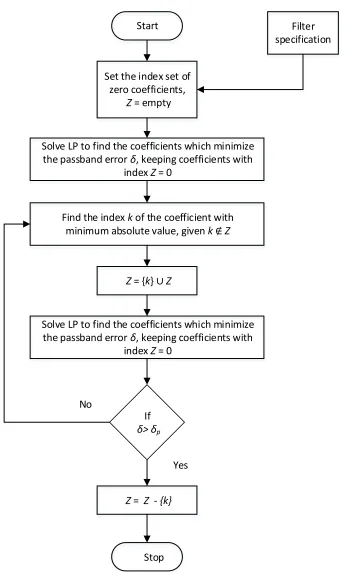
In this algorithm, first some of the coefficients are fixed to 0 before proceeding with the
remaining algorithm. The reason is that, if a coefficient is 0, then there is an immediate
reduction in two adders in the delay chain.
After this, the passband gain is divided into number of partitions and the tree search
algorithm, as in [8], is used to fix successively the coefficients to the middle of their feasible
range. The filter coefficients from each gain are synthesized using an MCM algorithm [2]
and the one which yields the result with minimum number of adders is chosen as the final
solution.
4. [9] proposes a polynomial time algorithm which optimizes the coefficients in two steps.
The first step is similar to the one proposed in [7]. After the initial solutions for each gain
are obtained, the ones which are feasible are selected for the second step of the
optimization.
In the second step the coefficients are divided into groups. Each group has 20 coefficients
(the last group might have less than 20 coefficients). Each group is optimized one by one
using a tree search algorithm similar to [6]. Expanding subexpression technique is used to
synthesize the coefficients as they are constructed to yield minimum number of adders.
Once all the groups have been optimized, the process is repeated again several times
starting from the first group. After 2-3 iterations the algorithm converges. The solution at
the gain which yields the best result in terms of number of adders is chosen as the final
solution.
The above algorithm is capable of finding solutions which, in most of the cases, are optimal
23 2.1.2
Heuristic
algorithms1. In [10], GA is used to design FIR filter with coefficients which are constrained to the
sums of two numbers, which are powers of two. In order to constrain the search space, a
specific coefficient coding scheme is used. Instead of coding the values of the coefficients
directly, the differences from some leading values are chosen and coded. The leading
values are chosen as the coefficients obtained after quantizing the optimal continuous
coefficients. In the case, when sum of power of two terms (SOPT) is used, the quantization
is done such that the quantized value is the nearest value in the domain of SOPT from the
continuous value.
As the optimal discrete filter coefficients are generally relatively not far away from the
continuous filter coefficients, therefore the differences to be encoded are not very large and
can be encoded using lesser number of bits, compared to encoding the full coefficient
values.
2. In [11], a genetic algorithm is proposed for the design of multiplierless filters. In this
paper the search space is partitioned into a number of search spaces. This is done by
dividing the passband gain into a number of partitions, such that the EWL remains same
as specified. The continuous filter is constructed for each of the partition. Then a search
space is constructed around each solution and GA is used to find feasible solution in this
space having minimum hardware adders. The search space around the nth coefficient is
defined in the following way:
ℎ𝑞𝑚𝑢 (𝑛) = ℎ 𝑞𝑚
′ (𝑛) + 2𝑐𝑒𝑖𝑙(𝐵𝑚(𝑛)/3)− 1
ℎ𝑞𝑚𝑙 (𝑛) = ℎ𝑞𝑚′ (𝑛) − 2𝑐𝑒𝑖𝑙(𝐵𝑚(𝑛) 3⁄ )+ 1
2.2
Where, ℎ𝑞𝑚′ are the quantized coefficients scaled to integers. ℎ𝑞𝑚𝑢 is the upper limit of the
coefficients and ℎ𝑞𝑚𝑙 is the lower limit of the coefficients. 𝐵𝑚(𝑛) is the EWL of the nth
coefficient.
3. Another GA based algorithm is proposed in [12] for the design of multiplierless filters.
24
convergence of the algorithm and also avoids the good solutions to be cast away. The gain
is divided into a number of partitions as in [11]. In the second part of the paper the
algorithm is used to design filters in cascade form.
4. In [13] a two stage algorithm is proposed with sums of SPT terms. In the first stage, a
time domain method is used to assign SPT terms to the filter coefficients. In the second
stage a Verterbi’s algorithm type method is used. The problem is cast as dynamic
programming and a trellis search is done to iteratively add SPT terms one by one. The
number of adders are further reduced by using a subexpression sharing method to exploit
the redundancies among the coefficients.
5. A gradient based method, is used in [1]. In this method, the gradient information is
calculated and used to direct the search. The search is directed towards low gradients routes
first and when further improvement stops, the search is redirected to the steeper routes. The
method is semi-random in nature and has low computational cost.
2.2 MCM algorithms
In the following sub-sections two important MCM algorithms for designing multiplierless
realizations of filter coefficients are explained.
2.2.1 MCM algorithm of A. Yurdakul and G. Dündar [2]
There are a number of algorithms in the literature to find the multiplierless realizations of
filter coefficients. RAG-n and C1 algorithms are notable for producing realizations with
optimal number of adders in most of the cases. But these algorithms suffer from the
disadvantage of large memory requirements due to the use of large lookup tables. Also,
when the word-length is higher, the lookup tables become prohibitively large. In this case,
the algorithms can still construct these coefficients using heuristics, but do not guarantee
the optimal number of adders. A fast and efficient algorithm has been introduced in [2]. It
has pseudo-polynomial run-time and memory requirements in the worst case scenario.
The algorithm is based on pattern search in the binary or CSD values of the coefficients.
The pattern search is done at length of 2 throughout the algorithm. Pattern length is defined
25
word-length 8 is given as 11010110. Then, 1001 and 101 shown in bold as 11010110 and
11010110 respectively are patterns of length 2, whereas 1101 and 100101 are patterns of
length 3 shown in bold as 11010110 and 11010110 respectively. The algorithm iteratively
combines 2 non-zero terms to generate all the coefficients. The step by step realization of
constant multiplication is shown in the following figure:
Step 1:
Step 2:
Step 3:
1 0 1 0 1 0 0 1 0 1 0 1 0 0 1
Step 4:
0 0 t2 0 0 0 0 t1 0 1 0 0 0 0 t1
0 0 0 0 0 0 0 t4 0 0 0 0 0 0 t3
0 0 0 0 0 0 0 0 0 0 0 0 0 0 t5
Fig. 2.1. Constant multiplication realization using the algorithm.
+
+
+
+
+
1 4 1 8 5×2^5 9 2^5 9 169×2^7 41 21673Fig. 2.2. The adder tree for the above example
From the figure, we can see that the number of adders required for the synthesis is 5.
2.2.2 RAG-n algorithm
RAG-n algorithm [4] synthesizes the coefficients in two steps. The first part of the
algorithm is optimal and the second part is heuristic. If the algorithm is able to synthesize
all the coefficients in the first step, then the synthesized set is guaranteed to be optimal.
The algorithm uses a lookup table constructed by MAG algorithm. The lookup table
contains the minimum adder graphs of all the integers up to a certain cost, where cost is
the number of additions or subtractions required to synthesize that number. Only the odd
26
multiplying with 2, which is cost-free. For example, 2, 4, 8, and so on have cost 0 as these
can be constructed without any adders. 3, 5, 7, 9, etc. have cost 1 as they require one adder
for their synthesis as shown below:
4 - 1 = 3, 4 + 1 = 5, 8 - 1 = 7, 8 + 1 = 9
The basic steps of the algorithm are as follows:
First, all the coefficients are reduced to odd-fundamentals. This is done by making any
negative coefficients positive. Then making the coefficients odd by successively
dividing by 2.
Any repeated values are removed. The values 0 and 1 are also removed from the set.
All the odd-fundamentals which have cost 1 are removed from the set. The set of remaining fundamentals is called incomplete set. The number of adders used until now
is the number of fundamentals removed. The set of removed fundamentals is called
complete set.
Use the complete set and try to construct fundamentals in the incomplete set by adding
two coefficients from the complete set and their multiples with power of 2. The
fundamentals which are able to be constructed in this step are added to the complete
set and removed from the complete set.
The step 4 is repeated until there are no more fundamentals in the incomplete set or no
more fundamentals in the incomplete set can be constructed.
If by this time the incomplete set is empty then the algorithm stops and the resulting
synthesis is optimal, otherwise the remaining fundamentals are constructed using the
second part of the algorithm which is heuristic.
As the number of coefficients increases for a given word-length the chances of a set
constructed by the algorithm to be optimal increases. For example, when the word-length
is 8, the chances of optimal set are already more than 50% with a set size of around 10 and
almost 100% with a set size of 20. On the other hand, when the word-length is 12, around
27
2.3 Speeding up the linear program
The maximum number of extrema (i.e. maxima and minima) in the frequency response of
a filter of length 𝑁 is equal to
𝑁𝑒𝑥𝑡 = ⌊𝑁 + 1
2 ⌋ 2.3
The above number includes the points at frequencies 𝜔 = 0 and 𝜋, but does not include
the frequencies at the edge of the transition bands.
The filter coefficients for a low pass filter with pass and stop band cut-off frequency 𝜔𝑝
and 𝜔𝑠 respectively, can be evaluated by solving the following linear program
minimize: 𝛿
subject to: 1 − 𝛿 ≤ 𝐻(𝜔) ≤ 1 + 𝛿, for 𝜔 ∈ [0, 𝜔𝑝]
−𝛿𝑠
𝛿𝑝𝛿 ≤ 𝐻(𝜔) ≤ 𝛿𝑠
𝛿𝑝𝛿, for 𝜔 ∈ [𝜔𝑠, 𝜋]
2.4
Where, 𝛿𝑠
𝛿𝑝 is the ratio of stop and pass band error tolerances and 𝐻(𝜔) is the frequency
response of the filter.
In order to account for all the frequencies, the number of points on the frequency grid need
to be as large as possible. If the number of points is very large, then the number of
constraints of the LP is also very large, which can create instability in the solving algorithm
and also require large computational time. It can be noticed that the only points where
optimization is required are the extremal points on the frequency response. The problem is
28
In [14], a method, similar to the one used in Parks-mcCllellan is used to solve the above
equations. The algorithm is explained below:
1. 𝑁𝑒𝑥𝑡 number of points are initially chosen in the pass and stop band which are
roughly equally spaced.
2. The equations are solved at these points, in addition to pass and stop band cut-off
frequencies, to get filter coefficients.
3. Frequency response is evaluated using these filter coefficients at roughly 2𝑁
equally spaced points on the frequency grid.
4. Newton’s extrapolation method is applied to accurately determine the extrema of
the frequency response, which are the new 𝑁𝑒𝑥𝑡 number of points.
5. The steps 2-4 are repeated until the change in the extrema points is less than a given
tolerance.
2.4 Reducing the search space
If the magnitude of the coefficients are quantized to an 𝐸𝑊𝐿 of 𝐵 bits and the filter length
is 𝑁, then the total number of possible filter realizations are equal to (2𝐵+1)𝑁= 2(𝐵+1)𝑁.
Even for a moderate word-length of 8 and filter length 31, the number of possibilities
is 2279≈ 1084, which is enormous. It is impossible to check each and every possibility by
Brute force to optimize the filter.
A large majority of these possibilities give filters which deviate greatly from the desired
frequency response. The optimum filter coefficients lie close to the quantized filter
coefficients. Therefore it makes sense to look for the optimum filter coefficients in the
vicinity of the quantized filter coefficients. For example in [10], a neighborhood is selected
around each coefficient, which is much less than the full range of the given coefficient.
This way each filter’s neighborhood is encoded with a number of bits which is less than
the 𝐸𝑊𝐿 of the given coefficient. In this way the search space is drastically reduced.
Instead of quantizing the coefficients and then defining an arbitrary search space as
29
which satisfy the given filter specifications. This is done by solving the following LP for
each of the coefficients. To find the feasible range of ith coefficient, solve
minimize: 𝑓0 = ℎ(𝑖) and 𝑓1 = −ℎ(𝑖)
subject to: (1 − 𝛿𝑝) ≤ 𝐻(𝜔) ≤ (1 + 𝛿𝑝), for 𝜔 ∈ [0, 𝜔𝑝]
−𝛿𝑝 ≤ 𝐻(𝜔) ≤ 𝛿𝑝, for 𝜔 ∈ [𝜔𝑠, 𝜋]
2.5
Where, 𝐻(𝜔) = ∑⌊ ℎ(𝑛)Trig(𝜔, 𝑛)
𝑁−1 2 ⌋ 𝑛=0
The above equations represent two linear programs, one minimizing 𝑓0 = ℎ(𝑖) and the
other minimizing 𝑓0 = −ℎ(𝑖). The results of these give the minimum and maximum value
of the ith coefficient. The search space of the filter can now be limited to the feasible range
30
Chapter 3
Extremal Optimization
Extremal Optimization is a recent heuristic method inspired by models of co-evolution
such as Bak-Sneppen model [19]. It is one of many evolutionary algorithms, such as
Genetic Algorithm (GA), Ant Colony Optimization (ACO), Particle Swarm Optimization
(PSO), Artificial Bee Colony Optimization, etc. Evolutionary algorithms can successfully
optimize a wide variety of optimization problems as they do not make any assumptions
about the underlying fitness landscape of the problem. Therefore, these have been widely
used in the optimization of engineering problems, which are otherwise very difficult to
solve due to the complex nature of the fitness landscape, or due to the huge size of the
search space which is intractable with other algorithms.
GA algorithm is inspired from the Darwinian natural selection. It consists of basic steps of
biological evolution, which are inheritance, crossover, mutation and selection. [10]-[12]
and [15]-[17] use GA based algorithms for design of FIR filters. One of the limitations of
GA is the tendency to converge to local optima instead of global optima.
S. J. Gould [18], suggested that evolution of species takes place intermittently, instead of
in a gradual way. The evolution of a species affects its neighboring species and instead of
evolving towards an equilibrium state, they enter a state in which intermittent bursts of
evolution take place separated by quite states. The changes resemble avalanches. The sizes
of the avalanches come in all sizes and are scale free. In other words, there are sudden large
changes which are rare in frequency like large extinction events and small changes which
occur with high frequency. This state of the system is called self-organized critical state.
In genetic algorithms (GA) better solutions are produced from previous solutions by
selectively breeding good solutions. In contrast, in extremal optimization the bad
components of the solution are successively eliminated in order to achieve a better solution.
In order to achieve optimum solutions in GA, the parameters such as crossover and
31
experienced human intervention. On the other hand the original EO lacks any adjustable
parameters and thus can be implemented easily on wide variety of problems.
EO can be compared to Simulated annealing (SA) which also works on a single solution.
In SA, initially the magnitude of the changes is high and as the time progresses the
magnitude of changes decreases. After a long time the algorithm converges and the
algorithm sticks to the minimum which it has found at that place. In contrast, in EO the
changes occur forever. The probability of a change of a given magnitude remains the same
throughout the algorithm. Also, the probability of the changes is inversely related to the
magnitude of the changes. In other words, a change of small magnitude has higher chances
of taking place and of larger magnitude has lower chances of taking place. Due to this, EO
does not stick to a local minimum forever and always has chances of escaping a minimum
of any depth.
3.1
Bak-Sneppen Model
Per Bak and Kim Sneppen [19] proposed a model of evolution in which they say that an
entire species has a single fitness level. Multiple species affect the fitness of their
neighboring species and therefore in turn affect their evolution.
The species evolve only if, after mutation, the new configuration has higher fitness. There
is some low probability of mutations with lower fitness, allowing the evolution to evolve
out of the local minima of the fitness landscape.
3.2
Extremal Optimization
Extremal optimization was proposed by Stefan Boettcher and Allon Percus [20], [21] and
is based on Bak-Sneppen model of co-evolution. The method successively eliminates bad
components of a single solution, instead of breeding better solutions like GA. In the paper,
the method has been successfully applied on graph partitioning and travelling salesman
problem. The graph partitioning problem is NP hard, in which a graph has to be divided
into 2 sub-sets, such that minimum number of edges cut through the two sub-sets. The
32
annealing). It is observed that EO obtains optimal results in much shorter time for large
graphs. The EO can be explained in the following steps:
1. An individual is generated randomly by randomly initializing its 𝑛 variables in their
respective feasible ranges. Let’s call this individual 𝑆. Set the optimal solution 𝑆𝑏𝑒𝑠𝑡 = 𝑆.
2. For the current individual 𝑆:
(a) Evaluate the fitness 𝜆𝑖 for each decision variable, 𝑥𝑖 ∈ (1, … , 𝑛)
(b) Find 𝑗 satisfying 𝜆𝑗 < 𝜆𝑖 , for all 𝑖, i.e., 𝑥𝑗 is the worst variable.
(c) Choose 𝑆′ ∈ 𝑁(𝑆) such that 𝑥𝑗 must change its state, where, 𝑁(𝑆) is the neighborhood
of 𝑆.
(d) Accept 𝑆 = 𝑆′ unconditionally.
(e) If the current cost function value is less than the minimum cost function value,
i.e. 𝐶(𝑆) < 𝐶(𝑆𝑏𝑒𝑠𝑡), then set 𝑆𝑏𝑒𝑠𝑡 = 𝑆.
3. Repeat Step 2 as long as desired.
4. Return 𝑆𝑏𝑒𝑠𝑡 and 𝐶(𝑆𝑏𝑒𝑠𝑡) .
3.3
Generalized EO
In [22], a generalized EO algorithm is presented, which can be applied to broad class of
engineering problems. In an optimization problem consisting of 𝑁 design variables, each
one is randomly initialized and represented in fixed number of binary bits. All these binary
numbers are joined to form a string.
1. Let’s call this individual 𝑆. Set the optimal solution 𝑆𝑏𝑒𝑠𝑡 = 𝑆. Let 𝐶 be the fitness of
this individual. Set 𝐶𝑏𝑒𝑠𝑡 = 𝐶.
33
(a) Evaluate the fitness 𝜆𝑖 for each decision variable, 𝑥𝑖 ∈ (1, … , 𝑛) of 𝑆. This is done by
flipping each ith bit of 𝑆. The resulting fitness of the individual 𝑆′ with the flipped bit is
calculated. Let 𝐶′ be its fitness. Then the fitness of the bit is 𝐶′− 𝐶.
(b) Rank the fitnesses of all the bits with rank 𝑘 = 1, for the best fitness and 𝑘 = 𝑛 for the
worst fitness.
(c) Select a random rank 𝑘, with probability distribution of 𝑘, proportional to 𝑘−𝜏, where 𝜏
is a constant.
(c) Choose 𝑆′ ∈ 𝑁(𝑆) such that 𝑥𝑘 must change its state, where, 𝑁(𝑆) is the neighborhood
of 𝑆,
(d) Accept 𝑆 = 𝑆′ unconditionally,
(e) If the current cost function value is less than the minimum cost function value,
i.e. 𝐶(𝑆) < 𝐶(𝑆𝑏𝑒𝑠𝑡), then set 𝑆𝑏𝑒𝑠𝑡 = 𝑆.
3. Repeat Step 2 as long as desired.
4. Return 𝑆𝑏𝑒𝑠𝑡 and 𝐶(𝑆𝑏𝑒𝑠𝑡) .
3.4 Population based EO
A population based EO algorithm is proposed in [23]. It claims to have higher search
efficiency than the traditional EO. In this method instead of having only one individual, we
have a number of individuals as in GA. The basic steps of this algorithm are as below.
1. Generate 𝑚 individuals 𝑆, 𝑖 ∈ (1, … , 𝑚). Find the individual with best fitness and set
𝑆𝑏𝑒𝑠𝑡 equal to this individual. Let 𝐶 be the fitness of this individual. Set 𝐶𝑏𝑒𝑠𝑡 = 𝐶.