Experimental and Biological Variability in CFSE-based Flow
Cytometry Data
H.T. Banks, D.F. Kapraun, Kathryn G. Link, and W. Clayton Thompson
Center for Research in Scientific Computation
North Carolina State University, Raleigh, NC 27695-8212
Cristina Peligero, Jordi Argilaguet, and Andreas Meyerhans
ICREA Infection Biology Lab, Department of Experimental and Health Sciences
Universitat Pompeu Fabra, 08003 Barcelona, Spain
September 10, 2013
Abstract
In this article we assess variability in cell proliferation dynamics observed for CD4+ and CD8+ T cells collected from two healthy donors. We review a recently developed class of models that incorporates the so-called “cyton model” for cell numbers into a conservation-based PDE model for cell population dynamics and describe a statistical model that relates CFSE-based flow cytometry data to such mod-els. A parameter estimation scheme is summarized and then applied to a large body of data to assess experimental variability (variation in parameter estimates as identical experiments are replicated) and biological variability (differences in parameter estimates obtained for different donors and cell types). Variability in the data obtained from replicated experiments is also discussed.
1
Introduction
The adaptive immune response is a major component of the human immune system’s defense against invading pathogens. The adaptive immune system consists of B and T lymphocytes, which recognize invaders by specific cell surface receptors and exert their responses by soluble and cellular effector mechanisms. As the success of this system depends on the lymphocytes’ capacity to proliferate in response to an infection, the ability to accurately predict this behavior in the presence of specific environmental stimuli has important implications for human health research in areas such as the treatment and prevention of infectious disease and immunosuppression for organ and tissue transplants. Such predictions can be made through the use of mathematical models.
Over the last half-century, many mathematical models have been proposed that attempt to describe the dynamics of a proliferating population of cells, but until fairly recently it has been a challenge to validate such models. The discovery of the intracellular dye carboxyfluorescein succinimidyl ester (CFSE) was a major milestone in overcoming this obstacle. CFSE was originally developed as a tool for labeling lymphocytes so that their movements within animal subjects could be tracked over many months [46], but subsequently researchers determined that the dye could also be used to monitor lymphocyte proliferation [35]. Also, through the use of fluorescent antibodies specific to various lymphocyte surface markers, it is now possible to follow the proliferative behavior of different specific types of lymphocytes [34].
days, making it possible to construct a considerable number of five-day data sets for each donor and cell type. In theory, each such data set should be very similar, so one might expect that a set of parameters for describing cell proliferation dynamics observed in one of the data sets should be essentially equivalent to the set of parameters describing observations made using another of the data sets. By applying our parameter estimation scheme to each five-day data set, we are able to assess the degree of experimental variability that exists in the data-collection process by directly assessing the variability in the parameter estimates. Also, by collecting data from two different human donors and two specific cell types, we are able to make some observations concerning biological variablility in the cell proliferation parameters.
2
Data Collection Procedure
As discussed above, the goal of this study is to assess the experimental and biological variability in parameter estimates produced using CFSE-based flow cytometry data. To obtain such data, we collected blood samples from two human donors and isolated peripheral blood mononuclear cells (PBMCs) from these samples. The PBMCs (hereafter referred to as just “cells”) were then passed through a strainer to remove clumps of cells and stained with CFSE according to the standard protocol [34]. Forty-five minutes after CFSE staining, the cells were stimulated to divide by exposing them to phytohaemagglutinin (PHA), a nonspecific T cell mitogen. Then, approximately 1 million cells were placed into each of several “wells”, which are typical containers for cell culture experiments. Each well contained approximately 1 mL of RPMI-1640/10% fetal calf serum (FCS), which is a typical nutrient medium for such experiments. In this way, three wells were “seeded” for each of five measurement times in order to obtain measurements in triplicate at each time point for one of the donors; thus, 15 wells were seeded per donor. Since two donors were considered, a total of 30 wells were seeded at the beginning of the experiment.
Here we note that, as cells proliferate, CFSE in a dividing mother cell is distributed to two daughter cells. We assume that the CFSE isevenly distributed; i.e., each daughter cell receives one half of the CFSE that was present in the mother cell. CFSE bound inside the cells also naturally degrades over time. Thus, there are two mechanisms by which the mass of CFSE per cell can decline. Such a decline in CFSE per cell can be quantified by collecting cells from the wells at various points in time and passing them through a flow cytometer. So, at each of five time points corresponding to approximately 1, 2, 3, 4, and 5 days after PHA stimulation, we transferred the contents of one of the wells to a sample tube that contained a known number of “beads”. (The number of beads in each sample tube is fixed and is reported by the manufacturer of the tubes.) The actual times for data collection coincided with 23.5, 46.0, 67.5, 94.5, and 117.5 hours after stimulation with PHA. In order to minimize disruption of proliferating cell populations, the contents of any given well were harvested only once; however, we remark that beginning on Day 3 (after the Day 3 measurement was made) one third of the nutrient medium in each unused well was exchanged with fresh medium every 24 hours and that this exchange of medium could have affected the cell cultures in the wells that were harvested after Day 3. The cells were then labeled with fluorescently-tagged antibodies (anti-CD3, anti-CD4, and anti-CD8) as well as the viability dye known as Vivid, which allows for the identification of dead-but-not-disintegrated cells. A sample consisting of a fraction (about 10 to 50%) of the contents of the sample tube was then passed through a flow cytometer. During this process, the flow cytometer measured the fluorescence intensity (FI) at various wavelengths of each cell in the sample and counted the number of beads in the sample. Because we processed only a fraction of the contents of each tube, the “actual” cell counts for any given range of FI were obtained by scaling the observed counts upward by the ratio of known number of beads in the tube to counted beads for the sample. As mentioned above, this process was repeated using cells from three different wells (per donor) at each measurement time.
Because the FI emitted at wavelengths in the range 515 to 545 nm varies directly with the mass of CFSE within a cell [34, 46], this FI is a useful surrogate for CFSE mass. Also, because CFSE is allocated evenly (by assumption) to two daughter cells upon cell division, FI histograms associated with a population of cells acquire more “peaks” as the cells divide asynchronously. In Figures 1 through 8, we present summary histograms for the data collected in our study. Each of these figures illustrates the preceding point.
0 1 2 3 4 5 6 0 500 1000 1500 2000 2500 3000 3500 4000
Histogram Data for Day 1
Log FI
Cell Count
Sample 1 Sample 2 Sample 3
0 1 2 3 4 5 6
0 500 1000 1500 2000 2500 3000 3500 4000
Histogram Data for Day 2
Log FI
Cell Count
Sample 1 Sample 2 Sample 3
0 1 2 3 4 5 6
0 500 1000 1500 2000 2500 3000 3500 4000
Histogram Data for Day 3
Log FI
Cell Count
Sample 1 Sample 2 Sample 3
0 1 2 3 4 5 6
0 1000 2000 3000 4000 5000 6000 7000 8000
Histogram Data for Day 4
Log FI
Cell Count
Sample 1 Sample 2
0 1 2 3 4 5 6
0 1000 2000 3000 4000 5000 6000 7000 8000
Histogram Data for Day 5
Log FI
Cell Count
Sample 1 Sample 2 Sample 3
Figure 1: Summary histogram data for CD4+ T cells measured for Donor 1 using Vivid dye to exclude dead-but-not-disintegrated cells.
0 1 2 3 4 5 6
0 200 400 600 800 1000 1200 1400
Histogram Data for Day 1
Log FI
Cell Count
Sample 1 Sample 2 Sample 3
0 1 2 3 4 5 6
0 200 400 600 800 1000 1200 1400 1600 1800
Histogram Data for Day 2
Log FI
Cell Count
Sample 1 Sample 2 Sample 3
0 1 2 3 4 5 6
0 500 1000 1500 2000 2500 3000 3500
Histogram Data for Day 3
Log FI
Cell Count
Sample 1 Sample 2 Sample 3
0 1 2 3 4 5 6
0 1000 2000 3000 4000 5000 6000 7000 8000 9000
Histogram Data for Day 4
Log FI
Cell Count
Sample 1 Sample 2
0 1 2 3 4 5 6
0 2000 4000 6000 8000 10000 12000
Histogram Data for Day 5
Log FI
Cell Count
Sample 1 Sample 2 Sample 3
0 1 2 3 4 5 6 0 500 1000 1500 2000 2500 3000 3500 4000 4500
Histogram Data for Day 1
Log FI
Cell Count
Sample 1 Sample 2 Sample 3
0 1 2 3 4 5 6
0 500 1000 1500 2000 2500 3000 3500 4000 4500
Histogram Data for Day 2
Log FI
Cell Count
Sample 1 Sample 2 Sample 3
0 1 2 3 4 5 6
0 500 1000 1500 2000 2500 3000 3500 4000 4500
Histogram Data for Day 3
Log FI
Cell Count
Sample 1 Sample 2 Sample 3
0 1 2 3 4 5 6
0 1000 2000 3000 4000 5000 6000 7000 8000 9000
Histogram Data for Day 4
Log FI
Cell Count
Sample 1 Sample 2
0 1 2 3 4 5 6
0 1000 2000 3000 4000 5000 6000 7000 8000
Histogram Data for Day 5
Log FI
Cell Count
Sample 1 Sample 2 Sample 3
Figure 3: Summary histogram data for CD4+ T cells measured for Donor 1 without using Vivid dye to exclude dead-but-not-disintegrated cells.
0 1 2 3 4 5 6
0 200 400 600 800 1000 1200 1400
Histogram Data for Day 1
Log FI
Cell Count
Sample 1 Sample 2 Sample 3
0 1 2 3 4 5 6
0 500 1000 1500 2000 2500
Histogram Data for Day 2
Log FI
Cell Count
Sample 1 Sample 2 Sample 3
0 1 2 3 4 5 6
0 500 1000 1500 2000 2500 3000 3500 4000 4500
Histogram Data for Day 3
Log FI
Cell Count
Sample 1 Sample 2 Sample 3
0 1 2 3 4 5 6
0 2000 4000 6000 8000 10000
Histogram Data for Day 4
Log FI
Cell Count
Sample 1 Sample 2
0 1 2 3 4 5 6
0 2000 4000 6000 8000 10000 12000
Histogram Data for Day 5
Log FI
Cell Count
Sample 1 Sample 2 Sample 3
0 1 2 3 4 5 6 0 500 1000 1500 2000 2500
Histogram Data for Day 1
Log FI
Cell Count
Sample 1 Sample 2 Sample 3
0 1 2 3 4 5 6
0 500 1000 1500 2000
Histogram Data for Day 2
Log FI
Cell Count
Sample 1 Sample 2 Sample 3
0 1 2 3 4 5 6
0 500 1000 1500 2000 2500 3000
Histogram Data for Day 3
Log FI
Cell Count
Sample 1 Sample 2 Sample 3
0 1 2 3 4 5 6
0 1000 2000 3000 4000 5000 6000
Histogram Data for Day 4
Log FI
Cell Count
Sample 1 Sample 2 Sample 3
0 1 2 3 4 5 6
0 1000 2000 3000 4000 5000 6000 7000
Histogram Data for Day 5
Log FI
Cell Count
Sample 1 Sample 2 Sample 3
Figure 5: Summary histogram data for CD4+ T cells measured for Donor 2 using Vivid dye to exclude dead-but-not-disintegrated cells.
0 1 2 3 4 5 6
0 100 200 300 400 500 600 700 800
Histogram Data for Day 1
Log FI
Cell Count
Sample 1 Sample 2 Sample 3
0 1 2 3 4 5 6
0 100 200 300 400 500
Histogram Data for Day 2
Log FI
Cell Count
Sample 1 Sample 2 Sample 3
0 1 2 3 4 5 6
0 500 1000 1500 2000 2500
Histogram Data for Day 3
Log FI
Cell Count
Sample 1 Sample 2 Sample 3
0 1 2 3 4 5 6
0 1000 2000 3000 4000 5000 6000 7000 8000
Histogram Data for Day 4
Log FI
Cell Count
Sample 1 Sample 2 Sample 3
0 1 2 3 4 5 6
0 2000 4000 6000 8000 10000 12000
Histogram Data for Day 5
Log FI
Cell Count
Sample 1 Sample 2 Sample 3
0 1 2 3 4 5 6 0 500 1000 1500 2000 2500 3000
Histogram Data for Day 1
Log FI
Cell Count
Sample 1 Sample 2 Sample 3
0 1 2 3 4 5 6
0 500 1000 1500 2000 2500
Histogram Data for Day 2
Log FI
Cell Count
Sample 1 Sample 2 Sample 3
0 1 2 3 4 5 6
0 500 1000 1500 2000 2500 3000
Histogram Data for Day 3
Log FI
Cell Count
Sample 1 Sample 2 Sample 3
0 1 2 3 4 5 6
0 1000 2000 3000 4000 5000 6000
Histogram Data for Day 4
Log FI
Cell Count
Sample 1 Sample 2 Sample 3
0 1 2 3 4 5 6
0 1000 2000 3000 4000 5000 6000 7000
Histogram Data for Day 5
Log FI
Cell Count
Sample 1 Sample 2 Sample 3
Figure 7: Summary histogram data for CD4+ T cells measured for Donor 2 without using Vivid dye to exclude dead-but-not-disintegrated cells.
0 1 2 3 4 5 6
0 100 200 300 400 500 600 700 800
Histogram Data for Day 1
Log FI
Cell Count
Sample 1 Sample 2 Sample 3
0 1 2 3 4 5 6
0 100 200 300 400 500 600
Histogram Data for Day 2
Log FI
Cell Count
Sample 1 Sample 2 Sample 3
0 1 2 3 4 5 6
0 500 1000 1500 2000 2500 3000
Histogram Data for Day 3
Log FI
Cell Count
Sample 1 Sample 2 Sample 3
0 1 2 3 4 5 6
0 1000 2000 3000 4000 5000 6000 7000 8000
Histogram Data for Day 4
Log FI
Cell Count
Sample 1 Sample 2 Sample 3
0 1 2 3 4 5 6
0 2000 4000 6000 8000 10000 12000
Histogram Data for Day 5
Log FI
Cell Count
Sample 1 Sample 2 Sample 3
upon mass conservation principles. Such a model is described in detail in Section 3. Furthermore, when cells have been labeled with other markers (as is the case for the experiments in this study), information about FI at other wavelengths can be used to distinguish between different types of cells (e.g., CD4+ versus CD8+ T cells, or living versus dead cells) [34].
Since triplicate samples were collected on each of five days, there should be 35 = 243 possible ways to form a five-day “longitudinal” data set for each donor. However, data for one of the samples corresponding to Donor 1 and Day 4 was not available due to an instrument problem. Therefore, there are in fact only 34×2 = 162 possible ways to form a five-day “longitudinal” data set for Donor 1. It should also be noted explicitly that none of our data sets represent truly longitudinal data because measurements corresponding to each time point were made using distinct cell cultures (wells). In this type ofin vitro experiment (see, for example, [34], [27], [39], and [6])it is tacitly assumed that the populations of cells in each well are identical
(up until the moment cells are harvested from a particular well) in that they include the same numbers of total cells in the same proportions (according to cell type), but in reality there can be considerable variation in these populations due to experimental error in the initial seeding of the wells. For modeling purposes, we work under the standard assumption that the cell cultures in each distinct well are identical so that the data sets can be interpreted as having come from longitudinal observations.
3
Mathematical Model
Here, we summarize a class of models originally proposed in [44] and further developed in [11] and [6]. We then identify the specific model to be considered for the purposes of our variability study.
3.1
Basic Label-Structured Model for Cell Densities
Letni(t, x) be a structured density (in cells per unit FI), whereiis a whole number representing a specific
“generation” of cells (number of divisions completed), t denotes time elapsed (in hr) since some arbitrary starting time, and x denotes FI induced by CFSE. Also, let {αi(t)}, {βi(t)}, and v(t) denote exponential
division rates, exponential death rates, and the CFSE exponential decay rate, respectively (all in hr−1). Then the dynamics of a population of cells are described by
∂n0(t, x) ∂t −v(t)
∂[xn0(t, x)]
∂x = −(α0(t) +β0(t))n0(t, x) fori= 0, ∂ni(t, x)
∂t −v(t)
∂[xni(t, x)]
∂x = −(αi(t) +βi(t))ni(t, x) +Ri(t, x) fori≥1,
(3.1)
wherex≥0 and the “recruitment” terms are given by
Ri(t, x) = 4αi−1(t)ni−1(t,2x) fori≥1. The initial conditions are given by
ni(t0, x) =
(
Φ(x) fori= 0
0 fori≥1, (3.2)
wheret0 indicates the time of the first observation. A derivation of this model based on mass conservation principles can be found in Chapter 3 of [44]. We remark here that t0 typically coincides with the time at which the cells were stimulated to divide, but for the purposes of our experiment the first observation actually occurred approximately 24 hours after stimulation.
As proposed in [40], the solutions to the system of partial differential equations (PDEs) given in (3.1) can be factored as
ni(t, x) =Ni(t)¯ni(t, x),
where Ni(t) indicates the number of cells having completedi divisions at timet and ¯ni(t, x) describes the
(pdf) in the variablex, so that for any fixedt, ¯ni(t, x)≥0 for allxand
Z ∞
0 ¯
ni(t, x)dx= 1.
TheNi’s satisfy the system of ordinary differential equations (ODEs) given by
dN0(t)
dt = −(α0(t) +β0(t))N0(t) fori= 0, dNi(t)
dt = −(αi(t) +βi(t))Ni(t) + 2αi−1(t)Ni−1(t) fori≥1,
(3.3)
and have initial conditions given by
Ni(t0) =
(
N0=
R∞
0 Φ(x)dx fori= 0
0 fori≥1. (3.4)
Each ¯ni satisfies the PDE
∂¯ni(t, x)
∂t −v(t)
∂[x¯ni(t, x)]
∂x = 0 (3.5)
and the initial condition
¯
ni(t0, x) =
2iΦ(2ix) N0
(3.6) forx≥0.
3.2
Autofluorescence
Thus far, we have described a model that accounts only for FI induced by CFSE, but as noted in [44], the experimentally measured FI of a cell is actually the sum of CFSE-induced FI and the cell’s natural “autofluorescence”. Therefore, following the work of [25], we let ˜ni(t,x) be a structured density (in cells per˜
unit FI), whereiagain denotes a specific generation of cells, t denotes time elapsed (in hr), and ˜xdenotes
measured FI. Here,
˜
x=x+xa,
wherexandxa represent the FI due to CFSE and autofluorescence, respectively.
If we assume solutionsni(t, x) to (3.1) and (3.2) have already been computed and thatxais a realization of
a random variableXa with pdffXa(xa;t), then the densities ˜ni(t,x) can be computed using the convolution˜
integral [25, 40]
˜
ni(t,x) =˜
Z ∞
−∞
ni(t, x)fXa(˜x−x;t)dx= Z x˜
0
ni(t, x)fXa(˜x−x;t)dx. (3.7)
Under certain assumptions, this convolution integral can be computed quickly and efficiently as demonstrated in [25].
3.3
Cyton Model for Cell Numbers
random variables. These random variables are described by probability distributions, and so the cyton model requires parameters that can be used to uniquely determine the probability distributions for times until division and death of cells in a given population (e.g., CD4+ T cells having undergone 1 division). The authors of [27] chose the term “cyton” to denote the “combination of independent cellular machines governing times to divide and die” and represented a cyton symbolically using a pair of probability density functions, so we follow suit here. One additional consideration is that, in reality, not all cells in a given population will divide if they avoid death [27]. Therefore, the cyton model includes the notion of “progressor fraction”: for a given generation of cells, only a certain proportion have the potential to “progress” to the next generation via mitosis.
Let Fi denote the progressor fraction for generation i; that is, Fi represents the proportion of cells in
generationi that would (eventually) divide in the absence of any possibility of cell death. Then, define the random variableTdiv
i to be the time required for a cell in generation i (with the potential to progress) to
complete its next division (measured in hours since the completion of theithdivision, or in the case ofTdiv
0 , hours sincet0). Similarly, define the random variableTidie to be the time required for a cell in generation i
to die. Finally, letφi(t) andψi(t) be pdfs for Tidiv andTidie, respectively.
If we define Ni(t) as before, the cyton model is then given by
N0(t) = N0−
Z t
t0
ndiv0 (s) +ndie0 (s)
ds fori= 0, Ni(t) =
Z t
t0
2ndivi−1(s)−ndivi (s)−ndiei (s)
ds fori≥1,
(3.8)
where ndivi (t) andndiei (t) are rates (in cells/hr) at which cells in generationi divide and die, respectively. These rates are defined as
ndivi (t) =
F0N0
1−
Z t
t0
ψ0(s)ds
φ0(t) fori= 0
2Fi
Z t
t0
ndivi−1(s)
1−
Z t−s
0
ψi(ξ)dξ
φi(t−s)ds fori≥1
, (3.9)
and
ndiei (t) =
N0
1−F0
Z t
t0
φ0(s)ds
ψ0(t) fori= 0
2
Z t
t0
ndivi−1(s)
1−Fi
Z t−s
0
φi(ξ)dξ
ψi(t−s)ds fori≥1
. (3.10)
There is considerable experimental evidence [12, 26, 27] that supports the cyton model, and it has an advantage over models such as (3.3) in that it directly connects cell population numbers to probablity distributions describing times at which cells in a given generation will divide or die. Identifying these distributions for populations of lymphocytes exposed to specific environmental stimuli allows for a detailed quantitative description of the adaptive immune response.
3.4
Label-Structured Cyton Model for Cell Densities
As in [6], we incorporate the cyton model for cell numbers into the division- and label-structured model framework described previously by replacing the sink and source terms in the right-hand sides of (3.1) with terms involving the cyton-based rates to obtain
∂n0(t, x) ∂t −v(t)
∂[xn0(t, x)]
∂x = −(n
div
0 (t) +n
die
0 (t))¯n0(t, x) fori= 0, ∂ni(t, x)
∂t −v(t)
∂[xni(t, x)]
∂x = (2n
div
i−1(t)−ndivi (t)−ndiei (t))¯ni(t, x) fori≥1.
(3.11)
Solutions of this system are then given byni(t, x) =Ni(t)¯ni(t, x), where theNi(t)’s satisfy the cyton model
Like (3.1), the model given by (3.11) may be properly described as a division- and label-structured population model, as it makes use of structure variables for division number (or generation) i and CFSE label content (which is proportional to CFSE-wavelength FI)x. Also, as described in [25, 40] and summarized in [6], the factorable form of the solutions{ni(t, x)}and the technique for converting these to corresponding
solutions{n˜i(t,x)}˜ via convolution integrals (cf. (3.7)) makes it possible to obtain numerical solutions very
quickly when the model parameters are given [6, 25]. This model has been shown to yield a reasonably good fit to summary histogram data such as that presented in Figures 1 through 8, provided that the model parameters are chosen “optimally” [6]. More will be said about optimal parameter estimation in Section 4. Finally, we remark that (3.11) actually describes an entire class of models. In order to specify a particular model for further investigation, we must decide on forms for the distribution of the autofluorescenceXa, the
(exponential) label decay ratev(t), the cytons{φi(t), ψi(t)}, and the progressor fractions{Fi}.
3.5
Parameterization for a Specific Mathematical Model
Here, we list the assumptions for the specific mathematical model we consider. First, we assume that the random variableXa is time-independent and has a lognormal distribution with mean and variance denoted
E [Xa] and Var [Xa], respectively. Although experiments indicate that the distribution of autofluorescence
does, in fact, vary with time, ignoring this time-dependence greatly reduces the number of parameters required to designate the model and still allows for a reasonable fit to summary histogram data [6]. We therefore have two parameters that completely describe the distribution of autofluorescence:
(1) E [Xa], and
(2) SD [Xa] = (Var [Xa])1/2.
Next, we assume that the rate of decay in CFSE-induced FI is given by v(t) =c, wherec > 0 is some constant. This follows the convention of [6], in which the authors assume that an exponential decay model is sufficient to describe decay of CFSE in experiments for which the first data collection time occurs after approximately 24 hours. (Note that the decay of intracellular CFSE has been observed to occur very rapidly during the first 24 hours after initial labeling and much slower thereafter [9, 44] and that this observation can be fully supported with molecular-level modeling [2]. Thus, when data are collected in the first 24 hours, it is more accurate to describe the rate of loss of fluorescence intensity with a time-varying rate, as in a Gompertz decay model.) For our situation, we require only one parameter to completely describe the decay of CFSE:
(3) c.
We assume that each Tdiv
i has a lognormal distribution with mean and variance denoted E
Tdiv i and Var Tdiv i
, respectively. We further assume that, for i ≥ 1, all Tdiv
i are independent and identically
dis-tributed (i.i.d.). Such assumptions are consistent with earlier work using the cyton model [6, 26, 27], but may need to be revisited later. We therefore have four parameters that completely describe{Tdiv
i }: (4) E Tdiv 0 , (5) SD Tdiv 0 = (Var Tdiv 0
)1/2, (6) ETdiv= ETidivfori≥1, and
(7) SDTdiv= SDTidiv= (VarTidiv)1/2fori≥1. We also assume that the random variables Tdie
i for i ≥ 1 are i.i.d. with a lognormal distribution, in
this case with mean and variance denoted E
Tdie
and Var
Tdie
that have not died in the first 24 hours after stimulation. Therefore, as in [6], we work under the assumption that the cells in our “initial population” (consisting of those undivided cells that are still alive 24 hours after stimulation) that do not go on to divide experience essentially no death for the duration of the experiment. Hence, we have two parameters that completely describe{Tdie
i }: (8) E Tdie = E Tdie i
fori≥1, and (9) SD Tdie = SD Tdie i = (Var Tdie i
)1/2fori≥1.
The only remaining parameters that are required to designate our model are the progressor fractions {Fi}. We allowF0 to be one of our required model parameters and assume that each progressor fractionFi
withi≥1 is uniquely determined byF0 along with the mean and standard deviation of a “discrete normal distribution”, denotedDµ andDσ, respectively. This is consistent with the “division destiny” approach for
determining progressor fractions that was employed in [27] and [6], and we refer the interested reader to [6] for a complete discussion of the method by which the progressor fractions are computed. We therefore have three parameters that can be used to determine all the progressor fractions:
(10) F0, (11) Dµ, and
(12) Dσ.
Thus, our specific model depends on exactly 12 parameters. We remark that parameters (1) through (3), while important for describing the data, are not considered to be “biologically relevant” parameters in the sense that they do not have any bearing on the proliferative behavior of a population of cells. Note that the specific model described here is denoted Model 6 (with exponential label decay) in [6].
4
Parameter Estimation
In order to estimate the parameters in our specific mathematical model, we must first describe a statistical model that relates observable data to the mathematical model. As was previously explained, CFSE flow cytometry data are typically summarized in the form of histograms, and furthermore, measured FI is com-monly represented on a logarithmic scale (cf. Figures 1 through 8). Therefore, we begin by describing how our model can be used to obtain information on cell numbers in a form that can be compared directly with such summarized experimental data.
If we define the structured densities ˜ni(t,x) (in terms of˜ measured FI) as in Section 3, then the structured
density for the entire population of cells is ˜
n(t,x) =˜ X
i
˜ ni(t,x).˜
Now, because CFSE histogram data are most commonly reported using a base 10 logarithmic scale, we let z= log10(˜x) so that
ˆ
n(t, z) = 10zlog(10) ˜n(t,10z) gives the structured density in cells per base 10 log unit FI.
In the discussion that follows, we let ~q0 denote a hypothetical “true” parameter vector (so that, in the case of our specific mathematical model,~q0∈R12) and let
I[ˆn](tj, zk;~q0) =
Z zk+1
zk
ˆ
n(tj, z;~q0)dz (4.1)
denote the total number of cells with log (base 10) FI in the interval [zk, zk+1] at time tj. Also, we let B
denote the (fixed) total number of beads in each sample tube andbj denote the number of beads counted
Now, letNkj be a random variable representing the number of cells with log FI in the interval [zk, zk+1) measured at timetj. Then it has been argued [6] that
Nkj ∼ N
I[ˆn](tj, zk;~q0), B bj
I[ˆn](tj, zk;~q0)
; (4.2)
i.e., eachNkj is normally distributed with meanI[ˆn](tj, zk;~q0) and variance bBjI[ˆn](tj, zk;~q0). Note that this does not lead to either (1) a constant variance model or (2) a constant coefficient of variance model. Though these latter two types of statistical models are commonly assumed to underly data-collection processes [15, 18, 43], modified residual plots indicate that (4.2) is a better choice in this case [7, 44].
Define the weighted least squares (WLS) parameter estimator
~
qW LS = arg min ~
q∈QJ(~q;{N
j
k}),
where
J(~q;{Nkj}) =X
j,k
(I[ˆn](tj, zk;~q)−N j
k)
2
wjk ,
Qdenotes the space of allowable parameter vectors, and theweights (selected to match the variance of the Nkj’s) are given by
wjk=
(B
bjI[ˆn](tj, zk;~q0) forI[ˆn](tj, zk;~q0)> I
∗
B
bjI
∗ forI[ˆn](t
j, zk;~q0)≤I∗
. (4.3)
The value ofI∗ is positive to prevent division by zero, and in practice it is selected such that the modified residual plots produce uniform random patterns. We once again follow the convention of [6] and setI∗= 200. If we consider the measured data to be a set of realizations{njk} of the random variables{Nkj}, we can obtain the WLS parameterestimate
ˆ
qW LS = arg min ~
q∈QJ(~q;{n
j
k}). (4.4)
Note that to compute the weights {wkj} we need ~q0, but to estimate ~q0 we need the weights. In order to overcome this obstacle, we use a conventional weighted least squares iterative estimation procedure [15] as described in Algorithm 4.1. In this algorithm, note that ε is a threshold tolerance that allows the user to specify a termination criterion,~qtyp is a vector with elements that reflect the relative sizes of the parameters
to be estimated, and “./” denotes element-wise division. Algorithm 4.1Parameter Estimation Procedure
1. Obtain initial estimate ˆq(0) using (4.4) withwj
k = 1 for allj, k.
2. Compute weightswjk using (4.3) with~q0 replaced by ˆq(0). 3. Initialize the iteration counter`with the value 1.
4. Do:
• Compute ˆq(`)using (4.4) with current weights wkj. • Update the weights using (4.3) with~q0 replaced by ˆq(`). • Store the value of
[ˆq(`)−qˆ(`−1)]./[~qtyp]
in ∆.
• Increment`by 1.
5
Results and Discussion
In this section, we discuss the results of our study. Since triplicate measurements were collected at each point in a five-day time series, we are able to analyze the variability that exists in the data itself. Also, since these triplicate measurements make it possible to construct a large number of five-day data sets, we are able to analyze variability in the corresponding sets of parameter estimates. We consider experimental variability in the estimates for individual parameters (for each specific combination of donor, Vivid dye status, and cell type) as well as biological variability (i.e., differences between the parameter estimates obtained for different donors and different cell types).
5.1
Variability in the Data
It is clear from Figures 1 through 8 that, while theshapes of the histograms summarizing observed data do not vary much between triplicate experiments for any particular day and combination of donor, Vivid dye status, and cell type, thescale of the histograms can vary considerably. That is, there can be a significant difference between triplicate experiments in the number of cells represented in the respective histograms. One can also see in Figures 1 through 8 that there seems to be more variability in the cell counts at the later time points (those corresponding to Day 4 and especially those corresponding to Day 5). Tables 1 through 5 list the cell counts for each sample and each combination of donor, Vivid dye status, and cell type on Days 1 through 5, respectively, and can be compared with the histograms in Figures 1 through 8. For example, Table 1 shows all the cell counts in the various samples represented in the upper-left (Day 1) plots for each of Figures 1 through 8. Tables 1 through 5 also show an estimate of the coefficient of variation based on each row of sample cell counts. The coefficient of variation is a measure of the relative variation in the cell counts, and can be estimated as
ˆ cv=
s ¯ x,
where ¯xdenotes the sample mean of the cell counts (in the relevant biological samples) ands denotes the sample standard deviation. We refer to ˆcv as an “estimate” because it is derived from a finite “sample”
of data (in our case, from three cell counts derived from three biological samples). The true coefficient of variation would be computed as
cv =
σ µ,
whereµ andσare the mean and standard deviation, respectively, of cell counts for the “population” of all possible biological samples for the specific time, donor, Vivid status, and cell type in question.
In order to understand how variation in the cell counts arises, recall from Section 2 that approximately
Donor Vivid Used Cell Type Sample 1 Sample 2 Sample 3 C.O.V.
1 Y CD4 104124 117820 122408 8.29%
1 Y CD8 36778 38924 40190 4.47%
1 N CD4 128161 140770 146369 6.74%
1 N CD8 39899 42259 43478 4.34%
2 Y CD4 68651 68439 68680 0.19%
2 Y CD8 28699 28574 27387 2.57%
2 N CD4 91542 95914 90740 3.00%
2 N CD8 33983 34605 32692 2.89%
Table 1: Status of cell cultures at Day 1. The numbers in the columns corresponding to Samples 1, 2, and 3 represent cell counts after scaling (using bead counts). Each number in the C.O.V. column represents the coefficient of variation for the cell counts in the corresponding row.
Donor Vivid Used Cell Type Sample 1 Sample 2 Sample 3 C.O.V.
1 Y CD4 128535 139264 149408 7.51%
1 Y CD8 58115 61406 67116 7.32%
1 N CD4 156211 171078 181924 7.61%
1 N CD8 70147 75010 82658 8.31%
2 Y CD4 66884 63458 63162 3.21%
2 Y CD8 29242 28221 26734 4.49%
2 N CD4 82968 80701 80098 1.86%
2 N CD8 33223 33107 31048 3.77%
Table 2: Status of cell cultures at Day 2. The numbers in the columns corresponding to Samples 1, 2, and 3 represent cell counts after scaling (using bead counts). Each number in the C.O.V. column represents the coefficient of variation for the cell counts in the corresponding row.
Donor Vivid Used Cell Type Sample 1 Sample 2 Sample 3 C.O.V.
1 Y CD4 278399 277201 269793 1.69%
1 Y CD8 190473 183328 179769 2.95%
1 N CD4 331038 338423 328589 1.54%
1 N CD8 232513 228392 228203 1.06%
2 Y CD4 187718 206164 184355 6.09%
2 Y CD8 137646 150831 136055 5.73%
2 N CD4 212391 229784 208054 5.31%
2 N CD8 145740 158148 143890 5.19%
Donor Vivid Used Cell Type Sample 1 Sample 2 Sample 3 C.O.V.
1 Y CD4 746988 611600 N/A 14.09%
1 Y CD8 778452 616165 N/A 16.46%
1 N CD4 813670 672320 N/A 13.45%
1 N CD8 845757 672287 N/A 16.16%
2 Y CD4 465445 495995 450620 4.92%
2 Y CD8 562295 596485 550758 4.17%
2 N CD4 483623 512917 466908 4.77%
2 N CD8 572560 606627 560635 4.12%
Table 4: Status of cell cultures at Day 4. The numbers in the columns corresponding to Samples 1, 2, and 3 represent cell counts after scaling (using bead counts). Each number in the C.O.V. column represents the coefficient of variation for the cell counts in the corresponding row.
Donor Vivid Used Cell Type Sample 1 Sample 2 Sample 3 C.O.V.
1 Y CD4 675662 703755 731910 4.00%
1 Y CD8 960299 763048 823195 11.91%
1 N CD4 755566 752181 780992 2.06%
1 N CD8 998167 794116 853743 11.90%
2 Y CD4 418710 500372 659604 23.28%
2 Y CD8 578203 700480 940572 24.92%
2 N CD4 435902 519138 678801 22.67%
2 N CD8 590954 712185 954256 24.58%
Table 5: Status of cell cultures at Day 5. The numbers in the columns corresponding to Samples 1, 2, and 3 represent cell counts after scaling (using bead counts). Each number in the C.O.V. column represents the coefficient of variation for the cell counts in the corresponding row.
If we assume that the seeding of 1 million cells into a well is process that is subject to random error, then the amount of error is a random variable with some well-defined probability distribution. For our purposes, the “amount of error in the initial seeding” is synonymous with the “amount of relative variation in the cell counts at Day 1”, which we choose to measure using the coefficients of variation described previously. One important question to consider, then, is whether or not the amount of relative variation in cell counts (or more precisely, the sampling distribution of this statistic) changes between measurement times (days). As was previously asserted, Figures 1 through 8 provide convincing evidence that the amount of relative variation in cell counts does change with respect to time. More specifically, these figures lead us to suspect that there is a significant difference between the relative variation observed in the earlier days of the experiment (1 through 3) and that observed in the later days (4 and 5). The coefficient of variation estimates in the last columns of Tables 1 through 5 can be used to demonstrate this claim conclusively through the use of formal statistical hypothesis testing.
The two-sided Wilcoxon rank-sum test allows one to determine if two independent samples have been drawn from the same continuous distribution [31]. In our case, we assume that the eight coefficient of variation numbers corresponding to Day i are a random sample of a continuous random variable with cumulative density function (cdf)Fi fori ∈ {1,2,3,4,5} and that each of the five samples is independent
of all of the others. Thus, for any particular pair of days (i, j), we would like to test the null hypothesis that the corresponding samples of coefficient of variation numbers were drawn from the same population of values (or, equivalently, from two populations with identical cdf’s); i.e.,
H0: Fi(x) =Fj(x) for allx.
that one of the two corresponding distributions isstochastically larger than the other); i.e., HA: Fi(x)≤Fj(x) for all x, with strict inequality for at least somex,
or Fi(x)≥Fj(x) for allx, with strict inequality for at least somex.
As with any statistical hypothesis test, the Wilcoxon test produces a “test statistic” that can be converted into a “p-value”. Thep-value indicates the probability of obtaining a test statistic at least as extreme as the one which was actually observedassuming that the null hypothesis is true. If we use a “significance level” of 0.05, then we are asserting that outcomes with probability less than 0.05 are unlikely to occur. Therefore, we should reject the null hypothesis whenever thep-value is less than 0.05.
Suppose, for example, that we want to test the claim that there is no difference between the distribution of relative variations in cell counts observed at Day 1 and that observed at Day 2. This null hypothesis can be formalized as
H0: F1(x) =F2(x) for allx,
whereF1andF2denote the cdf’s for the coefficients of variation in cell counts at Days 1 and 2, respectively. The alternative hypothesis is that one of the two distributions isstochastically larger than the other; i.e.,
HA: F1(x)≤F2(x) for all x, with strict inequality for at least somex, or F2(x)≥F1(x) for allx, with strict inequality for at least somex.
We can use the coefficient of variation estimates from Tables 1 and 2 to perform a Wilcoxon test for these hypotheses. Based on thep-value of 0.2345 that results from this test, we fail to reject the null hypothesis (using a 0.05 significance level) and conclude that there is not a statistically significant difference between the relative variations in cell counts observed at Days 1 and 2, respectively. Similarly, we can perform Wilcoxon tests to conclude that there is not a statistically significant difference between the relative variations in cell counts observed at Days 1 and 3 (p= 0.8785) or the relative variations in cell counts observed at Days 2 and 3 (p = 0.1304). On the other hand, Wilcoxon tests lead us to conclude that there is a statistically significant difference between the relative variations in cell counts observed at Days 1 and 4 (p= 0.03792) and between the relative variations in cell counts observed at Days 1 and 5 (p= 0.02813). Similarly, there appears to be a statistically significant difference between the relative variations in cell counts observed at Days 2 and 5 (p = 0.03792) and between the relative variations in cell counts observed at Days 3 and 5 (p = 0.01476). (Wilcoxon tests do not indicate a significant difference between relative variations in cell counts observed at Days 2 and 4 or Days 3 and 4, but recall that at least some of the Day 4 coefficients of variation are based on fewer cell counts because fewer biological samples were used for Donor 1 on Day 4; therefore, information concerning variation in cell counts for Day 4 is considerably less reliable.)
We propose that this change in the relative variation of the cell counts with respect to time cannot be explained by proliferation dynamics. In fact, if we assume that our mathematical model describing cell proliferation is correct, the relative variation in cell counts for distinct cultures proliferating with the same dynamics should not change in time. Relative variation can be measured in terms of percent differences or coefficients of variation and we offer proofs of the assertion in the preceding sentence with respect to both of these measures of relative variation in Appendix A, but it is easy (and instructive) to understand the validity of the assertion under the assumption of a simple exponential growth model. So, consider two cultures of cells, “A” and “B”, that are proliferating at the same exponential growth rateα. IfA0 andB0 denote the initial numbers of cells present in cultures A and B, respectively, then
A(t) =A0eαt
and
B(t) =B0eαt
describe the numbers of cells in the respective cultures at time t. The initial percent difference in the cell counts is
2(A0−B0) A0+B0
while the percent difference at any later timet is also 2(A0eαt−B0eαt)
A0eαt+B0eαt
=2(A0−B0)e
αt
(A0+B0)eαt
=2(A0−B0) A0+B0
.
Therefore, the percent difference in cell counts does not change with respect to time. Note that the amount of statistical variation (e.g., difference) in the cell counts does generally change in time, but the relative variation (e.g., percent difference) must remain constant.
Since we have clearly demonstrated that the relative variation in the cell counts does, indeed, change between Days 1, 2, and 3 and Day 5, then some source of variability must exist which is not accounted for in our model. We propose that the exchange of nutrient medium starting at Day 3 could be such a source of variability. Exchange of nutrient medium could feasibly remove, disturb, or damage some of the cells in the affected wells, and it would certainly change the amount of nutrient available to the cells in those wells. In fact,the very reason that the nutrient medium is replenished starting at Day 3 is that by that time it has begun to change color, indicating that the nutrient levels have declined. So, in addition to the changes in the amount of nutrient available to the cell cultures that occur at discrete points in time corresponding to nutrient medium exchange, we may infer that cells growing and dividing in the various cell cultures deplete nutrients in their respective wellsthroughout the experiment.
5.2
Variability in the Parameter Estimates
Figures 9 through 20 illustrate the results of applying the parameter estimation technique described in Section 4 to the various five-day “longitudinal” data sets described in Section 2. There is one figure for each of the 12 parameters from our specific mathematical model, and each of these contains 8 box plots. Specifically, for each combination of donor (“Donor1” or “Donor2”), Vivid dye status (“Vivid” indicating that Vivid dye was used to exclude dead-but-not-disintegrated cells or “NoVivid” indicating otherwise), and cell type (“CD4” or “CD8”), a box plot summarizing the results of either 162 or 243 (depending on which donor is represented) parameter estimations is provided. These box plots (and all other box plots in this document) adhere to the following conventions:
• The median value is indicated by a red line.
• The first and third quartiles (Q1andQ3) are indicated by the lower and upper boundaries of the blue box, respectively.
• Any value that falls aboveQ3+ 1.5(Q3−Q1) or belowQ1−1.5(Q3−Q1) is considered to be an outlier, and is indicated by a “+”.
• The black horizontal lines above and below the box (which are in most cases connected to the box via dashed vertical lines) represent the maximimum and minimum value, respectively, excluding outliers. These figures provide a wealth of information concerning the variability and identifiability of parameter estimates. Individually, the box plots within each figure can be used to determine a median parameter estimate and to visualize the variation (spread) in parameter estimates for a given donor and cell type when multiple five-day data sets are considered. Each box plot can also be used to conclude whether or not a particular parameter is likely to be identifiable for any particular donor and cell type. For example, Figures 16 and 17 reveal extremely large spreads in many of the box plots, indicating that the parameters E
Tdie
and SD
Tdie
may not be identifiable. On the other hand, Figure 14 shows box plots with relatively small spreads, indicating that the parameter E
Tdiv
can be estimated with relatively high reliability. Furthermore, there seems to be less variation in E
Tdiv
as estimated for various donors and cell types than there is for, say, ET0div, which is represented in Figure 12.
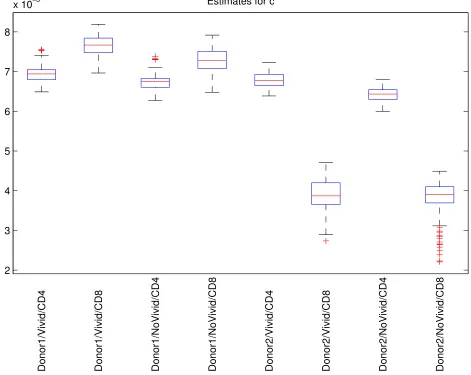
• The use of Vivid dye does not appear to lead to a statistically significant difference in the estimate obtained for the parameter c (cf. box plots 1 and 3, 2 and 4, 5 and 7, and 6 and 8 from Figure 11, numbering sequentially from left to right).
• The estimate forcis larger for CD8+ T cells than for CD4+ T cells when considering data for Donor 1 (cf. box plots 1 and 2 or 3 and 4). The estimate for c is larger for CD4+ T cells than for CD8+ T cells when considering data for Donor 2 (cf. box plots 5 and 6 or 7 and 8)
• There does not appear to be a statistically significant difference between Donor 1 and Donor 2 in the estimate obtained for c when considering CD4+ T cells (cf. box plots 1 and 5 or 3 and 7), but the Donor 1 estimate is considerably larger than the Donor 2 estimate when considering CD8+ T cells (cf. box plots 2 and 6 or 4 and 8).
We summarize all the conclusions that can be drawn in light of Figures 9 through 20 in Section 5.2.1. By examining scatter plots of various pairings of parameter estimates, we can determine whether or not any correlations might exist between some of the parameters. For example, Figures 21 and 22 indicate a strong correlation between the parameters E
Tdiv 0 and SD Tdiv 0 and E Tdie and SD Tdie , respectively. We therefore implemented a variation of our parameter estimation scheme in which one or more of the 12 model parameters can be fixed, hoping that this might reduce the variability seen in some of the other parameter estimates. The results of fixing ET0div
, ETdie, or both ET0div
and ETdieare discussed in Sections 5.2.2, 5.2.3, and 5.2.4, respectively.
As was demonstrated in Section 5.1, the amount of relative variation in the cell counts undergoes signif-icant changes between Day 3 and Day 5. We therefore also attempt to estimate parameters using only data from Days 1 through 3. The results of this approach are discussed in Section 5.2.5.
5.2.1 Interpreting Basic Parameter Estimates
Here, we summarize all the conclusions that can be drawn by analyzing the box plots in Figures 9 through 20. One general conclusion that can be made from these figures is that the use of Vivid dye does not seem to have a large effect on the estimates obtained for most of the model parameters. Therefore, throughout Section 5.2.1 we will focus on the box plots summarizing “NoVivid” data sets.
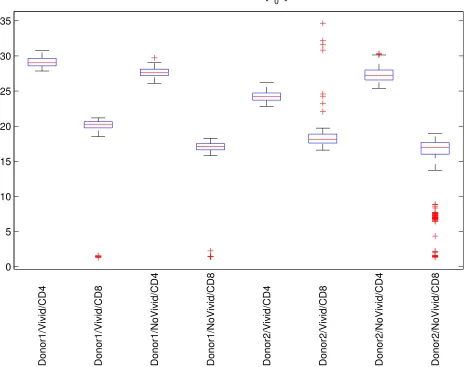
Box plots summarizing estimates for the parameter E [Xa], which represents the mean autofluorescence,
are shown in Figure 9. The 3rd and 4th box plots in that figure indicate that there is a considerable difference in the mean autofluorescence of CD4+ T cells and CD8+ T cells obtained from Donor 1. (Note that the box plots do not “overlap”.) More specifically, CD8+ T cells appear to have a larger mean autofluorescence than CD4+ T cells for Donor 1. On the other hand, the 7th and 8th box plots indicate that CD4+ T cells have a larger mean autofluorescence than CD8+ T cells when considering cells obtained from Donor 2. When we compare CD4+ T cells obtained from the two distinct donors (compare 3rd and 7th box plots), it appears that E [Xa] is larger for Donor 2 than for Donor 1. When comparing CD8+ T cells from the two donors
(compare 4th and 8th box plots), it appears that E [Xa] is larger for Donor 1 than for Donor 2.
Box plots summarizing estimates for standard deviation of the autofluorescence, SD [Xa], are shown in
Figure 10. As with the mean autofluorescence, it appears that the value of this parameter is larger for CD8+ T cells than for CD4+ T cells in the case of Donor 1 and larger for CD4+ T cells than for CD8+ T cells in the case of Donor 2. Also, when comparing CD4+ T cells obtained from the two distinct donors, it appears that SD [Xa] is larger for Donor 2 than for Donor 1, and when comparing CD8+ T cells from the two donors,
it appears that SD [Xa] is larger for Donor 1 than for Donor 2.
Box plots summarizing estimates for the parameter c, which describes exponential decay of CFSE, are shown in Figure 11. It appears that the value of this parameter is larger for CD8+ T cells than for CD4+ T cells in the case of Donor 1 and larger for CD4+ T cells than for CD8+ T cells in the case of Donor 2. When we compare CD4+ T cells obtained from the two distinct donors, there does not appear to be a significant difference in the parameterc; however, when comparing CD8+ T cells from the two donors, it appears that cis larger for Donor 1 than for Donor 2.
Box plots summarizing estimates for the parameter E
Tdiv
0
200 300 400 500 600 700 800
Donor1/Vivid/CD4 Donor1/Vivid/CD8 Donor1/NoVivid/CD4 Donor1/NoVivid/CD8 Donor2/Vivid/CD4 Donor2/Vivid/CD8 Donor2/NoVivid/CD4 Donor2/NoVivid/CD8
Estimates for E[Xa]
200 250 300 350 400
Donor1/Vivid/CD4 Donor1/Vivid/CD8 Donor1/NoVivid/CD4 Donor1/NoVivid/CD8 Donor2/Vivid/CD4 Donor2/Vivid/CD8 Donor2/NoVivid/CD4 Donor2/NoVivid/CD8
Estimates for SD[Xa]
3.5 4 4.5 5 5.5 6 6.5 7 7.5 8 8.5
x 10−3
Donor1/Vivid/CD4 Donor1/Vivid/CD8 Donor1/NoVivid/CD4 Donor1/NoVivid/CD8 Donor2/Vivid/CD4 Donor2/Vivid/CD8 Donor2/NoVivid/CD4 Donor2/NoVivid/CD8
Estimates for c
40 60 80 100 120 140
Donor1/Vivid/CD4 Donor1/Vivid/CD8 Donor1/NoVivid/CD4 Donor1/NoVivid/CD8 Donor2/Vivid/CD4 Donor2/Vivid/CD8 Donor2/NoVivid/CD4 Donor2/NoVivid/CD8
Estimates for E[T
0 div]
40 45 50 55 60 65 70 75
Donor1/Vivid/CD4 Donor1/Vivid/CD8 Donor1/NoVivid/CD4 Donor1/NoVivid/CD8 Donor2/Vivid/CD4 Donor2/Vivid/CD8 Donor2/NoVivid/CD4 Donor2/NoVivid/CD8
Estimates for E[T
0 div]
0 5 10 15 20 25 30
Donor1/Vivid/CD4 Donor1/Vivid/CD8 Donor1/NoVivid/CD4 Donor1/NoVivid/CD8 Donor2/Vivid/CD4 Donor2/Vivid/CD8 Donor2/NoVivid/CD4 Donor2/NoVivid/CD8
Estimates for SD[T
0 div]
Figure 13: Box plots illustrating variability in estimates for the parameter SD
Tdiv
0
0 50 100 150
Donor1/Vivid/CD4 Donor1/Vivid/CD8 Donor1/NoVivid/CD4 Donor1/NoVivid/CD8 Donor2/Vivid/CD4 Donor2/Vivid/CD8 Donor2/NoVivid/CD4 Donor2/NoVivid/CD8
Estimates for E[Tdiv]
7 8 9 10 11 12 13
Donor1/Vivid/CD4 Donor1/Vivid/CD8 Donor1/NoVivid/CD4 Donor1/NoVivid/CD8 Donor2/Vivid/CD4 Donor2/Vivid/CD8 Donor2/NoVivid/CD4 Donor2/NoVivid/CD8
Estimates for E[Tdiv]
0 50 100 150
Donor1/Vivid/CD4 Donor1/Vivid/CD8 Donor1/NoVivid/CD4 Donor1/NoVivid/CD8 Donor2/Vivid/CD4 Donor2/Vivid/CD8 Donor2/NoVivid/CD4 Donor2/NoVivid/CD8
Estimates for SD[Tdiv]
0 1 2 3 4 5 6 7 8 9
Donor1/Vivid/CD4 Donor1/Vivid/CD8 Donor1/NoVivid/CD4 Donor1/NoVivid/CD8 Donor2/Vivid/CD4 Donor2/Vivid/CD8 Donor2/NoVivid/CD4 Donor2/NoVivid/CD8
Estimates for SD[Tdiv]
Figure 15: Box plots illustrating variability in estimates for the parameter SD
Tdiv
0 50 100 150
Donor1/Vivid/CD4 Donor1/Vivid/CD8 Donor1/NoVivid/CD4 Donor1/NoVivid/CD8 Donor2/Vivid/CD4 Donor2/Vivid/CD8 Donor2/NoVivid/CD4 Donor2/NoVivid/CD8
Estimates for E[Tdie]
0 50 100 150
Donor1/Vivid/CD4 Donor1/Vivid/CD8 Donor1/NoVivid/CD4 Donor1/NoVivid/CD8 Donor2/Vivid/CD4 Donor2/Vivid/CD8 Donor2/NoVivid/CD4 Donor2/NoVivid/CD8
Estimates for SD[Tdie]
0.2 0.3 0.4 0.5 0.6 0.7 0.8 0.9 1
Donor1/Vivid/CD4 Donor1/Vivid/CD8 Donor1/NoVivid/CD4 Donor1/NoVivid/CD8 Donor2/Vivid/CD4 Donor2/Vivid/CD8 Donor2/NoVivid/CD4 Donor2/NoVivid/CD8
Estimates for F
0
2 3 4 5 6 7 8 9 10
Donor1/Vivid/CD4 Donor1/Vivid/CD8 Donor1/NoVivid/CD4 Donor1/NoVivid/CD8 Donor2/Vivid/CD4 Donor2/Vivid/CD8 Donor2/NoVivid/CD4 Donor2/NoVivid/CD8
Estimates for D µ
0 1 2 3 4 5 6
Donor1/Vivid/CD4 Donor1/Vivid/CD8 Donor1/NoVivid/CD4 Donor1/NoVivid/CD8 Donor2/Vivid/CD4 Donor2/Vivid/CD8 Donor2/NoVivid/CD4 Donor2/NoVivid/CD8
Estimates for D µ
Figure 19: Box plots illustrating variability in estimates for the parameterDµ. In the upper set of box plots,
0.5 1 1.5 2 2.5
Donor1/Vivid/CD4 Donor1/Vivid/CD8 Donor1/NoVivid/CD4 Donor1/NoVivid/CD8 Donor2/Vivid/CD4 Donor2/Vivid/CD8 Donor2/NoVivid/CD4 Donor2/NoVivid/CD8
Estimates for D
σ
52 54 56 58 60 62 64 66 0 5 10 15 20 25 30 35 Donor1/Vivid/CD4
E[T0div]
SD[T
0
div
]
47 48 49 50 51 52 53 54
15 16 17 18 19 20 21 22 23 24 Donor1/Vivid/CD8
E[T0div]
SD[T
0
div
]
52 54 56 58 60 62 64 66
0 5 10 15 20 25 30 Donor1/NoVivid/CD4 E[T 0 div] SD[T 0 div ]
44 46 48 50 52 54 56 58
0 5 10 15 20 25 Donor1/NoVivid/CD8 E[T 0 div] SD[T 0 div ]
58 58.5 59 59.5 60 60.5 61 61.5 62 62.5
22 22.5 23 23.5 24 24.5 25 25.5 Donor2/Vivid/CD4 E[T0 div ] SD[T 0 div ]
46.5 47 47.5 48 48.5 49 49.5 50 50.5
17 17.5 18 18.5 19 19.5 20 20.5 21 Donor2/Vivid/CD8 E[T0 div ] SD[T 0 div ]
59 60 61 62 63 64 65 66 67
23 24 25 26 27 28 29 30 31 32 Donor2/NoVivid/CD4
E[T0div]
SD[T
0
div
]
40 60 80 100 120 140 160
0 5 10 15 20 25 Donor2/NoVivid/CD8
E[T0div]
SD[T
0
div
]
Figure 21: Scatterplots illustrating a correlation between E
20 40 60 80 100 120 140 0 50 100 150 Donor1/Vivid/CD4
E[Tdie]
SD[T
die
]
0 50 100 150
0 50 100 150
Donor1/Vivid/CD8
E[Tdie]
SD[T
die
]
20 30 40 50 60 70 80 90 100 110 120
0 50 100 150
Donor1/NoVivid/CD4
E[Tdie]
SD[T
die
]
0 50 100 150
0 50 100 150
Donor1/NoVivid/CD8
E[Tdie]
SD[T
die
]
35 40 45 50 55 60 65 70 75 80 85
10 20 30 40 50 60 70 80 90 Donor2/Vivid/CD4
E[Tdie]
SD[T
die
]
20 30 40 50 60 70 80 90 100
0 10 20 30 40 50 60 70 80 90 Donor2/Vivid/CD8
E[Tdie]
SD[T
die
]
10 20 30 40 50 60 70 80 90 100
0 50 100 150
Donor2/NoVivid/CD4
E[Tdie]
SD[T
die
]
0 10 20 30 40 50 60 70 80 90 100
0 50 100 150
Donor2/NoVivid/CD8
E[Tdie]
SD[T
die
]
Figure 22: Scatterplots illustrating a correlation between E
Tdie
and SD
Tdie
T cells than for CD8+ T cells, regardless of which donor we consider. Also, there does not appear to be a significant difference in ET0div when comparing CD4+ or CD8+ T cells obtained from the two distinct donors. Figure 13 indicates that similar statements hold true for SD
Tdiv
0
, which represents the standard deviation in the time to divide for undivided cells.
Box plots summarizing estimates for the parameter E
Tdiv
, which represents the mean time to divide for cells that have divided at least once, are shown in Figure 14. There does not appear to be a significant difference in the value of this parameter for CD4+ and CD8+ T cells, whether we consider cells from Donor 1 or Donor 2. On the other hand, when we compare CD4+ or CD8+ T cells from the two distinct donors, it appears that ETdiv
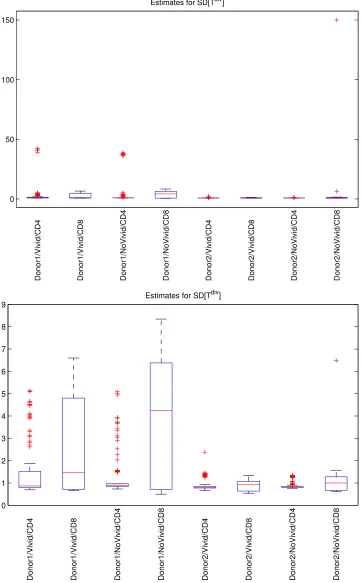
is larger for Donor 1 than for Donor 2. Box plots summarizing estimates for the parameter SD
Tdiv
, which represents the standard deviation in the time to divide for cells that have divided at least once, are shown in Figure 15. For this parameter, there does not appear to be a significant difference in the estimated value when comparing the two cell types from a single donor, or when comparing two donors and a single cell type. Considering the widths of the relevant box plots, we see that there is larger variation in the parameter estimates obtained for CD8+ T cells than those obtained for CD4+ T cells. In fact, the variation in parameter estimates observed for Donor 1 CD8+ T cells is so large that it might lead one to suspect that this parameter is not identifiable.
Box plots summarizing estimates for the parameter ETdie, which represents the mean time to die for cells that have divided at least once, are shown in Figure 16. As was the case with the parameter SD
Tdiv
, there does not appear to be a significant difference in the estimated value of the parameter ETdie when comparing the two cell types from a single donor, or when comparing two donors and a single cell type. For this parameter, we see that there is larger variation in the parameter estimates obtained for Donor 1 cells (of both types) than those obtained for Donor 2 cells. In fact, the variation in parameter estimates observed for Donor 1 cells is so large that it might lead one to suspect that this parameter is not identifiable.
Box plots summarizing estimates for the parameter SD
Tdie
, which represents the standard deviation in the time to die for cells that have divided at least once, are shown in Figure 17. Similar to the situation observed for E
Tdie
, for this parameter there does not appear to be a significant difference in the estimated value when comparing the two cell types from a single donor, or when comparing two donors and a single cell type. Also similar to the situation observed for E
Tdie
, we see that there is larger variation in the estimates for SD
Tdie
obtained for Donor 1 cells (of both types) than those obtained for Donor 2 cells. The variation in parameter estimates observed for Donor 1 cells is once again so large that it might lead one to suspect that the parameter SD
Tdie
is also not identifiable.
Box plots summarizing estimates for the parameter F0, which represents the progressor fraction for undivided cells, are shown in Figure 18. It appears that the value of this parameter is larger for CD8+ T cells than for CD4+ T cells in the case of Donor 1 and larger for CD4+ T cells than for CD8+ T cells in the case of Donor 2. When we compare CD4+ T cells obtained from the two distinct donors, there does not appear to be a significant difference in the parameterF0; however, when comparing CD8+ T cells from the two donors, it appears thatF0 is larger for Donor 1 than for Donor 2.
Box plots summarizing estimates for the parameterDµare shown in Figure 19. There does not appear to
be a significant difference in the value of this parameter for CD4+ and CD8+ T cells in the case of Donor 1, but the parameter value is larger for CD8+ T cells in the case of Donor 2. When we compare CD4+ T cells obtained from the two distinct donors, there does not appear to be a significant difference in the parameter Dµ; however, when comparing CD8+ T cells from the two donors, it appears thatDµ is larger for Donor 2
than for Donor 1.
Box plots summarizing estimates for the parameter Dσ are shown in Figure 20. It appears that the
parameter value is larger for CD8+ T cells than CD4+ T cells in the case of Donor 1, but there does not appear to be a significant difference in the parameter value for CD4+ and CD8+ T cells in the case of Donor 2. When we compare CD4+ T cells obtained from the two distinct donors, it appears that Dσ is
5.2.2 Interpreting Parameter Estimates Obtained Using Fixed Value for E
Tdiv
0
Here we discuss the parameter estimates obtained when fixing the value of the parameter E
Tdiv
0
. We choose to fix the value of this parameter at the (approximate) median estimates obtained from the basic parameter estimation scheme (with no fixed parameters). Since these medians vary for the different combinations of donor, Vivid dye status, and cell type, we use different fixed values for each of these combinations. The specific fixed values we use are shown in Table 6, and the results of applying our modified parameter estimation technique (fixing the value of ET0div
) are provided in Figures 23 through 33. Recall that our goal in fixing the value of the parameter E
Tdiv
0
is to reduce the variability in the param-eter estimates for SD
Tdiv
0
, which seems to be correlated with E
Tdiv
0
(based on Figure 21). Throughout the discussions that follow, we will use the interquartile range (IQR) as a rough measure of variability in the parameter estimates for a given combination of donor, Vivid dye status, and cell type. Comparing Figures 13 and 26, we see that using a fixed value for E
Tdiv
0
does considerably reduce the variability in the estimates of SDT0divin the case of Donor 1 data; however, this is not generally true in the case of Donor 2 data. In fact, when using data for Donor 2’s CD8+ T cells (without use of Vivid dye), the variability in the estimates for SDT0div
is substantially larger (IQR of 1.66 vs. 0.81) when fixing the parameter ET0div
. Returning to Figure 21, note that the scatter plots reveal strong correlation between E
Tdiv 0 and SD Tdiv 0
in the case of Donor 1, but weak correlation (or no correlation) between these two parameters in the case of Donor 2. Therefore, the results when fixing one of the parameters in question are actually consistent with what one might expect.
Comparing Figures 23 through 33 with Figures 9 through 20 (or, more precisely, comparing the IQR’s for the corresponding box plots in those figures) reveals that fixing the value of ET0div
isnot a universally advantageous approach if our goal is to reduce variability in the parameter estimates. Interestingly, this approach is almost always advantageous in the case of Donor 1 data, but for many of the parameter estimates this approach causes anincrease in variability when considering the Donor 2 data. For example, estimates for E [Xa], SD [Xa], SD
Tdiv 0 , E Tdie , SD Tdie
, andDµ all experience significant increases in variability
for at least some of the combinations of Vivid dye status and cell type when considering Donor 2 data.
5.2.3 Interpreting Parameter Estimates Obtained Using Fixed Value for E
Tdie
Here we discuss the parameter estimates obtained when fixing the value of the parameter E
Tdie
. Again, we choose to fix the value of the parameter at the approximate median estimates obtained from the basic parameter estimation scheme. The specific fixed values we use are shown in Table 7 and the results of applying our modified parameter estimation technique (fixing the value of E
Tdie
) are provided in Figures 34 through 44.
Recall that our goal in fixing the value of the parameter E
Tdie
is to reduce the variability in the param-eter estimates for SD
Tdie
, which seems to be correlated with E
Tdie
(based on Figure 22). Comparing Figures 17 and 41, we see that using a fixed value for ETdie does considerably reduce the variability in the estimates of SD
Tdie
in most cases; however, when using data for Donor 2’s CD4+ T cells (with use
Donor Vivid Used Cell Type ET0div
1 Y CD4 64
1 Y CD8 51
1 N CD4 62.5
1 N CD8 49
2 Y CD4 60.5
2 Y CD8 48
2 N CD4 64
2 N CD8 47
350 400 450 500 550 600 650 700 750 800
Donor1/Vivid/CD4 Donor1/Vivid/CD8 Donor1/NoVivid/CD4 Donor1/NoVivid/CD8 Donor2/Vivid/CD4 Donor2/Vivid/CD8 Donor2/NoVivid/CD4 Donor2/NoVivid/CD8
Estimates for E[Xa]
Figure 23: Box plots illustrating variability in estimates for the parameter E [Xa] when the parameter
E
Tdiv
0
200 220 240 260 280 300 320 340 360 380 400
Donor1/Vivid/CD4 Donor1/Vivid/CD8 Donor1/NoVivid/CD4 Donor1/NoVivid/CD8 Donor2/Vivid/CD4 Donor2/Vivid/CD8 Donor2/NoVivid/CD4 Donor2/NoVivid/CD8
Estimates for SD[X
a]
Figure 24: Box plots illustrating variability in estimates for the parameter SD [Xa] when the parameter
E
Tdiv
0
2 3 4 5 6 7 8
x 10−3
Donor1/Vivid/CD4 Donor1/Vivid/CD8 Donor1/NoVivid/CD4 Donor1/NoVivid/CD8 Donor2/Vivid/CD4 Donor2/Vivid/CD8 Donor2/NoVivid/CD4 Donor2/NoVivid/CD8
Estimates for c
Figure 25: Box plots illustrating variability in estimates for the parameterc when the parameter E
Tdiv
0
0 5 10 15 20 25 30 35
Donor1/Vivid/CD4 Donor1/Vivid/CD8 Donor1/NoVivid/CD4 Donor1/NoVivid/CD8 Donor2/Vivid/CD4 Donor2/Vivid/CD8 Donor2/NoVivid/CD4 Donor2/NoVivid/CD8
Estimates for SD[T
0 div]
Figure 26: Box plots illustrating variability in estimates for the parameter SD
Tdiv
0
when the parameter ET0div
10 15 20 25
Donor1/Vivid/CD4 Donor1/Vivid/CD8 Donor1/NoVivid/CD4 Donor1/NoVivid/CD8 Donor2/Vivid/CD4 Donor2/Vivid/CD8 Donor2/NoVivid/CD4 Donor2/NoVivid/CD8
Estimates for E[Tdiv]
7 8 9 10 11 12 13
Donor1/Vivid/CD4 Donor1/Vivid/CD8 Donor1/NoVivid/CD4 Donor1/NoVivid/CD8 Donor2/Vivid/CD4 Donor2/Vivid/CD8 Donor2/NoVivid/CD4 Donor2/NoVivid/CD8
Estimates for E[Tdiv]
Figure 27: Box plots illustrating variability in estimates for the parameter E
Tdiv
when the parameter ET0div
0 5 10 15 20 25 30
Donor1/Vivid/CD4 Donor1/Vivid/CD8 Donor1/NoVivid/CD4 Donor1/NoVivid/CD8 Donor2/Vivid/CD4 Donor2/Vivid/CD8 Donor2/NoVivid/CD4 Donor2/NoVivid/CD8
Estimates for SD[Tdiv]
0 1 2 3 4 5 6 7 8 9
Donor1/Vivid/CD4 Donor1/Vivid/CD8 Donor1/NoVivid/CD4 Donor1/NoVivid/CD8 Donor2/Vivid/CD4 Donor2/Vivid/CD8 Donor2/NoVivid/CD4 Donor2/NoVivid/CD8
Estimates for SD[Tdiv]
Figure 28: Box plots illustrating variability in estimates for the parameter SD
Tdiv
when the parameter E
Tdiv
0
0 50 100 150
Donor1/Vivid/CD4 Donor1/Vivid/CD8 Donor1/NoVivid/CD4 Donor1/NoVivid/CD8 Donor2/Vivid/CD4 Donor2/Vivid/CD8 Donor2/NoVivid/CD4 Donor2/NoVivid/CD8
Estimates for E[Tdie]
Figure 29: Box plots illustrating variability in estimates for the parameter E
Tdie
when the parameter E
Tdiv
0
0 50 100 150
Donor1/Vivid/CD4 Donor1/Vivid/CD8 Donor1/NoVivid/CD4 Donor1/NoVivid/CD8 Donor2/Vivid/CD4 Donor2/Vivid/CD8 Donor2/NoVivid/CD4 Donor2/NoVivid/CD8
Estimates for SD[Tdie]
Figure 30: Box plots illustrating variability in estimates for the parameter SD
Tdie
when the parameter E
Tdiv
0
![Figure 9: Box plots illustrating variability in estimates for the parameter E [Xa].](https://thumb-us.123doks.com/thumbv2/123dok_us/1440701.1176480/19.612.72.537.204.562/figure-box-plots-illustrating-variability-estimates-parameter-xa.webp)
![Figure 23: Box plots illustrating variability in estimates for the parameter E [Xa] when the parameterE�T div0�is fixed.](https://thumb-us.123doks.com/thumbv2/123dok_us/1440701.1176480/35.612.74.539.193.557/figure-plots-illustrating-variability-estimates-parameter-parametere-xed.webp)
![Figure 24: Box plots illustrating variability in estimates for the parameter SD [Xa] when the parameterE�T div0�is fixed.](https://thumb-us.123doks.com/thumbv2/123dok_us/1440701.1176480/36.612.73.538.200.557/figure-plots-illustrating-variability-estimates-parameter-parametere-xed.webp)