Annotating Subjective Content in Meetings
Theresa Wilson
School of Informatics University of Edinburgh Edinburgh, U.K. EH9 8LW [email protected]
Abstract
This paper presents an annotation scheme for marking subjective content in meetings, specifically the opinions and sentiments that participants express as part of their discussion. The scheme adapts concepts from the Multi-perspective Question Answering (MPQA) Annotation Scheme (Wiebe et al., 2005; Wilson, 2008), an annotation scheme for marking opinions and attributions in the news. The adaptations reflect the differences in multiparty conversation as compared to text, as well as the overall goals of our project.
1.
Introduction
Applications such as meeting browsers and meeting assis-tants aim to identify, extract, and summarisemeeting con-tent — information about what happens and what is dis-cussed in meetings. Some meeting content is primarily ob-jective, for example, information about what topics are dis-cussed (Hsueh and Moore, 2006) and who is assigned to work on a given task (Purver et al., 2006). However, an-other type of meeting content that is important is the sub-jective contentof meetings, that is, the opinions and sen-timents that the participants express during discussion in the meeting. Recognizing subjective content is important because, intuitively, it seems that such information would help with existing meeting-browser tasks, such as decision detection (Hsueh and Moore, 2007). But subjective content in and of itself is also interesting and important to extract and summarise. We would like to know not only what a particular decision was but who supported or opposed the decision. Imagine asking a meeting assistant not only to summarise the major ideas that were discussed but also the pros and cons expressed about those ideas.
To extract and summarise the subjective content of meet-ings, we first need to be able to identify when something subjective is being said and also to recognize the type of subjective content that is being expressed (e.g., positive or negative sentiment). We also need to be able to identify the
sourceand thetargetof the subjectivity—who the subjec-tivity is attributed to and what it is about. Although it is likely that most of the time the speaker is expressing his or her own opinions, it is not unusual for the speaker to re-port someone else’s opinion or to be speaking on behalf of the group. For example, in (1) below, the speaker is report-ing the opinion of the company, and in (2), the speaker is reporting information from a user study about remote con-trols. In example (3), the speaker is reiterating an opinion that the group as a whole holds.
(1) The first one is that um uh the company’s decided that teletext is outdated uh because of how popular the internet is.
(2) Um people uh additionally aren’t aren’t liking the appearance of their products
(3) Also we talked earlier about R S I and wanting to prevent um any sort of like Carpal Tunnely kind of thing
In this paper, we present an annotation scheme for mark-ing subjective content in meetmark-ings. The annotation scheme adapts concepts from the Multi-perspective Question An-swering (MPQA) Annotation Scheme (Wiebe et al., 2005; Wilson, 2008), an annotation scheme developed for mark-ing opinions and attributions in news articles. The adap-tations reflect the differences in multiparty conversation as compared to text, as well as our overall project goals, which are focused more on recognizing positive and negative sen-timents than on other types of subjectivity.
In the sections that follow, we first give an overview of the MPQA Annotation Scheme, followed by a discussion of the things we needed to consider as we set about adapting the concepts in the MPQA Scheme to multiparty conversa-tion and our project goals. After that, we present our new annotation scheme for marking subjective content in meet-ings and an inter-annotator agreement study to show that the annotations can be marked reliably. We discuss the in-teraction between the subjectivity annotations and the dia-logue act tags in the annotated corpus. The paper ends with a discussion of related work and conclusions.
2.
Overview of MPQA Annotation Scheme
frames: direct subjective frames,expressive subjective el-ement frames, objective speech event frames, and agent frames. In (Wilson, 2008), the MPQA scheme is extended to include two new types of annotation frames: attitude framesandtarget frames.
The direct subjective frame and the expressive subjective element frame are both used for representing private states, but they capture distinct ways that private states are ex-pressed. Direct subjective frames are used to mark expres-sions that explicitly refer to private states and expresexpres-sions that refer to speech events1 in which a private state is
ex-pressed. The phrase “have doubts” in (4) is an example of an expression that explicitly refers to a private state. In (5), the phrase “was criticized” refers to a speech event in which a private state is being expressed, as does the phrase “said” in (6). The word “criticized” conveys that a nega-tive evaluation was expressed by many people, even though their exact words are not given. With “said” in (6), it is the quoted speech that conveys the private state of the speaker, specifically the phrase “a breath of fresh air.” Expressive subjective element frames are used to mark expressions that indirectly express private states, through the way something is described or through a particular wording. The phrase “a breath of fresh air” is an example of an expressive subjec-tive element, as is the phrase “missed opportunity of his-toric proportions” in (7).
(4) Democrats also have doubts about Miers’ suitability for the high court.
(5) Miers’ nomination was criticized from people all over the political spectrum.
(6) “She [Miers] will be a breath of fresh air for the Supreme Court,” LaBoon said.
(7) This the nomination of Miers is a missed opportunity of historic proportions.
Although private states are often expressed during speech events, not all speech events express private states. The objective speech event frame in the MPQA scheme is used to mark speech event phrases that refer to these objective speech events. In sentence (8), an objective speech event is marked on the word “said.”
(8) White House spokesman Jim Dyke said Miers’ confirmation hearings are set to begin Nov. 7.
The agent frame in the scheme is used to mark noun phrases that refer to sources of private states and speech events. The source of a private state is the experiencer of the pri-vate state, and the source of a speech event is its speaker or writer. In (4) above, “Democrats” would be marked as an agent, as would “people all over the political spectrum” in (5) and “LaBoon” in (6).
All of the above annotation frames contain various at-tributes used to further characterize each expression that is annotated. Both private state frames, for example, in-clude attributes for capturing the intensity of the private state being expressed and the polarity of the expression that
1
A speech event is considered any event of speaking or writing.
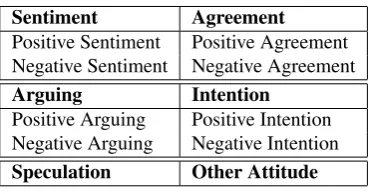
Table 1: Attitude Types in the MPQA Scheme
Sentiment Agreement
Positive Sentiment Positive Agreement Negative Sentiment Negative Agreement
Arguing Intention
Positive Arguing Positive Intention Negative Arguing Negative Intention
Speculation Other Attitude
is marked. One attribute that is included in all the annota-tion frames is thenested sourceattribute, which represents a key part of the MPQA annotation scheme. We describe this attribute below; details on the other frame attributes can be found in (Wiebe et al., 2005).
As previously mentioned, the source of a private state is the experiencer of the private state, and the source of a speech event is its speaker or writer. However, in tex-tual discourse such as the news, there are frequently lev-els of attribution. For example, in (4) above, it is ac-cording to the writer of the sentence that the Democrats have doubts. Similarly, in (5) is it according to the writer that people are criticising the nomination. The nested sourceattribute captures these levels of attribution. In sen-tence (4), both the direct subjective frame (“have doubts”) and the agent frame (“Democrats”) are marked with the attribute nestedsource = hwriter, democratsi, where
writeranddemocratsare unique identifiers that represent those agents in the discourse. Similarly, in (6) the expres-sive subjective element frame (“breath of fresh air”), the direct subjective frame (“said”), and the agent frame (“La-Boon”) are all marked with the attributenestedsource =
hwriter, labooni. In the example sentences above, there are no more than two levels of attribution; sentence (7) only has one level for the writer of the sentence. However, in the news domain, it is not uncommon to find three or even more levels of attribution.
The last two types of annotation frames in the MPQA scheme are the attitude frame and the target frame (Wil-son, 2008). The attitude frames are linked to direct subjec-tive frames. The purpose of an attitude frames is to capture the attitude being expressed overall by the private state to which it is linked. Similarly, target frames are linked to attitude frames; they are used to capture the target of the at-titudes to which they are linked. The types of atat-titudes that are included in the attitude frame representation are listed in Table 1.
To date, the MPQA Annotation scheme has been used to annotate a corpus of 535 news articles (about 10,000 sentences) 2. The MPQA annotations have been used in
sentence-level subjectivity classification, phrase-level sub-jectivity and sentiment recognition, and source identifica-tion.
2
3.
Adapting the MPQA Scheme to
Multi-party Conversation
As we set about adapting the MPQA Scheme for marking subjective content in meetings, there were several questions that we needed to consider. First, what type of subjective content would be most valuable to mark? To answer this question, we considered the goals of the end application we were envisioning, an automatic meeting assistant. Ideally, a meeting assistant would be able to extract and summarise information such as who supported or opposed a particular decision and what were the pros and cons behind a certain idea. To extract this kind of information the system will need to be able to identify positive and negative opinions, evaluations, and emotions, as well as agreements and dis-agreements. Although other types of subjectivity may also be informative, those listed above are the most important for our purposes, and this should be reflected in the new annotation scheme.
Also relevant to the question of what types of subjectivity we should mark is whether there arenewtypes of subjec-tive content that appear in conversational discourse that are not encountered in discourse such as the news. The an-swer to this isquestions. In multiparty conversation such as we find in meetings, participants often ask each other questions. Questions obviously can be used to elicit objec-tive information, such as in (9), but they also can be used to elicit subjective information, as in (10).
(9) What shape are the buttons?
(10) What do you think about the design?
Example (10) doesn’t express a private state for the asker of the question, but the expected response to the question will be subjective. Because of this, it will be helpful for the end system to be able to identify subjective questions: Identifying subjective questions may in turn help to identify the subjective utterances that follow. Also, subjective ques-tions use much of the same subjective terminology (e.g., “think”) as subjective statements, and thus would be a po-tential source of noise if they were excluded from consid-eration.
The next question to consider was whether there was a need to represent sources of private states in the new subjective content annotations. In conversation, most of the opinions and sentiments that are expressed will likely be those of the current speaker. However, as previously mentioned, there are certainly instances where the speaker reports opinions that are attributed to someone else. Thus, the new anno-tation scheme at least needs to be able to differentiate tween opinions belonging to the speaker and opinions be-ing reported by the speaker. Is there a need to represent the nesting of sources, as is done in the MPQA Corpus? For spoken conversation, we think this is not important. Rarely will there me more than two levels of sources. If a source is marked that is not the speaker, the nesting will be implicit. The final question that we considered was what granu-larity of subjectivity annotation would be most appropri-ate. The MPQA annotations are expression-level annota-tions. Would expression-level annotations be appropriate
Subjective Utterances
positive subjective negative subjective
positive and negative subjective uncertainty
other subjective subjective fragment
Objective Polar Utterances
positive objective negative objective
Subjective Questions
positive subjective question negative subjective question general subjective question
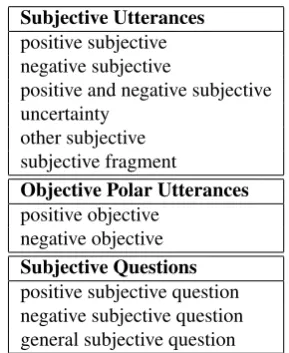
Table 2: AMIDA Subjectivity Annotation Types
or would larger units such as turns be a better choice to an-notate? The more fine-grained the annotations are, the bet-ter the subjective content is pinpointed. However, the more fine-grained and detailed the annotations are, the more time consuming they are to produce. Would it be important or even feasible to mark the spans that refer to the sources and targets of opinions? Or, should source and target informa-tion just be captured as attributes on the subjectivity an-notations? After exploring the meeting data and consider-ing different levels of annotation, we decided on utterance-level annotations. For these annotations,utterance is de-fined loosely. Anutterancemay be a single phrase or ex-pression, but whenever possible it is a sentence or propo-sition with references to the source and target of the sub-jectivity included in the span that is marked. Sources and targets are then marked as attributes of the subjectivity an-notations.
4.
AMIDA Scheme for Annotating
Subjective Content in Meetings
In this section we describe the final scheme we developed for marking subjective content in multiparty conversation. Table 2 lists the annotation types that are included in the scheme. There are three main categories of annotations,subjective utterances,objective polar utterances, and sub-jective questions. We describe each of these in more detail below.
4.1. Subjective Utterances
A subjective utterance is a span of words (or possibly sounds) where a private state is being expressed, either through choice of words or prosody. There are six types of subjective utterances in the scheme:positive subjective,
negative subjective,positive and negative subjective,other subjective,uncertainty, andsubjective fragment.
Thepositive subjective category includes agreement, pos-itive sentiments (emotions, evaluations, and judgments), positive suggestions, arguing for something, beliefs from which positive sentiments can be inferred, and positive re-sponses to subjective questions. The negative subjective
those in the positive subjective category, specifically, dis-agreement, negative sentiments, negative suggestions, ar-guing against something, beliefs from which negative senti-ments can be inferred, and negative responses to subjective questions. Example (11) contains two positive subjective utterances and one negative subjective utterance. Each an-notation is indicated by a pair of angle brackets.
(11) UmhPOS-SUBJit’s very easy to usei. Um hNEG-SUBJ but unfortunately it does lack the advanced functionsi hPOS-SUBJwhich I I quite like having on the controlsi.
Thepositive and negative subjectivecategory is for mark-ing cases of positive and negative subjectivity that are so closely interconnected that it is difficult or impossible to separate the two. For example, some subjective words or phrases inherently evoke both a positive and negative sen-timent. One example is the word bittersweet. Other ex-amples come from when the grammatical structure makes it difficult to separate the positive and negative subjectiv-ity into two utterances that clearly capture both the positive and the negative. This is the case with example (12) below. The positive suggestion is to use the remote only to con-trol the television. The negative suggestion is to not use the remote to control the VCR, DVD player, etc.
(12) Um hPOSNEG-SUBJ they’ve also sug-gested that we um we only use the remote con-trol to concon-trol the television, not the VCR, DVD or anything elsei.
Other than positive and negative subjectivity, the only other type of subjectivity that we are specifically identifying is uncertainty. We included this category with the idea that being able to identify when individuals are uncertain might be useful for recognizing when there are problems or when things remain undecided. Below is an example of an uncer-tain utterance.
(13) UmhUNCERTI’m not entirely sure what the corporate colour isi.
Contrary to its name, theother subjectivecategory is not used to mark all other expressions of private states that do not fall into the above categories. Rather, it is used to mark neutral emotions or evaluations, as well as beliefs, argu-ments, and speculations that are not indirectly conveying a positive or negative sentiment. An example of an emotion that is not always positive or negative is surprise. Example (14) is an utterance that would also be marked as other sub-jective. In this example, a belief or opinion is being express that it is neither positive or negative.
(14)hOTHER-SUBJI think one factor would be production costi.
Thesubjective fragmentcategory is used to mark short frag-ments that are clearly subjective, either because of subjec-tive words or phrases or because of the prosody used when expressing the fragment, but there is not enough being said to determine one of the other subjective categories or what the subjectivity is about. There is a subjective fragment marked in (15).
(15)hSUBJ-FRAGLooks kind ofiYeah .
4.2. Objective Polar Utterances
Objective polar utterances are statements or phrases that describe positive or negative factual information about something without conveying a private state. The sentence
The camera broke the first time I used it gives an exam-ple of negative factual information; generally, something breaking the first time it is used is not good. An example of a sentence with positive factual information isThe cam-era lasted for sevcam-eral years past its warranty. Utterances that express positive factual information are marked with thepositive objectivecategory. Those that express negative factual information are marked with thenegative objective
category.
4.3. Subjective Questions
Subjective questions are questions in which the speaker is eliciting the private state of someone else. In other words, the speaker is asking about what someone else thinks, feels, wants, likes, etc., and the speaker is expecting a response in which the other person expresses what he or she thinks, feels, wants, or likes. A subjective question may be a yes/no question, as in example (16) below, or it may be a more open-ended question, as in example (17).
(16) Do you like the large buttons?
(17) What do you think about the large buttons?
In our annotation scheme, we distinguish between three types of subjective questions:positive subjective questions,
negative subjective questions, andgeneral subjective ques-tions. A positive subjective question is a question that is specifically trying to elicit the positive private state of someone else, and a negative subjective question is trying to elicit a negative private state. For example, (16) above is a positive subjective question. It can easily be changed into a negative subjective question:Do you hate/not like the large buttons? Positive subjective and negative subjective questions do not need to be yes/no questions. For example, the question What do you like about the buttons? would also be a positive subjective question because it is specifi-cally trying to elicit an answer that is expressing a positive private state. Subjective questions that do not ask specifi-cally about the positive or negative private state of someone else aregeneral subjective questions. Question (16) above is an example of a general subjective question.
4.4. Sources and Targets
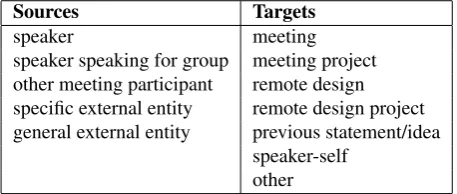
In our new annotation scheme, sources and targets are rep-resented conceptually as enumerated attributes of subjec-tive utterances and objecsubjec-tive polar utterances. Table 3 lists the categories of sources and targets that can be marked. Sources and targets are marked only on the subjective ut-terances and the objective polar utut-terances.
Sources Targets
speaker meeting
speaker speaking for group meeting project other meeting participant remote design specific external entity remote design project general external entity previous statement/idea
speaker-self other
Table 3: AMIDA Source Types and Target Types
(18)hNEG-SUBJ SOURCE=SPEAKER Find-ing them is really a pain, you knowi.
(19) UmhUNCERT SOURCE=SPEAKERI’m not entirely sure what the corporate colour isi.
The source of a subjective utterance or an objective polar utterance may also be some entity external to the meeting. If this is a specific entity, for example, the company or the speaker’s parents, the source is marked as aspecific exter-nal entity. In example (20), the source of the negative sub-jective utterance is the company, which is aspecific external entity. An external entity may also be general, for example, “people” or “the man on the street.” If this is the case, as in example (21), the source is marked as ageneral external entity.
(20) The first one is that um uh hNEG-SUBJ SOURCE=SPECIFIC-EXTERNAL the com-pany’s decided that teletext is outdatedi uh because of how popular the internet is.
(21) UmhNEG-SUBJ SOURCE=GENERAL-EXTERNAL people uh additionally aren’t aren’t liking the appearance of their productsi
If the source of the subjective utterance or objective polar utterance is one or more of the meeting participants other than the speaker, then the source is markedother meeting participant. If the source of the subjective utterances or objective polar utterance is the speaker plus one or more of the other meeting participants (e.g., “Tom and I”, “we”) then the source is markedspeaker speaking for group. There are seven possible target categories that can be marked on a subjective utterance or an objective polar ut-terance (Table 3). The meeting target category is used when the subjectivity is specifically about the activity or the progress of the meeting itself. For example, a strong suggestion that the participants move onto the next topic would havemeetingas its target. The target of the subjec-tive utterance below ismeeting.
(22) Shall we sh well hPOS-SUBJ
SOURCE=SPEAKER TARGET=MEETING
we’ll stick to kind of your area for nowi.
The meetings that we developed this annotation scheme for are scenario meetings from the AMI corpus (Carletta et al., 2005a). For these meetings, participants play the role of a
design team and hold a series of meeting in an instrumented meeting room. Occasionally, participants make a subjec-tive comment related to some aspect of the overall meeting project, as in (23) below. For these utterances, the target is marked asmeeting project.
(23) hNEG-SUBJ SOURCE=SPEAKER TARGET=MEETING-PROJ Unfortunately we’re not allowed to talk outside the meeting roomi.
The remote designandremote design projecttarget types are task related categories. In the AMI scenario meetings, the participants are designing a remote control. If the sub-jectivity is specifically being expressed about some aspect of the remote design, thenremote designis the target. For subjectivity that is expressed about things related to the mote design project other than the actual design of the re-mote, e.g., marketing strategy or the project budget, the tar-get isremote design project.
Another common target for subjectivity is aprevious state-ment or idea. This will typically be the target category used when the subjectivity category is agreement or disagree-ment, but other types of subjectivity may also be directed toward previous statements or ideas raised earlier.
When the target of the subjective utterance or objective po-lar utterance is the speaker of the utterance, e.g., the speaker saying something negative about his or herself, then the tar-get isspeaker-self, as in (24).
(24) hNEG-SUBJ SOURCE=SPEAKER TARGET=SPEAKER-SELF I’m kind of pathetic with things like thisi.
4.5. Overlapping Annotations
It is possible for the annotation types described above to overlap or nest. For example, if the speaker expresses a private state about someone else’s private state this will lead to nested annotations. This is the case for (15). The speaker is expressing an opinion (“I think a recurring theme here is . . . ”). In addition, the speaker is also reporting the opinion of the company (“the company wants . . . something that’s fashionable and sleek and trendy”).
(25) hOTHER-SUBJ SOURCE=SPEAKER TARGET=REMOTE DESIGN I think a recurring theme here is hPOS-SUBJ SOURCE=SPECIFIC EXTERNAL TAR-GET=REMOTE DESIGNthe company wants it to be [disfmarker] wants us to make something that’s fashionable and sleek and trendyi i
Other sorts of nesting can occur as well, for example, the speaker expressing his or her own private state through prosody while asking a subjective question.
5.
Agreement Study
Kappa % Agreement Subjective Utterances (excluding fragments) 0.56 79
Positive Subjective 0.58 84
Negative Subjective 0.62 92
Positive Subjective + Positive Objective 0.58 83 Negative Subjective + Negative Objective 0.68 93
Subjective Question 0.56 95
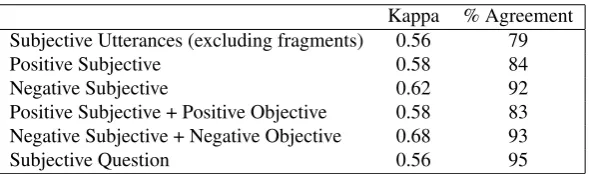
Table 4: Interannotator agreement for the AMIDA subjectivity annotations
XML Toolkit (NXT) (Carletta et al., 2005b). Although an-notations are marked on the meeting transcript, annotators were instructed to listen to the meeting audio and to view the meeting videos as part of the annotation process. When performing the subjective content annotations, an-notators were not given a fixed set of units or unit bound-aries to annotate. Instead, the annotators chose the spans that they felt best captured the concepts described in the scheme. Because of this, the sets of annotations that the two annotators marked are different, which makes evaluat-ing agreement less straightforward. One possible method for calculating agreement is to measure the precision and recall of one annotator’s tags with respect to the other’s. Although this method is informative, it does not take into account the agreement that is expected by chance. Instead, we chose to measure agreement based on the dialogue act segments already marked in the corpus. We found that only a small percentage of the subjectivity annotations marked by each annotator (13% for annotator A, and 27% for anno-tator B) actually crossed dialogue act segment boundaries. Between the two meetings in the study, there are a total of 1,889 dialogue act segments.
Because it is possible for a dialogue act segment to contain more than one subjectivity annotation, we measured agree-ment for each annotation type separately. Table 4 shows the agreement for key annotation types measured in terms of Kappa (Cohen, 1960) and percent agreement. Agreement for whether a segment contains a subjective utterance is 0.56 kappa. The annotators have similar agreement for pos-itive subjective utterances and subjective questions. Inter-estingly, agreement for whether a segment contains a neg-ative subjective utterance is higher, 0.62 kappa, suggesting that negative subjectivity is easier to recognise, or at least less ambiguous, than positive subjectivity. Hypothesising that some of the disagreement might be due to confusion between the positive/negative subjective categories and the positive/negative objective categories, we also calculated agreement after conflating the two positive categories and the two negative categories. Although this did not lead to improved agreement for recognizing the combined positive categories, it did improve agreement for the combined neg-ative categories, indicating that there is some confusion be-tween negative subjective and negative objective utterances.
6.
Subjectivity Annotations and Dialogue
Acts
To date, 20 scenario meetings (almost 12 hours) from the AMI corpus have been annotated with the scheme pre-sented in Section 4.. Out of the 19,071 dialogue act
seg-ments in the meetings3, 42% were annotated with (i.e., overlap with) one or more of the subjective content anno-tations. Table 5 shows the percentage of total dialogue act segments and the percentage of annotated segments with different annotation types. Interestingly, the largest cate-gory of annotations by far is thepositive subjective cate-gory. This is due in part to agreement being included in the positive category. However, it also seems to to be a property of the type of discourse. In the news, for exam-ple, negative subjectivity is more prevalent. Evidently the opposite is true for meeting data, at least for the types of meetings that were collected for the AMI corpus.
One last thing we want to explore is the intersection be-tween dialogue act tags and the subjective content annota-tions. Dialogue act tags capture the intention of the speaker. Although dialogue act coding schemes vary, some schemes include labels specifically for marking when the intention of the speaker is to express something subjective. This is also true for the AMI dialogue act coding scheme. The AMI dialogue act tagset has a total of 15 labels. Included in tagset are theSuggest,Assessment,Be Positive, andBe Negative labels. The Suggest and Assessment labels are used for marking suggestions and assessments, things that we expect would also be captured by the new subjectivity annotations. The Be Positive andBe Negative labels are used to mark utterances in which the speaker’s intention is to make an individual or the group feel more or less happy. We would also expect this sort of information to be cap-tured by the new annotations. This raises the questions of how the subjective dialogue act tags and the new subjectiv-ity annotations overlap, and how much new information is being captured by the subjectivity annotations.
To answer this question, we looked at how many segments for each of the different dialogue act tags overlapped with subjective utterance annotations and subjective question an-notations. This information is presented in Table 6. Three types of dialogue act tags are excluded from the analysis:
stall,fragment, andother. Looking at the table, we see that the majority of dialogue acts that we expected to be subjec-tive based on their dialogue act tags are indeed subjecsubjec-tive. However, none of the majorities are overwhelming: There are still quite a few dialogue act segments that we would expect to be subjective that are not. For example, around 35% of suggestions are not marked as subjective, and close to 45% of assessment are not marked as subjective. On the other hand, over 40% of informs are marked as
sub-3Segments that contained only vocal sounds and segments
% Total DA Segments % Annotated DA Segments
Subjective Utterances 36.6 87.6
Subjective Question 3.5 8.4
Subjective Utterances + Questions 39.3 94.2
Positive Subjective 22.0 52.6
Negative Subjective 8.5 20.4
Uncertainty 4.0 9.7
Other Subjective 3.3 7.9
Objective Polar Utterances 2.6 6.3
Table 5: Percentage of total dialogue act (DA) segments and percentage of annotated segments with the different annotation types.
% DAs overlapping with Subj Utter Subj Quest
inform 41.8 0.8
elicit inform 28.6 13.3
suggest 61.8 3.6
offer 12.9 0.8
elicit offer/suggest 12.9 47.9
assess 56.3 0.5
elicit assess 27.8 56.0
comment understand 13.8 1.2
elicit comment understand 27.3 18.2
be positive 26.0 0.9
be negative 67.9 0.0
backchannel 10.6 0.0
Table 6: Percentage of each dialogue act (DA) type that overlap with subjective utterance and subjective question annotations.
jective. These results reinforce the idea that the expression of private states is distinct from the expression of speaker intention.
7.
Related Work
In the past few years, there has been some work on rec-ognizing subjective content in multiparty conversations, in-cluding the annotation of meeting data. However, none of annotation schemes capture the level of detail provided by our annotation scheme. Wrede and Shriberg (2003) have worked on recognizing meeting hotspots, which are places in meetings in which the participants are highly involved in the discussion. For that work, they developed a scheme for annotating spurts in terms of speaker involvement. Hillard et al. (2003) developed an annotation scheme for marking agreements and disagreements in multiparty conversation. Although agreements and disagreements are an important type of subjective content, they are far from the only type of subjective content that we will need to identify. So-masundaran et al. (2007) developed a scheme for anno-tating sentiment and arguing expressions in meetings. Al-though their scheme lacks some of the types of information that we include, such as the sources and targets of opin-ions, we feel that our two annotation schemes are comple-mentary. Their annotations capture subjective expressions, which is a level of detail that we do not aim for in our
an-notations. Laskowski and Burger (2006) propose an anno-tation scheme for markingemotionally relevant behaviorin meetings. Although their annotation scheme is fairly rich in the types of subjective content captured, as with the other schemes above, it lacks information about sources and tar-gets. Reidsma et al. (2006) annotate emotions and men-tal states in meetings; however, their annotations are not geared toward extracting subjective content.
8.
Conclusions
In this paper we presented an annotation scheme for mark-ing subjective content in meetmark-ings. The annotation scheme identifies positive and negative subjectivity and different types of subjective questions, as well as uncertainty and positive and negative objective polar statements. The scheme also identifies the sources and targets of the an-notations that are marked, distinguishing between tivity attributed to the speaker of an utterance and subjec-tivity attributed to someone else that the speaker is only reporting. Through an inter-annotator agreement study, we showed that the key concepts in the annotation scheme can be reliably annotated.
We also investigated the interaction between the new sub-jectivity annotations and dialogue act tags, which capture speaker intention. Although there is some overlap between the two types of information, the results of this study show that the expression of subjectivity is not merely a subtype of speaker intention, but rather that the two concepts are distinct. There is much more subjectivity being expressed in multiparty conversation than is captured by subjective di-alogue act tags. Furthermore, utterances that we expect to be subjective based on their dialogue act tag, e.g., sugges-tions and assessments, in actually are not always expressing subjectivity.
9.
References
J. Carletta, S. Ashby, S. Bourban, M. Flynn, M. Guillemot, T. Hain, J. Kadlec, V. Karaiskos, W. Kraaij, M. Kronen-thal, G. Lathoud, M. Lincoln, A. Lisowska, I. McCowan, W. Post, D. Reidsma, and P. Wellner. 2005a. The AMI meeting corpus. In Proceedings of the Measuring Be-havior Symposium on “Annotating and Measuring Meet-ing Behavior”.
Lan-guage. Language Resources and Evaluation Journal, 39(4):313–334.
J. Cohen. 1960. A coefficient of agreement for nominal scales. Educational and Psychological Measurement, 20:37–46.
Dustin Hillard, Mari Ostendorf, and Elizabeth Shriberg. 2003. Detection of agreement vs. disagreement in meet-ings: Training with unlabeled data. In Proceedings of HLT-NAACL 2003.
Pei-Yun Hsueh and Johanna Moore. 2006. Automatic topic segmentation and lablelling in multiparty dialogue. InProceedings of IEEE/ACM Workshop on Spoken Lan-guage Technology.
Pei-Yun Hsueh and Johanna Moore. 2007. What decisions have you made: Automatic decision detection in conver-sational speech. InProceedings of NAACL-HLT 2007. K. Laskowski and S. Burger. 2006. Annotation and
analy-sis of emotionally relevant behavior in the ISL meeting corpus. InProceedings of LREC 2006.
M. Purver, P. Ehlen, and J. Niekrasz. 2006. Detecting ac-tion items in multi-party meetings: Annotaac-tion and ini-tial experiments. InProceedings of MLMI 2006. Randolph Quirk, Sidney Greenbaum, Geoffry Leech, and
Jan Svartvik. 1985. A Comprehensive Grammar of the English Language. Longman, New York.
Dennis Reidsma, Dirk Heylen, and Roeland Ordelman. 2006. Annotating emotion in meetings. InProceedings of LREC 2006.
Swapna Somasundaran, Josef Ruppenhofer, and Janyce Wiebe. 2007. Detecting arguing and sentiment in meet-ings. InProceedings of SIGdial 2007.
Janyce Wiebe, Theresa Wilson, and Claire Cardie. 2005. Annotating expressions of opinions and emotions in lan-guage. Language Resources and Evaluation (formerly Computers and the Humanities), 39(2/3):164–210. Janyce Wiebe. 1994. Tracking point of view in narrative.
Computational Linguistics, 20(2):233–287.
T. Wilson. 2008. Fine-grained Subjectivity and Sentiment Analysis: Recognizing the Intensity, Polarity, and Atti-tudes of Private States. Ph.D. thesis, University of Pitts-burgh.