H. C. Andersen Conversation Corpus
Niels Ole Bernsen, Laila Dybkjær and Svend Kiilerich
Natural Interactive Systems LaboratoryUniversity of Southern Denmark Campusvej 55, 5230 Odense M, Denmark
{nob, laila, kiil}@nis.sdu.dk
Abstract
This paper describes the design, collection and current status of the Hans Christian Andersen (HCA) conversation corpus. The corpus consists of five separate corpora and represents transcription and annotation of some 57 hours of English spoken and deictic gesture user-system interaction recorded mainly with children 2002-2005. The corpora were collected as part of the development and evaluation process of two consecutive research prototypes. The set-up used to collect each corpus is described as well as our use of each corpus in system development. We describe the annotation of each corpus and briefly present various uses we have made of the corpora so far. The HCA corpus was made publicly available at http://www.niceproject.com/data/ in March 2006.
1.
Introduction
The complete Hans Christian Andersen (HCA) conversation corpus described in this paper was made available at http://www.niceproject.com/data/ by end of February 2006. The corpus includes five different corpora representing transcription of approximately 57 hours of English spoken user-system interaction recorded 2002-2005. Common to the corpora is that they present ortho-graphically transcribed and transcription-tagged data from conversations between, primarily, children and youngsters and 3D life-like animated fairytale author HCA. Other-wise, the corpora are different in several respects, reflect-ing their different purposes in the development process.
In this paper, we briefly describe the HCA system and the role of the corpora in its development, followed by a detailed characterisation of the HCA corpus. We conclude by describing ongoing corpus work.
2.
The HCA System
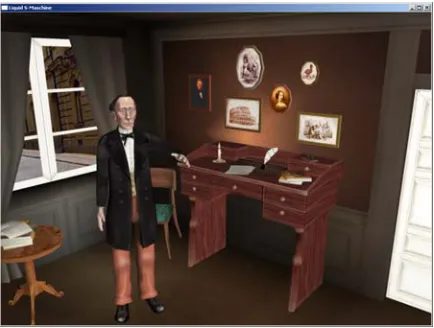
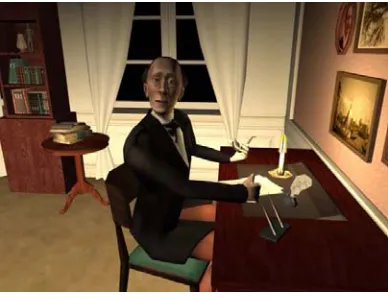
The HCA system was developed in the EU NICE project on Natural Interactive Communication for Edu-tainment, http://www.niceproject.com. A key project goal was to explore the feasibility for embodied conversational characters of carrying out domain-oriented conversation as opposed to standard task-oriented dialogue. Thus, with the HCA system, the 10-18 years old target users do not have any particular task(s) to solve during interaction. Rather, they are invited to have conversation with revived HCA about his fairytales, his life, his person, including his visual appearance on-screen, his study in which he receives his visitors (Figure 2.1), and the user. Jointly and separately, these domains of conversation are huge, and there was no way in which we could have provided virtual HCA with anything like the knowledge he once had. Thus, HCA tells his visitors on occasion that he is still far from knowing everything he once knew, and that users can ask him more about what he actually remembers.
The conversation with HCA is fully mixed-initiative and visitors may also use 2D deictic gesture when talking to HCA about objects in his study.
3.
The HCA Corpus
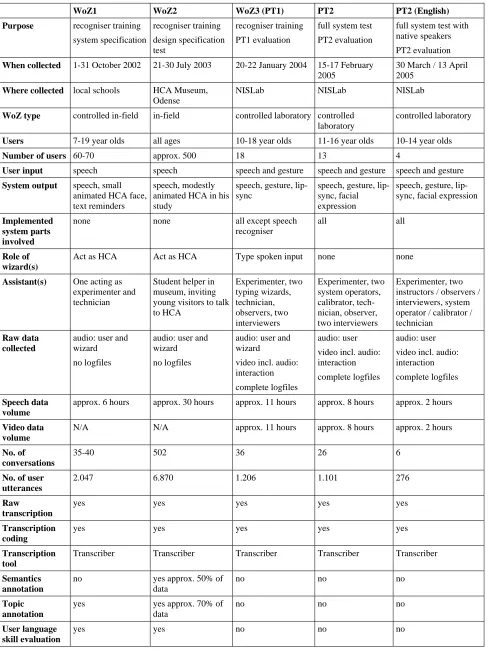
The HCA corpus consists of two early corpora and three user test corpora, cf. Table 3.1. Major goals in corpus development were to collect:
Figure 2.1. HCA in his study (second prototype).
• substantial acoustic speech data for tuning project partner Scansoft’s UK English speech recogniser with children’s speech;
• data for speech recogniser vocabulary and language model development;
• data on how users express themselves for natural language understanding module development;
• deictic gesture and combined speech/gesture data;
• data on what the users want to talk to HCA about. The corpora served various other purposes as well and were developed at different stages in the development life-cycle. In the following we provide more details on the five corpora, the setups used for collecting them, and their annotations (Section 4).
3.1. Early Wizard of Oz Corpora
The first two corpora were developed using Wizard of Oz (WoZ) simulation.
3.1.1. First Wizard of Oz Corpus
The purpose of the WOZ1 corpus was to explore chil-dren’s conversation with HCA. WOZ1 demonstrated that Danish kids were quite happy talking to HCA in English and curious to explore his knowledge and opinions.
like as possible, the interface Sound Blaster Live! was used for distortion along with the Sound Blaster card. The wizard was responsible for controlling the mouth, eye and head movements of a cartoon-like HCA face, which could be seen by the user via a mini-hub connection.
Figure 3.2. WOZ1 user (left) and (right) the HCA the user saw on the screen.
The user’s screen was covered with paper and through a hole HCA was visible (Figure 3.2). Below HCA a list of topics was written (e.g., childhood, youth, and travels). There were no restrictions on what the user could talk about. However, the list was meant to inspire the user in case s/he couldn’t think of anything to talk about. Figure 3.3 shows a conversation snippet.
user why do you begin to read histories
wizard
well at first i wanted to be an actor i tried to get into the theatre but they didn’t want me so instead i started to write
user where do you live the where do you live that you was little where you was little
wizard my childhood i spent in Odense i lived in Odense 'till i was fourteen years old then moved to Copenhagen user where do you live in Copenhagen
Figure 3.3. A dialogue snippet from WOZ1.
3.1.2. Second Wizard of Oz Corpus
Partly based on WOZ1, we developed a more detailed design specification for the first system prototype, inclu-ding HCA’s output in his domains of knowledge and discourse. The specification was simulated in a 10 days, in-field WOZ2 exercise at the HCA Museum in Odense (Figure 3.4). It was judged that a single wizard at-a-time could do the simulation without the need for an assistant. However, since the simulations would go on all day from 9 AM to 7 PM for 10 days in succession, two wizards took turns talking to the museum visitors.
The wizard was wirelessly connected to the laptop which showed a primitive HCA mock-up (Figure 3.5) and navigated HCA’s designed output in hypertext while speaking to the visitors using voice distortion. In addition to following the specification, the wizard made several planned improvisations, for instance to explore users’ interest in topics outside the specification, such as modern technical inventions which was a great interest of HCA’s.
In the museum, posters were put up inviting visitor to talk to “a nice person”. Moreover, an assistant invited
visitors to try the system, answered questions and helped the users put on the microphone headset, ensuring as much as possible that the microphone had the right distance to the mouth of the user. Then the assistant instructed the users to say hello to the system in order to start the conversation. Figure 3.6 shows a snippet from a conversation.
Figure 3.4. User talking to HCA in the museum.
Figure 3.5. HCA on-screen in WOZ2. He could only move his head and lips.
user i haven't heard much about the Little Mermaid could you please tell me 'bout it
wizard yes the mermaid saves a prince from drowning and falls in love with him. to become human and get legs she pays with her beautiful voice. because she is now dumb she cannot tell the prince who she is and he marries another causing the mermaid to die
user okay a
wizard do do you like the story
user yea i like i've watched a c cartoon about it a ca a cartoon movie
wizard what is a cartoon movie
user well they use drawings and they use a lot o' them and then they make this whole movie about it
Figure 3.6. Conversation snippet from WOZ2.
3.2. User Test Corpora
3.2.1. Third Wizard of Oz (PT1) Corpus
WOZ2 provided early confirmation that the target u-sers appreciated HCA’s story-telling approach. The first prototype, PT1, was developed following a modified ver-sion of the WOZ2 output design specification. Our third corpus, WOZ3, derives from the user test of PT1. WOZ3 is a “bionic” WOZ corpus in the sense that, when testing PT1, we still had wizards simulating the speech recogniser whereas the rest of the system was running.
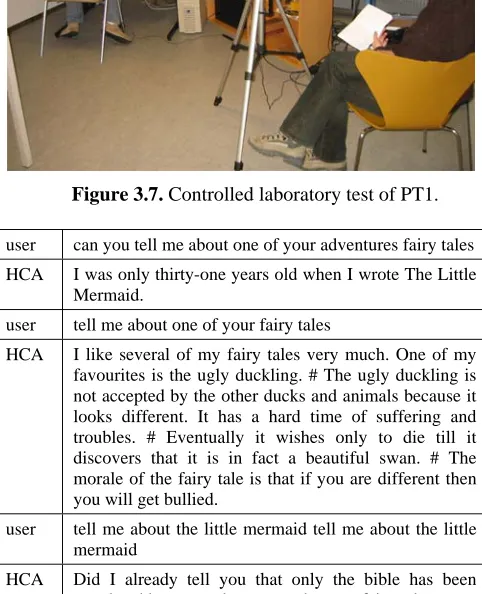
Users came in parallel. Thus, two offices had been pre-pared for user testing. In one room, the user had both a mouse and an 19” touch screen for producing 2D gesture input. In addition, the user could watch HCA on a 42” flat-panel screen (Figure 3.7). In the second room, the user had a mouse and an ordinary 19” screen. All users wore a headset for oral communication. The two wizards (one per user) were placed in a third room. Their job was to type in what the users said, thus replacing the speech recogniser that was not yet integrated with the rest of the system.
Figure 3.7. Controlled laboratory test of PT1.
user can you tell me about one of your adventures fairy tales HCA I was only thirty-one years old when I wrote The Little
Mermaid.
user tell me about one of your fairy tales
HCA I like several of my fairy tales very much. One of my favourites is the ugly duckling. # The ugly duckling is not accepted by the other ducks and animals because it looks different. It has a hard time of suffering and troubles. # Eventually it wishes only to die till it discovers that it is in fact a beautiful swan. # The morale of the fairy tale is that if you are different then you will get bullied.
user tell me about the little mermaid tell me about the little mermaid
HCA Did I already tell you that only the bible has been translated into more languages than my fairy tales.
Figure 3.8. A conversation snippet from WOZ3 (PT1).
Each user test session had a duration of 60-75 minutes. A session included conversation with HCA in two different conditions followed by a post-test interview. In the first condition, the users only received basic instructions on how to operate the system, i.e. speak using the headset, control HCA’s movements, control the four
virtual camera angles, and gesture using mouse or touch screen. After 15 minutes, the first session was interrupted and the user received a set of 13 typed scenario problems to be solved through speech or gesture input in the second session, such as “Find out if HCA has a preferred fairy tale and what it is” and “Tell HCA about games you like or know”. The problems might be addressed in any order and the user was not necessarily expected to carry out all of them. The purpose was to ensure a significant amount of user initiative to explore how the system would respond under the resulting user initiative pressure. Figure 3.8 shows a snippet from the WOZ3 (PT1) corpus.
3.2.2. PT2 Corpus
Following analysis of WOZ3 (see, e.g., [Bernsen and Dybkjær 2004]) and substantial system re-design, not least with the aim of obtaining far more flexible conversation, the second prototype, PT2, was built and tested with users in February 2005. Although the user test conditions were very similar to those in the PT1 test, the resulting corpus is different from WOZ3 because it shows the effects of (i) incorporating a speech recogniser and (ii) strongly improving the system’s conversational abilities.
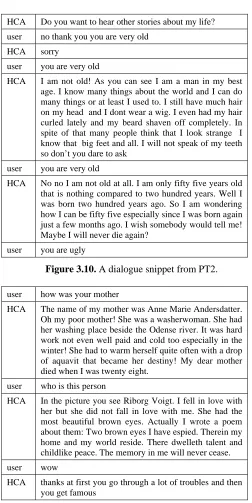
Each user used a microphone/loudspeaker headset, a touch screen for gesture input, and a keyboard for control-ling multiple virtual camera angles and for controlcontrol-ling HCA’s locomotion. Two cameras captured the user’s behaviour during interaction. A developer sat behind the user, monitoring the workings of the system modules, making observations, being ready to re-start a hanging or crashed system component, help users in case of difficulties with the equipment, etc. In about half of the user tests, an observer was present in the test room as well. Figure 3.9 shows a user interacting with PT2 HCA while Figure 3.10 shows an excerpt from the PT2 corpus.
Figure 3.9. Controlled laboratory test of PT2.
human-human conversation and that enabling the HCA system to support these properties is an important and difficult goal for “real” conversational systems as opposed to task-oriented spoken dialogue systems.
Martin et al. [to appear] present results from analysing deictic gesture and combined speech and deictic gesture input in PT2.
Ongoing work addresses (1) quantitative metrics conversation robustness based on PT2, (2) quantitative metrics for conversation success based on PT2, and (3) coding scheme and theory for spoken, deictic gesture, and combined speech-gesture reference to virtual scenes. This latter work is based on PT2 English.
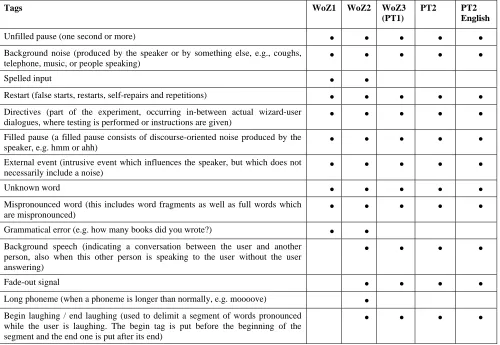
Tags WoZ1 WoZ2 WoZ3
(PT1)
PT2 PT2
English
Unfilled pause (one second or more) • • • • •
Background noise (produced by the speaker or by something else, e.g., coughs, telephone, music, or people speaking)
• • • • •
Spelled input • •
Restart (false starts, restarts, self-repairs and repetitions) • • • • •
Directives (part of the experiment, occurring in-between actual wizard-user
dialogues, where testing is performed or instructions are given) • • • • •
Filled pause (a filled pause consists of discourse-oriented noise produced by the
speaker, e.g. hmm or ahh) • • • • •
External event (intrusive event which influences the speaker, but which does not necessarily include a noise)
• • • • •
Unknown word • • • • •
Mispronounced word (this includes word fragments as well as full words which are mispronounced)
• • • • •
Grammatical error (e.g. how many books did you wrote?) • •
Background speech (indicating a conversation between the user and another person, also when this other person is speaking to the user without the user answering)
• • • •
Fade-out signal • • • •
Long phoneme (when a phoneme is longer than normally, e.g. moooove) •
Begin laughing / end laughing (used to delimit a segment of words pronounced while the user is laughing. The begin tag is put before the beginning of the segment and the end one is put after its end)
• • • •
Table 4.1. Overview of transcription tags used in the five corpora constituting the HCA corpus.
6.
Conclusions
We have described the collection of the HCA conver-sation corpus consisting of five different corpora and re-presenting transcription and annotation of some 57 hours of English spoken and deictic gesture user-system interac-tion. Most users are children and youngsters. The set-up used to collect each corpus has been described as well as our use of each corpus in system development. We have also described the annotation (transcription and otherwise) of each corpus and briefly presented various uses we have made of the corpora so far. If you are interested in obtaining the HCA corpus, please fill the registration form at http://www.niceproject.com/data/.
Acknowledgement
We gratefully acknowledge the NICE project support by EU’s Human Language Technologies programme, contract IST-2001-35293. We would also like to thank Michel Généreux who contributed to the development of the WOZ1 corpus, and Thomas K. Hansen who analysed users’ English proficiency in WOZ1 and WOZ2.
References
Bernsen, N. O.: Measuring relative target user group suc-cess in spoken conversation for edutainment. In J.-C. Martin et al. (Eds.): Proceedings of the LREC 2004 Satellite Workshop on Multimodal Corpora: Models of Human Behaviour for the Specification and Evaluation of Multimodal Input and Output Interfaces. Lisbon, Portugal. Paris: European Language Resources Asso-ciation (ELRA), 17-20.
Bernsen, N. O. and Dybkjær, L.: Evaluation of Spoken Multimodal Conversation. Proceedings of The Sixth International Conference on Multimodal Interaction, ICMI 2004, Penn State University, USA, 2004, 38-45. Bernsen, N. O., Dybkjær, L. and Kiilerich, S.: Evaluating
Conversation with Hans Christian Andersen. Proceedings of the Fourth International Conference on Language Resources and Evaluation (LREC’2004), Vol. III, Lisbon, Portugal, May 2004, 1011-1014. Martin, J. C., Buisine, S., Pitel, G., and Bernsen, N. O.: