Transition and Parsing State and Incrementality
in Dynamic Syntax
∗Masahiro Kobayashiaand Kei Yoshimotob
a
University Education Center, Tottori University, 4-101 Koyama-cho Minami, Tottori, 680-8550 Japan, [email protected]
and
b
Center for the Advancement of Higher Education, Tohoku University, Kawauchi 41, Aobaku, Sendai, 980-8576 Japan, [email protected]
Abstract. This paper presents an implementation of a gramar of Dynamic Syntax for Japanese. Dynamic Syntax is a grammar formalism which enables a parser to process a sentence in an incremental fashion, establishing the semantic representation. Currently the application of lexical rules and transition rules in Dynamic Syntax is carried out arbitrarily and this leads to inefficient parsing. This paper provides an algorithm of rule application and partitioned parsing state for efficient parsing with special reference to processing Japanese, which is one of head-final languages. At the present stage the parser is still small but can parse scrambled sentences, relative clause constructions, and embedded clauses. The parser is written in Prolog and this paper shows that the parser can process null arguments in a complex sentence in Japanese.
Keywords:Japanese, Dynamic Syntax, implementation, rule application, null argument
1. Introduction
Incremental processing of a sentence as it is inputted from left to right has been taken as most accurately simulating human sentence processing. When we attempt theoretically to account for this incrementality of sentence processing, however, we notice that there is a difference between initial languages and final languages. What we need to take into account is that in head-initial languages, like English, parsers canlook aheadto syntactic structures to be established to some extent as a word is consumed. By contrast, this is not the case in head-final languages such as Japanese, because in these languages the syntactic positions of NPs remain unfixed until the matrix verb is inputted finally in the sentence. The Dynamic Syntax approach (Kempson, Meyer-Viol, and Gabbay, 2001; Cann, Kempson, and Marten, 2005), which allows the parser to process a sentence in an incremental fashion, has settled this difficulty by adopting structural underspecification. However, Kempson, Meyer-Viol, and Gabbay (2001) and Cann, Kempson, and Marten (2005) do not provide an explicit algorithm for implementation of the framework as formally as Moot (1999) presentsGrail, the toolkit for a parser of Categorial Grammar Logics. This paper will delineate the basic idea of a parser for Japanese based on the Dynamic Syntax (hereafter, DS) framework, providing the algorithm of the application of lexical rules and transition
∗
We would like to thank two anonymous reviewers for valuable comments.
0
rules. This paper will also show that the parser is able to cope with null arguments or empty pronouns in embedded clauses. Currently the parser is implemented in Prolog.
The outline of this paper is as follows: the subsequent section will provide a brief introduction to the DS formalism and address issues of parsing inefficiency and the algorithm of rule appli-cation, discussing the previous studies. Section 3 will illustrate the implementation of the DS formalism and our algorithm to process head-final languages like Japanese. Section 4 shows how the parser deals with the complex sentences with empty pronouns. Section 5 will be devoted to the discussion. Section 6 will be a conclusion.
2. Dynamic Syntax and Issues of Implementation
2.1. Formalization and Unfixed Nodes
This subsection presents a brief illustration of the DS formalism. DS is a grammar formalism which allows a parser to process a sentence from the onset word to the final word in an incremen-tal way. The (partial) tree structure grows larger and larger, step by step, by the application of transition rules as well as the word consumption; the initial tree structureT0shifts to a subsequent
structureT1, and ultimately to the final tree structureTnas seen in (1).
(1) T0 =⇒rule application=⇒ T1=⇒ · · · ·=⇒ Tn−1=⇒rule application=⇒ Tn
The tree structureT is a set of nodes in the DS formalism, and the initial tree structure consists of a single node{T n(a), ?T y(t),3} (Kempson, Meyer-Viol, and Gabbay, 2001, pp.57) called the root node, where T nis a predicate which expresses an address of a node which includes the variableaindicating that a position of this node has not been specified yet. Moreover, the predicateT nexpresses the relationship between nodes; for instance,T n(01) is the functor node ofT n(0),T n(00) is the argument node ofT n(0).T y(t) is a predicate which expresses the type of the node. The question mark ‘?’ prefixed toT y(t) is called arequirement, which expresses that T y(t) needs to be satisfied by the end of processing: in this initial state, the goal of processing is to meet the condition that this node is of typet. In this sense, the parsing formalism of DS is called goal-directed. The pointer ‘3’ is used to highlight a node and the lexical rules and transition rules are applied to only pointed nodes.
The lexical items themselves take the form of rules such as IF A holds THEN execute B
ELSEexecuteC. These lexical rules as well as transition rules update the current tree structure to the subsequent structure. We assume the following transition rules in this paper for Japanese; LOCAL ∗ADJUNCTION, which is used to introduce an unfixed NP for local scrambling to the
tree structure; GENERALISED ADJUNCTION for introducing the embedded clause to the tree;
∗ADJUNCTIONfor long-distance scrambling; ELIMINATIONfor the functional application; COM
-PLETION, used to bring the pointer back to the mother node; THINNINGfor deleting or satisfying
the requirements; LINKADJUNCTIONfor introducing the relative clauses to the tree; LINKEVAL
-UATIONfor building up the semantic representation for relative clause construction; MERGEfor the unification of unfixed nodes with the vacuous, fixed nodes.
As we have accounted for, NPs in Japanese need to be kept unfixed until the verb has been consumed when the parser processes a sentence. In (2a) the sentence initial NP is the object of the simple main clause, whereas the first NP of (2b) is the object of the embedded, subordinate clause. However, the parser cannot specify the fixed positions of the initial NP of both (2a) and (2b) when the parser consumes them.
(2) a. B¯oru ball
o ACC
John John
ga NOM
b. B¯oru ball
o ACC
John John
ga NOM
nageta throw-PAST
to COMP
Tar¯o Taro
ga NOM
itta. say-PAST
“Taro said that John threw the ball.“
LOCAL∗ADJUNCTIONintroduces an unfixed node which is immediately dominated by the root
node. By contrast, in (2b), first, the unfixed root node of typetfor the embedded clause is intro-duced by GENERALISEDADJUNCTION, then LOCAL∗ADJUNCTIONintroduces an unfixed node which is immediately dominated by the root node of the embedded clause. These unfixed nodes need to find their fixed position by the end of parsing by means of the application of MERGE. Thus, the DS formalism is non-deterministic because the processing of the same sentence initial NP may yield multiple different tree structures. For a more detailed description about the formal-ism, readers are referred to Kempson, Meyer-Viol, and Gabbay (2001) and Cann, Kempson, and Marten (2005).
2.2. Issues of Implementation
This subsection addresses the issues of implementation of the DS framework. When we try to develop an account of linguistic phenomena with limited data, the paper-and-pencil approach is very inefficient. In implementing the DS framework we have two problems to address. The first issue is how we should handle the unfixed nodes efficiently: in the previous subsection we showed that in some case the sentence initial NP is treated as the locally unfixed node introduced by LOCAL ∗ADJUNCTION, whereas it is treated as the unfixed node dominated by the typet, an unfixed root node for the subordinate clause, introduced by GENERALISEDADJUNCTION. These unfixed nodes all need to find their fixed positions in the course of processing with the transition rule MERGE or other update processes. Originally Kempson, Meyer-Viol, and Gabbay (2001) deals with nodes in the tree structure as a set and thus it is very inefficient to search the pointed node among a set each time a rule is applied, if we implement the grammar this way. Purver and Otsuka (2003) and Otsuka and Purver (2003) present a generation and parsing model for English, in which the tree structure is represented as a set of nodes in Prolog. Since in Japanese we need to keep some nodes unfixed, this is not so efficient an approach to Japanese. Instead if we try to cope with these nodes as a normal binary tree structure, we will get into trouble. For example, in Prolog the normal binary tree structure is often implemented recursively:node(s, node(np, [], []), node(vp, [], [])) is the well-known Prolog notation for the tree diagram in which S goes to NP and VP. Unfixed nodes are not easy to be handled in this way. We propose a partitioned-parsing state to cope with these unfixed nodes and MERGEoperation.
3. Implementation of DS for Japanese
3.1. Parsing State
This subsection illustrates the parsing state. Our parser consists of a triplehW,S,Pi, whereW is a list of words to be consumed (words which have not been processed yet),S is a list of (partial) tree structures which the parser obtains until it processes the current word,Pindicates the position at which the pointer exists right now. The initial and final position of the pointer is the root node. The parsing successfully ends if and only ifW contains no word to be scanned, and the pointer goes back to the root node of the resulting fixed tree structure;P ispn(fixed, [root]), and the semantic formula is built up at the root node. The basic idea of the parsing process, from the initial to the final stage, is shown in (3).
(3) hW0,S0,pn(fixed, [root])i ⇒ · · · ⇒ hφ,Sn,pn(fixed, [root])i
In a triplehW,S,Pi,Sconsists of a doublehR,TiwhereRis a list of rules which has been applied to establish the current tree structure. T consists of a triplehF,G,LiwhereF is a fixed tree structure,Gis a tree structure which is introduced by GENERALISEDADJUNCTIONrule, and Lis a tree structure which is introduced by LINK ADJUNCTION. This definition of the parsing state allows the parser to have additional spaces for unfixed nodes and execute MERGEoperation
efficiently.
3.2. Algorithm of Rule Application
This subsection describes the algorithm for processing Japanese sentence on the basis of the DS framework. We also take a brief look at the approach to English sentences presented by Purver and Otsuka (2003) and Otsuka and Purver (2003). The basic idea of Purver and Otsuka’s approach is to divide transition rules into two groups in order to improve efficiency. One group isalways rules, which apply forcibly between the transitions, and the other is possible rules, which do not necessarily apply but can be applied. Since Japanese is a typ-ical head-final language, it is not easy to predict what syntactic structure comes next when the parser processes a sentence in an incremental fashion. To put it another way, the syntactic struc-ture of Japanese is determined (or fixed) by the word the parser has processed to some extent. Japanese is lexically driven in that sense. In order to process Japanese sentences efficiently we need to take into account when lexical rules are applied together with transition rules. Therefore, Purver and Otsuka’s approach is efficient to parse English sentences, but it does not apply di-rectly to Japanese. This subsection proposes an algorithm for Japanese, which is a slightly revised version of Kobayashi (2007).
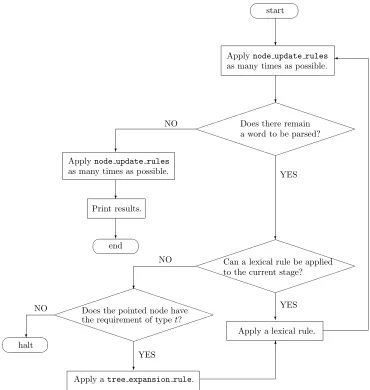
The key idea of this algorithm is that the transition rules are classified into two groups: one istree expansion rules, which are used to expand the current tree structure, providing, for example, a new unfixed node; the other one is node update rules used to update the information of the pointed node and to move the pointer up to the mother node (COMPLETION). tree expansion rulesincludes LOCAL∗ADJUNCTION, GENERALISEDADJUNCTION, and LINK ADJUNCTION. By contrast, MERGE, LINK EVALUATION, ELIMINATION, THINNING, and COMPLETION belong to node update rules. The algorithm is illustrated in Figure 1. In node update rules, rules are applied in the following order; MERGE, LINK EVALU
-ATION, ELIMINATION, THINNING, and COMPLETION. This is because the parser has to es-tablish the semantic representation with ELIMINATION and delete the requirement with THIN
?- parse([boru, o, john, ga, nageta], X).
Step 0
Nothing applied.
Pointer: pn(fixed, [root]) Root: [tn([0]), an([?ty(t)]), []] Gen_adj: []
Linked: link([[], [], []])
Step 1
local_adj, boru applied.
Pointer: pn(fixed, [root, local])
Root: [tn([0]), an([?ty(t)]), [loc([fo(ball), ty(e), ?ty(e)])]] Gen_adj: []
Linked: link([[], [], []])
Step 2
thinning, o applied. Pointer: pn(fixed, [root])
Root: [tn([0]), an([\/[1, ty((e->t))], ?ty(t)]), []]
[tn([0, 1]), an([\/[0, ty(e)], \/[0, fo(ball)], ty((e->t))]), []] [tn([0, 1, 0]), an([fo(ball), ty(e)]), []]
Gen_adj: []
Linked: link([[], [], []])
Step 3
local_adj, john applied.
Pointer: pn(fixed, [root, local])
Root: [tn([0]), an([?ty(t), \/[1, ty((e->t))]]), [loc([fo(john), ty(e), ?ty(e)])]] [tn([0, 1]), an([\/[0, ty(e)], \/[0, fo(ball)], ty((e->t))]), []]
[tn([0, 1, 0]), an([fo(ball), ty(e)]), []] Gen_adj: []
Linked: link([[], [], []])
Step 4
thinning, ga applied. Pointer: pn(fixed, [root])
Root: [tn([0]), an([\/[0, fo(john)], \/[0, ty(e)], ?ty(t), \/[1, ty((e->t))]]), []] [tn([0, 0]), an([fo(john), ty(e)]), []]
[tn([0, 1]), an([\/[0, ty(e)], \/[0, fo(ball)], ty((e->t))]), []] [tn([0, 1, 0]), an([fo(ball), ty(e)]), []]
Gen_adj: []
Linked: link([[], [], []])
Step 5
nageta applied.
Pointer: pn(fixed, [root, 1, 1])
Root: [tn([0]), an([?ty(t), \/[0, fo(john)], \/[0, ty(e)], \/[1, ty((e->t))]]), []] [tn([0, 0]), an([fo(john), ty(e)]), []]
[tn([0, 1]), an([\/[0, ty(e)], \/[0, fo(ball)], ty((e->t))]), []] [tn([0, 1, 0]), an([fo(ball), ty(e)]), []]
[tn([0, 1, 1]), an([fo(lambda(ball, lambda(john, throw(john, ball)))), ty((e->e->t))]), []] Gen_adj: []
Linked: link([[], [], []])
Step 6
completion, elimination, completion, elimination, thinning applied. Pointer: pn(fixed, [root])
Root: [tn([0]), an([ty(t), fo(throw(john, ball)), \/[1, fo(lambda(john, throw(john, ball)))], \/[0, fo(john)], \/[0, ty(e)], \/[1, ty((e->t))]]), []]
[tn([0, 0]), an([fo(john), ty(e)]), []]
[tn([0, 1]), an([fo(lambda(john, throw(john, ball))), \/[1, fo(lambda(ball, lambda(john, throw(john, ball))))], \/[1, ty((e->e->t))], \/[0, ty(e)], \/[0, fo(ball)], ty((e->t))]), []]
[tn([0, 1, 0]), an([fo(ball), ty(e)]), []]
[tn([0, 1, 1]), an([fo(lambda(ball, lambda(john, throw(john, ball)))), ty((e->e->t))]), []] Gen_adj: []
Linked: link([[], [], []])
Semantic Representation: fo(throw(john, ball))
?- parse([john, ga, naomi, ni, kyoujyu, ni, shoukaisuru, to, itta], X).
Step 0
Nothing applied.
Pointer: pn(fixed, [root]) Root: [tn([0]), an([?ty(t)]), []] Gen_adj: []
Linked: link([[], [], []])
Step 1
local_adj, john applied.
Pointer: pn(fixed, [root, local])
Root: [tn([0]), an([?ty(t)]), [loc([fo(john), ty(e), ?ty(e)])]] Gen_adj: []
Linked: link([[], [], []])
~~~~~~~~~~~~~~~~~~~~~~~~~~~~~~~~~~~~~~~~~~~~~~~~~~~~~~~~~ ~~~~~~~~~~~~~~~~~~~~~~~~~~~~~~~~~~~~~~~~~~~~~~~~~~~~~~~~~
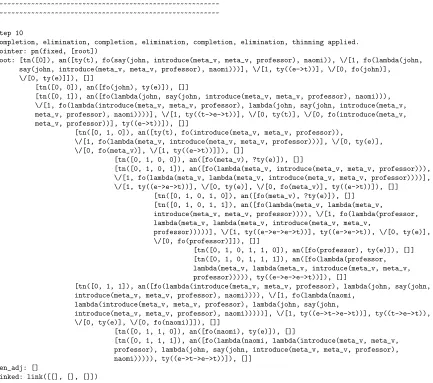
Step 10
completion, elimination, completion, elimination, completion, elimination, thinning applied. Pointer: pn(fixed, [root])
Root: [tn([0]), an([ty(t), fo(say(john, introduce(meta_v, meta_v, professor), naomi)), \/[1, fo(lambda(john, say(john, introduce(meta_v, meta_v, professor), naomi)))], \/[1, ty((e->t))], \/[0, fo(john)], \/[0, ty(e)]]), []]
[tn([0, 0]), an([fo(john), ty(e)]), []]
[tn([0, 1]), an([fo(lambda(john, say(john, introduce(meta_v, meta_v, professor), naomi))), \/[1, fo(lambda(introduce(meta_v, meta_v, professor), lambda(john, say(john, introduce(meta_v, meta_v, professor), naomi))))], \/[1, ty((t->e->t))], \/[0, ty(t)], \/[0, fo(introduce(meta_v, meta_v, professor))], ty((e->t))]), []]
[tn([0, 1, 0]), an([ty(t), fo(introduce(meta_v, meta_v, professor)),
\/[1, fo(lambda(meta_v, introduce(meta_v, meta_v, professor)))], \/[0, ty(e)], \/[0, fo(meta_v)], \/[1, ty((e->t))]]), []]
[tn([0, 1, 0, 0]), an([fo(meta_v), ?ty(e)]), []]
[tn([0, 1, 0, 1]), an([fo(lambda(meta_v, introduce(meta_v, meta_v, professor))), \/[1, fo(lambda(meta_v, lambda(meta_v, introduce(meta_v, meta_v, professor))))], \/[1, ty((e->e->t))], \/[0, ty(e)], \/[0, fo(meta_v)], ty((e->t))]), []]
[tn([0, 1, 0, 1, 0]), an([fo(meta_v), ?ty(e)]), []] [tn([0, 1, 0, 1, 1]), an([fo(lambda(meta_v, lambda(meta_v,
introduce(meta_v, meta_v, professor)))), \/[1, fo(lambda(professor, lambda(meta_v, lambda(meta_v, introduce(meta_v, meta_v,
professor)))))], \/[1, ty((e->e->e->t))], ty((e->e->t)), \/[0, ty(e)], \/[0, fo(professor)]]), []]
[tn([0, 1, 0, 1, 1, 0]), an([fo(professor), ty(e)]), []] [tn([0, 1, 0, 1, 1, 1]), an([fo(lambda(professor, lambda(meta_v, lambda(meta_v, introduce(meta_v, meta_v, professor))))), ty((e->e->e->t))]), []]
[tn([0, 1, 1]), an([fo(lambda(introduce(meta_v, meta_v, professor), lambda(john, say(john, introduce(meta_v, meta_v, professor), naomi)))), \/[1, fo(lambda(naomi,
lambda(introduce(meta_v, meta_v, professor), lambda(john, say(john,
introduce(meta_v, meta_v, professor), naomi)))))], \/[1, ty((e->t->e->t))], ty((t->e->t)), \/[0, ty(e)], \/[0, fo(naomi)]]), []]
[tn([0, 1, 1, 0]), an([fo(naomi), ty(e)]), []]
[tn([0, 1, 1, 1]), an([fo(lambda(naomi, lambda(introduce(meta_v, meta_v, professor), lambda(john, say(john, introduce(meta_v, meta_v, professor), naomi))))), ty((e->t->e->t))]), []]
Gen_adj: []
Linked: link([[], [], []])
Semantic Representation: fo(say(john, introduce(meta_v, meta_v, professor), naomi))
{T n(0),T y(t),3,
F o(say(john,introduce(V,W,professor),naomi))}
```````
{T n(00),T y(e),F o(john)} {T n(01),T y(e→t),
F o(λx(say(x,introduce(V,W,professor),naomi))}
( ( ( ( ( ( (
( hhhhhhhh
{T n(010),T y(t),
F o(introduce(V,W,professor))}
{T n(011),T y(t→e→t),
F o(λy.λx.say(x,y,naomi))}
``````
{T n(0110),T y(e),
F o(naomi)}
{T n(0111),T y(e→t→e→t),
F o(λz.λy.λx.say(x,y,z))}
``````
{T n(0100),
T y(e),F o(V)}
{T n(0101),T y(e→t),
F o(λx.introduce(x,W,professor)}
``````
{T n(01010),
F o(W),T y(e)}
{T n(01011),T y(e→e→t),
F o(λy.λx.introduce(x,y,professor))}
``````
{T n(010110),T y(e),
F o(professor)} {F oT n((010111),λz.λy.λx.introduceT y(e→e→(xe→,yt,)z))}
Figure 4: Abbreviated Parsing Output of (5)
5. Discussion
In this paper we have accounted for the algorithm of the application of lexical and transition rules and the implementation of the DS parser for Japanese. This section provides a discussion regarding the current DS grammar, one on the implementation and future research. One of DS’s goals is to explore language faculty, and our implementation can contribute to the study of this issue by the simulation of human sentence processing. Although this DS Prolog grammar can parse a simple sentence, relative clause constructions, and embedded structure, currently the coverage of this grammar is very small. As future research we would like to integrate a stochastic approach into the system. Another issue to be tackled is how we should deal with pragmatically-related problems such as pronoun resolution. For instance, the parser provides place-holders such as ameta v, but as far as I know there is no research given in the literature about how the parser merges entities in the context with these variables on the basis of the DS framework. This paper deals with only Japanese and we need to make sure whether this algorithm can be applied to other head-final languages such as Korean.
6. Conclusion
References
Cann, R., R. Kempson, and L. Marten. 2005. The Dynamics of Language. Elsevier, Oxford. Hoji, H. 1998. Null object and sloppy identity in japanese.Linguistic Inquiry, 29:127–152. Kempson, R., W. Meyer-Viol, and D. Gabbay. 2001. Dynamic Syntax: The Flow of Language
Understanding. Blackwell Publishers, Oxford.
Kobayashi, M. 2007. Incremental processing and design of a parser for japanese: A dynamic approach. InProceedings of the Fourth International Workshop on Logic and Engineering of Natural Language Semantics (LENLS2007), pages 261–273.
Kuroda, S.-Y. 1965. Generative Grammatical Studies in the Japanese Language. Ph.D. thesis, MIT.
Moot, R. 1999. Grail: An automated proof assistant for categorial grammars. In R. Delmonte, editor,Proceedings of Venezia per il Trattamento Automatico delle Lingue ’99 (VEXTAL99), pages 225–261.
Otsuka, M. and M. Purver. 2003. Incremental generation by incremental parsing. InProceedings of the 6th Annual CLUK Research Colloquium, pages 93–100.
Purver, M. and M. Otsuka. 2003. Incremental generation by incremental parsing: Tactical gener-ation in dynamic syntax. InProceedings of the 9th European Workshop on Natural Language Generation, pages 79–86.