Realization of Common Statistical Methods in Computational Linguistics
with Functional Automata
Stefan Gerdjikov Faculty of Mathematics
and Informatics, Sofia University 5 James Bourchier blvd.,
1164 Sofia, Bulgaria st gerdjikov@
abv.bg
Petar Mitankin Faculty of Mathematics
and Informatics, Sofia University 5 James Bourchier blvd.,
1164 Sofia, Bulgaria pmitankin@ fmi.uni-sofia.bg
Vladislav Nenchev Faculty of Mathematics
and Informatics, Sofia University 5 James Bourchier blvd.,
1164 Sofia, Bulgaria lucifer.dev.0@
gmail.com
Abstract
In this paper we present thefunctional au-tomataas a general framework for repre-sentation, training and exploring of vari-ous statistical models as LLM’s, HMM’s, CRF’s, etc.
Our contribution is a new construction that allows the representation of the derivatives of a function given by a functional au-tomaton. It preserves the natural repre-sentation of the functions and the stan-dard product and sum operations of real numbers. In the same time it requires no additional overhead for the standard dy-namic programming techniques that yield the computation of a functional value.
1 Introduction
Statistical models such as n-gram language mod-els (Chen and Goodman, 1996), hidden Markov models (Rabiner, 1989), conditional random fields (Lafferty et al., 2001), log-linear models (Dar-roch and Ratcliff, 1972) are widely applied in the natural language processing in order to approach various problems, e.g. parsing (Sha and Pereira, 2003), speech recognition (Juang and Rabiner, 1991), statistical machine translation (Brown et al., 1993). Different statistical models perform differently on different tasks. Thus in order to find the best practical solution one might need to try several approaches before getting the desired ef-fect. Disposing on a general framework that al-lows the flexibility to change the statistical model or/and training scheme would spend much efforts and time.
Focusing on this pragmatical problem, we pro-pose the functional automata as a possible solu-tion. The basic idea is to consider the
mathemati-cal expressions of sums and products arising in the statistical models as regular expressions. Thus re-garding the functions in these expressions as indi-vidual characters, the sums as unions and the prod-ucts as concatenation, we get the desired corre-spondence. The relation between a particular sta-tistical model and a functional automaton for its representation is then rather straightforward.
The training of the statistical models is in a way more involved. Most of the approaches require a gradient method that estimates the best model pa-rameters. To this end one needs to have an efficient representation not only of the function used by the model but also of its (partial) derivatives.
To solve similar problem Eisner and Li in-troduce first-order and second-order expectation semirings. In (Jason Eisner, 2002; Zhifei Li and Jason Eisner, 2009) it is shown how derivatives of functions arising in statistical models can be represented. This is achieved by the means of an algebraic construction that: (i) considers pairs of functions (first-order expectation semiring) and quadruples of functions (second-order expectation semiring); (ii) introduces an operation on pairs and quadruples, respectively, of functions that replaces the multiplication and is used to simulate the mul-tiplication of first- and second-order derivatives, respectively. Thus the higher the order of the derivatives in interest, the more complex would be the necessary expectation semiring and the opera-tions that it would require.
In the current paper we propose an alternative approach. It is based on a combinatorial construc-tion that allows preserving both: (i) manipulaconstruc-tion with single functions and (ii) the usage of the stan-dard multiplication and addition of real numbers. Thus we get a uniform representation of functions, their first- and higher order derivatives. Our ap-proach requires the same storage as the apap-proach
in (Jason Eisner, 2002; Zhifei Li and Jason Eis-ner, 2009) and enables the same efficiency for the traversal procedures described in (Zhifei Li and Jason Eisner, 2009).
In Section 3 we show that the values of a func-tion represented by an acyclic funcfunc-tional automa-ton can be efficiently computed by the means of a standard dynamic programming technique. We further describe how to construct functional au-tomata for the partial derivatives of F by given functional automaton representingF. We show in Sections 2 and 6 that such automata can be used for training log-linear models, hidden Markov models and conditional random fields. We only require that the objective function is represented via functional automata. In Section 5 we present a construction of functional automaton for a log-linear model where one of the feature functions uses an n-gram language model (Chen and Good-man, 1996).
In Section 7 we present evaluation of a devel-oped system, based on functional automata, on the tasks of (i) noisy historical text normalization and (ii) OCR postcorrection.
2 Log-linear models
We consider the task of automatic normalization of Early Modern English texts. In the next two paragraphs we define some notions related to this task. We use them afterwards to formulate typical problems of training and search that can be effec-tively solved by functional automata.
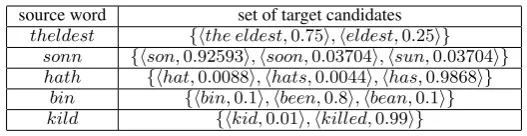
Given a source text s, say s = theldest sonn hath bin kild, and the goal is to find the most relevant modern English equivalent ofs. Acandidate generator is an algorithm that for a fixed source word or sequence of words, say sisi+1. . . si+k, generates finite number of
normalization candidates and supplies each normalization candidate, c, with a conditional probability, pcg(c|sisi+1. . . si+k). Hence we
can assume that the candidate generator provides the information in the form of Table 1. In this sense the candidate generator corresponds to the word-to-word or phrase-to-phrase translation tables in statistical machine translation systems (Koehn et al., 2003). From the candidates we construct possible normalization targets: eldest sun hat been kid, the eldest soon has bean killed, the eldest son has been killedetc. For normaliza-tion of texts produced by OCR system from noisy
source word set of target candidates theldest {⟨the eldest,0.75⟩,⟨eldest,0.25⟩}
sonn {⟨son,0.92593⟩,⟨soon,0.03704⟩,⟨sun,0.03704⟩}
hath {⟨hat,0.0088⟩,⟨hats,0.0044⟩,⟨has,0.9868⟩} bin {⟨bin,0.1⟩,⟨been,0.8⟩,⟨bean,0.1⟩}
kild {⟨kid,0.01⟩,⟨killed,0.99⟩}
Table 1: Source words and their corresponding set of candidates provided by the candidate generator. Each target candidate cfor the source wordsi is
associated with a probabilitypcg(c|si).
historical documents the candidate generator could take into account both typical OCR errors and historical spelling variations, (Reffle, 2011) or can use directly automatically extracted spelling variations, for example (Gerdjikov et al., 2013).
A normalization pair is a pair p = ⟨w, c⟩ such that the sequence of target words c is a normalization candidate for the sequence of source words w. We call w left side and c right side of the normalization pair p. The left and the right sides of p are denoted l(p) and r(p) respectively. In our example some of the normalization pairs are⟨theldest, eldest⟩,
⟨theldest, theeldest⟩, ⟨kild, killed⟩, etc. A nor-malization alignmentfromstot, denoteds→ t, is a sequence of normalization pairs p1p2. . . pk
such that s = l(p1)l(p2). . . l(pk) and t =
r(p1)r(p2). . . r(pk). Thei-th normalization pair
pi of the alignments → t is denoted (s → t)i.
The lengthkof the alignment is denoted|s→t|. Thus a possible normalization alignment in our example, froms=theldest sonn hath bin kild to t=eldest sun hat been kid is ⟨theldest,eldest⟩
⟨sonn,sun⟩⟨hath,hat⟩⟨bin,been⟩⟨kild,kid⟩. We denote withAsthe set of all normalization
align-ments from s. Note thatAs is always finite,
be-cause the number of normalization candidates for each sequencesisi+1. . . si+k of source words is
finite.
Problem.Given a training corpus of normaliza-tion alignmentstraina log-linear model that com-bines the candidate generator with ann-gram sta-tistical language model. Once the model is trained, find a best normalization alignment s → t for a given sources.
Firstly, we consider the case where n = 1, i.e. we have a monogram language model which assigns a nonzero probability plm(ti)
to each target word ti. The general case of
to Section 5. There are two feature functions: hlm(s→t) = log
∏|t|
i=1plm(ti)andhcg(s→t) =
log∏|is=1→t|pcg[r((s→t)i) | l((s→t)i)]. The
probability of a normalization alignment s→t givensispλ(s→t|s) =
exp[λlmhlm(s→t) +λcghcg(s→t)]
∑
s→t′∈Asexp[λlmhlm(s→t′) +λcghcg(s→t′)]
,
where λ = ⟨λlm, λcg⟩ are the parameters of the
model.
Training. Assume that we have a train-ing corpus T of N normalization alignments, T =⟨s(1)→t(1), s(2)→t(2), . . . , s(N)→t(N)⟩. The training task is to find parametersˆλthat opti-mize the joint probability over the training corpus, ˆ
λ=argmaxλ
∏N
n=1pλ(s(n) →t(n)|s(n)).
Search. Once the parameters λˆ are fixed, the problem is to find a best normalization alignment s→ t=argmaxs→t′∈As pˆλ(s→ t′)for a given
inputs.
Introducing es→t(λ) = exp[λlmhlm(s → t) +
λcghcg(s→t)]and
Zs(λ) =
∑
s→t′∈As
es→t′(λ), (1)
we obtainλˆ=argmaxλL(λ), where
L(λ) =∑Nn=1[λlmhlm(s(n)→t(n))+
λcghcg(s(n)→t(n))−log Zs(n)(λ)]. (2) To optimizeL(λ) we use a gradient method that requires the computation of L(λ), ∂λ∂L
cg(λ) and
∂L
∂λlm(λ)by givenλ. Fori=lm, cgwe obtain
∂L ∂λi
(λ) =
N
∑
n=1
[hi(s(n)→t(n))− ∂Z
s(n)
∂λi (λ)
Zs(n)(λ) ].
(3) One possible choice of first order gradient method for the optimization ofLis a variant of the conju-gate gradient method that converges to the unique maximum of L for each starting point λ0 = ⟨λlm0, λcg0⟩, (Gilbert and Nocedal, 1992).
3 Functional automata
The problem we faced in the previous Sec-tion is how to compute L(λ) and ∂λ∂L
i(λ) at a
given point λ. The computation of the terms λihi(s(n)→t(n)) for i = cg (or i = lm) is
easy since it requires a single multiplication and
|s(n) → t(n)| (or |t(n)|) additions. However the
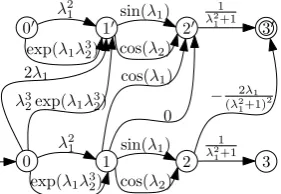
λ2 1
0 1 2 3
exp(λ1λ32) cos(λ2)
sin(λ1) 1
λ2 1+1
Figure 1: Functional automaton representing the function F(λ1, λ2) = λ21sin(λ1)λ21
1+1 + λ21cos(λ2)λ21
1+1
+ exp(λ1λ32) sin(λ1)λ21 1+1
+
exp(λ1λ32) cos(λ2)λ21 1+1
termZs(λ)may require much more efforts. It
suf-fices that each source wordsi generates two
can-didates for the expression in Equation 1 to explode in exponential number of summation terms. Com-puting the derivatives then becomes even harder. In this Section we present a novel efficient solu-tion to these problems. It is based on a compact representation of the mathematical expressions via functional automata.
Imagine, that we have the function F(λ1, λ2)
given as an expression: λ2
1sin(λ1)λ21 1+1
+
λ21cos(λ2)λ21
1+1 + exp(λ1λ
3
2) sin(λ1)λ21 1+1 + exp(λ1λ32) cos(λ2)λ21
1+1
. Let us further assume that we interpret the individual functions λ21, cos(λ2), λ21
1+1
, etc, as single symbols. If we further interpret the multiplication of functions as concatenation and the addition as union, then the expression for F(λ1, λ2) given above can be
viewed as a regular expression for which a finite state automaton can be compiled, see Figure 1. This is the motivation for the following two definitions:
Definition 3.1 Let d be a positive natural num-ber. Functional automaton is a quadruple
A=⟨Q, q0,∆, T⟩, where Q is a finite set of
states,q0∈Qis a start state,∆is a finite multiset
of transitions of the formq −→W pwherep, q∈Q are states and W : Rd → R is a function and T ⊆Qis a set of final states.
Definition 3.2 Let A = ⟨Q, q0,∆, T⟩ be an
acyclic functional automaton (AFA). A path π from p0 to pk inA is a sequence of k ≥ 0
tran-sitionsπ = p0 −→W1 p1 −→W2 p2. . . pk−1 Wk
−→ pk.
The label ofπ is defined aslπ =
∏k
j=1Wj. Ifπ
is empty (k = 0), then lπ = 1. Asuccessful path
is a path fromq0to a final stateq ∈T. The
func-tionFA :Rd→ Rrepresented byAis defined as FA =∑πis a successful path inAlπ.
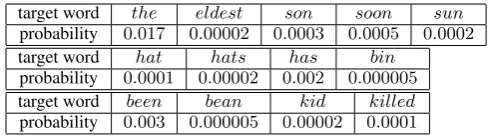
target word the eldest son soon sun probability 0.017 0.00002 0.0003 0.0005 0.0002
target word hat hats has bin
probability 0.0001 0.00002 0.002 0.000005 target word been bean kid killed probability 0.003 0.000005 0.00002 0.0001
Table 2: Target words and their language model probabilities.
Classical constructions for union and concate-nationof automata (Hopcroft and Ullman, 1979) can be adapted for functional automata. IfAis the result of the union (concatenation) ofA1 andA2,
thenFA=FA1 +FA2 (FA=FA1 ·FA2).
3.1 Computation of a functionFA
represented by an AFAA
In order to efficiently computeFA(λ)for a given λ = ⟨λ1, λ2, . . . , λn⟩, we use standard dynamic
programming. Without loss of generality we as-sume that A = ⟨Q, q0,∆, T⟩ has only one final
state and each transition in A belongs to some successful path. Firstly, we sort topologically the states of the automatonAin decreasing order. Let p1, p2, . . . , p|Q| be one such order of the states,
i.e. (i) p1 ∈ T is the only one final state, (ii)
p|Q| = q0 is the start state and (iii) if there is
a transition from pi to pj then j < i. For
ex-ample for the automaton on Figure 1 we obtain 3,2,1,0. Afterwards for each statepj we
com-pute a value vj in the following way: v1 = 1
andvj+1 =
∑
pj+1
W(λ)
−→pk
W(λ)·vk. Eventually
FA(λ) = v|Q|. If the computation of W(λ) by
given λ takes time O(1) for all label functions W, then the time for the computation of FA(λ) isO(|∆|).
Now we focus on the problem how to com-pute Zs(λ) at a given point λ, see Equation 1.
We illustrate how Zs(λ) can be represented by
an AFA, As, on the example from Section 2, s=theldest sonn hath bin kild. Table 1 lists the sets of candidates in modern English for each source word si. Table 2 presents the language
model probabilities for each target word. Given this data we represent the possible normaliza-tion alignments via an acyclic two-tape automa-ton, see Figure 2. This automaton can be con-sidered as a string-to-weight transducer (Mohri, 1997) parameterized with λlm and λcg.
Specif-ically, each path from state i − 1 to state i, 1 ≤ i ≤ |s|, corresponds to a target
candi-the/ exp[λlmlog(0.017)
+λcglog(0.75)] eldest/ exp[λlmlog(0.00002)
+λcglog(0.25)] eldest/
exp[λlmlog(0.00002) +λcglog(1)]
0
6
1
son/
exp[λlmlog(0.0003) +λcglog(0.92593)]
soon/
exp[λlmlog(0.0005) +λcglog(0.03704)]
sun/ exp[λlmlog(0.0002)
+λcglog(0.03704)]
2
hat/
exp[λlmlog(0.0001) +λcglog(0.0088)]
hats/
exp[λlmlog(0.00002) +λcglog(0.0044)]
has/
exp[λlmlog(0.002) +λcglog(0.9868)]
3
bin/
exp[λlmlog(0.000005) +λcglog(0.1)]
been/
exp[λlmlog(0.003) +λcglog(0.8)]
bean/
exp[λlmlog(0.000005) +λcglog(0.1)]
4
kid/ exp[λlmlog(0.00002)
+λcglog(0.01)]
killed/ exp[λlmlog(0.0001)
+λcglog(0.99)]
5
Figure 2: The functional automaton
Atheldest sonn hath bin kild is obtained by removing the words from the transition labels.
date c for the i-th source word si and has a
label exp[λcglog(pcg(c|si)) +λlmlog(plm(c))].
On our example, for i ≥ 2 each such path consists of a single transition, because the can-didates are single words. In order to repre-sent the candidate the eldest we use the ad-ditional state 6. The transition from 0 to 6 corresponds to the first word the of the can-didate and accumulates the whole probability pcg(the eldest|theldest) = 0.75. The transition
from6to1corresponds to the second wordeldest of the candidate. It should be clear that remov-ing the target words from the transitions, we ob-tain the AFA As representing Zs(λ). For each
alignment s(n) → t(n) from the training corpus we build a separate functional automaton, like the one on Figure 2, representingZs(n)(λ). Thus we haveN automata that we use to computeL(λ)via Equation (2).
3.2 Computation of partial derivates via AFA
Our next goal is to compute the partial derivates
∂L
∂λi(λ). Let us turn back to the functionF(λ1, λ2)
soon andeldest sun. We overcome this problem of ambiguity by extendingA1 =⟨Q1, q1,∆1, T1⟩
to equivalent automaton A2 in which for each
state the sequence of n −1 preceding words is uniquely determined. The set of states of A2
is Q2 = {⟨w1w2. . . wn−1, q⟩ | q ∈ Q1 and
w1w2. . . wn−1 is a sequence of preceding words
forqinA1}. The set of transitions ofA2is∆2 = {⟨w1w2. . . wn−1, q′⟩
W
→ ⟨w2. . . wn−1wn, q′′⟩ |
transition q′ →W q′′ ∈ ∆1 is
associ-ated with wn}. In A2 the transition ⟨w1w2. . . wn−1, q′⟩ →W ⟨w2. . . wn−1wn, q′′⟩
is associated with the word wn. Finally,
from A2 we construct functional automaton A3 that represents Zs(⟨λlm, λcg⟩) by adding
exp[λlmlog(plm(wn|w1w2. . . wn−1))] to the
label of each transition t where wn is the word
associated witht.
Ifmis an upper bound for the number of correc-tion candidates for every sequencesisi+1. . . si+k,
then|Q2| ≤mn−1|Q1|and|∆2| ≤mn−1|∆1|.
6 Other statistical models
In this section we apply the technique developed in Sections 3 and 4 to other statistical models.
Conditional random fields. A linear-chain CRF serves to assign a labelyi to each the
obser-vation xi of a given observation sequence x. We
assume that the observationsxi belong to a setX
and the labelsyibelong to a finite setY. We shall
further consider that the probability measure of a linear-chain CRF with|x|states is
pλ(y|x) =
exp[∑|ix=2| ∑Kj=1αjfj(yi−1, yi, x, i)
+∑|ix=1| ∑Kj=1βjgj(yi, x, i)]
Zx(λ)
where|x|=|y|,fj :Y ×Y ×X∗×N→ Rand
gj : X∗ ×N → R are predefined feature
func-tions, λ = ⟨α1, α2, . . . , αK, β1, β2, . . . , βK⟩
are parameters and Zx(λ) =
∑
y∈Y|x|exp[∑|ix=2| ∑jK=1αjfj(yi−1, yi, x, i)+
∑|x| i=1
∑K
j=1βjgj(yi, x, i)]. The training task
is similar to the one described in Sec-tion 2. We have a training corpus of N pairs ⟨x(1), y(1)⟩,⟨x(2), y(2)⟩, . . . ,⟨x(N), y(N)⟩ and we need to find the parameters ˆ
λ = argmaxλ
∏N
n=1pλ(y(n) | x(n)). Formulae
very similar to (2) and (3) can be derived. Thus the main problem is again in the computation of
the termZx(λ). In (Lafferty et al., 2001)Zx(λ)is
represented as an entity of a special matrix which is obtained as a product of|x|+ 1matrices of size (|Y|+ 2)×(|Y|+ 2). The states of an AFAAx representingZx(λ)are as follows: a start states, a
final statef and|x|·|Y|“intermediate” statesqi,γ,
1≤i≤ |x|,γ ∈Y. The transitions ares→G q1,γ
for G= exp∑Kj=1βjgj(γ, x,1), qi,γ′ F
→qi+1,γ′′
for F = exp∑Kj=1[αjfj(γ′, γ′′, x, i+ 1)+
βjgj(γ′′, x, i+ 1)] and q|x|,γ 1
→f. Transitions with label0can be removed from the automaton. If there are many such transitions this could significantly reduce the time for training.
Hidden Markov models. We adapt the nota-tions and the defininota-tions from (Rabiner, 1989). Let λ= ⟨A, B, π⟩be the parameters of a HMM with R states S = {S1, S2, . . . , SR} and M distinct
observation symbols V = {v1, v2, . . . , vM},
where A = {aSiSj} is a R × R matrix of
transition probabilities, B = {bSj(vk)} are the
observation symbol probability distributions and π = {πSj} is the initial state distribution. The
probability ofO1O2. . . OT ispλ(O1O2. . . OT) =
∑
q1q2...qT∈STc(q1q2. . . qT), wherec(q1q2. . . qT) =
πq1bq1(O1)aq1q2bq2(O2). . . aqT−1qTbqT(OT).
Given a training set of N observations O(1), O(2), . . . , O(N)the optimal parametersλˆ = argmaxλ
∏N
n=1pλ(O(n)) have to be determined
under the stohastic constraints ∑jaSiSj = 1,
∑
kbSj(vk) = 1 and
∑
jπSj = 1. Applying
the method of Lagrange multipliers we obtain a new function F(λ, α, β, γ) = ∏Nn=1pλ(O(n))+
∑
iαi[(
∑
jaSiSj)−1] +
∑
iβi[(
∑
kbSj(vk))−
1]+γ[(∑jπSj)−1]. For each training
observa-tion sequenceO(n)withT(n)symbols the function
pλ(O(n)) can be represented by an AFA AO(n) with RT(n) + 2 states, R(T(n) + 1) transitions and a single final state as follows. We have the start state s, the final state f and RT(n) “in-termediate” states qt,Si, 1 ≤ t ≤ T
(n), 1 ≤
i ≤ R. The transitions are sπSibSi(O (n) 1 )
−→ q1,Si,
qt,Si
aSiSjbSj(O(t+1n))
−→ qt+1,Sj andqT(n),S
i
1
→f. The concatenation of all N automata AO(n) gives one automaton representing∏Nn=1pλ(O(n)). The
union of two automata representing functions F1
andF2 gives an automaton for the functionF1 +
F2. So using unions and concatenations we obtain
functional automata for the partial derivatives ofF (first order and if needed second order), see Propo-sition 3.3. Thus we can use a gradient method to find a local extremum ofF.
7 Evaluation
In this section we evaluate the quality of a noisy text normalization system that uses the log-linear model presented in Section 2. The system uses a globally convergent variant of the conjugate gra-dient method, (Gilbert and Nocedal, 1992). The computation of the gradient and the values of the objective function is implemented with func-tional automata. We test the system on two tasks: (i) OCR-postcorrection of the TREC-5 Confusion Track corpus1 and (ii) normalization of the 1641 Depositions2- a collection of highly non-standard 17th century documents in Early Modern English, (Sweetnam, 2011), digitized at the Trinity College Dublin.
For the task (i) we use a parallel corpus of30000 training pairs (s, t), wheres is a document pro-duced by an OCR system and t is the corrected variant ofs. The30000pairs were randomly se-lected from the TREC-5 corpus that has about5% error on character level. We use25000pairs as a training set and the remaining5000pairs serve as a test set. With a heruistic dynamic programming algorithm we automatically converted all these 25000 pairs (s, t) into normalization alignments s → t, see Section 2. We use these alignments to train (a) a candidate generator, (b) smoothed 2-gram language model, to find (c) statistics for the length of the left side of a normalization pair and (d) statistics for normalization pairs with equal left and right sides. Our log-linear model has four fea-ture functions induced by (a), (b), (c) and (d). As a candidate generator we use a variant of the al-gorithm presented in (Gerdjikov et al., 2013). The word error (WER) rate betweensandtin the test set of5000pairs is 22.10%and the BLEU (Pap-ineni et al., 2002) is58.44%. In Table 3 we com-pare the performace of our log-linear model with four feature functions against a baseline where we use only one feature function, which encodes the candidate generator. Table 3 shows that the com-bination of the four features reduces more than twice the WER. Precision and recall, obtained on the TREC 5 dataset, for different candidate
gener-1
http://trec.nist.gov/pubs/trec5/t5 proceedings.html
2http://1641.tcd.ie
Log-linear model WER BLEU
only candidate generator 6.81% 85.24% candidate generator + language model
3.27% 92.82% + other features
Table 3: Only candidate generator vs. candidate generator + other features. OCR-postcorrection of the TREC-5 corpus.
ators can be found in (Mihov et al., 2007; Schulz et al., 2007; Gerdjikov et al., 2013). To test our system on the task of normalization of the 1641 Depositions, we use a corpus of 500 manually created normalization alignments s → t, where s is a document in Early Modern English from the 1641 Depositions and t is the normalization ofsin contemporary English. We train our sys-tem on450documents and test it on the other50. We use five feature functions: (b), (c) and (d) as above and two language models: (a1) one2-gram language model trained on part of the normalized training documents and (a2) another 2-gram lan-guage model trained on large corpus of documents extracted from the entire Gutenberg English lan-guage corpus3. We obtain WER5.37%and BLEU 89.34%.
8 Conclusion
In this paper we considered a general frame-work for the realization of statistical models. We showed a novel construction proving that the class of functional automata is closed under taking par-tial derivatives. Thus the functional automata yield efficient training and search procedures us-ing only the usual sum and product operations on real numbers.
We illustrated the power of this mechanism in the cases of CRF’s and HMM’s, LLM’s and n-gram language models. Similar constructions can be applied for the realization of other methods, for example MERT (Och, 2003).
We presented a noisy text normalization sys-tem based on functional automata and evaluated its quality.
Acknowledgments
The research work reported in the paper is sup-ported by the CULTURA project, grant 269973, funded by the FP7 Programme (STReP) and Project BG051PO001-3.3.06-0022/19.03.2012.
References
Peter F. Brown, Vincent J. Della Pietra, Stephen A. Della Pietra, and Robert L. Mer-cer, 1993. The mathematics of statistical machine translation: parameter estimation. Computational Linguistics, 19(2):263–311.
Stanley F. Chen and Joshua Goodman. 1996. An em-pirical study of smoothing techniques for language modeling. Proceedings of the 34th annual meeting on Association for Computational Linguistics, ACL ’96, 310–318.
J. N. Darroch and D. Ratcliff. 1972. Generalized it-erative scaling for log-linear models. The Annals of Mathematical Statistics, 43:1470–1480.
Jason Eisner. 2002. Parameter Estimation for Proba-bilistic Finite-State Transducers. Proceedings of the 40th annual meeting on Association for Computa-tional LinguisticsACL ’02, 1–8.
Stefan Gerdjikov, Stoyan Mihov, and Vladislav Nenchev. 2013. Extraction of spelling varia-tions from language structure for noisy text correc-tion. Proceedings of the International Conference on Document Analysis and Recognition
Jean Charles Gilbert and Jorge Nocedal. 1992. Global Convergence Properties of Conjugate Gra-dient Methods for Optimization. SIAM Journal on Optimization, 2(1):21–42.
John E. Hopcroft and Jeffrey D. Ullman. 1979. Intro-duction to Automata Theory, Languages, and Com-putation. Addison-Wesley Publishing Company.
B. H. Juang and L. R. Rabiner. 1991. Hidden Markov Models for Speech Recognition. Technometrics, 33(3):251–272.
Philipp Koehn, Franz Josef Och, and Daniel Marcu. 2003. Statistical phrase-based translation. Proceed-ings of the 2003 Conference of the North American Chapter of the Association for Computational Lin-guistics on Human Language Technology - Volume 1, 48–54
John D. Lafferty, Andrew McCallum, and Fernando C. N. Pereira. 2001. Conditional Random Fields: Probabilistic Models for Segmenting and Label-ing Sequence Data. Proceedings of the Eigh-teenth International Conference on Machine Learn-ing, ICML ’01, 282–289.
Zhifei Li and Jason Eisner 2009. First- and second-order expectation semirings with applications to minimum-risk training on translation forests. Pro-ceedings of the 2009 Conference on Empirical Methods in Natural Language Processing: Volume 1 -Volume 1, EMNLP ’09, 40–51.
S. Mihov, P. Mitankin, A. Gotscharek, U. Reffle, C. Schulz, and K. U. Ringlstetter. 2007. Using au-tomated error profiling of texts for improved selec-tion of correcselec-tion candidates for garbled tokens. AI 2007: Advances in Artificial Intelligence, 456-465.
Mehryar Mohri. 1997. Finite-state transducers in lan-guage and speech processing. Computational Lin-guistics, 23(2): 269–311.
Franz Josef Och. 2003. Minimum error rate training in statistical machine translation. Proceedings of the 41st Annual Meeting on Association for Computa-tional Linguistics - Volume 1, 160–167.
J. Omura. 1967. On the Viterbi decoding algo-rithm. IEEE Transactions on Information Theory, 13(2):260–269.
Kishore Papineni, Salim Roukos, Todd Ward, and Wei-Jing Zhu. 2002. BLEU: a Method for Automatic Evaluation of Machine Translation. Proceedings of the 40th Annual Meeting of the Association for Com-putational Linguistics, 311–318.
Lawrence Rabiner. 1989. A tutorial on HMM and se-lected applications in speech recognition. Proceed-ings of the IEEE, 77(2):257–286.
Ulrich Reffle. 2011. Efficiently generating correc-tion suggescorrec-tions for garbled tokens of historical lan-guage. Natural Language Engineering, 17(02):265– 282.
K. U. Schulz, S. Mihov, and P. Mitankin, 2007. Fast selection of small and precise candidate sets from dictionaries for text correction tasks,Proceedings of the International Conference on Document Analysis and Recognition471-475.
Fei Sha and Fernando Pereira, 2003. Shallow pars-ing with conditional random fields, Proceedings of the 2003 Conference of the North American Chapter of the Association for Computational Linguistics on Human Language Technology - Volume 1, 134–141.