CSEIT1725132 | Received : 01 Oct 2017 | Accepted : 09 Oct 2017 | September-October-2017 [(2)5: 646-650]
International Journal of Scientific Research in Computer Science, Engineering and Information Technology © 2017 IJSRCSEIT | Volume 2 | Issue 5 | ISSN : 2456-3307
646
Semantic-based Information Mining Information from User
Input Data
Dinakar S
1, Dr. S. Raja Ranganthan
2, Dr. P. C. Thirumal
31Assistant Professor, Department of Information Technology, Coimbatore Institute of Engineering and Technology, Coimbatore,
TamilNadu, India
2Assistant Professor (SG), Department of Computer Science and Engineering, SNS College of Technology, Coimbatore,
TamilNadu, India
3HOD, Department of Information Technology, Coimbatore Institute of Engineering and Technology, Coimbatore, TamilNadu,
India
ABSTRACT
The semantic web provides a smoother way for web-based services which harmonizes and organizes the information prevailing over the internet in an orderly manner. For extracting information from the internet the precision of choosing needed information is based on the user demands and considering them for theoutcome is regarded as a key dispute. The intention is to design a scheme for matching information prevailing over the internet using the associations and the retrieval is accomplished through a smart mediator. The mediator offers all the analyzed information in terms of user demands based on which the user could locate the needed data. During a circumstance for a user without any metric for exploration, the data could be viewed by the mediator with the knowledge of the source. The descent of these unidentified data from the prevailing could be acquired using semantic-based web extortion. The intention is to offer a smart mediator based web extraction prototype for exploring the user demands preceded by the prevailing conventional mechanism for instance Google. The smart mediator verified the explored information and descends only those which are semantically associated based on the user input keyword.
Keywords : Semantic Web, Web-based Services, Mediator, Internet and Information Mining.
I.
INTRODUCTION
Due to the immense growth and increased utilization of the internet, there are tons and tons of data distributed over the internet for serving the users on demand. The existing context-based analysis regularly falls short to retrieve the related pages and reviews because of inappropriate pages prevailing over the internet which attempts to influence the users during their request for a particular context. This is a regular issue faced by the user because all the needed information is present over the web b but cannot be made use due to poor retrieval since all the data prevailing over the web are distributed, unplanned, incoherent and mostly inadequate [1] [2]. The information sets are not connected with one another due to which extraction of needed information becomes more intricate.
The identification of indefinite data is quite impractical with the aid of web 2.0 because there are no prevailing
associations between the information sets where the prevailing web-based data extraction is roughly substandard. For enhanced information extortion, the users are presently making use of web 3.0 where the data is offered in a clearly described and planned way so that the machine and users could work freely and effortlessly. The information within the semantic web is connected with one another in terms of relationship thus allowing improved identification, automation and adaptation. This information is parsed by the machine and could be distributed and worked on with the help of computerized equipment along with users also.
statements comprising RDFs and OWLs. The relationship terminology layer entails distributed data and portrays the semantic-based association among diverse sorts of data. The relationship is regarded as the vertebrae for semantic-basedweb framework which offers a machine passable semantics and a distributable province assisting transmission between the users and diverse levels of applications.
The semantic web is perceived as theelevation of web-based on machine parsable data. Consider the present day's search engine which is presently very influential but it still offers extremely outsized and inappropriate list of data during a search. The machine passable data could direct the search engine to the related pages which in turn enhances the accuracy and recollection. Information extraction is a process for extorting needful and motivating data from an immense volume of information. The web-based information extraction is focused on exploring the perceptions related to the implication of web sources and their utilization. It is noted that the predominant syntax based information are being extracted which literally means that the exploration of information is quite intricate and practically not feasible based only on the information. Hence the reinforcement of the semantics for websites and navigation based activities are becoming more usual. The semantically based web extraction aggregates the semantic-based web and web-based information exploration. The information prevailing over the internet is not planned and structured for easy and effortless identification and usage by the users since the volume of information stored is immense due to which its processing and utilization could only be feasible with the aid of capable and efficient machines. The semantic-based web resolves the initial segment of these disputes by attempting to make the information as machine recognizable while the web-based mining resolves the subsequent segment by mechanically mining the needful data concealed within this information thus making it accessible as a combination of controllable segments rather mining semantic-based information from the internet thus allowing the data extraction over the internet.
Figure 1 : Semantic Mediator for Extraction of
Information over the Internet
A smart mediator arrangement allows the users to locate the needed outcomes for all the feasible notions in terms of prerequisites. The intention is to aim at the mechanism where the mediator identifies all the probable objects from the relationship during web-based extraction in terms of user inquiries about itself in a computerized way thus allowing the users to identify indefinite data [9] [10].
II.
Related Works
The immense volume of machine-based conversion schemes is being designed presently with the intention of transferring the contents easily over languages. Moreover, the intention is that several semantic edges are focused on accomplishing advanced computerized translations. The major problem is that machine conversion system must take care about haziness. A compromising mechanism for addressing the issue is by making use of web technologies. The purpose is to deliver the outcomes of a regular analysis of techniques which are dependent on the semantic-based web technologies within machine conversion techniques. A comprehensive analysis recommends that the semantic web techniques could improve the quality of machine conversion outcomes for several issues [1].
information sets to multitude sourced and mines information which is of minimal quality. The quality of information is regularly regarded as suitability to deliver. In parallel, the main dispute is to decide the type of information with respect to a precise use case. The intention is to offer outcomes of a computerized analysis of schemes for gaining access to the open information. The conventional schemes are acquired and estimated and combined under a regularly ordered scheme. Precisely the schemes are united and structured along with the formally employed schemes in terms of quality of the information. Moreover, a complete catalog of the measurement and parameters are offered. The intention is to offer information to the scholars and information collectors a complete appreciation of the prevailing works which inspire the analysis and design of fresh schemes in terms of information quality [2].
The information extraction and data exploration in repositories are a focus in deriving theimmense level of vision from the information. The process achieved in these domains is data focused and could often gain subsidy from making use of added data from diverse conditions. Moreover, several schemes are designed which aggregates the semantic-based web data along with the information extraction and data exploration process. The analysis offers a complete analysis of these schemes in several phases of the information exploration process. Consider the mechanism of open information which is employed at diverse phases for constructing content based suggestion system. The analysis reveals that several promising features are used with thefullest ability of semantic web and open information for extortion of information which still remains unexplored [3].
III. Designed Approach
It is clear from prevailing approaches that the information over the internet is unplanned and it is quite tough to gather them into a combined framework. It is regarded that both the conventional web-based extraction and semantic-based web extraction framework performs with the aid of semantic mediator for aggregation among a well-planned network and unplanned real-world network conditions. The designed scheme is depicted in Fig. 1 and is explained below.
Step 1: The query demands of the users are forwarded
to the query processor with the aid of a query boundary. The query processor is the subsections within the information server which works based on the user demands.
Step 2:The query processor calls concurrently both the
conventional query engines and smart mediator with the aid of interface engine with user demands as ametric. The interface break organizer allows the users to close extraction suddenly during needs. The query engine is a service which takes a narration for a search demand, estimate and accomplishes the demands based on which the outcomes are reverted to the user. These services serve as an in-between layer among the client and prevailing information resources by inferring the search based demands and safeguarding the clients from descriptions related to the mechanism of making use of information supplies. The conventional query engine delivers the preliminary outcomes to the interface engine and the outcomes are forwarded to the RDF repositories.
Step 3: For accomplishing mediator based examining
the preliminary relationship shall construct this preliminary relationship of diverse perceptions regarding the objects about the internet requiring to be accumulated. Largely dedicated grouping schemes are employed to acquire information over the wen. The relationship-based prototype combines data from skilled in the environment to construct a preliminary relationship. The relationship level will be hoarded in the relationship directories for theforthcoming level of utilization [4].
Step 4: During the demands of users, the metrics
acquired by the mediator from the query processor with the aid of interface engines, mediator verification verifies the RDF repositories. In case if the RDF repositories hold needed outcomes by caching the mediator straightforwardly forwards the outcomes to the user using the interface engine. Somehow the mediator looks out for all probable associations among the user demands and other web objects from the relationship directories and constructs a relationship platform with the relational objects in case the needed outcomes are not prevailing within the RDF repositories.
information from the internet there happen significant issues which are unrelated data since most of the information over the internet is unplanned. The overall prototype is extremely focused on this information procurement.
Step 6: The source node of the adjacent features are identified and gathered by source procurement component. These nodes are hoarded into the RDF repository.
Step 7: The semantic web-based extraction extorts the
information in RDF repositories for an improved outcome and it is forwarded to the mediator.
Step 8: For improving the significance of outcomes the
mediator implements several straining operations for the semantic web based extraction component.
Step 9: Lastly all the relational outcomes will be
forwarded to the interface engine from RDF repository by the mediator. The outcome score engine is employed for scoring the outcomes after which the outcomes are delivered to the user using an outcome interface. The outcomes are offered to the user displaying the entire probable relational features based on which the user can acquire the needed data which might be recognized or unrecognized. The operation is very much effective when the users do not have anadequate level of information metrics for locating the needed outcomes from the internet.
IV. Relationship-based Examining
The relationship level holds all the abstract data about the objects in the domain and hoards them into the relationship directory. During a call by the user to the mediator with some information metrics, the mediator commences examining all the probable nodes connected to the user given metrics. These queries become conceivable since all the information sets are connected with one another and are clearly entailed in thesemantic web. The mediator offers a broad variety of capabilities to select what precisely the user is demanding. Therefore the user’s senses relief offered by the semantic web mediator than web 2.0 based search engine.
The intention is to model a data structure by making use of semantic web based techniques. For analysis 40 – 50 public and private sector colleges from Coimbatore is focused. In brief only Information Technology faculty is focused where general data about each and individual college is focused by using
anOWL. Each and every faculty/department is converted based on the research and development aspects, finance related data, education and firm partnership and journals.
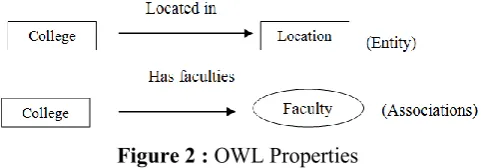
Different characteristic entities within the area are assembled where the elements are binary associations on the inhabitants. The OWL set is inferred as set holding inhabitants. It is entailed with the aid of prescribed portrayals which represent accurate prerequisites for the association of the set. The OWL elements characterize associations. There are three key levels of elements as represented in fig. 2.
a) Entity Elements: It characterizes the
association among two elements.
b) Data Elements: It characterizes the elements
to the information verbatim.
c) Comment Elements: It is employed to append
the data to sets, elements, and entity based elements.
There are several sorts of entity elements termed as reverse, efficient, alteration, linearity and automatic moreover based on these elements there is also two constraint-based elements namely survival and widespread.
V.
OWL Relationship Modules
The relationship could be gained based on the questions and keywords where these questions yield the associations among the elements in RDF which comprises (subject+associations+entities). There are two sorts of user demands as entailed below.
Figure 2 : OWL Properties
a) Data Acquirement
The user needs comprehensive data related to theprecise department. The association with all the probable nodes associated is reimbursed.
b) Indefinite Data Detection
there does not exist any undeviating association among them. Here the mediator locates the nearest node associated with both the college and faculty where the closest node represents the place of its location. The mediator displays all the probable association among the college – faculty and faculty – position. Based on all these associations the user will be able to locate association among the college and faculty as depicted in Fig. 4.
Figure 3 : Acquiring Simple Data
Figure 4 : Indefinite Acquisition of Data
VI. CONCLUSION
The key obstacle prevailing with the present search engine is associated with the data congestion. While performing an analysis the commonly encountered issue is that a minimal number of websites is acquired but plenty of websites are reimbursed. The analysis outcomes are in hundreds and thousands which are much more typical than the anticipation. Several websites are reimbursed due to their uncomplicatedness since they hold a word which represents an analysis parameter though the website may not be related to the analysis based on the keyword. Moreover, key issues prevailing with the prevailing search engine is due to abstruse nature of words. Because of this, the search engine is capable of locating a variance among the diverse denotation which is delivered as anoutcome by the search engines comprising all these words irrelevant to the denotation parting the user with an immense set of both related and unrelated documents. The semantic-based web foresees an atmosphere with
mediators for distribution and transmission of planned data in an open and partially computerized manner. The target route is identified by the mediator effectively using associations in terms of user demands and offers diverse functionalities like computerization, artificial intelligence, aggregation, machine to machine transmission and capabilities. With the aid of all these functionalities, the users of the internet are provided with information extortion rather extortion of data. The plan is assisted by a solitary mediator and a mechanism to look after the intended information from a massive data. For themulti-usersystem, the intention is to attain synchronization among all sorts of mediator. The design could be further refined by focusing on multi – mediator environment, their transmission and management. Focusing on these circumstances multi – mediator absorbs from the environment by itself termed as perilous data extortion.
VII.
REFERENCES
[1]. M. Hepp. Semantic Web and Semantic Web Services: Father and Son or Indivisible Twins? IEEE Internet Computing, vol. 10, no. 2, pp. 85-88, March/April, 2006.
[2]. W3C Semantic Web, http://www.w3.org/2001/sw/ [3]. T. Berners-Lee, Weaving the Web: The Original
Design and Ultimate Destiny of the World Wide Web byIts Inventor. 1999,Harper San Francisco.
[4]. W. Yong-gui and J. Zhen. Research on semantic Web mining. 2010 International Conference onComputer Design and Applications (ICCDA), vol. 1, pp.67-70, 2010.
[5]. A. Seaborne and E. Prud'hommeaux. SPARQL Query Language for RDF, W3C Recommendation, W3C,January, 2008.
[6]. I. Horrocks, P. F. Patel-Schneider, F. V. Harmelen. From shiq and rdf to owl: The making of a webontology language. Journal of Web Semantics 1 (2003) 2003.
[7]. A. Grigoris and F. van Harmelen. A Semantic Web Primer. The MIT Press, Cambridge, MassachusettsApril 2004.
[8]. Semantic Web - XML2000, slide 10". W3C.
http://www.w3.org/2000/Talks/1206-xml2k-tbl/slide10-0.html. [accessed on 13-05-2012]
[9]. S. Russell and P. Norvig. Artificial Intelligence: A Modern Approach (3rd ed.). Prentice Hall Press, UpperSaddle River, NJ, USA. 2009
[10]. A. Chakravarthy. Mining the semantic web. In: Paper Proceedings of the First AKT Doctoral Colloquium(2005).