Geometric Range Queries on Encrypted Spatial Data using hybrid AES and
Tiny algorithm
Jyoti¹, Neeraj Verma², Dr.Pratima Kumar³
¹Student, Department of Computer Science Engineering, Prannath Parnami Institute of Management and Technology, Hissar, Haryana, India
²Assistant Professor, Department of Computer Science Engineering, Prannath Parnami Institute of Management and Technology, Hissar,Haryana, India
³Professor, Prannath Parnami Institute of Management and Technology, Hissar,Haryana, India
ABSTRACT
Accessible encryption is a procedure to perform significant questions on encoded information without uncovering protection. Be that as it may, geometric range look on spatial information has not been completely examined nor boosted by existing accessible encryption plans. In this we plan a symmetric-key accessible encryption conspire that can boost geometric range inquiries on encoded spatial information. One of our real commitments is that our outline is a general approach, which can boost diverse sorts of geometric range questions. At the end of the time, our outline on encrypted information is free from the states of geometric range queries. In addition, we additionally expand our plan with the extra utilization of hybrid AES-Tiny to accomplish look multifaceted nature that is speedier than linear.
Keywords : Geometric range search, spatial data and encrypted data.
I.
INTRODUCTIONRecently, the network intrusion detection community has made large-scale efforts to collect network audit logs from different sites. In this application, a network gateway or an Internet Service Provider (ISP) can submit network traces to an audit log repository.
However, due to the presence of privacy sensitive information in the network traces, the gateway will allow only authorized parties to search their audit logs. We consider the following four types of entities: a gateway, an untrusted repository, an authority, and an auditor. We design a cryptographic primitive that allows the gateway to submit encrypted audit logs to the untrusted repository. Normally, no one is able to
port numbers, time-stamp, protocol number, etc. Among these attributes, suppose that we would like to support queries on the time-stamp t, the source address a and the destination port number p. Our encryption scheme provides the following properties: • Range query on attributes: An authority can issue a decryption key for all flows whose (t, a, p) falls within a certain range: t ∈ [t1, t2] and a ∈ [a1, a2] and p ∈ [p1, p2]. Notice that range query implies equality and greater-than (smaller-than) tests, e.g., t ≥ t1 and a = a1 and p ≤ p1. With this decryption key, all flows whose (t, a, p) tuple falls within the above range can be decrypted.
• Security requirement: Normally, no one can learn any information from the ciphertexts. Under special circumstances, however, an auditor may obtain a decryption key from an authority for some range t ∈ [t1, t2] and a ∈ [a1, a2] and p ∈ [p1, p2]. For any flow, if at least one attribute among t, a, p lies outside the specified range, the auditor fails to decrypt it. The auditor inevitably learns that the (t, a, p) tuple of this flow does not lie within the given range. However, apart from this information, the auditor cannot learn anything more about the flow. For example, the auditor cannot learn anything about attributes other than t, a, p; in addition, she cannot decide whether tt2, etc.
II.
METHODS AND MATERIAL
1. Problem statement
We are among the earliest to study the problem of point encryption, range query, and conditional decryption of matching entries. We propose a provably secure encryption scheme that allows us to achieve these properties. It summarizes the asymptotic performance of our scheme in comparison with other approaches. We study the practical performance of RQED, and show that it makes the encrypted network range query application feasible. We also study the dual problem to RQED, where one
assigned to the cloud service, which is this assumed to have ample storage space and power resources to store and query encrypted data through its sharing database services for the client. All data are assumed to be protected using existing symmetric or asymmetric data encryption schemes, which are not the focus of this paper, though symmetric encryption is encouraged.
5. Previous Methods
Some SE schemes that help comparisons can perform rectangular range queries by applying various measurements. Be that as it may, those augmentations don't work with other geometric range regions, e.g., circles and polygons all in all. Wang at a proposed a plan, which especially recovers focuses inside a hover over encrypted information by utilizing an arrangement of concentric circles. Zhu et al. likewise fabricated a plan for roundabout range search over encrypted spatial information. Lamentably, these two plans only work for circles, and don't make a difference to other geometric zones. Ghinita and Rughinis outlined a plan, which underpins geometric range queries byutilizing Hidden Vector Encryption. Rather than encoding a point with a parallel vector of T2 bits, where T is the measurement estimate, it uses a various leveled encoding, which lessens the vector length to 2log2 T bits. Notwithstanding, its pursuit time is as yet direct with respect to the quantity of tuples in a dataset, which runs gradually finished vast scale datasets as well as debilitates proficient updates. Our current work shows a plan that can work discretionary Bloom channels effectively shows whether a point is inside a geometric region. Its propelled form with R-trees can accomplish logarithmic hunt by and large. In spite of the fact that it additionally uses SSW as
6. Proposed method
7. Proposed work for Tiny-Block hybridization in AES-128
One of the most common implementation of encrypting the data that is converting the plain text in to cipher text and decrypting the data is by using the single core system Here only one core is used irrespective of the size of the file which has to be encrypted or decrypted. This method will work slowly if the data file is big in size. It may work well for data files which are small but it is sure that it takes much longer time to encrypt and decrypt the data for bigger files. So as to overcome the above mentioned drawbacks and make improvements in the field of AES implementation, a parallel core processor is introduced in the paper. With this method we made improvements in the conventional methods by reducing the run time process. AES is a symmetric key segment cryptography procedure. AES block cipher has 128, 192 or 256 bit keys to encode and decode information in blocks of 128-bits. AES has a discrete key development stage for the increase of 128, 192 or 256-bit keys so that these keys can be helped in numerous circles of cryptography process [11].
A. For encryption, every round involves of the subsequent four steps:
A non-linear sub-byte replacement stage every byte is substituted with alternative allowing to a lookup all-around measured method for formation the s-box tables [13]. Over the matrix that becomes functioned upon all over the encryption is identified as state. This alteration completed of 2 phases: (i).
Multiplicative inverses of every byte in the state. (ii). the outcome in this step is gained from phase (i) by altering y = f(x) Change Rows – an inversion step where every row of the state is shifted regularly a positive number of times. Shift row convert the line of state which accumulative the offset of rotation moves left, first line unaffected. Another line loop left 1 byte, third line loop left 2 bytes, likewise 4th
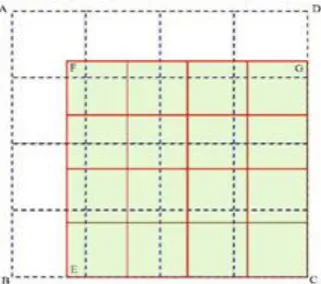
line loop 3 bytes [10][9]. The Inverse Shift Rows revolution achieves these circular shifts the further technique for every of the last three lines. Mix Columns – a mixing process which works on the columns of the state, merging the four bytes in every column. It creates complicate changes to columns in the state. Efficiently a matrix increase in GF (28) using prime poly m(x) =x8+x4+x3+x+1. Add Round Key – every byte of the state is joint with the round key; each round key is resulting from the cipher key using a key program. In this phase the 128 bits of state are bitwise XOR with the 128 bits of the round key. The process is perceived as a column wise procedure among the 4 bytes of a state column and single word of the round key. This conversion is as straightforward as would be sensible which supports in productivity though it also affects all of state. A small modification of this block based procedure can recover the entire text/data. Such modification of the block preparation of text is designated as S-Block retrieve. For instance, 4 × 4 non overlying blocks for storage in matrix formation shifted from standard and size (N×M) box which gotten through M rows from the top and N columns from left. Let us signify the cropped image by Îu; v is (N-4) × (M-4).
Figure 1 : Tiny Block based reconstruction from S-Box
Another possible way of retrieve is to use a block size other than 4 × 4 i.e. using blocks of sizes m × n
where m ≠ 4 and n ≠ 4. In such a case, the quantization matrix Q has to be changed accordingly to size m × n at the time of data extraction.
The TEA is a kind of Feistel type ciphers which usages operations from mixed (orthogonal) arithmetical groups XOR, ADD and SHIFT. A dual shift causes all bits of the data and key to be assorted commonly.
The key program process is modest; the 128-bit key K is separated into four 32-bit blocks K = ( K [0], K[1], K[2], K[3]). Tiny encryption algorithm aspects to be extremely resilient to difference cryptanalysis (Biham et al., 1992) and achieves whole dispersion (where a one bit alteration in the plaintext will cause about 32 bit differences in the cipher text). Time routine on a workstation is very stirring of this approach.
B. Steps involved in research
The Encoded file is in print on MATLAB platform and accepts a 32-bit word size. The 128 bit key is divided into four portions and is put in storage k [0] - k [3] and the Data is kept in v[0] and v[1].
1. Make m×n non-overlapping block separating size of AES-128 matrix
2. Let designate this set of blocks byPI u, v (m×n)
3. Select a set of blocks from PÎ u, v (m×n) (using a key
common through both ends) and achieve the cypher text in every nominated blocks by every standard SHA based authentication scheme. The quantization matrix Q which is a shared secret is used for finding the quantized coefficients.
4. Apply DE quantization and Inverse for same size of block matrix would be extracted for small size of message.
The sender sends A to The receiver B. Then Decryption side\
Receiver B essential does the subsequent: 1- Get the cipher text () from A.
2- Calculate (r) as follows: r = yp-1-x mod p
3- Improve the plaintext as follows: m = ( r * z ) mod p
The TEA usages adding and calculation as the flexible operatives in its place of XOR. The TEA encryption routine depends on the alternative use of XOR and ADD to deliver nonlinearity. The procedure has 32 cycles (64 rounds). TEA is short sufficient to inscribe into virtually some sequencer on any computer.
The block based Tiny Encryption Algorithm (B-TEA) is a block cipher encryption procedure that is very modest to device has fast implementation time, and takings nominal storing space [2]
C. Authentication using SHA
algorithm. It is definite in the NIST (National Institute of Standards and Technology) typical „
FIPS
180-4
‟. NIST similarly deliver a no. oftest vectors
to confirm accuracy of application.1. FIPS 180-4 requires the communication has a „1‟ bit attached, and is formerly amplified to an entire quantity of 512-bit blocks, counting the text extent (in bits) in the last 64 bits of the previous block.
2. Subsequently user must have a byte-stream fairly than a bit-stream; calculation a byte „10000000‟ (0x80) adds the compulsory bit “1”. 3. To change the text to 512-bit slabs, it compute
the no of slabs essential, N, formerly for every these it will generate a 16-integer (i.e. 512-bit) collection. For every these numbers, It will take four bytes from the communication (using char Code At), and left-shift them through the suitable quantity to pack them into the 32-bit number.
4. The char Code At () technique proceeds NaN for out-of-bounds, then the „|‟ operative changes this to zero, so the 0-padding is completed indirectly on change into slabs.
5. Formerly the measurement of the message (in bits) wants to be added in the last 64 bits, that is the latter two numbers of the concluding block. In code, this could be done
On the other hand, JavaScript bit-ops change their influences to 32-bits, so n >>> 32 would provide 0. Therefore it uses mathematics operatives in its place: for the most-significant 32-bit quantity, it will distribute the (unique) extent through 2^32, and use floor () change the consequence to an integer.
Most important is that refunded is the recorded hexadecimal symbol of the second hash. This can be valuable for example for storage hashed PINs, but if it will want to usage the hash as a key to an encryption routine, for instance, you will famine to use the dual worth not this written illustration.
D. Encryption using Tiny-Block hybridization in AES-128
BLOCK –TINY
TEA is a modest but influential encryption procedure (grounded on a „Feistel cipher‟). TEA is a light-weight explanation more suitable for certain uses than „manufacturing strength‟ methods such as
AES
which can be valuable for web uses that need safety or encryption. It will provide protected cryptology, robust encryption in a few outlines of brief. TEA form is nearer than the innovative (64-bit block form) when encoding longer slabs (ended 16 chars), and is new safe („an individual bit will alteration around one partial of the minutes of the whole block, parting no place where the variations start‟). It is also modest to implement for encoding arbitrary-length manuscripts (presence mutable block size, it needs no „mode of operation‟). The tiny encryption algorithm usages a 128-bit key which is used for increased safety and an encoded or hashed form of the complete password.BLOCK-TINY and AES-128 operation
Tiny encryption algorithm works as a Feistel system (a symmetric slab code) that usages a mixture of bit unstable, XOR, and enhance processes to generate the essential dispersal and misperception of data.
mechanisms in an actual key agenda.
The innovative operation works on 64 bits (two words) of facts at a time, though options (such as Block TEA) permit arbitrary-sized blocks.
AES-128
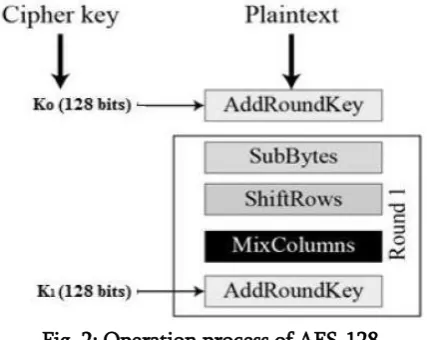
We confine to depiction of a characteristic round of advance encryption algorithm. Every round include of four sub-processes. The 1st
round procedure is represented below:-
Fig. 2: Operation process of AES-128
Byte Substitution (Sub Bytes)
The 16 input bytes are replaced in observing up a secure table (S-box) assumed in strategy. The consequence is in a matrix of 4 rows and 4 columns.
Shift rows
All of the 4 rows of the matrix are removed to the left-hand. Some accesses that „fall off‟ are re-inserted on the correct crosswise of row. Shift is approved out as surveys −
1st row is not removed.
2nd row is removed 1 (byte) location to the left.
3rd row is removed 2 locations to the left.
4th row is removed 3 positions to the left.
The consequence is a novel matrix containing of the similar 16 bytes but removed w.r.t each other.
Mix Columns
Every column of 4 bytes is currently altered using a singular exact purpose. This purpose taking as input the four bytes of one column and productions four entirely new bytes, which change the unique column. The consequence is alternative novel matrix containing of 16 novel bytes. It must be well-known that this stage is not achieved in the previous round.
Add round key
The 16 bytes of the matrix are currently measured as 128 bits and are XORed to the 128 bits of the round key. In case this is the most recent round formerly the productivity is the cipher text. Then, the subsequent 128 bits are construed as 16 bytes and we instigate additional comparable round.
III.
Result and discussion
Figure 3: Distribution of Test Dataset such as high frequent clustered location in dark color and black
data points are different location of dataset
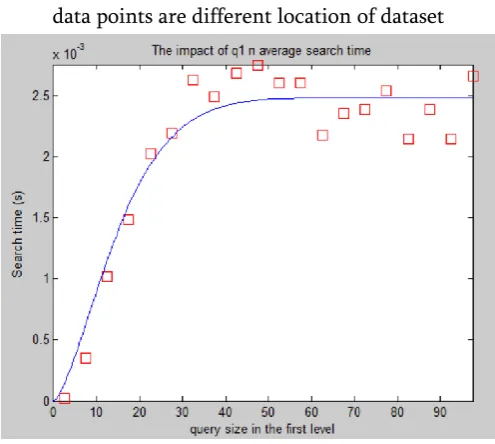
Figure 4: Searching time improvement for Distribution of Test Dataset with query size minimization in are different locations, red mark specification for base work fluctuation of time as far
our proposed approach having sequential time
Figure 5: Different location , red mark specification for base work in low spots color and high contrast
specification for our proposed approach having sequential data sizes using AES-TINY proposed
Figure 6: In blue line for different lat-long CDF for base work in line segment for our proposed approach
having sequential data probability using AES-TINY proposed improving distribution capacity for various
locations
IV.
Conclusion
security of our scheme is formally defined and analyzed with in distinguishability under Selective Chosen-Plaintext Attacks. Our design has great potential to be used and implemented in wide applications, such as Location-Based Services and spatial databases, where the use of sensitive spatial data with a requirement of strong privacy guarantee is needed.
V.
REFERENCES
1. R A. Popa, F. H. Li, and N. Zeldovich, "An ideal-security protocol for orderpreserving encoding," in Proc. IEEE SP, May 2013, pp. 463-477.
2. F Kerschbaum and A. Schropfer, "Optimal average-complexity ideal- security order-preserving encryption," in Proc. ACM CCS, 2014, pp. 275-286.
3. B Wang, Y. Hou, M. Li, H. Wang, H. Li, and F. Li, "Tree-based multi-dimensional range search on encrypted data with enhanced privacy," inProc. SECURECOMM, 2014, pp. 1-25.
4. E-O. Blass, T. Mayberry, and G. Noubir, "Practical forward-secure range and sort queries with update-oblivious linked lists," in Proc. PETS, 2015, pp. 81-98.
5. B Wang, M. Li, H. Wang, and H. Li, "Circular range search on encrypted spatial data," in Proc. IEEE ICDCS, Jun./Jul. 2015, pp. 794-795.
6. Online]. Available:
http://aws.amazon.com/solutions/casestudies/ 7. D X. Song, D. Wagner, and A. Perrig, "Practical
techniques for searches on encrypted data," in Proc. IEEE SP, May 2000, pp. 44-55.
8. C Shahabi, L. Fan, L. Nocera, L. Xiong, and M. Li, "Privacy-preserving inference of social relationships from location data: A vision paper," in Proc. ACM SIGSPATIAL GIS, 2015, pp. 1-4.
9. B Chazelle, "Filtering search: A new approach to query-answering," SIAM J. Comput., vol. 15, no. 3, pp. 703-724, 1986.
10. P. K. Agarwal and J. Erickson, "Geometric range searching and its relatives," Discrete Comput. Geometry, vol. 223, pp. 1-56, 1999. 11. A. Narayanan, N. Thiagarajan, M. Lakhani, M.
Hamburg, and D. Boneh,"Location privacy via private proximity testing," in Proc. NDSS, 2011. 12. H. Shirani-Mehr, F. Banaei-Kashani, and C. Shahabi, "Efficient reachability query evaluation in large spatiotemporal contact datasets," Proc.VLDB Endowment, vol. 5, no. 9, pp. 848-859, 2012.
13. M. de Berg, O. Cheong, M. van Kreveld, and M. Overmars, Computational Geometry: Algorithms and Applications. Berlin, Germany:Springer-Verlag, 2008.