Management Systems
Joost Reede
August 4, 2007
Master’s Thesis
Information Systems Chair Computer Science Department
This thesis is supervised by:
dr. M.U. Reichert, University of Twente
A. Wombacher, University of Twente
Abstract
In the current web oriented information technology world, an increasingly
large number of services take place via the web. These web services often
re-quire the user to identify himself in order to receive personalized information
or services. The result is an increase in the amount of authentication
proce-dures a user must deal with. One of the methods to cope with this, is using
federated identity management.
Federated identity management provides the framework for the
organiza-tions to implement methods that reduce the frequency in which users must
authenticate. Single sign-on is a prominent method, and is often used in
fed-erations. With single sign-on, a user needs only one authentication procedure,
in order to be allowed access to resources from all federation members. One of
the initiatives that allows for single sign-on in a federation environment is Alfa
& Ariss’ core product “A-Select”, which is also the target system of this thesis.
Alfa & Ariss are keen on extending their collective knowledge on the
sub-ject of federated identity management and in particular on the effect of a broader
adoption of federated identity management in A-Select. Gaining this
knowl-edge is necessary to extend A-Select in such a way that it can cope with future
challenges of working in federated environments.
The required information is mainly divided into two fields which are, in
short, the basics of federations and the problems that are typically occur in
fed-erated identity management environments. I have been researching the topics
by literature survey and working out a concrete scenario to pinpoint the actual
issues discussed in the literature.
The basics of federated identity management are worked out in fine detail.
The illustrated problems are illustrated extensively and where possible, solved
up to a certain extend. In general, I am convinced that this document can be a
source of knowledge that helps the development of A-Select a great deal.
Preface
This thesis is written to present findings of my research on federative
iden-tity management, conducted roughly from September 2006 until April 2007.
In this period I have worked at Alfa & Ariss trying to find out what
conse-quences the use of this specific form of identity management would inflict on
their core product, A-Select. The A-Select project started in the mid-90’s and
is currently used for the authentication procedures of a large amount of web
services, mostly provided by organizations in the Dutch public sector. The
information gathered during my research project helps Alfa & Ariss develop
A-Select further.
A lot of people have helped me in some way during the course of the
project, for which I am very grateful. I will note a few of them. First of all I
would like to thank my parents, sister, cat and all my friends for their
men-tal support. Also, this thesis wouldn’t be here without the help of my
ever-jolly colleagues at Alfa & Ariss and their infinite A-Select wisdom. I especially
would like to thank Remco for his in-depth reviewing of the thesis and Ali for
giving me the opportunity to do this project. Last but not least, I thank the
people at the University. In particular Andreas, for his devotion in supervising
the process and providing me with invaluable feedback, and Manfred, who
has the burden of assessing my work.
Contents
Abstract iii
Preface v
Contents ix
List of Figures xi
1 Introduction 1
1.1 Background . . . 1
1.2 Motivation . . . 2
1.3 Goals . . . 3
1.4 Approach . . . 3
1.5 Thesis structure . . . 3
2 Federation fundamentals 5 2.1 Conceptual model . . . 5
2.2 Concepts . . . 7
2.2.1 Federation . . . 7
2.2.2 Principal . . . 7
2.2.3 Provider . . . 7
2.2.4 Identity . . . 8
2.2.5 Attribute . . . 8
2.3 Trust Relations . . . 9
2.3.1 Direct and Indirect Trust . . . 9
2.3.2 Trust Models . . . 9
2.4 Standards and evolvement . . . 11
2.4.1 Introduction . . . 11
2.4.2 SAML . . . 12
4.4.2 Identity provider discovery . . . 46
4.4.3 Minimal information disclosure . . . 47
4.4.4 Enforcement of attribute mappings . . . 49
4.4.5 Provider identity and trust . . . 50
4.4.6 Single sign-off . . . 51
5 Conclusion 57 5.1 Discussion . . . 57
5.1.1 Establishing the principles and foundations . . . 57
5.1.2 The issues of federations . . . 58
5.1.3 The results considering A-Select . . . 58
5.2 Recommendations . . . 59
5.3 Future work . . . 60
Bibliography 66
List of Figures
2.1 Federation conceptual model . . . 6
2.2 A composite domain, consisting of a service provider and an
identity provider . . . 8
2.3 An indirect trust relation between A and C . . . 10
2.4 Pairwise business trust relation with direct (left) and indirect
(right) authentication trust . . . 10
2.5 Brokered business trust relation with direct (left) and indirect
(right) authentication trust . . . 11
2.6 Community business trust relation with direct (left) and indirect
(right) authentication trust . . . 11
2.7 Time line illustrating the convergence of the different standards 16
3.1 Two identity providers with attribute format discrepancy . . . . 28
4.1 Architecture used in the example . . . 36
4.2 The trust architecture used in the example . . . 39
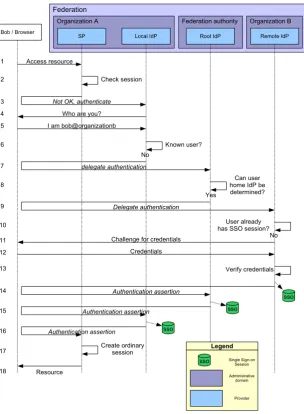
4.3 Sequence diagram of single sign-on procedure in the SURFnet
Federation . . . 43
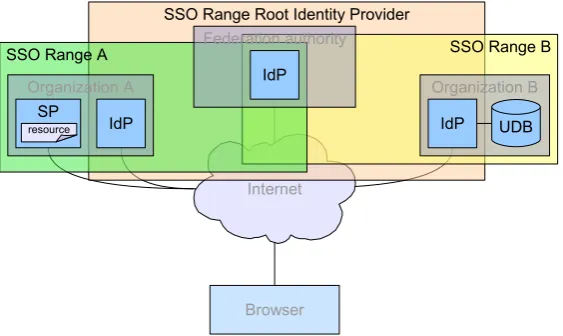
4.4 The ranges of the individual single sign-on sessions . . . 52
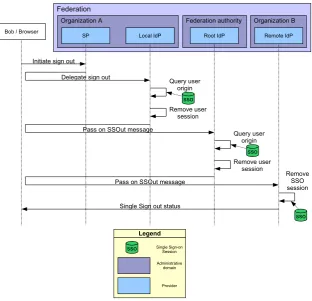
4.5 Single sign-off procedure by using browser redirects . . . 53
4.6 Single sign-off procedure by using IdP-to-IdP messaging . . . . 54
Introduction
1.1
Background
In our current society where information means everything, web services play
an increasingly important role in providing this information. For the user, to
find his way around, he has to work his way through a jungle of web services.
Also, more and more of these services require that the identity of the user is
known, in order to present a personalized web page. The page may contain
privacy sensitive information or simply a convenient selection of information
that the user is interested in. Because these web services require knowledge of
the user’s identity, user credentials are needed to get access to the content. So,
for each service the user wants to subscribe to, he needs to fill in a form that,
most of the time, contains the same information. This can be very annoying
for the user. Even more important is the fact that the user loses track of all the
passwords associated with the services. This results in the user trying to find
ways to manage his passwords. Since human beings do not have the mental
capability to remember an endless amount of passwords [20], they use
alterna-tives. Passwords are written down on pieces of paper, one password is used
for multiple services, easy to remember (and therefore computationally weak)
passwords are chosen, etc. All these alternatives have in common that they
severely lower the level of safety that the identity of the user possesses.
In order to keep the identity of the user safe and still allow access to all
the different services, the identity of the user must be unified instead of
shat-tered among countless web services. A Federated Identity Management (FIM)
system provides the means to share the user’s identity between two or more
trusted parties. By sharing this information, the principle ofSingle sign-on (SSO) can be applied. A Single sign-on service only requires the user to
authen-ticate once, but lets the user access an arbitrary number of identity dependent
services.
Enabling communication between the services is not a straightforward
pro-cess. If two services want to share their user databases it is very likely that
the form the user information is stored in is not 1-to-1 compatible. A
stan-dard to transfer user information is required. One of these stanstan-dards is
devel-oped by the OASIS group and is named Security Assertion Markup Language
(SAML) [35]. It is the most widely adopted standard providing this
connectiv-ity.
The focus system in this thesis is A-Select, developed by Alfa & Ariss. Alfa
& Ariss was founded in 1999 and specializes in developing authentication
so-lutions. A-Select [2] is one of the core products of Alfa & Ariss, and can be used
to build an authentication system. Its flexibility allows it to be a fundamental
part in a federation. Therefore, a federation is also the application of A-Select
that is the context of this thesis. A more elaborate technical survey on A-Select
can be found in paragraph 2.6.1.
1.2
Motivation
In the near future A-Select will likely be used in more and larger Federated
Identity Management systems. In order to be sure that A-Select is ready for
such large scale systems, the consequences for Federated Identity Management
systems in general and A-Select in particular need to be studied. Together with
the company we have determined two main fields of which the knowledge
level within the company should raise, and where more research should be
conducted on: The basics of federated identity management and issues that
apply to A-Select in the federated identity management context. These two
research fields have been split into three goals, one for the former, two for the
1.3
Goals
This thesis reports on how the main goal is reached. This main goal is toIdentify problems to occur in large federated identity management systems based on A-Select. The main goal is split up into three sub goals:
• Goal 1 - Identify the principles and foundations of Federated Identity Management;
• Goal 2- Identify potential issues of federations, with special attention to scalability;
• Goal 3- Find out which of the issues exist in A-Select and give solutions on how to solve them.
The process is divided into three phases. Each of the three sub goals is the main
goal of the corresponding phase.
1.4
Approach
The first part of the thesis consists of a literature survey of which the results are
used to form a conceptual model of a federation and to define sets of use cases
and models (goal 1). In the second part, I take a look at what issues are
pre-sented in the literature. Since the goal is to find the issues of large federations,
the issues are also examined with a significant expansion of scale in mind (goal
2). Finally, the issues found in the second part are addressed in the third. The
findings are adapted to the A-Select scenario. This results in a series of
recom-mendations and considerations that can be taken into account by Alfa & Ariss
in the future (goal 3).
1.5
Thesis structure
The remainder of this document is organized to match the three sub goals
men-tioned above. Chapter two elaborates on the process to identify main
princi-ples of federated identity management and presents results thereof. It distincts
several layers of abstraction within the general principles and discusses the
Chapter three illustrates some of the problems apparent in the field of
fed-erated identity management. These issues are distilled from literature and
filtered for their importance to the company. Where applicable, it describes
which of the core abstraction layers or concepts, mentioned in chapter two, are
affected by the issue. If possible, a solution to the problem is also presented.
In chapter four, the issues discussed in chapter three are applied to a use
case scenario based on a system of A-Select enabled components. In this use
case, the principles as discussed in chapter two are made concrete. This
en-ables for a good overview of A-Select functions within the context set by the
principles discussed earlier. The second part of this chapter gives an indication
of what issues of chapter three are applicable to A-Select and at what point in
the scenario they become apparent. Also, possible solutions are given. If such
a solution is not known or applicable, ideas are given on the general direction
where a exact solution can be found.
The thesis is concluded in chapter five. In this chapter a summary of the
problems is given and discussed. Also, the solutions from chapter four are
summarized and casted into recommendations to the company. Finally, I present
a list of open, but important points that still need to be covered, in a future
Federation fundamentals
This chapter elaborates on the concept of federations and federated identity
management, with an overview of the common terms and principles in the
field. Point of focus in this chapter is a conceptual model of federations. The
model will clarify the basic concepts and the relations between them.
Preced-ing the next chapter, the used federation models and use cases are described in
detail at the end of this chapter.
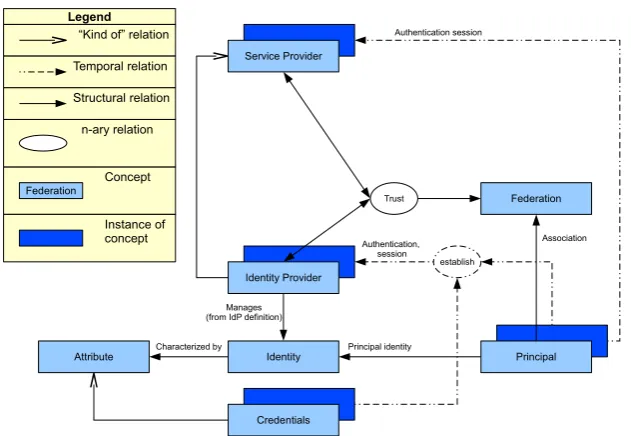
2.1
Conceptual model
The conceptual model illustrates core components of a federated identity
man-agement system and how these concepts relate. This model provides the most
abstract of overviews of a federation and forms the foundation on which the
next sections are built. The model is constructed with the use of literature [19,
21, 34, 35, 43] and terminology used by the leading parties in the development
of standards used for federated identity management [10, 11, 12].
The model has evolved from an incoherent and far too large collection of
definitions to what it is now. The first step was to find similarities among
stan-dards and other reviews and eliminating specific non-fundamental elements.
The set of concepts distilled from these standards appeared far too extensive to
work with. Attempts to construct a conceptual model containing all concepts
resulted in a model that was for too complicated. In order to avoid that, the set
of concepts to work with was striped to the core concepts. Building a model
out of this set gained the satisfactory result; A clear overview of the core of
Federation
Figure 2.1: Federation conceptual model
erated identity management (figure 2.1). Another problem that occurred was
the classification of certain entities that were neither clearly a concept nor a
re-lation. One of these was the “credentials”, that is ultimately defined as being
a concept, but was also considered a relation between identity provider and
principal.
A distinction must be made between the abstract concepts and their
in-stances in the model, as can be seen in the model (represented by the light
and darker boxes respectively). This same distinction is apparent regarding
the structural and temporal part of the model, which is also present in the
fig-ure. Although both kind of relations are a substantial part of a federation, the
structural relations (that also includes the kind-of relation) differ from the
tem-poral relation in that they connect abstract concepts and are present as long as
the federation exists. The temporal relations connect instances of concepts and
2.2
Concepts
Now we take a closer look at the separate concepts and determine their role
within a federation. The terms that are displayed initalicscan be found in the glossary at the end of the thesis. The definitions in the glossary are mostly
extracted from the specific initiative glossaries [10, 11, 12].
2.2.1
Federation
TheFederation forms the conceptual center of the model. Technically, it con-sists of a number of service providers that have mutual trust relations and
prin-cipals that are associated to it. Concretely, this implies a network of service
providers and identity providers that have a direct or indirect trust relation,
depending on how the federation is modeled (see section 2.3) and the position
of the provider in that model.
It must be noted that, besides the general definition of the word there is
also the act of federation. This refers to the act where a party enters into a trust
relation with a second party.
Related to that is the termIdentity Federation. It is used when a principal’s identity, stored at an identity provider, is in some way associated with another
identity of that principal, stored at a different identity provider. Methods to
perform the act of identity federation are discussed extensively in section 2.5.
2.2.2
Principal
Principalis a general term for a party that benefits from being able to authen-ticate itself. This can be a tangible individual, also known as a user, or an
abstract process such as a web service. A principal is said to be associated to
a federation when it is part of a domain and has its identity stored at the
do-main’s identity provider. Although a principal refers mostly to a concrete user,
we keep referring to them as principals, since it is the most general term. In
the rest of this thesis, when the term “user” is applied, this refers to a principal
that can only be a real person.
2.2.3
Provider
The term “Provider” is used to annotate service providers and identity providers.
IdP
SP
Figure 2.2: A composite domain, consisting of a service provider and an
iden-tity provider
services to requesting principals. TheIdentity Provider(IdP) is a kind of Ser-vice Provider. Identity providers store identity information of the principals
and are able to verify identity information originating from other providers
with the intention to authenticate a principal or federate a principal’s remote
with his local identity.
A clear distinction between the two must be made. In order to do that, an
Administrative Domainproviding functionality of both providers is modeled as having both, although it could well be that it is in fact only a service provider
with a user database attached. This kind of domain is displayed as in figure 2.2.
2.2.4
Identity
TheIdentityis often mapped to a Principal (Principal Identity) and uniquely describes a principal by its characteristics. In the context of federated identity
management, an identity is often a set of attributes that is stored at an identity
provider. When multiple identities of a principal are stored at different identity
providers, the act of identity federation can be conducted byIdentity Mapping, also known asAccount Linkage.
2.2.5
Attribute
AnAttributeis a characteristic of the identity of a principal. Mainly, attributes are stored at the identity provider, in the form of a value that is identified by its
key. This format and the key name are crucial in order to guarantee portability
in the communication protocol and therefore compatibility among providers.
An identifier is a special kind of attribute that, alone or in a set, identify an
to the identity provider and establish a trust relation called aAuthentication Session. Although credentials are identifiers, not all identifiers are credentials. Credentials do not have to be stored at the identity provider, but must allow
the identity provider to authenticate a principal through some predetermined
process.
2.3
Trust Relations
As discussed in the last section and as can be seen in the conceptual model,
fed-erations are formed using mutual trust relations between service and identity
providers. Multiple providers can together form a trust network. The Liberty
Alliance have identified what models can be applied when defining trust
rela-tions [28]. These give a good idea of how to classify trust models as used by the
different initiatives. The models indicate how a small number (2 or 3) parties
relate, but hybrid lay-outs can be formed to model more extensive trust
net-works. Liberty distinguish between business trust in the form of a contract
be-tween the parties and authentication trust that is enforced using cryptographic
key certificates.
2.3.1
Direct and Indirect Trust
The concept ofTrust is a classification of the relations between providers in a federation that indicates that one provider is willing to rely on the other
providers for handling its principal identities. When a providerB has trust
relations with both providerAand provider C andAandC do not have
ar-ranged a direct trust relation, thenAandCare said to have an indirect trust
relation, in whichBis the intermediary (see figure 2.3).
2.3.2
Trust Models
Liberty classify models depending on the status of the business trust relation.
Within a model the authentication trust relation can be either direct or indirect.
Opposite to the business trust relation, the authentication trust relation must
A
B
C
LegendDirect trust relation
C Provider
Figure 2.3: An indirect trust relation between A and C
A B A B
CA LegendProvider
CA Certificate authority Business trust Authentication trust
Figure 2.4: Pairwise business trust relation with direct (left) and indirect (right)
authentication trust
Pairwise trust model
The pairwise trust model illustrates a direct business trust relation. This model
ensures strong trust business wise, but is very limited when it comes to
scal-ing. Although possible, authentication trust relations are not likely to be
indi-rect, since new parties need to establish business agreements with federation
members (see figure 2.4).
Brokered trust model
When business trust is established indirectly, the brokered trust model applies.
Indirect trust is negotiated via an intermediary that acts as the trusted party on
behalf of the local service provider. This provider can either decide to indicate
what remote providers to trust or leave that decision up to the intermediary,
thereby creating a more dynamic trust network. In both ways this model is
more dynamic than a pairwise trust model, since far less business agreements
A B
Figure 2.5: Brokered business trust relation with direct (left) and indirect (right)
authentication trust
Figure 2.6: Community business trust relation with direct (left) and indirect
(right) authentication trust
Community trust model
In the community trust model, there are no business agreements between providers,
either direct or indirect. Instead of by business agreements, trust is established
purely by technical means, such as by using trust infrastructures such as Public
Key Infrastructure (PKI) (see figure 2.6).
2.4
Standards and evolvement
Now that the conceptual model and trust models are clear, we can take a look
at the practical side of the matter; The standards that are present in federated
identity management and how they evolved over time.
2.4.1
Introduction
Multiple parties in the field of identity management recognized the necessity
of federating identities across multiple domains. The fact that this implied
the use of standards resulted in the formation of consortiums that aimed at
forming these standards: The Liberty Alliance created the Identity Federation
(WS-*) specifications and the Organization for the Advancement of Structured
Information Standards (OASIS, [32]) supervised the development of the
Secu-rity Assertion Markup Language (SAML) standard. Another party involved
with development of Federated Identity Management Systems is Shibboleth,
which not only extended SAML, but also provides a complete implementation.
2.4.2
SAML
The Security Assertion Mark-up Language (SAML) [35] is a framework, based
on eXtensible Markup Language (XML, [44]) that enables the exchange of user
information. Supervised by OASIS, version 1.0 of the SAML specification was
adopted as standard in November 2002. This version provided support for
only basic functionality, such as Web Single Sign-on. Since then, SAML has
evolved to a flexible and extensive framework. SAML version 2.0, which is
the focus framework in this thesis, is built up out of several components that
are designed in a way that allows a flexible framework, independent on the
foundation on which it is used.
Assertions
An assertion is a piece of information that contains a statement about a subject.
Usually, an assertion is sent from the Asserting Party to the Relying Party containing information of a subject of the asserting party. There are three kinds
of statements that can be made using an assertion:
• Authentication statementsindicate that is principal is successfully
authen-ticated and at what time that happened,
• Attribute statementscontain specific attributes of a principal and
• Authorization decision statements define actions a principal is allowed to
do.
Assertions are composed using XML. SAML has a specific XML schema that
defines the valid structure and contents of an assertion.
Protocols
The SAML protocols define what sequence must be followed in order to form
• Authentication request protocol- A principal can request assertions carrying
authentication statements and attribute statements;
• Single logout protocol- Protocol for activation of sign-off procedures at all providers;
• Assertion query and request protocol- Defines queries with which assertions
can be requested, either by ID, subject or statement type;
• Artifact resolution protocol- Defines a mechanism for the use of artifacts.
Artifacts are small pieces of data referencing to the actual protocol
mes-sage. After receiving an artifact this protocol describes how to contact the
original message creator for obtaining the message;
• Name identifier management protocol - Allows a requester to change the
value or format of the name identifier or to end the association of a name
identifier;
• Name identifier mapping protocol- Allows mapping of two name identifiers.
Again, SAML specifies a XML schema for all protocols.
Bindings
SAML bindings define how protocol messages can be carried using technology
of the transport layer, such as HTTP. SAML v2.0 defines the following bindings:
• HTTP Redirect bindinguses HTTP redirect messages,
• HTTP POST bindingdefines how to transport messages using POST and
HTML forms,
• HTTP Artifact bindingspecifies the transport of artifacts over HTTP,
• SAML SOAP bindingis used for defining how to carry messages using
SOAP 1.1 over HTTP,
• Reverse SOAP (PAOS) bindingspecifies a multi-stage protocol that allows an ordinary HTTP client to communicate using SOAP and
• SAML URI bindingdefines how to retrieve an assertion using a universal
Profiles
SAML profiles define a series of use cases and indicate what bindings,
proto-cols and assertions are required to employ the use case. The SAML v2.0 profiles
include:
• Web browser SSO profile defines single sign-on (SSO) with ordinary web browsers using the authentication request protocol, SAML response
mes-sages and assertions and HTTP redirect, HTTP POST and HTTP artifact
bindings;
• Enhanced Client and Proxy (ECP) profilealso defines SSO, for the use with
specific clients using the PAOS and SOAP bindings;
• Identity provider discovery profileallows service providers to find out what identity providers a user has visited before;
• Single logout profile defines how to combine the Single logout protocol
with SOAP, HTTP redirect, HTTP POST and HTTP Artifact bindings;
• Assertion query/request profile combines the Query and request protocol
with synchronous bindings such as SOAP;
• Artifact resolution profilespecifies how to combine the Artifact resolution protocol with synchronous bindings such as SOAP;
• Name identifier management profile defines the combination of the Name
identifier management protocol with the SOAP, HTTP redirect, HTTP
POST and HTTP artifact bindings;
• Name identifier mapping profilecombines the Name identifier mapping
pro-tocol with a synchronous binding such as SOAP.
2.4.3
Liberty Alliance
The Liberty Alliance [26] is an organization involved in the development of
standards for identity management. The goal of this consortium is to provide
a set of standards to form a holistic specification to especially federated
iden-tity management. These standards are divided into three modules providing
ID-FF
The Liberty Identity Federation Framework (ID-FF) is a set of protocols, schema
and profiles that can be used to implement identity federation by supplying
features such as account linkage and single sign-on. It is developed, based on
the SAML v1.1 standard, with flexibility in mind and is therefore suitable for
heterogeneous platforms and all kinds of systems, so it will integrate well with
systems and specifications that are used. The single sign-off feature from ID-FF
is used in SAML 2.0.
ID-WSF
The Liberty Identity Web Services Framework (ID-WSF) provides another set
of protocols, schema and profiles for interoperability that is built on top op the
ID-FF. ID-WSF can be used for discovery, consumption and creation of identity
web services and provides features for enhanced and personalized identity
ser-vices and attribute sharing.
ID-SIS
The Liberty Identity Service Interface Specification (ID-SIS) is built on top of
the ID-WSF and contains a collection of specifications for services providing
specific functionality, so Liberty enabled organizations are able to exchange
these services. Examples of the possibilities are a calendar or a contact book.
The Liberty Alliance have at this point released two specifications, the ID
Per-sonal profile (ID-SIS-PP) and the ID Employee profile (ID-SIS-EP).
2.4.4
WS-*
WS-* is the name of a collection of standards providing a framework for
secu-rity for web services. It was originally developed by a group of corporations
lead by Microsoft and IBM. It contains specifications for all kinds of security
purposes, of which WS-Security and WS-Federation are of most interest to this
document.
WS-Security
Web Services Security (WS-Security) specifies how security tokens can be
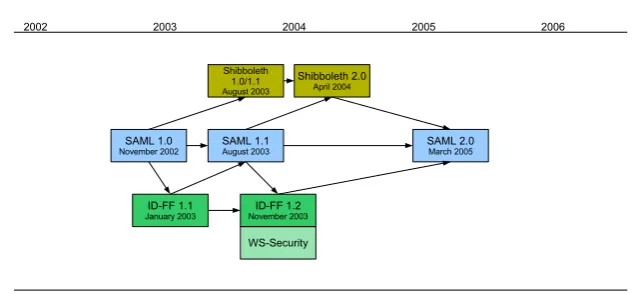
2002 2003 2004 2005 2006
SAML 1.0
November 2002 SAML 1.1August 2003 SAML 2.0March 2005
ID-FF 1.1
January 2003 November 2003ID-FF 1.2
Shibboleth 1.0/1.1
August 2003
Shibboleth 2.0
April 2004
WS-Security
Figure 2.7: Time line illustrating the convergence of the different standards
headers to the message. WS-Security is used in the Liberty ID-FF 1.2 standards
and is now a part of the OASIS specifications.
The WS-Security specifications provide a secure foundation on which SAML
messages can be built. WS-Security can be used in combination with SAML
assertions to embed security tokens and to ensure message integrity and
con-fidentiality.
WS-Federation
WS-Federation specifications define how to share identity information in a
cross-Realmenvironment. It distincts two major profiles: TheActive Requestor profile uses a fully SOAP compliant client andPassive Requestorprofile only needs a HTTP compliant client such as any modern browser. WS-Federation
invokes WS-Trust, which is also part of WS-*, for specification of security token
exchange and issuance.
2.4.5
Time line
In the early days of federated identity management, there were multiple
ini-tiatives available to accommodate such a system. Every initiative focused on
a different section of the market. SAML (v1.0, v1.1) aimed at the
business-to-business world, Liberty focused on the business-to-customer market and
Shibboleth (see paragraph 2.6.2) was most active in the educational sector.
preferred over a system working with providers that use different standards
and need to use adapting middleware to be able to interoperate. With this
knowledge in mind, OASIS, Liberty Alliance and Shibboleth started working
on SAML 2.0, that would converge their standards into a generally supported
one.
SAML version 2.0 is based on version 1.1 and is compiled with a great deal
of participation from the Shibboleth project and the Liberty Alliance’s ID-FF
1.2 (see fig. 2.7).
2.5
Identity Federation Use Cases
In this section we elaborate on the identity federation use cases that are most
important to the rest of this document. These scenarios are part of the SAML
2.0 standard mentioned above and are described in the SAML technical overview
[35]. All use cases assume a user want to access a resource at a service provider
that is not his home identity provider and he decides to federate his local
iden-tity with the one of his home ideniden-tity provider. In the case of a persistent
feder-ation, the user needs to authenticate only once to access data on both providers,
after the identity federation process. Federation using transient pseudonyms
has other advantages, as is discussed later.
2.5.1
Out-of-band
Out-of-band identity federation uses a procedure and communication
proce-dure that is not part of the SAML standard. Therefore, it was the only kind of
identity federation possible in SAML 1.0 and 1.1. Providers that federate their
stored identities must agree on the method used for federating and the
map-ping of the identities. The method can be either in batch form or a real time
synchronization.
2.5.2
Persistent Pseudonym
After a successful authentication at the identity provider, the service provider
receives an authentication assertion. Added to that assertion is a reference to
the user’s identity at the identity provider (the pseudonym), that is only linked
to the user profile at the identity provider, thereby not disclosing the identifier
and if so, a record is stored at the service provider that holds a reference to the
local identity, the identity provider and the pseudonym gained from the
iden-tity provider. The ideniden-tity provider creates the same kind of record. Using this
information, the trust relation between identity provider and service provider
enables the user to use both identities with a single log in procedure.
2.5.3
Transient Pseudonym
The transient pseudonym is similar to the persistent pseudonym, but differs
in the fact that the pseudonym provided by the identity provider is not in any
way linked to an identity of the service provider. The implications of that are
that the user does not have to authenticate at the service provider and
there-fore does not have to identify himself. The user remains anonymous to the
service provider and only uses the trust relation between the service and
iden-tity provider and authentication at the latter in order to gain access to
informa-tion at the service provider. Using the transient pseudonyms, it is possible to
have a service provider that does not have any identities stored, saving a lot of
maintenance load.
2.6
Initiatives
The trust models, standards and use cases discussed above form an abstract
foundation on which federated identity management is built. What remains
are concrete implementations of these principles. There are several initiatives
providing implementations of federated identity management systems, of which
we will discuss a few. The focus is on the SURFnet federation and Shibboleth,
of which the former is the perspective from which the following chapters are
defined. Although the analysis of the issues (chapter 3) is broadly oriented, the
discussion of the practical application of the issues applies only to the SURFnet.
2.6.1
SURFnet Federation
The SURF foundation [40] manages the SURFnet [41], a technologically
ad-vanced physical network connecting Dutch educational organizations
mutu-ally and to the Internet. The foundation also develops all kinds of services
to customers to optimize the use of the network. One of these services is the
that A-Select makes possible. A-Select facilitates authentication mechanisms
in the SURFnet, thereby providing it with federation capabilities. The A-Select
server must be configured to run in so-called “cross A-Select” mode. A cross
A-Select set-up needs some elaboration.
First of all, there are some different naming conventions used in cross
A-Select. The use cases described in the SAML documentation and above use
the terms “service provider” for the provider where the principal wants to
access a resource and that needs an authentication assertion, that in A-Select
is called a “Ticket Granting Ticket” (TGT). Cross A-Select uses the term “Local
A-Select server” for that entity. The identity provider from SAML, that is used
to authenticate the user, is named the “Remote A-Select server”.
Cross A-Select can be used for remote authentication, in the same way the
web browser/single sign on SAML profile functions. The local A-Select server
defines all remote servers and imports their public key certificates in the local
keystore. The remote A-Select server defines the local servers in the
configura-tion and imports their respective public key certificates.
Cross A-Select can also be used as a proxy between a group of local and a
group of remote servers. The certificates and administration is managed by the
proxy on behalf of the local and remote servers. To the local servers, the proxy
acts as a remote server and to the remote servers it is a local server. This
cen-tralizes the management of server administration, which makes management
less complicated.
Supported use cases
At the moment of writing, there is no support for active user account linkage.
This implies that identity federation using persistent pseudonyms is not
possi-ble. Out-of-band identity federation would theoretically be possible, although
there is no system that provides such functionality. On the other hand, the use
of the transient pseudonym is not only possible, but is also the main use of the
SURFnet Federation.
Supported trust relations
Trust in a cross A-Select environment is established with the use of Public Key
Infrastructure (PKI). Plain cross A-Select relies on direct trust only. As
relation between two A-Select servers. Cross A-Select in combination with a
proxy, in comparison, is a good example of indirect trust. Servers exchange
their certificates with the proxy that becomes the authority which the server
trust. A local server that requests an authentication assertion from a remote
server, now requests this assertion via the proxy. Since the proxy trusts the
remote server and the local server trusts the proxy, an indirect trust relation
exists.
In the case of SURFnet, business trust is established only via brokered trust.
New parties only form agreements with the SURF Foundation that manages
the so-called Root Identity Provider (RootIdP), that functions as the
intermedi-ary between two providers that want to exchange identity information.
Incorporated standards
Communication in A-Select is based on HTTP with URL encoding. An
alter-native is to use Simple Object Access Protocol (SOAP, [38]), but this is not
con-ventional since this channel is not fully SOAP compliant. This also applies
to compatibility with the SAML standard. Although a pure A-Select system
uses its own communication protocol, there is an adapting module available
to enable the use of the SAML 1.1 protocol, especially for communicating with
Shibboleth-based networks.
Supported use cases
At the moment of writing, there is no support for active user account linkage.
This implies that identity federation using persistent pseudonyms is not
possi-ble. Out-of-band identity federation would theoretically be possible, although
there is no system that provides such functionality. On the other hand, the use
of the transient pseudonym is not only possible, but is also the main use of the
SURFnet Federation.
2.6.2
Shibboleth
The Shibboleth Project [37] is an initiative by the Internet2 community [18]
aiming at providing a Single Sign-on and attribute exchange solution for use
in the Higher Education sector. Shibboleth is based on the OpenSAML [33]
identity system framework’s most distinctive component is the Where Are You
From (WAYF) server that is used to determine the home identity provider of
the user that needs to be authenticated or of which some specific attributes
need to be retrieved.
As is the case in A-Select, naming conventions differ from the Liberty/SAML
standard. Although many documents on Shibboleth use Liberty/SAML
vo-cabulary, there originally were other terms. The service provider from the
SAML example, discussed in section 2.6.1, is named the “Target”. The
iden-tity provider is often referred to as the “Origin”.
Supported use cases
Since SAML 1.1 is the foundations underneath Shibboleth, and SAML 1.1 does
not support identity federation within the specification, this also applies to
Shibboleth. As is with SAML 1.1, out-of-band identity federation is
theoreti-cally possible, using some external communication application.
Supported trust models
The Shibboleth project did not define any trust models. This is because
Shib-boleth is a direct descendant of SAML 1.1 and therefore supports SAML’s trust
models, that were originally defined by the Liberty Alliance.
Incorporated standards
Shibboleth is built on top of SAML 1.1, with extensions added to it. The
at-tribute profile that was originally part of Shibboleth, is adopted by the OASIS
Federation issues
3.1
Introduction
In the previous chapter the basic concepts, trust models, use cases and
stan-dards for federated identity management are illustrated. This chapter
dis-cusses common problems that occur in the world of federated identity
man-agement. The rest of this chapter is organized as follows: First, the methods
that are used to identify the issues are discussed and the boundaries to which
the contexts of the issues are confined are defined. Next, the issues are
elabo-rated on in section 3.2 and the chapter is closed with conclusions that are drawn
from the issue discussions in section 3.3.
3.1.1
Methodology
The issues discussed in this chapter are extracted from a wide array of
liter-ature on identity management. Some of these issues are related directly to
federated identity management. For others, the original context was identity
management in general and these need some more elaboration and reflection
on identity federation management, in order to make the transition to that
con-text. The result of the literature survey was an extensive list of issues. A filter
was applied to the list in order to filter out any issues that are not relevant for
the topic. The remaining issues were categorized. A second round of filtering
was applied, in which the company indicated the relevance they assigned to
each issue. The issues in the categories were then merged to form a single
is-sue per category, resulting in the list of isis-sues discussed below. These isis-sues
therefore form a good overview of the problems that are both relevant to the
topic and of interest to the company.
3.1.2
Boundaries
In the last section a filtering process was mentioned. Issues mainly were
fil-tered out because their context was not within the boundaries of this research.
The main characteristics for every issue regarded important for the thesis are:
• SAML - If an issue is dependent on the information transport layer of
the network, it must be concerning SAML, either 1.x or 2.0. However,
solutions for the issues can originate from any standard since it is the
general idea that counts, not the implementation;
• Zero footprint - If an issue relates to the interaction between principal and
network, only naive clients are taken into account, most likely ordinary
web browsers (also known as passive requestors, in WS-*);
• Issue not applicable - As indicated earlier, many issues originate from
the field of identity management. Some of these issues are also
appli-cable to federated identity management. However, some issues cannot
be adapted to the federated identity management context and these are
therefore skipped.
Now that the boundaries are determined, it is clear in what context the issues
must be placed.
3.2
Issues
3.2.1
Issue 1: User control
Any system that is developed to be used by an arbitrary set of users should
encourage people to use it. For identity management systems, this
encour-agement should come from establishing trust in the system among the user
group. People tend to trust the system when they feel that they are in
con-trol of the information managed by it [4]. Therefore, an identity management
Problem
Reflecting this issue onto federated identity management systems, there are
some specific differences compared to regular identity management. First of
all, there is the distinction between federations that enforce user privacy rules
by policy, such as Liberty enabled systems, and federations that do not [30].
Next, it is important what environment the federation is in. User control is
much easier to apply in a homogeneous environment than in a heterogeneous
one.
Known solutions
Applying user control policies should guarantee that each provider in the
fed-eration puts users in control. Especially in a heterogeneous fedfed-eration, the
enforcement of a policy is difficult to maintain and verify, so extensive testing
of new parties is necessary. The paper of GailJoon Ahn and John Lam [1]
in-dicates four key concepts that need to be taken into account, when devising
policies regarding user control and consent:
• Notice- Users should receive prior notice of the information practices;
• Choice- Users have a choice to specify what information will be used and
the purpose for which the information is collected;
• Access- Users should be able to access and modify their personal
infor-mation if necessary and when needed;
• Security- Users should be assured that the organizational system is
capa-ble of securing their personal information.
Also, the paper identifies different scenarios for notifying and communicating
with users about their preferences regarding their attributes. These give a good
all round plan for ensuring user control and could therefore serve as a good
foundation in federation policies on that topic.
3.2.2
Issue 2: Identity provider discovery
Web services that allow delegated authentication, as is the case with service
providers in federated identity management, must be able to guide a user to
is directed to and what is the nature of the identity provider. This knowledge is
crucial to the web service in order to perform the right steps for communication
and trust negotiation.
Problem
In a static federation where every identity provider is known by default, a list
of possible principal’s identity providers is always present and can always be
consulted. If, however, this is not the case and the federation is of a dynamic
nature and new identity providers are arbitrarily connected, sending the
prin-cipal to his home identity provider is not so straightforward. The list that
the service provider can present to the principal is most likely to be
incom-plete. The users of the new identity provider are not able to choose their home
identity provider, and therefore cannot be authenticated. A failed
authentica-tion results in the principal not being able to access the resource of the service
provider.
Known solutions
This problem is recognized as being notoriously difficult to solve [19]. SAML
v2.0 defines a special profile for identity provider discovery. This profile uses
a domain cookie to store preferred identity providers of the principal. There
are two drawbacks to this approach. First of all, it requires the use of cookies
that can be read by identity provider that is not the original issuer of the cookie
information. Usually, this is prohibited by default in any modern user agent,
and thus requires the user to lower the security level of the agent [24]. This is
not recommended and should therefore not be a necessary step in the identity
provider discovery solution. Without lowering the security level, this approach
can only be used within one administrative domain, and this is impossible in
larger federations. A second drawback is that the cookie only stores preferred
identity providers. If a user has not defined his preferred identity provider yet,
then it will not be known to the service provider and cannot be selected by the
user.
3.2.3
Issue 3: Minimal information disclosure
In every identity management system, there is always the possibility of identity
minimum. Also, one must not forget to reduce the impact of an identity theft
event as well. Reducing impact can be accomplished by storing the absolute
minimum of the required information. This implies not only to store the least
amount of information, but also only for the time it is needed and no longer.
For example, a service provider that hosts information for different age groups,
does not need to know the birthday of users. Storing only the age category is
sufficient in this case [4].
Problem
Identity theft prevention in a stand-alone identity management system is a
difficult problem, and this problem is even more severe in the case of
feder-ated identity management. In federfeder-ated identity management, many identity
providers can store identity information of one principal. So, identity theft can
occur via multiple channels. The impact is even higher when identities of the
principal are federated. In the worst case, the trespasser can access information
on all identity providers the principal has stored information on and has
fed-erated identities with. In general, federating identities tends to enlarge both
the chances and impact of identity theft, unless serious measures are taken.
Note that, although important, the focus is not on the technical point of view
of reducing the chances of identity theft. We assume that identity theft is an
inevitable event that has a certain chance of occurrence at a single point in the
federation. We focus on reducing the chance and impact of identity theft in a
federation as a whole.
Known solutions
There are several measures that can be taken in order to reduce chance and
impact of identity theft. SAML v2.0 introduces a new dynamic way of
federat-ing identities by usfederat-ing transient pseudonyms, which guarantees anonymity of
principals. Identities are linked only temporally and without mutual
knowl-edge of the other party’s identity information (see also paragraph 2.5.3). This
reduces the impact of an identity theft event. Besides this technical solution,
there is also the necessity of defining policies. Policies should define and
clar-ify how identity providers should cope with identity information stored
lo-cally or received from remote identity providers. Because of the open and
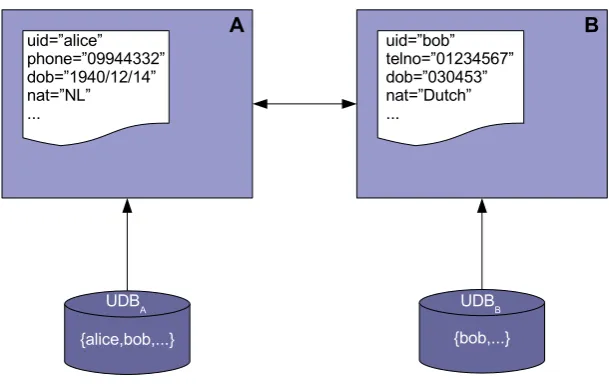
{bob,...} {alice,bob,...}
uid=”alice” phone=”09944332” dob=”1940/12/14” nat=”NL” ...
uid=”bob” telno=”01234567” dob=”030453” nat=”Dutch” ...
A B
UDBA UDBB
Figure 3.1: Two identity providers with attribute format discrepancy
and provide a fine granularity. The approach of Bertino, Bhargav-Spantzel and
Squicciarini [3] defines five categories of policies, to be implemented by
iden-tity providers and principals that cover the full spectrum of information flow
within a federation. The authors also propose an assertion language that can be
used to define flexible and dynamic policies, necessary for information
man-agement in federations. A different approach is that of Cassasa Mont, Pearson
and Bramhall [30]. This approach allows for very fine granularity policy
defi-nition, since policies can be attached to each individual message. Although the
approach is focused on regular principal-service provider communication, it is
applicable to federation systems as well.
3.2.4
Issue 4: Enforcement of attribute mappings
A user’s identity that is stored at an identity provider is composed of attributes.
These attributes hold a single property of a principal. Usually, these attributes
have a key=value format. In the case a principal wants his identities federated,
Problem
Suppose user “bob” has an identity at his identity providerB, containing all
kinds of identity related information. He also has a lightweight account at
identity providerA, consisting of some other arbitrary attributes, and wants
to federate his identities, so Acan use his identity information in a session
directly. As indicated by identity information of “alice” in figure 3.1,Ais aware
of the same identity attributes asB, but the information differs in format. This
implies thatAcannot directly access information ofB, because of discrepancy
in the attribute mapping. In the field of databases, this problem is well known,
and is often referred to as the data integration problem [25]. Extensive research
has been performed in this field as well. However, within the context of this
thesis the focus will be on attribute mapping problems and their solutions.
Different kinds of mapping problems are( [14]):
Attribute name differs
Often the mapping fails on retrieving a certain attribute, because this attribute
is not known by the name the requesting identity provider uses. This is
illus-trated by the “phone” attribute ofA. This is in fact the same attribute as the
“telno” attribute ofB, but has a different name. This fact complicates the phone
number attribute query ofAtoBand vice versa.
Attribute syntax differs
Another problem lies in the fact that the names are the same, but the syntax
of the values is not. This can be seen in the example, regarding the “dob”
attribute. This attribute, representing the date of birth of the principal, has
different notations at the different identity providers and the attribute value
must therefore be processed before it can be used byB.
Attribute semantics differ
Similar to the problem of syntactical differences, is the problem of semantical
differences. In contrast, the values of the attributes are semantically different.
This is illustrated by the “nat” attribute, that indicates the nationality of the
principal. Although the values of the attribute represent the same country, the
values can not be translated without a list of countries’ nationality names (for
Composed attribute differences
The mapping problems described above illustrate what issues can arise when
a 1-on-1 mapping is possible. However, there is also the possibility that an
attribute is split up at one identity provider and is composite at the other. For
example, the birthday attribute could also be split up into separate attributes
for day, month and year of birth.
Known solutions
It is clear that this issue puts quite a severe strain on federated identity
man-agement, considering the amount of times this is referenced in the literature.
Often it is only referenced to as apparent, without presentation of a solution.
However, there are some papers that present solutions varying in level of
de-tail.
Attribute layout transformation [14]
The first solution is to create an adapting interface between providers that is
capable of translating attributes from any and to any schema. Hommel and
Reiser [14] propose such a solution. It involves an attribute converter, present
at any identity provider. The attribute schema need not be changed, since all
conversions take place in the stand-alone converter. Conversions are carried
out using XSL Transformations [6], that is useful because of its flexibility and
powerful XML transformation possibilities. The last addition proposed in the
paper is the centrally placed Federation Schema Correlation Service, that is
in charge of conversion rule distribution and is therefore capable of providing
every attribute provider with appropriate rules for transforming their attribute
assertions into the requested form for any other party to communicate with.
Standard schema [13]
A different approach is the use of standard schema throughout the
federa-tion [13]. The Liberty Alliance have defined two profiles that can be applied
when developing providers that need or distribute personal (ID-SIS-PP, [23]) or
employee (ID-SIS-EP, [22]) information. Profiles are in development for contact
book, geolocation and principal presence services. Besides using pre-defined
schema such as in the ID-SIS profiles, it is also possible to define schema for
a federation. All providers should comply to this schema and therefore it is
maintain.
Combined solution
It is possible that the two approaches that are discussed are combined into one.
For example, it is hard to match semantically different attributes, since
addi-tional information is needed for that. It could well be, that a clear definition of
such attributes is stated in the policies and the decision on how to format the
other attributes is left to the individual providers in order to interfere with their
internal processes as little as possible. However, the border between technical
and legal enforcement is a thin and vague one and should be properly defined.
3.2.5
Issue 5: Provider identity and trust
As already indicated in the discussion on User Control, the trust of the user
in the system is vitally important. Trusting a system means trusting the
indi-vidual components, which in this case are the providers, user clients and the
connections between them. Therefore, the providers need to properly identify
themselves to users to gain their trust and the providers need to establish
mu-tual business trust and authentication trust relations with each other in order
to enhance trust of the users in the network as well [36]. In this case, identity
and trust are intertwined concepts. Determining the true identity of the other
component is a significant part in the process of establishing a trust relation
between two components. If a trust relation exists, this implicitly means that
the identities of the trust relation participants are known.
Problem
Concretely, the problem is how to distribute trust in a federated identity
man-agement system. Especially in a large federation consisting of many indirect
trust relations, it may not be desirable to add another provider using only
man-ual certificate exchanges for authentication trust distribution. Although it is
possible to exchange certificates with only one provider and rely on indirect
trust for secure communication with the rest of the providers, this generates
an increase in overhead interaction, when the network grows. Besides
over-head growth, the communication also becomes more fragile when depending
on an increasing amount of parties. Both the safety and the reliability of the
Known solutions
For providers to be able to verify the identity of other providers, and establish
trust relations with them, an administration is necessary. In order to keep this
information available for all providers, it needs to be a central administration.
Such an approach is presented in [9]. This paper introduces the concept of a
notary server in federated identity management. This central authority is able
to distribute trust to other federation members.
The notary server authority allows only identity providers of good
reputa-tion. Identity providers can rely on the fact that registered identity providers
are to be trusted.
3.2.6
Issue 6: Single sign-off
One of the most prominent uses of federated identity management is the
Sin-gle sign-on feature. Specifications for that use case are well evolved and
ex-tensively discussed in many papers and technical documents. A less popular
subject, that is in fact equally important, is Single Sign-off. The process of Single sign-off has the exact opposite result of the Single sign-on process, and
causes all current sessions the principal has with the different identity and
ser-vice providers to be closed.
The single sign-on feature is managed within a single sign-on session. This
session is responsible for the distribution of the authentication assertions as
soon as a requesting party requires it. This is where the single sign-on session
differs from the ordinary session, that can only maintain authentication for and
grant access to a single web service.
Problem
From a federated identity management perspective, a complicated problem
appears. Independent of whether the single sign-off process is initialized by
the service provider or the identity provider, the identity provider is
respon-sible for sending sign off messages to all service providers. In the case of a
service provider initialized single sign-off process, the service provider
dele-gates the responsibility of fulfilling the task to the identity provider. Although
the process for performing a single sign out action is well defined in the
to maintain the necessary administration of involved service providers. This
administration is necessary for determining what sessions need to be closed.
Sessions are closed by sending a logout request from identity provider to
ser-vice provider usingHTTP GETmessages in combination with redirects via the
principal, or directly using SOAP messages.
Known solutions
WS-Federation [21] is the only of the major specifications that mentions the
ad-ministration inconveniences. It proposes the use of a loose framework, based
on messaging as defined in WS-Eventing [7]. WS-Eventing defines a messages
protocol that can be used to subscribe to an information service. The
informa-tion service uses the resulting administrainforma-tion to send informainforma-tion messages to
all subscribers. The federated sign-off functionality as described in the
WS-Federation specification indicates the use of two different message flows to
ac-complish global sign out in a federation. The sequential method relies on every
individual provider that maintains a local session of the principal to pass the
single sign-off message through to the next provider. The last provider then
sends a message back to the initializing identity provider. This method is
con-sidered very fragile; If one link in the chain fails to re-send the sign-off message,
the rest of the chain is left unnoticed. A second approach is to notify the
indi-vidual providers in parallel. This approach is much more stable and is
there-fore the mandatory implementation in systems that comply to WS-Federation.
In order to receive sign out messages, the providers must subscribe to the
orig-inating identity provider. Upon receiving a sign-off message, the provider is
indicated to clear its session information. Although this sequence provides
bet-ter results, the protocol does not provide a fully predictable outcome. As said,
the protocol is quite loose, and relies on one-way sign-off messages, requiring
no reply. Furthermore, the sign-off messages act as a hint and providers are
not obliged to clean up the session.
3.3
Conclusion
Although the choice for using federated identity management can ease identity
management administration, there are some serious issues to consider. Some of
federated identity environment. Others are new and originate from federated
identity management. Although this list of issues is not complete, it presents a
good overview of issues that may occur in any federated identity management
Application to A-Select
4.1
Introduction
In the previous chapter, some issues are discussed that can arise in a federated
identity management system. Now that these issues are identified and, if
pos-sible, accompanied by a solution, the next step is to see whether these issues
are also apparent in the target system. The target system we are interested in
is the SURFnet Federation.
This chapter is organized as follows: First, the methodology that is used to
find the issues is explained in section 4.2. In section 4.3, a complete scenario
is described that will be used to search for and pinpoint the problems. Section
4.4 handles the issues and elaborates on every issue individually in order to
establish its presence and its place in the model.
4.2
Methodology
The issues that are discussed in the last chapter vary in the level of
abstrac-tion of the federated identity model they can occur. Therefore, to find out if
and where these issues occur within the SURFnet Federation, all abstract
lev-els (mostly discussed in chapter 2) need to have a concrete example to work
with. Next, a concrete example of a simple federation is presented that
con-sists of the most basic components. Of every issue, the place in the example
is identified so it is possible to give a good indication of the implications the
issue carries for the SURFnet federation. In the next chapter, the conclusions of
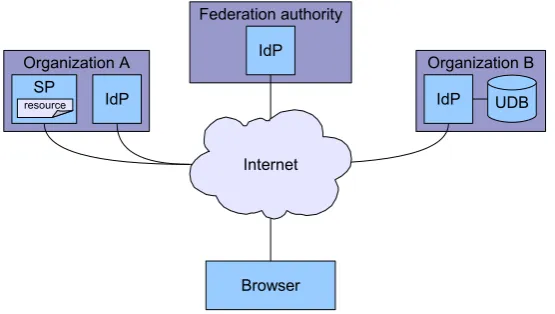
Organization A Organization B Federation authority
Browser IdP
SP
IdP
IdP
Internet
UDB
resource
Figure 4.1: Architecture used in the example
the analyses are discussed and recommendations are drawn.
4.3
The scenario
4.3.1
Situation sketch
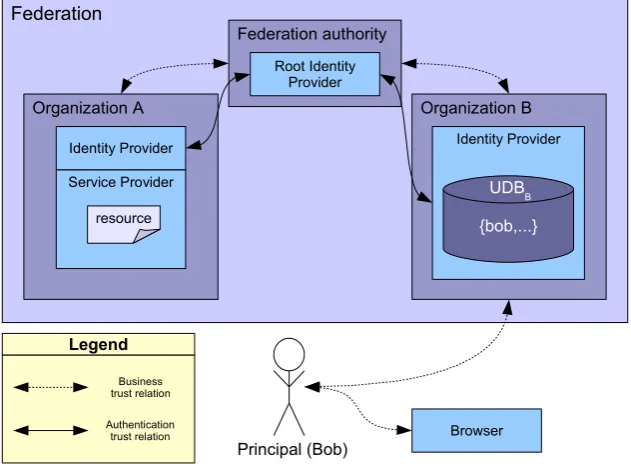
Suppose a principal, Bob, is trying to access a resource that is hosted and
main-tained by Organization A. Organization A is connected to the SURFnet
Feder-ation, and so is Organization B. Organization B is the home identity provider
of our principal Bob. The SURFnet Federation also has a root identity provider
that is known and trusted by all organizations in the federation. It could well
be that there are more organizations connected to the SURFnet federation.
These are not important in the example and are therefore not discussed. Let
us take a look at the technical specifications of the individual components (see
figure 4.1):
Organization A
Organization A is an administrative domain that hosts a service provider,
con-taining the resource, and an identity provider.
Service Provider
The service provider contains resources, among which is the resource Bob wants
valid authentication assertion. Validity of the assertion is guaranteed if the
assertion is given out by a trusted party, in this case organization A or
Organi-zation B.
The service provider can be any web service platform. This access control
is managed by a component called the A-Select filter. This filter negotiates
with the local identity provider in order to determine whether a certain user is
allowed to access the requested resource. The A-Select filter can be seen as an
extension of the identity provider and will not be discussed further.
Identity Provider
The identity provider is an A-Select server set to communicate with the root
identity provider, using the “Cross A-Select” mode. This enables the
Iden-tity Provider to act as a service provider requesting authentication assertions,
thereby delegating the act of user authentication to the root identity provider
(see also the extensive description in paragraph 2.6.1). Cross mode also implies
this communication mode is bi-directional, thereby letting the root identity
provider act as a service provider requesting authentication assertions from
the local identity provider. The loca