TermWise: A CAT-tool with Context-Sensitive Terminological Support
Kris Heylen
∗, Stephen Bond
∗, Dirk De Hertog
∗, Ivan Vuli´c
†, Hendrik Kockaert
∗‡∗QLVL-Linguistics Department (KU Leuven),†LIIR -Department of Computer Science (KU Leuven), ‡University of the Free State, Bloemfontein
{kris.heylen, stephen.bond, dirk.dehertog, hendrik.kockaert}@kuleuven.be, [email protected]
Abstract
Increasingly, large bilingual document collections are being made available online, especially in the legal domain. This type of Big Data is a valuable resource that specialized translators exploit to search for informative examples of how domain-specific expressions should be translated. However, general purpose search engines are not optimized to retrieve previous translations that are maximally relevant to a translator. In this paper, we report on the TermWise project, a cooperation of terminologists, corpus linguists and computer scientists, that aims to leverage big online translation data for terminological support to legal translators at the Belgian Federal Ministry of Justice. The project developed dedicated knowledge extraction algorithms and a server-based tool to provide translators with the most relevant previous translations of domain-specific expressions relative to the current translation assignment. The functionality is implemented as an extra database, aTerm&Phrase Memory, that is meant to be integrated with existing Computer Assisted Translation tools. In the paper, we give an overview of the system, give a demo of the user interface, we present a user-based evaluation by translators and discuss how the tool is part of the general evolution towards exploiting Big Data in translation.
Keywords:Computer Assisted Translation, Legal Terminology, Big Data
1.
Introduction
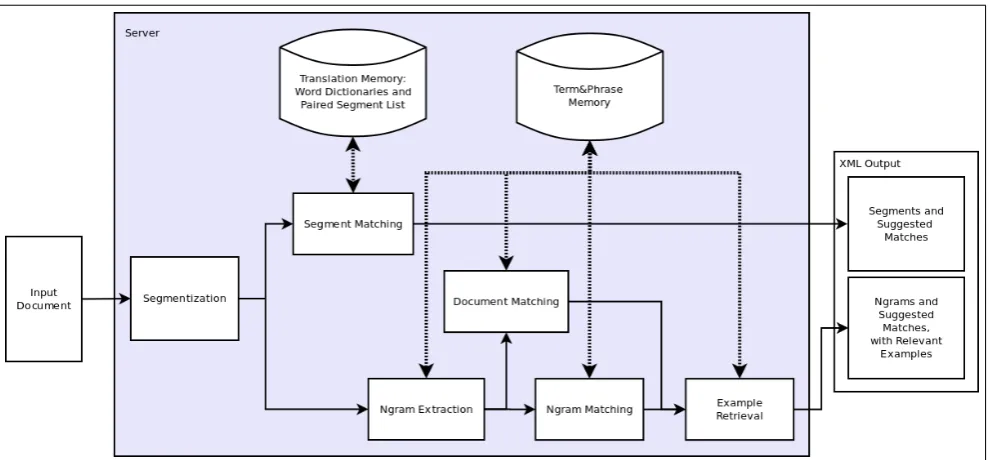
In this paper and the accompanying poster and demo, we present TermWise, a Computer Assisted Translation (CAT) tool that offers additional terminological support for domain-specific translations. Compared to existing CAT-tools, TermWise has an extra database, a Term&Phrase Memory, that provides context-sensitive suggestions of translations for individual terms and domain-specific ex-pressions. The Term&Phrase Memory has been compiled by applying newly developed statistical knowledge acqui-sition algorithms to large parallel corpora. Although these algorithms are language- and domain-independent, the tool was developed in a project with translators from the Bel-gian Federal Justice Department (FOD Justitie/SPF Justice) as end-user partners. Therefore the tool is demonstrated in a case study of bidirectional Dutch-French translation in the legal domain. In this paper, we first describe the specific needs that our end-user group expressed and how we translated them into the new Term Memory function-ality. Next, we summarize the term extraction and term alignment algorithms that were developed to compile the Term Memory from large parallel corpora. Section 4. de-scribes how the Term&Phrase Memory functions as server database that is now, in this proof-of-concept phase, ac-cessed via a lightweight stand-alone tool, but that is de-signed to be fully integrated with a CAT user-interface so as to provide context-sensitive terminological support in the normal translation work-flow. Section 5. presents short de-scription of the evaluation scheme. Section 6. concludes with a discussion of how TermWise is an example of a ded-icated linguistic search tool that allows translators to exploit Big Data that takes the form of large online bilingual docu-ment collections.
TermWise was funded by KU Leuven IOF grant KP/09/001. Special thanks to Martine Perpet of the FOD Justitie.
2.
Term&Phrase Memory
Figure 2: Screen cap of TermWise GUI with n-grams highlighted in the source text and translation examples displayed in the Term&Phrase Memory pane