Utilizing constituent structure for compound analysis
Jón Friðrik Daðason & Kristín Bjarnadóttir
The Árni Magnússon Institute for Icelandic StudiesUniversity of Iceland E-mail: [email protected], [email protected]
Abstract
Compounding is extremely productive in Icelandic and multi-word compounds are common. The likelihood of finding previously unseen compounds in texts is thus very high, which makes out-of-vocabulary words a problem in the use of NLP tools. The tool described in this paper splits Icelandic compounds and shows their binary constituent structure. The probability of a constituent in an unknown (or unanalysed) compound forming a combined constituent with either of its neighbours is estimated, with the use of data on the constituent structure of over 240 thousand compounds from the Database of Modern Icelandic Inflection, and word frequencies from Íslenskur orðasjóður, a corpus of approx. 550 million words. Thus, the structure of an unknown compound is derived by com-parison with compounds with partially the same constituents and similar structure in the training data. The granularity of the split returned by the decompounder is important in tasks such as semantic analysis or machine translation, where a flat (non-structured) sequence of constituents is insufficient.
Keywords: decompounding, constituent structure, Icelandic compounds
1.
Introduction
Compounding is extremely productive in Icelandic, which poses problems in certain NLP tasks, as the result of the productivity is a quantity of unknown words. Many NLP tasks, including part-of-speech tagging, machine transla-tion and informatransla-tion retrieval, may rely on lexicons with a good coverage of the vocabulary, and the tasks can be adversely affected by the presence of out-of-vocabulary words. The success of NLP tools for Icelandic can there-fore be greatly enhanced by compound splitting or de-compounding, i.e., the process of breaking compounds into constituent parts.
Decompounding of unknown words has proven useful for other languages, for tasks such as machine translation (Brown, 2002; Koehn and Knight, 2003; Alfonseca, 2008), information retrieval (Hedlund et al., 2001; Braschler et al., 2003), and speech recognition (Ad-da-Decker et al., 2000). The difference between the methods in general use and the method proposed in this paper is that here the constituent structure of the com-pounds is used to analyse the unknown parts.
Assuming binary branching (Bjarnadóttir, 2005), each compound is split into two parts, i.e., modifier as a first part, and head as a second part. In Icelandic, the second part of a compound is always the morphological (i.e., inflectional) head. Compounds can be formed by joining any combination of the open word classes, although noun-noun compounding is by far the most productive, and will be used for demonstration in this paper. However, the decompounder described here works equally well for other combinations of the open word classes.
In this paper, a method for generating the constituent structures of compound words is presented. The method is based on the probability that pairs of modifiers and heads can form a compound together, as derived from a large corpus of manually annotated compounds. Using the training data, it is possible to estimate the probability of
unknown compounds by comparison with known com-pounds with a similar structure. The constituent structures can be used in order to split unknown compounds at various levels of granularity, depending on the task at hand. This method is then evaluated on a set of manually annotated Icelandic compounds.
The paper is structured as follows. Section 2 contains a description of Icelandic compounds, and previous work is described in section 3. The description of the decom-pounder is the body of the paper, with methodology in Section 4 and evaluation in Section 5. Section 6 contains the conclusion and thoughts on future work.
2.
Compounding in Icelandic
An example of an Icelandic noun-noun compound is skólabókasafn ‘school library’ (skóla ‘school’ + bókasafn ‘library’), where the second part, bókasafn ‘library’, is also a compound (bóka ‘book’ + safn ‘collection’). The structure of a compound can be ambiguous, as is the case in the above example; the word skólabókasafn could potentially also refer to a collection of textbooks (skólabóka ‘school books’ + safn ‘collection’).
Fig. 1. The constituent structure of Alþjóðaheil-brigðismálastofnun.
The analysis of Icelandic compounds is further compli-cated by variation in combining forms. Nominal modifi-ers can thus appear as stems or inflectional forms, i.e., in the genitive, singular or plural, or (rarely) the dative, and link phonemes also occur (Bjarnadóttir, 2002). The choice between the first three of these seems to be arbitrary, but not free, i.e., the form itself can be said to be lexicalized (Bjarnadóttir, 1995), as in Table 1:
Stem Gen.sg. Gen.pl. Meaning
bóksala *bókarsala *bókasala ‘book store’ *bókkápa bókarkápa *bókakápa ‘book cover’ *bókbúð *bókarbúð bókabúð ‘book store’
Table 1. Lexicalization of form in the first part of noun-noun compounds.
The choice between variant forms is usually not mean-ing-related, as can be seen in the words barnsmeðlag and barnalífeyrir ‘child support/child maintenance/child allowance’ (barn, gen.sg. barns, gen.pl. barna, ‘child’, meðlag/lífeyrir ‘allowance/support/pension’). The word barnsmeðlag is used of child support paid by a parent, but barnalífeyrir refers to payment by an official body, e.g., the government, etc. The point is that the choice of geni-tive singular or genigeni-tive plural in the modifier does not have a semantic significance; both words can apply to benefits due to one or more children.1 The variant forms
1This is a simplification, as there are compounds where number
is significant in the modifier, as in bróðursonur (bróður gen.sg. ‘brother’ + sonur sg. ‘son’) ‘nephew’, i.e. the son of one's brother (pl. bróðursynir); bræðrasynir (bræðra gen.pl. ‘er’, synir pl. ‘sons’) ‘sons of brothers’’ or ‘sons of one’s broth-ers’’. The form bræðrasonur ‘the son of brothers’’ is not found. This kind of distinction of number in the first part of a noun-noun compound is rare.
of nouns allowed in the first part of compounds is thus determined by convention, independently of lexicalized semantic relations between the constituent parts.
As inflectional word forms in Icelandic are highly am-biguous (Bjarnadóttir, 2012), lemmatization of the con-stituents is needed for the disambiguation of the modifiers. The word andahyggjumaður is a case in point, as the genitive plural anda can be lemmatized as either andi ‘spirit’ or önd ‘duck’. The other two base words in the compound are unambiguous, i.e., hyggja ‘thought’ and maður ‘man’. The meaning of the compound could therefore be either ‘spiritualist’ or ‘duck-minded person’ (as of someone specializing in ducks). The first meaning is the correct one, i.e., the accepted or lexicalized version, with the first part andahyggja ‘spiritualism’, although the second reading is also in accordance with the rules of productive compound formation. It should be noted that there is no structural morphological difference between productive compound formation and lexicalized com-pounds in Icelandic, i.e., they are formally compositional to the same degree.2 The structure of all compounds can therefore be analysed by the same decompounder, but the lemmatization of ambiguous constituents entails the use of semantic features, as in the differentiation of ‘spirit’ and ‘duck’ in anda.
Fig. 2. The constituent structure of stjórnmálaflokkur.
The granularity of the split returned by the decompounder is important, as indicated by the examples andahyggju-maður and stjórnmálaflokkur above. For certain NLP tasks, such as PoS-tagging and lemmatization (of syntac-tic atoms, i.e., words), it might be sufficient to split compounds into constituent parts (without structural analysis), as the morphological head is generally the only part of a compound that is modified by inflection. For this purpose, knowing the full structure of the compound and being able to specify a less granular split is not important. The same might not apply for other tasks, such as se-mantic analysis or machine translation. This can be demonstrated by the compound stjórnmálaflokkur ‘polit-ical party’ (stjórnmála [stjórn ‘control’ + mál ‘matters’] = ‘politics’ + flokkur ‘party’). Translating the base words that the compound stjórnmálaflokkur is made up of would result in a mistranslation (e.g., ‘control affairs party’ instead of ‘political party’). Similarly, incorrectly
2Archaic forms occur in a few words; these can easily be listed
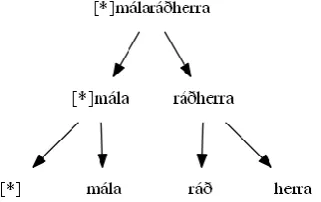
mála-Larger templates are constructed from groups of com-pounds that are very similar in composition. Training the decompounder on a large collection of constituent struc-tures makes it possible to make certain observations about the structure of compounds that share very similar char-acteristics. For example, consider fjármálaráðherra ‘finance minister’ (fjármála ‘finance’ + ráðherra ‘minis-ter’), dómsmálaráðherra ‘justice minister’ (dómsmála ‘justice’ + ráðherra ‘minister’) and a number of other similar compounds. They all share the same head, ráðherra, and a modifier that is itself a compound with the head mála (i.e., fjár ‘money’ + mála ‘affairs’, dóms ‘court’ + mála ‘affairs’, etc.). The structure of these compounds can be used to gain an insight into the prob-ability of unknown words with the same structure.
Fig. 3. A template for a group of compounds, such as fjármálaráðherra and dómsmálaráðherra.
The probability of samgöngumála ‘transport’ and ráð-herra ‘minister’ forming the compound samgöngu-málaráðherra is estimated by multiplying the probabili-ties of samgöngu+mála and *mála+ráðherra.
Constituent structures (binary trees) are built bottom-up for every possible segmentation of the compound, by iteratively joining the two adjacent nodes with the greatest probability of forming a compound together until only one node (the root) remains. The resulting constituent structures are then ranked by the probability of their last joining operation, and the structure with the highest probability is chosen.
In the compound andahyggjumaður ‘spiritualist’ (cf. Sec. 2), the probabilities of the adjacent parts suggest the constituent structure andahyggju+maður.4 There are in fact a number of terms like andahyggja ‘spiritualism’ in use, all of which can be modifiers in compounds ending in maður ‘man’, e.g., dulhyggja (‘occultism’, from dulur ‘secret, hidden’), efahyggja (‘skepticism’, from efi ‘doubt’), efnishyggja (‘materialism’, from efni ‘matter, material’), félagshyggja (‘socialism, communitarianism’, from félag ‘association, society’), frjálshyggja (‘libertar-ianism’, from frjáls ‘free’). Disambiguation, and therefore
4A single citation of the compound hyggjumaður ‘a man of
thought’ in The Written Language Archive at The Árni Mag-nússon Institute for Icelandic Studies could indicate the other possible binary tree for the word andahyggjumaður. However, the citation is from the 16th century, and the word hyggjumaður is exceedingly rare.
correct lemmatization of the first part anda (i.e., andi ‘spirit’ and not önd ‘duck’), should be possible by se-mantic clustering at a later stage, but for now the data suffices to produce the correct binary tree, as there is quite a number of compounds with the same constituent struc-ture in the data.
5.
Evaluation
The method described in this work is evaluated on a collection of manually annotated Icelandic Wikipedia articles, containing a total of 6.098 words (of which 3.319 are compounds).
The evaluation is two-fold. First, we evaluate the accu-racy of the decompounder when used to analyse the structure of compound words. Second, the overall per-formance of the decompounder is evaluated on the full set of words.
N Count Atoms Binary split Binary tree
N=2 2.709 99.5% 99.6% 99.5%
N=3 513 93.2% 97.9% 91.8%
N=4+ 97 91.8% 96.9% 88.7%
Total 3.319 98.3% 99.2% 98.0%
Table 2. The results of the evaluation on compound word analysis, where N denotes the number of base words the
compounds were comprised of.
Table 2 shows the ratio of compounds which the de-compounder successfully breaks down into the sequence of base words (‘atoms’) which they are comprised of, the ratio of compounds that were successfully split in two, and finally the ratio of compounds for which the de-compounder could correctly determine the entire con-stituent structure (i.e., their binary tree representation). The overall performance of the decompounder is evalu-ated in terms of precision and recall. The precision of the decompounder is computed as the number of correctly split compounds (into binary trees) divided by the total number of words that are split. The recall is computed as the number of correctly split compounds divided by the number of compounds in the text. When evaluated on the full text, the decompounder achieves a precision of 97.6%, a recall of 98.0% and an accuracy of 99.2%.
6.
Conclusion and future work
The results presented in this paper show that the method reduces the number of unknown (i.e., unanalyzed) com-pounds substantially. By using the binary tree of the constituent structure rather than splitting the compounds into flat sequences of words, it is possible to specify splits at various levels of granularity. This is essential for the disambiguation of the compounds, both in the disambig-uation of individual constituents (as in anda ‘spirit’/‘duck’ in andahyggjumaður) and in the disambiguation of the compound structures themselves (as in stjórnmálaflokkur ‘political party’).
Studies, such as automatic word excerption for additional vocabulary for the DMII, and for the correction of com-pounds in the context-sensitive spellchecking application Skrambi (work in progress).
Future work includes exploring the use of semantic clus-tering in order to obtain better results on unknown com-pounds. The disambiguation of anda in section 4.2 shows an example of this. The word andi ‘spirit’ is more con-vincing in a semantic cluster with the words dulur ‘secret’, efi ‘doubt’, efni ‘matter’, félag ‘society’ and frjáls ‘free’ than the word önd ‘duck’ would be, as any semantic categorization will show. The fact that these words (and quite a few more) are the first constituent in terms for philosophical and political “isms” of all kinds ending in -hyggja demonstrates the point.
7.
Acknowledgements
The project described in this paper forms a part of a collection of NLP tools being developed at the Árni Magnússon for Icelandic Studies (AMI) in Reykjavík. The prototype was developed in 2012 by Jón Friðrik in his M.Sc. program in Computer Science at the University of Iceland, and thanks are due to his teacher in computa-tional linguistics, Professor Eiríkur Rögnvaldsson. Sigrún Helgadóttir and Professor Sven Þ. Sigurðsson, from the AMI and the University of Iceland respectively, also took an active part in the work on the project, in an advisory capacity; they truly deserve our gratitude. Thanks are also due to Þórdís Úlfarsdóttir, our colleague at the AMI, and anonymous LREC reviewers for their helpful comments, which we have taken into account as far as possible. All mistakes and short-comings are ours, of course.
8.
References
Bjarnadóttir, Kristín. (1995). Lexicalization and the Selection of Compounds for a Bilingual Icelandic Dic-tionary Base. In Ásta Svavarsdóttir, Guðrún Kvaran, Jón Hilmar Jónsson (ritstj.). Nordiske studier i leksikografi 3:255-263.
Bjarnadóttir, Kristín (2002). A Short Description of Ice-landic Compounds. Retrieved from http//www.lexis.hi.is/ kristinb/comp-short.pdf.
Bjarnadóttir, Kristín. (2005). Afleiðsla og samsetning í generatífri málfræði og greining á íslenskum gögnum. Reykjavík: Orðabók Háskólans. [Derivation and compounding in generative grammar and the analysis of Icelandic data.]
Bjarnadóttir, Kristín (2012). The Database of Modern Icelandic Inflection. In Proceedings of the workshop Language Technology for Normalization of Less-Resourced Languages, SaLTMiL 8 - AfLaT, LREC 2012, pp. 13-18, Istanbul, Turkey.
Braschler, M., Göhring, A., & Schäuble, P. (2003). Eu-rospider at CLEF 2002. In C. Peters, M. Braschler & J. Gonzalo (Eds.) Advances in Cross Language Infor-mation Retrieval (Vol. 2785, pp. 164-174): Springer Berlin / Heidelberg.
Brown, R. D. (2002). Corpus-Driven Splitting of Com-pound Words. In Proceedings of the Ninth
Interna-tional Conference on Theoretical and Methodological Issues in Machine Translations (TMI-2002).
The Database of Modern Icelandic Inflection. [Beygingarlýsing íslensks nútímamáls.] (n.d.) Kristín Bjarnadóttir, editor. The Árni Magnússon Institute for Icelandic Studies. http://bin.arnastofnun.is/
Hallsteinsdóttir, E., Eckart, T., Biemann, C., Quasthoff, U., & Richter, M. (2007). Íslenskur Orðasjóður - Building a Large Icelandic Corpus. In Proceedings of NODALIDA-07, Tartu, Estonia.
Hedlund T., Keskustalo H., Pirkola A., Airio E. & Järvelin K. (2001) Utaclir @ CLEF 2001 – effects of compound splitting and n-gram techniques. In Second Workshop of the Cross-Language Evaluation Forum (CLEF), Revised Papers.
Íslenskur orðasjóður. (n.d.) Universität Leipzig. http://wortschatz.uni-leipzig.de/ws_isl/
Koehn, P., & Knight, K. (2003). Empirical methods for compound splitting. In Proceedings of the tenth con-ference on European chapter of the Association for Computational Linguistics - Volume 1, Budapest, Hungary.
Ritmálssafn Orðabókar Háskólans. (n.d.) The Árni Magnússon Institute for Icelandic Studies. http://www.arnastofnun.is/page/ritmal.