New bilingual speech databases for audio diarization
David Tavarez, Eva Navas, Daniel Erro, Ibon Saratxaga, Inma Hernaez
Aholab - Dept. of Communications Engineering. Faculty of Engineering. University of the Basque Country. Alda. Urquijo s/n 48013 Bilbao
email: david, eva, derro, ibon, [email protected]
Abstract
This paper describes the process of collecting and recording two new bilingual speech databases in Spanish and Basque. They are designed primarily for speaker diarization in two different application domains: broadcast news audio and recorded meetings. First, both databases have been manually segmented. Next, several diarization experiments have been carried out in order to evaluate them. Our baseline speaker diarization system has been applied to both databases with around 30% of DER for broadcast news audio and 40% of DER for recorded meetings. Also, the behavior of the system when different languages are used by the same speaker has been tested.
Keywords:Spoken Language Resource, Speaker Diarization, Bilingual Speech Database
1.
Introduction
Speaker diarization is the process of identifying “who spoke when” in an audio recording, mainly without any pre-vious information about the number of speakers present in the recording, the types of audio included or the amount of speech in the audio (Anguera Miro et al., 2012). This process usually requires the detection of speaker changes and the subsequent identification of each different speaker within the resulting speech segments. Speaker diarization has been primarily used in two different application do-mains:
• Broadcast news audio: Radio and television pro-grams that usually contain commercial breaks, mu-sic, interviews, voice with different types and levels of background noise etc. They are generally recorded on a single channel. Speech has different levels of quality depending on the origin of the recording; it ranges from clean studio speech to speech recorded at the street with background noise and even telephone speech in some cases.
• Recorded meetings: Meetings and conferences where several people interact in the same room. Recordings are predominantly made with multiple microphones and contain different noises. The number of speak-ers is usually smaller in recorded meetings than in broadcast audio, but speaker turns are shorter due to the spontaneity of meeting speech, with many inter-ruptions between participants and overlapping speech segments.
As it occurs in any other speech technology, there is a need for transcribed data in order to develop quality speaker di-arization systems. In the last years, important efforts have been done to collect and transcribe several databases, such as the ISL audio corpus (Burger et al., 2002), the ICSI meeting corpus (Janin et al., 2003) and the AMI meeting corpus (Carletta et al., 2006) for the meeting environment and the COST278 broadcast database (Vandecatseye et al., 2004), the DiSCo German corpus (Baum et al., 2010) and the Catalan 3/24 database (Zelen´ak et al., 2012) for the
broadcast audio domain. These diarization databases are mostly monolingual. The ones that include speech in more than one language, like COST278 database, have different speakers for different languages. The databases presented in this paper include bilingual speakers recorded both in Spanish and Basque. There are multilingual databases that include speakers talking in more than one language, how-ever they have not been designed with audio diarization purposes but to study code switching between different lan-guage pairs (Han-Ping Shen et al., 2011), to perform speech and language recognition in non-native languages (Imseng et al., 2012) or to evaluate speaker recognition systems over the telephone in multilingual environments (Cieri et al., 2004).
The main purpose of the work described in this paper is the collection and recording of two new speech databases which will support the development and implementation of multilingual diarization systems for both main application domains.
The paper is organized as follows: it begins by describ-ing the main characteristics of the two new databases, their recording purposes and the labeling available for each of them. Next, some diarization experiments performed in order to evaluate each database are presented. Finally, the paper concludes with a brief discussion on the per-formed work and possible future uses and availability of the databases.
2.
Ahonews Database
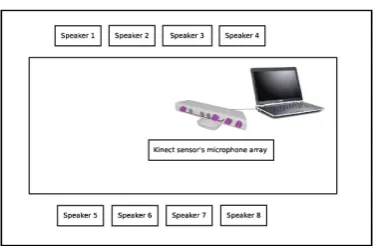
Figure 1: Audio set up for the Ahomeetings database ac-quisition
kept constant and the signal levels were tested at the be-ginning of each recording session to ensure that the record-ing conditions were unchanged. Not all the speakers are present in every session, thus the number of speakers varies between 5 and 10 per session.
To label the signals, an automatic segmentation process has been applied to locate the appearances of each speaker (Lu-engo et al., 2010). Then, a manual review has been com-pleted and notes about specific background disturbances have been included in the label files. As the applied au-tomatic segmentation system is able to assign only one speaker label at each time instant, overlapping speech seg-ments have also been identified during the subsequent man-ual labeling process.
Wavesurfer label file format has been used for the Ahome-etings transcriptions, with the ID character determining one of the following categories of acoustic event:
• spkN: speech from a speaker identified by number N. Due to the automatic segmentation process, some speakers might have different IDs in each session they took part in. It is also possible that one speaker is iden-tified by more than one ID within a session. Finally, in some cases, one ID might correspond to more than one speaker.
• o: overlapped speech segments produced by multiple speakers talking at the same time. Just the presence of overlap is indicated, without taking into account the individual speakers involved in it.
• n: specific disturbances related to background condi-tions and noises (knock on door or table, chair moving, laughs...).
• s: silence segments corresponding either to absence of signal or to breath pauses.
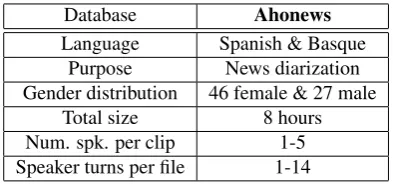
Table 2 summarizes the most important characteristics of Ahomeetings database. In this database, as usually corre-sponds to a meeting speech database, there are fewer dif-ferent speakers, with more interaction among them which reflects in the higher number of speakers turns compared with Ahonews database.
Database Ahomeetings
Language Spanish & Basque Purpose Meetings diarization Gender distribution 2 female & 8 male
Total size 4,5 hours
Num. spk. per file 5-10
Spk. turns per file 200-701
Table 2: Main characteristics of Ahomeetings database
4.
Diarization Experiments
In order to evaluate the new databases gathered, a previ-ously assessed diarization system has been applied to both of them and the results obtained have been analyzed with detail.
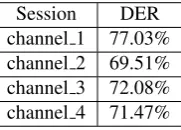
In these experiments, the diarization system built by our research group for the Albayzin 2010 speaker diarization evaluation campaign (Luengo et al., 2010) has been used. The applied algorithm is based on an efficient implementa-tion of a BIC change detector and an off-line speaker clus-tering, and it was the top-performing system in Albayzin 2010 evaluation with 30% DER (Diarization Error Rate) (Zelen´ak et al., 2010). At the above mentioned campaign a Catalan broadcast news database from the 3/24 TV channel was used (Zelen´ak et al., 2012). Therefore, due to the sim-ilarities of both databases, the experiments developed with Ahonews database were expected to give similar DER as the ones obtained with the Catalan database. In the case of Ahomeetings database, the different characteristics of broadcast audio and audio from recorded meetings were likely to degrade the results of the diarization process. The obtained results of the diarization system for the three Ahonews sessions are shown in Table 3. Due to the short length of Ahonews news clips (they are around 2 minutes long), Ahonews sessions have been used in this test in or-der to obtain more reliable DER values. These values have been calculated according to the criteria defined by NIST.
Session DER
Ahonews 1 35.65% Ahonews 2 26.83% Ahonews 3 1.73%
Table 3: Results of the baseline diarization system for the Ahonews sessions
As displayed in Table 3, the two first sessions get DER values comparable to the one obtained in the Albayzin 2010 evaluation campaign. However, it can also be seen that the DER value for Ahonews 1 session is significantly higher. This is due not to the Ahonews database itself, but to the differences between the acoustic characteristics of Ahonews sessions (mainly the number of speakers) and the default configuration of the diarization system.
Christopher Cieri, Joseph P. Campbell, Hirotaka Nakasone, David Miller, and Kevin Walker. 2004. The mixer cor-pus of multilingual, multichannel speaker recognition data. InProc. 4th International Conference on Language Resources and Evaluation (LREC), pages 26–28, Lisbon, Portugal.
Han-Ping Shen, Chung-Hsien Wu, Yan-Ting Hsu, and Yang Chun-Shan. 2011. CECOS: A Chinese-English code-switching speech database. InInternational Conference on Speech Database and Assessments (Oriental CO-COSDA), pages 120–123, Hsinchu, Taiwan.
David Imseng, Herv´e Bourlard, Holger Caesar, Philip N. Garner, Gw´enol´e Lecorv´e, and Alexandre Nanchen. 2012. MediaParl: Bilingual mixed language accented speech database. InIEEE Spoken Language Technology Workshop (SLT), pages 263–268, Miami, USA.
Adam Janin, Adam Baron, Jane Edwards, Dan Ellis, David Gelbart, Nelson Morgan, Barbara Peskin, Thilo Pfau, Elizabeth Shriberg, Andreas Stolcke, and Chuck Woot-ers. 2003. The ICSI meeting corpus. InIEEE Interna-tional Conference on Acoustics, Speech and Signal Pro-cessing (ICASSP), pages 364–367, Hong Kong.
Iker Luengo, Eva Navas, Ibon Saratxaga, Inma Hern´aez, and Daniel Erro. 2010. AhoLab Speaker Diarisation System for Albayzin 2010. InFALA 2010, pages 393– 396, Vigo, Spain.
An Vandecatseye, Jean-Pierre Martens, Joao Neto, Hugo Meined, Carmen Garcia-Mateo, Javier Dieguez, France Mihelic, Janez Zibert, Jan Nouza, Petr David, Matus Pl-eva, Anton Cizmar, Harris Papageorgiou, and Christina Alexandris. 2004. The COST278 Pan-European Broad-cast News Database. In 4th international conference on Language Resources and Evaluation (LREC), pages 873–876, Lisbon, Portugal.
Martin Zelen´ak, Henrik Schulz, and Javier Hernando. 2010. Albayzin 2010 Evaluation Campaign: Speaker Di-arization. InFALA 2010, pages 301–304, Vigo, Spain. Martin Zelen´ak, Henrik Schulz, and Javier Hernando.