Automatic Classification of Spoken Languages
using Diverse Acoustic Features
Yaakov HaCohen-Kerner
Ruben Hagege
Dept. of Computer Science
Dept. of Electronics
Jerusalem College of Technology –
Lev Academic Center
Jerusalem College of Technology –
Lev Academic Center
21 Havaad Haleumi St., P.O.B. 16031
9116001 Jerusalem, Israel
21 Havaad Haleumi St., P.O.B. 16031
9116001 Jerusalem, Israel
[email protected]
[email protected]
Abstract
Many of the language identification (LID) systems are based on language models using machine learning (ML) techniques that take into account the fluctuation of speech over time, such as Hidden Markov Models (HMM). Considering the fluctuation of speech results LID systems use relatively long recording intervals to obtain reasonable accuracy. This research tries to extract enough features from short recording intervals in order to enable successful classification of the tested spoken languages. The classification process is based on frames of 20 milliseconds (ms) where most of the previous LID systems were based on much longer time frames (from 3 seconds to 2 minutes). We defined and implemented 173 low level features divided into three feature sets: cepstrum, relative spectral (RASTA), and spectrum. The examined corpus, containing speech files in seven languages, is a subset of the Oregon Graduate Institute (OGI) telephone speech corpus. Six machine learning (ML) methods have been applied and compared and the best optimized results have been achieved by Random Forest (RF): 89%, 82%, and 80% for 2, 5, and 7 languages, respectively.
1
Introduction
LID is used either as a standalone task or as a pre-processing step, capturing the first seconds (sec) of the recording and processing it in order to transfer
the control to the appropriate next stage; e.g. speech recognition systems, multilingual translation systems or call-centers (e.g., emergency calls) routing, where the response time of a native operator might be critical.
LID is a process by which a given spoken utterance language is automatically identified (Muthusamy et al., 1994). Most LID systems are based on high level features such as frequency of a single phoneme, phoneme sequences (Zissman and Singer, 1994), syllable, words, and prosody (Thymé-Gobbel and Hutchins, 1996). Such LID systems need a comprehensive corpus, including transcription from trained humans, and long enough intervals to correctly classify, first, these high level features and then the spoken language (Zissman, 1996; Greenberg, 1999). Any error in the higher level feature recognizers is carried over, and probably/possibly amplified in, the following steps. However, providing a comprehensive corpus enables higher level features which ensure better results than using acoustic features alone. LID systems based on higher level features have one principal problem: Tokenizing those features accurately has proven to be the main obstacle thus far in high accuracy of natural LID (Abramson, 2003). Matejka et al. (2005) found that separating gender before processing improved the LID’s accuracy.
A LID system has two main parts: feature extraction, where a vector of measurements that
275
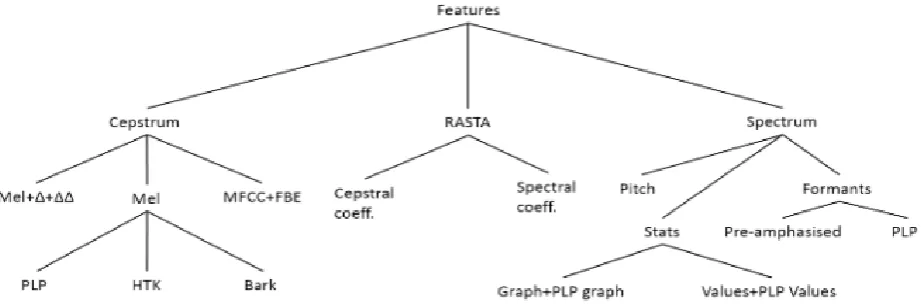
Figure 1. The computed acoustic features.
3
Acoustic Features
In this research, we consider 173 acoustic features divided into three main feature sets: 114 Cepstrum features, 28 RASTA features, and 30 Spectrum features. The hierarchical structure of the three feature sets is described in Figure 1. Although most of these features have been extensively used in previous LID systems, these features were a basis for higher level features. In contrast, our system is solely relying on an extensive combination of low level features which has never been used before to the best of our knowledge.
The Cepstrum features set is composed of groups of coefficients which represent the filter sources (e.g., shape of the mouth etc.). The Bark and Mel scales (Stevens et al., 1937; Stevens and Volkmann, 1940) are perceptual scales of the pitch. Filter Bank Energy (FBE) represents the energy from all the band filters (Huang et al., 2001) used to extract the MFCCs. HTK (HMM ToolKit) represents the CCs extracted using parameters close to the original HTK (Young et al., 2002; Ellis, 2005; Brookes, 1997) approach.
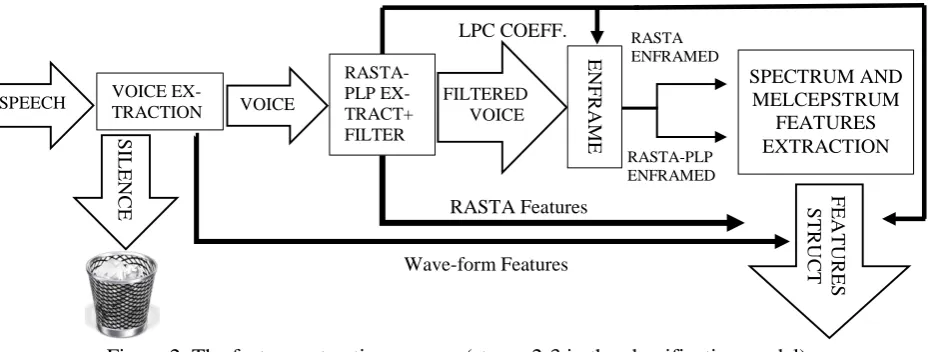
The RASTA set represents features extracted af-ter filaf-tering. These features are extracted in both spectrum and cepstrum, taking cepstrum coeffi-cients using both Linear Predictive Coefficoeffi-cients (LPC), which are used to compute spectral and cepstral features, and RASTA filter.
We implemented the IIR RASTA filter as it is de-scribed in Equation 1 (Ellis 2005; Matlab RASTA’s filter transfer function implementation).
H(z) = 0.1 ×2z5+z4−z2−2z
z−0.94 (1)
The -0.94 weight in the denominator side was chosen in our Matlab implementation to improve filter response time from the original 500ms to 160ms response time using -0.98 that is applied in some of the previous works (Zissman, 1996).
The Spectrum features set consists of the follow-ing feature sets: (1) The pitch (F0) feature (Titze, 1994; Zahorian and Hu, 2008). (2) The graph fea-tures, which are statistical features that record the occurrence of each frame’s median peak. (3) Values (mean, median, min, max, std), and frequency (me-dian) stats, describing each frame’s FFT. (4) For-mants are the principal spectral component of a frame, defined by "the spectral peaks of the voice spectrum". Linguists largely maintain that the first two formants (in EN at least) are sufficient to differ-entiate between all vowels (Ladefoged and Johnson, 2014). We decided to extract the 4 first formants.
There is a spectral tilt in speech caused by the voice-source (vocal tract). The vocal tract creates the formant frequencies, so when these are estimated (using FFT), the spectral tilt needs to be removed. This is usually done with a simple pre-emphasis filter, as in our case.
technique. Ensemble methods use multiple learning algorithms to obtain better predictive performance than what could be obtained from any of the constituent learning algorithms. RF is based on what’s called a random tree: a tree that randomly chooses K attributes and then build a simple tree with no pruning. RF let us choose the number of features (K) and the number of random trees (I) we want to use.
3. MultiBoostab (MB) (Webb, 2000) is an exten-sion to the highly successful AdaBoost (Freund and Schapire, 1996) technique for forming deci-sion committees. MB technique can be viewed as combining AdaBoost with wagging (Bauer and Kohavi, 1999). It is able to harness both AdaBoost's high bias and variance reduction with wagging's superior variance reduction. Us-ing C4.5 as the base learnUs-ing algorithm, Multi-boosting is demonstrated to produce decision committees with lower error than either Ada-Boost or wagging significantly more often than the reverse. It offers the further advantage over AdaBoost of suiting parallel execution. In WEKA, the default base classifier for MB is De-cision Stump (Iba and Langley, 1992).
4. BayesNet (BN) is a variant of a probabilistic statistical classification model that represents a set of random variables and their conditional dependencies via a directed acyclic graph (DAG) (Friedman et al., 2000; Heckerman, 1997; Pourret, 2008).
5. Logistic regression (LR) (Cessie et al., 1992) is a variant of a probabilistic statistical classifica-tion model that is used for predicting the out-come of a categorical dependent variable (i.e., a class label) based on one feature or more (Landwehr et al., 2005; Sumner et al., 2005). 6. Sequential Minimal Optimization (SMO; Platt,
1998; Keerthi et al., 2001) is a variant of the Sup-port Vectors Machines (SVM) ML method (Cortes and Vapnik, 1995). The SMO technique
is an iterative algorithm created to solve the op-timization problem often seen in SVM tech-niques. SMO divides this problem into a series of smallest possible sub-problems, which are then resolved analytically.
These ML methods have been applied using the WEKA platform (Frank, 2006; Hall et al., 2009). We performed parameter tuning with Info-Gain (IG), a feature selection metric for classification purposes. Yang and Pedersen (1997) reported that IG performed best in their multi-class benchmarks. The accuracy of each model was estimated by a 10-fold cross-validation test.
5
Experimental Results
The OGI Multi-language Telephone Speech Corpus (Muthusamy et al., 1992; Muthusamy et al., 1993) consists of telephone speech recorded in eleven languages: EN, FA, FR, GE, HI, JA, KO, MA, SP, TA and VI. The OGI corpus is not balanced between males and females: the male files represent more than 75% of the corpus. Thus, in this study, we only used the male speech files. The examined corpus contains 478 files (each from a different person) from seven selected languages with an average length of 44.3 sec, each file consists of free, continuous speech.
Since our classification system was heavily consuming a classic workstation's RAM, the final corpus had to be reduced to 10,000 frames per language (equally distributed on the various files), that are equivalent to 100 sec of speech. As most of telephone speech corpus based LID systems (Hermansky, 2011), we used a RASTA filter (Matlab implementation; Ellis, 2005) to reduce the channel (telephone) effect noises.
Table 1 presents general information about the speech files contained in the examined corpus. The number of speech files for each language is ranging from 53 to 86. The average time length is rather similar for all languages (from 42.2 to 47.5 sec).
# Language # of speech files Length of speech files in sec. Avg. time length in sec.
1 French (FR) 55 37<x<49 47.5
2 Farsi (FA) 81 5<x<49 44.4
3 Japanese (JA) 53 23<x<49 46.6
4 Korean (KO) 62 4<x<49 42.2
5 Mandarin (MA) 73 10<x<49 42.5
6 Tamil (TA) 86 8<x<49 44.3
7 Vietnamese (VI) 68 7<x<49 43.9
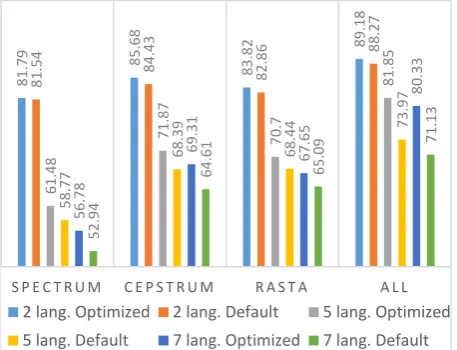
Multiple conclusions can be drawn from Figure 3: (1) RF has a great optimizing potential, (2) The more language it classifies, the greater become the optimization over default results, (3) The Cepstrum feature set has the greatest differentiation potential. A possible explanation for these results can be the high number of relevant features: the more relevant data one have, the easier classification become. (4) RASTA has the greatest differentiation potential per feature; its performance is almost equal to the Cepstrum set while using only a quarter of its number of features.
6
Summary and Future Research
In this paper, we present a methodology for classifying speech files from 7 different languages based on combined cepstrum, RASTA, and spectrum feature sets. This methodology compares six different ML methods. RF, the best ML method achieves relatively high accuracy results of 89.18%, 81.85%, and 80.33% for the following classification experiments: 2, 5, and 7 best language combinations, respectively.
The novelties of this research are in its reliance: (1) on low-level features alone, rather than using low-level features changes over time to predict intermediate features as in previous work, and (2) on much smaller frames (20ms) in comparison to most previous LIDs whose results are based on much longer time periods (at least 3 sec. or longer; see Martinez et al., 2013, among many other references below, for detail on the impact of frame length on result). Eliminating reliance on intermediate features is an important contribution, especially for low-resource languages.
Our results are comparable to the accuracy level of top LID systems from about 20 years ago (that also used different versions of the OGI corpus; see section 2). However, our LID system uses a time frame that is at least 60 times shorter than the time frames used by previous LID systems. To the best of our knowledge, there is no LID system which is based on a such short time frame.
Future directions for research are: (1) Developing additional feature sets in general and additional features in particular (with an emphasis on the RASTA set), (2) Applying other ML methods in order to find the most suited method for LID purposes, (3) Conducting more experiments using more speech files from more languages, (4)
Discovering which combination of features in particular are appropriate for LID of speech files using the system we developed, and (5) How well does the system based on acoustic features work for non-native speakers?
Acknowledgments
The authors would like to thank Shmuel Kirshner for his many advises on theory of speech processing, Edmond Shalom for enabling us to start this research, Shlomo Engelberg for his continuous support, on each aspect of this endeavor, Shimon Mizrahi for giving us the time needed to accomplish such a work, Boris Dekhovitch for his comments, Evgeni Frishman and Yaakov Friedman for financing of the database. Many thanks to the Dept. of Electronics and the rector Kenneth Hochberg of the Jerusalem College of Technology, Lev Academic Center, for their assistance during this research. We would also like to thank the three reviewers for their useful and instructive comments.
References
Arthur S. Abramson. 2003. A Practical Introduction to Phonetics (review).volume 79. Clarendon Press Oxford.
Régine Andre-Obrecht. 1988. A New Statistical Approach For The Automatic Segmentation Of Continuous Speech Signals. IEEE Transactions on Acoustics, Speech, and Signal Processing, 36(1):29– 40, January.
Eric Bauer and Ron Kohavi. 1999. An Empirical Comparison of Voting Classification Algorithms: Bagging, Boosting, and Variants. Machine Learning, 36(1):105–139.
Leo Breiman. 2001. Random Forests. Machine Learning, 45(1):5–32.
Mike Brookes. 1997. Voicebox: Speech Processing Toolbox for Matlab. … From Www. Ee. Ic. Ac. Uk/Hp/Staff/Dmb/Voicebox/Voicebox ….
Corinna Cortes and Vladimir Vapnik. 1995. Support-Vector Networks. Machine learning, 20(3):273–297.
Namrata Dave. 2013. Feature Extraction Methods LPC, PLP and MFCC In Speech Recognition. International Journal for Advance Research in Engineering and Technology, 1(Vi):1–5.
Daniel P.W. Ellis. 2005. PLP and RASTA (and MFCC, and Inversion) in Matlab. Http://Www.Ee.Columbia.Edu/~Dpwe/Resources/Ma tlab/Rastamat/.
Joachim Frank. 2006. Electron Tomography: Methods for Three-Dimensional Visualization of Structures in the Cell. Morgan Kaufmann.
Yoav Freund and Re Robert E Schapire. 1996. Experiments with a New Boosting Algorithm. In International Conference on Machine Learning, volume 96, pages 148–156.
Nir Friedman, M Linial, I Nachman, and D Pe’er. 2000. Using Bayesian Networks to Analyze Expression Data. Journal of computational biology : a journal of computational molecular cell biology, 7(3-4):601– 620.
Steven Greenberg. 1999. Speaking in Shorthand - a Syllable-Centric Perspective for Understanding Pronunciation Variation. Speech Communication, 29(2):159–176.
Mark Hall, Eibe Frank, Geoffrey Holmes, Bernhard Pfahringer, Peter Reutemann, and Ian H. Witten. 2009. The WEKA Data Mining Software. ACM SIGKDD Explorations Newsletter, 11(1):10.
Timothy J Hazen and Victor Zue. 1993. Automatic Language Identification Using a Segment-Based Approach. In 3rd International Conference on Spoken Language Processing, pages 1307–1310.
David Heckerman. 1997. Bayesian Networks for Data Mining. Data Mining and Knowledge Discovery, 119(1):79–119.
Hynek Hermansky. 2011. Speech Recognition from Spectral Dynamics. Sadhana - Academy Proceedings in Engineering Sciences, 36(5):729–744.
Hynek Hermansky and Nelson Morgan. 1994. RASTA Processing of Speech. Speech and Audio Processing, IEEE Transactions on, 2(4):578–589.
and Raj Foreword By-Reddy. Huang, Xuedong, Alex Acero, Hsiao-Wuen Hon. 2001. Spoken Language Processing : a Guide to Theory, Algorithm, and System Development. Prentice Hall PTR.
Wayne Iba and Pat Langley. 1992. Induction of One-Level Decision Trees. In ML92: Proceedings of the Ninth International Conference on Machine Learning, Aberdeen, Scotland, 1–3 July 1992, pages 233–240.
Sathiya S. Keerthi, S. K. Shevade, C. Bhattacharyya, and K. R. K. Murthy. 2001. Improvements to Platt’s SMO Algorithm for SVM Classifier Design. Neural Computation, 13(3):637–649.
Katrin Kirchhoff and Sonia Parandekar. 2001. Multi-stream Statistical N-gram Modeling with Application to Automatic Language Identification. In INTERSPEECH, number 1, pages 803–806.
Peter Ladefoged. 2001. A Course in Phonetics.volume 53. Cengage learning.
Lori F. Lamel and Jean-Luc Gauvain. 1994. Language Identification Using Phone-Based Acoustic Likelihoods. In Proceedings of ICASSP ’94. IEEE International Conference on Acoustics, Speech and Signal Processing, volume i, page I/293–I/296 vol.1.
Niels Landwehr, Mark Hall, and Eibe Frank. 2005. Logistic Model Trees. Machine Learning, 59(1-2):161–205.
Haizhou Li Haizhou Li, Bin Ma Bin Ma, and Chin-Hui Lee Chin-Hui Lee. 2007. A Vector Space Modeling Approach to Spoken Language Identification. IEEE Transactions on Audio, Speech, and Language Processing, 15(1):271–284.
Richard P. Lippmann. 1997. Speech Recognition by Machines and Humans. Speech Communication, 22(1):1–15.
David Martinez, Eduardo Lleida, Alfonso Ortega, and Antonio Miguel. 2013. Prosodic Features and Formant Modeling for an Ivector-based Language Recognition System. In ICASSP, IEEE International Conference on Acoustics, Speech and Signal Processing - Proceedings, pages 6847–6851. IEEE.
David Martínez, Oldřich Plchot, Lukáš Burget, Ondřej Glembek, and Pavel Matějka. 2011. Language Recognition in iVectors Space. Proceedings of the Annual Conference of the International Speech
Communication Association,
INTERSPEECH(August):861–864.
Pavel Matejka, Petr Schwarz, Jan Cernocký, and Pavel Chytil. 2005. Tuning Phonotactic Language Identificaion System. Technical Report 4.
Yeshwant K. Muthusamy, Etienne Barnard, and Ronald a. Cole. 1994. Reviewing Automatic Language Identification. IEEE Signal Processing Magazine, 11(4):33–41.
Yeshwant Kumar Muthusamy, Kay M Berkling, T Arai, Ronald a Cole, and E Barnard. 1993. A Comparison of Approaches to Automatic Language Identification Using Telephone Speech. In 3rd European Conference on Speech Communication and Technology, volume 2, pages 1307–1310.
Thangavelu Nagarajan and H. A. Murthy. 2004. Language identification using parallel syllable-like unit recognition. In 2004 IEEE International Conference on Acoustics, Speech, and Signal Processing, volume 1, pages I–401. IEEE.
François Pellegrino and Régine Andre-Obrecht. 2000. Automatic language identification: an alternative approach to phonetic modelling. Signal Processing, 80(7):1231–1244.
John C. Platt. 1998. Sequential Minimal Optimization: a Fast Algorithm for Training Support Vector Machines. Advances in Kernel MethodsSupport Vector Learning, 208:1–21.
Olivier Pourret. 2008. Bayesian Networks: a Practical Guide to Applications.volume 73. John Wiley & Sons.
John Ross Quinlan. 1993. Programs for Machine Learning.volume 240. Elsevier.
John Ross Quinlan. 2014. C4. 5: Programs for Machine Learning. Elsevier.
Lawrence R. Rabiner. 1989. Tutorial on Hidden Markov Models and Selected Applications in Speech Recognition. Proceedings of the IEEE, 77(2):257– 286.
Itahashi Shuichi and Du Liang. 1995. Language Identification Based on Speech Fundamental Frequency. In 4th European Conference on Speech Communication and Technology, volume 2, pages 1359–1362.
Stanley S. Stevens. 1937. A Scale for the Measurement of the Psychological Magnitude Pitch. The Journal of the Acoustical Society of America, 8(3):185.
Stanley S. Stevens. 1939. The Relation of Pitch to the Duration of a Tone. The Journal of the Acoustical Society of America, 10(3):255.
Marc Sumner, Eibe Frank, and Mark Hall. 2005. Speeding up Logistic Model Tree Induction. In Knowledge Discovery in Databases: PKDD 2005, volume 3721, pages 675–683. Springer.
Ann E. Thyme-Gobbel and S. E. Hutchins. 1996. On Using Prosodic Cues in Automatic Language Identification. In Proceeding of Fourth International Conference on Spoken Language Processing. ICSLP ’96, volume 3, pages 1768–1772.
Ingo R. Titze and Daniel W. Martin. 1998. Principles of Voice Production. The Journal of the Acoustical Society of America, 104(3):1148.
Pedro A. Torres-Carrasquillo, Douglas A. Reynolds, and J. R. Deller. 2002. Language Identification Using Gaussian Mixture Model Tokenization. In 2002 IEEE International Conference on Acoustics, Speech, and Signal Processing, volume 1, pages I–757–I–760.
Geoffrey I. Webb. 2000. MultiBoosting: a Technique for Combining Boosting and Wagging. Machine Learning, 40(2):159–196.
Yiming Yang and Jan O Pedersen. 1997. A Comparative Study on Feature Selection in Text Categorization. In Proceedings of the Fourteenth International Conference on Machine Learning, volume 97, pages 412–420.
(ICSLP, 現INTERSPEECH), volume 92, pages 895– 898. Citeseer.
Steve Young, Gunnar Evermann, Dan Kershaw, Gareth Moore, Julian Odell, Dave Ollason, Valtcho Valtchev, and Phil Woodland. 2002. The HTK book.volume 3. Entropic Cambridge Research Laboratory Cambridge.
Stephen A Zahorian and Hongbing Hu. 2008a. YAAPT Pitch Tracking MATLAB Function. The Journal of the Acoustical Society of America, 123:4559–4571.
Stephen A. Zahorian and Hongbing Hu. 2008b. A Spectral/Temporal Method for Robust Fundamental Frequency Tracking. The Journal of the Acoustical Society of America, 123(6):4559–4571.
Marc A. Zissman. 1996. Comparison of Four Approaches to Automatic Language Identification of Telephone Speech. IEEE Transactions on Speech and Audio Processing, 4(1):31–44, January.