Neural Joint Learning for Classifying Wikipedia Articles into Fine-Grained
Named Entity Types
Masatoshi Suzuki†, Koji Matsuda†, Satoshi Sekine§, Naoaki Okazaki†, Kentaro Inui†
†Tohoku University §Language Craft Inc
{m.suzuki,matsuda,okazaki,inui}@ecei.tohoku.ac.jp [email protected]
Abstract
This paper addresses the task of assigning fine-grained NE type labels to Wikipedia articles. To address the data sparseness problem, which is salient particularly in fine-grained type clas-sification, we introduce a multi-task learning framework where type classifiers are all jointly learned by a neural network with a hidden layer. In addition, we also propose to learn article vectors (i.e. entity embeddings) from Wikipedia’s hypertext structure using a Skip-gram model and incorporate them into the in-put feature set. To conduct large-scale prac-tical experiments, we created a new dataset containing over 22,000 manually labeled in-stances. The dataset is available. The results of our experiments show that both ideas gained their own statistically significant improvement separately in classification accuracy.
1 Introduction
Recognizing named entities (NEs) in text is a crucial component task of a broad range of NLP applica-tions including information extraction and question answering. Early work on named entity recognition (NER) defined a small number of coarse-grained en-tity types such as Person and Location and ex-plored computational models for automatizing the task. One recent direction of extending this research field is to consider a larger set of fine-grained entity types (Lee et al., 2006; Sekine et al., 2002; Yosef et al., 2012; Corro et al., 2015). Recent studies report that fine-grained NER makes improvements to such applications as entity linking (Ling et al., 2015) and
question answering (Mann, 2002). Given this back-ground, this paper addresses the issue of creating a large gazetteer of NEs with fine-grained entity type information, motivated by the previous observations that a large-coverage gazetteer is a valuable resource for NER (Kazama and Torisawa, 2008; Carlson et al., 2009). Specifically, we consider building such a gazetteer by automatically classifying the articles of Wikipedia, one of the largest collection of NEs, into a predefined set of fine-grained named entity types.
The task of classifying Wikipedia articles into a predefined set of semantic classes has already been addressed by many researchers (Chang et al., 2009; Dakka and Cucerzan, 2008; Higashinaka et al., 2012; Tardif et al., 2009; Toral and Muñoz, 2006; Watanabe et al., 2007). However, most of these studies assume a coarse-grained NE type set (3 to 15 types). Fine-grained classification is nat-urally expected to be more difficult than coarse-grained classification. One big challenge is how to alleviate the problem of data sparseness when applying supervised machine learning approaches. For example, articles such as “Japan”, “Mt. Fuji”, and “Tokyo dome”, may be classified asCountry, Mountain, andSports_Facilityrespectively in a fine-grained type set whereas all of them fall into the same typeLocation in a common coarse-grained type set. Given the same number of labeled train-ing instances, one may obtain far fewer instances for each fine-grained type. Another challenge is in that fine-grained entity types may not bedisjoint; for example, “Banana” can be classified as Floraand Food_Othersimultaneously.
To address these issues, in this paper, we propose
Label name Frequency Example
Person 4,041 Isaac Asimov, Hillary Clinton, J. K. Rowling
Broadcast_Program 2,395 Sesame Street, Star Wars, Glee (TV series)
Company 1701 Sony, IBM, Apple Inc., Rakuten
City 975 New York, Tokyo, Melbourne
Product_Other 964 Microsoft Windows, Apple II,
Date 916 1977, January 3,
Book 909 Gutenberg Bible, The Lord of the Rings
Game 625 Lacrosse, Soccer, Table tennis
Pro_Sports_Organization 484 New York Yankees, Japan national baseball team
Position_Vocation 462 Physiotherapist, Prosecutor, Professor
Table 2: Infrequent labels within the annotated dataset
Frequency Number of labels Examples
0 55 URL,Temperature,Paintings
1 8 Ship,Star,Time
2-5 16 Canal,Market,Bridge
6-10 23 Earthquake,Treaty,School_Age
11-20 23 Public_Institution,Religious_Festival,Nationality
Table 3: Distribution of the number of labels per article
Number of labels assigned Number of articles
1 21,624
2 850
3 187
4 14
6 2
We labeled such articles as CONCEPT. Wikipedia also includes articles or pages specific to Wikipedia like “List of characters in The Lion King” and “Wikipedia: Index”. Those pages need to be dis-carded as well. We therefore decided to label such pages asIGNORED. Among our 22,667 articles, 2,660 articles are labeled asCONCEPTand 611 asIGNORED. Overall, our task is to classify Wikipedia articles into the 202 categories (Sekine et al.’s 200 types and the two additional categories).
Table 1 lists 10 most frequent labels that appear in the annotated articles and Table 2 shows examples of infrequent labels. As shown in these tables, the distribution of NE types in our data set is highly skewed. This makes the data sparseness problem salient particularly for the long tail of infrequent NE types.
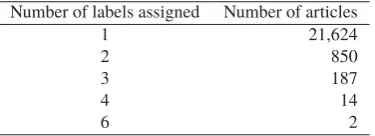
Table 3 shows the distribution of the number of labels assigned to one article in the annotated data.
Most of the articles have only one label whereas 4.6% of articles were assigned multiple labels. This figure may seem not to be a big deal. However, given that the error rate of our model is already below 20% (see Section 5.2), considering the 4.6% is inevitable to seek further improvements.
4 Proposed Methods
4.1 Joint Learning of Multi-Label Classifiers
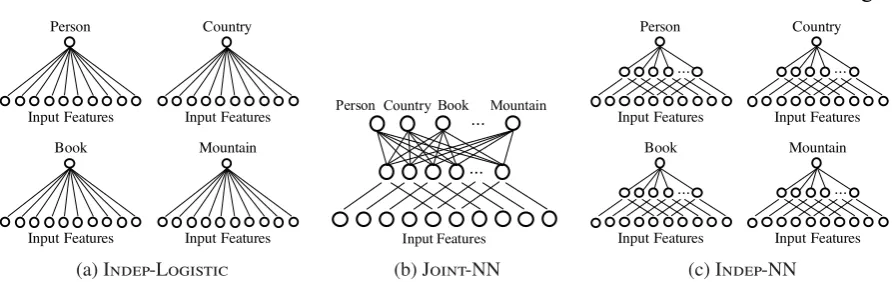
As a baseline approach of multi-label classification, we construct a classifier for each NE type; each classifier independently decides whether an article should be tagged with the corresponding NE type. We model this setting using binary classifiers based on logistic regression (Figure 2a). We call this model Indep-Logistic.
prob-Input Features Person
Input Features Country
Input Features Book
Input Features Mountain
(a) Indep-Logistic
Input Features Person Country Book Mountain
(b) Joint-NN
Input Features Person
Input Features Country
Input Features Mountain
Input Features Book
(c) Indep-NN
Figure 2: The three models for labeling types of articles.
ability of assigning the label of an NE type. Note that the activation function of the output layer is the singmoid function, not the softmax function. This means that this model can output mutiple labels of NE types for each article. In this method, we aim to learn effective combinations of input features which can also be used for labeling of infrequent NE types. We call this model Joint-NN.
Note that there are two changes from Indep-Logistic to Joint-NN: incorporating of a hidden layer and applying of joint learning. To examine the effect of each individual method separately, we also consider an intermediate model, Indep-NN (Figure 2c). Similarly to Indep-Logistic, this model trains a classifier for each label, but has a hidden layer.
Formally, the Indep-Logistic model estimates the conditional probability that a given Wikipedia article represented by ann-dimensional feature vector x ∈
Rnbelongs to NE typec:
pIndep-Logistic(yc=1|x) =σ(wc·x+bc), (1)
wherewc ∈ Rn andbc ∈ Rdenote a weight vector and a bias term for NE typec, respectively. σ(x) =
1
1+e−x is a sigmoid function.
The Joint-NN model maps an input feature vector to a hidden layer with a matrixW whose parameters are shared across all the types:
pJoint-NN(yc =1|x) =σ(wc·σ(W x+b)+bc), (2)
whereW ∈Rn×kandb∈Rkdenote a weight matrix and a bias vector of thek-dimensional hidden layer,
wc ∈ Rk andbc ∈ Rdenote a weight vector and a bias term, respectively, of the output layer, for each NE typec.
In contrast, the Indep-NN model maps an input feature vector to a hidden layer by using a matrix
Wc whose parameters are trained for each NE type independently:
pIndep-NN(yc =1|x)=σ(wc·σ(Wcx+bc)+bc), (3) where Wc ∈ Rn×k and bc ∈ Rk denote a weight matrix and a bias vector, respectively, of the k -dimensional hidden layer for each NE typec. wc ∈
Rkandb
c ∈Rdenote a weight vector and a bias term of the output layer for the NE typec, respectively.
The training data withNarticles andCNE types is represented as{x(i),y(i)}iN=1, wherex is a feature vector of an article and y = {yc}Cc=1 is an array of binary variables indicating if the article belongs to an NE typec. With this data set, we minimize the cross entropy lossL of each model by using Adam gradient-based optimization algorithm (Kingma and Ba, 2014):
L =− x,c
{yclog(p(yc =1|x))
+(1−yc)log(1−p(yc =1|x))} (4)
4.2 Input Features
We used two sets of features for building the mod-els; one is a reproduction of the previous study (Hi-gashinaka et al., 2012), and the other is our novel proposal.
4.2.1 Baseline Features
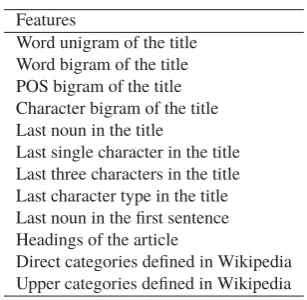
As a baseline feature set, we reproduced the fea-tures proposed by Higashinaka et al. (2012). Ta-ble 4 lists all of the basic features.4 We were not 4Note that although the features of “Last n character(s) in the title” are effective in labeling NE types of Japanese article titles,
Features
Word unigram of the title Word bigram of the title POS bigram of the title Character bigram of the title Last noun in the title
Last single character in the title Last three characters in the title Last character type in the title Last noun in the first sentence Headings of the article
Direct categories defined in Wikipedia Upper categories defined in Wikipedia
able to reproduce features T8, T12, T14, and M22 described in the original paper (Higashinaka et al., 2012) because those features require the authors’ in-ternal resources to implement. For similar reasons, we used MeCab (Kudo et al., 2004) as a morpho-logical analyzer instead of JTAG (Fuchi and Takagi, 1998), which was unavailable to us. For extracting text from Wikipedia dump, we used Wikipedia Ex-tractor (http://medialab.di.unipi.it/wiki/ Wikipedia_Extractor). We denote this baseline feature set asFb.
4.2.2 Article Vectors
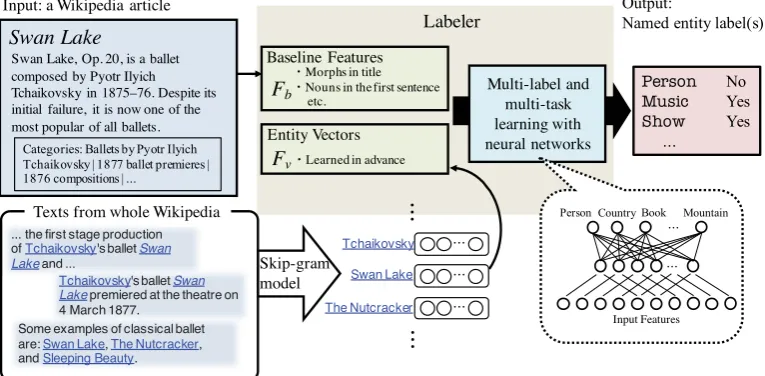
To extend the aforementioned basic feature set, we hypothesize that the way how each article (i.e. named entity) is mentioned in other articles can also be a useful clue for classifying that article. To test this hypothesis, we introduce distributed representations of Wikipedia articles.
Consider an article “Mount Everest”. This article is hyperlinked from other articles as follows:
(1) ... After his ascent of Everest on 29 May 1953 ...
(2) ... reached the summit of Everest for the twenty-first time ...
(3) ... fatalities of the 2014 Mount Everest avalanche ...
In this example, words near the anchor text, such
as summit and avalanche, can be useful for
esti-mating the semantic category of “Mount Everest” and assigning the label Mountain to the article “Mount Everest”. While a number of approaches
Higashinaka et al. (2012) reports that “Last two characters in the title” are not so useful in combinations with other features.
sentations of words, we simply adopt the Skip-gram model (Mikolov et al., 2013a) in this study.
Skip-gram trains a model so that it can predict context words from a centered word in a document. We apply this model to learn the embeddings of Wikipedia articles. To this end we need to address the following issues:
• An anchor text is not always identical to the article title to which the anchor refers. For this reason, we need to normalize an anchor text to the title of the article linked by the anchor.
• Article titles often consist of multiple words such as “White House”. Therefore, we need a special treatment for tokenizing article titles.
• Not all of mentions to other articles are marked as anchor text in the Wikipedia articles. Typically, when an article mentions an entity multiple times, a hyperlink is inserted only at the first appearance of the mention to the entity5.
To address these problems, we designed the follow-ing preprocessfollow-ing steps. First, we replace every an-chor text with the title of the article referred to by the hyperlink of the anchor text. Next, we assume all occurrences of the phrase identical to an anchor text to have hyperlinks to the article linked by the anchor text. This is based on the one-sense-per-discourse assumption. In addition, all white spaces in article titles are replaced with “_” to prevent article titles from being separated into words. In this way, we jointly learn vectors of words and articles. We use word2vec6to obtain 200 dimensional vectors.
We denote the 200-dimension article vector asFv.
5 Experiments
To demonstrate the effectiveness of our models, we conducted experiments for labeling NE types to Japanese Wikipedia articles.
5.1 Settings
We tested the three classifier models (Indep-Logistic, Indep-NN, and Joint-NN) with two dif-ferent feature sets (FbandFb+Fv). For each
combi-5https://en.wikipedia.org/wiki/Wikipedia: Manual_of_Style/Linking
Table 5: Entity-based precision, recall and F1 of the models with different settings.
Fb Fb+Fv
Model Precision Recall F1 Precision Recall F1
Indep-Logistic 83.59 83.57 83.34 85.79 86.76 85.84
Indep-NN 84.00 84.68 83.94 86.90 88.05 87.00
Joint-NN (our model) 86.32 86.54 86.14 88.48 88.63 88.28
Table 6: NE labels whose weight vectors in output layers in (Joint-NN,Fb) have high similarity to that of the NE label (in the header line of the table), accompanied with improvements of the label-based F1 score between (Indep-NN,Fb) and (Joint-NN,Fb). The number of articles assigned with an NE label is given in brackets.
Label (# of articles) ΔF1 Label (# of articles) ΔF1 Label (# of articles) ΔF1
Book(909) 5.28 Country(282) 1.38 Food_Other(57) -0.13
Nearest Labels
Broadcast_Program(2395) 2.08 Nationality(14) 32.73 Flora(80) 5.04
Movie(438) 3.64 County(126) 0.00 Dish(47) 10.36
Show(43) 5.18 Clothing(12) 10.83 Compound(51) 8.12
Name_Other(92) 0.53 River(58) 0.00 Mineral(12) 9.56
Printing_Other(24) 4.64 Island(56) 3.72 Religious_Festival(12) -5.92
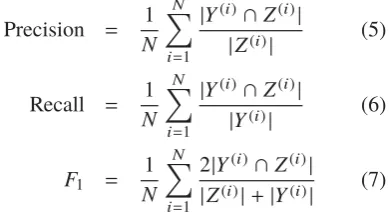
nation of model and feature set, we evaluated classifi-cation performance by measuring entity-based/type-based precision, recall, and F1 value (Godbole and Sarawagi, 2004; Tsoumakas et al., 2009) over 10-fold cross validation. Entity-based precision, recall, and F1 value are calculated as below:
Precision = 1
N
N
i=1
|Y(i)∩Z(i)|
|Z(i)| (5)
Recall = 1
N
N
i=1
|Y(i)∩Z(i)|
|Y(i)| (6)
F1 =
1
N
N
i=1
2|Y(i)∩Z(i)|
|Z(i)|+|Y(i)| (7)
Here,Y(i)andZ(i)denote the set of correct labels and the set of predicted labels of articlei, respectively N
denotes the number of documents. For type-based evaluation, we calculated precision, recall and F1 value of each named entity types.
For Indep-Logistic, we used scikit-learn (Pe-dregosa et al., 2011) to train classifiers. We used L2 penalty for regularization. For Indep-NN and Joint-NN, we used Chainer (Tokui et al., 2015) to implement neural networks. The dimension of the hidden layer was set to k = 200. When training the models, we used most frequent 10,000 baseline features (Fb) and 200-dimension article vectors (Fv)
as input features of classifiers. For optimization, we used Adam with a learning rate of 0.001 and a mini-batch size of 10 and iterated over the training data until the cross-entropy loss per document gets smaller than 1.0×10⁻⁴.
Indep-Logistic was implemented as a baseline model intended to reproduce the model proposed by Higashinaka et al. (2012). Note, however, that the results of our experiments cannot be compared directly with those reported in their paper because some of the features they used are not reproducible and the training/test data sets are not identical.
5.2 Results
The overall results are summarized in Table 5. We conducted binomial tests to determine statistical sig-nificance of the results, confirming that the improve-ment between any pair of settings is statistically sig-nificantp < 0.01 except that the improvement from (Indep-Logistic,Fb) to (Indep-NN,Fb) was signif-icant atp<0.05.
Comparing the results between the baseline method (Indep-Logistic, Fb) and our full model (Multi-NN, Fb + Fv), entity-based F1 score im-proved by about 5 points (83.34% to 88.28%), which is about 30% reduction of error rate. Table 5 also indicates that both of our two proposed methods, multi-task learning and article vector features, have
Weikum. 2007. Yago: A core of semantic knowledge. InProceedings of WWW, WWW ’07, pages 697–706, New York, NY, USA. ACM.
Sam Tardif, R. James Curran, and Tara Murphy. 2009. Improved text categorisation for wikipedia named en-tities. InProceedings of ALTA Workshop, pages 104– 108.
Seiya Tokui, Kenta Oono, Shohei Hido, and Justin Clay-ton. 2015. Chainer: a next-generation open source framework for deep learning. InProceedings of Work-shop on Machine Learning Systems (LearningSys) in The Twenty-ninth Annual Conference on Neural Infor-mation Processing Systems (NIPS).
Antonio Toral and Rafael Muñoz. 2006. A proposal to automatically build and maintain gazetteers for named entity recognition by using wikipedia. InProceedings of Workshop on New Text, EACL.
Grigorios Tsoumakas, Ioannis Katakis, and Ioannis Vla-havas. 2009. Mining multi-label data. InData mining and knowledge discovery handbook, pages 667–685. Springer.
Yotaro Watanabe, Masayuki Asahara, and Yuji Mat-sumoto. 2007. A graph-based approach to named entity categorization in wikipedia using conditional random fields. InProceedings of EMNLP-CoNLL. Mohamed Amir Yosef, Sandro Bauer, Johannes Hoffart,