Focusing on a Subset of Scripts Enhances the Learning Efficiency of
Second Language Writing System
Ching-Pong Au Yuk-Man Cheung
Community College of City University Hong Kong Baptist University 6/F, AC2, City University of Hong Kong, SCE, 2/F, Franki Centre, 320 Junction Road Tat Chee Avenue, Kowloon Tong, Hong Kong Kowloon Tong, Hong Kong
[email protected] [email protected]
Charles Chen, Jr.
The Hong Kong Polytechnic University Hung Hom, Kowloon, Hong Kong
Abstract
Memorizing the whole set of graphemes is generally accepted as the first step of learning a phonogramic language. However, it is demanding for L2 learners to familiarize the whole inventory of graphemes in advance if the language has a relatively large inventory size. We propose that learning a subset of graphemes would largely enhance the learning efficiency by reducing the memory burden. With homophony minimized, effort of acquiring vocabulary in elementary stage can be greatly reduced. In this paper, the writing system of Thai is used to illustrate the main idea. Besides, the method may also be extendable to Japanese and Korean, which grapheme inventory sizes are smaller.
1 Introduction
There is a general assumption in many language textbooks that L2 learners are able to comprehend and produce scripts of any second language just because they have acquired the reading and writing ability in their first language. However, different processes and strategies are actually involved in L1 and L2 writing systems (L1WS and L2WS) and should not be ignored by the learning material designers or the language teachers (Bassetti, 2006). English is an international language learnt globally by most people and textbooks of English are perhaps the most convenient model being imitated
by textbooks of other languages for L2 learners. In the first lesson of learning a L2WS, the first thing that comes to our mind is the 26 letters. Therefore, learning how to read and write kana and hangul are expected in the first chapter of Japanese or Korean textbooks, because they function like the 26 letters of English as the most basic building blocks in the writing system (WS, hereafter).
Although it may take some time for learners to “swallow” graphemes like kana or hangul, it is not a daunting task for most people to master (at least to recognize) them well enough for general usage. However, there are also WSs which are less “learner-friendly” – Thai WS is one of them. In Hong Kong, we observed through classroom teaching that many L2 learners of Japanese or Korean can memorize kana or hangul reasonably well within weeks or even days; while L2 learners of Thai tend to give up learning to read and write for good, and confine their learning to verbal language.
In the present thesis, we propose that (1) WSs that have relatively large inventory size could be learnt more efficiently through reordering the learning sequence; (2) the usage frequencies of the basic writing units are important criteria for deciding on the learning sequence; (3) learning materials designed for L2WS adult learners should be different from those for L1WS children learners, as two groups have had different experience before they learn the target WS.
Obviously, Thai WS have three main properties that make learning it a more difficult task than learning kana or hangul:
(1) The G-inventory size is large and many homophones are in the consonant system; (2) Complicated phonic rules are required to
predict the actual tone value of each syllable. (3) The forms of vowels vary under different
phonological conditions and not all diphthongs are direct combinations smaller units.
3.1 Inventory Size and Homophony
Due to phonological changes in history, some consonants which were distinctive in the past became homophones in the modern Thai (Smalley, 1994: 194-195; Diller, 1996). In many cases, the original written forms are still in use nowadays despite the sound changes.
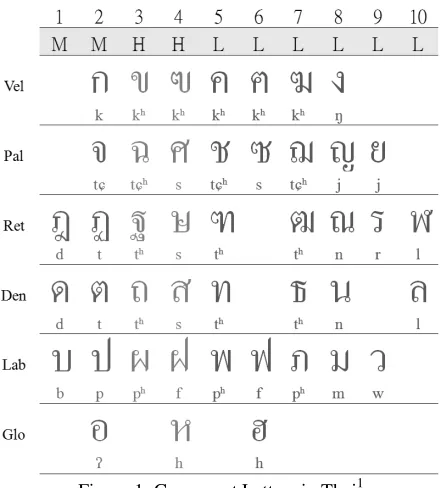
Figure 1: Consonant Letters in Thai1
In the consonant chart (figure 1), the IPA below each script is its actual phoneme at syllable initial position in modern Thai, but the columns represent manners of articulation and the features of aspiration and voicing in historical sense:
1 It is controversial whether should be transcribed as a
glottal stop, as glottal stop seems not to be contrastive with zero (See Noss 1964; Harris, 2001 for details).
- Columns 1&2: Unaspirated, unvoiced obstruents - Columns 3&4: Aspirated, unvoiced obstruents - Columns 5&6: Unaspirated, voiced obstruents - Column 7: Aspirated, voiced obstruents
- Column 8: Nasals
- Column 9: Approximants (and Trills) - Column 10: Lateral approximants
It is important to highlight that, in modern Thai, consonants in Columns 3, 5 and 7 all changed to aspirated, unvoiced stops or affricates as shown in IPA, although the columns had aspiration and/or voicing contrasts before. Consonants (fricatives in the past) in Column 6 were also devoiced.
On the other hand, in the consonant chart, different places of articulation: vel(ar), pal(atal), ret(roflex), den(tal), lab(ial) and glo(ttal) are classified into six rows. It can be easily observed that the rows ‘ret’ and ‘den’ had merged completely. All in all, a lot of homophones arise from the mergers in the dimensions of manners, places, aspiration and/or voicing. Homophony is one of the sources that make Thai WS complicated.
3.2 Complicated Phonic Rules for Tones
In figure 1, the consonants are divided into three groups. They are traditionally named “Mid class”, “High class” or “Low class”, based on the voicing and aspiration properties of the consonants:
- Mid class (M, hereafter) consonants include those which were historically unaspirated, unvoiced obstruents (i.e. Column 1 & 2). Consonants in Column 1 are unaspirated, voiced in modern Thai, but it was sprung from Column 2;
- High class (H, hereafter) consonants include aspirated, unvoiced obstruents (i.e. Columns 3&4); - Low class (L, hereafter) consonants include all
voiced consonants (Columns 5-10) in the past inventory, although Columns 5-7 are currently unvoiced in modern Thai.
One of the major functions of the M-H-L classification is to be part of the conditions of the phonics rules for tones. It is not surprising for voicing/aspiration correlating with tones as many similar phenomena can be found in sound changes of various Chinese dialects and other languages.
respectively. (Remark: The “high”, “mid” and “low” in tones and H, M, L consonants are totally two different concepts.)
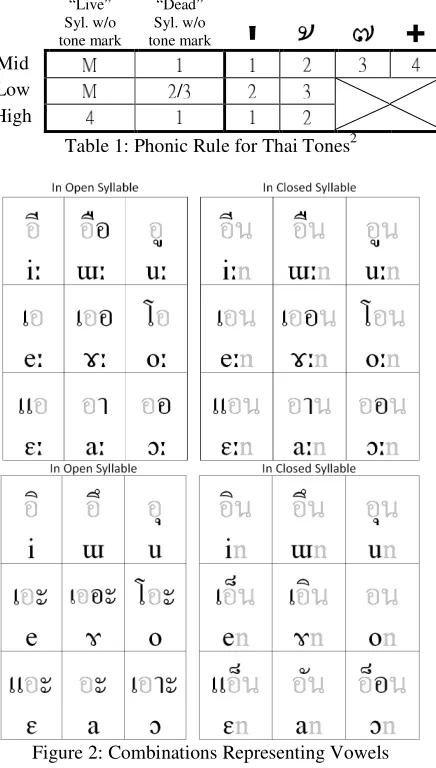
Thai WS has four symbols to mark tones. They are put above the initial consonant (if a vowel occupies the place, the mark is put above the vowel). The phonic rules for tones are listed in table 1. Among the three types of consonants, the rules for M consonants are the easiest to remember:
ones 1, 2, 3 and 4 respectively “live” syllables without tone mark is tone M; dead syllables without tone mark is tone 1. The rules for H and L consonants are more complicated. (see table 1).
“Live” Syl. w/o tone mark
“Dead” Syl. w/o tone mark
Mid
Low /
High
Table 1: Phonic Rule for Thai Tones2
Figure 2: Combinations Representing Vowels
2A “live” syllable is one (1) with only a long
vowel as rime or (2) with a nasal consonant as final, while a “dead” syllable is one (1) with only a short vowel as rime or (2) with stop consonant as final.
3.3 Inconsistency in Written Forms of Vowels and Diphthongs
In figure 2, vowels (in black) can be represented by a combination of one to three components ( in grey is an initial consonant; in grey is a final consonant). For long vowels (upper matrixes of figure 2), patterns in open and closed syllables are almost identical except .L9.+ which requires an extra in an open syllable. However, cases of short vowels (lower matrixes) are rather inconsistent. Non-high short vowels are completely different between open (lower, left) and closed (lower, right) syllables.
Besides, some diphthongs are irregular (figure 3), although the majority of larger units are combined with the smaller units:
(1) diphthong = monophthong + glide; (2) triphthong = /-a/ diphthong + glide.
Figure 3: Irregular Combinations
4 A Usage-based Approach in Design
As Thai has a relatively large inventory size, a good learning sequence would help improving the learning efficiency. In this section, we intend to look for the optimized learning sequence by considering the usage frequencies of the consonant letters.
4.1 Measuring Usage Frequencies
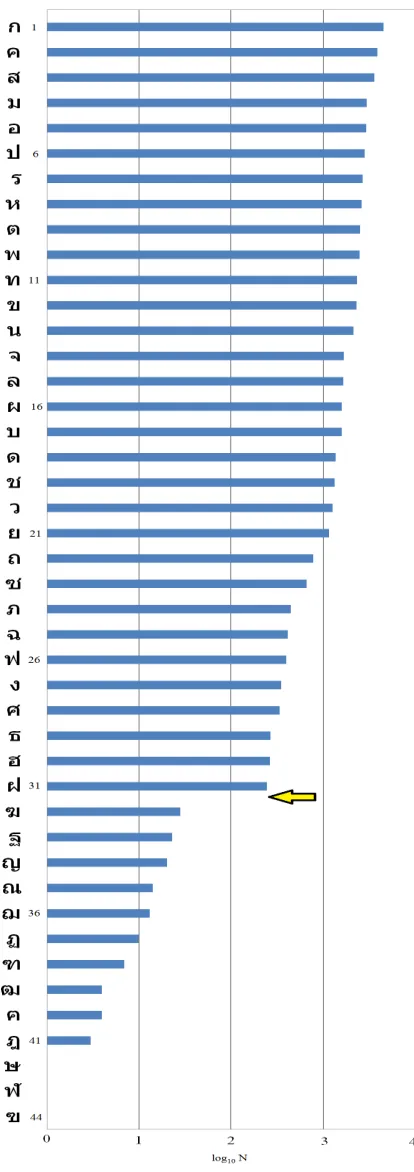
that the numbers of entries in the dictionary count only the words with the letters as word initial. However, the data are still sufficient to estimate the relative usage frequencies, in order to reveal the “usefulness” of the letters for the learning material design.
4.2 Grouping and Reordering Consonants
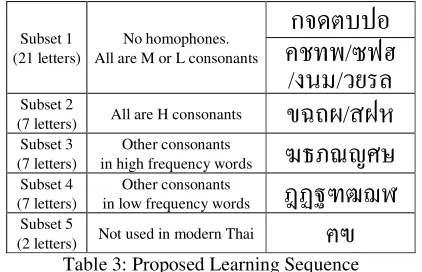
In order to look for a desirable learning sequence, the phonological nature of the letters was examined. Learning high frequency letters in the early stage will let learners utilize the WS as early as possible. However, simply adopting the most-to-least sequence as the learning sequence would make the learning process unordered and not systematic. It would not be easy for learners to remember the letters. Therefore, besides the usage frequencies, forming phonologically-correlated subsets are also important criteria for a good learning sequence.
According to the finding in figure 4, the consonant letters can be primarily divided into two subsets based to their usage frequencies: high on the left and low on the right in figure 5. In order to seek for phonologically-correlated subsets, the information about the phonological origin of the letters in figure 1 is also extracted and listed in two tables. The first observation from the left table is that all phonemes (including the zero initial, ) can all be found. Besides the fricatives (/f/, /s/ and /h/) and the aspirated obstruents (/kh/, /ph/, /th/ and /tsh/), all other letters are not repeated in the left table. The repeated ones are only either H or L consonants. Comparing the repeated letters as shown in table 2, it is obvious that letters in high usage frequencies all come from Columns 3-6 in figure 1 (H3, H4, L5 and L6). Therefore, it is quite reasonable to put the three letters: (24th), (28th) and (29th) to later stages of the learning sequence.
Consonant Rank / MOA
kh 2/L5 > 12/H3
ph 10/L5 > 16/H3 > 24/L7 th 11/L5 > 22/H3 > 29/L7
tsh 14/L5 > 25/H3
f 26/L6 > 31/H4
s 3/H4 > 23/L6 > 28/H4
h 8/H4 > 30/L6
Table 2: Ranking of Corresponding Consonants Figure 4: No. of Entries for Each Thai Consonant in a
they learn to write, they remember the spellings by heart, although some native speakers may learn a reverse version of table 1 to predict the spellings from the sound of tone.
Some speakers tend to remember written and spoken forms separately when they learn a second language. In a recent study about Cantonese speakers learning Korean as a second language, learners could pronounce hangul spellings more accurately for words than non-words. This indicates that remembering the spoken forms by heart instead of predicting pronunciations from spellings is the main strategy the speakers use (Au and Cheung, 2014). This subconscious strategy is also applicable to people who are learning other more complicated WSs such as Thai.
5 Consonant names are burden to
non-native adults
Another advantage of learning only a subset without homophones is to get rid of the names of the Thai consonant letters. Similar to English’s “A for apple”, “B for boy”, “C for cat”, Thai children learn the name of each Thai consonant letter, which composes of one consonant-vowel syllable
(e.g. .sg.*/N9.(%`mc%nmd noun that contains this
particular consonant letter:
- .sgN933%lnm33%sgn933.%(Ramayana character)
- .sgN933
%ogt951 %sg`v51
.%(old man)%
- .sgN933%sg`45%g`9m14.(soldier)%
- .sgN933%sgnM33.%(flag)
The nouns help in disambiguating homophonic consonant letters. In the above example, all four
letters called .sgN922.%become distinguishable orally.
As their native language, Thai children have already learnt a certain amount of spoken forms of Thai words at home before learning the written forms in school. They can remember all letters more easily with the letters’ names because they have probably acquired some, if not all, sound-meaning relationship of the words such as “old man”, “soldier” and “flag”. On the contrary, as the letters and the nouns are both new to the foreign learners, the names are in fact extra burdens to the L2 learners. In our proposal, when only one of the four is learnt in the subset 1, learners can simply
call as .sgN933.. In subset 2, although there is
another .sg., as the tone is different, can be
called .sgN914. without mentioning its name. In this
case, the learning of names can be postponed to later stages of the study after learners gain enough vocabularies and knowledge of Thai culture in order to know the disambiguating names of the letters.
6 Applying to learning of other languages
The concept we propose is also applicable to other languages, although their WSs may not be as complicated as Thai scripts.
Similar to table 3 for Thai WS, Japanese WS can
be divided into three subsets:
- subset 1 is hiragara (e.g. ), the basic set
of graphemes;
- subset 2 is katakana e.g. ), another set
of graphemes used mainly for loanwords; and
- subset 3 is kanji, adopted Chinese characters.
To enhance the learning efficiency, instead of teaching both sets of kana (hiragana and katakana) at the start of a beginner course, some teachers may teach hiragana first and postpone the teaching of katakana until learners become more familiar with the hiragana through acquiring large amount of vocabularies. This is a way to reduce the interference between two sets of kana.
In the case of the WS of Korean language, although each phoneme is represented by only one consonant letter in hangul, letters with similar pronunciations and shapes can also be learnt in different stages:
- subset 1 includes .o., .s., .j., .sÅ.,
.r., .g., .l., .m., .M. and .k.;
- subset 2 is the tense consonants .p͈., .t͈.,
.jŸ., .sÅŸ. and .rŸ., which are formed by doubling the first five consonant letters in subset 1; and
- subset 3 is the aspirated consonants .og.,
.sg., .jg. and .sÅg., which have similar
shapes as the first four consonant letters in subset 1.
Similarly, learning efficiency can be improved by focusing on only a subset of graphemes at the beginning. Consonants in simpler shapes (subset 1) can be learnt first, with considerable amount of simple vocabularies that are strictly formed by the first ten consonants. After having enough exposure to subset 1, learners can start learning the five tense consonants in subset 2. The phonetic contrasts of the obstruent consonants in the two subsets should also be introduced in this stage. After the learners are familiarized with the 15 consonants under the context of simple words and sentences formed by them, they can proceed to subset 3 and learn the concept of aspiration.
Although all 19 consonant graphemes are phonemically contrastive in Korean language, the three groups of obstruent consonants may not be perceptually or consciously distinctive to many non-native speakers (Au and Cheung, 2014). Therefore, allocating these “pseudo”- homophonic
obstruent consonants (e.g. , and ) into three
different subsets resembles the case of Thai shown in table 3.
In terms of usage frequencies and relatively complexity of grapheme shapes, the tense and aspirated consonants are lower, compared to the other ten consonants. Thus, it should not be difficult for course developers to gather sufficient
basic sentence structures and everyday
vocabularies for compiling the first few lessons without using subsets 2 and 3.
This arrangement will not only reduce the memory burden of the second language learners at the beginning stages, but also highlight the phonetic contrast among the three groups of obstruent consonants.
7 Conclusion
The present paper tries to demonstrate that the efficiency of a second language WS with a relatively large letter/grapheme inventory size (such as Thai) could be enhanced by separating the large inventory into (at least) two subsets, based on the usage frequencies. The high frequency subset(s) can be learnt early through knowing the grapheme-phoneme correspondence, while the low frequency subset(s) can be learnt in later stages in the way similar to learning a logogramic language (such as Chinese characters), by remembering the spelling and the sound individually.
Theoretically, the learning sequences proposed would improve efficiency and effectiveness of acquiring a new second language writing system, although the actual improvement needs to be substantiated by future researches on students’ acceptability and performance.
References
Gabriel Altmann and Fengxiang Fan. 2008. Analyses of Script: Properties of Characters and Writing Systems. Mouton de Gruyter.
Ching-Pong Au and Yuk-Man Cheung. 2014. Phonological Tendencies in Korean Spoken by Hong Kong Cantonese Learners. Proceedings of 5th ICPM, Gwangju, South Korea, 263-266.
Benedetta Bassetti. 2006. Learning Second Language Writing systems. Centre for Languages, Linguistics and Area Studies, Guide to Good Practice. 29 Nov., 2006. https://www.llas.ac.uk/resources/gpg/2662
Vivian. J. Cook and Benedetta Bassetti. 2005. Second Language Writing Systems. Clevedon, UK: Multilingual Matters.
Anthony Diller 1996. Thai and Lao Writing. In P. T. Daniels and W. Bright (eds.). The World’s Writing Systems, 457-466.
Jimmy G. Harris. 2001. States of the Glottis of Thai Voiceless Stops and Affricates. In M. R. K. Tingsabadh and A. S. Abramson (eds.), Essays in Tai Linguistics. Bangkok: Chulalongkorn University Press.
Richard B. Noss. 1964. Thai Reference Grammar. Washington: Foreign Service Institute.
William A. Smalley. 1994. Linguistic Diversity and National Unity: Language Ecology in Thailand. Chicago and London: The University of Chicago Press.