CSEIT1833133 | Received : 12 March 2018 | Accepted : 24 March 2018 | March-April-2018 [ (3) 3626-630]
© 2018 IJSRCSEIT | Volume 3 | Issue 3 | ISSN : 2456-3307
626
Performance Analysis of MAC layer on Saturation Throughput
B. GantaiahAssistant Professor, Department of MCA, KBN PG College (Autonomous), kothapeta,VJY, Andhra Pradesh, India
ABSTRACT
My analysis work primarily aims at computing the saturation outturn of the mac layer and targets its improvement. The current study is conducted to look at each Physical and MAC layer protocols to investigate the performance of exciting IEEE 802.11 customary. The Distributed Coordination function (DCF) and point Coordination function (PCF) are the two different categories of the MAC layers that are outlined in the reference paper. The DCF protocol user Carrier Sense Multiple Access with Collision dodging (CSMA/CA) mechanism and is obligatory, whereas PCF is outlined as a choice to support the delivery of the frames of information with in a finite time interval. The DCF protocol in IEEE 802.11 standard defines the procedures in which the medium is shared among stations. DCF that is predicated on CSMA/CA consists of a basic access technique and an elective channel methodology with request-to-send and clear-to-send (CTS).
Keywords : CSMA/CA, Distributed Coordination Function, MAC layer, Collision dodging.
I.
INTRODUCTION
The modeling of the 802.11 mackintosh layer is a crucial issue for the evolution of this technology. the present models for 802.11 assume that each one shared among all stations (STAs) have identical physical conditions at the receiving STA (same power, same writing...), therefore once 2 or a lot of STAs emit a packet within the same slot time, all their packets are lost, which can not be the case really once for example one STA is near the receiving STA and therefore the alternative STAs off from it. This exhibition is called the capture impact, STA’s special positions will be used for the analyzing of this. STA’s which are within the special positions are thought of the computing limits of a wireless networks.
1.1. MAC Layer Service Time
There square measure 3 basic methods once the waterproof layer transmits a packet: the decrement process of the backoff timer, the flourishing packet
transmission method that takes a period of time of Tsuc and also the packet collision method that takes a
period of time of Tcol. Here, Tsuc is that the chance
variable representing the amount that the medium is detected busy due to a flourishing transmission, and Tcol is that the chance variable representing the
amount that the medium is detected busy by every station owing to collisions. The MAC layer service time is that the measure from the time instant that a packet becomes the pinnacle of the queue and starts to contend for transmission, to the time instant that either the packet is acknowledged for a flourishing transmission or the packet is born. Now is very important once we examine the performance of upper protocol layers. Apparently, the distribution of the waterproof layer service time may be a distinct chance distribution as a result of the littlest quantity of the backoff timer may be a slot. Tsuc and Tcol rely
Need and Importance
Present days, the IEEE 802.11 wireless local area network technology offers the most important deployed wireless access to the web. This technology specifies each the Medium Access management (MAC) and also the Physical Layers (PHY). The PHY layer selects the proper modulation theme given the channel conditions and provides the mandatory information measure, whereas the mac layer decides in a very distributed manner on however the offered information measure is shared among all stations (STAs). This normal permits a similar mac layer to control on prime of 1 of many PHY layers. This model has completely different extensions on that I'm acting on. One extension considers Associate in Nursing Access purpose (AP) that transmits packets, which might permit finding the best Access purpose placement for a given topology. There are varied makes an attempt to model and analyze the saturation outturn and delay of the IEEE 802.11 mac layer. mechanisms for next-generation high-throughput WLANs
- DionysiosSkordoulis Qiang Ni, Hsiao-hwa Chen, Adrian P. StephensChangwen Liu, Abbas Jamalipour 3. Performance of reliable transport protocol over IEEE 802.11 wireless LAN: analysis and enhancement
- Haitao Wu, Yong Peng, Keping Long, Shiduan Cheng, Jiam Ma
4. An IEEE 802.11 p-based
multichannel MAC scheme with channel
coordination for vehicular ad hoc networks - Q Wang, S Leng, H Fu, Y Zhang
5. Throughput analysis and measurements in IEEE 802.11 WLANs with TCP and UDP traffic flows
- R Bruno, M Conti, E Gregori
6. Modeling the 802.11 distributed coordination function in non-saturated conditions
- P. Chatzimisios, V. Vitsas and A. C. Boucouvalas
CSMA/CA with RTS/CTSexchange
If the channel is busy for the supply STA, a go into reverse time (measured in slot times) is chosen every which way within the interval (0; CW), wherever CW is termed the rivalry window.
This timer is decremented by one as long because the channel is perceived idle for a DIFS (Distributed put down Frame Space) time. It stops once the channel is busy and resumes once the channel is idle once more for a minimum of DIFS time. CW is associate whole number with the vary determined by PHY layer characteristics: CW min and CW soap. CW are going to be doubled once every unsuccessful transmission, up to the utmost worth that is set by CW max + one. once the rear off timer reaches zero, the supply transmits the information packet. The ACK is transmitted by the receiver straight off once an amount of your time known as SIFS (Short put down Frame Space) that is a smaller amount than DIFS. Once an information packet is transmitted, all different stations hearing this transmission change their Network Allocation Vector (NAV) that is employed for virtual metallic element at the raincoat layer.
the info transmission by causation a CTS frame before the transmission of actual data packet. Note that STA’s within the sender’s vary that hear the RTS packet update their NAVs and defer their transmissions for the length nominal by the RTS. Nodes refrain the values after they catch the CTS and update the network allocation vector.
This way, the hidden nodes problem or the problems are not affecting the transformation of information and the receiving of the acknowledgement.
System parameters:
MAC header 224bits
PHY header 192bits
CTS 112bits+PHY
header
ACK 112bits+PHY
header
RTS 160bits+PHY
header Packet Payload 8224bits Channel bit rate 1Mbps
Initial backoff
window size (W)
31
Long retry limit 4
Short retry limit 7
Propagation delay 1us
Slot time 20us
Maximum backoff stages(m)
5
SIFS 10us
DIFS 50us
III.
Methodology
One of the foremost promising models has been the supposed Bianchi model. This model uses a straightforward and chic distinct time Markov chain technique to research the caseof saturated shared among all stations (STAs), STAs that invariably have packets to send. The theme DCF is to reinforce the performance of reliable transport protocol over local area network, and analyzed it to additional extension
to contemplate finite packet try limits as outlined within the IEEE 802.11 customary. It provides closed type expressions for the saturation turnout and for the chance that a packet transmission fails as a result of collision. My future work is to resolve the model numerically and show the saturation turnout per station is powerfully dependent not solely on the station’s position however additionally on the positions of the opposite stations.
The essential access technique
Figure 1 : Basic access protocol
Figure 2 : RTS/CTS access protocol
Upon having received a packet properly, the destination station waits for a SIFS interval right away following the reception of the information frame and transmits a positive ACK back to the supply station, indicating that the information packet has been received correctly(Figure I). Just in case the supply station doesn't receive AN ACK, the information frame is assumedto be lost and therefore the supply station schedules the retransmission with the CW for back-off time doubled. once the information frame is transmitted, all the opposite stations hearing the information frame modify their Network Allocation Vector(NAV), that is employed for virtual Cs at the mackintosh layer, supported the period field worth within the information frame received properly, which has the SIFS and therefore the ACK frame coordinated universal time following the information frame.
The RTS/CTS access technique
In 802.11, DCF conjointly provides a facultative method of transmission information frames that involve transmission of special short RTS and CTS frames before the transmission of actual information frame. As shown in Fig.2, AN RTS frame is transmitted by a station that must transmit a packet.
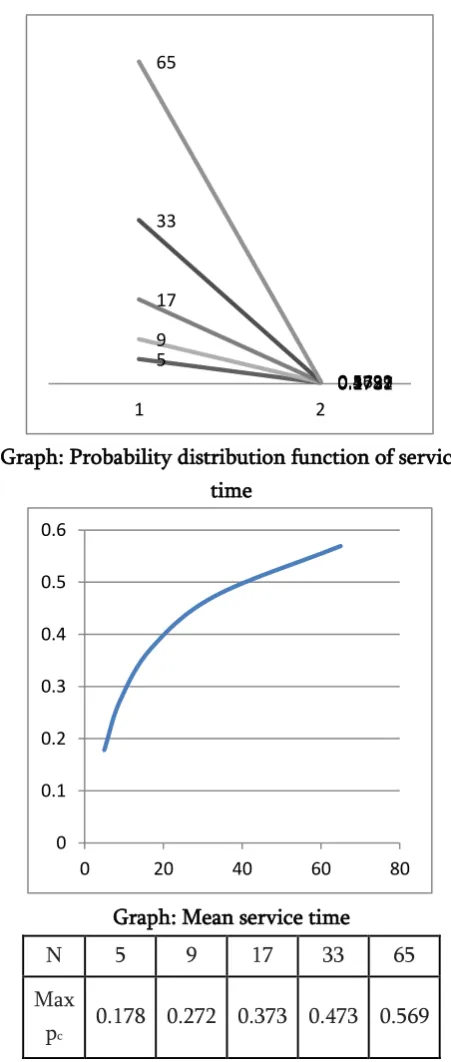
Graph: Probability distribution function of service time
Graph: Mean service time
N 5 9 17 33 65
Max
pc 0.178 0.272 0.373 0.473 0.569
Once the destination receives the RTS frame, it'll transmit a CTS frame once SIFS interval right away following the reception of the RTS frame. The supply
5
0.1781 9
0.2727 17
0.3739 33
0.473 65
0.5692
1 2
0 0.1 0.2 0.3 0.4 0.5 0.6
station is allowed to transmit its packet providing it receives the CTS properly. Note that everyone the opposite stations area unit capable of change the NAVs supported the RTS from the supply station and therefore the CTS from the destination station, that helps to combat the hidden terminal issues. In fact, a station ready to receive the CTS frames properly, will avoid collisions even once it's unable to sense the information transmissions from the supply station. If a collision happens with 2 or a lot of RTS frames, a lot of less information measure is wasted in comparison with the things wherever larger information frames in collision.
IV.
Conclusion
IEEE 802.11 waterproof is planned to support packet transmission over LAN and DCF is that the basis of 802.11. attributable to its own protocol characteristics, like waterproof ACK, waterproof retransmissions, are completely different from those of ancient wireless medium, the performance of reliable transport protocol, like transmission control protocol, over LAN desires careful studies. TCP desires the transport layer acknowledgement (TCP ACK) on the backward direction. Within the situation of transmission control protocol over LAN wherever a shared channel is employed for multiple accesses, the forward transmission control protocol information and therefore the backward transmission control protocol ACK can view the channel, which can cause collisions and degrade the performance. Supported these observations, this paper proposes a theme named DCF+ to reinforce the performance of transmission control protocol over LAN. This paper conjointly proposes a brand new and easy analytical model supported Markov process to cypher the turnout performance of IEEE 802.11 DCF and our planned DCF+. This model is used for each the fundamental access technique and therefore the RTS/CTS access technique in DCF. Comparisons with simulations similarly because the model conferred in paper [11] show that this model is correct in predicting the 802.11 system turnout. Our modeling
results for DCF+ also are verified by elaborate simulations. The performance of transmission control protocol over LAN is examined by elaborate simulations, each for DCF and DCF+. Also, another contribution of this paper is that theanalysis of the simulation results of transmission control protocol over LAN. Finally we have a tendency to conclude that DCF+ is accustomed enhance the performance of transmission control protocol over LAN all told the 3 metrics we have a tendency to examine during this paper: good put, fairness index and delay.
V.
REFERENCES
[1]. IEEE 802.11 WG, part 11a/11b/11g, “Wireless LAN Medium Access Control (MAC) and Physical Layer (PHY) specifications,” Standard Specification, IEEE, 2009.
[2]. Giuseppe Bianchi, “Performance Analysis of the IEEE 802.11 Distributed Coordination Function”, IEEE Journal on Selected Areas in Communications.
[3]. C. H. Foh, M. Zukerman, “Performance Analysis of the IEEE 802.11 MAC Protocol”, Proceedings Of the EW 2006 Conference, Italy. [4]. H. Wu, Y. Peng, K. Long, J. Ma, “Performance of Reliable Transport Protocol over IEEE 802.11, Wireless LAN: Analysis and Enhancement”, Proc. of IEEE INFOCOM, vol.2, pp. 599-607, 2007.
[5]. H. Kim and J. Hou, “Improving protocol capacity with model-based frame scheduling in
IEEE 802.11-operated WLANs”, ACM
MobiCom 2003, Sep. 2008.
[6]. P. Chatzimisios, V. Vitsas and A. C.