DOI : 10.32628/CSEIT1722170
QR-Code Based Bus Ticketing System with Real Time Tracking
Shantanu Hingmire1, Tanvi Mahalle1, Shivani Bhandekar1, Nikita Malamkar1, Vikash Kumar1, Prof. Pranali Zade2 1BE Scholar, Department of Computer Engineering, Bapurao Deshmukh College of Engineering, Wardha,
Maharashtra, India
2Assistant Professor, Department of Computer Engineering, Bapurao Deshmukh College of Engineering,
Wardha, Maharashtra, India
ABSTRACT
The development of data society and the improvement of people needs has made E-ticket an inevitable trend, making it a typical stage for online ticketing. The development in technology has expanded the skylines of the advanced world. This development has reduced the need for real money and popularized the use of virtual money. E-ticketing is one of the most well-known types of online exchanging. Utilizing Android Phones customers can reduce their trouble of remaining in the queue and booking the tickets. The downside of hanging tight for the ticket was reduced with the invention of the savvy cards, however, the user needed to remember to convey the card with him. Additionally, the disadvantage of savvy cards was that it could get misplaced or stolen. With the advent of E-Ticketing, the customer just needed to convey an SMS or a printout of the ticket which the customer had booked online. In any case, that required PCs or desktop for booking. Therefore came into the front the use of advanced mobile phone application where conveying a PDA will do practically everything. Likewise, our Android application provides a bus area with advance google map which demonstrates the area of the bus. Keywords: QR Code, Bus Ticket, GPS, Live Tracking
I. INTRODUCTION
The areas of use of the E-ticketing system has increased due to the development of internet technology. E-ticketing is being deployed at an international level. It makes use of modern data technology to achieve the whole process of paperless electronic ticketing, charging, and check-in procedures. The different areas where the e-ticketing system can be deployed are the travel industry, cinema, conference, large-scale venues with noteworthy traffic. The customary paper tickets were unable to meet the demand of the modern world in this manner giving scope for the development of the E-ticketing system. E-ticket has following advantages:
• E-ticket keeps up a database to store different sorts of data in the advanced structure which is used to facilitate classified management and evaluating service for users.
• For the plan and adjustment of sales policies, it provides accurate, timely, quantitative data. • The short reserving procedure as there is no need
to personally collect the tickets or sit tight for the ticket delivery.
• Makes Booking independent of time and space and removes the overhead of lost tickets or damaged tickets.
scanner and Android Application. QR Code based Universal and Customizable Online Ticket Booking System is essentially a method for purchasing tickets for the customized event. It is a simple application which enables users to purchase tickets in an efficient manner, with the help of a shrewd Android application. They can likewise convey tickets in the type of a Quick Response (QR) code which is really a technology which enables for putting away the details of the ticket in an encrypted structure. The data about a specific user is stored in the database for ceaseless and easy access anywhere and everywhere. The data about the tickets and event are likewise stored in the database and are retrieved when required. The data is transferred in a secured manner as a QR code and is received by the user as a personal SMS. Ticket checker can likewise verify tickets utilizing ticket numbers provided in SMS in the event that they neglected to convey QR code with them at the event venue.
II. LITERATURE REVIEW
Public Transport system (PTS) remains the major source of income in most of the developing countries like India. However, PTS now faces severe malfunctions and various security problems. First, there is a lot of confusion between the passengers regarding fares which lead to quarrels and chaos. The bus ticketing system is expected to be fully automated, reliable, transparent and convenient. GPS is more popular technology which is used in many applications. This existing system gives information about vehicle position and route travelled by vehicle and this information can be monitor from any remote place or location. This system depends on GPS and GSM technology. This system lags in some features like its track vehicle only on PC not on mobile. And also there is no application depending on mobile device to track and get a real time and current view of target or vehicle [1].
F.Araujo et al discussed the challenge of creating an electronic ticketing system for transportation systems that can partially or completely run on the cloud. This challenge is defined within the scope of an industrial project. The resulting system should be able to reach a large spectrum of customers and should provide two key advantages: lower operational costs, especially for small clients without IT departments, and faster execution of queries for monthly or other sorts of analysis, using the elasticity of cloud-based resources. To fulfill the goals of the project, a system was proposed with very standard technologies and procedures: a three-tiered architecture; a separation of the online and analysis databases; and an Enterprise Service Bus to get the input from very diverse hardware and software stacks. In this paper several options regarding the location of these facilities on the cloud was discussed and evaluate the costs involved was evaluated [6].
K.Seibenhandl et al described Self-service ticket vending machines (TVMs) have become an increasingly important distribution channel in the public transport sector, progressively replacing the traditional ticket counter. In a public transport setting, where ticket counter closures have left different groups of people dependent on TVM to meet their mobility needs, a single, effective system is required. A prototype for a novel generation of TVM was developed in three phases: First, the context of use was analyzed. In the second phase, a requirements analysis was conducted. Third, different hardware and software interaction designs were iteratively tested and evaluated. The resulting prototype met the - Requirements of most user groups, though further adjustments are necessary. Conclusions: The UCD approach proved to be a valuable framework for the development and design of self-service systems [7].
A Nunes et al described a methodology for estimating the destination of passenger journeys from automated fare collection (AFC) system data. It proposes new
spatial validation features to increase the accuracy of destination inference results and to verify key assumptions present in previous origin-destination estimation literature. The methodology applies to entry only system configurations combined with distance-based fare structures, and it aims to enhance raw AFC system data with the destination of individual journeys. [8]
Lin and Zeng proposed a set of bus arrival time prediction algorithms for a transit traveler information system implemented in Blacksburg, Virginia. Four algorithms were introduced with different assumptions on input data and were shown to outperform several algorithms from the literature. Their algorithms, however, did not consider the effect of traffic congestion and dwell time at bus stations [9] The above mentioned paper includes the integrated use of the smart cards with GPS system.
In today’s world smart cards became mostly used
• User
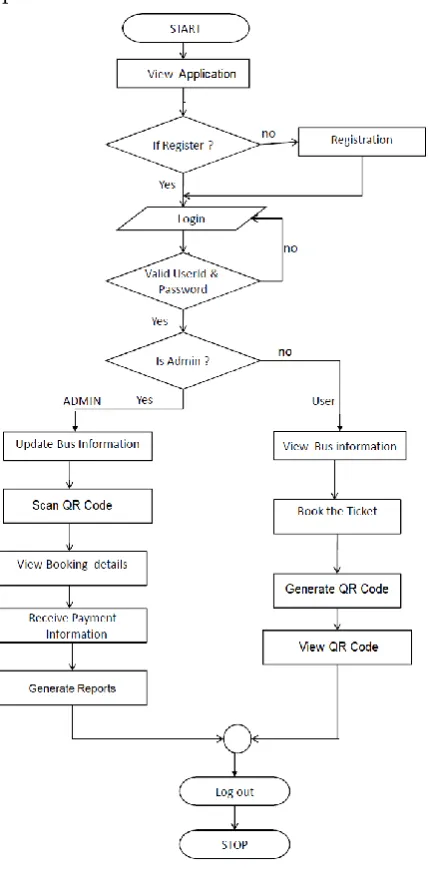
This Project basically provides a Bus information and regarding bus information. First of all, in our website any user or visitor are view our system and also search the bus and how many seats are available in our buses. User can also register its own seats in bus and generate QR code. However, user can compulsory registered first in the system.
• ADMIN
In this system, admin can maintain all the Bus information. In this system admin can view the registered users, bus bookings Scan QR Code and Approve Seat.
Figure 1. Flowchart
MODULE SPECIFICATION
Login: Login Module includes various utilities like User Authentication, Change Password and Forgot Password.
Registration: The application provides some facility where user can Registered in this application. User can use this facility so user can make a registration. Book the Ticket: In this module, admin can add new bus category using this module.
Search Bus: User can search bus and get fair of buses by entering source and destination
Report Generation: This module is used to generate reports.
Generating Tickets: Here the web application will fetch the Event information from database and will generate tickets for the Event with ticket category, Ticket price and Event Date time venue information. Every ticket will be provided with a unique QR code attached with it. This is important from the security point of view as information related to any audience can be retrieved in case of emergency.
QR code scanner: QR code scanner will be an equipment to check valid tickets at the entry gate of event venue. QR code scanner fetch data of sold tickets from database and match it with the information provided in the QR code of Customer.
IV. CONCLUSION
group in each bus between specific hours, in case if the group in the bus exceeds the number of passengers who can be seated in a bus, then it means some other arrangement must be made at that specific hour from that source to destination, which can be solved by the vehicle department.
V. REFERENCES
[1] Joao Leal,Rui Couto,Pedro Mauricio,Teresa Galvao: IEEE tra- sanction on ”Exploring ticketing approaches using mobile technolo- gies:QR Codes,NFC and BLE” In:18th International Conference on In- telligent Transportation System (2015).
[2] Linli Hu, Yuhao Wang, Dong Li, Jing Li: IEEE transaction on” A hybrid client/server and browser/server mode-based universal mo- bile ticketing system”, In: ICIME.2010.
[3] V N Kamalesh, Vikram Ravindra, Pradeep P Bomble, M P Pa- van, B K Chandan, S K Srivatsa:” virtual ticketing International Research Journal of
Engineering and Technology system” In: Inter-
national Conference on e-Education,
Entertainment and e-Management (2011).
[4] Yue Liu, Ju Yang, Mingjun Liu:” Recognition of
QR Code with mobile phones”, In: -CCDC.2008.
[5] Li Li, Wu Chou:” Design and Describe REST API without Vi- olating REST: A Petri Net Based Approach”, In: IEEE International Conference on Web Services 2011.
[6] Beng Bao, L. Anantharaman, R. Deng:” Design of
portable mobile devices based e-payment system and e-ticketing system with digital signature”, In: ICII.2001.
Cite this article as :