CCASH: A Web Application Framework for Efficient, Distributed Language
Resource Development
Paul Felt, Owen Merkling, Marc Carmen, Eric Ringger,
Warren Lemmon, Kevin Seppi, Robbie Haertel
Department of Computer Science Brigham Young University
Provo, Utah 84602 USA
E-mail: [email protected], [email protected], [email protected], [email protected], [email protected], [email protected], [email protected]
Abstract
We introduce CCASH (Cost-Conscious Annotation Supervised by Humans), an extensible web application framework for cost-efficient annotation. CCASH provides a framework in which cost-efficient annotation methods such as Active Learning can be explored via user studies and afterwards applied to large annotation projects. CCASH’s architecture is described as well as the technologies that it is built on. CCASH allows custom annotation tasks to be built from a growing set of useful annotation widgets. It also allows annotation methods (such as AL) to be implemented in any language. Being a web application framework, CCASH offers secure centralized data and annotation storage and facilitates collaboration among multiple annotations. By default it records timing information about each annotation and provides facilities for recording custom statistics. The CCASH framework has been used to evaluate a novel annotation strategy presented in a concurrently published paper, and will be used in the future to annotate a large Syriac corpus.
1.
Introduction
The current success and widespread use of data-driven techniques in language-related fields make annotated corpora an often essential language resource. For instance, many popular Natural Language Processing (NLP) algorithms require significant amounts of human-annotated training data in order to perform effectively. Also, annotated text can be useful in its own right as a means of qualitatively exploring the annotated text. For example, one might use part-of-speech (POS) annotations to study the syntax of a language, or morphological annotations to study the formation of words in a morphologically rich language.
Along with the need for annotated corpora comes the need for tools capable of creating these corpora. However, the process of creating annotated corpora is not trivial. For one thing, employing human specialists to annotate each instance in a corpus by hand can be prohibitively costly. A general purpose annotation tool should make use of existing cost-efficient annotation methods such as automatic annotation and Active Learning (see Section 2). However, cost-efficient annotation is an area of active research, so annotation tools should also be sufficiently flexible to encourage novel methods to be implemented and explored. Indeed, since the effectiveness of various annotation methods may vary across tasks and domains, even projects interested only in applying known annotation methods to a large corpus may wish to conduct exploratory studies to compare the efficiency of several annotation methods before proceeding on a large scale. In addition to cost, many other problems must be dealt with. If the annotation task being conducted is uncommon, project developers may need to customize an existing annotation tool or create their own custom tool to implement that annotation task. Annotation projects that
employ multiple annotators must solve problems of data distribution and consistency. Such projects must somehow distribute views of the corpus to each annotator and collect annotations into a central location, handling any conflicts among the annotations.
Although this discussion by no means exhausts the demands that might be made of a general-purpose annotation tool, we believe they are an important subset. Ideally then, an annotation tool would offer at a minimum the following high-level features:
• Accommodate proven cost-efficient annotation methods
• Encourage novel cost-efficient annotation methods
• Facilitate exploratory studies and comparisons of annotation methods (e.g. measure annotation costs)
• Accommodate custom annotation tasks • Coordinate the efforts of multiple annotators In this paper we introduce CCASH (Cost-Conscious Annotation Supervised by Humans), a web application framework for corpus annotation designed to implement this feature set by using familiar programming paradigms, open standards technologies, and by providing reasonable default implementations whenever possible, always allowing those with unique requirements to define their own features from the ground up.
on annotation confidence, which allows annotators to engage in a kind of manual AL.
3.
Web Application Framework
Although the features outlined in Section 1 could be implemented in a variety of ways, CCASH designers felt that a web application framework was most fitting for a number of reasons. Previous annotation tools have tended toward client-server relationships in order to centralize data and facilitate multiple annotator collaboration. Web applications make client-server architecture easy and natural. Among the tools described in Section 2, GATE and MMAX2 seem to be the most popular due in large part to their support for extensive programmatic customization. A web application seemed a good choice for a customizable architecture, since Internet architecture has a tradition of being extremely customizable, even allowing modules written in different languages and running on different platforms to interoperate.
Being a web application gives CCASH other key advantages in a distributed annotation project. The overhead of configuring a collaborative annotation project can be handled by a single administrator with access to the server. Annotators can then immediately begin annotating texts from any GWT-supported web browser with virtually no per-user configuration time. Since web applications are reloaded every time a user revisits the site or refreshes the browser, there is no difficulty associated with distributing software or project configuration updates. Any updates to the annotation task or to the CCASH framework are instantly and transparently available to all annotators.
4.
CCASH Architecture
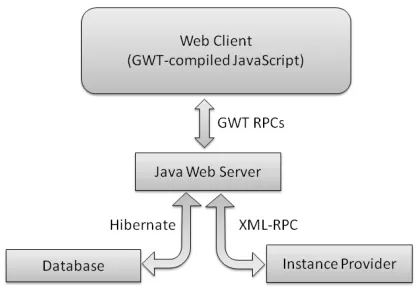
CCASH’s architecture consists of four parts: a web client, a web server, a database, and an instance provider (see Figure 1).
4.1 Instance Provider
Instance providers are processes with a single responsibility: to provide instances to annotators. In this context an instance is a piece of text, such as a word or
sentence, which requires expert annotation. The instances that an instance provider returns may optionally be pre-annotated. Instance providers are largely independent from the rest of CCASH. They make themselves available as web services at some address by implementing a simple XML-RPC interface (see Section 5.3). In CCASH, part of setting up an annotation project is giving it the address of a valid instance provider. Because instance providers are decoupled across the network from the rest of CCASH, they may be implemented in any language. This is particularly valuable since instance providers are a prime target for making use of NLP algorithms such as pre-labeling and AL. Algorithm libraries and custom research tools exist in many languages besides Java, and may be reused as part of implementing an instance provider. Because of this network decoupling, instance providers may also be located at anywhere in the world, although because of network latency issues we anticipate that they will commonly be located either on the same machine as the web server, or nearby.
For convenience, CCASH provides Java instance providers that use generics to return any type of instance in sequential and random order. We are also working on including Java instance providers that implement several varieties of pre-labeling and AL.
4.2 Data Model
Deciding how to represent and store instances and annotations was a difficult design decision in CCASH. Ideally, one would invent a data structure that is both efficient and also able to encode every instance and annotation type that might be required. For example, a POS tagging task might require annotations to be a sequence of tags. Dependency parsing, on the other hand, might require annotations to contain sets of directed connections between word pairs in the corresponding instance. One can imagine that a data structure able to represent both of these annotations (not to mention a multitude of other possible annotation tasks) would run the risk of being bulky and cumbersome. However, if the data structure were not sufficiently general, it would lose the ability to represent certain tasks and the framework would be unusable for them. Also, if a data structure required users to radically alter their own data schemas in order to fit CCASH’s structures, it might discourage them from using the framework.
Recall that one of our high-level design goals is to provide reasonable default implementations whenever possible, always allowing those with unique requirements to define their own functionality. Guided by this principle, we decided to provide some reasonable default data representations and separate the CCASH framework from task-specific data structures as much as possible, allowing developers to use their own data structures, if desired, with minimal interference from the framework.
know how to appropriately display the data instances and collect the desired annotations. The instance provider must select instances, possibly pre-label them, and then send them to the client. It receives new annotations from the client, updating its models with new annotations and recording the annotations alongside the data. The web client and the instance provider share a common method of serialization, and between those two endpoints, CCASH is ignorant of instance and annotation values. CCASH simply passes the serialized value along as a member variable of wrapper objects that CCASH uses to maintain records in its own database.
4.3 Web Client and Server
The web client is the portion of the application that runs in a user’s browser using a combination of HTML and JavaScript. The CCASH client-side framework is written using the Google Web Toolkit (see Section 5.1), and we recommend that CCASH developers extending that framework or implementing new annotation tasks (see Section 6) do the same. While annotating, the web client’s principle responsibility consists of requesting instances from the web server, displaying them to the user, and collecting annotations. The client then sends those annotations back to the web server.
The web server is in charge of facilitating client interactions with other components such as instance providers and the database. It passes on client requests for new instances to the appropriate instance provider and notifies the same instance provider when annotations are
completed, giving the instance provider a chance to update its models given this new information.
The CCASH framework uses a combination of client-side interfaces and server-side storage to provide out-of-the-box user account management and project management. It also maintains a database containing information about each annotation (see Section 4.5), allowing access to project statistics.
4.4 Widget Libraries
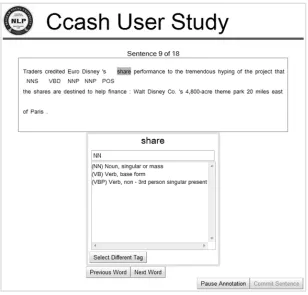
In order to make new tasks as easy as possible to implement and customize, we implement default tasks by creating and assembling re-usable GWT widgets. For example, the English POS task in Figure 2 is a combination of a sequential annotation widget (allowing navigation over a sequence of instances), an instance annotation widget (highlighting the current instance in a box) and an English POS instance annotation widget which makes use of an auto-completion widget populated with the Penn Treebank tag set. The auto-completion widget allows users to type in any part of the tag or description, narrowing down selection options to entries that match any part of the selection.
Because CCASH is intended to be used for research as well as large-scale annotation projects, the framework includes widgets useful for building user studies. These currently include widgets for instructions, surveys, and tutorial annotations with feedback.
6.1 Building a Client-side User Interface
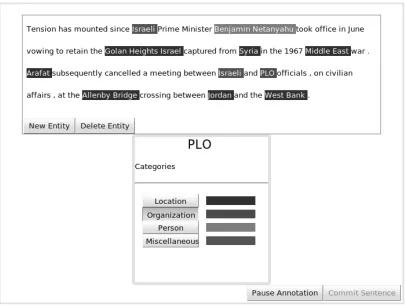
In the CCASH framework we have implemented an English part of speech (POS) annotation task (Figure 2) and a named entity recognition (NER) annotation task (Figure 3). In both of these tasks, the user is presented with an interface that gives context at the top of the page and a more focused inspector that we call the “lens” below. When implementing a new task in the web client, developers may either take advantage of this pre-existing layout or else build their own layout.
To build custom client-side interfaces, developers extend a helper class that takes care of bookkeeping such as firing standard timeline events (see Section 4.5). They then create and assemble the widgets necessary to implement their task. As mentioned before, third party widget libraries are available for GWT. CCASH also provides widgets for handling common high-level tasks such as navigating within a sequence of instances and highlighting the instance currently in focus. If no helper widgets fit a given task, a developer is free to implement that task from scratch.
Finally, a task designer who is interested in task-specific timing information will want throw custom timeline events in the web client at the appropriate times.
6.2 Building an Instance Provider
Creating an instance provider consists of implementing an XML-RPC interface whose most important method
allows clients to get the next instance for a particular annotator. As explained in Section 5.3, instance providers need not be implemented in Java. However, if a new instance provider is implemented in Java, it can make use of convenience methods for filtering timing events, serialization, and XML-RPC implementation.
CCASH includes Java helper classes with generic instance and annotation types that may be used to implement instance providers with a variety of data types. These helper classes currently support only trivial instance orderings (sequential and random), but we hope to soon provide a complete AL and pre-labeling framework.
7.
Case Study
One of CCASH’s principle objectives is to facilitate exploratory studies and comparisons of different annotation methods. CCASH has been used for that purpose in a recent user study conducted by Carmen et al. (2010). In this study CCASH was used to record the times of a group of thirty-three linguistic graduate students as they annotated Penn Treebank sentences with English POS tags. They were given additional help in the form of suggestions from a POS tag dictionaries, which consist of simple mappings from each word type to tags that were previously applied to that type. The coverage level of such dictionaries was shown to have an impact on annotation time and accuracy.
Annotation: Cost-efficient Resource Usage for Base Noun Phrase Chunking. In Proceedings of ACL, pp. 117-125.
Ogren, P. V. (2006). Knowtator: A Protégé plug-in for Annotated Corpus Construction. In Proceedings of the 2006 Conference of the NAACL-HLT. New York: Companion Volume, Demonstrations, pp. 273-275. Ringger, E., McClanahan, P., Haertel, R., Busby, G.,
Carmen, M., Carroll, J., et al. (2007). Active Learning for Part-of-speech Tagging: Accelerating Corpus Annotation. In Proceedings of the Linguistic Annotation Workshop at ACL, pp. 101-108.
Ringger, E., Carmen, M., Haertel, R., Seppi, K., Lonsdale D., McClanahan P., Carroll, J., & Ellison, N.. (2008). Assessing the Costs of Machine-assisted Corpus Annotation through a User Study. In Proceedings of LREC 2008. Morocco.
Settles, B., Craven, M., & Friedland L. 2008. Active Learning with Real Annotation Costs. In Proceedings of the NIPS Workshop on Cost-Sensitive Learning, pp. 1069-1078.
Settles, B. (2009). Active Learning Literature Survey. University of Wisconsin-Madison. Computer Sciences Technical Report 1648.