DOI : https://doi.org/10.32628/CSEIT195670
Design of Decision Support System for Mapping Student Interest
in Information Technology and Computing Specialization
Sri Sumarlinda, Wiji Lestari*
Faculty of Computer Science, University/of of Duta Bangsa, Surakarta, Indonesia
ABSTRACT
The mapping of students will help the selection of student specialization in the research field. The purpose of this research is to develop and develop a decision support system to map and provide direction in the suitability of specialization in the field of computer / information technology to students. Development of a decision support system design to map computer students with regard to the types of specialization in IT and Computing specialization. The specialization of students is divided into 8 specializations. The specialization is then correlated with indicators namely interests, grade of subjects, learning styles, multiples intelligences and cognitive styles. The leaning styles according to Memeletics Learning Styles Inventory consist 7 types namely : Visual, Aural,
Verbal, Physical, Logical, Social and Solitary. The Multiple Intelligences according to Gardner.’s Multiple
Intelligences Scale consist 8 types namely : Linguistics Intelligence, Logical Mathematics Intelligence, Visual Spatial Intelligence, Bodily Kinesthetics Intelligence, Musical Intelligence, Interpersonal Intelligence, Intrapersonal Intelligence and Naturalist Intelligence. The Cognitive Styles according to Martin Cognitive Styles Inventory consist 5 types namely: Systematic Style, Intuitive Style, Integrated Style, Undifferentiated Style and Split Style.
Keywords : Decision Support Systems, Mapping, Student Specialization, Learning Styles, Multiple Intelligences
I. INTRODUCTION
Students are the subject of learning on campus and college. Lecturers, curriculum, facilities and infrastructure as well as campus management are supporting factors for optimizing student success. Students (especially undergraduates) who are generally still in developing minds need direction, guidance and role models in achieving future success. Curriculum demands and relevance to daily life are represented in learning outputs and learning outcomes. Students are also required both in personal initiative and guidance to understand their potential and competence, it is necessary to choose an interest in higher education.
Decision support systems and soft computing are two very broad computing paradigms in their use. Decision support system based on soft computing will improve the quality of data presented as information. The application of decision support systems in the education sector is quite extensive. Decision support systems are used for campus management [1], [2], [3], [4], [5], [6]. Decision support systems are used for academic, student and learning activities [4], [5], [7], [8], [9], [10], [11], [12], [13], [14], [15].
Decision Support System (DSS) is useful to help managers make a decision precisely and accurately because DSS has been supported by the ability to analyze carefully based on data and methodology. Besides the DSS output can be presented more clearly, in detail and can involve multimedia [16]. Therefore it is not easy to build a DSS that can really solve various problems encountered. But in general there are some characteristics that must be considered in building DSS, namely: clear topics, systematic methodology, data management, data analysis and can be interactive [4], [7], [13], [17].
The application of decision support systems in the education sector is quite extensive. Decision support systems are used for campus management [1], [2], [3], [4], [5],[6]. Decision support systems are used for academic, student and learning activities [4], [5], [7], [8], [9], [10], [11], [13], [14], [15].
The Mapping is a technique used to identify similar objects or individuals by taking into account several criteria [18]. The Mapping is a grouping with certain references. Clustering is a method for grouping elements that are similar as research objects into distinct and mutually exclusive clusters. Another definition is an effort to find a group of objects that represent a character that is the same or almost the same (similar) between one object with other objects in a group and has a difference (not similar) with objects in other groups [18], [19], [20], [21].
Researches related to student mapping and clustering are student mapping related to research themes [18]. The mapping students based on student personal character for IT technopreneurship [22]. Student clustering based on multiple intelligences (multiple intelligence) using Artificial Neural Network algorithms [23] student mapping based on learning styles using Fuzzy C-means, student mapping related to entrepreneurial values and multiple intelligence [20], [21], [24].
The personal characteristics are personal
characteristics or potential that are attached personally to a person. Personal characteristics of students related to the character of students in learning or lectures. These characters include learning styles, multiple intelligences, cognitive styles), tests of academic potential, talents, interests and academic achievement [23].
Interest and Personality Behavior (Personal Characteristics) is a person's internal potential for life processes. Learning style refers to the psychological state that determines how a person receives information, interacts, and responds to his learning environment. Learning style has several variables including perceptual factors and information processing, motivational factors, and psychological factors [25]. Each individual has unique characteristics in learning. Learning styles describe the uniqueness as the signature of each person. Based on the Memeletics Learning Styles Inventory there are 7 learning styles, namely visual, aural, verbal, physical, logical, social, and solitary [25].
intelligence. Compound intelligence according to Gardner is Linguistic intelligence, Mathematical-Logic intelligence, Visual-Spatial intelligence, Bodily Kinesthetics intelligence, Musical intelligence, Interpersonal intelligence, Intrapersonal intelligence and naturalist intelligence [23]. Cognitive Styles are differences in cognitive behavior, thinking, and memory that will affect the behavior and activities of individuals both directly and indirectly. According to Martin Cognitive Styles or cognitive style consists of Systematic Style, Intuitive Style, Integrated Styles, Undifferentiated Style and Split Style [23].
II. METHODS AND MATERIAL
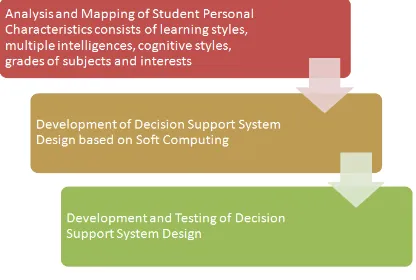
This research uses research development method. The first stage was a study of the personal characteristics of students. Furthermore, a soft computing based Decision Support System will be built for mapping and clustering student specialization. he stages of research are shown in Figure 1, below.
Figure 1. Research Stages
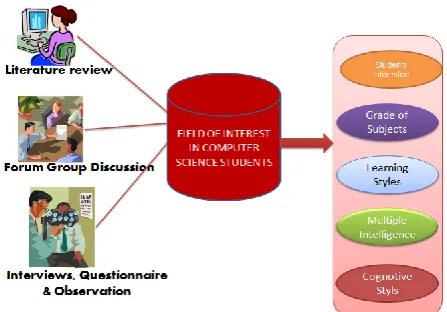
In the first stage, students' personal characteristics were mapped, including learning styles, multiple intelligences, cognitive styles, related subject values and student interests. Retrieval of input data used a questionnaire / questionnaire for learning styles, multiple intelligences, cognitive styles and interests, for the value of the eyes using secondary data in campus or primary data interviews with students.
Figure 2. The Mapping Personal Characteristics of Students
The architecture of the proposed Decision Support System is as shown in Figure 3 below:
Figure 3. The architecture of the proposed Decision Support System
The stages of the research were begun by mapping the fields of specialization of students in the field of computing and information technology. Making knowledge and rule representations and making prototypes of soft computing-based decision support systems for mapping and clustering student specialization.
III.RESULTS AND DISCUSSION
produce mapping of specialization in computer science students while development research is used to make a prototype of a decision support system for mapping and clustering student specialization based on soft computing.
Figure 4. The Students Mapping Method flowchart
The Specialization of students in the field of computing and technology is very much and broad reach. In this research, limitation and description of students' interest in computing and information technology are conducted, based on the Group Discussion Forum (FGD), literature study, interviews and questionnaires for computer lecturers and students, namely:
A. Specialization 1
Specialization 1 is related to data analysis. The scope of this specialization is quite broad from Database Management System, Data Mining, Data Warehouse, Intelligen Business, Text Mining, database migration and so on. The subjects related to this specialization are Programming and Data Structure, Database, Data Mining, Data Warehose, and others.
B. Specialization 2
Specialization 2 is related to software development and application. This specialization covers web programming and applications, mobile programming and applications,
e-learning, e-business, e-commerce,
Entrepreneurship System, and so on. Courses in
Programming and Data Structure, Web
Programming, Mobile Programming, Systems Analysis and Design, Software Engineering, and others.
C. Specialization 3
Specialization 3 deals with multimedia, animation and game technology. This specialization includes Digital Multimedia System and Technology, Multimedia Application, Learning Multimedia, Animation and Graphics, Game Technology, Virtual Reality, Augmented Reality, and so on. Subjects related to this specialization are Programming and Data Structures, Multimedia, Computer Graphics, Software Engineering, and others.
D. Specialization 4
Specialization 4 is related to computer systems and physical computing. The scope of this specialization includes Computer Hardware
Systems, Embedded Systems, Physical
Computong, Internet of Think (IoT), and so on. Courses related to this specialization are Programming and Data Structures, Computer Architecture and Organization, Digital Systems, Microprocessors and Microcontrollers, Internet of Think (IoT), Embedded Systems, and others.
E. Specialization 5
Specialization 5 deals with computer networks and security systems. This specialization includes Computer Network, System Security, Digital Forensic, and others. Subjects related to this field are Programming and Data Structures, Databases,
Computer Networks, Web Programming,
Internet, Databases, Information Systems Security, and others.
F. Specialization 6
Mining, Decision Support Systems and others. Subjects related to this field are Programming and Data Structures, Databases, Intelligent Systems, Artificial Intelligence, Soft Computing, Decision Support Systems, Data Mining, Software Rekatyasa and so forth.
G. Specialization 7
Specialization 7 is related to digital image processing and computer vision. The scope of this field includes Image processing, Computer Vision, Visualization and Computer Graphics, Biomedical Informatic, Pattrens Recognition, Speech Recognition, and others. Subjects related to this specialization are Programming and Data Structure, Digital Image Processing, Computer
Vision, Computer Graphics, Artificial
Intelligence, Data Mining, and so on.
H. Specialization 8
Specialization 8 is related to information technology technopreneurship and system and
information technology audits. This
specialization includes IT Technopreneurships and Information Systems and Technology Audit. My eyes relating to this specialization are Management and business, Business Feasibility, Programming and Data Structures, Databases, Web and Mobile Programming, Software Engineering, System Evaluation, and others.
The mapping of specialization based on Computing students based on student interests, Course Values, Learning Styles, Compound Intelligence and Cognitive Styles generated through literature study, related subject analysis, questionnaires, interviews, Forum Group Discussion and observation, then the mapping scheme as shown in figure 5, below:
Figure 5. Student Specialization Mapping Scheme
The mapping of students is based on interests by being related to several indicators such as interests, grades in learning styles, multiple intelligences aand cognitive styles. The leaning styles according to Memeletics Learning Styles Inventory consist 7 types namely : Visual, Aural, Verbal, Physical, Logical, Social and Solitary. The Multiple Intelligences according to Gardner.’s Multiple Intelligences Scale consist 8 types
namely : Linguistics Intelligence, Logical Mathematics Intelligence, Visual Spatial Intelligence, Bodily Kinesthetics Intelligence, Musical Intelligence, Interpersonal Intelligence, Intrapersonal Intelligence and Naturalist Intelligence. The Cognitive Styles according to Martin Cognitive Styles Inventory consist 5 types namely: Systematic Style, Intuitive Style, Integrated Style, Undifferentiated Style and Split Style.
IV.CONCLUSION
learning styles, multiples intelligences and cognitive styles. The leaning styles consist 7 types namely : Visual, Aural, Verbal, Physical, Logical, Social and Solitary. The Multiple Intelligences consist 8 types namely : Linguistics Intelligence, Logical Mathematics Intelligence, Visual Spatial Intelligence, Bodily Kinesthetics Intelligence, Musical Intelligence, Interpersonal Intelligence, Intrapersonal Intelligence and Naturalist Intelligence. The Cognitive Styles consist 5 types namely: Systematic Style, Intuitive Style, Integrated Style, Undifferentiated Style and Split Style. The design of this decision support system will be further developed by integrating soft computing algorithms so that it is expected to be implemented for student mapping.
V. REFERENCES
[1]. Robledo, L.F., sepulveda, J., Archer, S. 2013. Hybrid
Simulation Decision Support System for University Management. Proceedings of the 2013 Winter
Simulation Conference,
978-1-4799-2076-1/13/$31.00 ©2013 IEEE.
[2]. Mabu, A.M., Muhammad, F.A. 2016. An Admission
Decision Support System for Nigerian Universities. International Journal of Computer Applications (0975 - 8887) Volume 133 - No.2, January 2016.
[3]. Vohra, R. Das, N.N. 2011. Intelligent Decision
Support Systems for Admission Management IN Higher Education Institutes. International Journal of Artificial Intelligence & Applications (IJAIA), Vol.2, No.4, October 2011.
[4]. Soriano, L.T., Capucao, J.N.B., Palaoag, T.D. 2018.
Decision Support Model for Managing
AcademicWorkload in State Universities and Colleges. International Journal of Information and Education Technology, Vol. 8, No. 7, July 2018.
[5]. Cabrerizo, F.J., Molinera, J.A.M, Perez, C.J., Gijon,
J.L., Viedma, E.H. 2015. A Decision Support System to Develop a quality Management in Academic Digital Libraries. Information Sciences 323 (2015) 48-58.
[6]. Shobaki, Al., Mazen, J., Naser, A., Samy, S. 2017.
Requirements for Applying Decision Support
Systems in Palestinian Higher Education
Institutions - Applied Study on Al - Aqsa University in Gaza. International Journal of Information Technology and Electrical Engineering, Volume 6, Issue 4 August 2017.
[7]. Elnashar, E.A., Heggi, A. 2017. Decision Support
System for Higher Education Research examiners &
Reviewers in Egyptian. Innovation and
Entrepreneurship, ISSN 1314-9253 Volume V, number 3, 2017.
[8]. Saptarini, N.G.A.P.H., Prihatini, P.M. 2015.
Decision Support System for Scholarship in Bali State Polytechnic Using AHP and TOPSIS.
International Conference On Information
Technology And Business, ISSN 24607223 20th -21th August 2015.
[9]. Sudarma, M., Sudana, A.G.K.O., Cahya, I. 2015.
Decision Support System for the Selection of Courses in the Higher Education using the Method of Elimination Et Choix Tranduit La Realite. International Journal of Electrical and Computer Engineering (IJECE) Vol. 5, No. 1, February 2015, pp. 129~135. ISSN: 2088-8708.
[10].Kostoglou, V., L Vassilakopoulos, M., Ploskas, N.
2013. Towards A Web Based Decision Support System for Choosing Higher Education Studies. XI Balkan Conference on Operation Research, 07-10 September 2013.
[11].Livieris, I.E., Mikropoulos, T.A., Panagiotis
Pintelas, P. 2016. A decision support system for
predicting students’ performance. Themes in
Science & Technology Education, 9(1), 43-57, 2016.
[12].Pratiwi, D., Lestari, J.P., Agushinta, D.R. 2014.
Decision Support System to Majoring High School Student Using Simple Additive Weighting Method. International Journal of Computer Trends and Technology (IJCTT) - volume 10 number 3 - Apr 2014.
[13].Gurkut, C., Muesser Nat, M. 2018. Important
Mathematics, Science and Technology Education, 2018 14(3):923-932.
[14].Ardana, I.M, Ariawan, I.P.W, Divayana, D.G.H.
2016. Development of Decision Support System to Selection of the Blended Learning Platforms for Mathematics and ICT Learning at SMK TI Udayana. (IJARAI) International Journal of Advanced Research in Artificial Intelligence, Vol. 5, No. 12, 2016.
[15].El-Quliti, S.A., Ragab, A.H.M., Abdelaal, R.,
Mohamed, A.W., Mashat, A.S., Noaman,A.Y., Altalhi, A.H. 2017. Strategic Decision Support System Based Hybrid Models for Colleges
Enrollment Capacity Planning, Design &
Implementation. The Online Journal of Science and Technology - April 2017 Volume 7, Issue 2.
[16].Sumarlinda, Sri. 2013. Sistem Pendukung
Keputusan Penentuan Plafon Kredit Dengan Fuzzy MADM (Multiple Attribute Decissio Making) Menggunakanan Metode SAW (Simple Additive Weightin) Di PD.BPR BKK Boyolali Cabang Simo. DutaCom Journal , Vol. 5.
[17].Sumarlinda, Sri. 2017. Sistem Pendukung
Keputusan Progresivitas Karyawan dengan Metode Fuzzy di STMIK Duta Bangsa Surakarta. DutaCom Journal, Volume 11, Isue 1, pp 23-42.
[18].Lestari, W., Purnomo, S. 2013. Aplikasi Algoritma
Competitive Network untuk Clustering Minat Mahasiswa Terhadap Topik-Topik Penelitian. Duta.Com, Jurnal Ilmiah Teknologi Informasi dan Komunikasi, ISSN: 2086-9436, hal : 37 - 44.
[19].Shovon, M.H.I., Haque, M. 2012. An Approach of
Improving Student’s Academic Performance by
using K-means clustering algorithm and Decision tree. International Journal of Advanced Computer Science and Applications, Vol.3, No. 8, 2012.
[20].Oyelade, O. J, Oladipupo, O. O, Obagbuwa, I. C.
2010. Application of k-Means Clustering algorithm
for prediction of Students’ Academic Performance.
International Journal of Computer Science and Information Security, Vol. 7, No. 1, 2010.
[21].Facca, T.M., Allen, S.J. 2011. Using Cluster Analysis
to Segment Students Based on Self-Reported Emotionally Intelligent Leadership Behaviors.
Journal of Leadership Education, Volume 10, Issue 2 - Summer 2011.
[22].Purnomo, S., Lestari, W., Hastuti, I. 2017. Expert
System Design for Guidance of Information Technology (IT) Technopreneurships Based on Students Personal Characteristics. International Journal of Engineering Research and Technology (IJERT), ISSN : 2278-0181.
[23].Lestari, Wiji. 2014. Sistem Clustering Kecerdasan
Majemuk Mahasiswa Menggunakan Algoritma Self Organizing Maps (SOM). Jurnal Saintech, Jurnal Penelitian dan Pengabdian Masyarakat, ISSN: 2355-5009, hal : 52 - 58
[24].Purnomo, S., Lestari, W., Hastuti, I. 2016. The
Mapping The Information Technology (IT) Technopreneurships Based of Learning Styles and
Multiple Intelligence. Paper Proceedings
International Conference of Education and Technology for Empowering Agents of Change ISSN : 2541-1578.
[25].Lestari, Wiji. 2015. Pemetaan Gaya Belajar Mahasiswa dengan Clustering Menggunakan Fuzzy C-Means. Jurnal Saintech, Jurnal Penelitian dan Pengabdian Masyarakat, ISSN: 2355-5009, hal : 95 - 102.
Cite this article as :
Sri Sumarlinda, Wiji Lestari, "Design of Decision Support System for Mapping Student Interest in
Information Technology and Computing
Specialization", International Journal of Scientific Research in Computer Science, Engineering and Information Technology (IJSRCSEIT), ISSN : 2456-3307, Volume 6 Issue 1, pp. 44-50, January-February
2020. Available at doi :
https://doi.org/10.32628/CSEIT195670