Annotating Relation Mentions in Tabloid Press
Hong Li, Sebastian Krause, Feiyu Xu, Hans Uszkoreit, Robert Hummel, Veselina Mironova
Language Technology Lab
German Research Center for Artificial Intelligence (DFKI) Alt-Moabit 91c, 10559 Berlin, Germany
Abstract
This paper presents a new resource for the training and evaluation needed by relation extraction experiments. The corpus consists of annotations of mentions for three semantic relations: marriage,parent–child, siblings, selected from the domain of biographic facts about persons and their social relationships. The corpus contains more than one hundred news articles from Tabloid Press. In the current corpus, we only consider the relation mentions occurring in the individual sentences. We provide multi-level annotations which specify the marked facts from relation, argument, entity, down to the token level, thus allowing for detailed analysis of linguistic phenomena and their interactions. A generic markup tool Recon developed at the DFKI LT lab has been utilised for the annotation task. The corpus has been annotated by two human experts, supported by additional conflict resolution conducted by a third expert. As shown in the evaluation, the annotation is of high quality as proved by the stated inter-annotator agreements both on sentence level and on relation-mention level. The current corpus is already in active use in our research for evaluation of the relation extraction performance of our automatically learned extraction patterns.
Keywords:Corpus Annotation, Relation Extraction, Semantic Relations, People Domain, Tabloid Press
1.
Introduction
In this paper we present a new resource for performing periments in the area of text analysis and information ex-traction, namely a corpus consisting of more than one hun-dred documents annotated with mentions of several seman-tic relations. The targeted relations were selected from the domain of biographic facts about persons and their fam-ily relatives. The provided annotation specifies the marked facts down to the token level, it thereby allows for detailed analysis of language phenomena.
This resource is intended to foster research in the task of de-tecting mentions of semantic relations (relation extraction; RE) in texts and extracting factual knowledge from them. The corpus is particularly useful to evaluate and compare the output of competing RE systems. Such comparison at-tempts are commonly hard to perform because of the lack of freely available gold-standard corpora. The typical fallback solutions for comparing systems then have to rely on ad-hoc methods, such as manual investigation of output samples or fuzzy matching of data against some database of known facts, thus, the results of such a comparison are of limited significance. An additional benefit of our resource is that it enables the training of classic supervised RE systems.
The corpus was annotated using the markup tool Recon (Li et al., 2012) by two human experts with additional conflict resolution performed by a third expert. The annotation is of high quality and is already in active use in our RE re-search, some of which is described in Section 5. Other ex-amples include the work we described in (Xu et al., 2010) and (Krause et al., 2012), where we utilized preliminary versions of this corpus. We hope that the publication of this resource will encourage other researchers to work on the interesting problems of this research field.
2.
Related Work
There has been some work on preparing evaluation corpora for relation extraction in the past. An early example in-cludes the Message Understanding Conference series in the eighties and nineties, which prepared different text collec-tions with annotacollec-tions in order to use them for information extraction competitions, e. g., the MUC 6 corpus (Chinchor and Sundheim, 2003) dealing with business related infor-mation. Another prominent example is the Automatic Con-tent Extraction program, which led to the development of evaluation corpora, like the ACE 2005 corpus (Walker et al., 2006).
These existing corpora are unfortunately not appropriate for certain application scenarios. For example, the ACE 2005 corpus contains relatively few mentions per relation, mak-ing it hard to evaluate the impact of filtermak-ing strategies for pattern-based RE approaches.
Recently, corpus annotation efforts focused on automatic high-precision annotation of corpora, in particular with mentions of entities and their disambiguation. Examples are the Wikilinks corpus (Singh et al., 2012) and the “Free-base Annotation of the ClueWeb Corpora” (Gabrilovich et al., 2013), each of them containing millions of marked en-tity mentions.
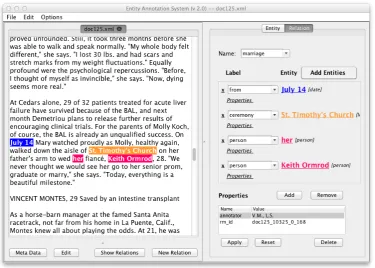
Figure 1: Annotation example in Recon, cf. Example 1a).
Annotation Results
Table 2 presents statistics of the annotation of the two an-notators (referenced byAandB).
Anno-tator
Sentences w/ Concept Relation Relation Mention Mentions Mentions
A 908 4003 1125
B 872 3542 1081
A∪B 971 4090 1318
Table 2: Overview of the annotation results by two annota-torsAandB
Of the approximately 25,000 sentences of the corpus, only 4% have been annotated with relation mentions by at least one of the experts. About 80% of these sentences contain exactly one relation mention, 15% have two mentions and the remaining 5% have three or more relation mentions. The average number of concept mentions in the sentences with relation mentions is 4.2.
4.4. Inter-annotator Agreement
After the initial annotation, we calculated the agreement between the two experts both on sentence level and on relation-mention level.
Agreement on Sentence Level
The sentence-level agreement is evaluated by reducing the complexity of the annotation to the binary choice whether a given sentence of the corpus contains a mention of a given target relation. This abstraction allows to calculate standard inter-annotator agreement measures, depicted in Table 3. The agreement between the annotators is very good for all three relations. This indicates that relations between
per-marriage parent–
child siblings
micro-avg. Pos. Agreem. 0.9358 0.8745 0.8545 0.8926
Cohen’sκ 0.9348 0.8721 0.8532 0.8910 PCC 0.9349 0.8730 0.8546 0.8554
Table 3: Inter-annotator agreement measures on sentence level. PCC is short for Pearson correlation coefficient.
sons are commonly expressed in a clear and relatively ob-jective way. Note that the two annotators have a higher agreement for the relationmarriagethan for the other two relations.
Agreement on Relation-Mention Level
To measure the agreement of the actual relation mention annotation, we use theagrmetric described by Wiebe et al. (2005):
agr(A||B) = # of relation mentions annotated byAandB # of relation mentions annotated byA
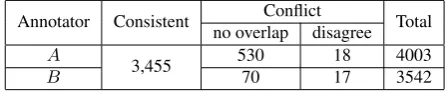
(1) Table 4 presents for all relations the number of mentions annotated byA∩B,A/B,B/A, and also the agreement metrics. Consistent with the agreement on the sentence level, the agreement for the relationmarriageis higher than for the other two relations. This might be caused by the potentially higher number ofpersons in a sentence which are related byparent–child/siblingsthan formarriage, thus having a higher potential of disagreement. Another reason might be that the annotators disagree about specific details of the relation definitions.
suf-marriage parent–
3,455 530 18 4003
Documents Sentences Sentences with Relation Mentions
Concept Mentions as Rel. Arguments
Relation Mentions
marriage parent–child siblings Total
142 25,065 967 2,506 421 550 249 1,220
Table 7: Final statistics of the published corpus.
In our future work we plan on the one hand to annotate this and other corpora with relations from different do-mains (e. g., business related) and also want to employ a hierarchy for the relation arguments (e. g., SPOUSE → WIFE/HUSBAND). On the other hand, we want to annotate the corpora with more detailed concept information, includ-ing complete resolution of coreferrinclud-ing expressions, both in-and cross-document-wise.
7.
Acknowledgements
This research was partially supported by the German Fed-eral Ministry of Education and Research (BMBF) through the project Deependance (contract 01IW11003) and by Google through a Focused Research Award for the project LUcKY granted in July 2013.
8.
References
Nancy Chinchor and Beth Sundheim. 2003. Message un-derstanding conference (MUC) 6. Linguistic Data Con-sortium, Philadelphia.
Witold Drozdzynski, Hans-Ulrich Krieger, Jakub Piskorski, Ulrich Sch¨afer, and Feiyu Xu. 2004. Shallow processing with unification and typed feature structures — founda-tions and applicafounda-tions. K¨unstliche Intelligenz, 1:17–23. Evgeniy Gabrilovich, Michael Ringgaard, and Amarnag
Subramanya. 2013. Facc1: Freebase annotation of ClueWeb corpora, version 1.
Sebastian Krause, Hong Li, Hans Uszkoreit, and Feiyu Xu. 2012. Large-scale learning of relation-extraction rules with distant supervision from the web. In Proceedings of the 11th International Semantic Web Conference. Springer, 11.
Hong Li, Xiwen Cheng, Kristina Adson, Tal Kirshboim, and Feiyu Xu. 2012. Annotating opinions in ger-man political news. In Nicoletta Calzolari (Conference Chair), Khalid Choukri, Thierry Declerck, Mehmet Uur Doan, Bente Maegaard, Joseph Mariani, Jan Odijk, and Stelios Piperidis, editors, Proceedings of the Eight International Conference on Language Resources and Evaluation (LREC’12), Istanbul, Turkey, may. European Language Resources Association (ELRA).
Andrea Moro, Hong Li, Sebastian Krause, Feiyu Xu, Roberto Navigli, and Hans Uszkoreit. 2013. Semantic rule filtering for web-scale relation extraction. In 12th International Semantic Web Conference, Sydney, Aus-tralia, October.
Robert Parker. 2011. English gigaword fifth edition. Lin-guistic Data Consortium, Philadelphia.
Sameer Singh, Amarnag Subramanya, Fernando Pereira, and Andrew McCallum. 2012. Wikilinks: A large-scale cross-document coreference corpus labeled via links to Wikipedia. Technical Report UM-CS-2012-015.
Christopher Walker, Stephanie Strassel, Julie Medero, and Kazuaki Maeda. 2006. ACE 2005 multilingual train-ing corpus. Ltrain-inguistic Data Consortium, Philadelphia, February.
Janyce Wiebe, Theresa Wilson, and Claire Cardie. 2005. Annotating expressions of opinions and emotions in lan-guage. volume 39(2/3), page 165210.