51
A study of scope and impact of Big Data analytics on
Information Technology in India
Mr. Shaikh Mohammad Ali
1, Mr. Shoaib Sayyed
2.
MBA IT 1, Operations 2 .Poona Institute of Management Sciences & Entrepeneurship1,2 Savitribai Phule Pune University, Pune, Maharashtra, India1,2
Email: [email protected] , [email protected] 2
Abstract- Big data is leading topic across a various fields, with both the sectors having use of big data analytics.
It is determine by size, type, flow of data, and by the using various algorithms data. In this paper, understand the term ‘big data’. The role of big data analytics does not involve personal data. Using climate and weather data. Big data analytics can involve repurposing personal data. Any organization has collected some personal data for commercial purpose and then decides to start analyzing it for completely different purposes then it needs to make its users aware of this. This is particularly important if the organization is planning to use the data for a purpose that is not apparent to the individual because it is not obviously connected with their use of a service.
A key feature of big data is using ‘all’ the data, which contrasts with the concept of data minimization in the data protection principles. This raises questions about whether big data is excessive, while the variety of data sources often used in the analysis may also prompt questions over whether the personal information being used is relevant. The challenge for organizations is to address this by being clear from the outset what they expect to learn or be able to do by processing that data, as well as satisfying themselves that the data is as per requirement or not. Organizations must have security issues of any information stored at big data. Security depends upon the proper assessment of risk, and so responsible organizations should apply their normal risk management policies and procedures when they acquire new datasets or use existing ones for big data analytics. Big data can also be a tool to improve information security. As well as looking extensively at the data protection issues presented by big data, this paper also suggests areas .
Index Terms- Data Protection Act [DPA], Small and Medium enterprises [SME's], Online Analytical
Programming [OLAP], Centre for Economics and Business Research [CEBR], Complex Event Processors [CEP], Data Stream Management Systems [DSMS], Big Data Analytics Agents [BDAA].
1. INTRODUCTION:
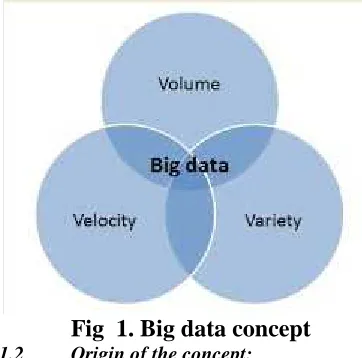
1.1 Definition : “Big Data” is a term a direction which uses for various techniques to take input data, process, and analysis and access large amount Data for specific time set frame not accessible to various standard IT technologies. But using bridges, and necessary platform, tools, software etc. used for necessary requirement are together form called “Big Data technologies”. The new perspective of Big Data is dealing with the maintenance cost of storing and processing of Data the cost of storage has been reduced by many segment by the Cloud computing, which cuts huge amount of economy of organization by dealing with various IT investment cost for all business. As a result the “Big Data concept” has opportunity for many business & developing Research centers for various objective.
Fig 1. Big data concept
1.2 Origin of the concept:52 social platforms. Major social platform like
Google, Wikipedia and Face book and Twitter, has enhanced the application of data
volumes at internet on large scale depend upon situation .Now these solutions have partly moved into the some open source and easily available to all. It led the approach to Big Data with easy and cost free solution for business problems
.
Meanwhile, two parallel breakthroughs have further helped accelerate the adoption of solutions for handling Big Data:
The availability of Cloud based solutions has dramatically lowered the cost of storage, amplified by the use of commodity hardware. Virtual file systems, either open source or vendor specific, helped transition from a managed infrastructure to a service based approach;
In term of large volume of data over the server is distributed data and load balancing over many servers. Up gradation of database design for storage and Parallel or Multi processing has given support to various Business products originating into Hadoop platform. Upon acceptance, authors are required to submit their data source file including postscript files for figures.
1.3 Big data and personal data:
Personal data is the data relates to a living individual who can be detected. ‘Identify’ means individual can be identified from the data, either individual or combined information. In assessing whether the data could be combined with other information to identify
an individual, it is necessary to consider what means are reasonably likely to be used to identify them. The ICO has produced guidance that explains this
definition further Data protection is concerned with personal data, but it is important to remember that
many instances of big data analytics do not involve personal data at all. E.g. of non personal big data include: world climate and weather data; using geospatial data from GPS-equipped buses to predict arrival times; data from radio telescopes in the Square Kilometer Array. Data from sensors on containers carried on ships. These are all areas where big data analytics enable new discoveries and improve services and business processes, without using personal data. Big data analytics that do involve processing personal data, for example: Monitoring devices of data in Medical, Mobile, and Location with respect to data, with respect to purchase data. Big data analytics has potential to generate new personal data. For example, social media and other data about an individual could be analyzed to find the person’s lifestyle as a factor in determining credit rate, or risk during of developing a medical condition. Car pooling system has various sensors in cars provide all data about the car as well as individuals for various decisions making, Big data can be used to understand the emerging and current trends for decision making. For example, data from travel cards that record journeys made by individuals, such as Oyster card, could be combined with traffic data to plan new bus routes. In such cases the data may often be anonymised before being analyzed.
2. SCOPE AND IMPACT OF BIG DATA A NEW WORLD OF OPPORTUNITIES:
According to the McKinsey Global Institute report on Big Data from 2012, the most developed regions, such as Europe, have the biggest potential to create value through the use of Big Data. The enormous economic impact of Big Data is further shown in another study prepared by the Centre for Economics and Business Research (CEBR),
55 critically
underdeveloped.
4 There is a well-established understanding in export oriented companies to deliver high-value products and services (e.g. "premium cars") by using innovation networks
No wide spread knowledge about freely available data ("getting new insights by merging different data sources")
5 Growing interest from SME's using cloud computing and software services
Analytical Big Data services for SME's within Europe are currently non-existing
.
5. Opportunities of Big Data:
i. A rising customer demands in Europe for smarter products, higher individualization, and mass customization.
ii. Globally SME’s can benefit by enhancing their products and services with big data analytics and privacy by design, e.g. offering preventive maintenance services in the utilities industry, usage-based analytics for distant product development, self-learning behaviors for energy optimization (e.g. Nest thermo state) or new business models thanks to better usage insights (like Rolls-Royce and their power by the hour performance based contracting).
iii. Globally SME’s could benefit enormously by reducing copyright infringements with smart networked products and services.
iv. Better use of freely available data.
v. Leveling the playing field by giving access to formerly very demanding analytical tools through commoditization.
vi. Developing new products and services enhanced with Big Data analytics and privacy by design, developing products adapted to European privacy standards
vii. Established innovation networks could reduce skill shortages by spreading knowledge with online trainings and generating hands-on expertise based on commoditized analytical services.
6. Threats of Big data:
i. Globally there is a fast growing knowledge about using data as an asset class for leveraging the industrial competitiveness, for example in China, India.
ii. There is a massive venture-capital driven development in the US to commoditize formerly complex big data analytics for the mainstream market, www.bigml.com is an example of the commoditization efforts around Hadoop. SME’s in Europe have no alternatives to choose comparable services from European vendors.
iii. Insufficient capabilities of European companies to scale to the world market.
iv. There are serious concerns among European businesses about using big data analytics
56 neglecting European privacy standards and
expectations. In the meantime, foreign competitors take their
7. Technical aspects:
It purely deals with Hardware & Software specification and with respect to real time Implementation is the big challenges in the real time Environment, data management and performance and scalability, pros and cons to some extent, distributed storage ref.[2]. In detail, the following directions for future research efforts.
1. The methodology towards data analysis with quick approaches algorithms by generated massive data collections (heterogeneity, multimodality, size etc.)
2. The probability of data to used for betterment of the Business.
3. With regards to visual analytics, it is important to - on a general scale - promote the need for understanding the relevance and relatedness of information.
4. There is requirement for the presentation on the type of data it may temporary or permanent scales. Therefore necessary tools supporting various platform interactions with user friendly transitions for aggregation of data to one another. ref.[2].
8. Conclusion:
We have
entered an era of Big Data for better analysis of the large amount of data size which areavailable in open source, for faster growth of Business to increase profitability However, many technical challenges described in this paper must be addressed
before this potential can be realized fully. The challenges include not just the obvious issues of scale, but also heterogeneity, lack of structure, error-handling, privacy, timeliness, provenance, and visualization, at all stages of the analysis pipeline from data acquisition to result interpretation. The technical challenges are common across the globe, and are not cost-effective to address in the context of one domain alone. Furthermore, these challenges will require alternatives or parallel solutions, and will not have impact on next generation of business products. We must support and encourage fundamental research towards addressing these technical challenges if we are to achieve the promised benefits of Big Data.
9. REFERENCES:
[1] Big data and data protection 20140728 Version: 1.0
[2] NESSI White Paper, December 2012 Big Data A New World of Opportunities [3] https://ico.org.uk
[4] http://www.ijircst.org [5] https://www.linkedin.com
[6] http://its.fhsalzburg.ac.at - Koehler Martin [7] http://sloanreview.mit.edu