33
Automatic Propbank Generation for Turkish
Koray Ak
Department of Computer Engineering Is¸ık University
˙Istanbul, Turkey
Olcay Taner Yıldız
Department of Computer Engineering Is¸ık University
˙Istanbul, Turkey
Abstract
Semantic role labeling (SRL) is an im-portant task for understanding natural lan-guages, where the objective is to analyse propositions expressed by the verb and to identify each word that bears a semantic role. It provides an extensive dataset to en-hance NLP applications such as informa-tion retrieval, machine translainforma-tion, infor-mation extraction, and question answer-ing. However, creating SRL models are difficult. Even in some languages, it is in-feasible to create SRL models that have predicate-argument structure due to lack of linguistic resources. In this paper, we present our method to create an automatic Turkish PropBank by exploiting parallel data from the translated sentences of En-glish PropBank. Experiments show that our method gives promising results.
1 Introduction
Semantic role labeling (SRL) is a well defined task that identifies semantic roles of the words in a sentence. Event characteristics and partici-pants are simply identified by answering “Who did what to whom” questions. Having this semantic information facilitates NLP applications such as machine translation, information extraction, and question answering. After the development of sta-tistical machine learning methods in the area of computational linguistics, learning complex lin-guistic knowledge has became feasible for NLP applications. Recent semantic resources specifi-cally for SRL which provides input for develop-ing statistical approaches are FrameNet (Fillmore et al., 2004), PropBank (Kingsbury and Palmer, 2002) (2003), (2005), (Bonial et al., 2014) and NomBank (2004). These resources enables us to understand language structure by providing a sta-ble semantic representation.
Among these resources PropBank is a com-monly used semantic resource which includes predicate - argument structure by stating the roles that each predicate can take along with the anno-tated corpora. It has been applied to more than 15 different languages. However, manually creating such semantic resource is labor-intensive, time-consuming and most importantly requires a pro-fessional linguistic perspective. Also limited lin-guistic data further blocks generating PropBank-like resources.
Various studies such as Zhuang and Zong (2010), Van der Plas et al. (2011) (2014), Kozhevnikov and Titov (2013), Akbik et al. (2015), which transfer semantic information using parallel corpus, are presented to cope with these problems. In this way, semantic information pro-jected from a resource-rich language (English) to a language with inadequate resources and Prop-Bank of the target language is automatically gen-erated. Here the assumption is translated parallel sentences generally share same semantic informa-tion. Word and constituent based alignment tech-niques are widely used to construct mapping be-tween source and target languages for annotation projection. Previous studies report translation di-vergences and language specific differences affect the quality of the projection. Filtering projections using learning methods is suggested to increase precision. In this paper, we present our study to create automatic Turkish PropBank using parallel sentences from English PropBank.
Section5, we conclude with the results.
2 PropBank
2.1 English PropBank
PropBank is the bank of propositions where predicate-argument information of the corpora is annotated and semantic roles or arguments that each verb can take are posited. It is constituted on the Penn Treebank (Marcus et al.,1993) Wall Street Journal [WSJ]. The primary goal is to la-bel syntactic elements in a sentence with specific argument roles to standardize labels for the simi-lar arguments such as the window in John broke
the window and the window broke. PropBank uses conceptual labels for arguments from Arg0 to Arg5. Only Arg0 and Arg1 indicate the same roles across different verbs where Arg0 means agent or causer and Arg1 is the patient or theme. The rest of the argument roles can vary across differ-ent verbs. They can be instrumdiffer-ent, start point, end point, beneficiary, or attribute.
Moreover, PropBank uses ArgM’s as modifier la-bels where the role is not specific to the verb group and generalizes over the corpora such as location, temporal, purpose, or cause etc. arguments. The first version of English PropBank, named as The Original PropBank, is constructed for only ver-bal predicates whereas the latest version includes all syntactic realizations of event and state se-mantics by focusing different expressions in form of nouns, adjectives and multi-word expressions to represent complete event relations within and across sentences.
2.2 PropBank Studies for Turkish
There have been different attempts to construct Turkish PropBank in the literature. S¸ahin (2016a; 2016b), S¸ahin and Adalı (2017) report semantic role annotation of arguments in the Turkish de-pendency treebank. They construct PropBank by using ITU-METU-Sabancı Treebank (IMST). In these studies, frame files of Turkish PropBank are constructed and extended by utilizing crowdsourc-ing. 20,060 semantic roles are annotated in 5,635 sentences. The size of the resource is stated as a drawback in the study. Recently, Ak et al. (2018) construct another Turkish Proposition Bank using translated sentences of English PropBank. So far, 9,560 of 17,000 translated sentences are annotated with semantic roles. Also, framesets are created for 1,330 verbs and 1,914 verb senses. These
stud-ies constitute a base for Turkish proposition bank, but their size is limited and construction of these proposition banks consumed a lot of time.
3 Automatic PropBank Generation Studies
PropBanks are also generated automatically for resource-scarce languages by using parallel cor-pus. In this section, proposition bank studies for automatic generation are presented. Zhuang and Zong (2010) proposed performing SRL on parallel corpus of different languages and merging the re-sult via a joint inference model can improve SRL results for both input languages. In the study an English and Chinese parallel corpus is used. First each predicate is processed by monolingual SRL systems separately for producing argument candi-dates. After the candidates formed, a Joint Infer-ence model selects the candidate that is reasonable to the both languages. Also, a log-linear model is formulated to evaluate the consistency. This ap-proach increased F1 scores 1.52 and 1.74 respec-tively for Chinese and English.
Van der Plas et al. (2011) presents cross-lingual semantic transfer from English to French. En-glish syntactic-semantic annotations were trans-ferred using word alignments to French language. French semantic annotations gathered from the first step were then trained with a French joint syntactic-semantic parser along with the French syntactic annotations trained separately. Joint syntactic-semantic parser is used for learning the relation between semantic and syntactic structure of the target language and reduces the errors aris-ing from the first step. This approach reaches 4% lower than the upper bound for predicates and 9% for arguments.
(Van der Plas et al., 2011) by building separate models for arguments and predicates. Also, prob-lems of transferring semantic annotations using parallel corpus is examined in the paper. Token-to-token basis annotation transfer, translation shifts, and alignment errors in the previous work is re-placed with a global approach that aggregates in-formation at corpus level. Instead of using En-glish semantic annotations of roles and predicate together with French PoS tags to generate French semantic annotations, English annotations of pred-icates and roles used separately to generate one predicate and one role semantic annotations sep-arately.
Akbik et al. propose a two stage approach (Ak-bik et al., 2015). In the first stage only filtered semantic annotation is projected. Since high con-fidence semantic labels projected, resulting target semantic labels will be high in precision and low in recall. In the next stage, completed target lan-guage sentences sampled and a classifier is trained to add new labels to boost recall and preserve pre-cision. Proposed system is applied on 7 different languages from 3 different language family. These languages are Chinese, Arabic, French, German, Hindi, Russian, and Spanish.
4 Methods
Among the studies for Turkish proposition bank, Ak et al. (2018) is constructed on parallel English - Turkish sentences from the Original English PropBank. We have used the corpus provided in this study to automatically generate proposition bank.
4.1 Automatic Turkish PropBank Using Parallel Sentence Trees
Penn Treebank structure offers advantages for building fully tagged data set in accordance with syntactic labels, morphological labels and parallel sentences. We used this structure to add English PropBank labels for each word in the corpus. In this manner, we exploited this parallel dataset to transfer English PropBank annotations to an auto-matic Turkish PropBank.
4.1.1 English PropBank Labels
Original English PropBank corpus (Palmer et al., 2004) is accessible through Linguistic Data Con-sortium (LDC). This resource is the initial version of the English PropBank and it only includes the
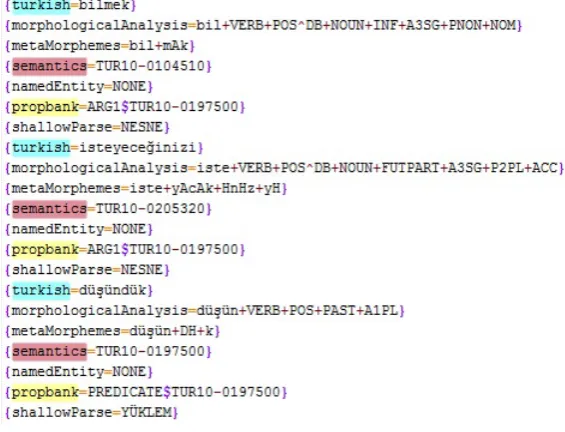
relations with verbal predicates. In the newer ver-sions adjective and noun relations are also anno-tated. Since we compare projection results with manually annotated corpus (Ak et al.,2018) which only contains verbal relations, we use the ini-tial version of the English PropBank. We down-loaded this dataset and imported annotations for the selected sentences. After this step 6,060 sen-tences among 9,558 were enhanced with the En-glish annotations. Below in Figure 1, a sample sentence is presented. English annotations are in-serted inside “englishPropbank” tags right after Turkish annotations which reside in “propbank” tags. Some of the words have only English an-notation, because there is no word translated in the Turkish sentence for this node. As an exam-ple, “their” in Figure1has annotations in the en-glishPropbank tag but there is no equivalent trans-lation in Turkish, presented as “*NONE*”, so propbank tag does not exist. English tags have predicate information that annotation belongs to. “M¨us¸terilerinin” (customers) in the same exam-ple has “ARG0$like 01#ARG1$think 01” in the englishPropbank tag which means there exists at least two words whose root is in verb form. Here the word is annotated with respect to “like” and “think” separately. We have separated multiple annotations with “#” sign and in each annotation predicate label and role is distinguished by “$” sign. In the Turkish annotation, WordNet id of the predicate was used instead of predicate label.
4.1.2 Transfering Annotations to Automatic Turkish PropBank Using Parallel Sentences
After importing English annotations, it is neces-sary to determine predicate(s) of the Turkish sen-tences. Morphological structures of the words are examined to detect predicate candidates. Words were morphologically and semantically analyzed in translated Penn TreeBank. We have used “mor-phologicalAnalysis” tag to check the morpholog-ical structure of the words. In Figure 1, sample morphological structure is displayed.
Figure 1: Part of a sentence tree : English PropBank annotations reside in “englishPropBank” tags.
predicate label in the annotations and transfered annotations matching with the predicate label. If we could not find a predicate in Turkish sentence or the corresponding English label did not contain Predicate role annotation, we skipped to the next predicate candidate.
During the transfer, a mapping was needed due to the difference between English and Turkish (Ak et al.,2018) argument labeling. English PropBank corpus has “-” sign in ArgM’s like ARGM-TMP and also some of the arguments from Arg1 to Arg5 are labeled with the prepositions such as ARG1-AT, ARG2-BY etc. We processed these differ-ences and then transferred labels into the “prop-bank” tags. After analyzing Turkish sentences we found out some sentences have more than one predicate, so we continued to search for another predicate in the sentence and ran the same proce-dure for each predicate candidate.
4.1.3 Experiments
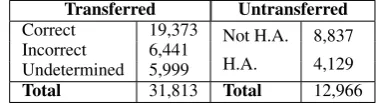
Annotations gathered from the English sentence were compared with the Turkish hand-annotated proposition bank (Ak et al.,2018). Comparisons were done at the word level by checking the an-notations for each corpus. Among the 6,060 sen-tences enhanced with English PropBank roles, 848 sentences did not have a predicate in Turk-ish proposition bank. Therefore, in 5,212 sen-tences, 44,779 word annotations were compared. 31,813 annotations were transferred from English to Turkish. Results of the comparison are pre-sented in Table 1. 19,373 words annotated with PropBank roles correctly . 6,441 annotations are incorrect, PropBank tags are different in both cor-pus. 5,999 annotations are undetermined, valid
PropBank labels transferred from English annota-tions but no annotation exists in hand annotated proposition bank. Annotations to be compared is not valid so we did not include this set in the eval-uation.
Transferred Untransferred
Correct 19,373
H.A. Not H.A.
4,129 8,837 Incorrect 6,441
Undetermined 5,999
Total 31,813 Total 12,966
Table 1: Results of the comparison between auto-matic proposition bank and hand annotated (H.A.) proposition bank.
When we remove undetermined 5,999 words in the comparison; 19,373 annotations from 25,814 annotations are correct, which gives us∼75% ac-curacy for transferred and comparable set. These 5,999 annotations may be hand-annotated and re-compared for validity of the transferred annota-tions.
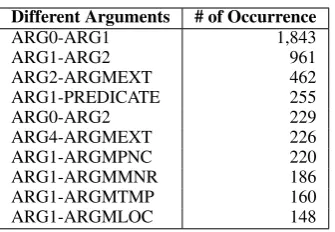
In Table2, we present occurrences of erroneous annotation transfers. Only top ten occurrences are presented. Arg0-Arg1 transfers are the most oc-curred incorrect transfers 1,843 among 6,441 in-correct annotations. Second most occurred error is in Arg1-Arg2 labels. Errors in Arg0-Arg1 and Arg1-Arg2 labels forms ∼44% of the transfer er-rors.
an-Different Arguments # of Occurrence
ARG0-ARG1 1,843
ARG1-ARG2 961
ARG2-ARGMEXT 462 ARG1-PREDICATE 255
ARG0-ARG2 229
ARG4-ARGMEXT 226 ARG1-ARGMPNC 220 ARG1-ARGMMNR 186 ARG1-ARGMTMP 160 ARG1-ARGMLOC 148
Table 2: Counts of different argument annotations between transferred annotations and hand annota-tions.
notated in the hand-annotated corpus. Only 4,129 are valid PropBank arguments. In this respect, if we count only valid arguments for untransferred annotations, accuracy is∼65%.
4.2 Automatic Turkish PropBank Using Parallel Sentence Phrases
In the previous method, annotation projection us-ing parallel sentence trees is discussed. However, finding such a resource in a special format is diffi-cult especially if you are working with a resource-scarce language. Most of the time creating a for-matted parallel resource like tree structured sen-tences complicates translation procedure. In this section, automatic generation with translated sen-tences without tree structure will be examined.
4.2.1 Phrase Sentence Structure
For the phrase sentences, English sentences re-translated without tree structure. Prior the an-notation projection, linguists in the team anno-tated phrase sentences and populated “propbank” and “shallowParse” tags so that we check the cor-rectness after the annotation transfer. 6,511 sen-tences among 9,557 phrase sensen-tences have pred-icate according to hand annotations for newly translated sentences. However, only 5,259 sen-tences have English PropBank annotation, so we take this set to transfer annotations. As you re-member, the same number in the previous section was 5,212. Here translation and annotation differ-ences change the processed sentence count.
Tag structure of Penn Treebank is preserved to simplify morphologic and semantic analysis requirements during the annotation transfer. In Figure 2, sample phrase sentence can be seen. Unlikely Figure 1, syntactic tags which indicate tree structure are not included. We used original
tree formatted English sentence to extract English propbank annotations. However, since the target sentence do not have tree structure definition we used other word alignment methods to determine annotation projection.
4.2.2 Semantic Alignment Using WordNet
In order to transfer annotations, first we tried to match predicates of English sentence and Turk-ish translation. Again we utilize “morphological-Analysis” tags to determine predicate candidates in the phrase sentence. Words which have a verb root and verb according to last inflectional group is treated as the predicate candidates of the sen-tence. Once we found all the words ensuring these conditions, we gathered all English PropBank an-notation labels which are tagged as “Predicate” in ‘englishPropbank” tag. To align predicates in dif-ferent languages, we tried to exploit WordNet’s (Ehsani et al., 2018) interlingual mapping capa-bilities. For each predicate in English sentence we find Turkish translation by searching English synset id in the WordNet. English synset id is lo-cated in englishSemantics tags as in the sample in Figure1. If there exists any translation in the WordNet, we take Turkish synset id and search it in the predicate candidates found for phrase sen-tence. Whenever translation found, we align pred-icates and try to transfer annotation with respect to aligned English label. For annotation transfer of other arguments we again align words using Word-Net’s interlingual mapping. An example WordNet record is presented in Figure3.
First results gathered with only WordNet map-ping were very low. True annotation count is 2,195 among 29,168 annotations tagged manually which yields 7.53%. However, transferred false annotation count is only 342. System heavily re-lies on semantic annotations for both English and Turkish words where some of the words failed to have semantic annotation. We look deeper into dataset provided by Ak et al. (2018), 11,006 En-glish words do not have semantic annotation so we failed to match these words with Turkish counter-parts.
Figure 2: Part of a phrase sentence : Translated words in Turkish tags. Helper tags gives additional information for each word.
Figure 3: Sample WordNet record found by searching “ENG31-01781131-v”, English synset id, from the sentence in Figure1.
noun “Dow Jones”, the same string also exists in the Turkish translation too. However, it may take additional suffixes, so we only check whether En-glish words starts with Turkish root word. Also, translational differences are encountered like deci-mal separator in English is “.” where some Turkish translations “,” is used. We replace this differences by looking whether the first morphological tag is “NUM”. After these tunings, we rerun the proce-dure and get 2,680 true and 531 false annotations which increases true annotations to 9.19%. An-other problem is erroneous semantic annotations. If English and Turkish semantic annotation is not right, alignment is not possible. Even in the best scenario where both word is annotated, if Word-Net mapping is incomplete, an alignment can not be established.
As an alternative we decided to reinforce an-notation transfer by using constituent boundaries identified with shallowParse tags by our linguist team mates. Example of shallowParse tags can be seen in Figure2. Prior to the annotation trans-fer, phrase sentences are annotated for constituent boundaries which can be used to group argument roles in the sentence. After transferring annota-tions with respect to semantic annotaannota-tions, we run another method over phrase sentences which cal-culates maximum argument types for each con-stituent and tags any untagged word with the cal-culated max argument role within the constituent boundary. This procedure further enhance true an-notations to 4,255 but also increase false annota-tions to 1,202. After constituent boundary cal-culation, correct annotation transfer percent is in-creased to ∼14.59%. In Figure 4 annotation of the sentence 7076.train is presented. Untagged words in “ ¨Ozne” and “Zarf T¨umleci” constituent boundaries are tagged with the found argument role within the boundary. Note that, we did not use the constituent types but we use boundaries of the constituents.
4.2.3 Word Alignment Using IBM Alignment Models
(1) [The less-rigorous Senate version]ARG0
[would]ARGM-MOD[defer]Predicate [the deductibility]ARG1
for [roughly five years.]ARG2-for
(2) [Daha az sıkı t¨urden bir Senato versiyonu]Ozne - Subject¨
[as¸a˘gı yukarı bes¸ yıl ic¸in]Zarf T¨umleci - Adverbial Clause
[d¨us¸¨ulebilirli˘gi]Nesne - Object[ertelerdi.]Y¨uklem - Predicate
(3) [Daha az sıkı t¨urden bir]NONE [Senato]ARG0
[versiyonu]NONE [as¸a˘gı yukarı]ARG2 [bes¸]NONE
[yıl]ARG2[ic¸in d¨us¸¨ulebilirli˘gi]NONE[ertelerdi.]PREDICATE
(4) [Daha az sıkı t¨urden bir Senato versiyonu]ARG0
[as¸a˘gı yukarı bes¸ yıl ic¸in]ARG2 [d¨us¸¨ulebilirli˘gi]NONE
[ertelerdi.]PREDICATE
Figure 4: Annotation reinforced with respect to constituent boundaries: (1) English sentence (2) constituent boundaries identified with shallow-Parse tags for sentence in 7076.train, (3) Argu-ment roles for the same sentence after annotation transfer, (4) Argument roles for the same sentence after reinforce method.
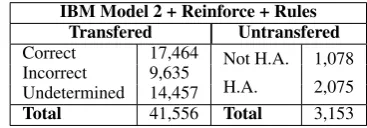
alignment models offer solution to our word align-ment problem. IBM Models are mainly used for statistical machine translation to train a transla-tion model and an alignment model. IBM Model 1 (Brown et al.,1993) is the primary word alignment model offered by IBM. It is widely used for solv-ing word alignments while worksolv-ing with parallel corpora. It is a generative probabilistic model that calculates probabilities for each word alignment from source sentence to target sentence. It takes a corpus of paired sentences from two languages as training data. These paired sentences are possible translation of the sentences from source language to target. With this training corpus, parameters of the model estimated using EM (expectation maxi-mization). IBM Model 2 has an additional model for alignment and introduce alignment distortion parameters. We decided to use IBM model 1 & 2 to establish word alignments instead of Word-Net’s interligual mapping. We input sentence pairs and gather alignment probabilities for each En-glish word to Turkish equivalent. 244,024 word pairs are taken as output where for each English word, 10 most probable Turkish words are listed. Alignment probabilities for word “Reserve” is pre-sented in Table 3 and4 for IBM Model 1 and 2 respectively.
After gathering alignment data, we transfer an-notations to phrase sentences from English Prop-Bank labels in the tree structured sentences. All
English Word Turkish Word Probability Reserve Reserve 0.72270917 Reserve Rezerv 0.15328414 Reserve mevduat 0.03056293 Reserve Bankası’nın 0.02731664 Reserve kurulus¸larındaki 0.01375332 Reserve komisyonları 0.01375332 Reserve Bankasının 0.00611259 Reserve kurulus¸larında 0.00458444 Reserve komisyon 0.00458444 Reserve Federe 0.00458444
Table 3: Word alignment probabilities for English word ”Reserve” calculated by IBM Model 1.
English Word Turkish Word Probability Reserve Reserve 0.67700755 Reserve Rezerv 0.14360766 Reserve Federe 0.06154614 Reserve Bankası 0.05265972 Reserve tasarruf 0.03072182 Reserve kurulus¸larına 0.02117394 Reserve ¨uzerindeki 0.01111856 Reserve bu 0.00212005 Reserve kurumlarına 0.00004452 Reserve Merkez 0.00000002
Table 4: Word alignment probabilities for English word ”Reserve” calculated by IBM Model 2.
words tagged with “PREDICATE” tag in English sentence are stored into a map which includes predicate label from the “englishPropbank” tag
e.g. “like 01” and English word from the “en-glish” tage.g. “like”. Then we search alignments for each found English predicate. Here we ob-served that aligned Turkish words may not occur in the phrase sentence as they found in the align-ment table. Words may include additional suffixes, so we use Finite State Machine(FSM) morpholog-ical analyzer available in our NLP Toolkit of Ak et al. (2018) to extract roots of the aligned Turkish words. Since we have several possible morpho-logical parse for each aligned word, we created an array for possible roots. In parallel, we found predicate candidates from the phrase sentence as we stated in the previous methods. Then we tried to match aligned words and possible roots with the found predicate candidates. If there exists a predi-cate candidate that matches with the aligned word or one of its roots in the array, we tagged the can-didate as “PREDICATE” and update map as pred-icate label and synset id of Turkish predpred-icate.
Turk-be checked quickly by the annotators and proposi-tion bank reach the final state.
References
Meyers A., R. Reeves, C. Macleod, R. Szekely, V. Zielinska, B. Young, and R. Grishman. 2004. The nombank project: An interim report. In HLT-NAACL 2004 Workshop: Frontiers in Corpus Anno-tation. Association for Computational Linguistics, Boston, Massachusetts, USA, pages 24–31.
K. Ak, O. T. Yıldız, V. Esgel, and C. Toprak. 2018. Construction of a Turkish proposition bank. Turk-ish Journal of Electrical Engineering and Computer Science26:570 – 581.
A. Akbik, L. Chiticariu, M. Danilevsky, Y. Li, S. Vaithyanathan, and H. Zhu. 2015. Generating high quality proposition banks for multilingual se-mantic role labeling. In ACL (1). The Association for Computer Linguistics, pages 397–407.
C. Bonial, J. Bonn, K. Conger, J. D. Hwang, and M. Palmer. 2014. Propbank: Semantics of new predicate types. In Proceedings of the Ninth In-ternational Conference on Language Resources and Evaluation (LREC-2014). European Language Re-sources Association (ELRA).
P. F. Brown, V. J. D. Pietra, S. A. D. Pietra, and R. L. Mercer. 1993. The mathematics of statistical ma-chine translation: Parameter estimation. Comput. Linguist.19(2):263–311.
G. G. S¸ahin. 2016a. Framing of verbs for turkish prop-bank. InTurCLing 2016 in conj. with 17th Interna-tional Conference on Intelligent Text Processing and Computational Linguistics (CICLING 2016).
G. G. S¸ahin. 2016b. Verb sense annotation for turkish propbank via crowdsourcing. In17th International Conference on Intelligent Text Processing and Com-putational Linguistics (CICLING 2016).
G. G. S¸ahin and E. Adalı. 2017. Annotation of seman-tic roles for the Turkish proposition bank. Language Resources and Evaluation.
R. Ehsani, E. Solak, and O. T. Yıldız. 2018. Construct-ing a wordnet for Turkish usConstruct-ing manual and auto-matic annotation.ACM Transactions on Asian Low-Resource Language Information Processing17(3).
C. J. Fillmore, J. Ruppenhofer, and Collin F. Baker. 2004. FrameNet and Representing the Link be-tween Semantic and Syntactic Relations, Institute of Linguistics, Academia Sinica, Taipei, pages 19–62. Language and Linguistics Monographs Series B.
P. Kingsbury and M. Palmer. 2002. From treebank to propbank. InLREC. European Language Resources Association.
P. Kingsbury and M. Palmer. 2003. Propbank: The next level of treebank. InProceedings of Treebanks and Lexical Theories. V¨axj¨o, Sweden.
M. Kozhevnikov and I. Titov. 2013. Cross-lingual transfer of semantic role labeling models. In ACL (1). The Association for Computer Linguistics, pages 1190–1200.
M. P. Marcus, M. A. Marcinkiewicz, and B. Santorini. 1993. Building a large annotated corpus of en-glish: The penn treebank. Computational linguistics 19(2):313–330.
M. Palmer, D. Gildea, and P. Kingsbury. 2005. The proposition bank: An annotated corpus of semantic roles.Comput. Linguist.31(1):71–106.
M. Palmer, P. Kingsbury, O. Babko-Malaya, S. Cotton, and B. Snyder. 2004. Proposition bank i. Philadel-phia: Linguistic Data Consortium. LDC2004T14.
L. Van der Plas, M. Apidianaki, and C. Chen. 2014. Global methods for cross-lingual semantic role and predicate labelling. InCOLING. ACL, pages 1279– 1290.
L. Van der Plas, P. Merlo, and J. Henderson. 2011. Scaling up automatic cross-lingual semantic role an-notation. In ACL (Short Papers). The Association for Computer Linguistics, pages 299–304.