1247
Exploiting Frame Semantics and Frame-Semantic Parsing for Automatic
Extraction of Typological Information from Descriptive Grammars of
Natural Languages
Shafqat Mumtaz Virk1, Azam Sheikh Muhammad2, Lars Borin3, Muhammad Irfan Aslam4, Saania Iqbal5, and Nazia Khurram6
1,3Språkbanken, University of Gothenburg, Sweden{shafqat.virk, lars.borin}@svenska.gu.se
2Department of CS & Eng., Chalmers University of Technology, Sweden,[email protected]
4University of Skövde, Sweden,[email protected]
5,6GIFT University, Pakistan,[email protected], [email protected]
Abstract
We describe a novel system for automatic extraction of typological linguistic infor-mation from descriptive grammars of nat-ural languages, applying the theory of frame semantics in the form of frame-semantic parsing. The current proof-of-concept system covers a few selected lin-guistic features, but the methodology is general and can be extended not only to other typological features but also to de-scriptive grammars written in languages other than English. Such a system is ex-pected to be a useful assistance for au-tomatic curation of typological databases which otherwise are built manually, a very labor and time consuming as well as cog-nitively taxing enterprise.
1 Introduction
There are more than 7,000 living languages in the
world and grammatical descriptions1are available
for some 4,000 of these (Seifart et al., 2017). A
central concern of the academic discipline of lin-guistics is to classify languages along different dimensions. The subbranch of linguistics which deals with classification and comparison of lan-guages based on their structural and functional
characteristics is known aslinguistic typology(or
typological linguistics. In addition to comparing the world’s languages, practitioners of linguistic typology aim to explore the distribution of vari-ous structural and functional patterns among lan-guages and to explain them in historical and/or
universal terms. (Song,2010)
1Grammatical descriptions are plain text descriptions of
various phonological, morphological, and syntactic charac-teristics of languages.
To achieve its goals, typological linguistics has relied largely on manual reading of available de-scriptive material about languages for the extrac-tion of pertinent feature values for comparison of these across languages. For example, in their sen-tence structure, different languages favor different word orders (e.g. subject-object-verb, verb-object-subject, or object-verb-verb-object-subject, etc). If word order is to be used as one structural feature for language comparison, the word order of all the languages to be compared has to be found out manually by reading available material on those languages. This is doable, if the scope of comparison is to be limited to a few features spanning across a few lan-guages. If one aims to extend the scope from a few to a few hundred features spanning across thou-sands of languages, the manual reading and com-parison strategy seems simply unfeasible. With the availability of large amounts of digital data, and the recent advances in natural language process-ing, automatic extraction of typological features from grammatical descriptions seems a plausible task.
There have already been a few attempts to au-tomatically extract typological and other
linguis-tic information from descriptive grammars (Virk
et al., 2017;Borin et al., 2018). In these studies, the authors have reported simple pattern match-ing and syntactic parsmatch-ing based approaches, and have shown that their strategy is useful, yield-ing reasonable precision and recall values. Even though simple pattern matching based systems are easy to comprehend, implement, and main-tain, they require a deep understanding of the rules/patterns which may not be very obvious in certain cases. Further, such systems are heuristics
based and also require a large manual effort (
Figure 2: Frame annotations
# Documents # Sentences # Frames # Frame Elements
66 3,926 7,080 4,599
Table 2: Annotated data statistics
this paper, and will be reported on in a separate publication.
4.2 Feature Selection and Training Data Generation
To train machine learning based classification models, the first task is to define a useful set of features, and then compute the feature values from the training data. The area of frame-semantic pars-ing is well researched meanpars-ing that a set of suit-able features both for the frame-element identifi-cation and frame-element classifiidentifi-cation tasks have
previously been explored (Johansson and Nugues,
2008; Das et al., 2014). Since our objective in this work is not to improve frame-semantic ing, but rather to show how frame-semantic pars-ing can be exploited to extract lpars-inguistic features from descriptive grammars, we have opted to use
the same feature set as described byJohansson and
Nugues(2008).
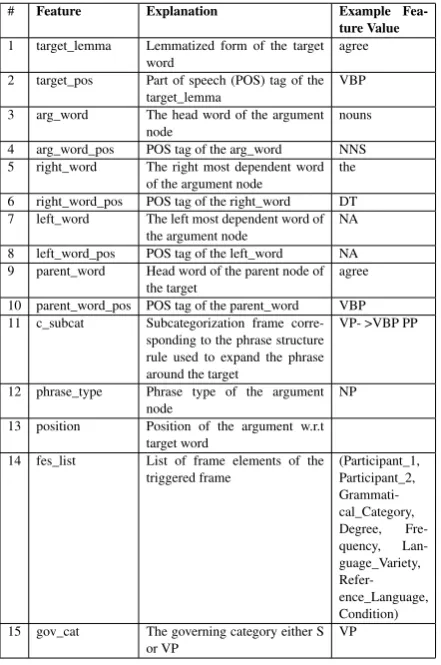
While a detailed explanation of the features can
be found inJohansson and Nugues(2008), Table5
lists15 features used for training both the
frame-element identification and frame-frame-element classifi-cation models. The procedure for generating the training instances and computing the features val-ues is as follows: Each sentence of the train-ing data set was parsed ustrain-ing the Stanford
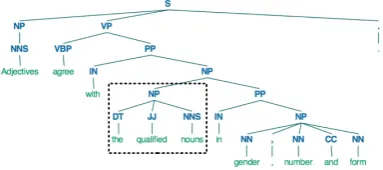
con-stituency parser (Manning et al., 2014) resulting
into parse trees as shown in Figure 3. Each node
of the tree is then taken as one training instance and the required feature values are computed. The
features values given in the last column of Table5
were computed for the NP node referring to the
qualified nouns(the one enclosed within the dotted area) as the argument node (i.e. the frame-element
node) and withagreeas the target word (i.e. frame
triggering word). When computing for the whole
tree, if a given argument node has been annotated as a frame element in the annotation the computed feature vector will get ‘Y’ as its class label, and ‘N’ otherwise resulting into the type of training
instances shown in Table3, and making it a binary
classification task.
For the frame-element classification task, the objective is not to learn whether an argument node is a frame element or not, but rather to learn the frame-element label for all the annotated nodes (a multi-class classification task). The training data for the frame-element classification task was gen-erated by going through all the nodes in the parse tree (as above), but this time only keeping those nodes which have been annotated as frame
el-ements together with their label. Table 4 below
shows a few instances from the generated frame-element classification data set.
Figure 3: Example parse tree
The described procedure resulted into a set of 197,313 training instances for the frame-element identification task, and 11,904 training instances for the frame-element classification task. After re-moval of duplicates, 81,878 instances were left. Out of these, 76,036 (92.86%) were labeled ‘Y’, and the remaining 5,842 (7.14%) were labeled ‘N’.
After removing duplicates, 5,855 cases were available for the frame-element classification task, covering 49 different classes of frame elements.
For the frame identification task, a simple dic-tionary lookup based approach was preferred at this stage simply because there are not many frames in the LingFN, indicating that frame dis-ambiguation is rarely required. In future, we in-tend to train model for this task as well.
4.3 Data Representation
All of the variables in both of the datasets are the same, except that they differ on the possible set
of values for the target variable,label. However,
Model Accuracy Precision Recall F_score Decision Tree 0.789 0.56 0.542 0.786
Logistic Regression 0.817 0.619 0.545 0.808
Naïve Bayes 0.528 0.481 0.489 0.537
Support Vector Machine 0.465 0.019 0.04 0.295
Table 7: Model comparison for the frame-element classification dataset using one hot encoding
The best performing logistic regression models were selected and used in the typological feature extraction system described in the next section.
5 Topological Feature Extraction System
Figure 4 shows the complete architecture of the
typological feature extraction system. As shown (the middle part within dotted area), the system takes a descriptive grammar in raw form and an-notate it with LingFN frames using the pre-trained models both for the frame-element identification and frame-element classification tasks (i.e. the part above the dotted area). The annotated data is fur-ther processed with a simple rule based module to convert those annotations to typological feature values (i.e. the part below the dotted area). Lets take an example to explain this part in particular, and the overall purpose of such a system in gen-eral.
Figure 4: System architecture
Suppose we are interested in finding an answer to the question “What is the order of adjective and
noun in the noun phrase” for the Siyin6language.
The LSI data set contains a grammatical descrip-tion of this language, and one of the sentences in
6A Tibeto-Burman language spoken in southern Tedim
township, Chin State, Burma. Also known as Siyin Chin and Sizang Chin, ISO 639-3: csy
that description isThe adjectives follow the noun
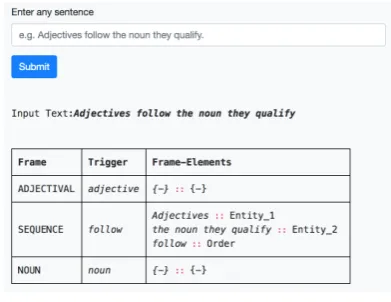
they qualify. Automatic parsing of this sentence using the developed LingFN parser will result into
the annotations shown in Figure 5 (a screenshot
from the web demo of the parser).
Figure 5: Automatic frame annotation
This parse contains the answer to the above
asked question. However, the typological
databases often record answers in a specific format. For example, the answer to the above question could be required to be of one of these values ‘NA’, ‘AN’, or ‘Both’ meaning that the order is ‘Adjective-Noun’, ‘Noun-Adjective’, or ‘Both’ respectively. If required, the above given parse information can be converted into specific feature values using a simple rule-based module such as given below (only a part of the full module is shown). The module simply checks the contents of different frame elements to formulate the feature value.
Using the same sort of procedure and the frames
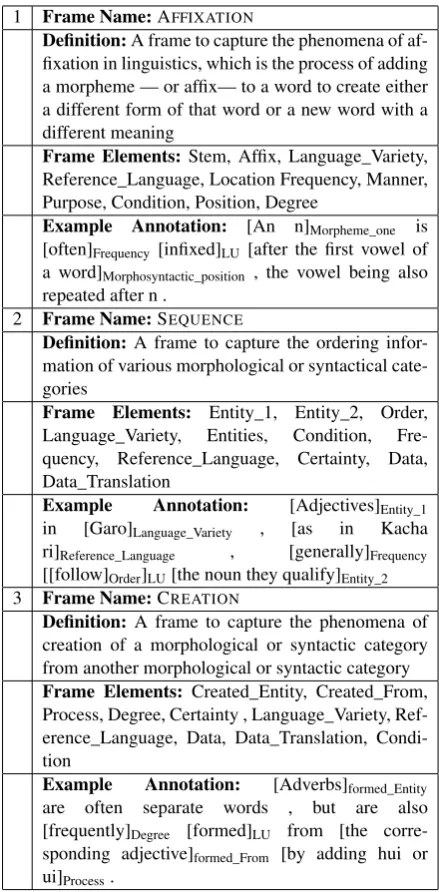
mentioned in Section 3, we have targeted to
ex-tract and formulate values for some of the
typo-logical features given in the Grambank7and other
typological databases. A few of these features are given below.
• Can an adnominal property word agree with
the noun in gender/noun class?
• Can an article agree with the noun in
gen-der/noun class?
• Can an article agree with the noun in
num-ber?
• Can the relative clause precede the noun?
7A typological database: https://github.com/
Tiago Timponi Torrent, Maria Margarida Martins Sa-lomão, Ely Edison da Silva Matos, Maucha Andrade Gamonal, Júlia Gonçalves, Bruno Pereira de Souza, Daniela Simões Gomes, and Simone Rodrigues Peron-Corrêa. 2014. Multilingual lexicographic an-notation for domain-specific electronic dictionaries: The Copa 2014 FrameNet Brasil project. Construc-tions and Frames6(1):73–91.
Shafqat Virk, Lars Borin, Anju Saxena, and Harald Hammarström. 2017. Automatic extraction of ty-pological linguistic features from descriptive gram-mars. InProceedings of TSD 2017. Springer, Cham, pages 111–119.
Dekai Wu and Pascale Fung. 2009. Semantic roles for
SMT: A hybrid two-pass model. In Proceedings
of HLT-NAACL 2009. ACL, Boulder, pages 13–16.