O R I G I N A L R E S E A R C H
Comparative Performance of Creatinine-Based
GFR Estimation Equations in Exceptional
Longevity: The Rugao Longevity and Ageing Study
This article was published in the following Dove Press journal: Clinical Interventions in Aging
Mengjing Wang1,2,* Xuehui Sun3,* Li Ni1
Minmin Zhang1 Jiaying Zhang4 Guoxin Ye1 Li Jin2,3
Xiaofeng Wang2,3 Jing Chen1,2
1Nephrology, Huashan Hospital, Fudan
University, Shanghai, People’s Republic of China;2National Clinical Research Center for Aging and Medicine, Huashan Hospital, Fudan University, Shanghai, People’s Republic of China;3State Key Laboratory of Genetic Engineering and Ministry of Education Key Laboratory of Contemporary Anthropology, School of Life Sciences, Fudan University, Shanghai, People’s Republic of China;4Nutrition, Huashan Hospital, Fudan University, Shanghai, People’s Republic of China
*These authors contributed equally to this work
Purpose: Reduced kidney function has been associated with an increased risk for adverse outcomes. Accurate assessment of glomerular filtration rate (GFR) is key to diagnosis and management of kidney disfunction. Debate exists on the best GFR estimation equation for elderly people. This study aimed to compare the predictive validity and discriminative ability of four GFR equations in relation to 2-year and 6-year mortality in exceptional longevity (EL) (those over 95 years old with intact health) individuals and is an ideal model to address factors relating to life span and age-related diseases.
Patients and Methods:This study used 6 years’data of 278 EL from the Rugao longevity cohort. Baseline GFR was estimated using four equations: Chronic Kidney Disease Epidemiology Collaboration (CKD-EPI) equation, Modification of Diet in Renal Disease Study (MDRD) equation, Berlin Initiative Study-1 (BIS) equation, and modified MDRD equation. Predictive validity was tested using Cox proportional hazards analysis. Overall improvement in reclassification based on estimated GFR (eGFR) was assessed applying net reclassification improvement (NRI).
Results: Mean age of participants was 97±2 years with median follow-up of 2.6 years. Median (IQR) eGFR by CKD-EPI, MDRD, BIS, and modified MDRD equations were 73.9 (62.2–77.6), 82.3 (67.4–98.6), 56.4 (47.9–63.9), and 101.5 (83.1–121.6) mL/min per 1.73 m2, respectively. Higher eGFREPIwas associated with lower mortality after multivariate
adjustment (for continuous eGFREPI, HRtwo-year 1.018, 95% CI 1.002–1.033, P=0.023;
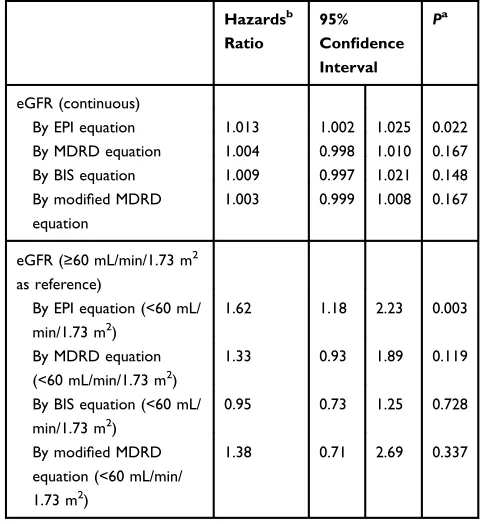
HRsix-year1.013, 95% CI 1.002–1.025,P=0.022), while eGFR from other equations did not
show any associations with mortality. NRI for two-year mortality was 0.14 and approxi-mately significant, which may favor the CKD-EPI when compared to BIS equation (P=0.052).
Conclusion:The CKD-EPI equation showed more accurate estimation of kidney function in the elderly with respect to GFR distribution and predictability of mortality risk.
Keywords: glomerular filtration rate, kidney function, equation, exceptional longevity, mortality
Introduction
Over the past two decades, China’s population has been aging rapidly. The
popula-tion aged over 80 years has reached 23 million.1According to Centers for Disease
Control and prevention (CDC) of the US, of those born in the year 2000, at least 15% of men and 20% of women are projected to reach the age of 90 years,
presenting a major challenge for health care systems.2,3 Older adults suffer high
rates of reduced kidney function which may occur as part of the normal ageing
Correspondence: Jing Chen; Xiaofeng Wang
Email [email protected]; [email protected]
Clinical Interventions in Aging
Dove
press
open access to scientific and medical research
Open Access Full Text Article
Clinical Interventions in Aging downloaded from https://www.dovepress.com/ by 118.70.13.36 on 24-Aug-2020
process or be related to comorbid disease.4,5 Glomerular
filtration rate (GFR) is the best measure of kidney
func-tion. It is reported that 62.2% of those aged 80 and older
had GFR < 60 mL/min/1.73 m2in NHANES 1999–2002
surveys, and this prevalence of reduced GFR in the United States is still going to increase in future decades.6,7
Attention should be paid to GFR decrease in older individuals since reduced GFR has been associated with an increased risk for adverse outcomes including
dis-ability, cardiovascular disease (CVD), and mortality.8–12
Thus, accurate GFR assessment is key to the diagnosis and management of kidney disfunction. The real GFR can be directly measured by the clearance of exogenous
filtration markers (eg, inulin and iohexol), however, due
to inconvenience of this measurement, GFR is always estimated by a series of equations using serum creati-nine which results in estimated GFR (eGFR). The eGFR
in older patients is based on equations largely
derived from young adults including Epidemiology
Collaboration (CKD-EPI) equation and Modification of
Diet in Renal Disease (MDRD) Study equation. There is a less frequently used Berlin Initiative Study (BIS) equation which was developed from older people, aged
70+ years.13–15 Until now, debate has continued with
regards to which equation is superior in elderly indivi-duals (mostly 70 to 85 years old) based on comparison with gold standard measurements or based on mortality
prediction.16–19 The underlying reason for diverse
results may be related to the population they used, either people admitted to hospital or the elderly in the com-munity with different comorbidities.
Exceptional longevity refers to those who survive to an advanced old age (EL, 95 years old and over) with intact health or function. EL is an ideal model to address factors that are related to life span and age-related diseases and, therefore, targeted prevention and
health promotion.20 Thus in this study, we aimed to
screen the best GFR estimation equation for the elderly by comparing the predictive validity and discriminative ability of four commonly used and creatinine-based equations: the CKD-EPI equation, the MDRD study
equation, the BIS equation, and the modified MDRD
equation in relation to short-term (two-year) and long-term (six-year) mortality using data from a prospective cohort of community-dwelling EL people and to further investigate the distribution of GFR in these individuals with healthy aging.20,21
Materials and Methods
Study Population
We extracted, refined, and examined data from 278
long-lived individuals enrolled in the Rugao longevity cohort, a population-based prospective study conducted between December 2007 and February 2008 in Rugao city of Jiangsu Province in China. Individuals in this study were
followed through April, 2014.20 Details regarding the
cohort are provided elsewhere.20 Briefly, after strict
four-step age verifications, 705 persons aged over 95 years (149
men and 556 women) including 102 centenarians, were
identified in Rugao city. Of them, 463 (103 men and 360
women) participants were recruited, with a response rate
of 65.7%. No significant difference in age and gender was
found between non-responders and responders according
to a previous study of Rugao longevity cohort.22 Of the
463 individuals, we excluded 177 individuals who had missing baseline data on serum creatinine; 7 individuals who were lost to follow-up, and 1 who was diagnosed with
cancer during recruitment of the cohort (Supplementary
Figure S1). Ourfinal study population consisted of 278 EL individuals. This study was approved by the Human Ethnics Committee of the School of Life Sciences of Fudan University, Shanghai, China. The ID number of the approval was 278. Written informed consent was obtained from each participant or a member of his or her immediate family prior to participation.
Demographic, Clinical, and Laboratory
Measures
A structured questionnaire was administered by trainedfield
staff that delved into areas including demographic charac-teristics, histories of chronic disease (eg, cardiovascular disease, cerebrovascular disease, hypertension, chronic obstructive pulmonary disease, malignancy), functional sta-tus (measured by activities of daily living (ADL)), and medications. Physical examinations were also performed by the trained staff. All interviews were tape-recorded, and 5% of the recorded interviews were evaluated for
interviewing quality.20
The Katz Index, which was based on six daily tasks: eating, dressing, bathing, indoor transferring, going to the toilet and cleaning oneself afterwards, was used to assess
ADL in this study.23 Each task has the following three
response alternatives: strongly independent, somewhat dependent, and strongly dependent, with a score of 1, 2, and 3 points, respectively. Lower scores indicated better
Clinical Interventions in Aging downloaded from https://www.dovepress.com/ by 118.70.13.36 on 24-Aug-2020
functional status. Based on the total summed scores, a nominal variable with three categories of functional
disability, “none” (total score=6), “moderate” (total
score=7–9),“severe”(total score≥10), was constructed.24
Fasting blood samples were drawn using uniform tech-niques for laboratory examination at recruitment for the study. All laboratory values were measured using Olympus AU5811 clinical chemistry analyzer (Tokyo, Japan) with standard laboratory techniques (performed by a technician in the biochemistry laboratory of Jiangsu Rugao Hospital of Traditional Chinese Medicine).
Outcome Assessment
Dates of death were obtained through the Bureau of Civil Affairs of Rugao. Survival time (in months) was calculated from February 2008 to the date of death or of censoring on April 2014. The Bureau of Civil Affairs in Rugao is respon-sible for providing pensions for persons aged 80 years or over every month. The penalty for any family trying to conceal the death of an elderly family member is high.
Estimation of GFR
Serum creatinine concentration was measured according to an enzymatic method with the Cica Creatinine reagent (KANTO Chemical, Tokyo, Japan) and Hitachi 7600 ana-lyzer (Hitachi, Tokyo, Japan). We calculated eGFR using the following 4 equations:
1. eGFRMDRD=175 × (serum creatinine [mg/dL])−1.154
× age−0.203× (0.742 if female)25,26
2. eGFREPI =144 × (serum creatinine [mg/dL]/
0.7)−0.329 × (0.993)Age if female and serum
creati-nine ≤0.7) or eGFREPI =144 × (serum creatinine
[mg/dL]/0.7)−1.209 × (0.993)Age if female and
serum creatinine >0.7) or eGFREPI =141 × (serum
creatinine [mg/dL]/0.9)−0.411 × (0.993)Age if male
and serum creatinine ≤0.9) or eGFREPI =141 ×
(serum creatinine [mg/dL]/0.9)−1.209 × (0.993)Age
if male and serum creatinine >0.9)14
3. eGFRBIS=3736 × (serum creatinine [mg/dL])−0.87×
age−0.95× (0.82 if female)15
4. eGFRmodified MDRD =175 × (serum creatinine [mg/
dL])−1.154× age−0.203× (0.742 if female) × (1.233 if
Chinese).21 We changed the coefficient of 186 to
175 based on the calibration factor used to adjust non-standardized MDRD study samples to isotope
dilution mass spectrometry (IDMS).25
Statistical Analyses
Continuous variables of patients’ characteristics were
expressed as mean ± standard deviation (SD), and catego-rical variables were expressed as percentages or ratios. eGFR was treated as continuous or categorical variables
with the cut-off value at 40, 60, and 80 mL/min/1.73 m2
according to the distribution of eGFR in longevity cohort. The association of eGFR with all-cause mortality was exam-ined by fully adjusted Cox proportional hazard models. We also examined potential non-linear relationships by using restricted cubic spline functions with four knots at the 5th, 35th, 65th, 95th percentile of each index and the reference
for eGFR was 80 mL/min/1.73 m2. The fully adjusted model
included age, gender, marital status, education, smoking, ADL, body mass index (BMI), hypertension, cardiovascular disease, cerebrovascular disease, chronic obstructive pul-monary disease, systolic blood pressure, serum albumin, and serum low-density lipoprotein cholesterol (LDL-C).
To assess reclassification, we created a 4 × 4
cross-tabulation of the eGFREPIand the eGFRMDRDor eGFRBIS
or eGFRmodified MDRDcategories, calculated the proportion
of participants reclassified by eGFREPIin each category of
eGFRMDRD or eGFRBIS or eGFRmodified MDRD, and
assessed whether risk of death differed between
partici-pants reclassified and those not reclassified. Overall
improvement in reclassification based on clinical
eGFREPIcategories was assessed applying net reclassifi
ca-tion improvement,27,28which was calculated as follows:
Net reclassification improvement (NRI) = clinically
cor-rect reclassification (proportion of participants reclassified
upward among those who died + proportion of participants
reclassified downward among those who survived) -
clini-cally incorrect reclassification (proportion of participants
reclassified upward among those who survived + proportion
of participants reclassified downward among those who died)
Differences in baseline characteristics between included
versus excluded patients were compared by Student’st-test
or X2test. The frequency of missing data was low [<1], and
multiple imputation methods withfive data-sets were used in
all regression analyses (Supplementary Table S10).
Analyses were conducted using STATA MP version 13.1 (StataCorp, College Station, TX).
Results
Characteristics of the Study Population
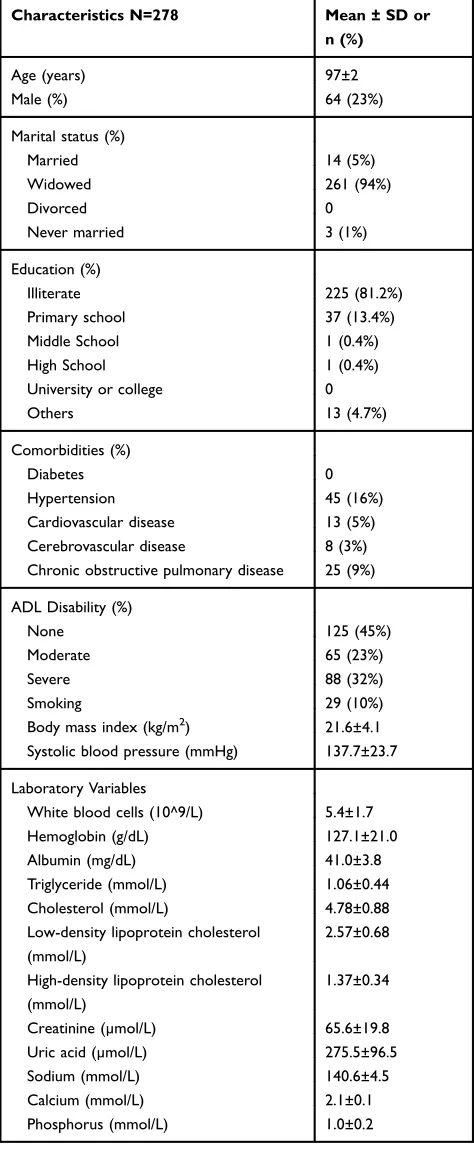
Table 1shows the demographic and clinical characteristics of participants. The mean±SD age was 97±2 years. TheClinical Interventions in Aging downloaded from https://www.dovepress.com/ by 118.70.13.36 on 24-Aug-2020
mean±SD BMI was 21.6±4.1 kg/m2. The participants were more likely to be women (77%), widowed (94%), and illiterate (81%). Mean serum baseline hemoglobin, albu-min, and creatinine levels were 127.1±21.0 g/dL, 41.0
±3.8 mg/dL, and 65.6±19.8 µmol/L, respectively
(Table 1). A total of 256 (92%) participants died during
the median follow-up of 2.6 years (IQR, 1.2–4.1 years)
with an incidence of 33 deaths per 100 person-years. Compared to 185 excluded persons who lacked data on serum creatinine, 278 included persons were more likely to smoke, had lower albumin, and had higher LDL-C and
calcium (Supplementary Table S1).
Distribution of eGFR by CKD-EPI
Equation, MDRD Study Equation, BIS
Equation, and Modi
fi
ed MDRD Equation
Median (IQR) eGFR by CKD-EPI, MDRD study, BIS
equation, and modified MDRD equations were 73.9
(62.-2–77.6), 82.3 (67.4–98.6), 56.4 (47.9–63.9), and 101.5
(83.1–121.6) mL/min per 1.73m2, respectively. The
distri-bution of eGFREPI and eGFRBIS were more concentrated
and on the left side of the axis, while the distribution of
eGFRMDRD and eGFRmodified-MDRD were more dispersed
and on the right side (Figure 1). The prevalence of chronic
kidney disease (CKD) stage 3–5 (defined as eGFR <
60 mL/min/1.73 m2) at baseline were 23%, 16%, 63%
and 4% by CKD-EPI equation, MDRD equation, BIS
equation, and modified MDRD equation, respectively.
Table 1Baseline Characteristics of the Rugao Longevity Population
Characteristics N=278 Mean ± SD or
n (%)
Age (years) 97±2
Male (%) 64 (23%)
Marital status (%)
Married 14 (5%)
Widowed 261 (94%)
Divorced 0
Never married 3 (1%)
Education (%)
Illiterate 225 (81.2%)
Primary school 37 (13.4%)
Middle School 1 (0.4%)
High School 1 (0.4%)
University or college 0
Others 13 (4.7%)
Comorbidities (%)
Diabetes 0
Hypertension 45 (16%)
Cardiovascular disease 13 (5%) Cerebrovascular disease 8 (3%) Chronic obstructive pulmonary disease 25 (9%)
ADL Disability (%)
None 125 (45%)
Moderate 65 (23%)
Severe 88 (32%)
Smoking 29 (10%)
Body mass index (kg/m2) 21.6±4.1 Systolic blood pressure (mmHg) 137.7±23.7
Laboratory Variables
White blood cells (10^9/L) 5.4±1.7
Hemoglobin (g/dL) 127.1±21.0
Albumin (mg/dL) 41.0±3.8
Triglyceride (mmol/L) 1.06±0.44 Cholesterol (mmol/L) 4.78±0.88 Low-density lipoprotein cholesterol
(mmol/L)
2.57±0.68
High-density lipoprotein cholesterol (mmol/L)
1.37±0.34
Creatinine (µmol/L) 65.6±19.8
Uric acid (µmol/L) 275.5±96.5
Sodium (mmol/L) 140.6±4.5
Calcium (mmol/L) 2.1±0.1
Phosphorus (mmol/L) 1.0±0.2
Notes:Values are expressed as mean ± SD or number (percent). Conversion factors for units: LDL-C and HDL-C in mmol/L to mg/dL, ×38.67; triglycerides in mmol/L to mg/dL, ×88.6; creatinine in µmol/L to mg/dL, ×0.01131; eGFR in mL/min/ 1.73m2to mL/s/1.73 m2, ×0.01667.
Figure 1Kernel density estimates of eGFR by four equations in Rugao longevity population.
Clinical Interventions in Aging downloaded from https://www.dovepress.com/ by 118.70.13.36 on 24-Aug-2020
High discrepancy of eGFR by 4 equations was seen after
GFR of approximate 80 mL/min/1.73 m2 where much
higher GFR values were obtained by MDRD and modified
MDRD equations compared to CKD-EPI and BIS
equa-tions (Supplementary Figure S2).
Prognostic Value of eGFR
EPI, eGFR
MDRD,
eGFR
BIS, and eGFR
modified-MDRDfor
Short-Term and Long-Term Mortality
Figure 2 shows the Kaplan–Meier curve for overall six-year survival of groups with eGFR higher or less than60 mL/min/1.73 m2. Those with eGFREPI higher than
60 mL/min/1.73 m2 had a statistically significant higher
survival rate compared to those with eGFREPI less than
60 mL/min/1.73 m2 (P=0.02 for CKD-EPI equation)
(Figure 2). After adjusting for case-mix and laboratory
variables, reduced eGFREPI was significantly associated
with two-year and six-year mortality (for continuous
eGFREPI, two-year estimates: HR 1.018, 95% CI 1.002–
1.033, P=0.02; six-year estimates: HR 1.013, 95% CI
1.002–1.025,P=0.02); however, GFR estimated by three
other equations did not show any significant association
with all-cause mortality (Tables 2 and 3, Supplementary
Table S8, S9). Models using spline functions yielded con-sistent results in which a trend toward lower mortality risk across higher eGFR was observed when GFR was
esti-mated by CKD-EPI equation (Figures 3 and 4). Cox
regression analysis was also carried out by considering
eGFR > 60 mL/min/1.73 m2as a reference category, and
it showed that reduced kidney function (eGFR < 60 mL/
min/1.73 m2) estimated by only CKD-EPI was signifi
-cantly associated with increased two-year and six-year
mortality (Tables 2and3).
Net Reclassi
fi
cation Improvement
The detailed table for calculating net reclassification
improvement for death based on eGFR categories is
shown in Supplementary Table S2–S7. During the
two-year follow-up, 61% (n=101) of 166 participants who did
not die were reclassified correctly to a lower risk (higher
eGFR) category by CKD-EPI equation compared to BIS equation. On the other hand, among 112 participants who
died during follow-up, 46% (n=52) were reclassified
incor-rectly to a lower risk (higher eGFR) group by CKD-EPI
equation (Supplementary Table S2). In sum, net
reclassi-fication improvement for death by the CKD-EPI equation
Figure 2Kaplan–Meier survival estimates and 95% confidence intervals for long term by GFR level using CKD-EPI (A), MDRD (B), BIS (C), and modified MDRD (D) equations.
Clinical Interventions in Aging downloaded from https://www.dovepress.com/ by 118.70.13.36 on 24-Aug-2020
compared to BIS equation was 0.14 (P=0.05). Results were obtained when comparing CKD-EPI equation with
MDRD equation or modified MDRD equation (EPI vs
MDRD, NRI=0.05, P=0.3; EPI vs modified MDRD,
NRI=0.002, P=0.5) (Supplementary Table S3–S4). The
NRI were 0.14 (P=0.4), −0.02 (P=0.5), and −0.05
(P=0.5) when comparing CKD-EPI equation with BIS,
MDRD, and modified MDRD equation using the six-year
follow-up data (Supplementary Table S5–S7).
Discussion
Overall, our results suggest that it might be more appro-priate to use the CKD-EPI equation when estimating GFR level in an elderly population according to its predictive validity and discriminative ability in relation to short-term and long-term mortality risk, in comparison to MDRD, BIS, and revised MDRD equation. Accordingly, ageing kidneys result in a decreased GFR with an average of
74 mL/min/1.73 m2 for extremely longevous population
aged over 95 years according to CKD-EPI equation, and intervention of reducing GFR decrease may still be neces-sary for improving survival. Though not all NRI results
support better overall reclassification by the CKD-EPI
equation, a larger sample size may be needed to further test our hypothesis.
It is well-known that kidney function has
a physiological decline in individuals without comorbid conditions and without intrinsic renal disease or protei-nuria. The magnitude of this decline has been reported as
an average of 0.75 mL/min per year.29Comparing against
previous studies which showed GFR by gold standard
method in older individuals,17,18,30the estimated value of
GFR from modified MDRD appeared less reasonable. This
may be attributed to the developing process of the tion by adding a racial factor based on the MDRD equa-tion in a cohort of younger CKD patients. In studies that evaluated accuracy of estimated GFR by equations with measured GFR in an older population, overestimation of GFR was often reported for MDRD and CKD-EPI
Table 2Adjusted Hazard Ratio (95% CI) for Short-Term (Two-Year), All-Cause Mortality According to Estimated GFR (eGFR) Determined by CKD-EPI or MDRD or BIS or Modified MDRD Equations
Hazardsb Ratio
95% Confidence Interval
Pa
eGFR (continuous)
By EPI equation 1.018 1.002 1.033 0.023 By MDRD equation 1.006 0.997 1.014 0.206 By BIS equation 1.011 0.995 1.029 0.176 By modified MDRD
equation
1.005 0.998 1.011 0.206
eGFR (≥60 mL/min/1.73 m2 as reference)
By EPI equation (<60 mL/ min/1.73 m2)
1.97 1.28 3.02 0.002
By MDRD equation (<60 mL/min/1.73 m2)
1.54 0.95 2.51 0.081
By BIS equation (<60 mL/ min/1.73 m2)
1.01 0.68 1.52 0.947
By modified MDRD equation (<60 mL/min/ 1.73 m2)
1.91 0.82 4.43 0.134
Notes:a
Adjusted for the following covariates: age, gender, marital status, educa-tion, smoking, body mass index, systolic blood pressure, serum albumin, low-density lipoprotein cholesterol, activities of daily living, hypertension, cardiovascular disease, cerebrovascular disease, chronic obstructive pulmonary disease.bEvery 1 mL/min/1.73 m2
decrease of GFR or compared to GFR≥60 mL/min/1.73 m2 . Abbreviations:CKD-EPI, Chronic Kidney Disease Epidemiology Collaboration; MDRD, Modification of Diet in Renal Disease Study; BIS, Berlin Initiative Study-1.
Table 3 Adjusted Hazard Ratio (95% CI) for Long-Term (Six-Year), All-Cause Mortality According to eGFR Determined by CKD-EPI or MDRD or BIS or Modified MDRD Equations
Hazardsb Ratio
95% Confidence Interval
Pa
eGFR (continuous)
By EPI equation 1.013 1.002 1.025 0.022 By MDRD equation 1.004 0.998 1.010 0.167 By BIS equation 1.009 0.997 1.021 0.148 By modified MDRD
equation
1.003 0.999 1.008 0.167
eGFR (≥60 mL/min/1.73 m2 as reference)
By EPI equation (<60 mL/ min/1.73 m2)
1.62 1.18 2.23 0.003
By MDRD equation (<60 mL/min/1.73 m2)
1.33 0.93 1.89 0.119
By BIS equation (<60 mL/ min/1.73 m2)
0.95 0.73 1.25 0.728
By modified MDRD equation (<60 mL/min/ 1.73 m2)
1.38 0.71 2.69 0.337
Notes:a
Adjusted for the following covariates: age, gender, marital status, educa-tion, smoking, body mass index, systolic blood pressure, serum albumin, low-density lipoprotein cholesterol, activities of daily living, hypertension, cardiovascular disease, cerebrovascular disease, chronic obstructive pulmonary disease.bEvery 1 mL/min/1.73 m2
decrease of GFR or compared to GFR≥60 mL/min/1.73 m2 . Abbreviations:CKD-EPI, Chronic Kidney Disease Epidemiology Collaboration; MDRD, Modification of Diet in Renal Disease Study; BIS, Berlin Initiative Study-1.
Clinical Interventions in Aging downloaded from https://www.dovepress.com/ by 118.70.13.36 on 24-Aug-2020
equations, with the bias of MDRD being slightly higher
than those observed in the CKD-EPI equation,15,18,30,31
especially at higher GFRs.15,32 In contrast,
underestima-tion of GFR was reported for BIS equaunderestima-tion.16–18 These
were in accordance with the current study which showed
GFR estimated by MDRD was higher than CKD-EPI and BIS equation, and greater discrepancy of eGFR was seen
after eGFR of approximate 80 mL/min/1.73 m2 where
MDRD and modified MDRD equations resulted in much
higher eGFR than CKD-EPI and BIS equations. The Figure 3Association of eGFR with short-term (2-year), all-cause mortality in fully adjusted model using splines in Rugao longevity population with GFR estimated by (A) CKD-EPI equation, (B) MDRD equation, (C) BIS equation, (D) modified MDRD equation.
Figure 4Association of eGFR with long-term (6-year), all-cause mortality in fully adjusted model using splines in Rugao longevity population with GFR estimated by (A) CKD-EPI equation, (B) MDRD equation, (C) BIS equation, (D) modified MDRD equation.
Clinical Interventions in Aging downloaded from https://www.dovepress.com/ by 118.70.13.36 on 24-Aug-2020
CKD-EPI equation includes two parts according to serum creatinine level which might avoid the resultant very high GFR in case of very low creatinine. This was especially important in older adults whose muscle mass may reduce
dramatically.14,33 Besides, The MDRD equation was
developed in CKD patients (mean GFR, 40 mL/min/
1.73 m2; mean age, 50.6),13 the external validation in
older individuals might not perform as well as CKD-EPI equation which was developed in a broader cohort with
better kidney function (68 mL/min/1.73 m2) and BIS
equation which was developed predominantly in cohorts of older people.14,15
To our knowledge, this is thefirst study which compared
the ability of different eGFR equations to predict short-term and long-term mortality in EL populations. Actually, CKD-EPI equation had already been shown to have improved risk prediction compared to MDRD equation in a large
commu-nity-based, middle-aged population.27,34 Though debate
exists around older populations, in some studies, they found creatinine-based BIS and MDRD equation was not superior to creatinine-based CKD-EPI equation for
predict-ing all-cause mortality.34–36 Here we demonstrated that
CKD-EPI was the only equation with ability of predicting mortality among EL populations when using Cox regression method. The assumption is that the mortality risk predicted by eGFR is based upon the impact on death by measured renal function. GFR estimated by CKD-EPI equation might be closer to measured renal function by gold standard method. It is more stable and less biased since the cohorts used to develop the CKD-EPI equation were larger, more
racially diverse and with broader range of age.14 Though
BIS equation was developed from European elderly
popula-tion, the single race draws into question BIS’ accuracy in
Asian people with different muscle compositions and diet-ary habits. Besides, the BIS equation tended to estimate
GFR lower than other equations. This helped to
reclassify those who died to more advanced GFR cate-gories, but may have, to a larger extent, inappropriately
reclassified those who survived to more advanced GFR
categories, giving less accurate outcome predictions.37
Thus, we also found that the NRI of CKD-EPI compared
with BIS was positive and with marginal significance. The
persistent predictive value of reduced eGFREPI in
short-term and long-short-term follow-up highlights the strengths of baseline renal function estimated by CKD-EPI equation as an important factor in risk-stratifying EL population. Since EL is an ideal model of healthy aging without various comorbidities that interfere with the association of GFR
and mortality, we believe CKD-EPI equation is superior to other equations for categorizing the risk for mortality in elderly population.
The mean GFR of the current study population esti-mated by BIS, CKD-EPI or MDRD equations was 5 to
10 mL/min/1.73 m2 higher than the averages reported in
previous studies for older people,6,16,38-43 perhaps due to
survival bias in our exceptional longevity setting.29People
with severe disease are more likely to die earlier. This phenomenon of compressed morbidity in centenarians compared to younger referent individuals was also seen in both the New England Centenarian Study (NECS) and
Longevity Genes Project (LGP) cohorts.44More than 80%
of the EL individuals had delayed or escaped most lethal diseases of the elderly population including heart disease,
non-skin cancer, and stroke.45Thus, we speculated that the
decrease of GFR in the current cohort was mostly due to physiological change. According to the low morbidity of
EL individuals, the declining rate of GFR in
healthy ageing, the accuracy of GFR estimated by CKD-EPI demonstrated in previous studies, and the conclusion, we found that GFR estimated by CKD-EPI was the
pre-dictor of mortality; the range of eGFR (IQR
62.2–77.6 mL/min/1.73 m2) by CKD-EPI equation might
be a reference of successful aging kidney function of EL population. Besides, intervention may not be needed if estimated GFRs are above or near this range. However,
future studies are needed to further verify thesefindings.
One of the strengths of the present study is the inclusion of a large community cohort of EL population followed prospectively over 6 years. To control for potential con-founding factors, results were adjusted for the main clinical conditions of elderly population associated with mortality. Moreover, we revealed again that the age-adapted CKD
definition should be changed to people without evidence of
kidney injury, especially for elderly people with healthy ageing. Some limitations of the present study should be mentioned. First, creatinine-based equation might affect accurate GFR estimation in EL individuals who suffer
from sarcopenia. However, mean BMI was 21.6±4.1 kg/m2
in our study which is very similar to the reported BMI of
elderly adults from Chinese community.46We speculate that
few participants suffered from sarcopenia. Second, the crea-tinine measured in the current study was measured using enzymatic method with the Cica Creatinine reagent and Hitachi 7600 analyzer which was not calibrated to the recognized Roche enzymatic method. Finally, proteinuria was not measured at baseline. Thus, we could not evaluate
Clinical Interventions in Aging downloaded from https://www.dovepress.com/ by 118.70.13.36 on 24-Aug-2020
eGFR and proteinuria simultaneously along with other fac-tors for the most accurate risk prediction.
Conclusion
In conclusion, GFR decreased in EL population with an
average of 74 mL/min/1.73 m2by CKD-EPI equation. The
CKD-EPI equation showed more accurate estimation of GFR in EL individuals with respect to predictability of mortality risk compared to the other equations, indicating greater clinical utility among older population in China.
Data Sharing Statement
Data were obtained by the staff and participants of the Rugao Longevity Cohort. Prof Xiaofeng Wang, one of our corresponding authors, would need to be emailed for available data.
Ethics Approval and Informed
Consent
This study was approved by the Human Ethnics Committee of the School of Life Sciences of Fudan University, Shanghai, China. Written informed consent was obtained from each participant or a member of his or her immediate family prior to participation.
Acknowledgments
We thank the staff and participants of the Rugao Longevity Cohort for providing the clinical data for this research.
Author Contributions
All authors made substantial contributions to conception and design, acquisition of data, or analysis and interpreta-tion of data; took part in drafting the article or revising it
critically for important intellectual content; gave final
approval of the version to be published; and agree to be accountable for all aspects of the work.
Disclosure
The authors declare that they have no conflict of interest.
References
1. Department of Economic and Social Affairs PD, United Nations. World Population Ageing.2015.
2. Arias E. United States life tables, 2000.Natl Vital Stat Rep.2002;51 (3):1–38.
3. Newman AB, Murabito JM. The epidemiology of longevity and exceptional survival. Epidemiol Rev. 2013;35(1):181–197. doi:10. 1093/epirev/mxs013
4. Fox CS, Larson MG, Leip EP, Culleton B, Wilson PW, Levy D. Predictors of new-onset kidney disease in a community-based population.JAMA.2004;291(7):844–850. doi:10.1001/jama.291.7.844 5. Stevens LA, Viswanathan G, Weiner DE. Chronic kidney disease and
end-stage renal disease in the elderly population: current prevalence, future projections, and clinical significance.Adv Chronic Kidney Dis. 2010;17(4):293–301. doi:10.1053/j.ackd.2010.03.010
6. Grams ME, Juraschek SP, Selvin E, et al. Trends in the prevalence of reduced GFR in the United States: a comparison of creatinine- and cystatin C-based estimates.Am J Kidney Dis.2013;62(2):253–260. doi:10.1053/j.ajkd.2013.03.013
7. Hoerger TJ, Simpson SA, Yarnoff BO, et al. The future burden of CKD in the United States: a simulation model for the CDC CKD initiative. Am J Kidney Dis. 2015;65(3):403–411. doi:10.1053/j. ajkd.2014.09.023
8. Lattanzio F, Corsonello A, Abbatecola AM, et al. Relationship between renal function and physical performance in elderly hospita-lized patients.Rejuvenation Res. 2012;15(6):545–552. doi:10.1089/ rej.2012.1329
9. Pedone C, Corsonello A, Bandinelli S, Pizzarelli F, Ferrucci L, Incalzi RA. Relationship between renal function and functional decline: role of the estimating equation. J Am Med Dir Assoc. 2012;13(1):84e11–84. doi:10.1016/j.jamda.2011.01.009
10. Matsushita K, van der Velde M, et al.; Chronic Kidney Disease Prognosis C. Association of estimated glomerularfiltration rate and albuminuria with all-cause and cardiovascular mortality in general population cohorts: a collaborative meta-analysis.Lancet.2010;375 (9731):2073–2081.
11. Tonelli M, Wiebe N, Culleton B, et al. Chronic kidney disease and mortality risk: a systematic review. J Am Soc Nephrol. 2006;17 (7):2034–2047. doi:10.1681/ASN.2005101085
12. O’Hare AM, Bertenthal D, Covinsky KE, et al. Mortality risk
strati-fication in chronic kidney disease: one size for all ages? J Am Soc Nephrol.2006;17(3):846–853. doi:10.1681/ASN.2005090986 13. Levey AS, Bosch JP, Lewis JB, Greene T, Rogers N, Roth D. A more
accurate method to estimate glomerularfiltration rate from serum creatinine: a new prediction equation. Modification of diet in renal disease study group. Ann Intern Med. 1999;130(6):461–470. doi:10.7326/0003-4819-130-6-199903160-00002
14. Levey AS, Stevens LA, Schmid CH, et al. A new equation to estimate glomerular filtration rate. Ann Intern Med. 2009;150 (9):604–612. doi:10.7326/0003-4819-150-9-200905050-00006 15. Schaeffner ES, Ebert N, Delanaye P, et al. Two novel equations to
estimate kidney function in persons aged 70 years or older. Ann Intern Med. 2012;157(7):471–481. doi:10.7326/0003-4819-157-7-201210020-00003
16. Fan L, Levey AS, Gudnason V, et al. Comparing GFR estimating equations using cystatin c and creatinine in elderly individuals. J Am Soc Nephrol. 2015;26(8):1982–1989. doi:10.1681/ASN. 2014060607
17. Vidal-Petiot E, Haymann JP, Letavernier E, et al. External validation of the BIS (Berlin initiative study)-1 GFR estimating equation in the elderly. Am J Kidney Dis. 2014;63(5):865–867. doi:10.1053/j. ajkd.2014.01.421
18. Lopes MB, Araujo LQ, Passos MT, et al. Estimation of glomerular
filtration rate from serum creatinine and cystatin C in octogenarians and nonagenarians. BMC Nephrol. 2013;14(1):265. doi:10.1186/ 1471-2369-14-265
19. Koppe L, Klich A, Dubourg L, Ecochard R, Hadj-Aissa A. Performance of creatinine-based equations compared in older patients.J Nephrol.2013;26(4):716–723. doi:10.5301/jn.500 0297
20. Cai XY, Wang XF, Li SL, et al. Association of mitochondrial DNA haplogroups with exceptional longevity in a Chinese population.PLoS One.2009;4(7):e6423. doi:10.1371/journal.pone. 0006423
Clinical Interventions in Aging downloaded from https://www.dovepress.com/ by 118.70.13.36 on 24-Aug-2020
21. Ma YC, Zuo L, Chen JH, et al. Modified glomerularfiltration rate estimating equation for Chinese patients with chronic kidney disease. J Am Soc Nephrol. 2006;17(10):2937–2944. doi:10.1681/ASN.20 06040368
22. Liu Z, Zhong G, Li S, et al. Use of serum albumin and activities of daily living to predict mortality in long-lived individuals over 95 years of age: a population-based study. Age (Dordr). 2015;37 (4):9809. doi:10.1007/s11357-015-9809-6
23. Katz S, Ford AB, Moskowitz RW, Jackson BA, Jaffe MW. Studies of illness in the aged. the index of Adl: a standardized measure of biologi-cal and psychosocial function. JAMA. 1963;185(12):914–919. doi:10.1001/jama.1963.03060120024016
24. Liu Z, Wang Y, Huang J, et al. Blood biomarkers and functional disability among extremely longevous individuals: a population-based study.J Gerontol a Biol Sci Med Sci.2015;70(5):623–627. doi:10.1093/ gerona/glu229
25. Levey AS, Coresh J, Greene T, et al. Expressing the modification of diet in renal disease study equation for estimating glomerularfi ltra-tion rate with standardized serum creatinine values. Clin Chem. 2007;53(4):766–772. doi:10.1373/clinchem.2006.077180
26. Levey ASGT, Kusek J, Beck G. A simplified equation to predict glomerularfiltration rate from serum creatinine [Abstract].J Am Soc Nephrol.2000;11:155A.
27. Matsushita K, Selvin E, Bash LD, Astor BC, Coresh J. Risk implications of the new CKD epidemiology collaboration (CKD-EPI) equation compared with the MDRD study equation for estimated GFR: the Atherosclerosis Risk in Communities (ARIC) study. Am J Kidney Dis. 2010;55(4):648–659. doi:10.10 53/j.ajkd.2009.12.016
28. Pencina MJ, D’Agostino RB Sr., D’Agostino RB Jr., Vasan RS. Evaluating the added predictive ability of a new marker: from area under the ROC curve to reclassification and beyond. Stat Med. 2008;27(2):157–172. (). doi:10.1002/sim.2929
29. Lindeman RD, Tobin J, Shock NW. Longitudinal studies on the rate of decline in renal function with age.J Am Geriatr Soc. 1985;33 (4):278–285. doi:10.1111/j.1532-5415.1985.tb07117.x
30. Kilbride HS, Stevens PE, Eaglestone G, et al. Accuracy of the MDRD (Modification of Diet in Renal Disease) study and CKD-EPI (CKD Epidemiology Collaboration) equations for estima-tion of GFR in the elderly. Am J Kidney Dis. 2013;61(1):57–66. doi:10.1053/j.ajkd.2012.06.016
31. Murata K, Baumann NA, Saenger AK, Larson TS, Rule AD, Lieske JC. Relative performance of the MDRD and CKD-EPI equa-tions for estimating glomerular filtration rate among patients with varied clinical presentations. Clin J Am Soc Nephrol. 2011;6 (8):1963–1972. doi:10.2215/CJN.02300311
32. Stevens LA, Schmid CH, Greene T, et al. Comparative performance of the CKD Epidemiology Collaboration (CKD-EPI) and the Modification of Diet in Renal Disease (MDRD) study equations for estimating GFR levels above 60 mL/min/1.73 m2.Am J Kidney Dis. 2010;56(3):486–495. doi:10.1053/j.ajkd.2010.03.026
33. Palus S, Springer JI, Doehner W, et al. Models of sarcopenia: short review.Int J Cardiol.2017;238:19–21. doi:10.1016/j.ijcard.2017.03.152 34. Matsushita K, Mahmoodi BK, Woodward M, et al. Comparison of risk prediction using the CKD-EPI equation and the MDRD study equation for estimated glomerular filtration rate. JAMA. 2012;307 (18):1941–1951. doi:10.1001/jama.2012.3954
35. Canales MT, Blackwell T, Ishani A, et al. Renal function and death in older women: which eGFR formula should we use?Int J Nephrol. 2017;2017:8216878. doi:10.1155/2017/8216878
36. Losito A, Zampi I, Pittavini L, Zampi E. Association of reduced kidney function with cardiovascular disease and mortality in elderly patients: comparison between the new Berlin initiative study (BIS1) and the MDRD study equations. J Nephrol. 2017;30(1):81–86. doi:10.1007/s40620-015-0244-7
37. Emrich IE, Pickering JW, Schottker B, et al. Comparison of the performance of 2 GFR estimating equations using creatinine and cystatin C to predict adverse outcomes in elderly individuals. Am J Kidney Dis.2015;65(4):636–638. doi:10.1053/j.ajkd.2014.12.006 38. Mandelli S, Riva E, Tettamanti M, Detoma P, Giacomin A, Lucca U.
Mortality prediction in the oldest old withfive different equations to estimate glomerular filtration rate: the health and anemia population-based study.PLoS One.2015;10(8):e0136039. doi:10.13 71/journal.pone.0136039
39. Canales MT, Blackwell T, Ishani A, et al. Estimated GFR and mortality in older men: are all eGFR formulae equal. Am J Nephrol.2016;43(5):325–333. doi:10.1159/000445757
40. Van Pottelbergh G, Vaes B, Morelle J, Jadoul M, Wallemacq P, Degryse J. Estimating GFR in the oldest old: does it matter what equation we use?Age Ageing.2011;40(3):401–405. doi:10.1093/age-ing/afr033
41. Van Pottelbergh G, Vaes B, Adriaensen W, et al. The glomerular
filtration rate estimated by new and old equations as a predictor of important outcomes in elderly patients. BMC Med.2014;12(1):27. doi:10.1186/1741-7015-12-27
42. Bowling CB, Sharma P, Fox CS, O’Hare AM, Muntner P. Prevalence of reduced estimated glomerularfiltration rate among the oldest old from 1988–994 through 2005–2010.JAMA.2013;310(12):1284–12 86. doi:10.1001/jama.2013.252441
43. Coresh J, Astor BC, Greene T, Eknoyan G, Levey AS. Prevalence of chronic kidney disease and decreased kidney function in the adult US population: third national health and nutrition examination survey. Am J Kidney Dis.2003;41(1):1–12. doi:10.1053/ajkd.2003.50007 44. Ismail K, Nussbaum L, Sebastiani P, et al. Compression of morbidity
is observed across cohorts with exceptional longevity.J Am Geriatr Soc.2016;64(8):1583–1591. doi:10.1111/jgs.14222
45. Evert J, Lawler E, Bogan H, Perls T. Morbidity profiles of centenar-ians: survivors, delayers, and escapers.J Gerontol a Biol Sci Med Sci. 2003;58(3):232–237. doi:10.1093/gerona/58.3.M232
46. Hu H, Wang J, Han X, et al. BMI, waist circumference and all-cause mortality in a middle-aged and elderly Chinese population. J Nutr Health Aging.2018;22(8):975–981. doi:10.1007/s12603-018-1047-z
Clinical Interventions in Aging
Dove
press
Publish your work in this journal
Clinical Interventions in Aging is an international, peer-reviewed journal focusing on evidence-based reports on the value or lack thereof of treatments intended to prevent or delay the onset of maladaptive correlates of aging in human beings. This journal is indexed on PubMed Central, MedLine, CAS, Scopus and the Elsevier
Bibliographic databases. The manuscript management system is completely online and includes a very quick and fair peer-review system, which is all easy to use. Visit http://www.dovepress.com/ testimonials.php to read real quotes from published authors.
Submit your manuscript here:https://www.dovepress.com/clinical-interventions-in-aging-journal
Clinical Interventions in Aging downloaded from https://www.dovepress.com/ by 118.70.13.36 on 24-Aug-2020