University of South Carolina
Scholar Commons
Theses and Dissertations
12-14-2015
Main Street, America: Histories of I-95
Mark T. Evans
University of South Carolina - Columbia
Follow this and additional works at:https://scholarcommons.sc.edu/etd
Part of theHistory Commons
This Open Access Dissertation is brought to you by Scholar Commons. It has been accepted for inclusion in Theses and Dissertations by an authorized administrator of Scholar Commons. For more information, please [email protected].
Recommended Citation
MAIN STREET, AMERICA
HISTORIES OF I-95
by
Mark T. Evans
Bachelor of Arts Winthrop University, 2006
Master of Arts
University of South Carolina, 2010
Submitted in Partial Fulfillment of the Requirements
For the Degree of Doctor of Philosophy in
History
College of Arts and Sciences
University of South Carolina
2015
Accepted by:
Mark M. Smith, Major Professor
Patricia Sullivan, Committee Member
Kent Germany, Committee Member
Robert Brinkmeyer, Committee Member
ii
DEDICATION
To my loving and endlessly supportive wife, Johanna.
You entered my life while I pursued this dream. As it becomes reality, we enter
iii
ACKNOWLEDGEMENTS
Researching a dissertation, especially one requiring extensive travel, is expensive.
To that end, I am extremely grateful for the support provided by the University of South
Carolina History Department, the University of South Carolina Graduate School, the
Institute for Southern Studies, and the John F. Kennedy Library Foundation.
The coursework component of a doctoral program is trying intellectually and
emotionally. I consider myself incredibly fortunate to have had a wonderful cohort who
shared in the pains, celebrated the victories, and in general, made the experience an
enjoyable one. Over the course of road trips to Boston, Charleston, and Atlanta to
research our respective dissertations, I grew a deep admiration for Michael Woods’ work
ethic and intellectual curiosity. And as trying as the doctoral program was, I emerged
with three great friends: Celia Galens, whose generosity inspires; Allen Driggers, who
will enter fatherhood a few weeks before me; and Lee Durbetaki, who stood beside me at
my wedding.
I have also been blessed with an inspiring, supportive, and patient advisor in Mark
Smith, who allowed me to take an unconventional path to PhD completion. I am not
certain I could have finished unless under his guidance. I am also grateful for the
selflessness of my dissertation committee: Kent Germany, Pat Sullivan, and Bob
Brinkmeyer, as well as others with whom I worked and studied over the past seven years:
iv
Glickman, Ann Johnson, and Lauren Sklaroff each made this dissertation possible in his
or her own way.
Successfully completing a doctoral degree requires non-academic support, as
well. For this reason, I should thank my mother and father, who sacrificed much so I
could pursue dreams. I entered graduate school with the enduring support of two
undergraduate professors I now consider family: Gloria Jones, who decided to be my
“mother in the South” the day we met, and Donald Friedman, whose brilliance,
friendship, and unshakeable optimism sustained me during good times and bad. I was
very fortunate to have a housemate pursuing a graduate degree in English while I lived in
Columbia. Christina Williams’ sense of humor was always appreciated during late-night
work sessions, and today I consider her among my closest friends, even if we are
separated by much more than a hallway. I also want to acknowledge others who made
this possible: my brothers, Chris and Cory; loving parents I picked up along the way,
Tom and Maryann Miehe; and a great friend, Jennifer Miller.
And of course, a special thank you to my wife, Johanna, who decided to date me
even though I was in grad school and then married me even though I spent countless
v
ABSTRACT
“Main Street, America: Histories of I-95” fills a historiographical gap by arguing
the Interstate Highway System can only be accurately understood through the study of
local histories. The existing literature tends toward national, system-wide evaluations and
consequently fails to capture the complexity of the Interstate Highway’s interaction with
the communities through which it passes. By focusing on the backbone of the Interstate
Highway System, I-95, this dissertation demonstrates responses to Interstate Highways
were dependent on the interplay of myriad local factors. Additionally, it argues that
I-95’s effect on communities was determined by local conditions. Studying individual
communities along a single route results in a new way of understanding the Interstate
Highway System. Rather than serving as a simple catalyst of economic growth or a
harbingers of destroyed cities, I-95 (and by extension, the larger Interstate Highway
System) emerges as a far more interesting subject, one with a history more complex than
vi
TABLE OF CONTENTS
DEDICATION ... ii
ACKNOWLEDGEMENTS ... iii
ABSTRACT ...v
LIST OF FIGURES ... viii
LIST OF ABBREVIATIONS ... ix
INTRODUCTION:THE ROAD BEHIND, THE ROAD AHEAD ...1
CHAPTER 1:“ANEW VISION HAS COME TO MOTORING MAN” ...18
ANTECEDENTS AND MOMENTUM ...24
MANUFACTURING SUPPORT ...35
THE RESULTS OF RHETORIC:TWO CASE STUDIES ...50
CHAPTER 2:PEOPLE AND PROGRESS IN WILMINGTON,DELAWARE ...67
EARLY RUMBLINGS:THE BANCROFT PARKWAY AND AN EASTERN OPTION ...69
THE JACKSON-ADAMS STREET CONTROVERSY ...73
THE FIGHT FOR ARDEN ...99
CHAPTER 3:RESISTANCE IN NEW JERSEY ...108
ANOTHER ROAD IN THE NEIGHBORHOOD ...109
ASUCCESSFUL FIGHT ...112
CHAPTER 4: WAITING IN SOUTHEAST FLORIDA ...130
PROMISES OF PROGRESS ...132
vii
CHAPTER 5:INTRASTATE SPARRING IN SOUTH CAROLINA ...160
PROMISE AND PROXIMITY ...186
CHAPTER 6:THE INTERSECTION OF I-95 AND BLACK WALL STREET ...192
CHAPTER 7:THE ROAD LESS TRAVELED ...214
A NEW SHERIFF IN TOWN ...228
CONCLUSION:APERSONAL ACCOUNT OF I-95 ...233
viii
LIST OF FIGURES
Figure 2.1 The Jackson/Adams Route ...106
Figure 2.2 The Bancroft Route and Eastern Option ...107
Figure 3.1 The Break in New Jersey’s I-95 ...129
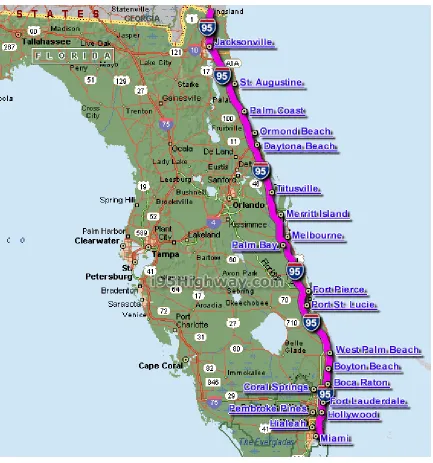
Figure 4.1 I-95 in Florida ...159
Figure 5.1 Route Options in South Carolina ...190
ix
LIST OF ABBREVIATIONS
AAA ... American Automobile Association (Heathrow, FL)
AASHO ... American Association of State Highway Officials
BPR ... Bureau of Public Roads
CPL ... Claude Pepper Library (Tallahassee, FL)
DHS... Delaware Historical Society (Wilmington, DE)
DPA...Delaware Public Archives (Dover, DE)
HM ... Hagley Museum (Wilmington, DE)
JFKL ... John F. Kennedy Presidential Library (Boston, MA)
LV ... Library of Virginia (Richmond, VA)
NJSA ... New Jersey State Archive (Trenton, NJ)
NJSL ... New Jersey State Library (Trenton, NJ)
MSA ... Maryland State Archives (Annapolis, MD)
PHS ... Princeton Historical Society (Princeton, NJ)
PKYL ... P.K. Yonge Library of Florida History (Tallahassee, FL)
PRBSC ... Princeton Rare Books and Special Collections (Princeton, NJ)
RBRL ... Richard B. Russell Library for Political Research and Studies (Athens, GA)
RULSC ... Rutgers University Libraries Special Collections (New Brunswick, NJ)
SAF ... State Archives of Florida (Tallahassee, FL)
TPA ... Taxpayers’ Protective Association
1
INTRODUCTION
THE ROAD BEHIND, THE ROAD AHEAD
In August of 1969, the Interstate Highway System was in its thirteenth year of
construction. With 28,000 of the 42,500 originally-planned miles complete and 5,000
additional miles in development, the transformation of the American landscape was well
underway. In many locations where segments of the system had opened to the public,
community leaders, politicians, and the media praised the technological marvel.
Elsewhere, Americans eagerly awaited construction; yet the news was not entirely
positive: the target completion date established in 1956 loomed a mere three years in the
future, the updated completion date of 1974 looked increasingly unattainable, and
financing battles in Washington plagued the program. In addition, thousands of miles had
been added to the original plan, exacerbating the problems. In some locations, opposition
to highway construction had been increasing since the 1960s and now presented a public
opinion obstacle the Interstate Highway System had not yet faced in its early years. In the
midst of this tumult, U.S. News and World Report published an article highlighting scores
of locations where the network’s development had been delayed. The magazine called
attention to specific trouble spots, such as a proposed cross-Manhattan segment
connecting New Jersey and Brooklyn and a stretch of highway bisecting the French
Quarter of New Orleans. In total, the article counted sixty-six disputes poised to disrupt
277 miles of highway construction. The article was damaging to the Interstate System at
2
“Trouble for Freeways” suggested the controversies listed were representative of
increasing opposition to the entire project.1
J.O. Bowen, publisher of the construction trade journal Dixie Contractor,
responded with a fiery letter to U.S. News and World Report’s editor, noting factual
errors and calling into question the representativeness of the article. Bowen’s primary
criticism of “Trouble for Freeways” was its implication that a number of local issues
amounted to a system-wide problem. Bowen wrote, “On the national scale that you
attempt to reflect, the difficulties in locating and building a freeway is not a problem, but
a finely grained, heterogeneous complex of local problems that are susceptible of no
major, national, or overall solution.”2 As a representative of the industry building the
highways, Bowen’s opposition to any coverage casting doubt on the network’s progress
and eventual completion was to be expected. However, Bowen’s specific critique of the
magazine’s argument set him apart from most of his contemporaries.
Bowen’s fellow commentators frequently extrapolated micro experiences to
conclusions about the Interstate System as a whole. For example, in a status report of the
Interstate Highway System published just two months prior to the U.S. News and World
Report article, the New York Times suggested that the same concerns motivated
opposition to Interstates in New York City and Philadelphia, and this experience would
be replicated in additional urban areas when construction inevitably reached new city
1 “Trouble for Freeways,” U.S. News and World Report, August 11, 1969, 77.
2 J.O. Bowen to David Lawrence, 26 August 1969. Herman Talmadge Collection, Subgroup C,
3
limits. Of New York and Philadelphia, the New York Times misleadingly wrote, “City
officials and civic groups contend that certain Interstate urban links will destroy scenic
and historic values, and cause undue hardship to the families and small businesses that
will be displaced.”3 Not only were the protests in these cities not representative of the
urban experience elsewhere in the United States, the opposition within these cities was
diverse in motivation. New York’s primary opposition was partially based on a fear that
highways would destroy ethnic neighborhoods, as the Times article suggested, but there
was also a vocal contingent of environmentalists who feared the effect of Interstate
Highways on public transportation funding. Meanwhile, in Philadelphia, primary
opposition came from individuals worried about property values.4
Similarly, other observers touted the benefits stemming from the highways
without an appreciation of local context. This view assumed the Interstate Highways
were so overwhelming as harbingers of positive change that they could overcome any
local realities; experiences in one place would translate to another, regardless of how to
the two locations may have differed. For example, as highway officials and civic leaders
plotted the course of I-95 through South Carolina, Charleston’s News and Courier told
readers they could expect tremendous development where I-95 would eventually intersect
I-26. As evidence, the newspaper pointed to Spartanburg, South Carolina, where the
intersection of I-85 and I-26 had been “the greatest single catalyst to Spartanburg’s recent
3 Joseph C. Ingraham, “Status Report on the Interstate Road System,” New York Times, June 8,
1969.
4 For an overview of diversity in urban highway opposition, see Raymond A. Mohl, “Stop the
4
economic growth.”5 The News and Courier overlooked the fact that Spartanburg’s
highways intersected fewer than ten miles from the city center while I-95 would intersect
I-26 at least twenty-five miles away from downtown Charleston. The paper also
discounted the tide of industrial development surging through Spartanburg prior to the
construction of I-95 as compared to the economic stagnation in Charleston since the close
of the World War II.
Observers across the United States eventually came to realize what Bowen had so
eloquently expressed in his letter to U.S. News and World Report: Interstate Highways
were the product of the diverse political, cultural, economic, and social environments
they traversed. In 1965, for example, Georgia governor Carl Sanders commented that
“the problems on I-95 have been locally based.”6 During the initial decades of Interstate
construction, however, few seemed to share Bowen’s insight. The historical record is
replete with examples of individuals treating the Interstate Highway System as a
homogeneous entity.
The historiography of the Interstate Highway System reflects the common
tendency of historical actors to view the System as a network of roads without variation.
Fueling the historiographical blindness toward heterogeneity is the philosophical slant of
much of the earliest literature. Highway detractors authored many of Interstate Highway
histories in the 1960s and 1970s, and their works are very critical of the System. Mark
Rose characterizes most of the writers during this period as “social critics” who were not
interested in the history of the Highway System so much as arguing against further
5 “Bring I-95 Near the Sea,” News and Courier, April 30, 1963.
6 Carl Sanders to Sam L. Varnedoe, 20 September 1965, Carl Sanders Collection, Series I, Box 4,
5
construction.7 The contributors to this critical point of view generally saw highways as
destroyers of cities and the cause of America’s pernicious reliance on the automobile.8
With the intent of arguing against Interstates in principle, these scholars were disinclined
to treat the roads with nuance.
Some social critics maintained their campaign against Interstate Highways for
several decades and continued writing long after the network was largely complete.9 By
the 1980s, however, a handful of Interstate Highway studies emerged that aimed to
understand the complex history of the roads. Mark Rose’s Interstate: Express Highway
Politics (1990) and Tom Lewis’ Divided Highways: Building the Interstate Highways,
Transforming American Life (1997) stand as the best-researched and most thoughtful
analyses of the Interstate Highways. More recently, Earl Swift’s The Big Roads: The
Untold Story of the Engineers, Visionaries, and Trailblazers Who Created the American
Superhighways (2011) contributed to the limited collection of scholarly interpretations of
7 Mark Rose, Interstate: Express Highway Politics, 1939-1989 (Knoxville: University of
Tennessee Press, 1990), xiii.
8
Jane Leavitt contends that the United States should stop building highways in most cases, as she says they are the primary cause of urban sprawl and the overall decline in the quality of urban life. In the introduction, Leavitt makes clear her position, proclaiming, “This book is about the men and institutions who promote highways and how they destroy our churches, schools, homes and parks.” In making this case, Leavitt singles out Interstate Highways as the most harmful. Jane Leavitt, Superhighway—Superhoax (Garden City, NY: Ballatine Books, 1970), 9. See also A.Q. Mowbray, Road to Ruin (Philadelphia: Lippincott, 1968); Richard O. Davies, The Age of Asphalt: The Automobile, the Freeway, and the
Condition of Metropolitan America (Philadelphia: Lippincott,1975); and Jon R. Meyer and Jose A.
Gomez-Ibanez, Auto Transit and Cities (Cambridge, MA: Harvard University Press., 1981).
9 In Asphalt Nation, for example, Jane Holtz Kay argues for a “depaving of America,” a massive
scaling back on road construction in favor of expanded public transportation. Kay sees the United States of the late twentieth century as disenchanted with highways, saying, “A landscape sacked by its highways has distressed Americans so much that even this go-for-it nation is posting ‘No Growth’ signs on development from shore to shore.” Jane Holtz Kay, Asphalt Nation: How the Automobile Took Over America and How
6
the Interstate Highway System. Collectively, these studies provide an excellent account
of the political, social, cultural, and technical contours of the most ambitious public
works project of the twentieth century. They filled historiographical voids by detailing
the major players at the national level, analyzing the debates in Congress that culminated
in the Federal Aid Highway Act of 1956, and providing accounts of how the roads had
affected Americans—positively as well as negatively.10 These contributions, taken with
earlier studies, have resulted in a body of literature that competently details the history of
the Interstate Highway System at the national level.
The propensity to think about the Interstate Highway System only in national
terms, however, has resulted in an incomplete and sometimes flawed understanding of the
subject. Studies of the Interstate Highway System that attempt to analyze the network as
a whole overlook or downplay the significance of local realities on the contour of the
network’s history. Lewis’ Divided Highways, for example, uses episodes from across the
country as it paints a picture of the Interstate experience. These local accounts are
insightful and well-researched, but Lewis presents each as emblematic of the national
10 Popularly known as the National Interstate and Defense Highways Act, the Federal Aid
Highway Act of 1956 codified the financing structure that made the Interstate System possible and initiated construction. The history of this landmark legislation is very well documented in most studies of the Interstate System.
For an examination of intersection between highway planning and politics, see Bruce E. Seely,
Building the American Highway System: Engineers as Policy Makers (Philadelphia: Temple University
Press, 1987). For studies of the effects of Interstate Highways on urban centers, see: Raymond Mohl, “The Interstates and the Cities: The U.S. Department of Transportation and the Freeway Revolt, 1966–1973, ”
The Journal of Policy History 20, no. 2 (2008), 193-226. A few interesting studies of Interstate Highways
7
story. For example, Lewis commits a chapter to analyzing the urban revolts that plagued
the Interstate Highway System in the 1960s and 1970s. He uses the resistance to I-10 in
the French Quarter of New Orleans as his case study, and he provides an excellent
account of the historical and political context for that specific highway battle. However,
Lewis submits what observers came to call the “Second Battle of New Orleans” as
representative of contemporaneous urban revolts while providing only a paragraph each
to the struggles in Philadelphia, San Francisco, Washington, New York, and Boston.11
Lewis misleadingly implies New Orleans is interchangeable with any of its
contemporaneous highway protests when seeking an understanding of the urban revolts.
The desire to write a national history of the Interstate Highways drives Lewis to write an
account of what happened in locations across the country, but he cannot commit the
space to explain why. Holding up one episode as an explanation is inherently flawed, as it
implies an equivalency across communities that simply did not exist. Each location’s
experience with highways directly resulted from circumstances particular to that
community, and to date, national accounts of the Interstate Highway System have failed
to capture the deeply textured reality of the network’s history.
11 Tom Lewis, Divided Highways: Building the Interstate Highways, Transforming American Life
8
A handful of location-specific investigations do exist.12 They successfully
contextualize particular episodes in the history of the Interstate System and admirably
explore the interplay between local reality and the highway; however, as stand-alone
studies, they do not allow for comparison, and no conclusions can be drawn about the
representativeness of the case study on the System as a whole. Ultimately, these accounts
reveal much more about the community under consideration than they do about the
Interstate. With national studies that fail to explain the significance of location on one
hand and microstudies that fail to comment on the System, writ large, on the other, the
historiography needs to bridge the gap and account for local texture while attempting to
understand the broader history of the Interstate Highway System. One approach that
satisfies this aim is to study individual roads. And, despite what has now become
considerable literature on the Interstate Highway System, few works take this approach.13
12
See: Joseph F.C. DiMento, “Stent (or Dagger?) in the Heart of Town: Urban Freeways in Syracuse, 1944-1967,” Sage 8, no. 2 (2009), 133-161; Douglas H Haebuer, The Baltimore Expressway
Controversy: A Study in the Political Decision-Making Process (Baltimore: John Hopkins University Press,
1974); Richard Henry Ginn, “Interstate-40 Through Overton Park: A Case Study of Location Decision-Making,” Master’s Thesis, University of Tennessee, 1970; and John E. Seley, “The Kink in Nashville’s Interstate-40,” in The Politics of Public-Facility Planning, ed. John E. Seley (Lexington, Massachusetts: Rowan & Littlefield, 1983), 57-66.
13 Roads predating the Interstate Highways have been the focus of dedicated studies much more
than have the Interstate Highways. Route 66, in particular, has been the subject of an expansive body of literature. See, for example, Quinta Scott and Susan Croce, Route 66: A Highway and Its People (Albuquerque: University of New Mexico Press, 1988) and Peter B. Dedek, Hip to the Trip: A Cultural
History of Route 66 (Albuquerque: University of New Mexico Press, 2007). Books have been written with
9
I-95, the backbone of the Interstate Highway System, is the ideal road for such a
study, as it traverses a diverse cross-section of the United States. It also warrants
dedicated study in its own right given its singular significance to the country. Despite
this, there are no dedicated studies to the road. Stretching 1,917 miles from south of
Miami, Florida, to the Canadian border in Maine, I-95 passes through fifteen states, feeds
forty-six seaports, and serves 103 commercial airports. On an average day, 72,000
vehicles drive on I-95, but traffic volume can reach 300,000 vehicles on holidays and
other peak travel periods. Of all the miles driven on American roads, I-95 constitutes 35
percent. The I-95 corridor, consisting of counties that lie within twenty miles of the road,
constitutes only 10 percent of the United States’ land area but is home to 37 percent of
the country’s population, nearly 110 million people. This zone’s economic output is
staggering; it bears $4.7 trillion in economic production every year, which accounts for
almost 40 percent of the national GDP. In fact, if the I-95 corridor were an independent
nation, it would have the third largest economy in the world.14 Despite its exceptional
There are a few works that do a wonderful job exploring the history of individual roads. Angus K. Gillespie and Michael Aaron Rockland’s Looking for America on the New Jersey Turnpike (Piscataway, New Jersey: Rutgers University Press, 1992) brilliantly argues the eponymous road reflects the values of the engineers who designed the road, the politicians who control it, and the citizens who travel upon it. More recently, Anne Mitchell Whisnant’s Super-Scenic Motorway (Chapel Hill: University of North Carolina Press, 2006) explored the role of the Blue Ridge Parkway in the economic development of southern Appalachia and the relationship of the road to the notion of “the public good.”
14
“I-95 Facts and Stats,” I-95 Corridor Coalition, accessed February 13, 2011,
10
importance to twentieth—and now twenty-first—century American history, no scholarly
work has focused on it.15
I-95 proves to be an excellent lens for a study of the relationship between roads
and the communities they traverse. I-95 passes through or near some of the most
populous cities in the United States; it also cuts through farmland, small towns, and
coastal communities. A drive up or down I-95 provides the tourist with an impressive
view of the diverse American landscape, from the largest urban centers of the country to
picturesque tobacco fields, from the pine forests of Maine to the palm groves of southern
Florida. In some places, I-95 drew traffic off older highways, such as U.S. 1, and in other
places, it connected communities via a major highway for the first time. I-95 aided in the
economic development (or redevelopment) of some regions, such as the Research
Triangle of North Carolina, and elsewhere destroyed the livelihoods of citizens who used
to make a living off the travelers on old highways.
To say Americans welcomed or resisted I-95 would be grossly simplistic. In some
places, observers celebrated I-95 as a herald of progress; in others, they resisted it as a
noxious force. Some community leaders fought to route I-95 through their towns. In other
locales, environmental and historical preservationists fought to keep precious resources
out of its path. Some cities welcomed I-95 in hopes it would revive downtown
economies; elsewhere municipal leaders and residents feared the highway would destroy
15
Dianne Perrier’s Interstate 95: The Road to Sun and Sand (Gainesville: University Press of Florida, 2010) purports itself to be a cultural history of I-95; however, the highway is mentioned preciously few times. The book instead focuses on the I-95 corridor, specifically its history prior to I-95’s
11
urban centers. An understanding of I-95 requires a complete understanding of the
circumstances under which it came to be in its full complexity and texture.
A dedicated study of I-95 yields conclusions that other works on the Interstate
Highway System have not been able to reach. The present study reveals community
attitudes toward the highways were incredibly complicated and were dependent on a
calculus of socioeconomic status, proximity to the proposed route, aspirations for one’s
community, and a number of additional factors. Since I-95 cuts through a diverse
segment of the United States, the complexity of this calculus becomes especially
apparent.
This study of I-95 also reveals that more local people favored the highway than
the historiography indicates. While much of the literature paints a picture of concerned
citizens standing up to business and political proponents of the highways, the story of
I-95 suggests that citizens, both political and apolitical, frequently supported the
construction of superhighways. Additionally, differences of opinion among politicians,
businessmen, and other community leaders come to light. Highway supporters frequently
cited the arguments employed by the highway lobby when convincing the United States
to build the Interstates when explaining their support of I-95. This suggests the highway
lobby’s influence was far more pervasive than historians have previously argued.
Whereas the current literature focuses on the lobby’s influence over politicians and some
civic leaders, the story of I-95 reveals the arguments trickled down through many layers
of society due to previously overlooked efforts of the lobby, especially the American
12
This study of I-95 also reveals that many observers saw symbolic value in the
Interstate Highways from the moment of inception. The historical record is replete with
individuals viewing the Interstates as symbols of progress, modernity, and wealth.
Beyond this, Americans frequently framed I-95, specifically, as a symbol of national
unity. At a time when the media and national leaders frequently reminded Americans of
regional differences through accounts of civil rights activities in the South, many viewed
I-95 as a thread that would bind the North and South together.
It is important to note that no study of I-95 can be truly comprehensive, especially
one that aims to understand the local histories associated with the road. There are simply
too many towns and too many people impacted by the highway for a fully inclusive
investigation. Through carefully selected and representative case studies, however, a
scholarly endeavor can tell a broad story with a limited scope. Anne Mitchell Whisnant’s
excellent Super-Scenic Motorway stands as proof. While the book does not account for
every town the Blue Ridge Parkway passes or evaluate every opinion expressed of the
road, Whisnant does a remarkable job of illustrating the complexity of the Blue Ridge
Parkway’s history by evaluating well-chosen case studies.16
No period in the life of I-95—or any Interstate—was as revealing as the time
before construction begins. Before routes were made official and bulldozers began
overturning earth, communities experienced periods of speculation and rumor, followed
by the official planning phase, when engineers conducted studies and interested parties
attempted to influence the route and other characteristics of the road. While the history of
I-95 certainly transcends this stage, the period provides the most insight into what
13
motivated historic actors and serves as the most fertile ground for investigation. As such,
this study explores many routing controversies but also explores other stages of I-95’s
development.
Before delving into local context, it is important to establish the national contours
into which I-95 appeared. In that regard, Chapter 1, “A New Vision Has Come to
Motoring Man,” explores highway advocates’ arguments in favor of Interstate Highways.
Drawing heavily from the collections of the American Automobile Association, this
chapter briefly traces the events leading up to the 1956 signing of the Federal Aid
Highway Act, which moved the Interstates from dream to reality. The legislative battle
culminating in this landmark legislation has been well documented by several scholars,
so this chapter provides only a cursory survey of the important milestones. Instead, it
focuses on the efforts of the AAA and other highway proponents to espouse the benefits
of Interstate Highways and explores the arguments used. Then, using two I-95 ribbon
cutting ceremonies as case studies—one in Richmond, Virginia and one in a rural area on
the Maryland/Delaware state line—the chapter demonstrates how the benefits that
highway advocates chose to highlight were highly dependent on locality.
Chapter 2, “People and Progress in Wilmington, Delaware,” examines a 1957
routing controversy in the industrial Mid-Atlantic city. As one of the first urban centers to
receive I-95—or any Interstate Highway, for that matter— Wilmington presents an
intriguing opportunity to study urban responses to the Interstate before the “urban crisis”
of the 1960s and 1970s. In these early years of Interstate Highway construction, few
people argued Wilmington did not need or want I-95. Rather, the Wilmington story is one
14
to the city—so long as it was routed through somebody else’s neighborhood. A proposed
route along Jackson and Adams Streets drew considerable attention since it was favored
by the Delaware State Highway Department and serves as the main narrative thread in
this chapter. The discussions surrounding this route reveal how urban highway
controversies proceeded before serious doubts about the benefit of Interstate Highways
were prevalent. In an environment where the benefits of highway construction were
rarely questioned, how individuals balanced their desire for community progress with
personal preservation makes for a fascinating counter narrative to the dominant “urban
resistance as urban revolt” narrative.
The value of Interstate Highways was not accepted as definite when Delaware
moved to extend I-95 into Wilmington’s northern suburbs in 1965. The communities of
Arden and Ardentown took a vastly different approach to resisting the Interstate than did
their southern neighbors nearly a decade earlier. Whereas the residents of downtown
Wilmington generally wanted the road built so long as it did not route through their
neighborhoods, Arden and Ardentown residents saw little value in I-95. The difference in
attitudes between these two episodes in Wilmington’s history was partly driven by the
elapse in time and partly driven by the characteristics of the communities involved.
Chapter 2 concludes by considering the factors that defined the different courses taken by
the Jackson/Adams Street and Arden controversies.
Chapter 3 investigates resistance to I-95 in the communities between Trenton and
Newark, New Jersey. With events transpiring over the course of the 1960s and 1970s,
New Jersey’s encounter with I-95 fell squarely into the urban revolt period and arguably
15
Hillsborough, and Piscataway make for significant case studies because they provide an
opportunity to understand how and why large towns—not major urban centers—
responded to the threat of Interstate Highways. These communities have been largely
overlooked in the literature on highway resistance, as past studies have favored revolts in
metropolises. This chapter rectifies this historiographical gap and, in so doing, assesses
how demographics, politics, and culture of these towns gave shape to the resistance
efforts.
Not all communities opposed Interstate construction during the 1960s, and
Chapter 4 uses southeast Florida coastal cities and towns to illustrate this. Concurrent
with the opposition in New Jersey and Wilmington’s northern communities, Florida held
state-wide elections in which West Palm Beach, Fort Pierce, and other Florida cities
became central subjects. At issue was whether the state of Florida had purposefully
delayed construction of I-95 in order to maximize profits on a parallel toll road. In
decrying the alleged actions by the state of Florida, the people of these coastal
communities demonstrated an intense desire for I-95. The pattern of southeast Florida’s
development and structure of the region’s economy served as the most significant engines
behind support for I-95.
Chapter 5 explores a 1963 controversy in South Carolina where two communities,
Charleston and Florence, engaged in rival lobbying efforts to sway the route of I-95
toward their respective borders. While the previous case studies reveal alliances between
residents and politicians, churches, economic boosters, and others, everyday citizens were
largely absent in South Carolina’s routing controversy. This chapter seeks to understand
16
favorable routings and also considers why most residents chose to stay silent while
politicians and economic boosters engaged in the debate.
Chapters 1-5 largely deal with planning and building the Interstate. Chapters 6
and 7 consider the effects of 95. Once routings were finalized and the road was built,
I-95 began the next phase of its life, affecting the future of communities and the day-to-day
lives of its neighbors. Here, too, local realities played a critical role in the history of I-95.
Chapter 6 explores the effect of I-95 on Jackson Ward, a predominately
African-American community in Richmond, Virginia. Once considered the “Harlem of the
South,” Jackson Ward’s thriving commercial, cultural, and social scenes were disrupted
by the arrival of I-95, which bisected the neighborhood. This chapter considers to which
extent I-95 facilitated the downfall of Jackson Ward and the extent to which Jackson
Ward’s local circumstances gave shape to I-95.
Chapter 7 examines coastal southeast Georgia to understand the effect I-95 had
on communities it bypassed. McIntosh County, Georgia had built its economies—
legitimate and illicit alike—off the traffic U.S.1 funneled through. I-95 drew these drivers
a few miles to the west and left the people of McIntosh County searching for answers.
The sudden absence of out-of-state drivers passing through McIntosh County also served
to dethrone a corrupt police chief who had built significant power through his ability to
control the activities along U.S. 1. Part of this power included bending the communities’
race relations to his will; in this way, the appearance of I-95 just outside McIntosh
County’s borders dramatically changed the very underpinning of society in this region of
17
When taken in total, this dissertation aspires to what J.O. Bowen accused U.S.
News and World Report of failing to do in 1969: it aims to understand the “heterogeneous
complex of local problems” that plagued an Interstate Highway System.17 It also
transcends Bowen’s call by attempting to illustrate that everything about I-95 is a
“complex,” the problems and benefits; the support and resistance; the local and the
national. In short, I-95’s history is far more complicated than previous research suggests.
Forty years after Bowen recommended U.S. News and World Report take note of local
circumstances when attempting to understand Interstate Highways, this study heeds his
advice.
18
CHAPTER 1
“ANEW VISION HAS COME TO MOTORING MAN”18
American University President Paul F. Douglass was an unusual choice to deliver
the keynote address at the Annual Meeting of the American Automobile Association
(AAA) in early November, 1947. Since the AAA’s founding in 1902, club members had
come to annual conventions expecting speeches on topics ranging from road financing to
the importance of increasing public awareness of the organization’s activities. Dictated
by the AAA’s status as an inchoate organization whose future depended upon the growth
of the personal automobile and the enthusiasm of its members, these past addresses
served the purpose of giving attendees direction for the coming months. Past speeches
had encouraged members to grow the organization’s membership and informed delegates
of AAA initiatives that would serve as selling points when recruiting new members.
Previous speakers included local club leaders, fundraising experts, and policy wonks. Dr.
Douglass, a renaissance man who dabbled in politics, city planning, law, and journalism,
among other interests, was notably different from every past keynote speaker. His
speech, likewise, broke from tradition. Far less bureaucratic
18 Paul F. Douglass, “The Civilizing Road,” (speech included in stand-alone document, “Annual
Meeting of the Delegates of the American Automobile Association,” Washington, D.C., November 4, 1947), AAA Archive, Heathrow, Florida, 75. The American Automobile Association possesses an extensive collection of publications and unpublished documents at its headquarters in Heathrow, Florida. The collection is not maintained by archivists and has no official organization. The “archive” is essentially a room with shelves upon which materials have been placed as they were discovered. As such, the citations for sources found in this archive will include as much information as possible to allow subsequent
19
and far more visionary, his address, “The Civilizing Road,” audaciously challenged AAA
members to imagine their efforts in the context of human history. Beginning with early
man’s advent of “direct paths over which men and animals moved to supply their
immediate physical needs” and concluding with a vision of roads that would one day tie
the world together, Douglass argued for the importance of roads in the story of
mankind.19 Underlying Douglass’ account of the history of roads was the argument that
the AAA stood to set the course for the next turning point, to take the next step toward a
day when roads would promote freedom across the globe. For an organization that had,
since its inception, focused on important but quotidian business of automobile ownership
and use, Douglass’ call seemed revolutionary.
Those who followed the various AAA publications, however, were not surprised
by Douglass’ message. AAA leaders had been planning for a superhighway push as
World War II raged in Europe and the Pacific and had revealed portions of their plans
throughout the 1940s. Those in attendance consequently understood the implicit message
in Douglass’ speech. Conference attendees would not simply return to their home towns
and recruit new members; Douglass’ address meant to inspire an army of advocates for a
state-of-the-art highway system. “The Civilizing Road” served as the opening shot of the
AAA’s full-blown efforts to persuade the American people and Congress to construct
what would become the Interstate Highway System.
The ensuing lobbying and legislative activities that culminated in the Federal Aid
Highway Act of 1956, the law that approved financing of the Interstate Highway System
and moved the network from dream to reality, has been very well documented. Most
20
notably, Mark Rose’s Interstate: Express Highway Politics does a remarkable job of
distilling the myriad interest groups and numerous compromises into a succinct and
insightful narrative. Other observers have contributed additional research on this subject.
Tom Lewis’ Divided Highways: Building the Interstate Highways, Transforming
American Life traces the historical antecedents of the system and offers illustrative
biographical analysis of the key players. More recent works by Earl Swift and Dianne
Perrier have provided further analysis of the Interstate System’s formative years. Swift’s
The Big Roads accounts for much of the same material as Lewis’ earlier Divided
Highways, but introduces more players to the story. Perrier’s work is a long history of
I-95, which, among other topics, explores how Native Americans used the route of I-95
long before European settlers arrived on the continent and, later, how nineteenth century
railroads sparked the tourism industry that would later rely heavily on I-95. As a result of
these works and others, the origins and administrative history of the Interstates are well
understood. The existing literature, however, has failed to adequately explore one of the
most important aspects of the Interstate System’s history. While the legislative battles
and lobbying efforts were undeniably vital, they would have had little effect without the
war for public opinion that began in the 1940s and continued long after construction
commenced.
At an estimated cost in the billions of dollars, many Americans were not
immediate supporters of the initiative to build a new nationwide highway system.20 Such
a construction project would require new taxes, additional federal involvement in state
affairs, and tremendous financial obligations by the states. When Americans first heard of
21
plans for the Interstate Highway System, countless questions arose. Questions about
financing: Who would pay? Would non-users pay a disproportionate amount? Questions
about administration: Who decided where roads would go? Would these be toll roads?
But most importantly, questions about value: Why were these roads necessary? Were
they worth the cost? Until highway advocates could convince the American people, the
business community, state governments, and ultimately, Congress of the value of such an
undertaking, there was little hope for realization of the plan. Convincing these groups of
the Interstate Highway System’s value required identifying arguments that would sway a
majority of Americans and then wielding these arguments effectively.21
Those who joined the effort to actualize the unprecedented building program
employed myriad arguments. The literature, with varying degrees of accuracy, notes the
benefits of Interstate Highways according to advocates of the System. The arguments,
when mentioned, are usually introduced as part of the legislative debates—not as
arguments used to sway public opinion. The least sophisticated accounts have reduced
the numerous and complex arguments in favor of a modern highway system to three:
greater economic growth, increased driver safety, and improved national defense. These
21The existing scholarship largely overlooks the need to build and propagate a case for Interstate
22
studies also occasionally submit unsubstantiated claims that will, desire, or pride played a
role in garnering support. In The Roads that Built America, for example, Dan McNichol
argues “the roots of the System are militaristic and defensive, with a large dose of
national pride thrown in.”22 Those inclined to believe McNichol’s interpretation of the
reasons America built the Interstate System are likely informed by the oft-cited story of
how Eisenhower, upon seeing Germany’s Autobahn in action during World War II, was
determined to see America construct a competitive highway network. While the story of
Eisenhower’s experience is true, advocates of the Interstates rarely invoked national pride
when making the case for the superhighways during the 1940s and 1950s. Instead,
purported benefits were often more tangible. Rose and Lewis posit economic growth,
driver safety, national defense, social progress, and the relief of urban traffic as the key
benefits touted by highways boosters. While certainly the most complete list of benefits
in the current literature, it is not comprehensive. Interstate advocates certainly submitted
these five benefits when promoting the highway program; however, they also often
employed additional pro-Interstate arguments that the historiography has overlooked.
This chapter begins by surveying the origins of the Interstate Highway System. In
so doing, it provides a brief summary of the milestones covered in several previous
histories of the superhighway network. This account, however, focuses on the public
relations component of Interstate history. As such, the AAA appears prominently, as it
played a significant role in the formation and proliferation of the pro-Interstate
arguments. The AAA and its fellow highway boosters recognized the importance of
22 Dan McNichol, The Roads that Built America (New York: Sterling, 2006), 10. McNichol’s
23
tailoring the pro-highway message for specific audiences. While the general arguments in
favor of the superhighway network remained throughout the 1940s, 1950s, and 1960s,
boosters highlighted particular benefits depending on the target audience. Often, boosters
changed the message based on the particular historical, cultural, economic, or social
environment of the locality they addressed.
Boosters did not cease promoting the benefits of Interstate Highways when the
Federal Aid Highway Act passed in 1956; in fact, their efforts increased after they won
the initial battle to build the System. Even though the Highway Act established a means
of paying for the construction, financing was a perennial fight in Congress. The Highway
Trust Fund became a target as some elected officials wanted to use the funds for other
initiatives, which led to the Trust Fund serving as a pawn in Congressional battles. Each
year, some member of Congress held the annual disbursement to the account as ransom
in budgeting negotiations. As such, highway boosters never felt safe reducing the
intensity of their advocacy, and their fear worsened through the 1960s as some urban
areas began to vehemently resist Interstate development. Sympathetic congressmen, such
as Massachusetts Senator Ted Kennedy, mounted campaigns to divert highway funding
for public transportation and other “urban friendly” initiatives. This threat further
motivated highway supporters to sustain their advocacy efforts. Despite this unrest—and
perhaps due to the continual efforts of highway supporters—the Interstate Highway
24
System continued to open for nearly fifty years after the Federal Aid Highway Act of
1956.23
The completion of segments of the Interstate System was the subject of much
fanfare, an opportunity for civic leaders to celebrate their state or municipality’s
accomplishment and for local citizens to glimpse or even test drive the roads that
promised to usher in a new wave of development and safety. Highway advocates seized
upon these ribbon-cutting ceremonies as high-visibility spectacles from which they could
champion the construction of additional miles of asphalt. Two ribbon-cutting ceremonies
along I-95, one in Richmond, Virginia in 1958 and another on the Mason-Dixon Line
between Maryland and Delaware in 1963, saw speakers and attendees extol the
superhighway. These two events witnessed highway advocates not only celebrate the
frequently cited benefits of highways but also draw attention to benefits that scholars of
the Interstate System have generally overlooked. Additionally, these events provide
excellent opportunities to explore how advocates altered the pro-highway arguments
based on locality. Ribbon-cutting ceremonies, regardless of the location, were an
opportunity to push for further highway construction and also to celebrate the long
struggle that culminated in a stretch of brand new asphalt.
ANTECEDENTS AND MOMENTUM
The Interstate Highway System, as imagined during and immediately after World
War II, was the latest manifestation of a persistent and long-running drive for good roads
in the United States. Since the first man took the wheel of an automobile, the need for
23
25
better roads had been apparent. Prior to the rise of the personal automobile, bicycle
enthusiasts were the primary group championing the construction of new roads or
improvements to the existing. By the turn of the twentieth century, automobile advocates
had grown in number to the point they appropriated the Good Roads Movement from the
bicycle lobby. The Good Roads Movement, under the leadership of automobile
enthusiasts, promoted the Lincoln Highway and later, the Dixie Highway, which
provided car owners the ability to tour the United States while driving east and west, and
then north and south.24 These routes were part of the informal network of auto trails
network that served as the best option to drivers in the early twentieth century.
By the 1920s, the inadequacy of America’s system of auto trails was apparent.
Usually privately funded and poorly maintained, these roads simply could not sustain the
number of cars and trucks using them each day. The federal government, recognizing the
economic benefit of roads capable of facilitating automobile traffic, instituted the United
States Numbered Highways in 1926. Many of the auto trails established earlier in the
century, the Dixie and Lincoln Highways included, became part of the system after
considerable upgrades. As the nation’s first integrated and government-maintained road
network, this system pushed the United States into the modern age of transportation,
which only fueled the popularity of the personal automobile. Even as the United States
Numbered Highways developed, observers questioned their long-term effectiveness, as
they were incapable of handling the ever-growing traffic of the United States and were
24 Several good histories of these roads and the Good Roads Movement, in general, exist. See, for
example, W.C. Hilles, “The Good Roads Movement in the United States, 1880-1916” (master’s thesis, Duke University, 1958); Drake Hokanson, The Lincoln Highway: Main Street Across America (Iowa City: University of Iowa Press, 1999); Howard L. Preston, Dirt Roads to Dixie: Accessibility and Modernization
26
notoriously dangerous. The United States fell into a cycle of building roads intended for
yesteryear. As Mark Rose observes, “The pace of road building never kept pace with
traffic increases nor with visions for faster traffic, social and urban change, and economic
improvement.”25 As the 1920s wore on, one truth became increasingly apparent: the
United States required a system of highways built for the automobiles and traffic volumes
of the future.
The Great Depression slowed the growth of the personal automobile ownership
rates, but a new highway system remained on the minds of some American leaders. The
Hoover administration briefly considered the job-creating potential of a massive highway
building program, but it was Harold Ickes who first submitted a formal proposal for such
an initiative. In 1933, Ickes proposed a state-of-the-art, limited-access, nationwide
superhighway network as a New Deal public works project. The notion intrigued
Franklin Roosevelt, who went so far as to develop a financing plan for the initiative, but
the President ultimately opted to invest the government’s resources elsewhere, declaring
highway programs “do not provide as much work as other methods of taking care of the
unemployed.”26
Wartime restrictions on gasoline, oil, steel, and rubber had drastically reduced the
opportunity—and thus, appetite—for recreational driving, and the public consequently
deprioritized better roads during the early 1940s. Nonetheless, the idea of a postwar
highway construction program persisted throughout WWII. Federal Roads Commissioner
25 Rose, 13.
26 Samuel I. Rosenman, ed., Public Papers and Addresses of Franklin D. Roosevelt, Vol. 8 (New
27
Thomas Harris McDonald and his engineers began developing a plan for a national
express network in 1941, but Congress stymied the program when it heeded the desires of
farmers, who wanted rural routes developed and improved, and interstate trucking
companies, who vehemently opposed the fuel taxes required to build such a system. The
American Association of State Highway Officials (AASHO) similarly advocated a
40,000-mile expressway network in 1943 but ran into the same opposition as the Federal
Bureau of Public Roads.27 Automobile manufacturers, gasoline distributors, tire
companies, and other enterprises also shared visions of a massive postwar road building
program but found little success advancing beyond the idea phase. By the time Paul F.
Douglass delivered “The Civilizing Road” to the Annual Meeting of AAA Delegates in
1947, the AAA and other advocates of a superhighway system had been watching roads
fail to live up to expectations for nearly forty-five years and saw few signs the complex
problems that had prevented previous initiatives from succeeding would relent any time
soon.
The AAA developed the superhighway system strategy that ultimately succeeded,
as marked by the passage of the Federal Aid Highway Act of 1956, during World War
27 I-95,at least in concept, had been long considered part of the Interstate network. Franklin
28
II.28 As the nation’s preeminent club for automobile and driving enthusiasts, the AAA’s
interest in Interstate Highways was natural. The organization viewed the Interstate
System as the catalyst that would bring the United States fully into the automobile age,
further encouraging the proliferation of the personal automobile as the nation’s primary
form of transportation. The AAA presented its plan to the club’s members throughout the
war, and the strategy clearly demonstrates the organization understood why previous
superhighway proposals had failed. The AAA did not make recommendations about how
many roads should be built or the path they should take, choosing instead to focus on the
framework necessary to push through the required legislation.29 In February, 1945, AAA
leadership presented some specifics of its plan in the organization’s flagship publication,
American Motorist. The AAA called for a unified network of roads of “national” and
“interregional significance” administered by one federal agency that would coordinate
efforts with the states; the federal Public Roads Administration would identify routes in
conjunction with state highway authorities.30 The AAA’s deference to the Public Roads
Administration and states on route development points to the level of comfort the
organization had with the proposals the parties had developed previously. With the
exception of Harold Ickes’ and Franklin Roosevelt’s ephemeral plan, which consisted
28 In a 1958 speech to the Harvard Graduate School of Business, AAA Executive Vice President
Russell E. Singer claimed President Eisenhower “decided upon [the] far reaching move” of “a ‘grand plan’ for highway building in America” in 1954. It is not clear why Singer would give so much credit to the President, especially since it is a well-established fact that many individuals had been promoting
superhighways for decades prior to 1954. Singer’s praise of Eisenhower may have stemmed from an era of good-will after the long-fought battle for Interstate Highways ended. Russell E. Singer, “The Motorists’ Program for Better Highways: A Case History in Public Relations” February 27, 1958, Folder: “Speeches-Singer, Russell: 1961-1965”, AAA Archive.
29
No single document in the AAA archive contains a comprehensive plan as developed by the AAA. Instead, the plan can be pieced together across multiple sources.
29
only of three north-south and three east-west routes, proposals universally recommended
connecting most major metropolitan areas. Both the Bureau of Public Roads and AASHO
plans called over 40,000 miles of concrete, and this satisfied the AAA.
States had previously balked at any highway program that saddled them with
construction costs. Under the AAA proposal, states would pay no more than half of the
construction and maintenance expense, and federal funds would come from general
revenue instead of a tax on fuel or automobiles. This strategy served the double function
of placating the states and the interstate trucking lobby. Under the AAA’s financing plan,
trucking companies would benefit from more efficient roads but would not pay more than
any other industry. The plan also capped the contributions required by the states,
guaranteed significant federal contributions, and addressed concerns over the
apportionment process. Apportionments for the United States Numbered Highway
System were the subject of much consternation, as the federal government distributed
funds for very specific components of projects instead of the project as a whole. As such,
delays were common while funds were short for a single maintenance shack even though
the overall road was under budget. In an attempt to improve the process, the AAA
recommended the Public Roads Administration develop a total cost per state for highway
construction, which would be distributed, earmark free, for highway construction and
maintenance.31 This plan also transferred significant control to the states, which reduced
tension among those who feared a public works project of this magnitude gave
Washington considerable opportunity to meddle in state administration.
30
The AAA remained close to the legislation as it made its way through
Congressional committees and the larger legislative process. However, pushing the
legislation through Congress was not the AAA’s primary activity during the 1940s and
early 1950s. Instead, the AAA spent most of its time rallying support for a system of
superhighways. This strategy was based on astute observations of the prior highway
battles on the part of the AAA leadership. AAA leaders recognized the single greatest
factor in the failure of previous legislation was a lack of vocal and enthusiastic support
for the initiative. Regardless of the areas of contention, the AAA believed Congress
would agree on legislation if business leaders and others with a vested interest in the
Interstate Highway program grew vocal enough about their desire to see the roads built.
To this end, the AAA was determined to rally road advocates for its postwar push and
recruit as many new supporters as possible.
The organization began coalition building in the early-to-mid 1940s, with club
members across the country soliciting the support of any businesses that would support
the cause. Senior leadership took responsibility for securing the support of larger
organizations that would provide the weight necessary to push through legislation.
Lower-ranking officials and local clubs solicited the support of less influential
businesses. To this end, AAA leaders spoke to as many businesses and organizations as
possible that stood to benefit from a superhighway system. These addresses often took a
similar shape. The speaker would paint a picture of advanced, almost futuristic,
automobile travel in an attempt to make audience members doubt their ability to
comprehend how different life would be when the new era of transportation arrived. In
31
capitalized on the growth of automobile travel; those who did not seize upon the
transformative power of the Interstate Highways would struggle to survive.
The AAA designed speeches to exploit audience fears that business would pass
them by. For example, speaking to the Southern Hotel Association in 1944, AAA
National Travel Director Elmer Jenkins encouraged the audience to imagine the future of
automobile travel and its implications on the hospitality business. Noting that “we still
have 80-mile an hour cars and 40-mile an hour roads”, Jenkins imagined the nature of
driving after the war.32 In some regards, Jenkins’ list of automobile enhancements
demonstrated considerable prescience, as it included shatterproof windshields, air
conditioning, and easy-care upholstery. In other regards, Jenkins’ imaginings took longer
to come to fruition or still remain the material of science fiction: tubeless tires, silent
vehicles achieving fifty miles per gallon, transparent roofs, and cars that received traffic
information via radio signal. These futuristic cars, Jenkins claimed, would be able to
travel over one hundred miles per hour on a new system of superhighways; as driving
became safer, more efficient, and more enjoyable, Americans would take to the roads in
unprecedented numbers. And their driving would take them further from home more
frequently. As they drove to distant locales for vacation, Americans would need lodging.
According to Jenkins, the “hotel men” in attendance stood to grow their business
exponentially if they advocated for the new highways.33 The AAA delivered a similar
message to affiliated and unaffiliated automobile clubs and organizations representing
32 Elmer Jenkins, “Post-War Automobile Travel,” free-standing document in “Speeches” drawer
of file cabinet, AAA Archive, 3.
32
gasoline distributors, restaurateurs, automobile manufacturers, and business owners in
would-be tourist destinations throughout the 1940s. In each case, the message was
essentially the same: the audience would benefit greatly by supporting the AAA’s efforts
in pursuing a modern highway system and a future without a new highway system was
far less lucrative.
The tremendous dedication of the AAA to coalition building and advocacy of a
superhighway system is apparent in the official organization records from the 1940s and
early 1950s. Senior leadership traveled extensively and on a near-constant basis as they
attempted to stoke interest in the highways. For example, the AAA’s Executive
Committee meeting minutes from February 13 and 14, 1947 shed light on the fervor with
which the organization advocated for a new highway system during the 1940s. Since the
previous Executive Committee meeting, held just three months prior, AAA President H.
J. Brunnier had traveled to Cuba to meet with the Federation of Inter-American
Automobile Clubs, to Mexico to meet with a national club, and to Los Angeles,
Columbus, and Toledo to speak to various clubs in the United States. Other officers
maintained similarly busy schedules in their pursuit of support.34
Ultimately, numerous interested parties came together to advocate the AAA plan.
In one sense, the alliance was formal. The “Road Gang,” consisting of approximately 250
individuals representing scores of industries, met in Washington on a regular basis to
discuss strategy. Tom Lewis notes that membership in the Road Gang was secretive, and
the group left few records behind. Nonetheless, the group’s players and their activities are
34 “Minutes of Meeting of the Executive Committee: February 13 and 14, 1947,” included in
33
easy to identify because, as Lewis notes, “what it did was so predictable.”35 Membership
certainly included representatives of the AAA and the Automobile Manufacturers
Association. It is reasonable to assume other represented interests consisted of oil,
cement, asphalt, tire, and construction companies. Congressmen Albert Gore, Sr. of
Tennessee and George Hyde Fallon of Maryland, arguably the two most important
legislators to the eventual success of the requisite highway legislation and eventual
cosponsors of the Federal Aid Highway Act of 1956, likely participated as well.36 In
another sense, the AAA alliance was informal, consisting of individuals and
organizations that never sat down as a unified body but threw their support behind the
AAA. Included in the informal alliance were wealthy automobile enthusiasts, small scale
businesses tied to the driving industry, members of the AAA and other automobile clubs,
and various businesses associated with the tourism industry that were not represented by
national organizations.
Despite the considerable support the AAA found with businesses and politicians,
the organization’s leadership soon realized capitalizing on business interests would not be
enough to advance legislation that would fund the Interstate Highways. The framework
the AAA proposed proved ineffective at curtailing all of the old complaints about a
massive highway-building program. The AAA proposal’s requirement that states match
federal contributions dollar-for-dollar, as they had done since the first federal highway
bill in 1916, became less palatable as cost estimates steadily increased. By 1955, the
35 Lewis, 310.
36 Outstanding detailed accounts of the legislative battle for the Interstate System are available.