A Randomized Trial Comparing Digital and Live Lecture Formats
DAVID J SOLOMON
Abstract
Problem Statement and Background – Medical education is increasingly being conducted in community-based teaching sites making it difficult to provide a consistent curriculum. We conducted a randomized trial to assess whether digital lectures could replace live lectures.
Methods – Students were randomized to either attending a lecture series at our main campus or viewing digital versions of the same lectures at community sites. Both groups completed an examination based on the lectures and the group viewing the digital lectures completed a feedback form.
Results – The group who viewed the digital lectures performed slightly better than the live lecture group however the differences were not statistically significant. Despite technical problems the students who viewed the digital lectures overwhelmingly felt the digital lectures could replace live lectures.
Conclusions – Digital lectures appear to be a viable alternative to live lectures as a means of delivering didactic presentations in a community-based setting.
The College of Human Medicine (CHM) at Michigan State University (MSU) has a community integrated structure where medical students spend the clinical portion of their training in one of six community campuses spread throughout the State of Michigan. While CHM’s community integrated structure has many advantages, it is challenging to provide a consistent educational experience for the students. To help address this challenge we
implemented an all-day lecture series held at one of the community campuses the week before the end of the internal medicine clerkship. The lecture series titled “Crush the Boards” was designed to prepare the students for the National Board of Medical Examiners (NBME) subject examination in internal medicine which is used as the final written examination for the clerkship.
The students and faculty presenters from other campuses travel from their home campus to the campus hosting the lecture series. While the lecture series has been successful, coinciding with a marked increase in subject exam performance, traveling to the host community is
inconvenient and time consuming for both the students and the faculty presenters. In addition, it is not practical for students at CHM’s rural medicine campus at Marquette to attend due to the distance, approximately 400 miles, from the other CHM campuses.
There is evidence that delivering the audio from a lecture in combination with the presenter’s slides can be an effective means of delivering lectures at remote sites and may even be as effective as traditional lectures.[3,4] We saw this as a potential solution for providing a consistent didactic curriculum in our clerkship but felt including video of the presenter as well as audio from a live lecture in combination with the presenter’s slides would be more enjoyable and more effective than audio alone. During the 2003-2004 academic year, we conducted a
CD-ROM-based multimedia versions of the same lecture series. If it were found that these digital lectures could help students master the material at the same or similar level of performance as the live lectures they could potentially replace the lecture series saving travel time for both the students and the faculty.
Methods
Students taking the third-year required internal medicine clerkship at CHM during the 2003-2004 academic year* were offered the opportunity to participate in the study. Those agreeing to participate were randomized into to one of two arms of the study. The control group traveled to one of the CHM community campuses (Lansing) and attended the Crush the Boards lectures with their colleagues who chose not to participate in the study. The experimental group stayed at their home campus on the day other students attended the Crush the Boards lectures and completed a parallel set of CD-ROM-based multimedia modules made from digital recordings of the previous year’s Crush the Boards lectures. The lecture series included six lectures covering asthma, coronary artery disease, renal failure, liver disease, thyroid disease, and antibiotic pharmacology.
At the end of the live lecture series, students were asked to complete a short feedback examination that included four to five questions based on each of the six lectures that were written by the presenters of the lectures. The students were informed the feedback exams would have no impact on their clerkship grades and were strictly for providing them with feedback on the mastery of the material and the presenters with feedback on the effectiveness of the lectures. After the students completed the exam, they were given a copy of the exam that included the correct answers and a short explanation of why the correct answer was correct. The exam forms
*
contained no student identifiers however the students were asked to indicate whether they had agreed to participate in the study. Students in the experimental arm of the study completed the same feedback examination in their home community after they had completed the digital lectures. They were also asked to complete a short feedback form asking whether they had any technical problems using the modules, what they felt were the advantages and disadvantages of the modules, and whether they felt the modules could serve as a suitable replacement for live lectures.
The CD-ROM modules were created using a technique developed by the author. A manual outlining how to develop these modules is available from (
http://www.msu-im.org/CDIM/manual.pdf). They included digitized multimedia clips (video and audio) from the presentation inserted as a window in the PowerPoint® slides from the presentation. As students
displayed each of the slides, they were able to observe the presenter in the multimedia window discussing the slide that was being viewed.
Group differences were tested for statistical significance by both an independent sample t-test for means and a Mann-Whitney test for ranks. A power analysis was conducted to assess the size of the difference between the groups that would likely be detectable given the number of students participating in the study. The data were also presented descriptively using means, standard deviations and mean ranks within the control and experimental groups. All analyses were conducted using the Statistical Package for the Social Sciences version 11. Approval for the project was obtained from the University Committee for Research Involving Human Subjects.
Results
were due to some of the students in the live lecture group failing to mark that they were
participating the study. A power analysis indicated with the number of subjects in the study, it would have be possible to detect differences of approximately 9/10ths of a standard deviation with a power of 80%, p< .05 for a one-tailed t-test.
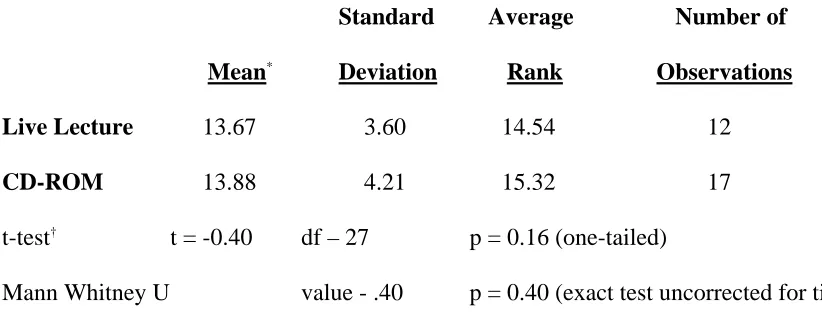
Table 1 displays the mean, standard deviation, and average rank of the exam score among the control and experimental groups. As can be seen in Table 1, the students who viewed the digital lectures performed slightly better than the students who attended the live lectures although the differences were not statistically significant (p <.05) for means (t-test) or medians (Mann-Whitney). The coefficient alpha reliability of the 29 item exam was .70.
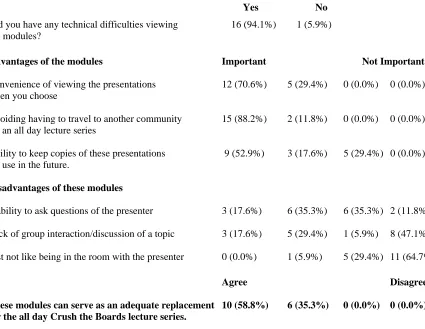
The 17 students who completed the digital lectures also completed a short feedback form on their experiences and impressions of the digital lecture format. These data are presented in Table 2.
Discussion
Although approximately 100 students completed the internal medicine clerkship during the academic year the study was conducted, only 29 participated in the study. This occurred for several reasons. During the first rotation, the study was not well advertised and there were technical problems in a demonstration of the digital lectures. The net result was that very few students chose to participate during that rotation. During the second and third rotations,
internal medicine clerkship due to space limitations in the three regular rotations and a live version of the lecture series was not given for the fourth rotation.
The statistical power of the study was limited do to the small sample sizes in each group. This is an issue for this study since the goal was to prove the “null hypothesis”, i.e., students completing the digital lectures would perform as well as those attending live lectures on a written test of the material contained in the lectures. Given the students who viewed the digital lectures actually performed slightly better than the students who attended the live lectures, we are fairly confident the digital lectures can provide an adequate replacement for the live lectures from a learning perspective although further research data confirming this would be helpful.
Despite the fact that almost all of the students experienced some technical difficulties using the modules, they had a very positive view of delivering the lectures using this format. All the students either agreed or strongly agreed the modules could serve as an adequate replacement for live lectures. They were particularly appreciative of not having to travel to another
community to attend didactic presentations and having the flexibility of viewing the modules at their convenience. Of the three potential disadvantages of the format that were listed on the feedback form, they felt their inability to ask a question of the presenter was the most important. In the future we are considering using a web-based bulletin board system as a means of allowing students to ask questions of the presenter.
assumed there would be less compatibility problems with the Window’s media files created via Movie Maker than the MPEG files created by Studio 8. Unfortunately, we later found out the Window’s media files created by Movie Maker require a codec for translation that was not shipped with earlier versions of Windows. We expect this was a significant cause of the technical problems the students experienced.
We have since abandoned the format we used for creating the digital lectures and are now using Impatica’s OnCue (http://www.impatica.com/) for creating digital lectures. OnCue
simplifies the process of creating the digital lectures and allows them to be distributed over the Web as well as via CD-ROM. It requires no special software other than a Java enabled browser and we expect it will solve the majority of the technical problems encountered with the original format.
Although the data collected in this study were fairly limited, it provides evidence that digital lectures are both well received by students and can provide a satisfactory substitute for live lectures from a performance standpoint. To complement these modules we have developed a web-based testing system for providing students with immediate feedback on their mastery of the material contained in the digital lectures. Such combined Web and CD-ROM distance learning formats have been shown to be effective in a number of educational settings. [5-6]
Both our current digital lectures developed using OnCue and a companion set of web-based feedback tests can be viewed at http://www.med-training.org/im/.
Acknowledgements: This study was funded in part by grant number 1 D16 HP 00119 01 from the Division of Medicine, Bureau of Health Professions, Health Services and Resources
Correspondence: David J Solomon, PhD, A-202 E Fee Hall, MSU, E Lansing, MI 48824; e-mail: [email protected]
References
1. Langlois JP, Thach SB. Bringing faculty development to community-based preceptors. Acad Med 2003:78;150-5.
2. Andreae MC, Freed GL. Using a productivity-based physician compensation program at an academic health center: A case study. Acad Med 2002:77;894-899.
3. Markova, T, Roth LM. E-conferencing for Delivery of Residency Didactics. Acad Med 2002:77; 748-749.
4. Wofford MM, Spickard AW, Wofford JL. The Computer-Based Lecture. J Gen Intern Med 2001;16;464-7.
5. Mattheos N, Nattestad A, Attstrom R. Local CD-ROM in interaction with HTML documents over the Internet. Eur J Dent Educ 2000:4;124-127.
Table 1
Performance on a Feedback Examination: CD-ROM versus Live Lecture Format
Standard Average Number of
Mean* Deviation Rank Observations
Live Lecture 13.67 3.60 14.54 12
CD-ROM 13.88 4.21 15.32 17
t-test† t = -0.40 df – 27 p = 0.16 (one-tailed)
Mann Whitney U value - .40 p = 0.40 (exact test uncorrected for ties)
*Mean number of correctly answered items out of 29.
†The t-test was calculated assuming equal variances. Differences in variances were tested via a
Table 2
Feedback on the CD-ROM Based Lectures
Yes No
Did you have any technical difficulties viewing 16 (94.1%) 1 (5.9%) the modules?
Advantages of the modules Important Not Important
Convenience of viewing the presentations 12 (70.6%) 5 (29.4%) 0 (0.0%) 0 (0.0%) when you choose
Avoiding having to travel to another community 15 (88.2%) 2 (11.8%) 0 (0.0%) 0 (0.0%) for an all day lecture series
Ability to keep copies of these presentations 9 (52.9%) 3 (17.6%) 5 (29.4%) 0 (0.0%) for use in the future.
Disadvantages of these modules
Inability to ask questions of the presenter 3 (17.6%) 6 (35.3%) 6 (35.3%) 2 (11.8%) Lack of group interaction/discussion of a topic 3 (17.6%) 5 (29.4%) 1 (5.9%) 8 (47.1%) Just not like being in the room with the presenter 0 (0.0%) 1 (5.9%) 5 (29.4%) 11 (64.7%)
Agree Disagree