Process design tools for reductive
biocatalysis
A thesis submitted to the University of London for the
degree of Doctor of Philosophy
by
Katherine Claire Thomas, BSc., MRes.
August 2000
All rights reserved
INFO RM A TIO N TO ALL U SER S
The quality of this reproduction is dependent upon the quality of the copy submitted.
In the unlikely event that the author did not send a complete manuscript
and there are missing pages, these will be noted. Also, if material had to be removed, a note will indicate the deletion.
uest.
ProQuest 10015703
Published by ProQuest LLC(2016). Copyright of the Dissertation is held by the Author.
All rights reserved.
This work is protected against unauthorized copying under Title 17, United States Code. Microform Edition © ProQuest LLC.
ProQuest LLC
789 East Eisenhower Parkway P.O. Box 1346
from it or information derived from it may be published without
Acknowledgements
Acknowledgements
I take the opportunity here to thank my supervisors John Woodley and Michel
Chartrain for their advice, supervision and friendship during my PhD. Also Malcolm
Lilly, Gary Lye and Mike Turner for their assistance and advice. I also thank the
BBSRC and Merck & Co. for providing the funds to make this project possible.
Thank you to all the members of Foster Court labs, past and present and others in
the Biochemical Engineering department at University College London. Most notable
among those are Steve, Vini, Kirsten, Jeet, Tim, Katie, Phil and Andreas.
Thank you to the employees of Merck & Co., Rahway, who made my time there
productive and enjoyable. Thank you especially to the technical assistance of my co
workers and Vic Pecore for his invaluable help with the statistical analysis of my data.
Thank you to Sarah, Casey and others for their friendship which made my time in
New Jersey a treasured memory.
Thank you to my friends and family. Mum, Dad and George, who have been
patient and not asked too many questions.
Abstract
Reductive biocatalysis is potentially a very useful tool as it creates a chiral centre. Enzyme catalysed reduction reactions generally require the addition of expensive
nicotinamide cofactors in stoichiometric amounts. To reduce the cost of these
cofactors they can be recycle by a second substrate or enzyme or by chemical or electrochemical methods.
A decisional tool is proposed to assist the choice of the optimal enzymatic cofactor regeneration system for reductive biocatalysis. The tool comprises a series of questions addressing a potential process involving an enzymatic cofactor regeneration system and offers possible solutions to guide an engineer to an economically feasible process.
A model system was chosen with which to test the proposed decision tool which was the reduction of 6-bromo-P-tetralone to (S)-6-bromo-P-tetralol by the yeast
Trichosporon capitatum.
An NADH-specific reductase enzyme from the yeast was isolated to apparent
homogeneity with an enantiomeric excess of 99.54%. Purification involved
protamine sulphate precipitation, anion exchange chromatography on Q Sepharose FF, affinity chromatography on Amicon Affinity Dyematrex Red A and gel filtration on Superdex 200 HR. The final purification stage resulted in a 54-fold increase in specific activity, to 430U/mg with a yield of 1.34%.
The optimum conditions for the operation of a bioconversion using the isolated tetralone reductase enzyme were investigated. The enzyme was immobilised onto Eupergit C in the presence of 0.5M phosphate buffer at pH7 with an optimum enzyme challenge of 0.5U/g beads; both the free and immobilised forms of the enzyme were investigated under process conditions. The optimum pH for activity o f the free enzyme was in the range 6-7 and 6-8.5 for the immobilised enzyme. Both forms of the enzyme were at their most stable over this range. The temperature optima, a trade off between optimum activity and stability were found to be 21 °C and 31°C for the free and immobilised forms respectively. Optimum solvent regime was 50% hexane for the free enzyme and 50% octanol for the immobilised enzyme.
A second enzyme for cofactor regeneration was selected and a combined, two enzyme system was optimised using a semi-automated, high throughput screening
method. The regenerative enzyme, formate dehydrogenase, converts formate to CO2
and recycles NADH. The optimum condition of pH (6.8), temperature (26°C) and solvent (30% octanol) were found by factorial experiments using a robotic liquid handling system to produce a semi-automated process.
The difficulties associated with operating the robotic system for enzyme reaction characterisation have been investigated with respect to bead handling and accuracy of
the system. The main problems identified with bead handling for immobilised
Table of Contents
Table of Contents
Title 1
Acknowledgements 4
Abstract 5
Table of Contents 6
List of Figures 12
List of Tables 15
Abbreviations 16
Nomenclature 17
1 Introduction 18
1.1 Bioconversions 18
1.1.1 General 18
1.1.2 Process Development 19
1.1.3 Process development tools 20
1.1.4 Catalyst Choice 22
1.1.5 Process choice 23
1.2 Redox reactions 23
1.2.1 General 23
1.2.2 Bioreduction 24
1.3 Cofactors 24
1.3.1 Definition 24
1.3.2 Chemistry o f NAD(P)(H) 28
1.4 Cofactor recycling 31
1.4.1 Definition 31
1.4.2 Economics 32
1.5 Cofactor Options 37
1.5.2.2 Enzymatic methods
1.5.2.3 Chemical methods
1.5.2.4 Photochemical methods
1.5.2.5 Electrochemical methods
1.5.3 Engineering options
1.5.3.1 General
1.5.3.2 Enzyme membrane reactor
1.5.3.3 Charged membrane reactor
1.5.4 Choice of conditions
1.5.5 Scale-up
1.6 Tetralone - tetralol bioreduction
2 A structured approach to the selection of cofactor recycle
systems for redox biocatalysis
2.1 Summary
2.2 Introduction
2.3 Economic scenarios
2.4 Selection strategy
2.4.1 Decision chart
2.4.2 Economic scenario
2.4.3 Synthetic reaction
2.4.4 Second Substrate
2.4.5 Regenerative Substrate
2.4.6 Regenerative Enzyme
2.4.7 Regenerative product
2.5 Modifications to selection strategy
2.5.1 Variation to decisional chart
2.5.2 A ll costs high
2.5.3 Low cost synthetic enzyme
Table o f Contents
2.5.4 Low cost regenerative enzyme 71
2.5.5 Low cost synthetic substrate 72
2.5.6 High cost synthetic enzyme 72
2.5.7 High cost regenerative enzyme 72
2.5.8 High cost synthetic substrate 73
2.5.9 A ll costs low 73
2.6 Discussion 73
3 Isolation of an oxidoreductase enzyme from the yeast 75
Trichosporon capitatum
3.1 Summary 75
3.2 Introduction 75
3.3 Materials and Methods 76
3.3.1 Yeast cultivation 76
3.3.2 Analytical Methods 76
3.3.2.1 Spectrophotometer microassay 76
3.3.2.2 Bioconversion assay 77
3.3.2.3 Reverse phase HPLC assay 77
3.3.2.4 Total protein assay 77
3.3.2.5 SDS-PAGE Gel electrophoresis 77
3.3.2.6 Chiral HPLC assay 78
3.3.3 Purification Techniques 78
3.3.3.1 Cell harvest and washing 78
3.3.3.2 Cell disruption 78
3.3.3.3 DNA removal 79
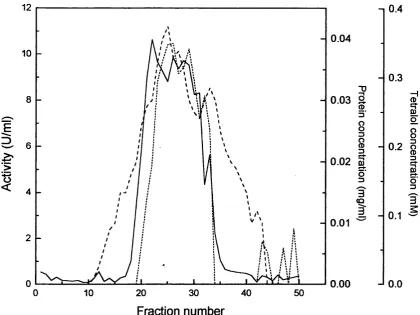
3.3.3.4 Anion exchange chromatography 79
3.4 Results 81
3.4.1 Cell homogenate production 81
3.4.2 Anion exchange chromatography 81
3.4.3 Affinity chromatography 85
3.4.4 Gel filtration 85
3.4.5 Cofactor preference 85
3.4.6 Enantiomeric excess 85
3.4.7 Kinetics 88
3.5 Discussion 88
4 Characterisation o f the asymmetric reduction of a ketone by an 94
oxidoreductase isolated from Trichosporon capitatum.
4.1 Summary 94
4.2 Introduction 94
4.3 Materials and Methods 95
4.3.1 Reactant and product solubility 95
4.3.2 Reactant and product stability 95
4.3.3 Enzyme isolation 95
4.3.4 Free enzyme assay 96
4.3.5 Enzyme immobilisation 96
4.3.6 Immobilised enzyme assay 96
4.3.7 Reverse phase HPLC analysis 97
4.3.8 Enzyme kinetics 97
4.3.9 pH optimum and stability 97
4.3.10 Temperature optimum and stability 98
4.311 Solvent choice 98
4.4 Results 99
4.4.1 Reactant and product characteristics 99
Table of Contents
4.4.1.2 Stability of reactants and products
4.4.2 Immobilisation conditions
4.4.3 Enzyme characteristics
4.4.3.1 Immobilised enzyme kinetics
4.4.3.2 pH optimum and stability
4.4.3.3 Temperature optimum and stability
4.4.3.4 Solvent optimum and stability
4.5 Discussion
5 Use of robotics to aid selection of conditions for a second
enzyme cofactor regeneration reaction
5.1 Summary
5.2 Introduction
5.3 Methods
5.3.1 Bead Handling
5.3.2 Accuracy
5.4 Results
5.4.1 Bead handling
5.4.2 Accuracy
5.5 Discussion
6 Optimisation of conditions for a second enzyme cofactor
regeneration reaction
6.1 Summary
6.2 Introduction
6.3 Methods
6.3.1 Enzyme production
6.3.2 Reverse phase HPLC assay
6.3.3 Immobilised enzyme assays
6.3.5 Cofactor challenge 128
6.3.6 Factorial design 129
6.3.7 Automated optimisation reactions 129
6.3.8 Scale-up 129
6.4 Results 132
6.4.1 Immobilisation of formate dehydrogenase 132
6.4.2 Substrate and product adsorption onto Eupergit C beads 132
6.4.3 Cofactor challenge 134
6.4.4 Optimisation 134
6.4.5 Scale-up 137
6.5 Discussion 137
7 Discussion 143
7.1 Limitations to the whole cell process 143
7.2 Potential benefits of the isolated enzyme 144
7.3 Isolated enzyme window 145
7.4 Use of robotics 150
7.5 Decision tool for cofactor recycle 154
8 Conclusions 160
9 Future Work 162
10 References 163
Appendix I; List of Suppliers 178
Appendix II: Standard Curves 180
List of Figures
List of Figures
1.1 A Structured approach to process development 21
1.2 Reduction and oxidation of chiral molecules. 25
1.3 Structure of NAD(H) and NADP(H) 29
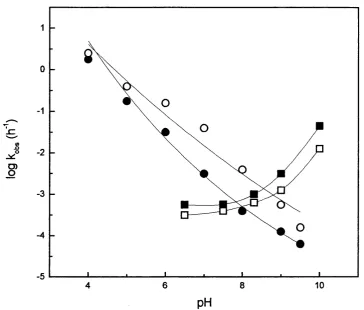
1.4 Stability of NAD+, NADP, NADH and NADPH as a function of 30
pH.
1.5 Percentage efficiency of regeneration vs. final active cofactor. 36
1.6 Principle of whole cell regeneration. 40
1.7 Principle of enzymatic regeneration. 42
1.8 Principle of chemical methods of regeneration. 44
1.9 Principle of photochemical methods of regeneration. 46
1.10 Principle of electrochemical methods of regeneration. 48
1.11 Tetralone to tetralol bioconversion. 55
2.1 Decision chart for enzymatic cofactor regeneration. 61
2.2 The recycling of NADPH using a two step conversion on a 66
alcohol derivative of a bicyclic ketone to produce lactones.
2.3 Decision chart for low cost regenerative enzyme scenario as an 70
example of how the chart can be modified for different economic scenarios.
3.1 Growth curve for T. capitatum grown in a 2L Erlenmeyer flask 82
aerobically incubated on an orbital shaker (250rpm) at 29°C.
3.2 200ml DEAE Sepharose column, loaded with clarified 83
homogenate from T. capitatum and run at 2mLmin'^ with a
gradient NaCl elution.
3.3 500ml Q Sepharose Fast Flow column, loaded with clarified 84
homogenate from T. capitatum and run at 20mLmin'^ with a
gradient NaCl elution.
3.4 100ml Amicon Red A column, loaded with pooled fractions from 86
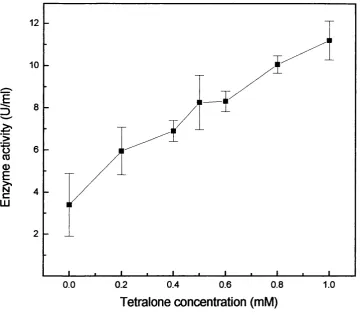
3.6 Kinetic studies o f the enzyme isolated to the stage of the affinity 89 column, determined at pH7 and 22°C, tetralone concentration
maintained at Im M throughout.
3.7 Kinetic studies of the enzyme isolated to the stage of the affinity 90
column, determined at pH7 and 22°C, NADH concentration maintained at 0.6mM throughout.
3.8 A process flowsheet for the purification protocol described. 92
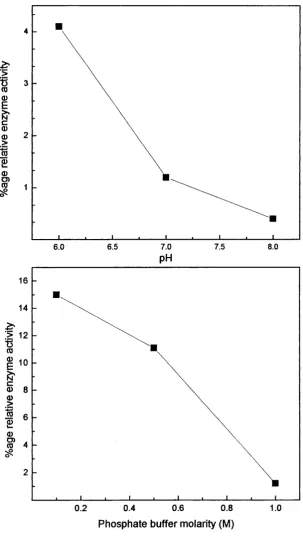
4.1 Relative activity of the enzyme after 24hours dialysis with 101
phosphate buffer as a percentage of the initial enzyme activity.
4.2 Enzyme loading o f the Eupergit C beads with immobilisation 103
conditions of 0.5M phosphate buffer at pH6, incubated at room temperature (22°C) for 72 hours.
4.3 Kinetic studies o f the immobilised enzyme determined at pH7 104
and 22°C, tetralone concentration maintained at 3mM throughout.
4.4 Kinetic studies of the immobilised enzyme determined at pH7 105
and 22°C, NADH concentration maintained at 0,6mM throughout.
4.5 Activity of both forms of the enzyme as a function of pH. 106
4.6 Stability, expressed as half life, of both forms o f the enzymes as a 107
function of pH, at 22°C.
4.7 Activity of both forms of the enzyme as a function of 109
temperature.
4.8 Stability, expressed as half life, of both forms of the enzyme as a 110
function of temperature, at pH7
4.9 Activity of both forms of the enzyme in the presence of a 50:50 111
solventiwater mixture with a sample of different solvents.
4.10 Stability, expressed as half life, of both forms o f the enzyme as a 112
function of solvent regime, using a sample of different solvents.
4.11 Optimum temperature window. 115
5.1 Parity plot showing predicted versus observed values for the dry 119
bead weights dispensed with the large orifice pipette tip and standard pipette tip.
5.2 Relationship between number of repeats and standard deviation 125
for different lengths of confidence intervals.
6.1 Semi-automated optimisation experiments. 130
6.2 Adhesion of tetralone and tetralol onto Eupergit C beads. 133
List o f Figures
6.3 Cofactor challenge. 135
6.4 Activity vs. temperature predicted values from the response 136
surface models of the combined two enzyme biotransformation for the three solvents tested.
6.5 Predicted values from the response surface model of the 138
combined two enzyme biotransformation for octanol.
6.6 Combined two enzyme biotransformation scaled up to 100ml 140
using the optimised conditions of pH6.8,26°C and 30% octanol.
7.1 Window o f pH vs temperature for free tetralone reductase 146
enzyme.
7.2 Window of pH vs temperature for immobilised tetralone 148
reductase enzyme.
7.3 Window of pH vs temperature for immobilised tetralone 149
reductase enzyme, with the enzyme activity from the factorial experiments superimposed over the window.
7.4 Time span for manual experimentation. 151
7.5 Time span for robotic experimentation. 152
7.6 Rate of experimentation with manual and robotic methods. 153
7.7 Decision tree modified for tetralone reductase catalysed process. 156
7.8 Modified scheme to follow for developing a process based on a 159
reduction reaction with cofactor recycle, to be used in the context of developing a whole process.
A ll RepTQsentàtive standard curve for Trichosporon capitatum grown 180
on production medium.
A ll Representative calibration curve for reverse phase HPLC of 181
tetralone standard with Zorbax RX-C8 column.
A ll Representative calibration curve for reverse phase HPLC of 182
tetralol standard with Zorbax RX-C8 column.
A ll Representative calibration curve for protein concentration by 183
Bradford method, using BSA as a standard.
A ll Representative standard curve for NAD^ concentration vs 184
absorbance at 260nm.
List of tables
1.1 Recent industrial research into biologically catalysed redox 26
reactions.
1.2 Cofactors involved in group-transfer reaction. 27
1.3 The order of magnitude for the cost of nicotinamide adenine 33
cofactors.
2.1 Economics scenarios, comparing the relative costs of the synthetic 59
and regenerative enzymes and the synthetic substrate.
2.2 Modifications to the decision chart depending on the economics 68
scenario for the process.
3.1 Purification table. 91
4.1 Stability and solubility of reactants and products. 100
5.1 Accuracy and precision of standard and large orifice yellow tips 120
for dispensing a lOOmg/ml bead slurry.
5.2 Errors associated with commencing identical experiments in 96- 122
well plates and in 6 sets of 96-well plates.
6.1 Comparison of tetralone and tetralol reaction catalysed b 141
immobilised tetralone reductase with formate dehydrogenase cofactor regeneration and the same reaction catalysed by whole cells.
Abbreviations
Abbreviations
Abs absorbance
ATP 2-deoxyadenosine 5-triphosphate
BSA bovine serum albumen
CoA coenzyme A
CV coefficient of variation
DCW dry cell weight
DSP downstream processing
FAD flavin adenine dinucleotide
FDH formate dehydrogenase
FMN flavin mononucleotide
g grams
mg milligrams
hrs hours
L litres
M molar concentration
mM milli molar concentration
mins minutes
mL millilitres
NAD^ P-nicotinamide adenine dinucleotide
NADH reduced P- nicotinamide adenine dinucleotide
NADP p-nicotinamide adenine dinucleotide phosphate
NADPH reduced P- nicotinamide adenine dinucleotide phosphate
OD optical density
PM production medium
SD standard deviation
SDS-PAGE Sodium dodecyl sulphate polyacrylamide gel electrophoresis
Tetralol (S)-6-bromo-p-tetralol
Nomenclature
A absorbance min
c concentration M
s molar absorption coefficient L mol * cm
L length of confidence interval %
À light path length cm
N number of repeats
-a standard deviation
-t student’s t-test value
Chapter 1: Introduction
1. Introduction
1.1 Bioconversions
1.1.1 General
A bioconversion is the transformation of an organic compound into a recoverable
product by simple, defined, enzyme catalysed reactions. In contrast to many chemical
processes the substrates and products of the reaction are structurally similar to each
other. Bioconversions can be brought about by the enzymes in whole cells, spores or
isolated enzymes. In all of these cases it is the enzymes that actually perform the
catalysis.
One of the characteristic features of enzymes is their specificity and selectivity in
the following respects:
■ Chemospecificity - the ability of an enzyme to use only one specific substrate
or a range of related substrates and to catalyse only one step with that
substrate
■ Regiospecificity - regiospecific resolution, is when a compound contains two
identical groups but only one is altered by the enzyme, regiospecific synthesis
is when a group is introduced in only one specific position
■ Enantiospecificity - the ability of an enzyme to resolve (separate) the
components of a racemate
■ Enantioselectivity - the ability of an enzyme to introduce a new chiral centre
Specificity and selectivity are not the only advantage of enzymes. It may be
possible to synthesise novel molecules, especially ones of a complex nature which
have not been possible to produce chemically. Enzymes also typically catalyse
reactions under mild conditions of temperature, pH and pressure. The advantage over
chemical reactions which require more extreme conditions is that there is less
chemical change due to isomérisation, épimérisation and racémisation, so that the
disadvantages as enzymes are not tolerant to changes in temperature and pH
(Ballesteros etal, 1994).
Bioconversions are not likely to replace existing methods of production as their
development is costly and still in its infancy. However, bioconversions can be a
useful tool to use alongside chemical processes particularly for the production of
single enantiomer drugs (Cannarsa, 1996 and Davies & Reider, 1996). For this
reason, bioconversion processes must be designed with this in mind and must be
suitable to fit within a sequence of chemical processes (Myles et al, 1991).
1.1.2 Process Development
Process development and reactor design are generally slow and expensive
processes because there are so many interrelated problems to be considered. Unlike
the chemical industry, which has been established for longer than the biochemical
industry, there have been few structured approaches to process design. This contrasts
with the need within the pharmaceutical industry, which biochemical engineering
largely serves, for a swift time to market of their products. The selection of a suitable
product and process selection tend to be separated in biochemical engineering. This
strategy contributes to the slowness of process development because many
unnecessary experiments are done. A more strategic approach has been developed
where both areas of research are combined, which should reduce the number of
experiments necessary to find the most suitable process for a particular reaction and
provide an informed choice for reactor design and configuration. The first stage is to
characterise the reaction to identify certain constraints on the use of a particular
process or reactor configuration. Then a change can be made to some aspect of the
process which vrill provide a new set of constraints, but hopefully at a higher level of
productivity. For example, if product inhibition is a constraint, in situ product
removal strategies can be adopted (Freeman et at, 1993). Other changes which can be
made include changes to the enzyme such as immobilisation, the use of genetic
engineering or protein evolution techniques or changes to the process conditions, such
as substrate feeding strategies. The process of step changes and re-characterisation
Chapter 1: Introduction
continues until the process has been fully developed (Figure 1.1) (Woodley & Lilly,
1994).
1.1.3 Process development tools
Alongside a more structured approach, tools to aid process development have also
been developed including windows of operation (Woodley & Titchner-Hooker, 1996).
Relevant parameters for the process are chosen and form the axes of a graph, on
which are imposed conditions such as enzyme stability and activity and constraints
imposed on the process. Thus many different objective functions may be expressed
on the same diagram. This allows complex information about the process to be
assessed and used to aid design.
Modelling of the process can also be used in development to help predict
information about the reaction and look at the best conditions without doing a large
number of experiments.
Other areas of pharmaceutical drug development employ techniques such as high
throughput screening (HTS) to help increase time to market. Combinatorial
chemistry has driven the development of such screening techniques which is both
cheaper and quicker than traditional methods of drug discovery (Persidis, 1998).
There are currently two different avenues of development within HTS: microtitre
plates and ‘lab on a chip’ systems. ‘Chips’ can perform functions such as parallel
solute quantification and analysis. The ‘chip’ iimovation utilises nanotechnology to
reduce the scale of traditional lab equipment so that it fits onto a support a few
centimetres square. The unit operations which have been miniaturised successfully in
this way include chromatography, electrophoresis, polymerase chain reaction vessels,
pumps and valves (Cowen, 1998). Chip technology could have many useful
applications in on-line analysis for process monitoring. However, the microtitre
plates will be useful for micro-scale down applications as they are frequently used to
Characteristic
Constraints
Change
New Characteristic
New Constraints
Change
Figure 1.1 A structured approach to process development
Chapter 1: introduction
1.1.4 Catalyst Choice
The first choice of catalyst for bioconversions may be whole cells, as they are
easiest to produce and require little processing from fermentation to use in
bioconversion. The substrate for the bioconversion may often be added straight to the
fermentation broth in the fermenter, once the cells have grown sufficiently. Whole
cells are also most suitable when there are more than two enzymatic steps especially
if the enzymes are membrane bound or if the isolated enzyme is not stable. Whole
cells do however, have certain disadvantages. Low molecular weight compounds are
limited in the rate at which they can travel across the cell membrane, leading to low
productivity (Angelova & Schmauder, 1999). Many enzymes are present in a cell and
so side reactions can occur, reducing the yield of the desired product. Therefore, with
increasing need for extremely pure chiral drugs, isolated enzymes are becoming the
favoured catalyst option for bioconversions (Cannarsa, 1996).
To date, most enzymes used in industrial applications have been those that catalyse
hydrolytic reactions or isomérisations (Faber, 1997). Potentially more useful enzyme
reactions such as carbon-carbon bond formation and redox reactions have been slower
to be exploited. Redox reactions, catalysed by cofactor dependent enzymes, have not
been developed on a large scale, partly due to the prohibitive cost of the cofactors
which means that they cannot be used in stoichiometric amounts. Where cofactor
dependent reactions have been used, the catalyst is usually a whole cell.
There is also a choice to be made between free or immobilised catalyst, for both
whole cells and isolated enzymes. Immobilisation increases the options for operation
and choice of reactor. It allows for easier recovery and reuse of the catalyst and
retention of the catalyst within the reactor, so that continuous stirred tank and plug
flow set ups can be used (Carleysmith et al, 1980). The immobilisation matrix can be very expensive however, and the immobilisation process can lead to a loss in activity
required protein than the wild type organism (Schreiber & Verdine, 1991). The gene
for the enzyme transketolase has been transformed back into E. coli under the control of a strong promoter so that much higher levels of the enzyme are produced (French
& Ward, 1995 and Lilly et al, 1996 ).
Protein engineering can be used to produce enzymes with increased stability or
with wider or different substrate or cofactor specificity (Ulmer, 1983). For example,
widening the substrate specificity of cytochrome P-450 (D i Primo et al, 1990, Fowler
et al, 1994 and Petersen & Martel, 1994) or changing the cofactor requirement of
glutathione reductase from NADPH to NADH which is cheaper to use (Scrutton et al,
1990).
1.1.5 Process choice
The catalyst is not the only area for improvement. Improvements can be made to
the whole process by altering the reactor configuration. The substrate may be
inhibitory at the high concentrations necessary for an optimum process or may be
toxic at relatively low concentrations and so in both cases the rate of the reaction will
be reduced (Ballesteros et al, 1994). These problems can be overcome by using a
fed-batch (Gbewonyo et al, 1991) or continuous flow operating system. These both keep
the substrate concentration which the enzyme is exposed to at any moment in time
fairly low, but in total, a large amount of the substrate is still converted to product
(Cabral & Tramper, 1994). In some cases the product may be inhibitory and so a high
product concentration, which allows for a low volume reactor to be used, cannot be
achieved. This can be avoided by using in situ product removal to keep the concentration of product which the enzyme is exposed to low and thus retaining a
high reaction rate (Freeman et al, 1993).
1.2 Redox reactions
1.2.1 General
Enzymes employed in redox reactions are classified into three categories:
dehydrogenases, oxygenases and oxidases. Dehydrogenases have been widely used
Chapter 1: Introduction
for the reduction of carbonyl groups of aldehydes or ketones and of carbon-carbon
double bonds, as well as in the recycle of nicotine adenine cofactors. Both of these
reactions offer potential asymmetric synthesis leading to a chiral product, a reaction
which is potentially very useful for the production of optically pure pharmaceuticals
and other fine chemicals. The reverse reaction, i.e. oxidation, results in the
destruction of a chiral centre but resolution of a racemic mixture, which is a less
useful reaction. Dehydrogenase enzymes require nicotine adenine cofactors to carry
the hydride group to be transferred to or from the substrate (Faber, 1992).
1.2.2 Bioreduction
Figure 1.2 demonstrates that reduction can produce products (2) or (3) from
substrate (1). An enzyme catalysed reduction may favour either product (2) or (3),
thus increasing the enantiomeric excess of the product. Oxidation can resolve the
racemate mixture of (2) and (3), but will also destroy the chiral centre. As the ability
to distinguish between chiral molecules is almost exclusive to enzyme (as opposed to
chemically) catalysed reactions, resolution is potentially a more powerful tool for a
biochemical engineer to have at their disposal.
Many companies have investigated the use of biologically catalysed reduction to
produce chiral products, but these all involve whole cells as the catalysts (Table 1.1).
To date, none have been investigated for use as an isolated enzyme, due to the
difficulties associated with enzyme isolation and the use of cofactors.
1.3 Cofactors
1.3.1 Definition
The terms coenzyme and cofactor refer to low molecular weight molecules
associated with certain enzymes which are essential for their activity. However, the
term cofactor is more appropriate as these molecules are not proteins and also do not
O reduction
O2H oxidation
(
1)
H .OH
CO2H
(
2)
H .OH
(
3)
CO2H
Figure 1.2: Reduction and oxidation o f chiral molecules.
(1) 4-oxo-hexanoic acid, (2) (R)-4-hydroxy-hexanoic acid, (3) (S)-4-hydroxy-hexanoic acid
Chapter 1: Introduction
Table L I : Recent industrial research into biologically catalysed redox reactions
Company Organism Reaction Reference
Eli Lilly & Co. Zygosaccharomyce
s rouxii
enantioselective reduction
Anderson et al,
1995
Konan Chemical Industry Co. Ltd.
Immobilisaed
Daucus carota
enantioselective reduction of prochiral ketones
Akakabe et al,
1995 Luso Farmaco spa. immobilised Saccharomyes cerevisiae enantioselective reduction to form P-lactam antibiotics
Banfï et al, 1994
Merck Mortierella alpina asymmetric
bioreduction of p-ketoesters
Chartrain et al,
1995
Merck Rhodotorula rubra asymmetric
bioreduction of ketosulphone
¥jà\zetal, 1996
Merck Microbacterium sp. Asymmetric
bioreduction of ketoester
Roberge et al,
1996 Merck Trichosporon capitatum asymmetric bioreduction of ketoester
Reddy et al,
1996
Smithkline Beecham
Pharmaceuticals
Rhodotorula rubra enantioselective
reduction of C=C bonds
Cantello et al,
1994
Tenabe Seiyaku Co.
Pseudomonas polycolor
asymmetric oxidation Takahashi et al,
1995
Tenabe Seiyaku Co.
Micrococcus freudenrichii
asymmetric reduction Takahashi et al,
1995
Zeneca Zygosaccharomyce
s rouxii
enantioselective reduction of P-ketoesters
Hallinan et al,
Table 1.2: Cofactors involved in group-transfer reactions
Cofactor Group transfered
nicotinamide adenosine diphosphate NAD(PXH)
flavin adenine nucleotide FAD(H)
adenosine tri-phosphate ATP
coenzyme A CoA
S-adenosyl-L-methionine SAM
3’-phosphoadenosine 5’-phosphosulphate PAPS
biotin
hydride ion
hydride ion
phosphate
acetyl
methyl
sulphate
carboxyl
Chapter 1: Introduction
same carrier molecules may participate in many different reactions within a cell, and
so there may be many different enzymes which require the same cofactor. Some
cofactors are covalently linked to the enzyme, these are called prosthetic groups. A
few cofactors are self-regenerating, such as pyridoxal phosphate and thiamine
pyrophosphate (Baricos et al, 1976), but most require a complementary reaction to regenerate the active form. Certain metal ions which interact with enzymes and are
essential for their activity may also be regarded as cofactors.
Biologically the most important group of coenzymes are the adenine coenzymes:
NAD, NADP, ATP, FAD and CoA. These are required by one third of the 2000
enzymes registered by the International Union of Biochemistry. This project
concentrates on the nicotinamide adenine cofactors N A D (P)(H )\
1.3.2 Chemistry of NAD(P)(H)
The nicotinamide adenine family of cofactors are nucleosides. In both cofactors
the electron transfer involves only the nicotinamide moiety. Figure 1.3 shows the
structure of all four of the native forms of the nicotine adenine cofactors. Enzymatic
reduction of NAD(P) directs the hydride attack at C-4 of the pyridinium ring and
forms exclusively the 1,4-dihydropyridine product, which is the only enzymatically
active form of NAD(P)H.
The nicotinamide cofactors are unstable in aqueous solution, especially at
extremes of pH (Chenault & Whitesides, 1987). Acidic conditions catalyse the
hydration and anomerization of the reduced cofactors (Wong & Whitesides, 1981).
Basic condition catalysed the hydrolysis of the nicotinamide-ribose bond o f the
oxidised cofactors (Guilbert & Johnson, 1977) (figure 1.4).
NAD(H)
/
H H
H H
O O
II
II
CH2O P O P O CH2
o o
+)
CONH2
o
OH OH
NH2
NADP(H)
H H
CONH2
O
I.
o
0
1
o
/
OH
NH2
0 = P OH
OH
Figure 1.3: Structure ofNAD(H) and NADP (F I)
Chapter 1: Introduction
8"
1
0
1
3
-4
5
6 8 10
4
pH
The reduced nicotinamide cofactors, and especially NADPH, are particularly
unstable in phosphate buffers (Wong & Whitesides, 1981).
In cells, ATP and NAD(P)(H) play an intermediary role in the transfer of energy.
Chemical energy derived from the oxidation of glucose is transformed into the energy
rich bonds of ATP and NAD(P)H. The energy derived in this way can then be used in
other biochemical pathways. NAD(P)(H) mediates two electron redox reactions.
Unlike flavin cofactors, nicotinamide cofactors are readily dissociable from their
enzymes. The hydride ion to be transferred from the cofactor is part of the
nicotinamide ring and is easily lost because the ring can achieve a more stable
aromatic state without it. Most redox reactions in vivo involve the association of NAD(P)(H) cofactors.
NAD(H) and NADP(H) differ only slightly chemically. NADP(H) has an extra
phosphate group which is far away from the nicotinamide moiety where the hydride
ion is lost and does not affect the transfer of this ion. It does however play a part in
the recognition of the cofactor by the enzyme. Enzymes tend to be quite specific with
regard to the species of nicotinamide cofactor they require and only show useful rates
with the correct species. In general, enzymes involved in catabolic reactions, such as
dehydrogenase-catalysed reactions of respiration, require NAD(H) and enzymes
involved in anabolic reactions, by transferring electrons to intermediates of
biosynthesis, require NADP(H). In this way the catabolic and anabolic pathways
within a cell can be regulated independently by varying the levels of NAD(H) and
NADP(H).
1.4 Co factor recycling
1.4.1 Definition
Cofactor recycling can be separated into two distinct processes which must both
occur to ensure that recycling takes place. The first process is the chemical
reformation of the active form o f the cofactor which is necessary for the proposed
reaction: this will be called regeneration. The second process is retention of the
cofactor. This process becomes important when employing a continuous or plug flow
Chapter 1: introduction
reactor configuration as the cofactor could be removed from the system with the
product. For regeneration, and therefore recycling to occur, the cofactor must remain
in or be returned to the reaction environment.
1.4.2 Economics
No attempt will be made to offer an accurate cash figure for the cost of the
nicotinamide adenine cofactors, although table 1.3 gives an idea of the possible order
of magnitude and the relative costs of each to the other. This is because quoted bulk
figures for the cost of cofactors are out of date (Coughlin et al, 1988 and Chenault & Whitesides, 1986) and chemical suppliers, such as Sigma Co. tend to sell these
cofactors in analytical quantities only. Even bulk prices quoted may well be
artificially high as there has only been a market for these chemicals in small
quantities to date. Furthermore a company wishing to develop a large scale process
could choose to produce the cofactors themselves and therefore the cost in a
company’s internal market is impossible to estimate.
Despite these problems, it can be reasonably assumed that the cost of cofactors is
high, often the most dominant cost in the process and higher than the value of the
product to be produced. Therefore it is necessary to use the cofactor more than once
in a process and as the cofactor is chemically altered during the reaction, it must be
regenerated to its active form.
The number of times a cofactor is recycled in a process is called the turnover
number, this refers to the number of moles of product formed per mole of cofactor
per unit time:
cofactor cycles moles of product
Turnover Number, TN = - ~
time (moles of cofactor)(time)
Turnover number refers to a rate and has units s-1. The total turnover number is
Table 1.3: The order o f magnitude fo r the cost o f nicotinamide adenine cofactors.
Cofactor $/g mol
NAD 100
NADH 1 000
NADP 10 000
NADPH 100 000
Chapter 1: Introduction
^ moles of product formed
Total Turnover Number, TTN
-moles of cofactor present in reaction
Total turnover number emphasises the total number of moles of product formed
per mole of cofactor during the whole process, and therefore the total number of
times a mole of the cofactor will be regenerated in a particular process.
The number of turnovers required depends on the relationship between the cost of
the cofactor and the value of the product. Generally, as the cost of the cofactor
increases, then the number of turnovers required for an economic process increases.
There are three categories which cofactor and product costs can fall into:
■ cofactor costs more than the product value
■ cofactor costs about the same as the product value
■ cofactor costs less than the product value
When examining the economics of a system, the cost of the cofactor must include
the cost of recycling if it is to be recycled. Therefore, when comparing the cost of a
cofactor added in stoichiometric amounts to one recycled, the initial cost may be
more for the recycled cofactor as extra equipment and consumables will be necessary.
However, the cost must be spread over the gross production of the product and not a
single batch. Also, when comparing the cofactor cost and the product value, it is not
sufficient for the total cost of the cofactor to equal the total value of the product. For
the process to be economically viable, the cofactor must cost a fraction of the product
value. This will also increase the number of times which the cofactor must be
recycled. Therefore, when calculating the required number of turnovers of the
cofactor, a term must also be added to take account of the proportion of the product
cost which should be represented by the cofactor:
Number of Cycles =
value per V %age contribution of ^
.mole of productAcofactor to product value;
Therefore, the number of turnovers required will increase if the cofactor cost
increases, if the product value decreases or if the cofactor is a small contribution to
the product value. Even if the cofactor costs the same as or slightly less than the
product value, it may still need to be recycled if it is to make only a small
contribution to the total product value. In most processes it is necessary for the
cofactor to be regenerated between 10^ and 10^ times to be economical (Simon et al,
1985).
With a high turnover rate, there is a need for a high selectivity for the regeneration
process. I f a large number of side reactions occur, then relatively high concentrations
of inactive cofactors w ill build up, which may act as inhibitors of the enzyme since
they may retain an ability to bind to the enzyme without being involved in the
reaction. Therefore, at each regeneration cycle a high proportion of the cofactor
present must be correctly regenerated. It is necessary for the method of regeneration
to be more than 99% efficient at regenerating active cofactor. Figure 1.5 shows that
even for only 10% of the original cofactor to remain active after as few as 10 cycles,
the regeneration method must be about 80% effective. More realistic figures of 50%
of the original cofactor to remain active after 10"^ cycles requires a regeneration
efficiency of 99.993% and after 10^ cycles of 99.99993%. Cofactor activity may also
be lost for other reasons including instability due to heat and pH. For example, NAD
is stable below pH 6, whereas NADH is stable above pH 8 (Wong & Whitesides, 1981
and Lowry & Passoneau, 1972) (see section 1.3.2).
The amount of cofactor needed for a process, and therefore the cost of the cofactor
will be a compromise between space-time yield and total turnover number. The
cofactor concentration should be high enough to avoid a significant drop in space
time yield after a slight drop in cofactor activity but low enough to provide high
turnover numbers (Kragl et at, 1993).
In addition to the cost benefits of recycling there are also other economic benefits
which could possibly be gained. The equilibrium position of a reaction can be
affected by coupling a thermodynamically unfavourable target reaction to a
Chapter 1: introduction
O
I
I
C/3
o
s
04 a Q
(L) 2
^
ë
I
_1000 cycles 100
100 cycles
95
90
85
10 cycles
80
40
20 60 80 100
Final active cofactor as a
percentage o f the original active cofactor
Figure 1.5: Percentage efficiency o f regeneration vs. fin a l active cofactor.
favourable regeneration reaction so that the target reaction is driven towards a
product. Recycling will also prevent the accumulation of the by-products of used
cofactors which may inhibit the forward reaction as they can still bind to the enzyme
although they cannot transfer a group in the reaction. The reduction in the amount of
cofactor added due to the elimination of the need for stoichiometric amount of
cofactor will not only reduce the cost of the total cofactor but may also simplify the
work up, although additives may be necessary with regeneration (Wong &
Whitesides, 1994).
1.5 Cofactor Options
1.5.1 Pre-regeneration
Cofactor recycling may not be the first option that should be assessed when setting
up a bioconversion using a cofactor requiring enzyme. I f the cost of the cofactor does
not make it economically unfavourable to do so, it may be possible to use the cofactor
in stoichiometric amounts, as if it were a second substrate. Although this is unlikely
to be a reality at the moment, it may be a realistic option in the future. Measures to
reduce the cost of the cofactors could make this pragmatic, for instance, by increasing
the stability of the cofactors and devising a cheaper method to produce them. The
current prices may be artificially high as the demand is low and most cofactors are
used in analytical quantities. I f the demand was raised by their use in industrial
processes the prices could be further reduced.
Another option could be to use an artificial cofactor that is cheaper than the natural
cofactors. Some work has been done in this area, for example by using a modified
triazine dye template, such as Blue N-3 (Burton et al, 1996 and Dilmaghanian et al,
1997). These artificial cofactors perform well in comparison to the natural cofactor,
but they are still fairly expensive and so not suitable for immediate application.
In addition to changes to the cofactor, changes could also be made to the enzyme
by genetic or protein engineering. The affinity of an enzyme can be switched from
one form of nicotinamide cofactor to another with the same redox status (Scrutton et
al, 1990). Although such techniques could be useful and very powerful, they are slow
Chapter 1: introduction
and rather random at the moment. They also tend only to make a change from one
expensive cofactor to a similarly expensive cofactor, although NAD^ is about one
hundredth the cost of NADP^ and therefore, in some circumstances, this may be a
significant change.
1.5.2 Methods of regeneration
There are numerous methods which have been described for the regeneration of
cofactors and several good reviews have been written on the subject including
Chenault et a l (1988) and Lee & Whitesides (1985). Most of the regeneration methods are for NAD(P)(H), but there are also a few for ATP (Bednarski et al, 1988, Poliak et al, 1977 and Shih & Whitesides, 1977) and coenzyme A (Billhardt et al,
1988). These methods follow a few basic principles for regeneration which are based
on the following:
whole cell / organelle methods
enzymatic methods
chemical methods
photochemical methods
electrochemical methods
Not all these principles are suitable for the regeneration of all cofactors, for
example electrochemical methods are only really applicable to NAD(P)(H). Almost
all of these methods can be used in organic solvents, although the cofactors
themselves are only soluble in aqueous solution and so if organic solvents are used,
there must be some aqueous component (Adlercreutz, 1996).
It is not easy to compare the relative efficiencies of different cofactor regeneration
methods from the literature. This is because many terms are used to describe the
efficiency of the cofactor regeneration methods. The most common of these is the
total turnover number (TTN), as described in section 1.4.2. However some papers
actual efficiency of the regeneration process because the process is not always
optimised to make the best use of the cofactor. As the initial amount of cofactor
added increases above the minimum amount required, the TTN decreases and
therefore the regeneration process appears to be less efficient. However, recycling
processes which employ a continuous reactor configuration appear to have higher
TTN number and in addition a higher rate of recycle (TN).
1.5.2.1 Whole cell / organelle methods
The cheapest and most efficient method to recycle any cofactor is to allow the
regeneration to occur by the normal biochemical processes within the cell. In some
examples the target bioconversion and regeneration occur within the same cell e.g.
yeast cells fed on ethanol for reduction reactions catalysed by baker’s yeast
(Kometani et al, 1994) (Figure 1.6). In other examples the target bioconversion is catalysed by an isolated enzyme while the regeneration alone is achieved by a
preparation of whole cells, e.g. the use of anaerobically grown yeast cells for the
regeneration of NADH using an alcohol dehydrogenase test system (Godbole et at,
1983) or the regeneration of NAD(P)H by hydrogenase enzyme within a preparation
o f whole cells with H2 gas added (Klibanov & Puglisi, 1980). In some cases dried
preparations of whole cells can be used for regeneration, e.g. the use of immobilised
dried yeast cells for. In this case ATP was regenerated within the whole cells, but
NAD was not and had to be added to the system (Kimura et al, 1981). Immobilised
E. coli and Leuconostoc mesenteroides have been used to regenerate NAD(P) (Burgstein et al, 1981 and Ergan et al, 1984). However, using whole cells as catalysts can have disadvantages, as discussed in section 1.1.3.
Methods involving the use of isolated whole organelles have also been described.
Karube and co-workers (1980) used isolated spinach chloroplasts immobilised in agar
to regenerated NADPH, although the isolated chloroplasts were very unstable. This
method used the natural process of photosynthesis, which produces NADPH in green
plants from the sun's energy. The advantages of these methods is that many enzymes
and enzyme complexes which are involved in the regeneration of NAD(P)(H) in vivo
are not stable once they are isolated, particularly as the activity of many of the
Chapter 1: introduction
target product target _
substrate cofactor
second substrate (eg. glucose or ethanol)
target substrate
target
enzyme target
product
cofactor cofactor^
second substrate v, (eg. glucose or ethanol)
Figure 1.6: Principle o f whole cell regeneration.
enzymes is dependent on their position within a membrane bound cascade. None of
the methods described for isolated organelles have been demonstrated on a
preparative scale and all suffer from a lack of stability once the organelles have been
isolated.
1.5.2.2 Enzymatic methods
The most prescribed principle of cofactor regeneration is the use of isolated
enzymes. Many different systems have been described. Some are used at preparative
scale and some are also used in analytical devices such as biosensors (e.g. ethanol
analyser (Yamazaki & Maeda, 1987)).
There are two basic ways of using isolated enzymes to regenerate cofactors which
can be described as second enzyme and second substrate methods (Figure 1.7). The
second enzyme method is more common and involves the use of a second
bioconversion, in addition to the target bioconversion, which uses the opposite
species o f the cofactor couple. If, for example, the target reaction uses NAD, the
regeneration reaction will use NADH. Thus by coupling these two reactions there is
constant cycling of the cofactor. The second bioconversion requires an additional
substrate to be added in stoichiometric amounts and an additional enzyme and w ill
also produce an additional product.
The second substrate method also involves the use of a second bioconversion, but
in this case only one enzyme catalyses the target and regeneration reactions. There is
a need for an additional enzyme to be added and an additional product will be
produced.
The advantage enzymatic systems is that the cofactor is regenerated with a very
high efficiency. The enzyme catalysed reactions are very specific about where the
hydride ion is added or removed from the cofactor and so there is little chance of an
inactive cofactor being regenerated. However, it may be difficult to optimise a
process for two enzymes and compromises may have to be made to the rate of both
processes. Some work has been done on optimising the rate of both the target and
Chapter 1: Introduction
Second Enzyme
target substrate
target
enzyme target
product
cofactor cofactor*
regeneration^
product regeneration
enzyme
regeneration substrate
Second Substrate
target substrate
target product
cofactor enzyme cofactor*
regeneration^ product
regeneration substrate
Figure 1.7: Principle o f enzymatic regeneration.
regeneration reactions (Hogan & Woodley, 1999 and Ikemi et al, 1990). The second substrate has to be added in stoichiometric amounts and so has to be inexpensive and
the second product is also produced in stoichiometric amounts and its removal will
add to the cost of downstream processing. A standard method for the regeneration of
NADH at a preparative scale uses the enzyme formate dehydrogenase with formate as
the substrate which produces CO2 as a gaseous product, thus making the work up
easier (Ward & Young, 1990).
1.5.2.3 Chemical methods
One of the biggest disadvantages of enzymatic methods is the need to add a second
enzyme in most cases. Not only will this make a significant contribution to the total
cost of the cofactor, but it will also add to the difficulty of process optimisation as
there will be two enzymes to optimise for. For this reason, chemical oxidising or
reducing agents which regenerate the cofactor may be an advantage.
Figure 1.8 shows the principle behind the use of chemical reagents to regenerate a
cofactor. In theory, the cofactor is regenerated by the chemical agent alone which is
then either recycled itself or added in stoichiometric amounts. In practice, the rate of
reduction or oxidation by the chemical is too slow to be of benefit and often an
additional enzyme must be added to allow for a favourable rate. For example, FMN
reductase can be used to catalyse the regeneration of NAD(P) (Drueckhammer et al,
1985). This of course will invalidate one of the advantages of the chemical methods
over enzymatic methods, in that there will be the additional cost and optimisation of a
second enzyme. A few methods also describe the addition of more than one chemical
agent, so that the hydride ions transferred in the regeneration process are passed along
a chain of several electron mediators to the cofactor which improves the rate
(Montaine et al, 1987).
There are few examples of the use of chemical reagents to regenerate NAD(P)H.
Jones and co-workers (1972) describe a method for preparative-scale reduction of
cyclic ketones and aldehydes using horse liver alcohol dehydrogenase with catalytic
amounts o f NADH regenerated by sodium dithionite. There is a risk with this method
Chapter 1: Introduction
target substrate
target
enzyme target
product
cofactor cofactor"
chemical agent*
chemical agent
Figure 1.8: Principle o f chemical methods o f regeneration.