Article
Impact of Foreign Direct Investment Inflows on Economic Growth; the Case of the Republic of Seychelles
Authors
Professor, Kong Yusheng 1, Sampson Atuahene Agyapong2*, Geoffrey Bentum-Micah3, Abigail Konadu Aboagye4
1 Research Institute of Industrial Economics, Jiangsu
University, Zhenjiang, China
Email: [email protected]
2 Ph.D. Candidate School of Finance and Economics,
Jiangsu University, Zhenjiang, China
Email: [email protected] * Corresponding author
3 Ph.D. Candidate, School of Management,
Jiangsu University, Zhenjiang,
Email: [email protected]
4 Ph.D. Candidate, School of Management,
Jiangsu University, Zhenjiang,
Email: [email protected]
Abstract:
This paper aims to research whether there is link between FDI inflows and Economic growth in the Republic of Seychelles Island. The ordinary least square results obtained shows that in the impact of FDI inflows on economic growth is low. Small Island Developing States attracts less FDI inflow because they are limited to few resources that attracts overseas firms which results in retarded development. The research lighted that impact of foreign direct investment on host countries does not only depend on the quality and quantity of the FDI inflows but some other variables such as the internal policies and the management skills, market structures, economic trends among others.
Keywords: foreign direct investment; economic growth; economies
JEL Classification: O11, A10
Introduction
Foreign direct investment (FDI) net inflows are the value of inward direct investment
made by non-resident investors in the reporting economy. Different economies have different
goals in emerging foreign direct investment flows. There is no doubt that FDI is a major
contributor of economic development of emerging economies especially developed economies
where their FDI inflows and outflows are quite significant (Echandi & Sauvé, 2013). As
confirmed by Lunn 1980, Schneider and Frey 2005, Carkovic and Levine, 2002 that in general
FDI inflow or inward FDI has positive impact on economic growth of a given state (Bilgili et al,
2012).
producers will be motivated to improve the quality of the goods and services produced in order to be competitive on the market (Borensztein et al, 1998). If has been established that, foreign direct investors use raw materials, auxiliary materials or services from the host country and therefore have a positive effect on local businesses.
The effect of FDI inflows on economic growth changes depending on the type of foreign direct investment. In some cases, the economic growth achieved due to FDI is reflected by adding new production capacities, additional jobs, the increase in consumption of the population and an increase in revenues from the contribution’s taxes and fees (Barrell & Pain, 1997). When FDI takes the form of privatization, the host country is like to benefit from technological progress. Privatized non-performing or low capacity companies also get the change to be by a revamped(Yueh, 2011). After adding new technology, the FDI enterprises becomes a strong competitor in the market of the host country, thereby motivating the local businesses.
Literature Review
According to UNU-WIDER 2008, research on foreign direct investment (FDI) in small island developing states (SIDS) is limited. Low absolute volume of capital flows is one of the main explanations to the lack of research in economic related issues affecting small island developing states and also the general neglect of issues relating directly to SIDS in the mainstream theoretical and empirical economics literature (Read, 2008).
It must however be noted that FDI represents an important additional source of investment capital to economies especially developing economies like Seychelles Island. Such economies is referred to as transition economies. and a potentially critical contributor to growth and development of world’s economies or economic growth (Seetanah, 2011).
According to Dunning (2009), in the 1970’s, location variables such as availability, price and quality of natural resources, physical infrastructure that enabled natural resources to be exploited, government restrictions and other investment incentives tended to be the key influences of FDI
location decisions.In spite of these factors that played an important role in the past years, it has
assumed relatively less important role in recent years (Dunning, 2014)
Haven analyzed existing literature on the determinants of FDI inflows, incorporating insights drawn from recent research on the determinants of growth in small states. A list used by UNCTAD for analytical purposes only states that there are twenty-eight Small Island developing states of which SIDS 7 of them are classified as least developed countries (Zhao et al, 2003). This paper represents one of the first attempts to address impact of foreign direct investment inflows on economic growth; to Seychelles even though attempt has been made by various to research to study FDI and economic growth-related issues in small and developing countries. The Seychelles was chosen for this research because, the Republic of the Seychelles is a Small Island Developing State (SIDS) situated in the Western Indian Ocean. It has middle-income country status and a high level of human development linked to a long-standing policy to invest in social protection (Iranah, 2018).
period to the global crises which reached its apex in 2008. However, because of policies in place and the focuses of their economy the economy bounced back in 2009 (Gerring et al, 2011). Statistics from the international monetary fund (IMF) show that there was GDP growth of 3.5% in 2015, 4.5% in 2016, 4.2% in 2017, and 4% 2018. It must be noted that from 2011 to 2017 the economy of the country has been on a predominance move although there was a slight globule in 2012 (Mirowski & Nik-Khah, 2017).
Chart 1
Researcher’s own work
Looking at Chart 1, in from 2007 to 2010, GDP of Seychelles drop three continues years in a role. Relatable, FDI and government fixed capital formation (fcf) also decreased in the same pattern during the same period. However, it must be mentioned that with FDI there is one-year lag; from 2008 to 2011. Their foreign direct investment inflows record a maximum value of 613million US dollars 2012 before dropping the next year (2013) to 57million US dollars.
Research objective
The objective of the study is to examine the impact of FDI on economic growth in Seychelles. However, in my regression model some additional explanatory variables were also included in order to examine their influence on the growth rate of GDP.
200.00 400.00 600.00 800.00 1,000.00 1,200.00 1,400.00 1,600.00
Million
USD
Axis Title
SCATTER DIAGRAM FOR GDP, FDI AND GFCF
FROM 2002 TO 2017
Hypothesis
H0: FDI inflows has no impact on economic growth of a country.
Methodology
Durbin-Watson test is a statistical test, which determines the autocorrelation using the regression. Using the Durbin-Watson test, we tried to determine whether there is a link between FDI inflows and GDP in Seychelles. We will also consider the linkage between GDP and other macro-economic variables such government expenditure, export, gross fixed capital formation and population. STATA Statistical tool was use to analyze the variable. Gross domestic product of the country will be used as a proxy for economic growth.
The model specification
Endogenous growth theory holds that economic growth is primarily the result of endogenous and not external forces. Endogenous growth theory holds that investment in human capital, innovation, and knowledge are significant contributors to economic growth.
To achieve these objectives, we begin with the following Cobb-Douglas production function:
Y=AKaLb,__________________________________(I)
where Y represent the output level of Gross Domestic Product, A denotes the exogenous state of technology or the efficiency of production, K represent the capital and L is the labour (measured by labour force of the country) (Antras, 2004). The production function shows that output of a country depends on the productivity parameter and its input (capital and labour).
Assuming that the production function will take a linear form, the empirical regression model, we are going to use to test the relationship specifies by the following equation:
Growth rate of GDPi,t= α +βXi,t + εi,t ,____________(II)
Where X is a set of independent variables that affect GDP, i denotes the country and t captures the time dimension (1976-2017).
Considering our variables, the following specification where drawn.
GDPi,t=a + b1FDIi,t + b2GFCAPi,t+b3GCONSi,t + ei,t---(III)
Taken the natural logarithm to reach a common base our final model is
lnGDP= a + b1lnFDIi,t + b2lnGFCAPi,t+b2lnGCEi,t + ei,t
The explanatory variables are FDI (Foreign Direct Investment), GCE is expenditures for government, and GFCAP denotes the Gross fixed capital formation.
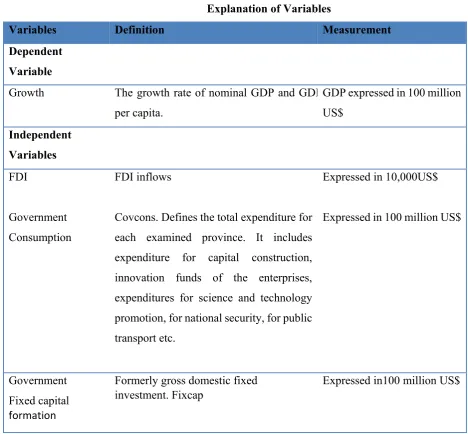
Table 2
Explanation of Variables
Variables Definition Measurement
Dependent Variable
Growth The growth rate of nominal GDP and GDP
per capita.
GDP expressed in 100 million US$
Independent Variables
FDI FDI inflows Expressed in 10,000US$
Government Consumption
Covcons. Defines the total expenditure for each examined province. It includes expenditure for capital construction, innovation funds of the enterprises, expenditures for science and technology promotion, for national security, for public transport etc.
Expressed in 100 million US$
Government Fixed capital formation
Formerly gross domestic fixed investment. Fixcap
Expressed in100 million US$
3. Data
(FDI), export (Ex), government expenditure (GE) and gross fixed capital formation (GFCF). The data for the research extracted from the World Bank database and expressed in millions from the year 1976 to 2017.
4. Findings and Analysis
Using the DW test (Durbin-Watson test), we tried to determine whether there is a link between FDI inflows and GDP in Seychelles. STATA a software for statistic and science was use for the calculations .The coefficient of determination r 2, measures the percentage of variation of the independent variables based on the deviation of the dependent variable.
Results of Durbin-Watson Test
Durbin-Watson d-statistic (4, 42) = 1.046418
The values obtained for the Durbin-Watson, are generally between 0 and 4. Indicator value 2 indicates that there is an autocorrelation between variables. Values between 0 and 2 show a positive autocorrelation and a value of the between 2 and 4, shows the negative autocorrelation, In our case
with for dependent variables and 42 observations our d. w. test results is 1.0464; which indicates
a positive autocorrelation between variables.
Estimated statistics for the dependent variable coefficients gross domestic product.
lnGDP Coefficients. Standard Error T Test P>|t| [95% Conf. Interval]
lnFDI .0494495 .030571 1.62 0.114 -.0124383 .1113373
lnGFCAP .2138443 .0406438 5.26 0.000 .1315652 .2961235
lnGCE .6947025 .0390257 17.80 0.000 .615699 .7737059
constant 2.048774 .3467977 5.91 0.000 1.346719 2.750829
Based on the equation (1), the relationship that expresses an aspect of macroeconomic balance, the calculations above, resulted:
lnGDP= 2.0487 + 0.04944.lnFDIi,t + 0.2138.lnGFCAPi,t+0.6947.lnGCEi,t
t test 5.91 1.62 5.36 17.80
R2 =98 Adjusted R2=98.59 F test =959.24
The results presented above show that lnFDI inflows have a positive impact on the gross domestic
product, with a coefficient of 0.04944. This means that an increase in lnFDI inflow by a single
unit will result in 4percernt proportionate increase in lnGDP. It suggest to achieve significant
economic development through foreign direct investment the country must campaign to attract more investors. The coefficient is positive, and highlights the positive impact of FDI inflows on GDP. From the table of analysis (Table 2) the impact of government consumption expenditure on
gross domestic product has resulted in a positive coefficient of 0.6947, which indicates a positive
influence of government consumption expenditure on gross domestic product in the Seychelles Island economy for the analyzed period. The econometric results revealed that, gross fixed capital
formation had a positive impact on gross domestic product. The value of 0.2138 obtained from the
analysis show its positive impact on GDP.
From our model, we can state three possible hypothesis.
The first hypothesis, which is a null hypothesis that ‘FDI inflows has no significant effect on Economic Growth in the Republic of Seychelles’. Using gross domestic product as proxy for
Economic growth; from the analysis, the t-value from the t-test in the case of lnFDI is 1.62. With
degree of freedom (d.f) of 3 and at 10 percent significant level, the calculated t-statistic compared
to the t distribution concludes the null hypothesis is true or is accepted. We will therefore not
considered any alternative hypothesis.
The second hypothesis is that “Government fixed capital formation (lnGFCF) has no significant
effect on Economic growth of Seychelles”; which is of course a null hypothesis. Here the calculate
t-value of lnGFCF is 5.6 which is greater than the t distribution. It implies that, we reject the null
The final hypothesis is whether government consumption expenditure has no significant effect on
Economic growth of the country. From the t-value government consumption expenditure (lnGCE)
of 17.80 is than the t-distribution, which means that government consumption expenditure has
significant effect on gross domestic product (lnGDP). We reject the null hypothesis and accept
the alternative hypothesis.
5. Conclusion
From the regression, results obtained shows that FDI inflows has positive impact on GDP. From in-depth, analysis FDI influences economic growth in The Republic of Seychelles Island. However to ensure significant growth the country must campaign for more foreign direct development inflow. There is also a positive correlation between FDI inflow and economic growth. Which connotes an increase in FDI inflows will lead to a proportionate increase in economic growth. However, it must be noted that dues to limited resources the impact of FDI inflows on GDP is relatively low compared to other major developing economies. The research revealed that government consumption expenditure has a significant effect on GDP in the country. Therefore, we recommend that the government should pay much attention to its spending.
Reference
Antras, P. (2004). Is the US aggregate production function Cobb-Douglas? New estimates of the
elasticity of substitution. Contributions in Macroeconomics, 4(1).
Barrell, R., & Pain, N. (1997). Foreign direct investment, technological change, and economic
growth within Europe. The Economic Journal, 107(445), 1770-1786.
Bilgili et al. (2012). The determinants of FDI in Turkey: A Markov regime-switching approach.
Economic Modelling, 29(4), 1161-1169.
Borensztein et al. (1998). How does foreign direct investment affect economic growth? Journal of
international Economics, 45(1), 115-135.
Echandi, R., & Sauvé, P. (2013). Prospects in international investment law and policy: world trade
forum: Cambridge University Press.
Gerring et al. (2011). Democracy, history, and economic performance: a case-study approach.
World Development, 39(10), 1735-1748.
Hewawasam, I. (2002). Managing the Marine and Coastal Environment of Sub-Saharan Africa:
Strategic Directions: The World Bank.
Iranah, P. (2018). Bridging Gaps between Conservation Action and Policy on Small Island
Mirowski, P., & Nik-Khah, E. (2017). The knowledge we have lost in information: the history of
information in modern economics: Oxford University Press.
Naidu, S. (2007). The Forum on China-Africa Cooperation (FOCAC) What Does the Future Hold?
China Report, 43(3), 283-296.
Read, R. (2008). Foreign direct investment in small island developing states. Journal of
International Development: The Journal of the Development Studies Association, 20(4),
502-525.
Seetanah, B. (2011). Assessing the dynamic economic impact of tourism for island economies.
Annals of Tourism Research, 38(1), 291-308.
Yueh, L. (2011). Enterprising China: Business, economic, and legal developments since 1979:
Oxford University Press.
Zhao et al. (2003). The impact of corruption and transparency on foreign direct investment: an
empirical analysis (1). Management International Review, 43(1), 41-63.
Abbreviation
FDI _______________________________________Foreign Direct Investment GDP______________________________________ Gross Domestic Product
SIDS ______________________________________Small Island Developing States