ABSTRACT
TREDWAY, RON, A Merger Case Study of Learning and Change: Exploring the Relationships Between Learning Styles and Change Orientation to Enhance Learning Interventions. (Under the direction of Paula K. Berardinelli)
This exploratory case study investigated the relationships between change orientation [readiness] scores and learning styles, of individuals within an organization undergoing complex change – mergers and acquisitions (M&A). The intent to understand where a learning intervention could be applied in a prioritized manner, in the area of greatest need – low change readiness, and most dominant learning style, was achieved. The study therefore adds to the change integration, and M&A literature, an exploration of individual change and learning tendencies and their collaborative use in intervention design and development, within an observed M&A environment; a medium-sized east coast company in the health sciences profession.
Understanding change readiness and ways to positively influence change outcomes in organizations dealing with complex change remains a strategic factor in helping
organizations realize synergies and achieve competitive advantage, especially in M&A environments. While learning interventions continue to be a primary strategy used by change organizations to influence effective change results, these organizations seek
intervention efficiency and effectiveness. Learning interventions based on learners’ [change recipients’] learning styles, helps ensure learning acceptance and application, which
enhances organizational change integration.
Bearley, 1986) and the Learning Style Inventory (Kolb, 1999), and analyzed using SAS 8.0 GLM. Qualitative data were collected through interviewing 10 randomly selected change recipients from the organization using a metaphor elicitation technique, and analyzed
through coding to understand cultural norms, employee learning needs, organizational goals, and perception of the acquisitions.
Investigation involved; 1) determination of the critical learning needs perceived by organizational managers and non-managers to ensure successful acquisition integration, 2) the identification of change readiness scores and learning styles of change recipients, 3) determination of how these scores and styles were distributed across the population investigated, 4) assessment of the relationships between change readiness scores and the individual learning styles among change recipients in the organization, and 5) assessment of the relationships between change readiness scores and demographic variables -
organizational entities, gender, age, race, function, management, and job change. Concluded from the analysis, three frequently mentioned learning needs for
Biography
Ron Tredway is a human resources and organizational development consultant with over twenty years of professional practice in multiple organizations. His involvement in starting, developing, reengineering, merging and acquiring, and shutting down business functions, has spanned military, telecommunication, banking, pharmaceutical, engineering, aviation and other organizations. Ron holds a Senior Professional in Human Resources (SPHR) certification from the Human Resources Certification Institute, and has served as an adjunct faculty instructor for three different universities in undergraduate, graduate, and continuing education programs associated with human resource management and organizational effectiveness over the last ten years.
Ron was born in Stuttgart, Germany to military parents who later settled in North Carolina. After graduating from Hayesville High School in western North Carolina, he too served in the military as an aviation electronics technician, supervisor and training manager. Subsequently Ron held several corporate positions of responsibility in human resources and line-management functions, before launching full-time into a consultative practice.
A passion for learning and leadership, as well as the development of others sparked Ron’s educational pursuits to earn a B.S. in Business Administration from North Carolina Wesleyan College, and a Masters in Business Administration (M.B.A.) from Campbell University, and ultimately this doctoral program in Training and Development. All three were completed while working full-time.
Following his doctoral completion, Ron plans to continue helping organizations improve their human performance, especially around change efforts. His endeavors are intentionally aimed at balancing his spiritual development, family interaction, consulting service, and adjunct contribution.
Acknowledgements
I thank God for His amazing love and provision of endurance, which allowed me to complete this work while experiencing four close deaths in the family and three major work transitions. Only by His grace, and the prayers of family and friends - I finished.
I owe tremendous gratitude to my wife Cathy, and my sons Aaron, Kyle and Scott, for their patience, understanding, and support during this process. Their unselfish
willingness to change schedules, make do with less, maintain quiet, as well as type, copy and sort research will never be forgotten. I especially thank Cathy for listening, encouraging, and persisting in those midnight hours.
I’d also like to express my sincere gratitude to the following people who have provided guidance and support in my learning journey, and in the successful completion of this research effort. I am grateful to my committee members Dr. James Burrow, Dr. Conrad Glass, and Dr. Don Martin. A special thanks goes to Dr. Paula Berardinella, my chairperson, who emphatically insisted on attention to detail, practical application, and most of all, continuation in the midst of frustration.
A real thanks goes to all the men of CBMC for never failing to encourage me and pray for me along the journey. Patrick O’Neal, Jim Chenet, Ellis McCoy, Mark Hoffort, Dan Huffman, Steve Zimmerman, Tyler Tibbits, Bruce Whitt, and so many others that helped keep the fire alive – I am grateful. Likewise, I thank Dr. Gene Wilkes, Dr. Carol Lorenz, Dr. Tony ODriscoll, Dr. Wayne Matthews, Glynn Graves, Steve Hopper and the late Dean Tom Folwell for their affirmation and support.
Table Of Contents
List of Tables . . . vii
List of Figures . . . ix
Chapter 1. Introduction . . . 1
Problem Statement and Background . . . 2
The Purpose and Questions . . . 4
Limitations of the Study . . . 6
Assumptions . . . 6
Significance of the Study . . . 7
Definition of Terms . . . 8
Chapter 2. Literature Review . . . 13
Organization Change . . . 13
Organizational Behavior . . . 16
Human Reaction to Change . . . 17
Human Behavior Theory . . . 20
Organizational Change Readiness . . . 22
Resistance . . . 23
Change Orientation . . . 25
Change Interventions . . . 26
Organizational Awareness . . . 27
Organizational Learning . . . 29
Learning . . . 32
Learning Theories . . . 32
Adult Learning Theory . . . 40
Learning and Change . . . 43
Learning Styles . . . 44
Individual Differences . . . 45
Assessment and Application . . . 46
Learning Interventions . . . 49
Intervention Design . . . 50
Theories of Instruction . . . 52
Curriculum Design . . . 54
Mergers and Acquisitions . . . 56
Need for Synergy . . . 56
M&A Complexities . . . 57
The Human Side . . . 60
Chapter 3: Methodology . . . 62
Framework . . . 63
Research Questions . . . 63
Research Design . . . 64
Target Population . . . 65
The Sample . . . 67
Instrumentation . . . 68
Organizational Change Orientation Scale© (OCOS) Inventory . . . . 68
Learning Style Inventory©(LSI) . . . 71
Data Collection Procedures . . . 73
Survey . . . 75
Interviews . . . 79
Data . . . 83
Change . . . 83
Learning . . . 83
Data Analysis and Statistical Procedures . . . 85
Chapter 4: Results . . . 90
Introduction . . . 90
Descriptive Statistics . . . 90
Change . . . 91
Learning . . . 94
Entities . . . 96
Functions . . . 99
Research Question One . . . 104
Description of Participants . . . 104
Summary of Responses . . . 105
Research Question Two . . . 108
Research Question Three . . . 109
Research Question Four . . . 110
Research Question Five . . . 111
Gender . . . 111
Age . . . 112
Race . . . 114
Manager . . . 115
Function . . . 115
Job Change . . . 116
Chapter 5: Conclusions and Recommendations . . . 118
Conclusions . . . 119
Conclusion #1 . . . 119
Conclusion #2 . . . 121
Conclusion #3 . . . 123
Conclusion #4 . . . 124
Conclusion #5 . . . 124
Summary . . . 127
Recommendations . . . 128
BigOrg . . . 128
Future Research . . . 129
References . . . 130
Appendices . . . 142
Appendix A . . . 142
Appendix B . . . 143
Appendix C . . . 144
Appendix D . . . 145
Appendix E . . . 154
Appendix F . . . 156
Appendix G . . . 157
Appendix H . . . 158
Appendix I . . . 159
List of Tables
Page
2.1 Learning Theories . . . 32
2.2 Laws of Learning – Thorndike . . . 34
2.3 Gestalt Psychology Principles . . . 36
2.4 Andragogy . . . 40
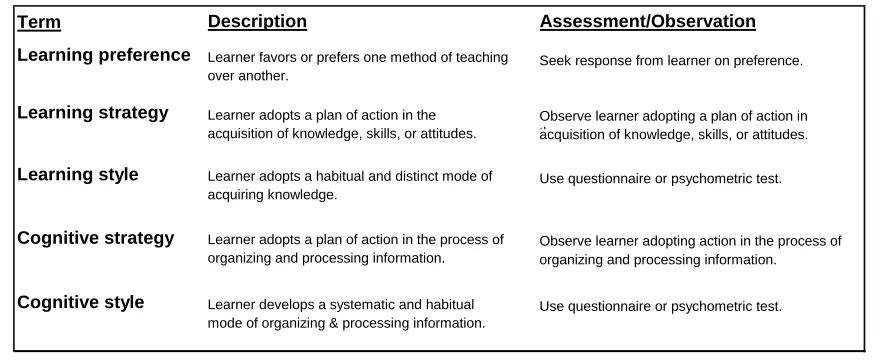
2.5 Learning Style Terms . . . 47
2.6 Learning Activity Suggestions . . . 51
2.7 Instructional Theory for Learning Interventions . . . 52
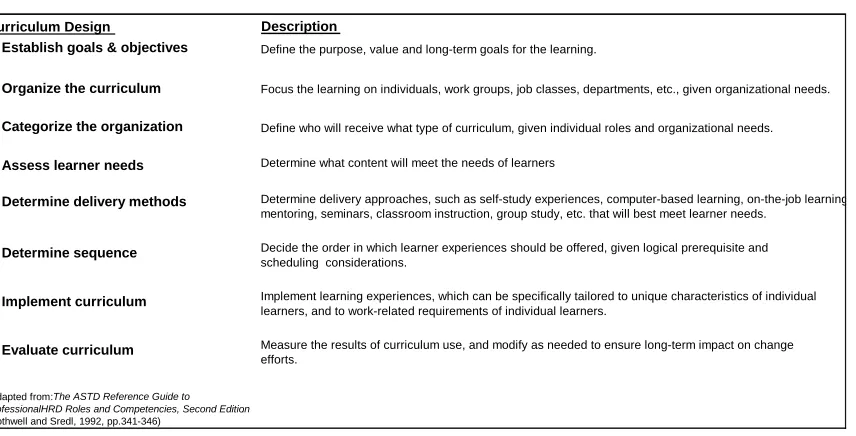
2.8 Curriculum Design Factors . . . 54
3.1 Cronbach’s Alpha on LSI . . . 72
3.2 OCOS Categories . . . 83
3.3 Learning Mode Calculations . . . 84
3.4 Learning Mode Continuum Calculations . . . 84
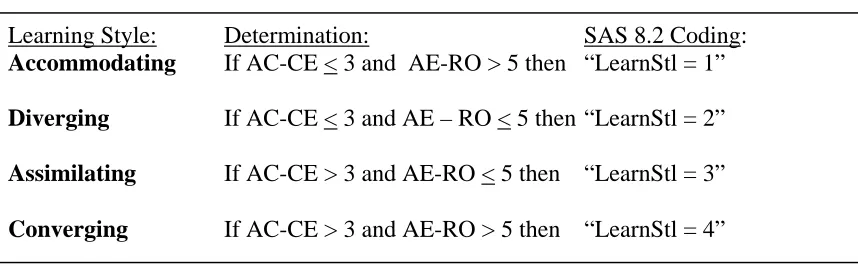
3.5 Learning Styles Determination . . . 85
4.1 Mean Change Scores for BigOrg . . . 92
4.2 Change Item Mean Scores by Change Behavior Type . . . 92
4.3 Change Item Mean Scores for Impaired Change Behavior . . . 94
4.4 Change Readiness Scores by Function . . . 100
4.5 Interview Participant Demographics . . . 104
4.6 Change Score Means and Standard Deviations for Organizational Entities 108 4.7 Change Scores by Learning Style Groups . . . 109
4.9 Mean Readiness and Impaired Change Scores by Age Groups . . . . 112
4.10 Mean Readiness and Impaired Change Scores by Combined Age Groups 113 4.11 Mean Readiness and Impaired Change Scores by Race . . . 114
4.12 Mean Readiness and Impaired Change Scores by SupvMgr . . . 115
4.13 Mean Readiness and Impaired Change Scores by Function . . . 116
List of Figures
Page
1.1 Conceptual Model-Organizational Change and Learning . . . 5
4.1 Impaired Change Behavior Mean Scores . . . 93
4.2 BigOrg Learning Modes Aggregated for Change Recipients . . . . 95
4.3 BigOrg Learning Styles Aggregated . . . . 96
4.4 Mean Change Readiness Scores by Organizational Entity . . . . 97
4.5 Org3 Learning Modes Aggregated for Change Recipients . . . . 98
4.6 Learning Styles by Organizational Entity in Relational Proximity . . . . 99
4.7 Learning Styles by Function in Relational Proximity . . . 101
4.8 Learning Styles Found Among Low and High Readiness Functions . . 103
Chapter 1: Introduction
People are dealing with change in organizations all the time (Burke, 2002) and with increased intensity and complexity (Senge, 1990). Effective integration of frequent and complex organizational changes relies on human readiness to change (Burke, 2002), and the way in which the people involved learn what is needed, learn how they influence the change integration content and process, and learn how to make the change work (Burke, 2002).
Learning is inherent in the change process (Rajagopalan and Spreitzer, 1997) where organizations are integrating new processes, programs, technologies, structures, or other similar changes. Whether learning to cope with the agony of a downsizing requirement, or learning critical new steps of a reengineered customer relationship management process, or learning how to realize synergies from integrating two distinct organizations following a merger and acquisition (M&A), the individual learning focus is important to achieving successful organizational outcomes (Marks, 1994). According to Marks (1994), such learning is needed throughout the period following a merger announcement until full integration is realized.
specific interventions that consider needs and perspectives at the individual level, and can be aggregated toward a group norm for organizational assessment.
Learning interventions are most effective when individual learning styles are applied to the design and development of the interventions (McLoughlin, 1999). This helps ensure the needs and application of learning material match with the cognitive styles of those engaged in the learning process during the change integration. Matching style to the development of critical learning materials increases the usability of material (McLoughlin, 1999), and may have a positive effect on individual change readiness, based on how recipients perceive the change (Senge, 1990).
Effective learning interventions applied in organizations experiencing change lead to more effective change integration. Applied learning is realized in organizational results. When the results being measured are related to the change occurrence, then the applied learning produces positive change outcomes or behaviors (Marks, 1994), which help indicate successful change integration. When learning interventions are not effectively applied, organizational results are negative, meaning the financial goals are often missed, the products don’t perform as well as expected in the market, and customer loyalty often
diminishes (Marks, 1994).
Problem Statement and Background
offer insights that help human resource developers of learning or training interventions, prioritize design and development requirements, such as materials and delivery methods, and perhaps offer insights for new approaches to development specific to change integration actions for organization development professionals.
Burke (2002) has described change readiness theories, techniques, and measures of success. Galpin (1996), like Burke (2002), has further explored the human impact of change, and ways to address organizational issues such as achieving critical mass, that is, achieving enough human acceptance and buy-in by the change recipients that the change can occur with expected business results. Jones and Bearley (1986) associated change readiness with individual change behaviors they called change orientation. French and Bell (1984) have linked change and learning at the organizational level, to explain key attributes of the change process and key measures of human performance. Robbins (1997), and Bowditch and Buono (1997) have linked cognitive style, perception, and personality typing to individual change readiness. Kolb (1984), who developed and tested experiential learning theory and
individual learning styles within an organizational context, also linked learning styles to learning intervention development supporting performance improvement outcomes [integration]. Yet the key thematic link between change readiness and individual learning style has not been empirically explored.
Developing learning interventions for all the major learning styles is theoretically desirable, in most learning situations. However, sometimes the resources, such as
developing materials, activities and approaches (McLoughlin, 1999), could a method for determining design and development priorities be beneficial to curriculum designers, developers, and evaluators?
The Purpose and Questions
The purpose of this study was to examine the relationships among individual change orientation [readiness] scores, individual learning styles as a measure of new information processing, and select demographic attributes, of individuals within an organization
Research Questions
The research questions investigated were as follows:
1. What are the critical learning needs perceived by organizational managers and non-managers to help ensure successful acquisition integration?
2. Is there a significant difference between Org1 (the original organization) and each of the other organizational entities with respect to their mean change readiness scores?
3. Is there a significant difference between four groups of change recipients,
Accommodating, Diverging, Assimilating, and Converging, with respect to their change readiness scores?
4. Is there a significant difference in mean scores between learning style groups and the three aspects of change orientation?
5. Is there a significant difference in change readiness and impaired scores between the demographic groups of gender, age, race, job function, manager, and job change?
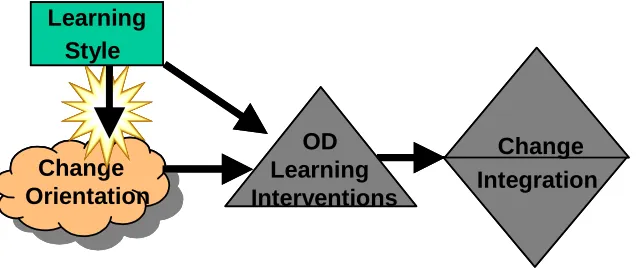
By investigating the relationships between learning styles and change readiness, this researcher sought to understand if there was an observable trend of one learning style having a higher, or lower, level of readiness associated with it among the population, which could be useful in suggesting learning intervention development, or prioritization of development for learning interventions. The conceptual framework is depicted as follows:
Change Orientation
Learning Style
OD Learning
Interventions Integration Change Change
Orientation Learning
Style
OD Learning
Interventions Integration Change
Investigating the relationship between change readiness scores and the target and acquiring entities adds to the merger and acquisition literature on how individuals reacted to change in this particular context, and provides a framework for other such studies.
Investigating the relationship between change readiness scores and learning styles prevalent in the merger organization enables concise focus of learning intervention development, adding to the literature on training, organization learning, and organization development. The demographic variables were investigated based on evidence of their importance found in the merger, change, and learning literature, as described in the literature review.
Limitations of the Study
The study focused on the relationships between the specific responses of change recipients in a merger organization on two defined instruments. Further, the investigation was aimed at examining the individual responses to learning styles and change readiness at one point in time. The intent was to understand where a learning intervention could be applied in a prioritized manner, that is, prioritized for application in the area of greatest need – low change readiness, and most dominant learning style.
Assumptions
Learning styles research describes the historical acknowledgement of learning styles as a variation on cognitive styles, which serves to reflect certain human characteristics inherent in the learning process, individually and within organizations. The use of a learning styles assessment instrument serves to identify key learning characteristics of change
The use of a change orientation assessment instrument serves to identify individual change recipient perception of change, and the recipients’ self-reported behavior during the organizational change. Using the change orientation scores derived from the assessment, allows for both composite characterization of the group norms, and for identification of critical behavior characteristics that could be addressed during the development of learning interventions. A learning activity on behaviors associated with human resistance to change, using personal experiences from change recipients was one possible example.
Change integration, while distinctly different for each organization, represents the collage of organizational results associated with completing the change as specified and planned. The variety of ways to identify, to assess or measure, and to report the actual results of the organizational change effort are beyond the scope of this study.
Significance of the Study
Learning interventions that match learners’ needs and are subsequently applied by those learners to daily job tasks and activities in organizations enable organizations to achieve optimal goals and gain competitive advantage. Such goal achievement and competitive advantage gain are key to successful organizational change efforts. By
understanding the relationships between learning styles and change readiness of the change recipients, learning interventions can be developed in ways that more effectively match the learners’ needs.
2002), no study was found that explored the relationships between learning styles and change orientation [readiness] scores of individuals experiencing organizational change. The outcomes of such a study, provides useful information for organizational leaders,
organization development (OD) professionals, and instructional designers creating learning interventions that more closely align with the instructional style needs of the change
recipients. The outcomes may also be useful in prioritizing development of materials and activities to support increased readiness levels in the change process.
Definition of Terms
The following terms used in the literature are included in this study. The reader may find that within each term some distinctions are identified between different authors, while carrying a contextually same or similar meaning.
Carnall, 1991) and transformation (Senge, 1990; Carr, Hard and Trahant, 1996) are found to be used with the same meaning.
Change orientation – tendencies of individuals to behave in predictable ways in response to change within a contextual framework, e.g.: organization after merger announcement (McKee, 2000; Jones and Bearley, 1986).
Change process – relates to the steps or phases an organization, and therefore the individuals in it, go through in the transition from the current state, or status quo, to the desired future state, as envisioned to be how things are supposed to be after the change (Carr, Hard, and Trahant, 1996; Connor, 1992; Lewin, 1958).
Change readiness – describes the level of commitment by members of the
organization, or change recipients, to fully implement the change process in such a way that the desired state is internalized in the daily behaviors of the organizational members. The opposite is resistance (Connor, 1992; Carr, Hard, and Trahant, 1996).
Change Recipient – is an individual involved in the change process in a way that makes her or him vulnerable to the outcomes of the organizational change. For example, the user of a new computer system would be vulnerable to new skills requirements. A middle manager, for example, could be vulnerable to an organizational restructuring change targeting level reduction and communication improvements.
Learning intervention – describes a type of organization development action, called intervention, which focuses on the learning needs of the individuals within the organization, for the purpose of improving organizational performance (French and Bell, 1984).
(1999), many researchers see learning style as a coherent whole that learners employ in their learning orientation, which may be attributed to underlying differences in personality and cognitive functioning. Kolb (1999a) offers a measure of four learning styles useful in identifying differences in learning needs among organizational members.
Organizational change – describes a set of activities or actions by the organization and its members, to embark upon a change in some aspect of the organization to meet strategic objects of the business. Examples include structural changes, technology changes, process changes, product portfolio diversification changes, leadership changes, policy and practice changes, and cultural changes (Burke, 2002).
Structural changes, which modify reporting relationships among the people in the organization, may appear in downsizing, restructuring, or revitalizing terms, while the intent is the same…move people in, out, or around. Technology changes are typically denoted by major equipment and/or software installations into the organization to enable or support the strategic business objectives. Process changes are often discussed as reengineering of business processes, to streamline process steps for greater efficiency in meeting strategic business goals (Carr, Hard, and Trahant, 1996). Merger, as a type of complex change, tends to involve combinations of these changes (Burke, 2002).
& Montgomery, 1997). However, some organizations, like the one in this study, prefer using the acquisition terminology.
Effectiveness - is defined in this study as the ability of the individual or organization to deliver on commitments in a timely manner to meet the strategic business requirements of the organization at the least cost and highest possible quality standard to maintain a
competitive advantage. In other words, doing the right thing as well as doing things right (Bowditch & Buono, 1997), are both important.
Merger – A term used conclusively to describe the action taken to bring two distinct and separate organizations of different financial corollaries together into a single unit of shareholder equity (Robbins, 1997). The financial distinction is made relative to generally accepted accounting principles (GAAP), where the separate organizations are recognized by investment and taxation entities as having solely separate and distinct assets and liabilities for the purpose of sustaining individual portfolios in their organizations’ mission. They may or may not be publicly traded at the time of their merger, although almost all historical cases reflect at least one out of the two to be publicly traded on a major stock exchange (Robbins, 1997; Gaughan, 1996).
Target –another term used to describe the company being acquired. The term is most familiar since the early 1980s when multiple simultaneous deals were being investigated, as a way to quickly grow a business. The “target” of an investigation for possible buy-out was considered fitting of the definition, whether acquired or not. A
Chapter 2: Literature Review
This study is focused on examining the relationships between learning styles, as a measure of individual learning differences across an organization, and change readiness measured by individual change orientation, within an organization change environment – M&A. The literature reviewed as relevant to this study includes writings and publications specific to organization change, human reaction to change as it relates to individual and organizational readiness, organizational change interventions, learning theory, learning interventions as they relate to achieving organization change, and learning styles. Given the focus on merger type change, literature on merger and acquisition concepts is reviewed.
Organization Change
Organization change is as old as organizations and their formations (Burke, 2002). The first organization change found in the Old Testament (The Holy Bible, 1984) reflected the establishment of a pyramidal organization. Having led the Israelites in their escape from the tyranny of the Egyptian pharaoh, Moses as leader of the people dealt with many social system issues (Burke, 2002), and had thousands with direct access to him. Following the suggestion of Jethro, his father-in-law, they reorganized the distribution of labor to assist Moses in focusing on higher-level strategic matters. The Holy Bible (1984) states,
Galpin (1996) also suggests change is not new to organizations. Mergers, downsizing, restructuring, and process reengineering have surfaced a greater level of
consciousness toward technical, financial and operational changes in organizations. With the variety and complexity of organization change increasing, the study of organization change has gained momentum, in an effort to find what systematically seems to facilitate and enhance effective change (Burke, 2002), that is, the accomplishment of planned change goals.
Hellriegel, Slocum and Woodman (1989) use the term “management of change” (p.29), which they define as “adapting an organization to the demands of the environment and modifying the actual behaviors of employees” (p.29). They go on to suggest that if employees resist the change, and do not change their behaviors, the organization cannot change (Hellriegel, Slocum and Woodman, 1989). This relates to Burke’s (2002) notion that the study of organization change must also include, “…what leads to failed attempts at organization change” (p.19).
Nadler and Tushman (1986) describe ten principles that can facilitate and enhance organizational change efforts, which include the following:
1. The diagnosis principle – aimed at analyzing the organization in its environment, understanding its strengths and weaknesses, and analyzing the implication of
anticipated changes. Solid diagnostic thinking and applied learning is needed to meet the challenges of surrounding forces, and to anticipate responses.
2. The vision principle – where casting vision of what the organization will look like at a future date after the change is the main focus. Deals with rationale for why the change is occurring, articulation of importance for stakeholders, description of core values that drive the change, setting performance objectives, casting organization structure and processes, and describing operating style or norms.
3. The energy principle – reflects the need for a sense of urgency, in the midst of inherent resistance to change in organizations. It involves helping reorient people in the organization by anticipating responses and launching proactive information about assumptions likely made about the current situation.
4. The centrality principle – suggests the change must be so central (applicable) to the vision and strategy that people are compelled toward it. Employees must be able to see the clear connection between the organizational requirements and individual needs.
6. The magic leader principle – focuses on the leadership attributes as critical for successful change. Effective attributes are highlighted as envisioning, energizing, and enabling.
7. The leadership-is-not-enough principle –reflects the need for investment in an effective team, not just a single leader.
8. The planning-and-opportunity principle – suggests effective change is guided by a process of iterative planning. “Planned organizational change involves a good deal of learning …and this learning can and should shape the development of the vision and reorientation.” (p.236)
9. The many-bullets principle – recognizes the need for interaction between
organizational and individual behavior, and therefore use different devices to change behavior. The authors further reflect:
“This involves planned changes in strategy, organizational structure, processes, and individual skills,
attitudes, and perceptions.” (p.237)
10.The investment-and-return principle – concerns the amount of effort and resources required to achieve a successful change effort.
Organizational Behavior
Robbins (1993) contends that although psychology studies human behavior around motivation, perception, and learning, and sociology studies people interacting in complex organizations, it is social psychologists that have investigated change and barriers to its acceptance [resistance] (p.18). Anthropology investigates cultural aspects of organizational life, while political science studies conflict structures pertaining to individual self-interest and organizational roles (Robbins, 1993).
Prevalent in the organizational behavior literature is the conceptual linkage between organizational change and organizational learning (Vasu, Stewart, and Garson, 1998). For example, Argyris (1990) suggests a learning metaphor to describe alternative change models, and Senge (1990) conveys the mental model, one of cognitive processing, of systems thinking, as a learning system within organizations, especially recognizable in change environments. While these models and perspectives of change and learning are explored relative to their impact on organizations, other OB literature describe the individual aspects of change (Galpin, 1996) such as reaction to change (Argyris, 1990), fear associated with change (Dellcave, 1996; Argyris, 1990), and organization dependency factors (Lewin, et al., 1944) by individuals experiencing organization change. Each are briefly described, and are important to understanding change orientation behaviors and the linkage to individual learning and learning style difference relationships. These constructs are supported by human behavior theory.
Human Reaction to Change
perceived is greater than the person is willing to assume. As such, the person is likely to cover up the true intended message and action, to gain a more favorable position with the recipients, and further cover up the cover up.
“Human beings are not usually motivated to produce what they do not wish or intend” (Argyris, 1990, p.87)
Argyris, in his research on overcoming organizational defenses (Argyris, 1990), describes the process of risk avoidance and hiding reality within organizations as “designing human errors” (p.71-75). Much like instilling a defect into a manufacturing production line, through faulty materials, malfunctioning equipment, process degradation or incompetent labor, the author refers to the introduction of human error into the behavioral interaction process of highly motivated and competent professionals. The two ways these errors happen in organizations are described as:
(1) Individuals are not aware of producing error while doing so.
(2) Individuals know they are producing error but have figured out a way to make the error look as if it was not an error.
This seems to parallel the Organizational Change Orientation Scale (OCOS) model developed by Jones and Bearley (1986), as reflecting non-functional and dysfunctional behaviors. Non-functional behaviors were associated with hiding [withholding] key information needed to make effective decisions, and dysfunctional behaviors were associated with sabotage [induced errors].
The Fear Factor
business. The difficulty was in attempting to move people who were content with current circumstances and job aids to processes and technology in which they were uncomfortable.
The fear found by Dellcave (1996) and Argyris (1990), is related to uneasiness in changing from what is known to work for the individual, to something unknown. The uneasiness can often turn to paranoia, which disrupts the work flow and negatively impacts the organizational effectiveness. Cited reasons for such a dilemma are the generational differences in which people have faced changes, how they perceive their outcomes based on prior experiences, and how the change is perceived in terms of personal value to them (Dellcave, 1996). It then appears age, as a depiction of generational differences, and prior change experience, such as job change, are important factors to observe in understanding change and learning relationships and are therefore included in the demographic aspect of this study.
The Dependency Factor
People also react to change based on their need and perceived fulfillment of
psychological success and failures (Lewin, et al, 1944). The amount of psychological energy a person has for a task, is strongly influenced by the degree of psychological success and failure experienced. Therefore, the more successful, the more energy exists. Conditions in the environment, such as communication, management support, and training opportunities influence individual perception, such that a level of dependency on the organization is used to cope with incongruities (Perry, 1984, p72).
reducing their dependence on the organization almost totally. All five examples are representations of levels of dependency by an individual on the organization. Taking time off would include absenteeism and prolonged time spent elsewhere. Psychological departure is recognizable as a person still performing in a role, yet it is clear to everyone their heart and passion are not in it (Chang, 2000). Psychological departure might depict non-functional behavior, while absenteeism could represent dysfunctional behavior (Jones and Bearley, 1986). Orth (2002), for example, in studying change-influencing factors in a financial organization, found a highly significant correlation between communication, supervisory support, learning interventions, and positive retention efforts.
Human Behavior Theory
The theoretical basis of this study includes the human behavior construct, and the channels that motivate sustained and desired behavior within the organizational
environment. When dealing with the question of how people effectively adapt to merger related changes, answers can be found in human motivation theory (Robbins, 1997; Galpin, 1996; Carnall, 1991), with development toward global perspectives and situational
perspectives.
Maslow’s model of hierarchy needs (Maslow, 1954) offers insight on individual feelings of security and acceptance, as a means of energizing individual behavior. These areas in particular are surfacing around merger integration, in the form of fear and role clarification. Recognition and identification of individual needs within an organization for the purpose of motivating behavior is important to successful integration (Hildebrand, 1996).
As a process theory, Vroom’s (1964) model identifies three components that motivate a worker. First, it is commonly believed within the environment that increased effort leads to good performance. Second, that the perception exists that good performance will lead to certain outcomes or rewards. And third, that the perceived value of the outcome or reward will partially determine the motivation of action by the individual. In a merger, performance based outcomes and expectations may shift significantly (Burke, 2002), which impact individual motivation (Galpin, 1996).
are no longer viewed as the key influencers they once were (Katz and Kahn, 1978), they prefer to resist such a change.
Organizational Change Readiness
Behaviors associated with organization changes reflect resistance and readiness relative to the organization and individual (Robbins, 2001). Organizational readiness for change, that is, the organization is ready to manage and sustain the change, is depicted in Lewin’s (1951) three-stages of unfreezing, movement, and refreezing. Unfreezing relates to dislodging the area that needs to change from the “norm” or routine so there’s opportunity to do things differently. Movement, refers to changing the way things are done, while
refreezing relates to integrating the change into the normal daily routine and sustaining it over time.
Nadler and Tushman (1986) also suggest that organizations go through stages when dealing with change. Their model seems to expand on that of Lewin (1951), to include awareness, experimentation, and understanding to be part of unfreezing, while commitment, education, and application appear to reflect movement. Integration into ongoing behavior reflects the same perspective as refreezing. Specific definitions in the model are as follows:
1. Awareness – organizational members become aware of the need for change, and seek to understand what the change is about.
2. Experimentation – on a small scale, efforts are made to try the change.
4. Commitment – the leadership makes visible commitment to the change, through personal action.
5. Education – employees experience transfer of skills toward the new way.
6. Application to leveraged issues – the new approach and perspective is applied to key issues in the organization, which need resolution.
7. Integration into ongoing behavior – the new approach, or change, becomes a normal routine, or occurrence within the organization.
Bridges (1991) uses a model similar to Lewin (1951) to describe individual readiness for change (Robbins, 2001), suggesting three stages individuals go through in dealing with changes. Ending is the stage where the individual recognizes something has stopped or ended, and therefore will never be the same again. This marks the transition into the change, and the initial reactions, such as fear, dependency, and resistance mentioned before. The second stage, the neutral zone, is a stage where the individual experiences a lot of questions, to which answers are sought. New beginning is the third stage, where the individual
recognizes possibilities about the change, and becomes more actively supportive rather than resistant to the change.
Resistance
were related to cost, existence, quality, and outcome. Findings from the study identified potential obstacles [barriers] to the change effort, such as lack of resources, and in one case, in VA hospitals, lack of training.
Further, Kennedy (2002) conducted a longitudinal case study in a Fortune 100 manufacturing organization between 1999 and 2001 to test change readiness from a change response perspective. Using the change type, that is, short-term or long-term change efforts, and the change readiness literatures as a conceptual framework, the researcher linked two aspects of organizational change, change readiness and change type, such as merger, to the successful change outcome, or integration.
As Kennedy (2002) describes, organizational change is comprised of change type, readiness, process, and resistance to change, and studies the link between the first two. This study focuses on the resistance to change in individual behaviors, within a specific change type, and its influence on readiness.
The Kennedy (2002) study tested if a directive performance management style would be most effective with a long-term radical change and a supportive management style would be most effective for a short-term continuous improvement change in the organization. While the study failed to support the hypothesis, it highlighted the measure of change readiness as being four primary factors; leadership, management style, performance management systems, and communication intention. Communication [information processing] and manager style also appear in the learning and learning style studies (Johnson, 2001).
Other studies have addressed the individual readiness perspective within
longitudinal study of 654 hospital staff regarding the occupational risks of change, ability to cope with change, job-related problem solving and readiness for organizational change. The organizational change readiness component was related to individual propensity to accept and support change. Results indicated high change readiness scores, as used in this fashion, along with active job-related problem solving were the best predictors of participation in redesign activities during a long-term change effort. Similarly, Orth (2002) studied
individual factors of organization change readiness among 500 state government employees involved in the implementation of a new performance evaluation system and a new
performance-based pay system. Change readiness measures were on self-reported behaviors. The study found readiness for change, as a measure of behavioral attributes, to be the best predictor of commitment to change and support for change, as well as resistance toward the change. Specific behavioral attributes were those behaviors focused on ‘change support’ and ‘change resistance.’ These seem to correlate with the individual change behaviors,
functional, non-functional, and dysfunctional used by Jones and Bearley (1986).
Change Orientation
The research on change orientation is focused on the behavioral attributes of individuals experiencing change that identify where the individual is moving toward or away from the desired change behavior. Orth (2002), suggests a two-factor model; support and resistance, where the individual behaviors either reflect more support and less
likely aligned with Lewin’s (1951) refreezing stage relative to the organization and Bridges’ (1991) new beginnings stage relative to individual change. A high score on ‘non-functional’ would most likely represent movement and neutral zone stages of change respectively, while a high score on ‘dysfunctional’ would most likely suggest more resistance, and alignment with unfreezing and endings stages respectively. Both Lewin (1951) and Bridges (1991) suggest an organization, and an individual, must progress through the change stages in sequence, that each stage takes time, and that the time in each stage is different for each organization and each individual. Therefore, the study of individual differences, and the aggregation to the organizational level, is important to adding depth and breadth to
understanding organization change, the people side of change, and complex merger changes. Lourens (2002) for example, studied the change orientation and leadership attributes of 879 senior managers in five different organizations. The study found significant
relationships between change-centered leadership orientation and emotional intelligence leadership attributes of self-motivation, empathy, and self-awareness. Also interesting, the demographic variables of race, educational level, number of people the leader is directly responsible for and functional group were found to be significant predictors of the change-centered orientation.
Change Interventions
The term is often used to refer to any learning technique or method available to the practitioner. Thus, any one of the extant methods available, what Burke and Hornstein call “the social technology of OD,” is an intervention according to this use…The technology of OD consists of educational activities, methods, and techniques; some “things to do” and some “things to be sure not to do”; questionnaires, observation and interview schedules, and so forth. Any of these can appropriately be considered an intervention when it is used to bring about organization improvements. (p.121)
The emphasis on educational activities, methods, and techniques is supported by Burke (2002), who also makes a connection between change and learning, related to interventions and their use in bringing about change. French and Bell (1984) suggest there are “assumed underlying dynamics of change and learning” (p.133) useful and necessary in categorizing and choosing OD interventions, that is, interventions used to bring about change needed in the organization. Features of different interventions “that may be causally related to learning and change” are also presented by French and Bell (1984). These five features include feedback, awareness of changing socio-cultural norms or dysfunctional present norms, increased interaction and communication, confrontation, and education.
Organizational Awareness
French and Bell (1984) emphasize the need for further study of organization change and the development of effective OD interventions supporting the five categories introduced above. They contend,
We are only beginning to understand the underlying mechanisms of change interventions. As that knowledge increases, greater precision in the selection of intervention activities will be possible. The issue can be stated as follows: OD does in fact work; why it works is less well known and understood. (p.134)
In support of deeper understanding of OD change interventions, French and Bell (1984) further classified change interventions as those that focus on; 1) team improvement, 2) inter-group relations improvement, 3) personal, interpersonal and inter-group processes, 4)
stated to be intervention activities that are “techniques and methods designed to change the culture of the organization, to move it from ‘where it is’ to ‘where it wants to be,’ and generally enable the organization members to improve their practices so that they may better accomplish their goals” (p.138).
An example of the use of ‘inter-group relations improvement’ and ‘structural’ change interventions, was used in the study by Halmo (2001) to assimilate smaller groups, 16 Numic Indian tribes, into a larger group, an incorporated entity. The study looked at the 1) role of corporate and organizational structure in articulating the social relations between the contending groups, and 2) shifts in the distribution of power as a result of changing the environment. Overall findings were significant for culture change understanding, in helping the individuals involved in the change [recipients] work toward improved collaborative practices.
Burke (2002) relates to the work of Blake and Mouton (1968) when these researchers applied a six-phase grid model to organization change and referred to it as the “grid
organization development” (Burke, 2002, p.37). As Burke highlights, the two most common barriers to organizational effectiveness considered by organizational managers in Blake and Mouton’s (1968) study were communication problems and a lack of planning. Seen as symptomatic and not causal (Blake and Mouton, 1968), these findings were determined to be as a result of a lack of effective strategy, and ineffective style and approach to
supervision and management (Burke, 2002). Burke (1994) relates this to organizational learning.
Blake and Mouton never state it, but they apparently assume that, unless an organization learns how
to communicate more effectively and plan more logically and systematically, its management will
never be able to deal optimally with the specifics of running a business. (p.121)
Organizational Learning
The underlying premise presented by French and Bell (1984) related to these OD change intervention classifications can best be summarized in their attempt to “examine techniques involved in applying behavioral science theory and practice to changing and improving ongoing systems” (p.120), and to offer guidance on change intervention selection and use to support furtherance of learning. In guiding selection and use, French and Bell (1984) pose some situations and subsequent questions regarding application of OD interventions, which have a direct connection to learning.
We are dealing with individual behavior right now; how can this learning be translated to learning for the group?
We are dealing with group phenomena right now; how can this learning be translated to learning for the individuals?
We have just learned about a phenomena by experiencing it; what theoretical or conceptual material would augment this learning?
We are dealing with issues and forces impinging on this group from outside the group; what
activities must be designed to facilitate more appropriate handling of these interface issues? (p.135)
The first situation links individual behavior concerns happening in the organization to organizational learning (Senge, 1990; Argyris, 1990), that is, learning that is happening in the organization as to how the behavior is accepted or tolerated. The second situation identified by French and Bell (1984) links the identification of group norms and behaviors, to the opportunity and need for individual learning. The third situation links experiential learning, that is, things learned from a specific experience, to interventions that enhance the learning. The fourth situation links the occurrence of external forces on the organization, such as system wide change (Burke, 2002; Senge, 1990) to the design and implementation of interventions that facilitate, or enhance, the implementation of the change.
when applying new sciences change theories of learning and self-organizing as change interventions. These findings imply a need for further exploration of how individuals learn and behave within organization change environments where chaos and complexity can influence strategic change interventions.
French and Bell (1984) support the use of Michael Beer’s (1980) decision making framework for determining selection and integrated use of OD interventions when dealing with organization change. These decision rules, which support the use of the Learning Styles Inventory and Organizational Change Orientation Scale (OCOS) assessments as distinct, and as a combined intervention, are described below.
1. Diagnostic data – interventions that will provide data needed to make subsequent intervention decisions should come first,
2. Maximize effectiveness – interventions that develop readiness, motivation, knowledge, or skills required by other interventions,
3. Maximize efficiency – interventions should conserve organizational resources such as time, energy, and money. (Interventions not needed by certain people or parts of the organization would be a violation.)
4. Maximize speed – interventions should maximize the speed with which organizational improvement is attained.
5. Maximize relevance – interventions that focus on immediate organization performance or task come before those aimed at individual and culture impact.
6. Minimize psychological and organizational strain – interventions that are least likely to create dysfunctional effects such as anxiety, insecurity, distrust, dashed expectations, psychological damage to people, and unanticipated and unwanted effects on organizational performance. (p.136)
French and Bell (1984) also suggest that successful OD change efforts require a strategy that can be articulated and made visible. They further say, “the [change] process can be
Relative to change management in change organizations, individual and
organizational learning is a tool for influencing more effective change (Senge, 1990; French and Bell, 1984). By being attentive to the learning potential, opportunity, and outcomes, an organization can reduce its organizational defense pattern (Argyris, 1990) and influence adaptation more effectively. The defense pattern is the emerging behavior that results from accepting the status quo, or by leaving things to chance. Argyris suggests “applying learning principles” (p.68). Simple actions in meetings, performance of work, and informal
exchanges of information can qualify as learning opportunities. The most critical factor being the change in action, or behavior, that occurs as a result of placing emphasis on the learning rather than the changing environment.
This focus and reinvigorating emphasis on learning, based on systems theory that all things work together in exchange and impact (Senge et. al., 1999), offers a challenging perspective to change organizations facing integration issues that affect the human capital of the business. Such an organization must seek specific insights from the perception of
individuals within the integration activities, and seek to understand how learning plays a part in the change practice as a “learning process”(Senge, et.al., 1999, p.168).
Vincent Barabba (1995) makes a case for prioritizing learning interventions within the change organization. According to Barabba (1995), the organization must be
Learning
The learning literature pertinent to this study includes learning theory in general, and learning specific to adult learners in complex change organizations. It also includes the theory and practice of learning styles and learning interventions. Learning theory provides a basis for learning style relevance. Learning style application is useful in prioritizing and designing learning interventions.
Learning Theories
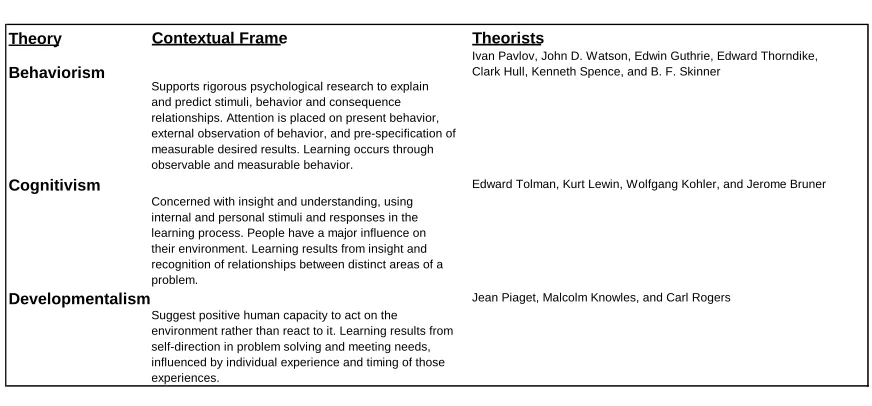
Three theories of learning outlined by Rothwell and Sredle (1992) highlight the theories important to the human resource development (HRD) professional practice, to organization development (OD) as a key function of HRD, and therefore to organizational change as related to OD. Behaviorism, cognitivism, and developmentalism, are described in Table 2.1, linking the concepts and theorists’ associations of each.
McDonald (1964) discusses learning theories differently, using the six categories; 1) recapitulation- based on the work of theorist Clark Hull, connectionism- linked to the
Table 2.1 Learning Theories
Theory Contextual Frame Theorists
Behaviorism
Ivan Pavlov, John D. Watson, Edwin Guthrie, Edward Thorndike, Clark Hull, Kenneth Spence, and B. F. Skinner
Supports rigorous psychological research to explain and predict stimuli, behavior and consequence relationships. Attention is placed on present behavior, external observation of behavior, and pre-specification of measurable desired results. Learning occurs through
observable and measurable behavior.
Cognitivism Edward Tolman, Kurt Lewin, Wolfgang Kohler, and Jerome Bruner Concerned with insight and understanding, using
internal and personal stimuli and responses in the learning process. People have a major influence on their environment. Learning results from insight and recognition of relationships between distinct areas of a problem.
Developmentalism Jean Piaget, Malcolm Knowles, and Carl Rogers Suggest positive human capacity to act on the
theorist Edward Thorndike, 2) pragmatism- linked to theorist John Dewey, Gestalt and field theory- based on the theories of Ogden, Hartman, and Lewin, 3) dynamic psychology- linked to the theorist Sigmond Freud, and 4) functionalism- linked to the work of Judd. Gage (1972) simply states three families of learning theories; 1) conditioning, 2) modeling, and 3) cognitive. Hilgard and Bower (1966) also group the theories differently, using 2 major families or groups; 1) Stimulus-response theories, which includes the works of Thorndike, Pavlov, Guthrie, Skinner, and Hull, and 2) Cognitive theories, which include Tolman’s work and that of Gestalt psychologists (p.8). Kingsley and Garry (1957) use a similar grouping, where 1) association or stimulus-response theories include Thorndike, Guthrie, and Hull, and 2) field theories include Lewin, Tolman, and Gestalt psychologists. For the purpose of this study, the three theories identified in Table 2.1 are selected due to close association to the HRD field, and the grounding for adult learning principles explored, and will therefore be addressed further.
Ivan Pavlov conducted pioneering work in the study of classical conditioning
(Lovell, 1980). His study of dogs responding to a conditioned buzzer stimulus he associated with a reward of food, an unconditioned stimulus, yielded a conditioned response of
salivation by the dogs and an early theory of learning around stimulus-response associations. Supporting Pavlov’s theory, Watson (1924) applied the stimulus-response association theory to a human subject, a small boy, teaching him to fear a white rat by association alone.
to a stimulus. Edward Thorndike (1928) furthered the behaviorism theory by developing the seven laws of learning, shown in Table 2.2, “and attempted to investigate how it is that specific responses became linked with specific stimuli” (Lovell, 1980, p.32).
Law Contextual Frame
The law of effect Satisfaction strengthens a response, annoyance weakens the response.
The law of readiness Readiness to act when stimulated and allowed to act brings satisfaction, while lack of readiness or inability based on forced response brings about annoyance.
The law of exercise The response to stimulus is strengthened when used, weakened when unused.
The laws of multiple responseA response not leading to satisfaction will lead the learner to attempt other responses.
The law of prepotency The learner selectively perceives the stimulus to which a response will be made.
The law of analogy The response to a new stimulus is based on the learner's analogy with responses to similar but known stimuli.
The law of associative shiftingThe learner can be taught to make a connection between a stimulus and a response even though the stimulus is not presented.
Hull (1952) conducted numerous laboratory experiments to test learning hypotheses, supported by stimulus-response learning perspectives, which he termed inputs and outputs, and inspired by systems theory, he projected a theory of intervening variables – the effects of environmental stimulus on the individual learner. Hull’s theory of the intervening variables; habit strength, drive, stimulus dynamism, and incentive, were built upon by Spence, who redefined the relationship between the variables to be additive rather than multiplicative. B. F. Skinner (1953) further theorized that some responses are not stimulated, in the classical conditioning other behaviorists suggested, yet those responses will be
repeated if reinforced, which Skinner called operant conditioning. Such conditioning is also emphasized by Lovell (1980), who suggests that behaviors that bring about learning, include
positive reinforcement, negative reinforcement, and punishment, although “the linchpin [to operant conditioning] is positive reinforcement” (p.37).
Behaviorist theory suggests that human nature is primarily reactive, in that “people respond to certain stimuli in the environment” (Cranton, 1994, p.8). Using this approach, learning occurs through observable and measurable behavior, where changes in external behavior, produces changes in internal values, beliefs, and attitudes. Environmental stimuli initiated by instructors, peers, the organization, and the learning process evoke learner responses, positive or negative, which are reinforced by various rewards, viewed favorably or unfavorably depending on whether it produces the desired response and is available. Therefore, in many ways, the learner is a product of the environment.
Cognitivism learning theory, formulated by Gestalt psychologists, is individually focused rather than environmentally stimulated, and deals with insight and understanding of the learner. The learner is therefore an influencer of the environment. Gestalt theorists promote the insight and understanding of the pattern of relationships between stimuli and responses rather than confining learning to only the two elements. Wolfgang Kohler (1925) observed caged apes on a tropical island, as he experimented with their ability to obtain bananas placed outside their reach. The cleverness demonstrated through stacking boxes to climb higher and using a stick to reach farther, revealed how insight, or what Kohler defined as recognition of relationships that exist between discrete parts of a larger problem, (Lovell, 1980), led to further theory and research on Gestalt systems theory and the personal side of learning (Munn, Fernald, Jr., and Fernald, 1969, p.625).
“individual change results from acute awareness” (Rothwell and Sredl, 1992, p.330). Gestalt psychology has proposed six principles related to individual perception, which may
influence change readiness, as reported in Table 2.3.
Gestalt Psychology Principle Conceptual M eaning
… of Direction Stimuli appearing to be meaningful and forming a pattern will stand out against a neutral background, in a way that observers can perceive the pattern.
… of Contiguity Stimuli occurring close together tend to be perceived as grouped together.
… of Em beddedness A large figure with multiple stimuli will stand out from small figures with fewer stimuli.
… of Likeness Similar objects will tend to be perceived together.
… of Joint Destiny Objects that move together will tend to be perceived together.
… of Closure The mind will tend to perceive experiences as complete or incomplete patterns.
An underlying assumption or belief in the Gestalt principles is that every psychological event or experience tends to be perceived as meaningful and complete (Knowles, 1978).
Edward Tolman theorized using experiments with rats in a maze, to test internalized associations between a goal, behaviors, and awareness of the environment in which the goal is located (Tolman and Honzik, 1930). By blocking certain routes between the entrance and exit of the maze, he observed the development of cognitive maps, that is the learning of which routes would work and which would not, as a learning process (Munn, Fernald, Jr., and Fernald, 1969). Learning, he contended, “occurs when expectations are aroused in connection with behaviors, within a unique environmental context” (Rothwell and Sredl, 1992, p.330). Cross (1981), and Knowles (1978) both refer to Tolman’s work as
fundamental to understanding learning motivation. Wlodkowski (1993), although not citing Tolman’s work directly, refers to the motivation theory expressed by Cross and by Knowles.
Kurt Lewin’s (1951) theory of learning supports Gestalt psychology and cognitive map learning, influenced by phenomenology, that is the belief that people interpret
experiences and those interpretations are central to their existence (McDonald, 1964, pp.1-26; Kingsley and Garry, 1957, p.83). Within this context, Lewin concluded that the individual is at the center of life space, that is, everything that affects the individual’s
behavior, and the environment itself, has no inherent meaning. The way individuals perceive themselves and their environment is crucial to understanding and influencing behavior (Lovell, 1980; Dewey, 1963, p.42; Lewin, 1948). Lewin (1951) uses the term valence to mean the perceived value or attractiveness of a goal to an individual, and barrier to depict the perceived difficulty an individual might realize in achieving a goal. He further suggests human behavior is essentially goal oriented and purposeful, toward achieving high valence. While Lewin (1948) does not emphasize cognitive mapping, he does establish the
foundation of experiential learning, that is, the transfer of learning through personal experiences (Mezirow, 1996, p.162), which also influences Kolb’s (1984) learning styles model discussed later. Lewin’s (1948) work is also the basis of action research in
organization development (OD) (French and Bell, 1984; Corey, 1953; Lewin, 1946), which suggests that group learning occurs through the three step process of unfreezing old beliefs, restructuring those beliefs, and refreezing with new beliefs (Peters and Robinson, 1984).
concepts based on identifying the similarities of attributes through a coding system, such as the use of metaphors – in word and picture form. Learners’ ability to create and use such a coding system depends on their individual qualities of; 1) set - their readiness to perceive, 2) need - their motivation to learn, 3) species - their current expanse or breadth of knowledge about similar concepts, and 4) diversity - breadth of experience in applying the ideas or concepts.
Cognitive-learning theorists suggest human beings are highly adaptive to their environment and even capable of changing it (Cross, 1981; Knowles, 1978). Learners play an active role, through experiential and personal involvement in the learning process (Lewin, 1948). The role of an instructor or facilitator in cognitivism is to “create [and maintain] an environment that will lead to individualized learning” (Rothwell and Sredl, 1992, p.330.).
Developmentalism is influenced by cognitive theory and encompasses the developmental learning theory of modern researchers and writers who embrace human freedom to learn and capacity to act on their environment rather than react to it. These theorists emphasize learning as internal to the learner, where learning is natural and human nature is essentially growth-oriented.
Carl Rogers (1969), a clinical psychologist, also influences learning in education and training arenas, as a developmentalism theorist. His theories, based on the assumption that psychological counseling is a learning experience, suggest:
- learning is entirely internal, making teaching impossible and learning learner-centered,
- people learn what they perceive to be worthwhile,
- people resist learning experiences the learner perceives to threaten their self-concept, and
- self-concept becomes more rigid when threatened.
Knowles (1978) speaks of Rogers’ approach as:
“We cannot teach a person directly, we can only facilitate his learning. A person learns significantly only those things which he perceives as being involved in the maintenance of, or enhancement of, the structure of self.” (pp.41-42)
Rogers supports the notion that people learn so they can fulfill or satisfy an unmet need, and so they can gain greater freedom to achieve more aspects of their potential (Knowles, 1978). Knowles (1978) furthers the developmentism theory to focus on adult learners. He supports Rogers’ theory that people are motivated to learn so they can achieve greater aspects of their capability (p.63).