EEG Based Smart Automation Using
Brain-Computer Interface Approach
Pranamya Bandyopadhyaya1, Dr. S. D. Lokhande2
P.G. Student, Department of E&TC Engineering, Sinhgad College of Engineering, Pune, Maharashtra, India1
Principal, Sinhgad College of Engineering, Pune, Maharashtra, India2
ABSTRACT:Brain-computer interface (BCI) is a collaboration between a brain and a device that enables signals from the brain to direct some external activity, such as control of a cursor or a prosthetic limb. The interface enables a direct
communications pathway between the brain and the object to be controlled.This is useful for people who cannot
operate the peripheral devices using our normal muscular body parts. The proposed system, called Thought Driven Automation, aims to control a robot and home appliances with the help of Human Attention and Meditation Levels, which comes under non-invasive method of brains signal measurement. The values of attention and Meditation lie in the range 0-100. The meditation levels are used for controlling home appliances while the attention values are used for operating a robot.
KEYWORDS:Brain Computer Interface, Automation, Brain sense, attention value, meditation value
I. INTRODUCTION
Advancements in technology have paved way for many scientific discoveries and have led to the development of many scientific applications that were unheard of earlier.Automation is one such application. Automation refers to the use of automatic equipment for carrying out a task. In other words, it is the technology that enables a process or procedure to be performed without human assistance.
The last century of neuroscience research has greatly increased our knowledge about the brain and particularly, the electrical signals emitted by neurons firing in the brain. The knowledge that we have now had people wondering if it were possible to integrate automation with brain’s activity. The result of this integration is termed Thought Driven Automation (TDA), or more popularly, Brain Controlled Automation (BCA).
The implemented TDA system is a real-time automation system that controls operation of home appliances. A Brain Sense headset is worn by the user. It captures the user’s brainwaves. Inside the headset is a NeuroSky Think Gear Asic Module (TGAM1). The TGAM1 processes and outputs EEG frequency spectrums, EEG signal quality, raw EEG, and three NeuroSkyeSense meters: attention, meditation and eye blinks.
The system works in two modes. The first mode is Smart Home Automation mode. In this mode the user is able to turn a bulb on and off using brainwaves. The second mode, called Robot Control Mode, allows user to control the movement of a robot car. Both modes are implemented using Arduino Uno board and Arduino IDE.
II. RELATEDWORK
Many systems have been proposed so far in the field of home automation and remote operation of appliances. However, these systems have their own limitations. In [1], the authors proposed a voice controlled smart house system. The method involved use of voice commands to control the movement of a wheelchair. Finite Inductive Sequences (FIS) were used for assisting voice command recognition. The main problem with this method was the fact that the system depended on the pronunciation/accuracy of the words. Changes in the words or their pronunciation restricted the movement of the chair. [2] describes a BCI system to help disabled people input phone numbers just by gazing at the buttons. In [3] the authors proposed a method to control home appliances by movement of the eye. They used a blink sensor for eye movement acquisition. The blink sensor produced a signal whenever the eye was closed. The processed signal was then used as an input for a microcontroller in order to control home appliances.
Visual Evoked Potentials (VEP) [3], Slow Cortical Potentials [4], P300 potentials, N400 potentials and Sensory Motor Rhythm (SMR) are some of the ways in which interaction between human brain and computer has been achieved. Wavelet-based feature extraction [5], Artificial Neural Network [6], Power Spectral Density [7], Band Power [8] and Adaptive Auto Regressive (AAR) [9] are some of the methods used for extracting and classifying features from brain signals.
III.IMPLEMENTATIONMETHODOLOGY
a) Capturing brainwaves
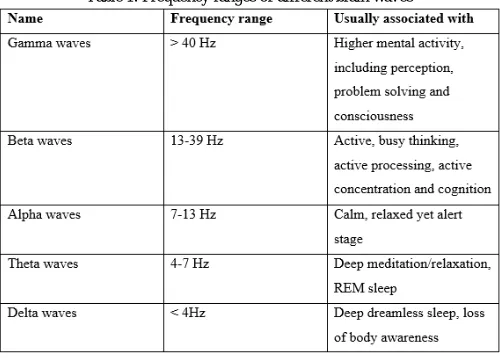
In this work, brain waves are captured using non-invasive BCI technique. The user wears the Brain Sense headset. The Brain Sense BCI sensor is brainwave sensing headset. It employs a medical probe to capture patterns and translate them to PC for further use with computer development platforms. This device consists of a headband and an ear clip. The ground and reference electrode are located on the ear clip whereas the EEG electrode is on the forehead. It uses a single AAA battery with 6 hours of battery life. Inside the Brain Sense headset, is a TGAM1 module which has a TGAT chip. Brainwaves are captured, processed and interpreted by this chip.Table 1 shows the frequency ranges of different brainwaves. This system uses only two waves: alpha and beta.
Table 1. Frequency ranges of different brain waves
b) Data processing
form of asynchronous serial byte stream which is parsed and interpreted as packets. Each packet has 3 parts viz. packet header, data payload and checksum byte. The header is 3 bytes long, the payload is 169 bytes long and the checksum is 1 byte long. Thus each packet has a maximum length of 173 bytes.Once the data stream in parsed, the TGAM module calculates the attention and meditation values which are then sent to the Arduino microcontroller using the HC-05 BT module present in the Brain sense headset.
c) Connection between HC-05 modules
Data is transmitted via the HC-05 module present in the headset. At the receiver end, this data is received by another HC-05 module interfaced with the Arduino microcontroller. In order for this communication to occur, it is important to configure the receiving HC-05 BT module. The headset’s BT module works at a baud rate of 57600. Hence it is necessary to configure the receiving BT module to work at the same baud rate. Also, the BT module connected to the Arduino microcontroller has to work in slave mode in order to receive data from the headset.
The BT module can be configured only in the command mode. In order to enter command mode, power off the HC-05 module, hold the command mode button, then power the HC-05 module back on. Once the module is in command mode, the module’s LED will blink after every 2 seconds.The BT module is configured for data reception by running the AT commands in command mode.
d)
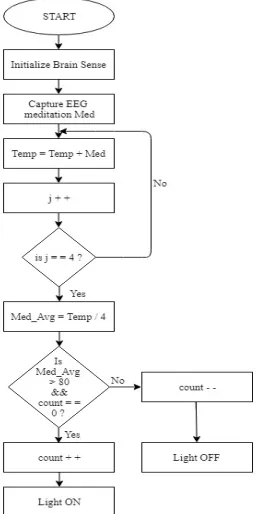
Implementing mode I: Smart home automationFig. 1 shows the design flow of smart home automation mode. After initializing the headset, meditation values are obtained. The meditation values lie in the range 0-100. The headset outputs a meditation value after every one second. A counter ‘j’ keeps track of 4 consecutive meditation values. Med_Avg is the average of these 4 meditation values. Initially the value of Med_Avg is set to 0. If the value of Med_Avg goes above 80, then the bulb turns ON. The bulb turns off when the next Med_Avg value crosses 80.
e) Implementing mode II: Robot control
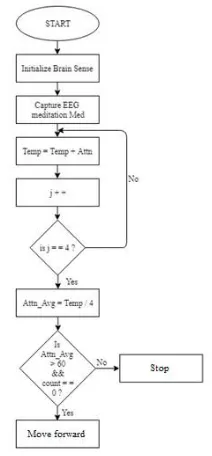
Fig. 2 shows the design flow of robot control mode. Once the headset is initialized, attention values are obtained. The attention values lie in the range 0-100. The headset outputs an attention value after every one second. A counter ‘j’ keeps track of 4 consecutive attention values. Attn_Avg is the average of these 4 meditation values. Initially the value of Attn_Avg is set to 0. If the value of Attn_Avg goes above 50, then the bot moves forward. It stops once the average value decreases and goes below 50.
Fig. 2. Design flow for mode II
IV.EXPERIMENTALRESULTS
Fig. 3 shows the output of the program on Arduino serial monitor for mode I. When the user wears the Brain sense headband, the meditation values are displayed on the serial monitor. These values range from 0 to 100, where 100 signifies the highest level. The more calm the user is, higher will be the meditation level. The bulb turns On when the average meditation value goes above 80. It turns Off when this average goes above 80 successively.
Fig. 4 shows the output for mode II. The attention values range from 0 to 100. When the average value of attention goes above 50, the robot moves forward and the onboard LED turns On. The robot continues to move forward as long as this value stays above 50. It stops once the average value decreases and goes below 50.
Fig. 4. Attention values
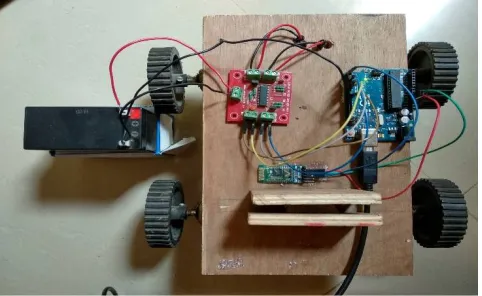
Fig. 5 shows the overall system setup.
Fig. 5. Experimental setup of the project
V. CONCLUSION
Brain computer interface provides a way to control and automate things. Unlike other systems, BCI makes use of only brain waves for automation. Two modes are implemented in this project. In the first mode the user can control household appliances using his brainwaves. This project only uses an LED to demonstrate this mode. Other appliances such as fan, TV etc. can also be incorporated in this mode using relays. In the second mode, called Robot control mode, the user can control the movement of a robot solely by his thoughts.
The BCI technology is in the early phase of development. The interaction between computers and users need to be more user-friendly. Better noise removal techniques, more efficient signal acquisition and processing methods are some areas in BCI which pave a way for further research in this domain.
REFERENCES
[1] C. Yerrapragada and P. S. Fisher, “Voice controlled smart house,” IEEE Int. Conf. on Consumer Electronics, vol. 1, pp. 154-155, 1993. [2] M. Cheng, X. R. Gao, S. K. Gao, and D. F. Xu, “Design and Implementation of a Brain-computer Interface with High Transfer Rates,” IEEE
[3] Joseph K George, Subhin K B, Arun Jose, Hima T, Eye Controlled Home Automation for Disables.
[4] N. Birbaumer, N. Ghanayim, T. Hinterberger, I. Iversen, B. Kotchoubey, A. Kübler, J. Perelmouter, E. Taub, and H. Flor, “A spelling device for the paralysed,” Nature, vol. 398, pp. 297- 298, 1999.
[5] V. Bostanov, “BCI Competition 2003{Data sets IB and IIB: Feature extraction from event-related brain potentials with the continuous wavelet transform and the T-value scalogram,” IEEE Transactions on Biomedical Engineering, vol. 51, no. 6, pp. 1057-1061, 2004.
[6] D. M. Taylor, A. B. Schwartz and S. I .Tillery, “Extraction algorithms for cortical control of arm prosthetics,” Curr. Opin.Neurobiol, 11 701–7, 2001.
[7] J. R. Mill and J. Mourino, “Asynchronous BCI and local neural classifiers: An overview of the adaptive brain interface project,” IEEE Transactions on Neural Systems and Rehabilitation Engineering, Special Issue on Brain Computer Interface Technology, 2003.
[8] G. Pfurtscheller, C. Neuper, D. Flotzinger, and M. Pregenzer, “EEG-based Discrimination between Imagination of Right and Left Hand Movement,” Electroencephalography and Clinical Neurophysiology, vol. 103, pp. 642-651, 1997.