Department of ECE, Adhiyamaan College of Engineering, Hosur, Tamilnadu, India.
Online Feedback System for Educational
Institutions for Better Evaluation of
Faculty’s Performance Using Semantic
Web (SW) Technology
Sivasankari.S1, Srimathi.P.S2, Ramya.S3, Dr.G.Fathima4
U.G.Scholars, Department of IT, Adhiyamaan College of Engineering, Hosur, Tamilnadu, India1,2,3
Professor and Head, Department of IT, Adhiyamaan College of Engineering, Hosur, Tamilnadu, India4
ABSTRACT: In recent times, Higher educational Institutions are paying increasing attention to the views of
students on the experience of learning and teaching through internal surveys. Online Feedback System is a
web based application that provides base for the colleges to conduct students’ feedback online. This online system is the good place to find feedback analyzed according to the requirements and it is the efficient one to get feedback analysis. Students give feedback through online using a standard designed form. In the proposed system, security is included, the result of which the feedback is only visible to authenticated users. Online feedback is an integral feature of evaluation of effective & efficient learning & teaching practices. Semantic Web technologies are being applied in recent times with different purposes in Education particularly for which it is used in the proposed system for generating useful feedback reports and the Semantic web tries to rebuild the existing web concepts by adding a layer that will enable us in doing advanced automatic processing of the web content, so that the data can be distributed and processed by both human-beings as well as software.
KEYWORDS: Feedback, Report, Online, Forms, Analysis, Semantic web
I. INTRODUCTION
Department of ECE, Adhiyamaan College of Engineering, Hosur, Tamilnadu, India.
informs the faculty’s about students' perceptions of the course's as well as their strengths and weaknesses that can prompt changes in delivery methods, course content, and guidance for the course.
Objectives of the system are,
To provide the platform to the students in identifying a greater role in the teaching -learning process, To develop a sense of responsibility and belonging to the institution among the students,
To develop the skill of critical evaluation,
To modify and rearrange the course contents based on students’ constructive suggestions To help the teachers modify and improve their teaching methodologies,
To open a transparent communication channel between the students and the teacher, and To maintain the functioning of teaching-learning process in the best possible way.
The layered architecture of the semantic web is shown in Fig.1.Semantic web applications are recently being developed in fields and disciplines including education.The Semantic Web is the expansion of the WWW that enables people to distribute content beyond the restrictions of applications and websites[1]. For the development of human mind power, both formal and informaleducation is important. In whichever format, education is being provided, the ability for the humans to learn effectively is of primaryimportance[2]
Fig.1: Semantic Web Layered Architecture
II. SYSTEM ARCHITECTURE
Department of ECE, Adhiyamaan College of Engineering, Hosur, Tamilnadu, India.
Fig.2: Architecture diagram of proposed system
III.SYSTEM IMPLEMENTATION
Home page:This page consists of student login, admin login, faculty login, HOD login and Principal login
form.
Admin Login: The page consists of options like adding departments, questions, users and activation of
feedback time duration and the Fig.3 and Fig.4 shows the time activation displays for a particular department of an institution to get activated for giving feedback.
Fig.3: Time Activation for particular Department of the Institution to give Feedback
Department of ECE, Adhiyamaan College of Engineering, Hosur, Tamilnadu, India.
IV. RESULTS AND DISCUSSIONS
The students provide feedback for each subject in eachsemester using an online web application as shown in Fig. 4
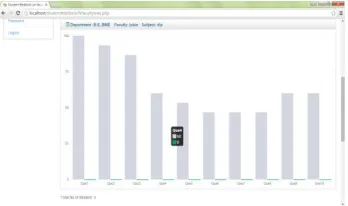
Standard feedback: The standardized feedback isgenerated by the classification of the subclasses. It is described by 10 factors as shown in the Fig.4.The questionnaire can be updated by the admin as and when required. Fig.5 and Fig.6 represents the semantic web usage to a database content and how it appears without the usage of semantic web technology.Fig.7represents the bar chart(intelligible form) generated based on the data(feedbacks) given by the students in an intelligible form of mining data based on semantic web. Semantic web technology is the connection of information that enables data to be linked from a source to any other source and to be understood by computers so that they can perform increasingly sophisticated tasks that can give the output of the data (input) in human intelligible form(charts)
Fig.5 Application developed without semantic web technologyFig.6 Application developed with semantic web technology
Fig.7: Bar chart generated as a knowledge pattern using semantic web
V. ADVANTAGES
This paper in which the concepts of semantic web used is beneficial for institutional use about teaching and curriculum enhancements made in response to student evaluation data. It can also be used in organizations’ feedback.This system has advantages like
Saves time in manual effort – By giving feedback through online system saves time and effort of the manual process.
Easy Management of the process – The entire process of giving feedback, viewing the report,doing the analysis can be managed easily. The result is generated automatically hence it gives easy and quick feedback.
Department of ECE, Adhiyamaan College of Engineering, Hosur, Tamilnadu, India.
VI. CONCLUSION
This system is implemented in such a way to reducethe burden of maintaining bulk of records of all the students’ feedback in an educational institution. Inserting, deleting,retrieving and updating details of users and receiving the feedbacks online are easy when compared to manual feedback process and storing. Maintaining the details in a database is quite manageable and easy to retrieve. It enhances quality of teaching and it can be increased through evaluation of feedbacks. Further enhancements can be made in designing the screens of the system. Some more forms can also be added so as to enhance better retrievalof feedback details.
ACKNOWLEDGEMENT
The authors would like to thank Adhiyamaan College of Engineering,Hosur,Tamilnadu, India for providing all the facilities required to develop the project and made it a successful one.
REFERENCES
[1] Shaymaa E. Sorour, JingyiLuo, KazumasaGoda and Tsunenori Mine ,” Correlation of Grade Prediction Performance with Characteristics of Lesson Subject”, 2015 IEEE 15th International Conference on Advanced Learning Technologies.
[2] Sana Shaikh ,PrashantSonawane ,Rajesh Patil ,RohitNeeraj,” Knowledge Extraction From Online Feedback System Using Ontology”, 2015 International Conference on Technologies for Sustainable Development (ICTSD-2015), Feb. 04 – 06, 2015, Mumbai, India.
[3] Peter Toth,” New Possibilities for Adaptive Online Learning in Engineering Education”, Proceedings of the 2015 International Conference on Industrial Engineering and Operations Management Dubai, United Arab Emirates (UAE), March 3 – 5, 2015. [4] HamadNaeem,Junsang,WaqaraliAbro,Muhammad Rashid naeem,” A generic feedback system for better evaluation of teacher
performance”, 978-1-4799-8353-7/15,2015,IEEE.
[5] María del Mar Sánchez-Vera , JesualdoTomásFernández-Breis , DagobertoCastellanos-Nieves,” Semantic Web technologies for generating feedback in online assessment environments”, 2012 Elsevier.