Study on Mechanical Behavior of Bamboo
Fiber Reinforced With Polymer Matrix
Composite: A Review
Nanda Kumar.D1, Raghul. K.S.1, Jeyakumar.R²
PG Student, Department of Mechanical Engineering, Sri Krishna College of Engineering and Technology,
Coimbatore, Tamilnadu, India1
Assistant Professor, Department of mechanical engineering, Sri Krishna College of Engineering and Technology,
Coimbatore, Tamilnadu, India2
ABSTRACT: The paper works describes the development of mechanical behaviour of bamboo fiber reinforced with various polymer composites such as epoxy, urea formaldehyde resin, polyester, phenolic, polylactic acid, polypropylene, polyester, poly (butylene succinate) and different filler materials. The results shows that bamboo fiber reinforced with epoxy composites have show the better mechanical properties. By adding filler materials increases the results of mechanical properties.
KEYWORDS: bamboo fiber, epoxy, urea formaldehyde, polyester, phenolic, polylactic, polypropylene, poly (butylene
succinate).
І.INTRODUCTION
A composite material can be defined as a combination of two or more materials that results in better properties than those of the individual components used alone. The two constituents are reinforcement and a matrix. The main advantages of composite materials are their high strength and stiffness, combined with low density, when compared with bulk materials, allowing for a weight reduction in the finished part. In most cases, the reinforcement is harder, stronger, and stiffer than the matrix. The reinforcement is usually a fiber or a particulate. Recently, instead of synthetic fibers, the use of cellulose fibers as reinforcements in polymer composites has gained popularity in engineering applications. Various researchers have investigated the strengthening effects on the plant fibers containing polyolefin, polystyrene, polyester, and polyester resins, respectively. Properties like low cost, light weight, high specific strength, and absence ofhealth hazard are among the most important selling points of this material.
Interest in natural fiber reinforced polymer composites is growing rapidly due to the high performance in mechanical properties, significant processing advantages, low cost and low density. Natural fibers are renewable resources in many developing countries of the world; they are cheaper, no healths hazards and finally, provide a solution to environmental pollution by finding new use for waste materials. Among the known natural fibers, bamboo has been accepted as a tough structural material and is already being used in its raw form for the construction of buildings. The structural performance offered by bamboo can be much more adaptable if the shape, size and strength of bamboo are dimensionally anddirectionally controlled.
II. SPECIMEN PREPARATION
IIІ.TEST METHOD
1. Tensile strength: the tension test is generally performed on flat specimens. The most commonly used specimen geometries are dog-bone specimen and straight-sided specimen. The tensile tests were conducted according to the ASTM standards.
2. Flexural strength: the flexural test measures the force required to bend beam under three point loading situations. The flexural modulus is used as an indication of a materials stiffness when inflection. Flexural strength was determined using universal testing machine equipment. The specimens are prepared as per ASTM standard.
3. Impact strength: In impact strength of the sample were measured using as per ASTM standard. The test specimen being supported as a simply support beam is strike broken by a single swing of the pendulum, with a scale plate reading the energy loss.
VI. LITERATURE SURVEY
Hemalata jena: describes the hybrid composites using bamboo-epoxy and cenosphere, as a filler material for preparation of the composite. The bamboo fiber is treated with alkali to improve its surface properties. The conventional hand layup technique is used to prepare different composites specimens. 20 numbers of different composites specimens are prepared with varying number of laminate and filler content. Increased in lamina from 3 to 7, the impact strength is increased and increasing the lamina to 9, the strength is decreased. 7 layer composites with 1.5 wt% of cenosphere have maximum impact strength of 18.132KJ/m².
Agus edy pramono: describes the bamboo fibers as reinforcement in phenolic resin composites. Composite fabrication
was done by hand layup technique. Bamboo fiber diameter 0.5mm, length 280mm, weight of 50:75:100 grams, arranged in a single direction (uni-directional) and double direction (bi-directional). The result of tensile strength test and punch shear test showed that increase in weight of the bamboo fibers may increase the strength of the composite. Composites with bi-directional fibers has a tensile strength lower than uni-directional. Composites with bi-directional fiber have punch shear strength higher than the uni-directional.
Sreenivasulu: investigation on the effect of fiber loading and filler content on mechanical behaviour of short bamboo fiber reinforced polyester composites. Evaluate the mechanical properties such as tensile strength, flexural strength of short bamboo fiber reinforced composites with and without alumina as a reinforced material. The result of tensile strength of the composites materials without filler increases with the increases in volume of fraction up to 45% of bamboo fiber. Flexural strength as without filler materials increases with increases in volume of fraction up to 30% of bamboo fiber.
Navdeep Sharma: work the seven different fiber reinforcement polymer composites were fabricated by hand layup method using short coconut, short bamboo and short glass fiber binding with urea formaldehyde. The different mechanical properties like density, tensile strength, hardness, flexural strength and percentage elongation of specimens were calculated and compare with pure urea formaldehyde resin. The result of bamboo, coconut, glass fibers in urea formaldehyde, there is decreases in the hardness of 20wt% and 10wt% has compared with 0wt% of fibers. Tensile strength of composites is increases with 20wt% of glass fiber. Flexural strength is increases the 10wt% of bamboo fiber. The percentage elongation was increases in 20wt% of coconut.
Vivek kumar: Has investigated the use of molded bamboo epoxy composites in the development of products from bamboo fiber composites with high mechanical properties. The composites contains between 30-40 wt% fibers although, up to 60wt% fiber can be used. Filler such as carbon black and fly ash can be added to these composites. The composites exhibit tensile strength of 140mpa, flexural strength 160mpa and charpy impact strength of 60 kJ/m2. The composites have mechanical properties comparable to current used engineering plastic and are appropriate for application in auto body parts.
Xiaoya chen: study is to develop a new composites materials bamboo fiber reinforced polypropylene composites. A composite was prepared by compression molding machine. The maleic anhydride content of the MAPP was 0.5wt%. it was found that with 24wt%of such MAPP being using in the composite formulation, there is increased in mechanical properties such as tensile modulus, tensile strength, impact strength. The MAPP can induce better distribution of bamboo fiber of (50wt% to 60wt %) in PP/MAPP matrix. The maximum value of tensile strength was (32 -36 Mpa) and tensile modulus (5 to 6 Gpa) were obtained up to 50wt% of bamboo fiber content.
V. MECHANICAL PROPERTIES
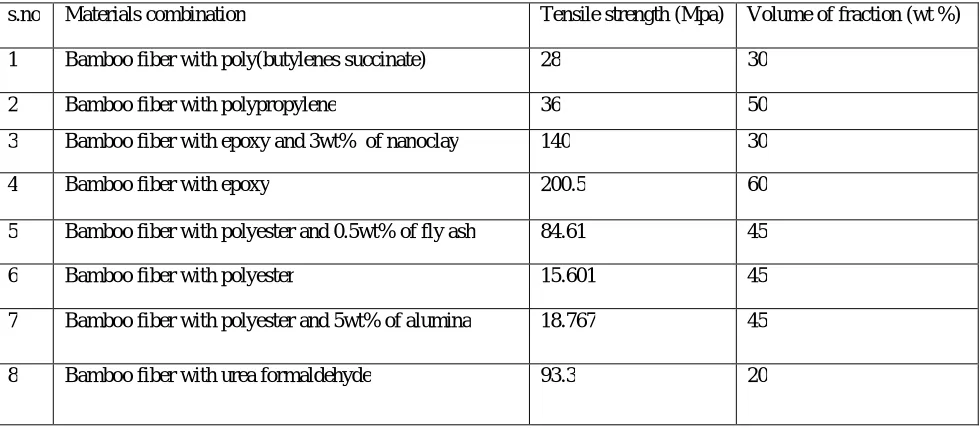
To comparing the mechanical properties of bamboo fiber with various polymers composite materials as shown in tables below.
Table 1. Tensile properties:
s.no Materials combination Tensile strength (Mpa) Volume of fraction (wt %)
1 Bamboo fiber with poly(butylenes succinate) 28 30
2 Bamboo fiber with polypropylene 36 50
3 Bamboo fiber with epoxy and 3wt% of nanoclay 140 30
4 Bamboo fiber with epoxy 200.5 60
5 Bamboo fiber with polyester and 0.5wt% of fly ash 84.61 45
6 Bamboo fiber with polyester 15.601 45
7 Bamboo fiber with polyester and 5wt% of alumina 18.767 45
8 Bamboo fiber with urea formaldehyde 93.3 20
Table 2. Flexural properties:
s.no Materials combination Flexural strength (Mpa) Volume of fraction (wt%)
1 Bamboo fiber with epoxy 230.09 60
2 Bamboo fiber with polyester and 0.5wt% of fly ash 233.02 45
4 Bamboo fiber with polyester and 5wt% of alumina 45.848 30
5 Bamboo fiber with urea formaldehyde 46.832 10
6 Bamboo fiber with epoxy and 3wt% of nanoclay 160 30
Table 3. Impact properties:
s.no Materials combination Impact strength (KJ/m²) Volume of fraction (wt%)
1 Bamboo fiber with polypropylene 4.2 50
2 Bamboo fiber with polylactic acid 1.7
3 Bamboo fiber with epoxy 63.54 60
4 Bamboo fiber with polyester and 0.5wt% of fly ash 17.02 45
5 Bamboo fiber with epoxy and 1.5wt% of cenosphere 18.32 45
6 Bamboo fiber with epoxy 18.38 30
7 Bamboo fiber with epoxy and 3wt% of nanoclay 60 30
VI. CONCLUSION
In the present study the mechanical behaviour of bamboo fiber reinforced with different polymer composites and different filler materials has been analysed.
The bamboo fiber reinforced epoxy composites has a better tensile strength, flexural strength compared with other polymer materials.
The impact strength is increased by adding bamboo fiber with matrix materials as compared with pure matrix materials
The composites materials which shows the higher mechanical properties by adding filler materials with polymer composites.
Tensile strength of some bamboo fiber reinforced polymer composites is more or less to the tensile strength of mild steel
These composites materials can be used for the applications such as car bumpers, panels, railway window frames, doors, etc.
REFERENCES
[1] Seung-Hwan Lee, Tsutomu Ohkita, “Bamboo Fiber (BF)-Filled Poly(butylenes succinate) Bio-Composite – Effect Of BF-e-MA On Th Properties and Crystallization Kinetics”, Vol. 58, pp. 537–543, 2004
[2] Xiaoya chen, Qipeng guo, Yongli mi, “Bamboo Fiber-Reinforced Polypropylene Composites: A Study of the Mechanical Properties”, Journal of Applied Polymer Science, Vol. 69, 1891–1899 1998.
[3] Ryoko Tokoro, Duc Minh Vu, Kazuya Okubo, Tatsuya Tanaka, Toru Fujii, Takayasu Fujiura “How to Improve Mechanical Properties of Polylactic Acid with Bamboo Fibers”, J Mater Sci, 43:775–787, 2008.
[4] V. Kumar, Rakesh Kumar, “Improved Mechanical and Thermal Properties of Bamboo–Epoxy Nanocomposites”, Society of Z Plastics Engineers, 2012.
[6] Venkateswara rao t, Venkatarao k, Lakshmi kanth ch, “Mechanical Properties of Bamboo Fibre Filled with Fly ash Filler Reinforced Hybrid Composite s”, International Journal of Engineering Research & Technology, Issn: 2278-0181 vol. 3 issue 9, September- 2014.
[7] A.V. Ratna Prasad, K. Mohana Rao, “Mechanical Properties of Natural Fibre Reinforced Polyester Composites: Jowar, Sisal and Bamboo”, Materials and Design , 4658–4663, 2011.
[8] Mohini saxe” and v. Sorna gowri, “ Studies On Bamboo Polymer Composites with Polyester Amide Polyol as Interfacial Agent”, Polymer Composites, vol. 24, no. 3, , june 2003.
[9] Navdeep Sharma, Sameer Sharma, S.P. Guleria, N.K. Batra, “Mechanical Properties of Urea Formaldehyde Resin Composites Reinforced with Bamboo, Coconut and Glass Fibers”, International Journal of Soft Computing and Engineering , ISSN: 2231-2307, Volume-5 Issue-2, May 2015. [10] Vivek kumar, Sanat mohanty, “High Performance Moldable Bamboo Fiber-Epoxy Composites”.
[11] Honey Banga , V.K. Singh , Sushil Kumar Choudhary, “Fabrication and Study of Mechanical Properties of Bamboo Fibre Reinforced Bio-Composites”, Innovative Systems Design and Engineering, Vol.6, No.1, 2015.
[12] S.sreenivasulu1, Dr. A chennakeshava Reddy, “Mechanical Properties Evalution of Bamboo Fiber Reinforced Composite Materials”, International Journal of Engineering Research, Volume No.3 Issue No: Special 1, pp: 187-194.
[13] Agus Edy Pramono , Indriyani Rebet, Anne Zulfia, Subyakto, “ Tensile and Shear Punch Properties of Bamboo Fibers Reinforced Polymer Composites”, International Journal of Composite Materials 2015.
[14] Hemalata Jena, Mihir Ku. Pandit, and Arun Ku. Pradhan, “Study the Impact Property of Laminated Bamboo-Fibre Composite Filled with Cenosphere”, International Journal of Environmental Science and Development, Vol. 3, No. 5, October 2012.
[15] Shinji Ochi, “Mechanical Properties of Uni-Directional Long Bamboo Fiber/Bamboo Powder Composite Materials”, Materials Sciences and Applications, 5, 1011-1019, 2014.
[16] Kazuya Okubo, Toru Fujii, Yuzo Yamamoto, “Development of bamboo-based polymer composites and their mechanical properties”, science direct, Composites: Part A 35, 377–383, 2004.
[17] U. c. Jindal, “Development and Testing of Bamboo-Fibres Reinforced Plastic Composites”, Journal of Composite Materials, vol 20-januray 1986.