Automatic Identification and Access Control
System
Avinash.S1, Deepika.S2, Sudeepkumar Kundgol3
U.G. Student, Department of Computer Application, KLE’s BCA College, Hubballi, Karnataka, India1 U.G. Student, Department of Computer Application, KLE’s BCA College, Hubballi, Karnataka, India2 Associate Professor, Department of Computer Application, KLE’s BCA College, Hubballi, Karnataka, India3
ABSTRACT: This describes the design of RFID(Radio Frequency Identification) based security and access control system which can be useful for securing data in many fields to complete this task the combination of RFID and biometrics are used when this RFID is installed at the hotel entrance it detects and verifies for a match where the image of user is registered if it matches then the access is granted otherwise an alarm turns on and the suspect can be caught..
I. INTRODUCTION
This describes the design of RFID(Radio Frequency Identification) based security and access control system which can be useful for securing data in many fields to complete this task the combination of RFID and biometrics are used when this RFID is installed at the hotel entrance it detects and verifies for a match where the image of user is registered if it matches then the access is granted otherwise an alarm turns on and the suspect can be caught. Paper is organized as follows. Section II describes automatic text detection using morphological operations, connected component analysis and set of selection or rejection criteria. The flow diagram represents the step of the algorithm. After detection of text, how text region is filled using an In painting technique that is given in Section III. Section IV presents experimental results showing results of images tested. Finally, Section V presents conclusion.This describes the design of RFID(Radio Frequency Identification) based security and access control system which can be useful for securing data in many fields to complete this task the combination of RFID and biometrics are used when this RFID is installed at the hotel entrance it detects and verifies for a match where the image of user is registered if it matches then the access is granted otherwise an alarm turns on and the suspect can be caught. This describes the design of RFID(Radio Frequency Identification) based security and access control system which can be useful for securing data in many fields to complete this task the combination of RFID and biometrics are used when this RFID is installed at the hotel entrance it detects and verifies for a match where the image of user is registered if it matches then the access is granted otherwise an alarm turns on and the suspect can be caught.
II. OVERVIEWOFRFIDTECHNOLOGY
1. System consists of three components namely transponder (tag), interrogator (reader) and computer containing the database; the interrogator reads the tag data and transmits it to the computer for authentication. The information is processed and upon verification, access is granted. The system offers diverse frequency band ranging from low frequencies to microwave frequencies [5]:
Low Frequency: 125-134 KHz
High Frequency: 13.56 MHz
Ultra High Frequency: 902-928 MHz
Depending upon the source of electrical energy, RFID tags are classified as either active or passive. The active tags use a battery for powering the circuit on the tag and transmit the tag information upon thereader request. However, these tags are very expensive and seldom used. On the other hands, tags are very cost-effective and hence most of the applications use them. A comparison of these tags highlighting important features is shown in Table I [6]
Fig1: Basic RFID system
III.SYSTEMCOMPONENTS
A. RFID Tag:-
IPC80 passive RFID tag operating at a frequency of 125KHz is issued to the user. The tag transmits information to the reader in ASK format [11].
B. RFID Reader:-
IP10 proximity card reader with operating frequency of 125KHz and reading distance up to 4 inches is used. The reader can be easily installed on metal doors, provides the tag information serially in RS232 format and is suitable for indoor as well as outdoor operations [11]. Three such readers are installed for hostel security: hostel entrance gate, hostel exit gate and mess entrance gate.
C. Camera Logitech:-
C500 webcam is used to capture images. The camera has 1.3 mega pixel sensors and can capture video up to 1280x1024 pixels. Two such cameras are installed for hostel security: one at the entrance and other at the exit. No camera is used for entering in the mess hall to reduce the overall complexity
D. GSM Modem:-
Nokia 12i GSM modem is used to make emergency call to the security van. Nokia 12i offers advance GSM connectivity and supports EDGE/GPRS and HSCSD with automated GSM connection establishment it is equipped to provide reliable remote connections and offers application level watchdogs, inbuilt self check mechanisms and a reliable Virtual Machine (VM) for JAVATM. Nokia 12i also supports reliable inbuilt internet protocols: TCP/IP for reliable data transfer, UDP/IP for audio and video streaming and HTTP for accessing web pages. The module can also be connected to an external GPS device that supports National Marine Electronics Association (NMEA) standard. The inbuilt NMEA parser can parse the location data from the output that it receives from the GPS device. External microcontroller can use AT commands to communicate with Nokia 12i and simple remote I/O applications can easily be controlled via text messages.
E. Microcontroller:-
F. Nonvolatile RAM:-
256K Nonvolatile RAM (NV-Ram) DS1230Y-85 is used for storing passwords against registered RFID numbers. NV-RAM is selected because it combines the best of RAM and ROM: the read and write ability of RAM and F. Non volatile RAM 256K Nonvolatile RAM (NV-Ram) DS1230Y-85 is used for storing passwords against registered RFID numbers. NV-RAM is selected because it combines the best of RAM and ROM: the read and write ability of RAM and Non-volatility of ROM. The DS1230 Nonvolatile SRAM is 262,144-bit, fully static, nonvolatile SRAM organized as 32,768 words by 8 bits. Each NV SRAM has a self-contained lithium energy source and control circuitry which constantly monitors VCC for an out-of-tolerance condition. When such a condition occurs, the lithium energy source is automatically switched on and write protection is unconditionally enabled to prevent data corruption.
G. Door Locks:-
Solenoid operated door locks are used in entrance, exit and mess gates of hostels. A relay is used to energize the solenoid to open the gate. H. Alarms Two alarms are installed; one at the entrance and other at the exit gate. These alarms are turned on if an illegal person tries to enter the hostel premises.
H. Identify the Headings:-
Headings, or heads, are organizational devices that guide the reader through your paper. There are two types: component heads and text heads. Component heads identify the different components of your paper and are not topically subordinate to each other. Examples include ACKNOWLEDGMENTS and REFERENCES, and for these, the correct style to use is “Heading 5.” Use “figure caption” for your Figure captions, and “table head” for your table title. Run-in heads, such as “Abstract,” will require you to apply a style (in this case, italic) in addition to the style provided by the drop down menu to differentiate the head from the text.
IV.SYSTEMOPERATION
The security and access control system is comprised of two phases: registration phase and recognition phase. In the registration phase, ten images of the hostel user are captured while issuing an RFID tag. These images are used to train a feed forward neural network with back propagation training algorithm and the converged weights are stored corresponding to a particular user. The recognition phase comes when the user wants to enter the hostel. At this point, after getting RFID user number, image of the user is captured and passed to the neural network for recognition. If a match is found, access is granted to the user. The user authenticity is checked at three places: hostel entrance, hostel exit and mess entrance. The entrance and exit modules use RFID and face recognition for identification while mess module use RFID with a password to grant permission. These modules communicate with computer system through a main controller. The main controller transmits the modules information to the computer system. The computer system after processing these interrupts issues commands to the modules through main controller.
V. ENTRANCE MONITORING CONTROLLER
help of scroll keys. If the message „access granted‟ is received by the controller, it opens the entrance gate by switching the relay. At the same time, entrance status of the user is updated in the non volatile RAM. The entrance monitoring module thus ensures the entry of registered and clear users in the hostel and also helps in catching suspicious persons that are not authorized to enter. The flow chart describing the operation of entrance monitoring module is shown in Fig.2
FIG2: FLOW CHART FOR ENTRANCE MONITORING MODULE
VI.EXIT MONITORING CONTROLLER
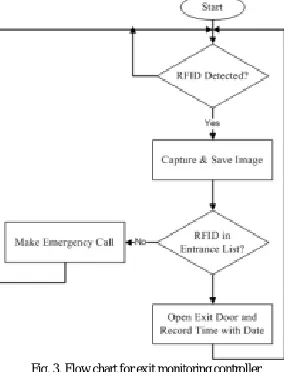
The exit monitoring module comprises of RFID reader, an alarm and door lock; all interfaced to AT89C52 microcontroller as shown in Fig. 5. Afterreceiving RFID tag information through reader, microcontroller sends a request to the entrance monitoring controller to search the user and its entrance status in NV-RAM. Upon receiving a „no‟ signal from the entrance controller, exit controller blocks RFID tagand sends a request to the computer system to
capture the user image. At the same time, it makes an emergency call through GSM modem interfaced to entrance controller and turns on alarm signal. On the other hand, if a „yes‟ signal is received, the exit controller sends a request
the card of other person. The exit monitoring controller thus enables the system to allow the valid person to leave the hostel. The flow chart describing the operation of exit monitoring controller is shown in Fig. 3
Fig. 3. Flow chart for exit monitoring controller
VII.COMPUTER SYSTEM AND WEB SERVER
The information provided by the system modules is maintained in a database inside the computer system. The database keeps record of user history including check-in time and date, check-out time and date, electricity, gas and mess charges, fine (penalty) details, RFID card lost details and user‟s visitor record. In addition to this, database also
keeps record of illegal persons trying to enter the hostel premises. A screen short of a user form in database The security and access control system is installed in eighteen hostels and computer systems in these hostels share the information to a web server which is the central station and can be searched to locate a particular user inside the hostels.
REFERENCES
[1] [1] D. L. Wu, Wing W. Y. NG, D. S. Yeung, and H. L. Ding, “A brief survey on current RFID applications,” in Proc. International
Conference on Machine Learning and Cybernatics, Baoding, July 12-15, 2009, pp. 2330-2334.
[2] B. Yan and D. Y. Lee, “Design of spot ticket management system based on RFID,” in Proc. International Conference on Networks Security,
Wireless Communications and Trusted Computing, 2009, pp. 496-499.
[4] N. Ahmad, S. Butler, and U. Ramachandran, “GuardianAngel: An RFID based indoor guidance and monitoring system,” 2010, pp. 546-551
[5] .K. S. Huang and S. M. Tang, “RFID applications strategy and deployment in bike renting system,” in Proc. ICACT 2008, pp. 660-663.
[6] S. Lahiri, RFID sourcebook, IBM Press, Westford, Massachusetts, 2006.
[7] F. Lourenco and C. Almeida, “RFID based monitoring and access control system,” in Proc. INFORUM, 2009\
[8] R. Weinstein, “RFID: A technical overview and its application to the enterprise,” IT Professional, vol. 7, no. 3, May-June 2005, pp. 27-33.
[9] X. L. Meng, Z. W. Song, and X. Y. Li, “RFID-Based security authentication system based on a novel face-recognition structure,” in Proc.
WASE International Conference on Information Engineering, 2010, pp. 97-100.
[10] D. L. Wu, Wing W. Y. NG, Patrick P. K. Chan, H. L. Ding, B. Z. Jing, and D. S. Yeung, “Access control by RFID and face recognition based
on neural network,” in Proc. International Conference on Machine Learning and Cybernatics, July 11-14, 2010, pp. 675-680.
[11] M. A. Mazidi, J. C. Mazidi, and R. D. Mckinaly, The 8051 Microcontroller and Embedded Systems, Pearson Education, 2006.
BIOGRAPHY
Avinash S studying in KLES’s BCA P C Jabin Science College Hubballi. Under Karnataka University dharwad. His research interest includes Automatic Identification and Access Control System
Deepika S studying in KLES’s BCA P C Jabin Science College Hubballi. Under Karnataka University dharwad. Her research interest includes Automatic Identification and Access Control System
Sudeepkumarkundgolreceived his BE and Mtech in ComputerScienceEngineering from