Tracking Multiple People from a Moving
Camera
Mr.Ingawale Mahadev Rajan
1, Mrs. Patil A. P
2M.E Student , Dept. of Electronics & Telecommunication, Dr. J.J.Magdum College of Engineering, Jayasingpur, India1 Professor, Dept. of Electronics & Telecommunication, Dr. J.J.Magdum College of Engineering, Jayasingpur, India 2
ABSTRACT: In this work, the problem of detecting and tracking multiple people as seen from a moving camera is accepted. The numbers challenges in these images are that people’s appearances vary widely, and people change their appearance in different environments, which complicates person detection. Also it is still far from trivial to detect people in a variety of poses, wearing a variety of clothing, and in cluttered environments full of closure. The complexity of the motion patterns of multiple people in the same scene. To address the above, we propose a principled method for tracking multiple people and estimating a camera’s motion simultaneously. The camera is mounted needs to react to people’s positions online, for example to plan to drive around them, our tracking method is capable of near real-time performance which gives the number of frames per second. Tracking people from a moving platform is a useful skill for the coming generation of service and human-interaction. It is also a challenging problem which involves sensing, interpretation, planning, and control, all in a dynamic environment.
KEYWORDS: Maximum-a-posteri,person detection, people tracking, RJ-MCMC Particle filtering method.
I. INTRODUCTION
Videos are nothing but the sequences of images, which is called as a frame and this frames are displayed, so that human eyes can represent the continuity of its content. It is easily perceived that all image processing techniques can be applied to individual frames. Also, the contents of two successive frames are usually closely related. Object detection in videos involves verifying the presence of an object in image sequences and possibly locating for recognition. Object tracking is the process of monitoring the objects spatial and temporal changes during a video sequence with including its size, shape, position and presence.
The tracking usually starts with detecting objects while detecting an object in subsequent image sequence is often necessary to help and verify tracking. This work addresses the challenging problem of detection and tracking of multiple people in cluttered scenes using a potentially moving camera. This is an important problem with a wide range of applications such as video indexing or surveillance of airports and train stations. Probably the most fundamental difficulty in detection and tracking many people in cluttered scenes is that many people will be partially and also fully occluded for longer periods of times. Robustness is achieved by pooling image evidence from of a set of fixed part detectors as well as a non-parametric representation of part configurations in the spirit of pose lets. When working with an explicit 3D representation of an object class, it should in principle be possible to estimate that pattern. Addressing self-occlusion is rather straight-forward with a 3D representation, since it is fully determined by the object shape and pose [1].
II. TRACKING WITH A MOVING CAMERA
SIMPLIFIED CAMERA MODEL: The simplified camera model assumes that all objects of interest rest on the
ground plane. Give the image location of the horizon and the camera height, the model estimates objects 3D occasions from the top and bottom of their bounding boxes in the image. In this work a simplified camera model is used. It allows finding a compact but powerful relationship between the variables i.e. targets and camera parameters. In order to reduce the large search space caused by the high dimensionality of the representation, include MCMC particle filtering algorithm which finds the best explanation in sequential fashion. The method is the first that uses MCMC for efficiently solving the joint camera estimation and multi-target problem.
We can obtain robust and stable tracking results which uniquely associate with object identities to each track by incorporating interaction models. Interaction between targets has been largely ignored in the object tracking due to the consequential computational complexity and high complexity in modeling moving targets. The independent assumption is reasonable when the scene is sparse. In a crowded scene the independent motion model often fails for the target's deviation from the prediction, for example if a collision is expected then targets will change their appearance and direction rapidly so as to avoid a collision. Thus, modeling interactions allows disambiguating occlusions between targets and better associate object labels to underlying trajectories.
GENERAL PINHOLE CAMERA MODEL: IF 3D input is available (i.e. depth image), we employ a pinhole camera
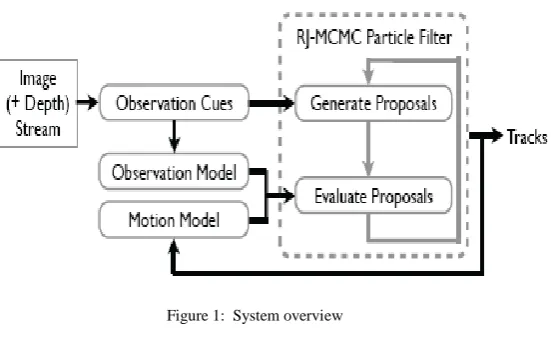
model to obtain a more accurate camera projection. Following the general pinhole camera model, the camera parameterization includes the focal length, the 3D location and the orientation angles. A system diagram is presented in Figure 1. The core of the system is the RJ-MCMC particle filter tracker, which generates proposals for subjects’ track states and the camera state, and evaluates proposals given both observations from the scene and a motion model. The RJ-MCMC algorithm enables the addition and removal of targets via random jump proposal moves between dimensions. The well-known “sample impoverishment” problem is avoided by re-sampling via MCMC sampling at each time frame, thus reducing the correlation among samples. There are three key ingredients in making such a system perform well for person tracking. First observation model and cues that are used which must account for the large variation in both people’s appearance and scene statistics. Second motion model is must account both for people’s unexpected motions as well as interactions between people. Third sampling procedure for the RJ-MCMC tracker, must efficiently sample the trajectories, while also accounting for people’s sudden unpredictable change or movements.
Figure 1: System overview
III. RJ-MCMC PARTICLE FILTERING METHOD
explore the configuration space and obtain the MAP solution, we use the Reversible Jump Markov Chain Monte Carlo Particle filtering method (RJMCMC) introduced by Khan [2]. Markov chain Monte Carlo (MCMC) techniques for a given fixed number of total signals and their extension Reversible Jump Markov chain Monte Carlo (RJMCMC) methods for an unknown total number of signals have become very popular to manage the integrations, as they effectively address the issue by sampling from a distribution proportional to the joint posterior density [2]. Tracking articulated figures in high dimensional state spaces require tractable methods for inferring posterior distributions of joint locations, angles, and occlusion parameters. Markov chain Monte Carlo (MCMC) methods are efficient sampling procedures for approximating probability distributions. We apply MCMC to the domain of people tracking and investigate a general framework for sample-approximation tracking based on the Particle Filter, MCMC.
Detection and tracking of a variable number of interacting objects is still difficult, implying three challenging tasks: (1) Reliably estimating the number of objects in the scene (2) Keeping the algorithm computationally tractable when multiple objects appear simultaneously (3) Modeling interactions between varying numbers of objects. To address the first problem, we propose an observation model which uses binary information taken from background subtraction, along with foreground and background color information, to predict the number of objects in the scene. In this work, a trans-dimensional Reversible jump MCMC algorithm is used to sample from the distribution of states given observations. The benefits of formulation include: efficient sampling, a state vector of variable dimension to handle varying numbers of objects, an explicit model for proximity based interactions, and the ability to handle multi-modality in a multi-object observation model. The approach addressed the problem of interaction as well, by defining a pair wise Markov Random Field (MRF) prior in the dynamical model, which is more computationally tractable. The MCMC-based particle algorithm is employed to estimate the posterior distribution of the target state to solve the tracking problem [3].
To efficiently explore the configuration space and obtain the MAP solution, we use the Reversible Jump Markov Chain Monte Carlo Particle filtering method (RJMCMC). The RJ-MCMC algorithm enables the addition and removal of targets via random jump proposal moves between dimensions. The well known “sample impoverishment” problem is avoided by re-sampling via MCMC sampling at each time frame, thus reducing the correlation among samples. To estimate the camera motion and identify target interaction as well as track multiple moving targets, so need to explore the combined configuration state space. MCMC is general purpose technique for generating samples from a probability in high-dimensional space, using random numbers drawn from uniform probability in certain range. MCMC is used to sample particles directly from the posterior distribution. Particle Filter is concerned with the problem of tracking single and multiple objects. In order to model accurately the system, it is important to include elements of non-linearity and non- gaussianity in many application areas, so particle filters can be used to achieve this.
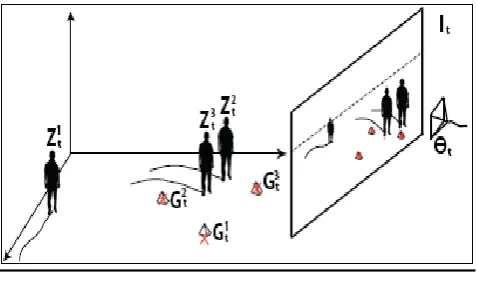
Figure 2: Given sensor inputs (i.e. images)
Figure 2. Given sensor inputs (i.e. images) It, it over time the goals of this work are 1) To track targets to obtain their trajectories, {Zt}, in a world coordinate system 2) To estimate the camera motion, Θt.
IV. MAXIMUM-A-POSTERI (MAP) SOLUTION
Many recent approaches to tracking pursue a tracking-by-detection strategy, where the targets are detected in a
pre-processing step, usually either by background subtraction or using a discriminative classifier from which the trajectories are later estimated. The benefit is an improved robustness against drifting and the possibility of recovering from tracking failure. In the comparatively simple single-target setting, where only one object is present in the scene, tracking can be approached by searching for the object of interest within the expected area and forming a plausible trajectory by connecting the object’s locations over time. When a higher, often unknown number of targets are observed simultaneously, the problem becomes much more complicated, because it is no longer obvious which object corresponds to which detection. This task of correctly identifying different objects over time is often referred to as data association. Moreover, motion, appearance, and visibility of objects are influenced by mutual dependencies that have to be taken into account. From a probabilistic point of view this entails inference often maximum a-posteriori (MAP), in a posterior distribution over several variables that are not independent.
The resulting optimization problem is highly non-convex in case of a continuous domain or non-sub modular in the discrete case and thus cannot be optimized globally without major simplifying assumptions. It is very easy to implement and has less complexity and storage requirements of order. A huge number of trajectories are required for reasonable performance especially for large datasets. The tracking and camera estimation problem is formulated as finding the maximum-a-posteri (MAP) solution of the joint probability. The MAP estimation framework provides information which is useful for dealing with problems posed. The MAP estimate can be seen as a Bayes estimate of the vector parameter when the loss function is not specified. MAP estimation can be applied to two classes of applications i.e. Parameter smoothing and Model adaptation. If an adequate statistical model exists for the observation noise then this error bound is attained by the maximum a posteriori (MAP) mode filter [4].
V. HIDDEN MARKOV MODEL
A Markov model is a system that produces a Markov chain and a hidden Markov model is producing the chain
are unknown or "hidden." The rules include two probabilities: (i) there will be a certain observation (ii) there will be a
certain state of transition which gives the state of the model at a certain time. The Hidden Markov Model (HMM) is a
mathematical approach to solving certain types of problems: (i) for given model, it can find the observations probability (ii) for given model and the observations, it can find the state transition trajectory (iii) maximize by adjusting the model's parameters.
Traditionally the Hidden Markov Model method has been used in pattern recognition problems, in speech
recognition, bioinformatics, signal processing and may be a model producing a sequence of observations. It has been used in structure prediction, sequence alignment, data-mining literature. The hierarchical hidden Markov model (HHMM) is a statistical model derived from the hidden Markov model. In hierarchical hidden Markov model each state is considered as self-contained probabilistic model. The hierarchical hidden Markov model and hidden Markov model are useful in many fields including pattern recognition. It is sometimes useful to use hidden Markov model in specific structures in order to facilitate learning and generalization [5].
Hidden Markov model always be used if enough training data is available. It can be beneficial to set the hidden Markov model into a greater structure which may not be able to solve any other problems than the basic HMM but can solve some problems more efficiently when it comes to the amount of training data required. In the hierarchical hidden Markov model each state is considered to be a self-contained probabilistic model.
VI. EXPERIMENTAL RESULT
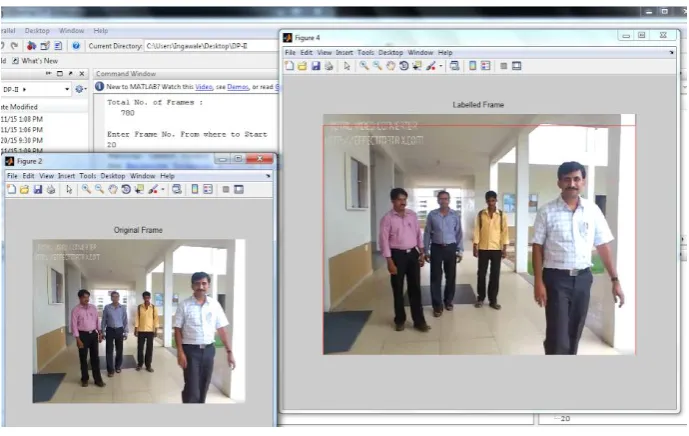
In this work, the Audio Video Interleave file i.e. AVI file is considered. This video file has 780 total numbers of frames. The video file can explain the process of video generation from a moving camera. It contains the observation model and information about cues. The observation model and cues are used to show the large variation in both people’s appearance and scene statistics. So, from the video generation file it possible to get the frames in the video file starting from 1 to 685.
Enter Frame Number from where to start i.e. from: 1 To 760. Resulted Frames: - 20
Figure 3: Output Figure
Figure 4: Tracked Output Figure
VII. CONCLUSION
In this groundwork a person tracking system is applied to two specific environments i.e. tracking people from
scene geometry, temporal factors formed into the tracking process by means of a MAP formulation. It believes that the approach can be applied to other trackers in order to improve their performance. The color-based observation model with the detection confidence density obtained from the HOG descriptor in order to increase the robustness of the tracker.
REFERENCES
1. C. Wojek, S. Walk, S. Roth, and B. Schiele. “Monocular 3d scene understanding with explicit occlusion reasoning”, Proc. IEEE Conf. In Computer Vision and Pattern Recognition, 2011.
2. Z. Khan, T. Balch, and F. Dellaert. “MCMC-based particle filtering for tracking a variable number of interacting targets”. IEEE Trans. Pattern Analysis and Machine Intelligence vol.27, no.11, pp. 1805-1819 Nov. 2005.
3. P. Minvielle, A. Marrs, S. Maskell, and A. Doucet. “Joint target tracking and identification-part i: sequential monte carlo model based approaches”. In International Conference on Information Fusion, 2005.
4. M. S. Arulampalam, S. Maskell, and N. Gordon. A tutorial on particle filters for online nonlinear/non-gaussian Bayesian tracking. IEEE Transactions on Signal Processing, 50:174–188, 2002.
5. J. Hu, et. al, “Writer Independent On-line Handwriting Recognition Using an HMM Approach”, Pattern Recognition, pp 133-147, 2000.
BIOGRAPHY
Mahadev R Ingawale received B.E degree in Electronics and Telecommunication Engineering from Dr.J.J.M. C.O.E.