Performance Analysis of Hierarchical Data
Aggregation Algorithms in WSN
Naina M. Boricha
1, Wasim J. Ghada
2P. G. Student, Dept. of Computer Engineering, B.H.Gardi College of Eng. and Tech, Rajkot, Gujarat, India1
Assistant Professor, Dept. of Computer Engineering, B.H.Gardi College of Eng. and Tech, Rajkot, Gujarat, India 2
ABSTRACT:In wireless sensor network sensor (WSN) nodes are very tiny devise with limited functionality. Many
limitations of sensor network are only depends on limited battery power. Large amount of power consumption is only because of redundant data transfer between sensor nodes to base station. Data aggregation is a technique to reduce the numbers of redundant data transmission. Many algorithms were developed for improving energy efficiency and network lifetime. In this paper, we investigate the different algorithms proposed to resolve the issue of more energy consumption, hierarchical algorithms for example. The goal of this paper is to help in developing a new algorithm after studying almost all available algorithms.
KEYWORDS: Data Aggregation; Hierarchical Algorithm; Energy Efficiency; network Lifetime.
I. INTRODUCTION
In today’s era, world is going towards making everything smart. Innovation in home and automation, in industrial and transportation represent smart environment. The Information from smart environment are obtain through Wireless Sensor Network (WNS). WSN is a collection of sensor nodes with one base station. Sensor nodes is comparatively small device and have limited functionalities that consist of only four unites sensing, processing, communication and power supply [1].
Sensor nodes have mainly two task sense the environment and send information to the base station. Sensor Nodes Co-operate with each other and have in-built processor, which pre-processed data before transmission. Base Station is more powerful than sensor nodes at where the collected data processed, analysed and make it useful for application. WSN received wide acceptance in difference fields like medical, military, agriculture, etc. It is more useful in physically unattended areas like forest. In WSN, not possible to change or recharge battery of sensor nodes that’s why to reduced power consumed by nodes is more essential. From lots of research, it concluded that more power consumed by node during data transmission [5].
Fig.1. Wireless Sensor Network
II. DATA AGGREGATION
In sensor field, when any event occurs sensor nodes sense some data like temperature, pressure etc. Than all nodes send their information to the base station. But the sensor nodes have limited functionalities. Battery of sensor is not rechargeable and changeable, we should think how to reduced power consumption by node. In sensor field, nodes are arrange closely, so nodes have almost same sensing data. But the more battery power is west only because of transmitting similar data to the base station[4]. If the numbers of transaction is reduced than power consumption by the sensor also reduced and the network lifetime is increased. Data aggregation is a technique which reduced the transaction by reducing the redundancy in data. It combines the large number of similar data and reduced the size of data by using different aggregation functions.
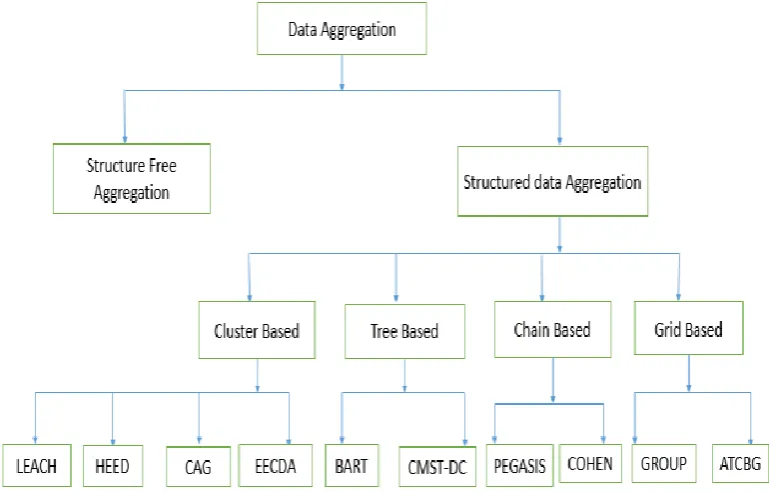
In data aggregation technique, data is gathered to sensor node using aggregation approaches. The data aggregation algorithm collects the sensor data from the sensor node and then aggregates at one particular node.Data aggregation is divides in two parts: 1) Structure Free, 2) Structured Data Aggregation[6]. In structure free aggregation there is no any particular or fix structure through which it aggregate data, aggregation performed manually by any node. The four structured aggregation techniques available as given below:
III.DATAAGGREGATIONALORIGHMSBASEDONHIERARCHICALNETWORKS
In Hierarchical data aggregation approaches data fusion is done at special nodes and it reduced the numbers of transmission so it helps in improving the energy efficiency and network lifetime. The hierarchical algorithms are given below:
Figure 3: Types of Hierarchical Algorithms
A. Cluster based Data Aggregation Algorithms
LEACH (Low-Energy Adaptive Clustering Hierarchy) protocol [9], it is a dynamic clustering algorithm. In which sensor nodes organized clusters and for every cluster one Cluster Head (CH) is selected. After every round new cluster head is selected, each round contain two phase: cluster setup phase and steady phase. In cluster setup phase, cluster formation and CH selection in performed. Than the selected cluster heads broadcast a message to all other non-cluster head nodes for informing that they are the non-cluster heads. After receiving advertisement message from CHs, all non-cluster head nodes decide that from which cluster they belongs to base on the signal strength of advertisement message. Than all node in particular cluster send their data to respective CHs and CH send data to the base station. The selection of cluster head is decide by node, choosing a random number between 0 and 1. The node heaving number less than following threshold, selected as CHs.
𝑇 𝑛 =
𝑝
1 − 𝑝 ∗ 𝑟 𝑚𝑜𝑑1 𝑝 0
𝑖𝑓 𝑛 ∈ 𝐺
Where p is the desired percentage of cluster heads (e.g. 0.05), r is= the current round, and G is the set of nodes that have not been Cluster heads in the last 1/p rounds.
network topology features (e.g., node degree, distance to neighbors) is used as a secondary parameter to break tie between candidate cluster heads, as a metric for cluster selection to achieve load balancing. The energy required in clustering is less in HEED as compare to LEACH.
CAG (Clustered Aggregation Technique) [11], which forms a clusters of sensor nodes based on the similarity of a sensing value by nodes. It used spatial and temporal correlation for remove the redundancy in data. CAG can work in two modes: 1) Interactive mode and 2) Steaming mode. In interactive mode, single set of response generated for query and in streaming mode, periodic responses are generated for query. It operate in two phase: query and response. In query phase, CAG forms clusters when forwarding tree is built using a user specified error threshold while building clusters. All nodes decide to join a cluster based on cluster head sensor reading (CR) and my local sensor reading (MR); if MR< CR± CR, then the sensor is included in the same cluster.
EECDA (Energy Efficient Clustering Data Aggregation) protocol [12], for heterogeneous WSNs which combines the ideas of energy efficient cluster based routing and data aggregation for better performance in terms of network lifetime and stability. It also includes a cluster head election technique and a path would be selected with maximum sum of residues for data transmission instead of the path with minimum energy consumption.
B. Tree Based Data Aggregation Algorithms
BART (Balanced Aggregation routing Tree) is a tree based protocol [13], in which sensor network construct a routing tree and data travels from leaf node to root node. BART is a complete binary tree protocol, in which parent node have two child nodes, the node with higher energy is selected as root node of a tree. Child nodes sense any event and send reading to their respective parent node, parent node aggregate child node’s data with their won and send it to their parent, at the end root node of a tree transfer information to the base station.
CMST-DC (Cluster-based Minimum Spanning Tree-Degree Constrain) is a combination to tree and cluster based protocol [14]. In this protocol sensor nodes geographically forms a clusters and cluster head (CH) is selected for every cluster, than in every cluster, a tree constructed between every nodes in particular cluster. Every CHs forms higher-level tree. Among these cluster heads only one head node chosen, which sends information to BS. This protocol work in two phase: 1) cluster formation Phase and 2) transmission phase. Cluster formation is done as like in LEACH, and transmission done as describe above.
C. Chain Based Data Aggregation Algorithms
PEGASIS (Power Efficient Gathering in Sensor Information System) is a chain based protocol [15] each node determines the distance to its neighbours using the signal strength and then adjusts the signal strength to communicate only with the closest neighbour. One chain leader is selected for every round, all node send their data to their closest neighbour, the neighbour node combine the received data with their won data and send it further and at last chain leader send data to the base station. In this algorithm chain is constructed using greedy algorithm and assumes that all nodes have global knowledge of network.
COSEN (Chain oriented Sensor Network for Efficient Data Collection) is chain-based routing protocol [16] like PEGASIS but it construct two-tier hierarchical chain in sensor network. In this technique sensor nodes construct several low- level chains. For each low-level chain, one chain leader is selected which have maximum residual energy. Than after between every low-level chain leader a high-level chain is constructed and high-level leader is selected. When communication start all non-chain leader nodes send their data to their closest neighbour and then to respective chain leader as like PEGAGIS, after that data reached at high-level leader and at last to base station. One drawback is COSEN increase a lot of redundant transmission paths for those nodes which are nearer to the BS.
D. Grid Based Data Aggregation Algorithms
(CHs) form a virtual cluster grid. The query for the data will be transmitted from base station to all nodes via cluster heads. The node with heaving matching answer for query send response in same route. In every round new cluster heads are selected. In GROUP, data forwarding is done in three processes: 1) grid construction process, 2) query forwarding, 3) data forwarding. In grid construction phase once the WSN deployed, all sinks in the network will elect one sink as the primary sink (PS), which starts the cluster grid construction process, based on their location. The PS is closer to the center of network than other sinks in order to keep a minimum duration of grid construction. Query forwarding phase queries are forwarded through limited- broadcast and unicast respectively. In Data forwarding phase, nodes with heaving matching query answer send data to the respective cluster head and then to the sink node.
ATCBG (Aggregation Tree Construction Based on Grid) is a greed based protocol [18]. In this protocol the aggregation tree is constructed by taking the sink as a center of a grid. The whole network is divide into same size cell call grid. The size of each cell is R× 𝑅. Nodes in each grid forms a cluster and one cluster head is selected by considering residual energy of that node. Cluster head is responsible for data aggregation. At last, all CHs construct tree-structure.
IV. PARAMETERS
A. Power Usage
Sensor node deployed with limited battery, hence power conservation and management takes additional importance. Power usage is defined as power consumed during the structure formation and execution of algorithm [7].
B. Overhead
Overhead defined as extra traffic increased at sensor nodes. For example, in cluster based technique, head node of a cluster have additional load than normal nodes [4].
C. Accuracy
It is defined as a ratio of total number of reading received at base station to total number of generated. It’s depends on specific application [8].
D. Query Based
In most of algorithms data automatically transfer to the base station by sensor nodes, it may increase overhead at base station. In the algorithms, in which data transfer happens only when base station send query for required data. Those algorithms known as query based [11].
E. Scalability
Network have thousands sensor nodes, algorithm should give proper result in case of network size increase or decrease. Scalability is defined as performance of algorithms, if nodes add or remove from the network [2].
V. CONCLUSION
In this paper based on different parameter measures’ study and analysis we have compared different hierarchical data aggregation algorithms. Data aggregation used to remove redundancy from data, so that network lifetime and other parameters can improve. From the above mentioned assessment, we bring to a close that clustering algorithms are increasing overhead at special node for example cluster head then other three. However dynamic clustering algorithms are better as compared to other three because of above mentioned parameters. In future work, we need to implement all these algorithms and check for specific parameters to choose good data aggregation algorithm.
According to analysis on different hierarchical data aggregation algorithms, I decide to work on combination of cluster, tree and chain based algorithm as our future work. In this algorithm, main parameters improves energy efficiency, minimize overhead, increase network lifetime.
REFERENCES
1. S.Gupta, P.Sinha, “Overview of Wireless Sensor Network: A Survey”, International Journal of Advanced Research in Computer and Communication Engineering, Vol. 3, January 2014.
2. G. Spandan, et al., “Data Aggregation prtotocols in Wireless Sensor Network”, International Journal of Computational Engineering Reasarch, Vol. 3, Issue 5 , May 2013.
3. M. Dagar, S. Mahajan, “Data Aggregation in Wireless Sensor Network: A Survey”, International Journal of Information and Computation Technology, Vol. 3, N0. 3, 2013.
4. J.Rajput, N.Garg, “A Survey on Secure Data Aggregation in Wireless Sensor Network”, International Journal of Advanced Research in Computer Science and Software Engineering, Volume 4, May 2014.
5. N. Patil, et al., “Data Aggregation in Wireless Sensor Network”, IEEE International Conference on Computational Intelligence and Computing Research,Vol. 3, Issue 5, 2010.
6. M. Bala Krishna, Noble Vashishta, “Energy Efficient Data Aggregation Techniques in Wireless Sensor Networks”, IEEE 5th International Conference on Computational Intelligence and Communication Networks, Vol. 3, N0. 3, 2013.
7. M. Young, The Technical Writer’s Handbook. Mill Valley, CA: University Science, 1989.
8. S. Mishra, H. Thakkar, “Features of WSN and Data Aggregation techniques in WSN: A Survey”, Volume 1, Issue
4, April 2012.
9. A. Ihsan, K. Saghar, et al., “Analysis of LEACH Protocol(s) using Formal Verification”, IEEE 12th International Bhurban Conference on Applied Sciences & Technology (IBCAST) Islamabad, Pakistan, 13th - 17th January, 2015.
10. H.Kour, A.Sharma, “Hybrid Energy Efficient Distributed Protocol for Heterogeneous Wireless Sensor Network”, International Journal of Computer Applications, Vol. 4 – No.6, July 2010.
11. J. Hao, et al., “Energy Efficient Clustering Algorithm for Data Gathering in Wireless Sensor Networks”, JOURNAL OF NETWORKS, VOL. 6, NO. 3, MARCH 2011.
12. D. Kumar, et al., “EECDA: Energy Efficient Clustering and Data Aggregation Protocol for Heterogeneous Wireless Sensor Networks”, Vol. VI, March 2011.
13. H. Kim and K. Han, “A Power Efficient Routing Protocol Based on Balanced Tree in Wireless Sensor Networks”, IEEE Proceedings of the First International Conference on Distributed Frameworks for Multimedia Applications (DFMA’05).
14. C. Liang, et al., “An Energy Efficient Routing Scheme in Wireless Sensor Networks”, IEEE 22nd International Conference on Advanced Information Networking and Applications – Workshops, 2008.
15. S.Lindsey,C. Raghavendra, “PEGASIS: Power-Efficient Gathering in Sensor Information Systems”, Computer Systems Research Department. 16. P. Patil, U. Kulkarni, “Analysis of Data Aggregation Techniques in Wireless Sensor Networks”, IJCEM International Journal of Computational
Engineering & Management, Vol. 16 Issue 1, January 2013.
17. L. Yu, et al., “GROUP: a Grid-clustering Routing Protocol for Wireless Sensor Networks”, IEEE 2006.
18. J. Shu, et al., “Study on Aggregation Tree Construction Based on Grid”, Journal Of Computers, Vol. 5, No. 6, June 2010.
BIOGRAPHY
Naina Boricha is a ME student in the Computer Engineering Department in B.H. Gardi college of engineering &
Technology, Rajkot, Gujarat, India. She received Bachelor of Information Technology degree in 2014 from R. K. College of Engineering and Technology, Rajkot, Gujarat, India. Her research interests are Computer Networks (Wireless Networks), Data Mining etc.
Wasim Ghada is an Assistant Professor with more than 5 years teaching experience. He is assistant professor of