Integral Controller for Load Frequency
Control in Deregulated Environment
P.Senthilkumar, Gayathri Katuri
Assistant Professor, Department of Electrical and Computer Engineering, College of Engineering and Technology
Mizan-Tepi University, Ethiopia.
Assistant professor, VMKV Engineering College, Chinna Seeragapadi, Periya Seeragapadi, Tamil Nadu, India
ABSTRACT: This paper deals with the Automatic Generation Control of the two area therma-thermal system in the restructured power system environment. The main objective of the automatic generation control is to regulate the power output of electric generator within an area in response to the changes in the system frequency and tie line loading. In the present competitive electricity market, fast power consumption may cause a problem of frequency oscillation. The oscillation of the system frequency may sustain and grow to cause a series frequency stability problem if no adequate damping is available. The concept of DISCO Participation matrix is introduced and reflected in the two area thermal-thermal system. The AGC in restructured power system environment should be designed in such a way that can contract individually with the GENCO for power. The concept of DISCO Participation matrix (DPM) is presented to simulate the GENCO and DISCOs. By using DPM, the dynamic response are obtained to satisfy the AGC requirements.
NOMENCLATURE
LFC Load Frequency Control AGC Automatic Generation Control ACE Area Control Error
CPF Contract Participation Factor DISCO Distribution Company GENCO Transmission Company DPM DISCO Participation Factor R Governor speed regulation B Frequency Bias factor Ki Integral gain
TG Governor Time constant
TP Time Constant of Power system
TT Turbine Time constant
KP Gain Constant of power system
i Area Index (1,2)
F Nominal System Frequency
ΔPtie Change in Tie line power (p.u. MW)
Schd Scheduled Act Actual
I. INTRODUCTION
Large scale power system are normally composed of control areas or regions presenting coherent groups of generators. An interconnected power system is basically a large power system consisting a number of power system. These power sytem or areas are connected by tie line. The objectives of a control strategy is to generate and deliver power in an interconnected power system as economically and reliably as possible, while maintaining the voltage and frequency within permissible limit. The Load Frequency Control (LFC) loop controls the real and frequency, while Automatic Voltage regulator (AVR) loop controls the reactive power and voltage. With the growth of interconnected power system, LFC has gained more importance.
It is a primary goal of the AGC to control the tie line power flow at the scheduled value defined by the contracts among various VIUs, to maintain a generation equal to the local load, thus controlling the frequencies of the control areas as close to the nominal value as possible during normal load changes. In cases of loss of generation in an area the neighboring utility will come to help it. In the classical AGC system, this balance is achieved by detecting the frequency and tie line power deviations to generate the ACE (area control error) signal which is in turn utilized in the integral feedback control strategy for a two-area system. It should be noted that this is a linearized model of the AGC, hence is based on an assumption that the frequency and tie line power deviations are small as referred in [2].
In the restructured power system, the engineering aspects of planning and operation have to be reformulated with the essential ideas remain the same. With the emergence of the distinct identities of GENCOs, TRANSCOs, DISCOs and the ISO, many of the ancillary services of a vertically integrated utility will have a different role to play and hence have to be modeled differently. In the new scenario, a DISCO can contract individually with a GENCO for power and these transactions are done under the supervision of the ISO as referred in [5].
The concept of DISCO participation matrix (DPM) is utilized to make the visualization and implementation of the contracts. The information flow of the contract is composed of traditional AGC and the simulation that reveal some interesting patterns. The trajectory sensitivities are helpful in studying the parameters as well as optimization of AGC parameters[4],[6].
The objectives of this paper includes
1. The frequency of the various bus voltages are maintained at the scheduled frequency. 2. The tie line power are maintained at the scheduled levels.
3. The total power is shared by all the generators economically.
4. Dynamic responses obtained should be satisfactory to the requirements of AGC.
In section II linearized model of an interconnected two area system with restructured power system is presented and discussed. The mathematical formulation is provided in section III and the simulation results are discussed under the section IV. Conclusions and future scope are presented in section V.
II. SYSTEMINVESTIGATED
A. Linearized model of an interconnected two area system
In two area system, two single area systems are interconnected via the tie line. Interconnection established increases the overall system reliability. Even if some generating units in one area fail, the generating units in the other area can compensate to meet the load demand. The power flowing across a transmission line can be modeled using the DC load flow equation as referred in [11].
(1)
This tie flow is a steady-state quantity. For purposes of analysis here, we will perturb the above equation to obtain deviations from nominal flow as a function of deviations in phase angle from nominal.
1 2
1tieflow tie
P
X
(2)
Where Δβ1 and Δβ2 are equivalent to Δδ1 and Δδ2.
Then
(3)
Where T is “tie-line stiffness” coefficient.
The areas are connected by a single transmission line. The power flow over the transmission line will appear as a positive load to one area and an equal but negative load to the other, or vice versa, depending on the direction of flow. The direction of flow will be dictated by the relative phase angle between the areas, which is determined by the relative speed-deviations in the areas.
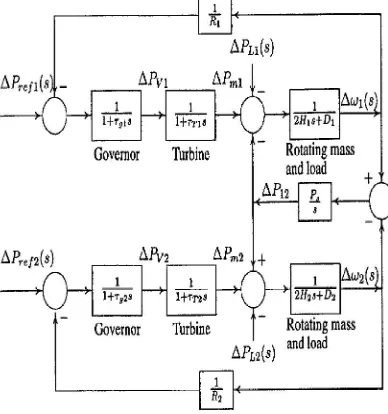
Fig. 1 Block diagram of interconnected system
Fig. 1 represents that the tie line power flow was defined as going from area 1 to area 2. Therefore, the flow appears as a load to area 1 and a power source (negative load) to area 2. If one assumes that mechanical powers are constant, the rotating masses and tie line exhibit damped oscillatory characteristics known as Synchronizing oscillations. It is quite important to analyze the steady-state frequency deviation, tie-flow deviation and generator output for an interconnected outputs for an interconnected area after a load change occurs. The net tie flow is determined by the net change in load and generation in each area.
B. Linearized model of an interconnected two area restructured power system
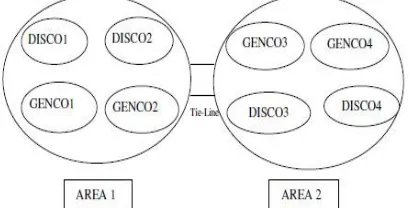
The traditional power system industry has a “vertically integrated utility” (VIU) structure. In the restructured or deregulated environment, vertically integrated utilities no longer exist. The utilities no longer own generation, transmission, and distribution; instead, there are three different entities, viz., GENCOs (generation companies), TRANSCOs (transmission companies) and DISCOs (distribution companies). As there are several GENCOs and DISCOs in the deregulated structure, a DISCO has the freedom to have a contract with any GENCO for transaction of power. After deregulation any DISCOs can demand for the power supply from any GENCOs. There is no boundation on the DISCOs for purchasing of electricity from any GENCOs. For understanding the concept of this kind of contracts DISCO participation matrix (DPM) is presented [9].
1 2
1
tieflow tie
P
X
1 2
tieflow
T
P
s
A DISCO has freedom to make contract with a GENCO in another control area and such transaction are called bilateral
transactions. All such transactions are completed under the supervision of independent system operator (ISO). The ISO controls various ancillary services, one of which is AGC.
A DPM is a matrix with the number of rows equal to the number of GENCOs and the number of columns equal to the number of DISCOs in the system [9]. Each entry in this matrix can be thought of as fraction of a total load contracted by a DISCO (column) towards a GENCO(row). The sum of all the entries in a column DPM is unity [9].
Fig. 2 Two area system in restructured power system
The DPM may be defined as
where cpfjd = Contract Participation factor of jth GENCO in the load following of dth DISCO.
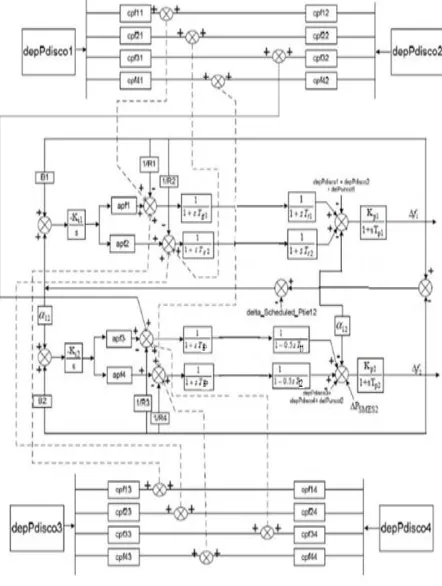
ACE participation factors are apf1 =0.5, apf2=1-apf1=0.5; apf3=0.5, apf4=1-apf3=0.5. Thus, the load is demanded only by DISCO1 and DISCO2 as defined in [2][14].
III. PROBLEMFORMULATION
The objective of AGC is to establish primary frequency regulation, restore the frequency to its nominal value as quickly as possible and minimize the tie line power flow oscillations between neighboring control areas. In the present work, an Integral Square Error (ISE) criterion is used to minimize the objective function as follows. The Area Control Error may be given as
ACE1 = B1Δf1 + ΔPtie1-2,error (4)
ACE2 = B2Δf2 + ΔPtie2-1,error (5)
Fig. 3 shows the block diagram of the two area thermal-thermal system with the Restructured power system.
Fig. 3 Linearized model of an interconnected system in Restructured power system
IV. SIMULATIONRESULTSANDDISCUSSION
An interconnected power system is considered as being divided into control areas, which are connected by tie lines. In each control area, all generators are assumed to form a coherent group. Some of the areas in the power system are considered having load perturbations having same magnitudes. The detailed block diagram of the interconnected power system is given in fig. 3.
Each area supplies its user pool, and tie-lines allow electric power to flow between areas. Therfore, each area affects others, that is, a load perturbation in one of the areas affects the output frequencies of other area as well as power flow on tie-lines. Due to this, the control system of each area needs information about the transient situation in all areas to bring the local frequency to its steady state value. While the information about each area is found in its frequency, the information about the other areas are in the perturbations of tie line power flows.
Case 1:
Response of two area system before deregulation
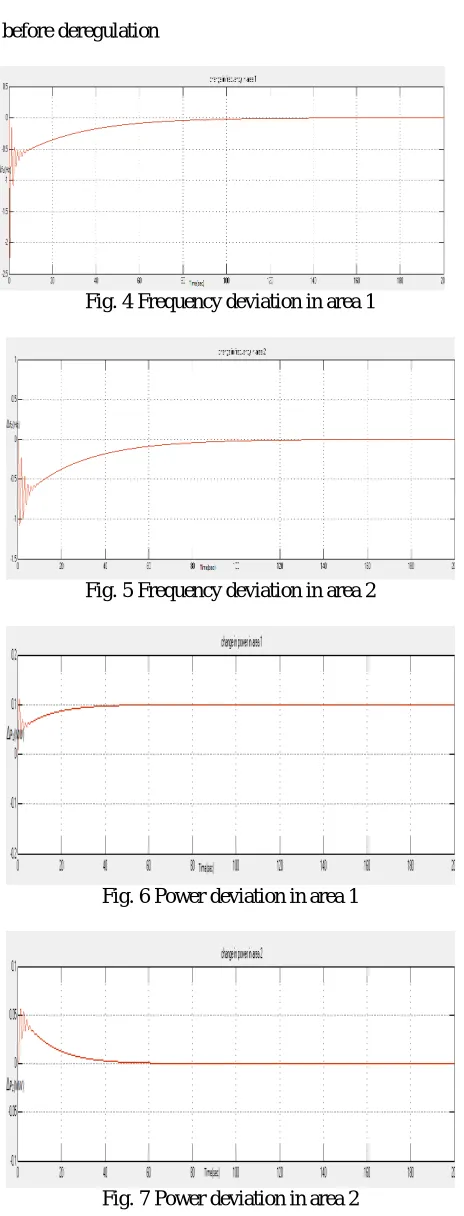
Fig. 4 Frequency deviation in area 1
Fig. 5 Frequency deviation in area 2
Fig. 6 Power deviation in area 1
Fig. 8 Change in tie line power
Case II:
Responses of the two area system after deregulation
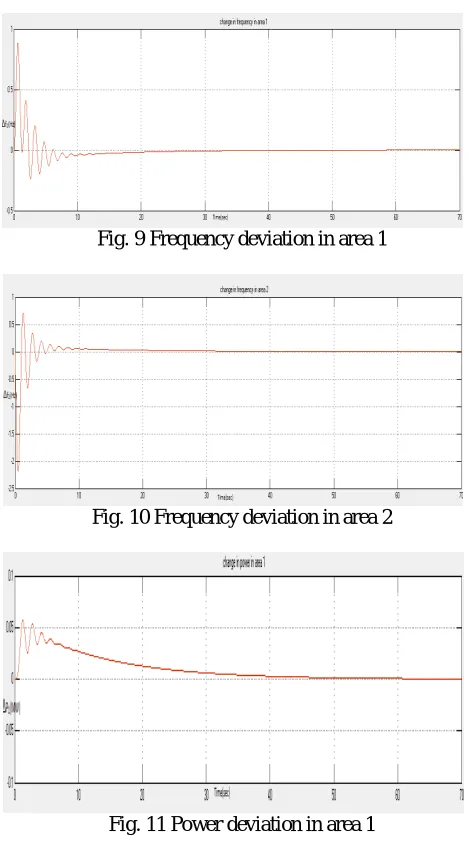
Fig. 9 Frequency deviation in area 1
Fig. 10 Frequency deviation in area 2
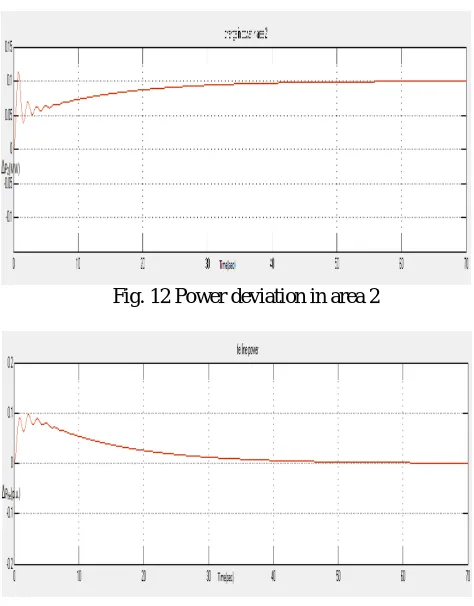
Fig. 12 Power deviation in area 2
Fig. 13 Responses after Deregulation
Figs. 4 - 8 shows the response of the two area system before deregulation. The system performance are in the terms of
Δf1, Δf2 ,ΔP1, ΔP2 and ΔPtie of area 1 and 2. Figs. 9 - 13 shows the response of the two area system after deregulation. The
system performance are in the terms of Δf1, Δf2 ,ΔP1, ΔP2 and ΔPtie of area 1 and 2.
Settling Time
Deviation Before Deregulation (step change of 0.2p.u. in area 1)
After Deregulation (step change of 0.2p.u. in area 1)
Frequency deviation in area 1
138 s 12.5 s
Frequency deviation in area 2
130 s 10.5 s
Change in tie line power
65 s 22.5 s
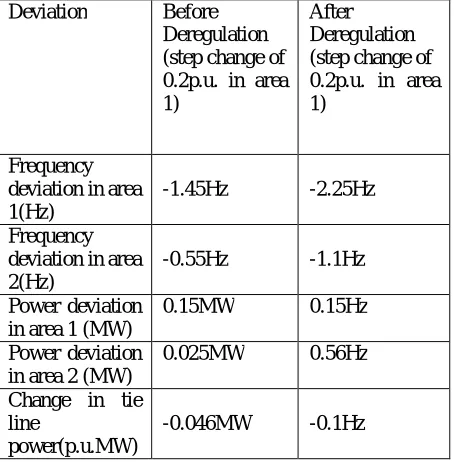
Peak Overshoot
Deviation Before Deregulation (step change of 0.2p.u. in area 1)
After Deregulation (step change of 0.2p.u. in area 1)
Frequency deviation in area 1(Hz)
-1.45Hz -2.25Hz
Frequency deviation in area 2(Hz)
-0.55Hz -1.1Hz
Power deviation in area 1 (MW)
0.15MW 0.15Hz
Power deviation in area 2 (MW)
0.025MW 0.56Hz
Change in tie line
power(p.u.MW)
-0.046MW -0.1Hz
Table. 2 Comparison of Peak Overshoot for before and after Deregulation
V. APPENDIX
(A) SYSTEM DATA
Tg = 0.08s
Tt = 0.3s
Tp = 20s
Kp = 120
Ki = 1
R = 2.4Hz/MW B = 0.415MW/Hz a = 1
apf’s = 0.5
VI. CONCLUSION
AGC is important in the power system. The frequency and tie-line power deviation responses are obtained for 20% SLP. In this work, we compare the dynamic responses of frequency and tie-line power for before and after deregulation. The concept of DISCO and GENCO are very useful in the deregulated environment. The design of Integral controller also plays an important role in obtaining the results in both before and after deregulation. The simulation results are satisfactory for two different operating cases in AGC before and after deregulation.
REFERENCES
[1]. Jaleeli, N., Van Slyck, L.S., Ewart, D.N., Fink, L.H., and Hoffmann, A.G.: "Understanding automatic generation control", IEEE Trans. Power Syst., vol. 3, no. 7, pp. 1106–1122, 1992.
[2]. V. Donde, M. A. Pai, I. A. Hiskens, “Simulation of Bilateral Contracts in an AGC System After Restructuring”, IEEE Trans, Power Syst., vol. 4, no. 6, 2003.
[3]. Praghnesh Bhatt, R. Roy and S.P. Ghoshal, "Optimized multiarea AGC simulation in restructured power system", accepted for the publication in Int. J. Electrical Power Energy Syst., 2010.
[4]. B. H. Bakken, and O. S. Grande, “Automatic Generation Control in a Deregulated Power System,” IEEE Tran. Power Systems, vol. 13, No. 4, pp. 1401-1406, 1998.
[5]. Vaibhav Donde, M. A. Pai, Ian A. Hiskens, “Simulation and Optimization in an AGC System after Deregulation”, IEEE Trans, Power systems, vol. 16, no. 3, 2001.
[6]. A.Suresh babu, Ch.Saibabu, S.Sivanagaraju, “Tuning of Integral Controller for Load Following of SMES and SSSC based Multi Area System under Deregulated Scenario”, IOSR Journal, e-ISSN: 2278-1676 Volume 4, Issue 3,PP 08-18, 2013.
[7]. O. I. Elgerd, Electric Energy Systems Theory: An Introduction, McGraw Hill, 1982.
[8]. R. D. Christie, and A. Bose, “Load Frequency Control Issues In Power System Operation after Deregulation,” IEEE Transactions on Power Systems, vol. 11, No. 3, August 1996, pp. 1191-1200.
[9]. Vijay Rohilla, K. P. Singh Parmar, Sanju Saini, “Optimization of agc parameters in the restructured power system environment using GA”, ISSN: 2231 – 6604, Volume 3, Issue 2, pp: 30-40, 2012.
[10].D. P. Kothari and I. J. Nagrath, “Power System Engineering”, 2nd edition, TMH, New Delhi, 2010. [11].P. Kundur, “Power system stability & control.” New York: McGraw-Hill, 1994, pp. 418-448.
[12].Barjeev Tyagi and S. C. Srivastava, “Automatic Generation Control Scheme based on Dynamic Participation of Generators in Competitive Electricity Markets”, Fifteenth National Power Systems Conference (NPSC), IIT Bombay, December 2008.
[13].N. Bekhouche, “Automatic Generation Control Before After Deregulation,” in Proc. of the Thirty Forth Southeastern Symposium on System Theory, March 2002, pp. 321-323.
[14].Arun Kumar, Sirdeep Singh, “Automatic Generation Control Issues in Power System Operation after Deregulation Review”, International Journal of Advanced Research in Computer Science and Software Engineering, Volume 4, Issue 5, 2014.
[15].Hadi Saadat, Power System Analysis, McGraw-Hill,2002.
BIOGRAPHY
P.Senthilkumar received the B.E. degree in electrical and electronics engineering from PSG College of Technology, Coimbatore. He obtained his M.E. degree in the field of Power System from College of Engineering Gundy (CEG), Anna University. Since 2012, he has been with the Department of Electrical and Computer Engineering in Adama Science and Technology University, Ethiopia and continuing his service as Assistant professor inMizan-Tepi University presently. His current research interests include power electronics, electrical machine drives, active filters, flexible ac transmission systems, high-voltage dc andwireless power transmission. He is a member of IEEE, IET and life-member of Indian Society for Technical Education (ISTE). Along with many International Journal publications, he guided funded projects for UG, PG and Ph.D scholars in the field of transistorized drives,induction heating converters and power flow control drives for power system.