Closed-Form Elasticity Solutions to Uniform
Rotating Discs Made of A Radially
Functionally Graded Material
Vebil Yıldırım1, Cem Boğa 2
Department of Mechanical Engineering, Çukurova University, 01330 Balcalı, Adana, Turkey1
Çukurova University Vocational School of Adana, 01160, Çukurova, Adana, Turkey 2
ABSTRACT: In this work the exact elastic response of a rotating disk made of a nonhomogeneous material is studied under four real physical boundary conditions and analytical formulas are presented in compact forms. As a special application of a simple power material grading rule the coefficients of the governing equation becomes constants. This allows ones to get closed-form solutions to the problem having Euler-Cauchy type of differential equations. The present formulation comprises both variations of elasticity modulus and material density including variation of the thickness except variation of Poisson’s ratio. The researchers, by and large, are obliged to verify their advanced results with the available literature which covers merely the formulas for stationary uniform disks subjected to an internal pressure. That is a little number of exact studies presenting the external pressure and rotational effects together with the internal pressure on the elastic behavior of the uniform disk made of a functionally graded material exist in the literature. This motivated to the authors to accomplish this study.
KEYWORDS:Elasticity Solution, Closed-Form, Exact Solution, Functionally Graded, Rotating Disk, Uniform Disk
I. INTRODUCTION
The analytical and numerical studies about functionally graded discs have gained momentum since the 1990s. There are numerous studies for stationary/rotating discs with constant/variable thickness and made of an isotropic and non-homogeneous material that is made of a functionally graded material in the literature. Some of those studies were performed analytically [1-13]. For some types of those material grading functions such as a simple power rule, or an exponential variation or a linear function it is possible to obtain a closed form solution to the problem. For instance if the grading function is chosen as a familiar simple power function as in this study, the differential equations turn into Euler-Cauchy types with constant coefficients. For linearly varying properties, the solution is obtained in terms of hyper-geometric functions. If the material grading is performed by an exponential function then Whittaker/Kumer functions or Frobenius series are employed in the solution. Apart from those, unlike general use of polar/cylindrical coordinates, elliptic cylindrical coordinate system can also be used to get closed form solutions in the formulation. For the two-dimensional analytical solution of such problems separation of variables technique with complex Fourier series are even implemented in the solution procedure. For arbitrary grading rules and for cylindric monoclinic materials, the analytical solution may be achieved by using iterative power series. However, in general, for other types of grading rules it is required to use a numerical solution techniques.
In the literature, especially analytical studies on such structures subjected to the only the inner pressure are relatively large. The number of studies considering the simultaneous effects of both the inner and outer pressures together with the rotation with a constant angular velocity are scarce.
Horgan and Chan [1-2] gave explicit exact solutions for rotating discs of constant density and thickness. Zenkour [3] studied analytically exponentially graded rotating annular discs with constant thickness. Closed form solutions incorporates Whittaker’s functions for exponential variation of both elasticity modulus and density. Eraslan
extended his study for such discs with rigid casing. Bayat et al. [6], based on the power-law distribution, gave both analytical and semi-analytical elastic solutions for axisymmetric rotating hollow discs with parabolic and hyperbolic thickness profiles. This semi-analytic solution was obtained by dividing the disc with varying thickness into
sub-domains with uniform thickness. Çallıoğlu et al. [10] performed stress analysis of annular rotating discs made of functionally graded materials by assuming that both elasticity modulus and density of the isotropic discs vary radially as a function of simple power rule. Nejad et al. [12] gave a closed-form analytical solution in terms of hyper-geometric functions to elastic analysis of exponentially functionally graded stationary discs subjected to internal and external pressure.
In this work the exact elastic response of a rotating disk made of a nonhomogeneous material is studied. Contrary to the literature all effects affecting the elastic behavior of the uniform disk such as internal and external pressures including rotation with a constant angular velocity are all studied under four physical boundary conditions and presented in compact forms. The present comprehensive study will be very helpful to the researches in the verification process of their results.
II. FORMULATION
The governing equation which is in general in the form of a second degree nonhomogeneous differential equations with variable coefficients are obtained by exploiting the strain-displacement relations, Hooke’s law and equilibrium equations for an axisymmetric case. For isotropic FG materials and axisymmetric loading, the problem is reduced to the solution of a second order nonhomogeneous differential equation with variable coefficients as follows:
( ) + ( ) ( )
( ) + + ( ) ( )
( ) − =−
( )
( ) (1)
where r is the radial coordinate, ( ) is the radial displacement, ν is the Poisson’s ratio, ω is the constant circular velocity, E(r) is the Young’s modulus, and ( ) is the density. Equation (1) in terms of radial displacement is also called Navier equation. This equation comprise both the inhomogeneity of the materials and the rotation as a body force. This type of problems is also referred to as boundary value problems. The complete solution is obtained by summing the homogeneous and particular solutions.
For a special case, by introducing the simple power material grading rule, such a second degree homogeneous/nonhomogeneous differential equation takes the form of Euler-Cauchy type differential equation with constant coefficients. This type of equations allows a closed-form solution. For any other material grading pattern which causes variable coefficients in the equation, in general, an appropriate numerical technique is required.
Any second-order non-homogeneous differential quation is called as an Euler Cauchy equation if it can be written in the following form
( ) + ( ) + ( ) = ( ) (2)
where , and are real/complex-valued constants. Assuming a homogeneous solution is in the form of ( ) = , a general solution of Euler-Cauchy equation is given by
( ) = + + ( ) (3)
where ( ) is the particular solution which may be found by general technique “variation of parameters” and are roots of characteristic equation. In this study equation (1) which is in the form of Euler-Cauchy is solved for , and then again using Hooke’s law
(4)
( ) = ( ) [ ( ) + ( )] together with strain-stress relations
( ) = ( )
(5)
( ) = ( )
both the radial and hoop stresses, and are calculated. In equation (5) and are radial and tangential strains. A metal and a ceramic material are composed radially with each other provided that it complies with a simple power material grading rule in order to create a new isotropic but no longer homogeneous material having more attractive material properties especially for the heat resistance.
( ) = (6a)
( ) = (6b) where
=
( )
( ) (7a)
= ( )
( ) (7b)
III. CLOSED-FORMSOLUTIONS
In this section the internal/external pressure effect and rotation effect are studied separately. For small deformations, the superposition principle will be hold to estimate the overall behavior of the structure under whole loadings.
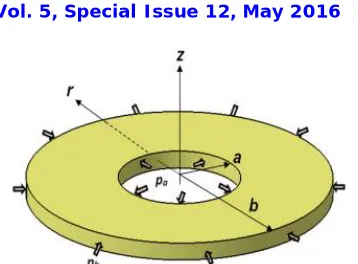
Internal/External Pressure Effects; The following is solved for pressurized uniform disk
( )
Fig. 1. Boundary Condition BC-0: Internal/External pressures at both surfaces (0) { ( ) =− ( ) =− }
By introducing
ξ= ( ( ))( ) (9)
the solution takes the following form
= ( )( + )
= − ( )( ( −2 − ) + ( −2 + )) (10)
=1 2
( )
2− ( − ) − −2 + ( + )
Where
= ( )( )
( ) ( )
(11)
=2
⁄ ⁄ ( ⁄ ( )
− ( ) ⁄ )( −1)
( − ) ( −2 − )
And
=
(12a)
=
2 ( ) ( )( −1)( ( −2 − )− ( −2 + ))
( − ) (( −2 ) − )
−2
( ) ( )
( −1)( ( −2 − )− ( −2 + ))
( − ) (( −2 ) − )
(13)
=
( ) ( )
+ ( ) ( )( )
Rotation Effect;
Let’s consider just the effect of rotation, ( = = 0) by the following nonhomogeneous governing equation
( )
+( ) + =−
( )
(14)
The general solution is written in terms of unknown coefficients and .
= ( )( + ) + Ω
=− ( )( ( −2 − ) + ⁄ ( −2 + )−2 ( )(3 + − + )Ω)
(15)
=− ( )( (−2 + ( − )) + ⁄ −2 + ( + ) −2 ( )(1 + (3 + − ) )Ω)
Where
Ω= ( )
( ( ) ) (16)
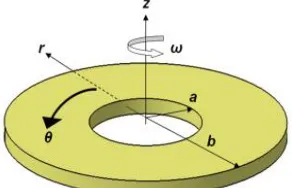
Fig. 2. Boundary Condition BC-1: Expansions are free at both surfaces (0) { (a)=0 and (b)=0}
These unknowns are found for the boundary condition BC-1 (Fig. 2), (a)=0 and (b)=0, as follows
=2 ( − )(− + − −3)Ω
( − )( −2 + )
= ⁄ ⁄(( ⁄)( ⁄ )() )Ω
Where
= 2 + + 6 (18)
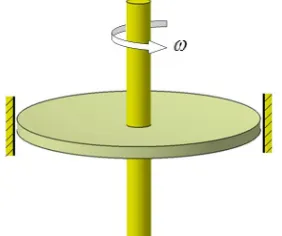
Fig. 3. Boundary Condition BC-2: Rigid shaft at the center, free expansion at the outer ( 0) { (a)=0 and (b)=0}
For the boundary condition BC-2 (Fig. 3), (a)=0 and (b)=0, and are determined as follows
= (Ω ( −2 − )−2Ω ( − − −3) )
( −2 + ) + (− + 2 + )
(19)
=− ( ⁄ ( ) ⁄ ( ) )
( ) ( )
Where
= ⁄ ⁄
(20) And finally, for the boundary condition BC-3 (Fig. 4), (a)=0 and (b)=0 those constants are as follows
=−
( )
Ω− ( ) Ω
−
(21)
=(
( )
− ( ))Ω
Fig. 4. Boundary Condition BC-3: Rigid shaft at the center, Rigid casing at the outer (0){ (a)=0and (b)=0}
IV.NUMERICALEXAMPLES
The geometrical properties of the disc are: = 0.025 , = 0.25 . Material properties of metal and ceramic are presented in Table 1. It is assumed that the inner surface is full metal while the outer surface is full ceramic. Numerical results are presented in Figs. 5-8.
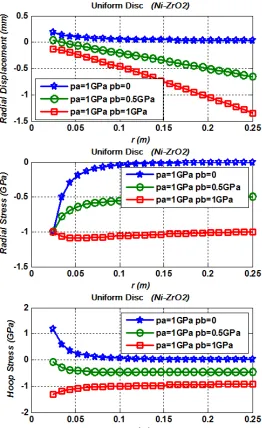
Fig. 5 shows the elastic response of the disk to the internal and external pressures. For disks subjected to the equal internal and external pressures, the hoop stress is larger at the internal surface than the external surface.
Fig. 6 shows the variation of the radial displacement with angular velocity and boundary conditions. Maximum radial displacement occurs at the outer surface when the angular velocity increases for BC=1.
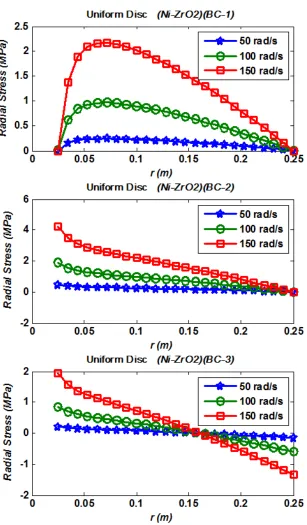
Fig. 7 shows the variation of the radial stress with angular velocity and boundary conditions. Maximum radial stress occurs at the inner surface when the angular velocity increases for BC=2.
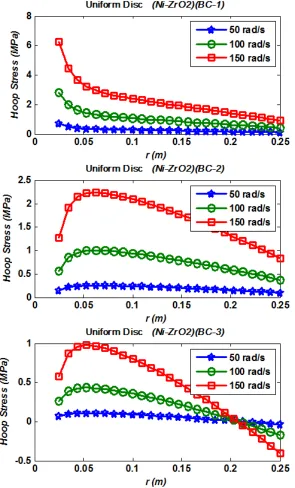
Fig. 8 shows the variation of the hoop stress with angular velocity and boundary conditions. Maximum hoop stress occurs at the vicinity of the inner surface when the angular velocity increases for BC=2.
Table 1. Material properties
METAL E
(GPa)
ρ
(kg/m3) ν CERAMIC
E (GPa)
ρ
(kg/m3) ν
Ni 199.5 8900 0.3
Zirconium oxide (ZrO2)
116.4 3657 0.3
V. CONCLUSIONS
In this work the exact elastic response of a rotating disk made of a nonhomogeneous material is studied analytically by considering all effects affecting the elastic behavior of the disk such as internal and external pressures including rotation with a constant angular velocity under four physical boundary conditions and presented in compact forms. These closed-form expressions may be directly used in many of engineering applications including material tailoring and optimization problems.
REFERENCES
[1] C., Horgan., and A., Chan., “The pressurized hollow cylinder or disk problem for functionally graded isotropic linearly elastic materials”, Journal of Elasticity, 55:43-59,1999.
[2] C., Horgan., and A., Chan., “The stress response of functionally graded isotropic linearly elastic rotating disks”, Journal of Elasticity, 55:219-230, 1999.
[3] A.M., Zenkour., “Analytical solutions for rotating exponentially-graded annular disks with various boundary conditions”, International Journal of Structural Stability and Dynamics, 5:557-577, 2005.
[4] A.N., Eraslan., and T., Akiş., “On the plane strain and plane stress solutions of functionally graded rotating solid shaft and solid disk problems”, Acta Mechanica, 181 (1–2):43–63, 2006.
[5] A.M., Zenkour., “Elastic deformation of the rotating functionally graded annular disk with rigid casing”, Journal of Materials Science, 42:9717-9724, 2007.
[6] M., Bayat., M., Saleem., B., Sahari., A., Hamouda., and E., Mahdi., “Analysis of functionally graded rotating disks with variable thickness”, Mechanics Research Communications, 35:283-309, 2008.
[7] X.L., Peng., X.F., Li., “Thermoelastic analysis of a functionally graded annulus with an arbitrary gradient”, Appl Math Mech, 30: 1211–1220, 2009.
[8] M.Z., Ashraf., and S.M., Daoud., “Stress function of a rotating variable-thickness annular disk using exact and numerical methods”, Engineering, 3:422-430, 2011.
[9] A., Saidi., A., Naderi., and E., Jomehzadeh., “A closed form solution for bending/stretching analysis of functionally graded circular plates under asymmetric loading using the Green function”, Proceedings of the Institution of Mechanical Engineers, Part C: Journal of Mechanical Engineering Science, 224:1153-1163, 2010.
[10] H., Çallıoğlu., N.B., Bektaş., and M., Sayer., “Stress analysis of functionally graded rotating discs: analytical and numerical solutions”, Acta Mechanica Sinica, 27:950-955, 2011.
[11] M.T., Ghorbani., “A semi-analytical solution for time-variant thermoelastic creep analysis of functionally graded rotating disks with variable thickness and properties”, International Journal of Advanced Design and Manufacturing Technology, 5:41-50, 2012.
[12] M.Z., Nejad., M., Abedi., M.H., Lotfian., and M., Ghannad., “Elastic analysis of exponential FGM disks subjected to internal and external pressure”, Central European Journal of Engineering, 3:459-465, 2013.