Evaluation of Different Kinds of Integral
Water Proofing Compounds as Per IS Codes
Abhishek G H1, Lokesh J K2
PG Student, Dept. of Civil Engineering, NMAMIT, Nitte Udupi Karnataka, India1
Asst. Professor, Dept. of Civil Engineering, NMAMIT, Nitte Udupi Karnataka, India2
ABSTRACT: This Study deals with the requirements of integral waterproofing compounds for cement mortar and concrete which shall be analysed using two main characteristics of the concrete the first one is permeability to water of specimen made from with and without adding water proofing compounds, by measuring percolations using standard specimen cylinders and secondly the physical tests of setting time and compressive strength of cement by adding recommended proportions of mortar / concrete waterproofing compounds and comparing the test results of similar tests on the same cement without admixing waterproofing compounds.
KEYWORDS: Integral Waterproofing, Percolations. Permeability.
I. INTRODUCTION
In practise one of the most important requirements of concrete is that it must be impervious to water under two conditions firstly when subjected to pressure of water, secondly to the absorption of the surface water capillary action, many studies have shown that concrete carefully designed, efficiently executed with sound materials will be impermeable to water. It has not been possible to really make a waterproofing structure in spite of many advancement in concrete technology. The problems of waterproofing of roofs, bathrooms, kitchens, basements, swimming pools and water tanks etc., have not been much reduced. The use of plasticizers, air-entraining agents, puzolanic materials and other workability agents help in reducing permeability of concrete by reducing the requirements of mixing water. In addition there are so many chemical admixtures are available for waterproofing concrete structure in our study we are dealing with Integral water proofing compounds which are in use from past 4 to 5 decades. These are convectional waterproofing compounds are either pore fillers, workability agents or repellents. The major classification of integral waterproofing compounds can be done as Densifiers, Repellents and Crystalline admixtures. The water proofing compounds used in this study are Conplast X421Ic, Conplast WP90 and Crystalline admixture from FOSROC chemicals are useful in making concrete more workable and homogeneous, and they also help in reducing W/c ratio. The performance requirements of integral waterproofing compounds are covered in IS 2645 of 1975. If the average percolation for the specimen incorporating the waterproofing compounds is less than 50 % of the average percolation in the case of specimen without waterproofing compounds, the integral waterproofing compound shall be considered satisfactory.
II. EXPERIMENTAL WORK
The major 3 tests in this study are permeability test, compressive strength and setting time which are conducted as guidelines prescribed in IS 2645
A .Permeability test:-
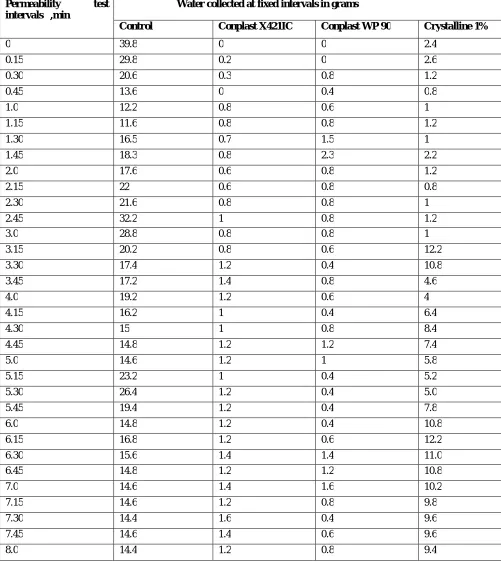
Table 1: permeability test readings Permeability test
intervals ,min
Water collected at fixed intervals in grams
Control Conplast X421IC Conplast WP 90 Crystalline 1%
0 39.8 0 0 2.4
0.15 29.8 0.2 0 2.6
0.30 20.6 0.3 0.8 1.2
0.45 13.6 0 0.4 0.8
1.0 12.2 0.8 0.6 1
1.15 11.6 0.8 0.8 1.2
1.30 16.5 0.7 1.5 1
1.45 18.3 0.8 2.3 2.2
2.0 17.6 0.6 0.8 1.2
2.15 22 0.6 0.8 0.8
2.30 21.6 0.8 0.8 1
2.45 32.2 1 0.8 1.2
3.0 28.8 0.8 0.8 1
3.15 20.2 0.8 0.6 12.2
3.30 17.4 1.2 0.4 10.8
3.45 17.2 1.4 0.8 4.6
4.0 19.2 1.2 0.6 4
4.15 16.2 1 0.4 6.4
4.30 15 1 0.8 8.4
4.45 14.8 1.2 1.2 7.4
5.0 14.6 1.2 1 5.8
5.15 23.2 1 0.4 5.2
5.30 26.4 1.2 0.4 5.0
5.45 19.4 1.2 0.4 7.8
6.0 14.8 1.2 0.4 10.8
6.15 16.8 1.2 0.6 12.2
6.30 15.6 1.4 1.4 11.0
6.45 14.8 1.2 1.2 10.8
7.0 14.6 1.4 1.6 10.2
7.15 14.6 1.2 0.8 9.8
7.30 14.4 1.6 0.4 9.6
7.45 14.6 1.4 0.6 9.6
The above table shows the representation of water collected in grams at the interval of 15 minutes, the overall experiment is conducted over a period of 8 hours.
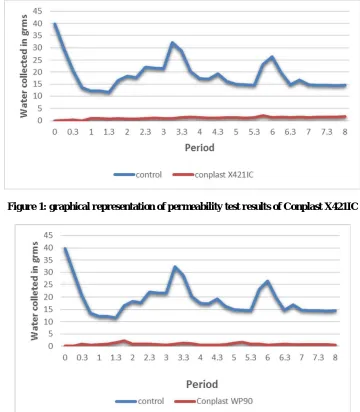
Figure 1: graphical representation of permeability test results of Conplast X421IC
.
Figure 3: graphical representation of permeability test results of crystalline 1%
It can be observered that there is considerable decrease in percolation of water in the samples by using Conplast X421IC,ConplastWP90 and Crystalline admixtures, The percolation is less than 50% than that of percolation in case of Normal samples.
B. Compression test:-
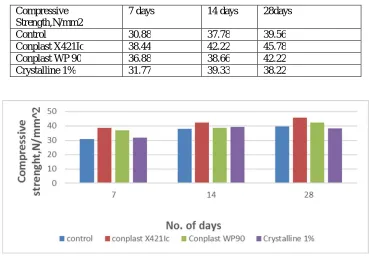
Compression test for both mortar and concrete samples are determined in this experiments, for mortar trails 12 7cm cubes are casted and compression strength for 7 days and 14 days are calculated as prescribed in IS2645-2003, for concrete (M30) trails 28 specimens is casted and cured for 28 days by using different waterproofing compounds i.e. conplast WP90, ConplastX421IC, and crystalline Admixtures. The strength is determined for 7days, 14days and 28 days the results are tabulated below:-
Table 2: 3days compression strength
Sl. no
Sample type
Weight of cube, g Compressive
strength, N/mm2
1 Control 800 27.84
2 Conplast X421lc 805 29.20
3 Conplast WP 90 802 27.84
4 Crystalline 1% 804 33.84
Table 3: 7days compression strength
Sl. no
Sample type
Weight of cube, g Compressive strength,
N/mm2
1 Control 800 41.60
2 Conplast X421lc 804 42.14
3 Conplast WP 90 805 42.87
4 Crystalline 1% 802 44.21
Figure 3: Graphical representation of Compression test of Cement mortar Table 4: Compression strength of concrete
Compressive Strength,N/mm2
7 days 14 days 28days
Control 30.88 37.78 39.56
Conplast X421Ic 38.44 42.22 45.78
Conplast WP 90 36.88 38.66 42.22
Crystalline 1% 31.77 39.33 38.22
Figure 4: Graphical representation of Compression test of Concrete
C. Setting time test:-
Table 5: Initial and final setting time
The control
Setting time(min)
Initial setting time Final setting time
210min 298min Conplast
X421IC
Initial setting time Final setting time
270min 397min Conplast
WP90
Initial setting time Final setting time
225min 328min
III.CONCLUSION
It is observed that the average percolation for the specimen incorporating the waterproofing compound is less than 50 percent of the average percolation in the case of the specimens without waterproofing compounds, which proves the requirements of the Is code 2645-2003 the average percolation of conplast WP90 is 5.26%, conplast X421IC is 4.17% and crystalline 1% Admixture is 30% with respect to the average percolation of the specimen without waterproofing compounds. It is also observed that the compressive strength of the cement mortar and the concrete also increased considerably due to addition of waterproofing compounds. In case of compressive strength of 7days cement mortar the average compressive strength is increased by 1.28%, 2.96%, and 5.90% of ConplastX421IC, ConplastWP90 and Crystalline Admixture Respectively than that of Control specimen. At 14 days the compressive strength is increased by 4.65%, 6.04% and 17.73% of ConplastX421IC, ConplastWP90, and crystalline admixture respectively than that of Control. The average compressive strength of concrete at 7 days is increased by 19.66%, 16.27% and 2.80% of ConplastX421IC, ConplastWP90 and Crystalline Admixture Respectively than Control, at 14 days the strength is increased by 10.52%, 2.27%, and 3.94% of ConplastX421IC, ConplastWP90 and Crystalline Admixture Respectively than that of Control specimen, at 28days the strength of ConplastX421IC, ConplastWP90 is increased by 13.59% and 6.30% but there is decrease in compressive strength of crystalline admixture by 3.5 % than that of the control specimen. It is also observed that in setting time test the initial setting time and final setting time of specimen with chemical admixture varies than that of the normal control specimen, admixing the integral waterproofing compounds also helps in the improving workability of concrete.
REFERENCES
[1] M.S Shetty “Concrete Technology and practice, S Chand publications seventh edition 2013. [2] S.C Rangwala “Building Construction”, Chaotar Publication, twenty fourth edition 2006.
[3] M .L Gambhir “Concrete technology” Theory & practice, McGraw Hill Publications, fifth edition 2004.
[4] Zhongnan song, Xiao Xue, Yanwen li, Jingna Yang, Zhongyu he, Shizhao Shen, Linhong Jiang, Weidong Zhang-“Experimental exploration of the waterproofing mechanism of the inorganic sodium silicate-based concrete sealers”, 9thDecember 2015.
[5] Roslan Talib, David Boyd, Susan Hayhow, A Ghafar Ahmed, Mzailan sulieman, - “Investigation effective waterproofing materials in preventing roof leaking: initial comparative study: Malaysia, U.K”. 6th February 2015.
[6] Nasir zakari Muhammad, Ali keyvanfar, Muhd Zaimi Abd. Majid, Arezou Shafaghat, Jahangir Mirza- “Waterproof performance of concrete: A critical review on implemented approaches”.15th October 2015.
[7] Xinxin Li, Qing Xu, Shenghon Chen-“An experimental and numerical study on water permeability of concrete”. 24th December 2015.