Vehicle Authentication Using Automatic
License Plate Recognition by OCR
K. Nirmala Devi1,V.Annapurna2
M. Tech, Dept. of E.C.E., JNTU College of Engineering, Anantapur, Andra Pradesh, India
Lecturer, Dept. of E.C.E., JNTU College of Engineering, Anantapur, Andra Pradesh, India
ABSTRACT: Automatic license plate recognition (ALPR) plays an important role in real-life applications because the usage of vehicles by the people has been increasing day by day due to population growth and human needs. So it is necessary to control the vehicles and to provide security to the vehicles. Main process of ALPR is divided into 5 stages: Image Acquisition, Pre-processing, Extraction of vehicle licence plate(VLP) from an image, Segmentation of each character in VLP and Recognition of each character in the licence plate by OCR , by following different methods in each stage. ALPR is most efficient and used in many applications like automatic car gate opening(ACGO), automatic ticketing of vehicles at parking area, traffic monitoring, tracking vehicles during signal violation, stolen car detection without direct human intervention. This paper also presents one real time application i.e., Authentication.
KEYWORDS: Automatic license plate recognition(ALPR); Vehicle license plate(VLP); Optical character recognition(OCR); Automatic car gate opening(ACGO); Extraction
I. INTRODUCTION
Automatic licence plate recognition(ALPR) is a image processing technology that identifies vehicles by their license plate. Vehicles play important role in transportation. ALPR system is important method used in Intelligent
Transportation System. Aspect ratio is very important factor in standardized vehicle's number plates, Aspect
Ratio=Width/Height. Recognition of Indian number plate is difficult when compared to foreign number plate because it follows particular standard shown in fig.1 in which 1 represent two-letter state code, 2 represent two-digit district code, 3 represent series code, and 4 represent actual registration number that is unique for each vehicle.
Fig.1: Indian vehicle number plate
ALPR system as shown in fig. 2 consists of five phases:-
1. Image Acquisition
2. Pre-processing
3. Extraction of Number Plate
4. Segmentation
5. Recognition
accurate portion and Number Plates exist on different location for different vehicles. Depending on the output of the extraction phase further process will proceed. Fourth phase is segmentation in which each character in the licence plate is segmented using image binarization, connected component labelling and bounding box. Last phase is recognition in which all characters are recognised by the computer. This final result is used in many applications like Authentication, which is also showed in this paper.
II. RELATED WORK
In [1] authors Sarbjit Kaur and Sukhvir Kaur proposed a efficient method of Indian vehicle number plate extraction using morphological operations, thresholding, sobel edge detection and connected component analysis, the accuracy of this method is 90% out of 40 vehicles for license plate extraction. Ronak P Patel [2] proposed new algorithm for number plate extraction using bounding box and morphological operations for recognition. In [3] author Shan Du presented a comprehensive survey on all existing techniques of Automatic licence plate recognition by comparing all methods with their pros and cons, which gives a better idea regarding all the methods. Najeem Owamoyo [4] proposed method for number plate extraction using Sobel filter and morphological operations. In [5] Divya Gilly presented an efficient method for license plate detection by connected component analysis. Isack Bulugu [6] to find the location of the plate has proposed edge finding method. Rupali Kate [7] proposed algorithm for number plate localization based on a combination of morphological operation with area criteria tests. Hadi Sharifi [8] has study and evaluates most important license plate detection algorithms and compared them in terms of accuracy, performance, complexity, and their usefulness in different environmental condition. P.Vasantha Kumar [9] proposed algorithm for extracting the Plate region using vertical projection method and edge detection algorithm.
This paper presents a simple method for the extraction, segmentation and recognition by following different methods with the help of existing method.
III.PROPOSED METHODOLOGY AND DISCUSSION
This section explains proposed method of licence plate recognition of Indian vehicles. Below figure shows main block diagram of this proposed method.
Fig 2: Block diagram of ALPR system
1. Image Acquisition:
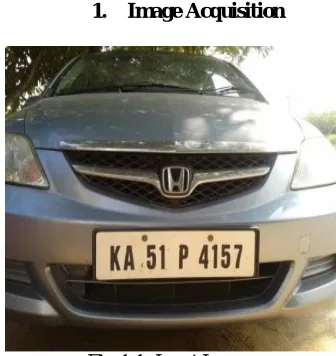
This is the first step to acquire the image which is input image using digital camera with high resolution. Images are acquired in different background in different illumination conditions.
2. Pre-Processing:
Pre-processing is done mainly to improve contrast in an image. It involves two steps:
RGB to Grayscale conversion
2.1.RGB to Grayscale conversion
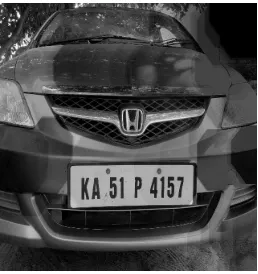
Here input image(RGB) is converted into gray scale image by formulating it by forming a weighted sum of R,G, and B components: Gray=0.2989 * R + 0.5870 * G + 0.1140 * B
2.2.Contrast enhancement using histogram equalization
Images are enhanced by using histogram equalization on gray scale image, to reduce the problem of low contrast and low quality in vehicle input images.
3. Extraction:
In extraction, license plate is extracted from entire vehicle image. It involves 4 steps:
Morphological opening
image subtraction operation
Image binarization using thresholding
Sobel Edge detection
Morphological operations(dilation and erosion)
Actual number plate area
3.1.Morphological opening
Morphological opening operation is performed on enhanced gray scale image to overcome brightness in the image. Morphological opening operation is performed by using structuring element and it is nothing
but erosion followed by dilation operation.
3.2.Image subtraction operation
Image subtraction is the differences between two images. Here subtraction of opening operation on enhanced gray scale image using disk shape structuring element.
3.3.Image binarization using thresholding
Here gray scale image is converted into black and white image by using threshold value of 127, which is middle value of 0 to 255 using otsu’s method. In the gray scale image, the pixels which are above the threshold value are converted into white and , the pixels which are below the threshold value are converted into black.
3.4.Sobel Edge detection
Here both vertical and horizontal edge detection is performed on the output of binary image by using sobel operator.
3.5.Morphological operations(dilation and erosion)
Morphological operations are mainly used to remove all the objects in the image, except licence plate area. In this firstly dilation operation is performed to overcome broken lines in the output of edge detection. Secondly, fully covered areas in the image are covered with holes. Thirdly, erosion operation is performed to remove unwanted areas.
3.6.Actual number plate
After the detection of number plate area, the actual number plate area is extracted by using connected component analysis and bounding box to find the row and column indices of plate area. With the help of indices, license plate is extracted from the gray scale image.
4. Segmentation
In segmentation stage, all the characters are segmented and extracted individually from the licence plate. It undergoes two stages
Removal of unwanted objects in the license plate
Extracting of each character in the license plate
4.1. Removal of unwanted objects in the license plate
4.2.Extracting of each character in the license plate
Now only characters leftover in the license plate and is extracted each character individually by using bounding box.
5. Recognition
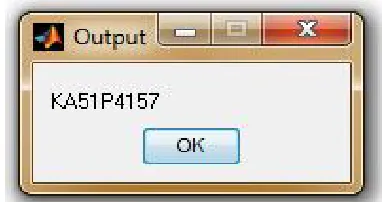
Each individual character obtained in segmentation stage, is recognized by the computer by using optical character recognition(OCR) and Correlation co-efficient. Each segmented character pixels are compared with all characters (0 to 9 & A to Z) of different font styles which is stored in database by using correlation coefficient r,
6. Authentication
Authentication is one of the real time application in which the system verifies the identity of a vehicle who wishes to access it. This application is used in automatic car gate opening, security purposes etc. This is done by comparing two files in the database, one file is stored with few vehicle numbers and another file contains output (License plate number of present vehicle which is recognized in the recognition stage), if output is matched with the any of the numbers in another file then it is authenticated otherwise unauthenticated.
IV.EXPERIMENTALRESULTS
The entire proposed method is implemented with MATLAB. The outputs of each stage in proposed method is shown below. The output of first stage, Image Acquision is shown in fig.1.1, Pre-processing result is shown in fig 2.1, Extraction output is shown in fig 3.1 to fig 3.8, Segmentation output is shown in fig 4.1 and Recognition output is shown in fig 5.1
1. Image Acquisition
Fig 1.1: Input Image
2. Pre-Processing 3. Extraction
Fig.2.1: Gray scale and contrast image and their respective histograms Fig.3.1: Morphological opening
Fig 3.2: Image subtraction Fig 3.3: Binarized Image Fig 3.4: Sobel Edge detection
Fig 3.5: Dilation operation Fig 3.6: Image after filling with holes Fig 3.7: Number plate area detection gray scale image
0 2 4 6 8
x 104
histogram of grayscale image before contrast enhancement
0 50 100 150 200 250
gray scale image after contrast enhancement
0 2 4 6 8 10
x 104
histogram of grayscale image after contrast enhancement
0 50 100 150 200 250
Opening effect using disk
Binarized Image
Vertical Edge Detection by Sobel operator
Image after filling holes
Number Plate Area Detection image subtraction
Fig 3.8: Extracted Number plate
4. Segmentation
Fig 4.1: Segmentation of each character in the license plate
5. Recognition
Total vehicle images
Successful number plates
Success Rate(%)
50 48 96
Table 1: Final Results
V. CONCLUSION AND FUTURE WORK
The simulation results showed that the proposed algorithm performs better with 96% accuracy by taking 50 vehicles and by following all different methods as indicated above. It is simple and efficient method presented in this paper. The proposed method is mainly designed for real-time Indian vehicles number plate. This process is tested over more than one number plates of vehicles under different illumination and various weather conditions i.e. daytime, night time,
rainy days, cloudy, sunny etc with good success rate. In future, video-based ALPR is done for above method.
ACKNOWLEDGMENTS
I would like to thank my parents and my brother for supporting me in all my studies. I thank “GOD” for making this mortal venture possible.
REFERENCES
1. SARBJIT KAUR AND SUKHVIR KAUR “ AN EFFICIENT METHOD OF NUMBER PLATE EXTRACTION FROM INDIAN VEHICLES IMAGE”
INTERNATIONAL JOURNAL OF COMPUTER APPLICATION,FEBRUARY 2014
2. Ronak P Patel, Narendra M Patel and Keyur Brahmbhatt, “Automatic Licenses Plate Recognition”, International Journal of Computer Science and Mobile Computing, April 2013.
3. [2] Shan Du, Mahmoud Ibrahim, Mohamed Shehata and Wael Badawy, “Automatic License Plate Recognition (ALPR): A State-of-the-Art Review”, IEEE Transaction on Circuits and Systems for Video Technology, February 2013.
4. Najeem Owamoyo, A.Alaba Fadele and Abimbola Abudu, “Number Plate Recognition for Nigerian Vehicles”, Academic Research International, 2013.
5. Divya Gilly and Dr. Kumudha Raimond, “License Plate Recognition- a Template Matching Method”, International Journal of Engineering Research and Applications (IJERA), 2013.
6. Isack Bulugu, “Algorithm for License Plate Localization and Recognition for Tanzania Car Plate Numbers”, International Journal of Science and Research (IJSR), 2013.
7. Rupali Kate, “Number Plate Recognition Using Segmentation”, International Journal of Engineering Research and Technology (IJERT), November 2012.
8. Hadi Sharifi Kolour, “An Evaluation of License Plate Recognition Algorithms", International Journal of Digital Information and Wireless Communications (IJDIWC), 2011.
9. P.Vasantha Kumar and Kumar Parasuraman, “An Efficient Method for Indian Vehicle License Plate Extraction and Character Segmentation”, IEEE International Conference on Computational Intelligence and Computing Research, 2010.
BIOGRAPHY
K Nirmala Devi, received Master of Technology(MTech) in the year 2015, Electronics and Communication Engineering from JNTU College of Engineering, Anantapur. She received Bachelor of Technology(BTech) degree from Intell Engineering College Anantapur, Andhra pradesh, India. Area of interests in digital image processing.