ISSN(Online): 2320-9801
ISSN (Print): 2320-9798
I
nternational
J
ournal of
I
nnovative
R
esearch in
C
omputer
and
C
ommunication
E
ngineering
(An ISO 3297: 2007 Certified Organization) Vol. 3, Issue 6, June 2015
Data-Aggregation in WSN Based On Distance
Based Routing With Secure Features
Soniya Patil, Prof. Dr. Arati M. Dixit
M.E Student, Department of Computer Engineering, PVPIT, Bavdhan Pune, India
Professor, Department of Computer Engineering, PVPIT, Bavdhan, Savitribai Phule University of Pune, Pune,
Maharashtra, India
ABSTRACT: Wireless Sensor Networks (WSNs) are rapidly growing technology made up of small tine devices called sensor nodes. Nodes have a battery with limited energy plan. In an expansive WSN a lot of data needs to be collected and sent hence requiring nodes to have more energy. In-network data aggregation, combines results at intermediate nodes during message routing, diminishes the measure of communication over head and energy utilization hence saving energy. In the proposed work a distance based routing is done after in-network aggregation of data to sink node. This method combines both tree based and cluster based in network aggregation of data after an event occurs. The algorithm works in steps, first a hop based tree is formed of entire WSN, later when event occurs the nodes which sense data called as collaborators form clusters and selection of cluster head (coordinator) is done which collects or aggregates data using synopsis diffusion, lastly the cluster head sends data to sink node through shortest path method and in most secure way by generating Message authentication code.
KEYWORDS: Wireless Sensor Networks (WNS), Message authentication code.
I. INTRODUCTION
A Wireless Sensor Network (WSN) is an sort of ad hoc network made out of a comprehensive amount of nodes equipped with extraordinary sensor devices. This network is handled by inventive improvement in low power wireless communications close by silicon compromise of distinctive functionalities for instance, sensing, communication, and operations. Likewise, a power origin supplies the energy needed to the gadget to perform the programmed work. This power origin repeatedly comprises of a battery with a limited energy plan. Likewise, it could be incomprehensible or improper to energize the battery, in light of the fact that nodes may be deployed in an unfriendly or strange environment. Then again, the sensor network ought to have a lifetime sufficiently long to satisfy the application requirements. Regularly, wireless sensor networks have strong stipulations regarding power resources moreover computational limit. Wireless Sensor Network (WSN) contains spatially separated autonomous devices that cooperatively sense physical or environmental situations, such as temperature, sound, vibration, pressure, motion, or pollutants at different locations. WSNs have been implemented in applications such as environmental monitoring, homeland security, critical infrastructure systems, communications, manufacturing, and many other applications that can be critical to save lives and assets. A Wireless Sensor Network (WSN) comprises of spatially proper self-governing gadgets that agreeably sense physical or ecological situations, for example, temperature, sound, vibration, weight, movement, or poisons at distinctive areas. WSNs have been consumed as a part of uses, for example, natural checking, country security, basic base frameworks, communications, producing, and number of various applications that can be distinguishing to save lives and resources. The most efficient technique to give assurance of the transmitting the sense data assumable after intrusion in communications and nodes discouragement are the principle challenge in the routing algorithm. In the event of the packet is loss, a lot of data additionally is lost, hence even data loss is big problem while routing data. High gathering rate, a lessened numerous messages for setting up a routing tree, a solid data transformation, and a dependable data transmission are the features show in the information gathering directing protocol, in the WSN link.
II. RELATED WORK
ISSN(Online): 2320-9801
ISSN (Print): 2320-9798
I
nternational
J
ournal of
I
nnovative
R
esearch in
C
omputer
and
C
ommunication
E
ngineering
(An ISO 3297: 2007 Certified Organization) Vol. 3, Issue 6, June 2015
overlapping routes, high aggregation rate, and dependable information aggregation and transmission. The presented DRINA algorithm was widely contrasted with two other known arrangements: the Information Fusion-based Role Assignment (Infra) and Shortest Path Tree (SPT) algorithms.
The authors L. Villas, A. Boukerche also presented the way that there are a couple of answers for information gathering in WSNs [2], most of them generate their structures focused around the solicitation of event occasion. This can challenge both an absence of load adjusting support and low standard routing trees, following the same tree is implemented all through the system lifetime. To handle these provocations they present a new algorithm called dynamic and scalable tree Aware of Spatial correlation (YEAST).The higly dynamic routing protocol that is Dynamic Data-Aggregation Aware Routing Protocol (DDAARP) for wireless sensor systems. This novel protocol collects element defeats, which upgrade the cost and nature of last routing tree.
A.P. Chandrakasan, A.C. Smith proposed a paper on The low-energy adaptive clustering hierarchy (LEACH)[3], a protocol development demonstrating for micro sensor frameworks that solidify the assumptions of energy effective cluster based routing and media get to gather with application-particular data aggregation to achieve extraordinary execution in regards to structure lifetime, absence of movement, likewise application law standard. LEACH joins an alternate, separated cluster improved method that engages relationship to relationship toward oneself of broad amounts of nodes, algorithms for adjusting clusters additionally turning cluster head positions to even handedly convey the energy load among all the nodes, and strategies to enable disperse sign taking care of to extra communications resources.
P.Thirumoorthy, R.N.K.Karthikeyan, S.Sudha ,B.Manimegalai [4] proposed the designs of data aggregation using the routing protocols that can reduce the cost of communication in the wireless sensor network. Due to the multiple sensor nodes has detected one or more events, results in heavy traffic. To save the energy, the network should notify the event properly, only when an event occurs. Overhead occurs in In FRA because its scalability is very low.
In paper [5] D. N. Rewadkar, Priti Madhukar Mithari proposed data aggregation ,A wireless sensor network (WSNs) consisting of many sensor nodes and these networks are deployed in different classes of applications for accurate monitoring. Wireless sensor nodes are limited energy supply has constrained the lifetime of a sensor network. Nodes in wireless sensor network are densely located and there is duplication of sensed data. This happens because of multiple nodes sensing same event. Such data duplication is responsible for wastage of node energy. Since energy conservation is one of the key issues in WSNs. So, data fusion and data aggregation should be used in order to save energy.
Anuradha M P and Gopinath Ganapathy proposed the paper [6] on Wireless Sensor Network (WSN) consists of spatially distributed autonomous devices that cooperatively sense physical or environmental conditions. Due to the non-uniform node deployment, the energy consumption among nodes is more imbalanced in cluster-based wireless sensor networks this factor will affect the network life time. Cluster-based routing and EADC algorithm through an efficient energy aware clustering algorithm is employed to avoid imbalance network distribution.
In paper [7] Eduardo F. Nakamura proposed different routing model, Wireless sensor network is most interesting and promising area of over the past few years and it the hot research area in the world. In the wireless sensor network efficient routing process can improve the data gathering and data abstraction process. So we need to study the different routing models. Here, this survey paper is mainly focus on the different routing models and compare the routing models.
M. Aravindhan presented a paper [8] on information fusion as Wireless sensor networks produce a large amount of data that needs to be processed, delivered, and assessed according to the application objectives. The way these data are manipulated by the sensor nodes is a fundamental issue. Information fusion arises as a response to process data gathered by sensor nodes and benefits from their processing capability. By exploiting the synergy among the available data, information fusion techniques can reduce the amount of data traffic, filter noisy measurements, and make predictions and inferences about a monitored entity.
In wireless sensor networks energy conservation is one of the main problems, which is discussed by aarthietal [9] since wireless sensor network is used in many sensitive applications such as military surveillance and other applications where accurate monitoring is necessary. It needs to reduce energy used by the sensor nodes to increase the performance and lifetime of sensors. Due to high density of nodes in wireless sensor network, the nearby nodes will detect the redundant data while sensing an event. In this case it can save energy by aggregating the data at intermediate nodes.
ISSN(Online): 2320-9801
ISSN (Print): 2320-9798
I
nternational
J
ournal of
I
nnovative
R
esearch in
C
omputer
and
C
ommunication
E
ngineering
(An ISO 3297: 2007 Certified Organization) Vol. 3, Issue 6, June 2015
reduce amount of data that need to send to base station. Data Aggregation is the process of aggregating the data from distributed sensors to eliminate redundant transmission and provide fused information to the base station.
A.Manickavasuki, R. Ramyaproposed, [11] Huge scale thick Remote Sensor Networks (Wins) will be progressively sent in distinctive classes of uses for precise checking. Because of the high thickness of hubs in these networks, it is likely that excess information will be caught by adjacent hubs when sensing an occasion. Since vitality preservation is a key issue in Wins, information combination and aggregation ought to be misused in request to spare vitality. For this situation, excess information can be accumulated at halfway hubs lessening the size and number of traded messages and, accordingly, diminishing correspondence expenses and vitality utilization.
Fatma Bouabdallah proposed this paper [12]on energy efficiency .Energy-efficiency is one of the major concerns in wireless sensor networks since it impacts the network lifetime. In this paper, it investigate the relationship between sensor network performance, particularly its lifetime, and the number of active reporting nodes N by using both analytical and simulation approaches. We first demonstrate that decreasing the number of reporting nodes increases the number of reports that need to be sent to the sink in order to achieve the desired information reliability regarding a detected event.
Yogesh Y Shinde and Santosh S Sonavane proposed a paper, [13]
in
wireless sensor network (WSN), due torestraint of node energy; energy efficiency is an important factor that should be considered when designing the protocol. In order to save energy data combination and aggregation should be exploited in this case decreasing energy consumption and communication cost by aggregate redundant data at transitional node which reducing size and number of exchange messages. The network formed is ad-hoc network, as nodes in this network communicate with each other without any infrastructure
III.PROPOSED ALGORITHM
A. System Overview:
In the fig 1 presented work is observed where an application information is created and after that simulation data. Implementing this data a multipath routing table is generated implementing distance vector routing creation and then generates a cluster. The selection of cluster head based on two conditions, first if the node is adjacent to sink node then select as a cluster head and if not found then node which have huge energy is selected as a cluster head. After that if two nodes send the data towards the sink node then the information gathering process implementing synopsis diffusion and MAC for trusted mechanism is done. The use of MAC adds a protective attributes which helps in describing if any sensor node along a path to sink node is hampering the collected data. It uses logic of bitwise OR operator, the accumulated data at sink node is again bitwise OR-ed to verify if it provides the same answer as got. If they are not similar then it is deducted that information has been destroyed with and retransmission is requested.
ISSN(Online): 2320-9801
ISSN (Print): 2320-9798
I
nternational
J
ournal of
I
nnovative
R
esearch in
C
omputer
and
C
ommunication
E
ngineering
(An ISO 3297: 2007 Certified Organization) Vol. 3, Issue 6, June 2015
B. Mathematical Model:
1) Create the multipath routing table for every node n: A multipath rutting is done using distance vector
routing.𝐶(𝑛1, 𝑛2) =
(𝐶𝑥𝑛1 − 𝐶𝑥𝑛2)2 + (𝐶𝑦𝑛1 − 𝐶𝑦𝑛2)2 Where,
𝐶(𝑛1, 𝑛2)Is the distance between two nodes𝐶(𝐶𝑥𝑛1, 𝐶𝑦𝑛1) 𝐶(𝐶𝑦𝑛1 , 𝐶𝑦𝑛2)are Coordinates of node 𝑛1 and 𝑛2 respectively.
2) Cluster head selection:
In this phase node having highest residual energy will be selected as a cluster head and all nodes in the cluster send data to the cluster head. Cluster head then takes multiple paths generated in Phase1 and calculates distance between two nodes using formula
𝐶𝑛𝑖; 𝑠 =∑𝑖=0𝑘 (𝐶𝑙𝑖 − 𝑘𝐶𝑙𝑖 + 1)2 + (𝐶𝑎𝑖 − 𝐶𝑎𝑖 + 1)2
Where K is total number of nodes in path.
3) Data Aggregation: Cluster head aggregates data using synopsis diffusion and generating MAC to authentic message.
Data aggregation formula: If node X receives synopsis𝐵𝑋1, 𝐵𝑋2,….,𝐵Xd from d child nodes 𝑋1,𝑋2,.,𝑋𝑑respectively,
then X computes 𝐵𝑋as follows
𝐵𝑋= 𝑄𝑋||𝐵𝑋1||𝐵𝑋2||,….,||𝐵𝑋1
Where denotes the bitwise OR operator. Note that𝐵𝑋 represents the sub-aggregate of node X, Cluster head then select
path that is having shortest distance to sink.
4) For energy calculation:
ETxdata = Eelec* k-bit/message + Eamp*k*𝑑2
Where, Eelec is energy required to send data. Eamp is ampere constant. D is distance between sensor nodes.
C. Algorithm
There are 3 main following algorithms to be used as aproposed system.
Distance Based Tree Configuration Phase:
A broadcast of Distance Configuration Message DCM Messages having two fields id and distance of node from sink node with the value of Distance To = x is send by sink node, //Ru is the set of nodes that receive the message DCM.
Algorithm 1 Distance Based Tree Configuration Phase
1: for each 𝑢 ∈ 𝑅𝑢
2: If DistanceToTree(u) > DistanceToTree(DCM) and First-Sending(u) then 3: 𝑁𝑒𝑎𝑟𝑒𝑠𝑡𝐷𝑖𝑠𝑡𝑎𝑛𝑐𝑒𝑢 ← 𝐼𝐷𝐷𝐶𝑀
4:𝐷𝑖𝑠𝑡𝑎𝑛𝑐𝑒𝑇𝑜𝑇𝑟𝑒𝑒𝑢 ← 𝐷𝑖𝑠𝑡𝑎𝑛𝑐𝑒𝑇𝑜𝑇𝑟𝑒𝑒𝐷𝐶𝑀 + 𝑑𝑖𝑠𝑡𝑎𝑛𝑐𝑒 5: 𝐼𝐷𝐷𝐶𝑀𝐼𝐷𝑢
6: 𝐷𝑖𝑠𝑡𝑎𝑛𝑐𝑒𝑇𝑜𝑇𝑟𝑒𝑒 ← 𝐷𝑖𝑠𝑡𝑎𝑛𝑐𝑒𝑇𝑜𝑇𝑟𝑒𝑒𝑢 7: 𝐹𝑖𝑟𝑠𝑡𝑆𝑒𝑛𝑑𝑖𝑛𝑔𝑢 ← 𝑓𝑎𝑙𝑠𝑒
8: else Discard Message
If the if condition is satisfied then In the message DCM, node u updates the value of the ID field also Node u updates
the value of the 𝐷𝑖𝑠𝑡𝑎𝑛𝑐𝑒𝑇𝑜𝑇𝑟𝑒𝑒 field in the message DCM andlater Node u sends a broadcast message of the DCM
ISSN(Online): 2320-9801
ISSN (Print): 2320-9798
I
nternational
J
ournal of
I
nnovative
R
esearch in
C
omputer
and
C
ommunication
E
ngineering
(An ISO 3297: 2007 Certified Organization) Vol. 3, Issue 6, June 2015
Algorithm 2 Cluster formation and leader election 1: input S //is set of nodes that detected the events and
2: output u //is a node of the set S that is elected as leader of the group. Where a cluster head called as collaborator is selected amongst other nodes that are called as coordinators.
3: for each 𝑢 ∈ 𝑆 do
4: 𝑟𝑜𝑙𝑒𝑢 ← 𝑐𝑜𝑜𝑟𝑑𝑖𝑛𝑎𝑡𝑜𝑟
5: Nu is set of neighbours of nodes 𝑢 ∈ 𝑆
6: for each 𝑤 ∈ 𝑁𝑢 do
7: 𝐷𝑖𝑠𝑡𝑎𝑛𝑐𝑒𝑇𝑜𝑇𝑟𝑒𝑒(𝑢) ← 𝐷𝑖𝑠𝑡𝑎𝑛𝑐𝑒𝑇𝑜𝑇𝑟𝑒𝑒(𝑤)then 8: 𝑟𝑜𝑙𝑒𝑢 ← 𝑐𝑜𝑜𝑟𝑑𝑖𝑛𝑎𝑡𝑜𝑟
9: else if 𝐷𝑖𝑠𝑡𝑎𝑛𝑐𝑒𝑇𝑜𝑇𝑟𝑒𝑒 𝑢
= 𝐷𝑖𝑠𝑡𝑎𝑛𝑐𝑒𝑇𝑜𝑇𝑟𝑒𝑒(𝑤)^𝐼𝐷(𝑢) > 𝐼𝐷(𝑤) then
10:𝑟𝑜𝑙𝑒𝑢 coordinator
Algorithm 3 Route establishment and hop tree update:
1: Leader node v of the new event sends a Route Establishment message REM to its 𝑁𝑒𝑎𝑟𝑒𝑠𝑡𝐷𝑖𝑠𝑡𝑎𝑛𝑐𝑒𝑣. REM
isreceived by node u
2: if 𝑢 = 𝑁𝑒𝑎𝑟𝑒𝑠𝑡𝐷𝑖𝑠𝑡𝑎𝑛𝑐𝑒𝑣then
3: 𝐷𝑖𝑠𝑡𝑎𝑛𝑐𝑒𝑇𝑜𝑇𝑟𝑒𝑒𝑢 ← 0 4: 𝑟𝑜𝑙𝑒𝑢 ← 𝑟𝑒𝑙𝑎𝑦
5: Node u broadcast the message DCM with the value of𝐷𝑖𝑠𝑡𝑎𝑛𝑐𝑒𝑇𝑜𝑇𝑟𝑒𝑒 = 1 Nodes that receive the DCM
messagesent by node u will run of algorithm 1.
6: It is done until the sink node or a node belonging to the routing structure already established is found.
7: if 𝑠𝑜𝑛𝑠𝑢 > 1 then
8: Generate MAC code for specific message
9: if𝑟𝑜𝑙𝑒𝑢 relay then
10: Execute Rout Repair Mechanism 11: else
12: Send data to 𝑛𝑒𝑎𝑟𝑒𝑠𝑡𝐷𝑖𝑠𝑡𝑎𝑛𝑐𝑒𝑢
13: if 𝑟𝑜𝑙𝑒𝑢 relay then
14: Execute Rout Repair Mechanism 15: End
16: End
17: Repeat the algorithm until the node has data to transmit/retransmit. In the above algorithm𝑠𝑜𝑛𝑠𝑢 is the number of
descendants of u.
IV.RESULTS AND DISCUSSION
A) NODES
Fig. 1: PDR Vs No of Nodes 0
100 200 300
200 400 600 800 1000
PA
CK
ET
D
ELI
VE
R
Y
RA
TI
O(%)
NUMBER OF NODES
PDR VS NO OF NODES
PROPOSED
DRINA
ISSN(Online): 2320-9801
ISSN (Print): 2320-9798
I
nternational
J
ournal of
I
nnovative
R
esearch in
C
omputer
and
C
ommunication
E
ngineering
(An ISO 3297: 2007 Certified Organization) Vol. 3, Issue 6, June 2015
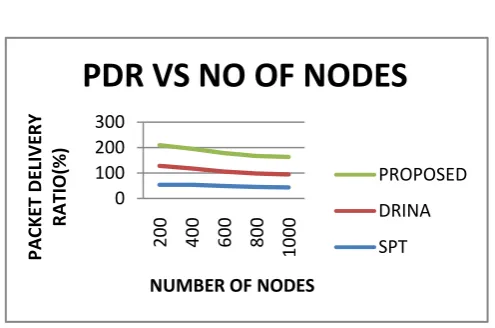
In the above given figure it depicts the comparison between PDR Vs No of Nodes. In this graph on X-axis there are number of nodes are given which are Proposed, DRINA, SPT, etc. its range starts from 0 to 1000. On Y-axis the Packet Delivery Ratio is compared in percentages where it starts from 0 to 250.
Fig. 2: PCK drop Count Vs No of Nodes
In the above given graph it shows the comparison between PCK Drop Count Vs No of Nodes. In this graph on X-axis there are number of nodes are exist those are SPT, DRINA, PROPOSED, etc. its ranges starts from 0 to 1000. On Y-axis the Packet Drop Count is compared with X-axis where it ranges from 0 to 60.
Fig. 3: Delay Vs No of Nodes
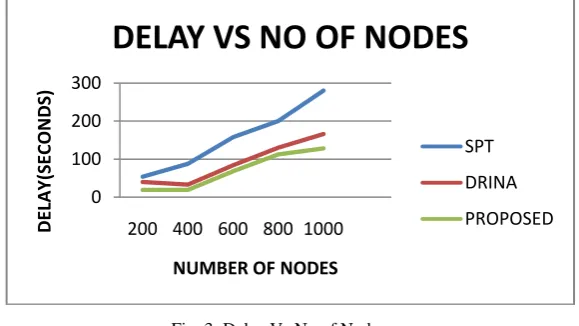
In the figure no.3 it depicts given the node comparison. In this figure on X-axis there are number of nodes are exist those are SPT, DRINA, PROPOSED, etc. its range starts from 0 to 1000. On Y-axis the Delays in seconds it is compared with X-axis where it ranges from 0 to 300 seconds. The SPT take to delay more than 250 seconds.
In the given graph it shows the comparison between Stainer Node Count Vs No. of Nodes. In this graph on X-axis there are number of nodes are exist those are namely SPT, DRINA, PROPOSED, etc. its ranges from 0 to 1000. On Y-axis the Stainer Nodes Count is exist, this is compared with X-Y-axis where it ranges from 0 to 15. In this graph SPT have grater count.
0 20 40 60
200 400 600 800 1000
PA
CK
ET
DROP
COUNT
NUMBER OF NODES
PCK DROP COUNT VS NO
OF NODES
SPT
DRINA
PROPOSED
0 100 200 300
200 400 600 800 1000
D
ELA
Y(S
ECON
D
S)
NUMBER OF NODES
DELAY VS NO OF NODES
SPT
DRINA
ISSN(Online): 2320-9801
ISSN (Print): 2320-9798
I
nternational
J
ournal of
I
nnovative
R
esearch in
C
omputer
and
C
ommunication
E
ngineering
(An ISO 3297: 2007 Certified Organization) Vol. 3, Issue 6, June 2015
Fig. 4: Stainer Node Count Vs No. of Nodes
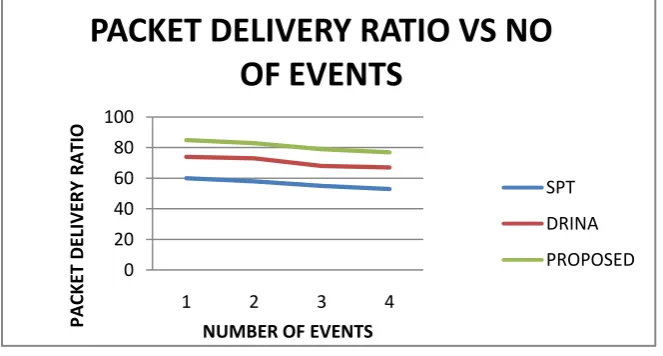
In the below graph it depicts the comparison between Packet Delivery Ratio Vs No. of Events. In this graph on X-axis there are number of events are given those are namely SPT, DRINA, PROPOSED, etc. here the events are shown in no. from 0 to 4. On Y-axis the Packet Delivery Ratio is given, this is compared with X-axis where it ranges from 0 to 90. In this graph SPT have grater count.
Fig. 5: Packet Delivery Ratio Vs No. of Event
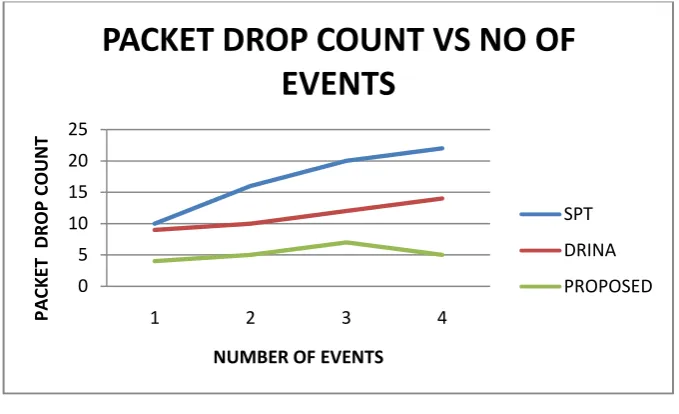
In the given figure it depicts the comparison between Packet Drop Count Vs No of Events. In this graph on X-axis there are number of events are shown which are SPT, DRINA, PROPOSED etc. its events exist from 0 to 4. On Y-axis the Packet Drop Count is compared in percentages where it starts from 0 to 25.
0 2 4 6 8 10 12
200 400 600 800 1000
STA
INE
R
N
OD
ES
COUNT
NUMBER OF NODES
STAINER NODE COUN VS NO OF
NODES
SPT
DRINA
PROPOSED
0 20 40 60 80 100
1 2 3 4
PA
CK
ET
D
ELI
VE
R
Y
R
A
TIO
NUMBER OF EVENTS
PACKET DELIVERY RATIO VS NO
OF EVENTS
SPT
DRINA
ISSN(Online): 2320-9801
ISSN (Print): 2320-9798
I
nternational
J
ournal of
I
nnovative
R
esearch in
C
omputer
and
C
ommunication
E
ngineering
(An ISO 3297: 2007 Certified Organization) Vol. 3, Issue 6, June 2015
Fig. 6: Packet Drop Count
In the figure no.7 it represents the event comparison. In this figure on X-axis there are number of events are exist those are SPT, DRINA, PROPOSED, etc. its range starts from 0 to 160. On Y-axis the Delays in seconds it is compared with X-axis where it ranges from 0 to 160 seconds. The SPT take to delay more than 140 seconds.
Fig. 7: Delay Vs No of Events
V. CONCLUSION AND FUTURE WORK
A study of the information gathering in wireless sensor network is aggregated in this paper. The present system create application information and after that simulation data. Using this information a multi path routing table using distance vector routing creation is generated along with cluster. The selection of cluster head based on two criteria, first if the node is adjacent to sink node then select as a cluster head and if not found then node which have grate energy is selected as a cluster head. Accumulation aware routing algorithms play a measure role in event-based WSNs. In this task, we proposed the DRINA algorithm, a novel and reliable information gathering Aware Routing Protocol for WSNs. This presented DRINA algorithm was immensely compared to two other known routing algorithms, the Infar
0 5 10 15 20 25
1 2 3 4
P
A
CK
ET
DRO
P
CO
U
NT
NUMBER OF EVENTS
PACKET DROP COUNT VS NO OF
EVENTS
SPT
DRINA
PROPOSED
0 50 100 150
1 2 3 4
D
ELA
Y
(SE
CON
D
S)
NUMBER OF EVENTS
DELAY VS NO OF EVENTS
SPT
DRINA
ISSN(Online): 2320-9801
ISSN (Print): 2320-9798
I
nternational
J
ournal of
I
nnovative
R
esearch in
C
omputer
and
C
ommunication
E
ngineering
(An ISO 3297: 2007 Certified Organization) Vol. 3, Issue 6, June 2015
and SPT, related scalability, communication costs, delivery effectiveness, aggregation rate, and gathered information delivery rate.
REFERENCES
1. Vadivel, R and V. Murali Bhaskaran,’Energy Efficient with Secured Reliable Routing Protocol (EESRRP) for Mobile Ad-Hoc Networks’, Procedia Technology 4,pp. 703- 707, 2012.
2. Leandro Aparecido Villas, AzzedineBoukerche, HeitorSoaresRamos,Horacio A.B. Fernandes de Oliveira, Regina Borges de Araujo, and Antonio Alfredo Ferreira Loureiro, DRINA: A Lightweight and Reliable Routing Approach for In-Network Aggregation in Wireless Sensor Networks, APRIL 2013
3. L. Villas, A. Boukerche, R.B. de Araujo, and A.A.F. Loureiro, “Highly Dynamic Routing Protocol for Data Aggregation in Sensor Networks,” Proc. IEEE Symp. Computers and Comm. (ISCC), pp. 496-502, ttp://dx.doi.org/10.1109/ISCC.2010.5546580, 2010. 4. A.P. Chandrakasan, A.C. Smith, and W.B. Heinzelman, “An Application Specific Protocol Architecture for Wireless Microsensor
Networks,” IEEE Trans. Wireless Comm., vol. 1, no. 4, pp. 660-670, Oct. 2002.
5. P.Thirumoorthy,R.N.K.Karthikeyan, S.Sudha , B.Manimegalai Associate Professor, Department of Computer Science and Engineering. Nandha College of Technology Professor and Head, Department of Information Technology, Sri Krishna College of Engineering and Technology Coimbatore, Tamilnadu, A Review on Routing Protocols for In-Network Aggregation in Wireless Sensor Networks, February 2014.
6. D. N. Rewadkar, PritiMadhukarMithari, University of Pune, RMD Sinhgad School of Engineering, Pune, India, An Efficient Routing Approach for In-Network Aggregation in Wireless Sensor Networks, November 2013
7. Anuradha M P and GopinathGanapathy. Article: Secure Aggregated Routing Protocol in WSN - A Review. International Journal of Computer Applications 100(16):17-22, August 2014
8. Eduardo F. Nakamura, Antonio A. F. Loureiro, Alejandro C. Frery Analysis, Research and Technological Innovation Center – FUCAPI Federal University of Minas Gerais – UFMG, Information Fusion for Wireless Sensor Networks: Methods, Models, and Classifications, August 2007.
9. M. Aravindhan , Dr. R. Siva Kumar, Embedded system technologies, Vel tech multi tech Dr. Rangarajan Dr. Sakunthala Engineering College, Chennai, India, A Peculiar Cluster Based Routing in Wireless Sensor Network, December 2013.
10. Aarthi and Pritha, Department of Computer Science and Engineering, Tagore Institute of Engineering and Technology, Attur-636112, Tamilnadu, India, Implementation of Energy Efficient Scheduling - Based Data Aggregation through Dynamic Routing in Wireless Sensor Networks, Jul. 2014.
11. Vishal VitthalBandgar, A S Bhatlavande, G.a.fattepurkar and SupriyaA Shegdar. Article: An Approach to Develop Fast and Efficient Routing for In-Network Aggregation. International Journal of Computer Applications 109(13):23-26, January 2015
12. A.Manickavasuki, R. Ramya, An Adaptive Energy Aware Clustering Based Reliable Routing for in-Network Aggregation in Wireless Sensor Network, April 2014
13. FatmaBouabdallah, NizarBouabdallah, RaoufBoutaba, "Toward Reliable and Efficient Reporting in Wireless Sensor Networks", IEEE Transactions on Mobile Computing, vol.7, no. 8, pp. 978-994, August 2008, doi:10.1109/TMC.2008