20th International Conference on Structural Mechanics in Reactor Technology (SMiRT 20) Espoo, Finland, August 9-14, 2009 SMiRT 20-Division 4, Paper 1717
Hazard Consistent Structural Demands and In-Structure Design Response
Spectra
Thomas W. Houston
a, Michael C. Costantino
b, and Carl J. Costantino
ca
Los Alamos National Laboratory, Research and Development Engineer, Los Alamos, New Mexico, U.S.A.,
e-mail: [email protected]
b
Carl J. Costantino and Associates, Principal, New York, New York, U.S.A., e-mail: [email protected]
c
Department of Civil Engineering, Professor Emeritus, City College of New York, New York, U.S.A., e-mail: [email protected]
Keywords: Seismic Analysis, Probabilistic, Soil-Structure Interaction Analysis, Nuclear Power Plant, Performance Based Design
1
ABSTRACT
Current analysis methodology for the Soil Structure Interaction (SSI) analysis of nuclear facilities is specified in ASCE Standard 4. This methodology is based on the use of deterministic procedures with the intention that enough conservatism is included in the specified procedures to achieve an 80% probability of non-exceedance in the computed response of a Structure, System, or Component for given a mean seismic design input. Recently developed standards are aimed at achieving performance-based, risk consistent seismic designs that meet specified target performance goals. These design approaches rely upon accurately characterizing the probability (hazard) level of system demands due to seismic loads consistent with Probabilistic Seismic Hazard Analyses.
This paper examines the adequacy of the deterministic SSI procedures described in ASCE 4-98 to achieve an 80th percentile of Non-Exceedance Probability (NEP) in structural demand, given a mean seismic input motion. The study demonstrates that the deterministic procedures provide computed in-structure response spectra that are near or greater than the target 80th percentile NEP for site profiles other than those resulting in high levels of radiation damping. The deterministic procedures do not appear to be as robust in predicting peak accelerations, which correlate to structural demands within the structure.
2
INTRODUCTION
3
DETERMINISTIC AND PROBABILISTIC SSI ANALYSIS
The procedures for the deterministic SSI analysis used in this study are defined by two consensus standards: ASCE 43-05 and 4-98. These standards define methods that are consistent with nuclear facilities governed by the U.S. Department of Energy and U.S. Nuclear Regulatory Commission. ASCE 43-05 describes the methodology to develop mean free-field, site-specific motions and strain compatible soil properties based on randomized One Dimensional (1D) site response analyses with input motions defined by the PSHA for a site. ASCE 4-98 defines a deterministic methodology to develop the SSI model and analyze the structural system based on input motions and soil properties developed from the site response analyses. The SSI analysis uses mean and mean +/- one standard deviation strain compatible soil properties and the mean 5% damped strain compatible surface motion as input from the 1D site response analyses, with a minimum range of soil properties that is established by using a coefficient of variation of 0.5 on the shear modulus of the soil.
The results of the three soil cases required by the methodology described in ASCE 4-98, the “deterministic procedure,” are enveloped, smoothed and broadened IRS, and enveloped peak accelerations. The IRS of the Best Estimate (BE) soil case are broadened +/-15%, then enveloped with the Upper Bound (UB) and Lower Bound (LB) soil cases, which refer to the mean plus one standard deviation and mean minus one standard deviation, respectively. In the current version of ASCE 4, these results are intended to achieve 90% NEP in demands given 84th percentile input motion as per ASCE 4-98 (2000). However, achieving target performance goals, as specified in ANS 2.26, through the implementation of performance based design requires that the design procedures used provide results that meet an approximate 80% NEP given a mean input motion.
The hazard consistent methodology used in this study implements probabilistic procedures, using Latin Hypercube Sampling (LHS) to develop a plausible collection of realizations that incorporates the effect of multiple random variables on the computed response of the structure. The probabilistic analysis randomizes the shear wave velocity (Vs) and shear modulus/damping relationships that are varied in the deterministic
analysis and, in addition, also randomizes structural stiffness and damping.
The results of the probabilistic analysis are IRS and peak accelerations at the 50% and 80% NEP based on rank ordered results from the SSI analyses of all realizations of the LHS collection. The SSI analysis of each realization uses the input motion defined by the PSHA, thus providing results consistent with the hazard level defined for the site.
The ability of deterministic procedures to achieve 80% NEP is examined by comparing demands computed using the deterministic procedures and those computed using the probabilistic procedures. Demands are based on peak accelerations, which correlate to structural demand, and IRS for equipment and component design.
3.1 Summary of the Latin Hypercube Sampling Method
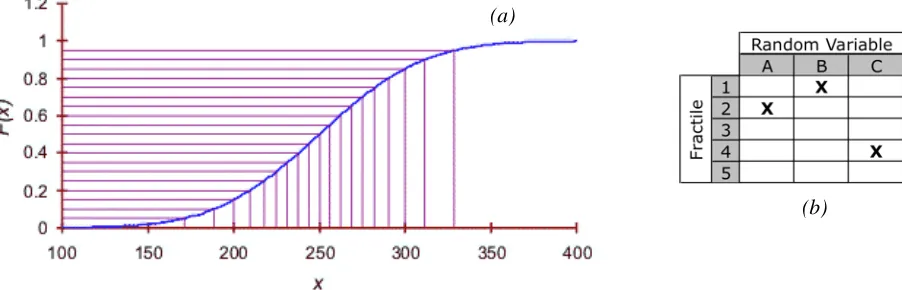
Figure 1. Fractile Distribution for 1 Random Variable (a) and the Conceptual Latin Square (b)
Using the midpoint probability of each fractile, rather than standard LHS where a single value is selected at random within each fractile, has been shown to provide better estimates of the parameters of the distribution (Morgan et al.), thus for this study the probability associated with any one fractile (i) is based on the midpoint probability of that fractile, and is calculated as shown in Equation 1,
P(X<xi) = (i – 0.5)/n (1)
4
METHODOLOGY
In this study, deterministic and probabilistic SSI analyses are performed on multiple structures and site soil conditions. The deterministic analysis procedures are performed for the sites and structures described in Sections 4.1 and 4.2, and the peak accelerations and IRS are developed using the guidance provided by ASCE 4-98. The probabilistic procedures are performed on the same sites and structures, and 80% NEP peak acceleration and IRS are extracted as described in Section 4.3.
The 1D site response convolution analyses are performed with the CARES computer code developed by Carl J. Costantino and Associates, and the SSI analyses are performed using the SASSI computer code originally developed by the University of California.
4.1 Selection of Site Profiles
Three sites are included for the SSI analyses of this study, each representative of site characteristics typical of U.S. Department of Energy facility locations. The three sites are (1) a deep, soft soil site typical of the Savannah River Site (SRS) in Aiken, South Carolina, (2) a layered site where a relatively soft layer of alluvium is underlain by bedrock, typical of site characteristics at Idaho National Laboratory (INL) in Idaho Falls, Idaho, and (3) a deep, stiff site typical of the Yucca Mountain Site (YUC) in Nevada.
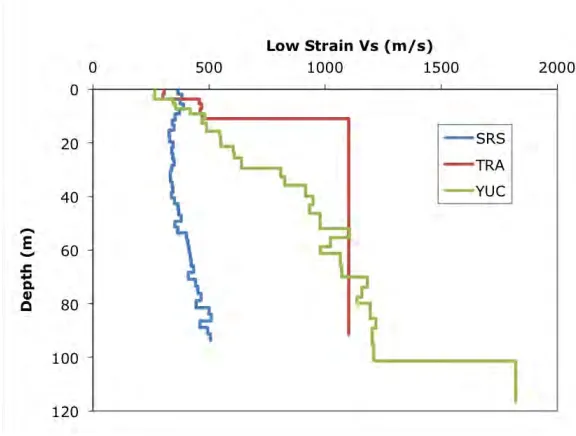
Each site soil profile is defined by layers of varying low strain shear wave velocity, unit weight, and shear modulus/hysteretic damping relationships to levels of shear strain. The low strain Vs profiles for each
site are shown in Figure 2. The SRS site is characterized as a deep, soft soil site with a low strain Vs that
ranges from 320 m/s to 520 m/s. The INL site is composed of 10.5 m of alluvium with Vs between 300-450
m/s underlain by 1,070 m/s volcanic rock. The YUC site is characterized by volcanic material that increases in stiffness with depth of the soil column. The column varies from 300 m/s at the surface to 1,220 m/s at the start of bedrock at a depth of 101 m, and is composed of alluvium in the upper 12 m underlain by volcanic tuff.
(a)
Figure 2. Low Strain Shear Wave Velocity Profiles
4.2 Selection of Building Models
Simplified structural models are selected that provide distinct fixed base structural modes. Although these simplified structural models do not capture the effects of responses due to local modes, they are deemed adequate to capture the expected overall behaviour of reactor type structures, and provide a useful assessment of whether the deterministic SSI methodology described in ASCE 4-98 contains sufficient conservatism to achieve structural responses that represent an approximate 80th percentile NEP. Since a limited number of fixed base modes are included, these models provide clear comparisons of structural response between realizations and cases related to this study. The baseline finite element model used in this analysis is a surface founded nuclear power plant structure, consisting of both a concrete containment shell and an internal equipment structure.
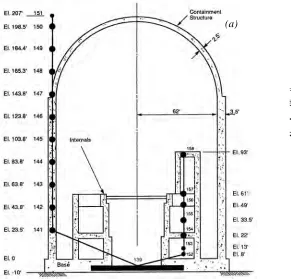
The surface structure used in these analyses is shown in Figure 3a. The structure consists of a rigid 3 m thick circular basemat with a radius of 20 m, a 63 m high containment shell, and a 28 m high internal structure. The total weight of the facility is 38.1 kilotons.
Figure 3b shows the fixed base absolute amplifications at the top of the containment (node 151) and internal structure (node 158). These amplifications represent the ratio of the peak acceleration response to a harmonic input motion of unit amplitude. As the figure shows, the containment structure has an initial mode at 5 Hz with a 2nd mode at 16 Hz. The internal structure has a 1st mode near 12 Hz with a 2nd mode near 17 Hz.
Figure 3. Surface Founded Finite Element Model (Lysmer et al. 2000)
4.3 Deterministic Procedure
The deterministic procedures are performed through guidance from ASCE 43-05 and 4-98. The randomized 1D site response analysis is performed using “Method 2” as described in ASCE 43-05, where 60 realizations of low strain Vs are analyzed using the mean bedrock outcrop motion defined as the Uniform Hazard Spectra
(UHS) by the site PSHA, as the input motion. The resulting strain compatible mean 5% damped surface response spectra are extracted and acceleration time histories are developed to match the mean spectra using procedures defined by ASCE 43-05. The BE, LB and UB strain compatible soil properties and input motion are combined with the structural finite element model as specified in ASCE 4-98, and enveloped and broadened IRS and peak accelerations are extracted.
4.4 Probabilistic Procedure
The LHS method is implemented to generate 32 realizations for random variables soil shear wave velocity (Vs), structural stiffness (Es) and structural damping (ζs). Each realization is analyzed using free-field 1D site
convolutions and a SASSI analysis, for each site and structure included in this study.
The RV’s are assumed to be distributed lognormally, where the mean and standard deviation of low strain Vs is defined from site geotechnical investigations. All layer Vs for a given site are fully correlated where the probability of occurrence of Vs is the same for each soil layer of a given realization. Variation in structural stiffness is implemented through a multiplying factor that is applied to Es of the structural elements of the SASSI finite element model. The median value of this factor is 1, and the COV is 0.35 as per Kennedy et al. (1994). Variation in structural damping is developed based on a median damping level of 5%,
(a)
After execution of the SASSI analysis for a realization, the peak accelerations and 5% damped IRS are extracted at the basemat, top of containment and top of the internal structure. This method is repeated for all 32 realizations, for each site and structure combination.
At the completion of the 32 analyses of one case study, the peak accelerations and IRS at each frequency are rank ordered over the entire 32 analyses. The peak accelerations and IRS at each frequency are then extracted at the 50% and 80% NEP as defined in Equation 1, which are represented by the midpoint between the 16th and 17th ranked result, and 26th ranked result, respectively.
5
RESULTS
The results of the analyses are presented as In-structure Response Spectra (IRS) and peak accelerations. Examples of the computed IRS are presented in Section 5.1 and peak accelerations in Section 5.2.
5.1 In-structure Response Spectra
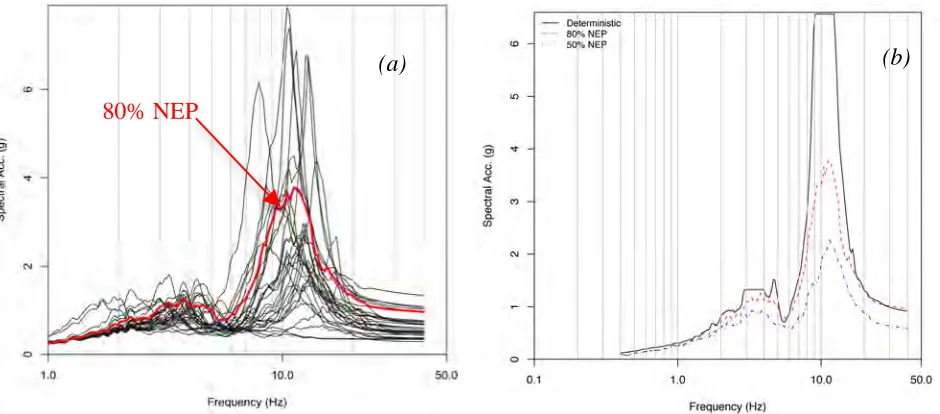
The 5% damped IRS from both the deterministic and probabilistic methodologies are compared to determine the effectiveness of the deterministic ASCE 4-98 procedures to produce results that exceed the 80th percentile responses. Figure 4a shows an example of 5% damped IRS at the 80% NEP computed from the 32 realizations for the INL 5 Hz embedded internal structure. A typical example of the comparison of the 80th percentile responses to the deterministically computed response is shown in Figure 4b.
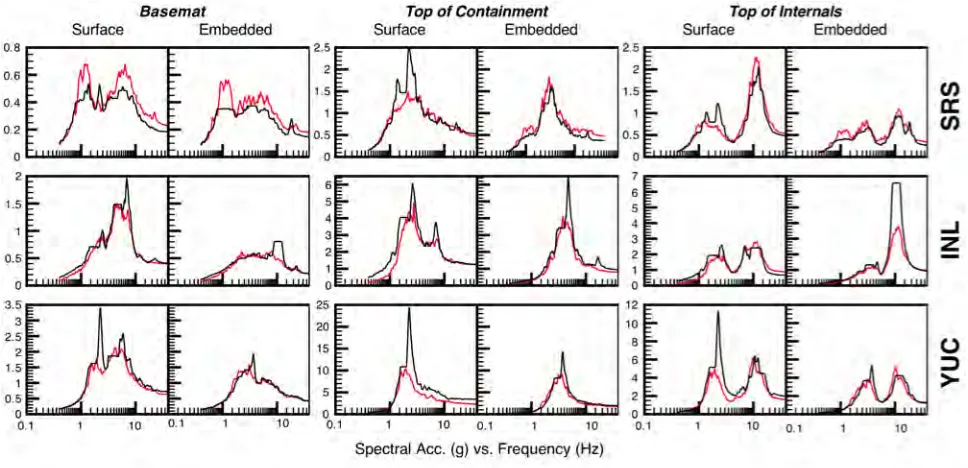
The results show that for most of the structure and site combinations considered in this study, the deterministic procedures result in computed IRS that envelope the 80% NEP IRS. The two structural frequencies of the containment shell considered in this study, 5 Hz and 10 Hz, do not appear to have a significant effect on the ability of the deterministic procedures to produce responses that exceed the 80% NEP IRS. The responses for the different sites for the 5 Hz models are shown in Figure 5 at the basemat, top of containment structure, and top of internal structure. As indicated by the plots, the deterministic procedures produce responses that exceed the desired 80% NEP responses for structures located on both the INL and YUC sites while falling short at the SRS site. The combination of the SRS site and the foundation geometry results in large radiation damping (on the order of 40% of critical). This large radiation damping causes the motion of the foundation to be very near that of the surface input motion. Since the input motion is defined as the mean response spectra, the response of the foundation will be very near the mean, and not the 80th percentile.
In the embedded case the deterministic IRS can produce results that are extremely conservative relative to the 80% NEP results, as indicated in Figure 4b below. This conservative response relative to the probabilistic analysis results is due to the lack of variation in frequency content in the stiffness and damping values used to describe the structural response for the deterministic cases.
80% NEP
Figure 5. 80% NEP (red) and Deterministic (black) 5% Damped IRS for 5 Hz Structure
5.2 Peak Accelerations
In a manner similar to that used for the IRS, the peak accelerations, which correlate to structural seismic demands, from both the deterministic and probabilistic methodologies are compared to determine the effectiveness of the deterministic ASCE 4-98 procedures to produce results that exceed the 80th percentile responses. The ratios of the maximum peak accelerations computed from the three deterministic cases to the 80th percentile NEP results for each structure and site considered in the study are computed, and are summarized in Tables 1 and 2. The shaded values in the tables highlight deterministic peak accelerations less than 90% of the 80% NEP peak accelerations from the probabilistic results.
The comparison of the peak accelerations computed does not provide as clear a correlation between radiation damping and the performance of the deterministic methodology as is evident with the IRS. Peak accelerations computed using the deterministic methodology generally do not attain the 80th percentile NEP for sites where radiation damping for the system is high (e.g. SRS) and can be as much as 25% to 30% low.
For cases where radiation damping is relatively low, the peak accelerations computed using deterministic methods can be very high or as much as about 20% low depending upon the frequency of the structure, the location of the structure (surface or embedded), and the site profile supporting the structure. There does not appear to be a direct correlation between the ability of the deterministic procedures to achieve an 80th percentile NEP and structural frequency, radiation damping or site profile.
Table 1. Ratio of Deterministic to Probabilistic Peak Accelerations for 5 Hz Structure
Basemat Top of Containment Top of Internal Structure Site
Surface Embedded Surface Embedded Surface Embedded
Table 2. Ratio of Deterministic to Probabilistic Peak Accelerations for 10 Hz Structure
Basemat Top of Containment Top of Internal Structure Site
Surface Embedded Surface Embedded Surface Embedded
SRS 0.80 0.72 0.98 0.76 1.07 0.75
INL 0.95 0.97 0.93 1.04 0.86 0.97
YUC 1.65 0.99 2.32 1.15 1.93 0.80
6
CONCLUSION
A study has been completed to evaluate the effectiveness of the deterministic SSI analysis approach, specified in ASCE 4-98, to achieve seismic demands that are at least at an 80th percentile non-exceedance probability given a mean seismic input motion. This study demonstrates that the deterministic procedures provide computed in-structure response spectra that are near or greater than the target 80th percentile NEP for site profiles other than those resulting in high levels of radiation damping in the SSI system. The deterministic procedures do not appear to be as robust in predicting peak accelerations, which correlate to structural demands within the structure. The computed accelerations range from as much as 25% to 30% lower in amplitude than the 80th percentile values and, in some cases more than two times higher.
This study represents an initial assessment of the potential for the ASCE 4-98 specified deterministic procedures to provide computed seismic structure responses that are at approximately the 80th percentile NEP. As such, a number of simplifying assumptions and limitations of the random variables considered were made. Given the results of the simplified evaluation described in this study, wherein there are indications that the deterministic methodology does not produce 80th percentile NEP demands for certain combinations of structures and site profiles, incorporation of some of the aspects that were neglected into the computed probabilistic demands is warranted and further studies should focus on developing efficient, deterministic approaches that will achieve 80th percentile NEP responses for use in seismic design. Simplifying assumptions used in this study that should be investigated further, include:
1. Seismic input motions used for the SSI analyses were developed following “Method 2” of NUREG-6728 (McGuire et al.) as described in ASCE 43-05, wherein a single time history is fit to the Uniform Hazard Spectrum (UHS) at depth and then convolved to the surface of the site. This approach, while it captures the variability in site soil properties, does not include the additional variability that is associated with a full description of the UHS. Incorporation of this source of variability into the probabilistic procedures could be important and should be considered in future studies. A more complete description of the probabilistic definition of seismic demand could be obtained by following “Method 3” of NUREG 6728 in the development of the surface input motions.
2. Full correlation of all layer velocities was assumed. In general, the layer velocities for the soil profile at any existing site, while not fully independent, will likely have correlations that are less than 1.0. The effect of this lack of correlation has not been assessed in this study.
3. Incoherence associated with the ground motion at specific sites has been shown to have the effect of decreasing the structural responses at higher frequencies. These affects have not been incorporated into this study.
REFERENCES
ANSI/ANS-2.26, 2004. Categorization of Nuclear Facility Structures, Systems, and Components for Seismic Design. American Nuclear Society.
ASCE 4-98, 2000. Seismic Analysis of Safety Related Nuclear Structures and Commentary. American Society of Civil Engineers.
Kennedy, R.P., Reed, J.W., 1994. Methodology for Developing Seismic Fragilities. Electric Power Research Institute. TR-103959.
Lysmer, J., Ostadan, F., Chin, C.C., 1999. SASSI 2000 User’s Manual. University of California, Civil Engineering Department.
Mcguire, R.K., Silva, W.J., Costantino, C.J., 2001. NUREG/CR-6728 Technical Basis for Revision of Regulatory Guidance on Design Ground Motions: Hazard- and Risk-Consistent Ground Motion Spectra Guidelines. U.S. Nuclear Regulatory Commission.